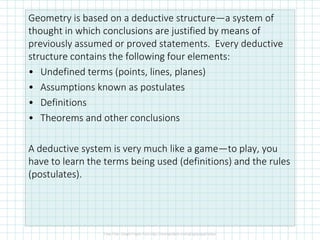
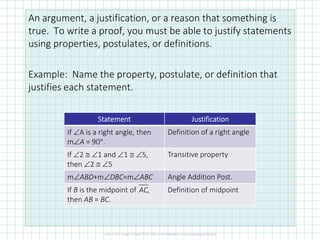
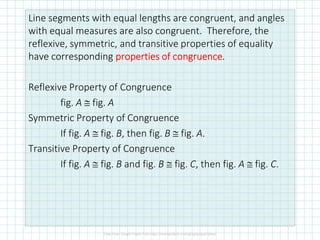
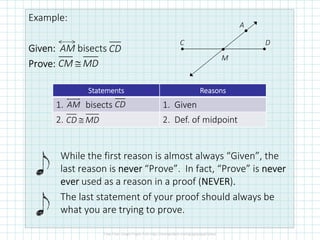
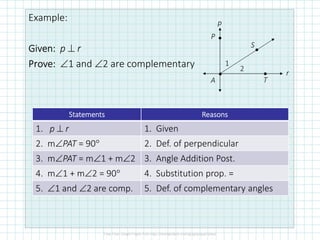
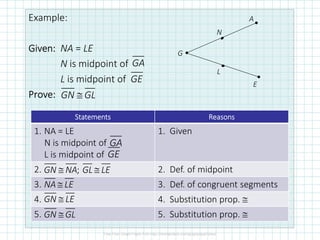
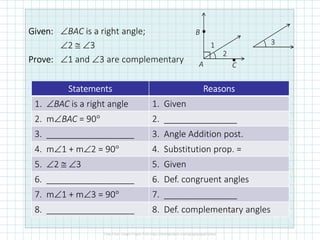
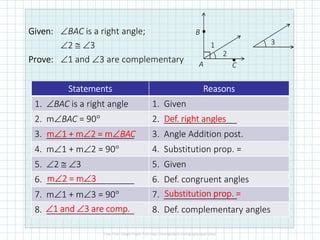
Geometry proofs follow a deductive structure with undefined terms, postulates, definitions, and theorems. A proof justifies statements using these elements through a series of statements and reasons. For example, if angle A is a right angle, then its measure is 90 degrees by the definition of a right angle. Proofs also use properties like the transitive property of equality and congruence. The last statement of a proof should be what is being proved, not "Prove."