UNIT 3.2 PROPERTIESUNIT 3.2 PROPERTIES
OF PARALLEL LINESOF PARALLEL LINES
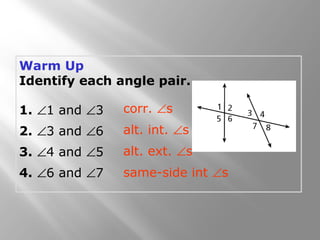
Warm Up
Identify each angle pair.
1. ∠1 and ∠3
2. ∠3 and ∠6
3. ∠4 and ∠5
4. ∠6 and ∠7 same-side int ∠s
corr. ∠s
alt. int. ∠s
alt. ext. ∠s
Prove and use theorems about the
angles formed by parallel lines and a
transversal.
Objective
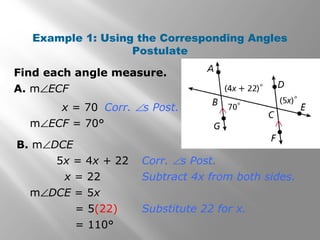
Find each angle measure.
Example 1: Using the Corresponding Angles
Postulate
A. m∠ECF
x = 70
B. m∠DCE
m∠ECF = 70°
Corr. ∠s Post.
5x = 4x + 22 Corr. ∠s Post.
x = 22 Subtract 4x from both sides.
m∠DCE = 5x
= 5(22) Substitute 22 for x.
= 110°
Check It Out! Example 1
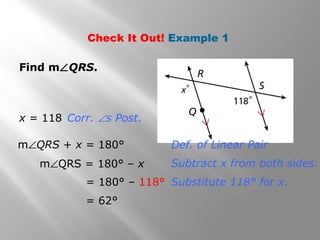
Find m∠QRS.
m∠QRS = 180° – x
x = 118
m∠QRS + x = 180°
Corr. ∠s Post.
= 180° – 118°
= 62°
Subtract x from both sides.
Substitute 118° for x.
Def. of Linear Pair
If a transversal is perpendicular to
two parallel lines, all eight angles are
congruent.
Helpful Hint
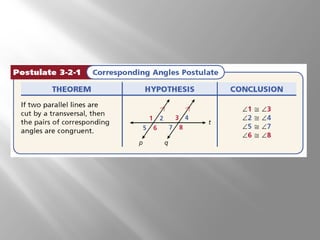
Remember that postulates are statements
that are accepted without proof.
Since the Corresponding Angles Postulate is
given as a postulate, it can be used to prove
the next three theorems.
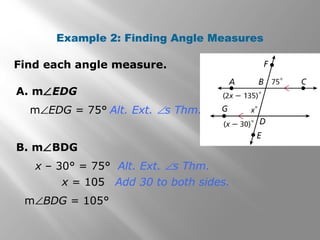
Find each angle measure.
Example 2: Finding Angle Measures
A. m∠EDG
B. m∠BDG
m∠EDG = 75° Alt. Ext. ∠s Thm.
m∠BDG = 105°
x – 30° = 75° Alt. Ext. ∠s Thm.
x = 105 Add 30 to both sides.
Check It Out! Example 2
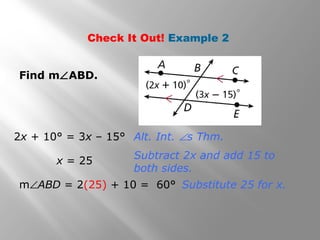
Find m∠ABD.
m∠ABD = 2(25) + 10 = 60°
2x + 10° = 3x – 15° Alt. Int. ∠s Thm.
Subtract 2x and add 15 to
both sides.
x = 25
Substitute 25 for x.
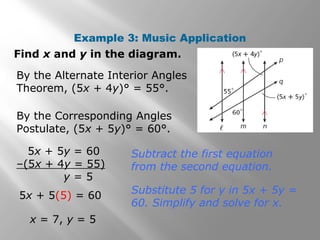
Find x and y in the diagram.
Example 3: Music Application
By the Alternate Interior Angles
Theorem, (5x + 4y)° = 55°.
By the Corresponding Angles
Postulate, (5x + 5y)° = 60°.
5x + 5y = 60
–(5x + 4y = 55)
y = 5
5x + 5(5) = 60
Subtract the first equation
from the second equation.
x = 7, y = 5
Substitute 5 for y in 5x + 5y =
60. Simplify and solve for x.
Check It Out! Example 3
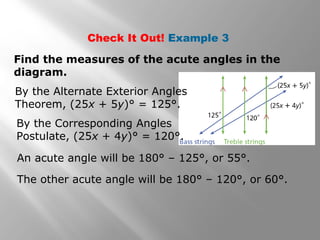
Find the measures of the acute angles in the
diagram.
An acute angle will be 180° – 125°, or 55°.
By the Alternate Exterior Angles
Theorem, (25x + 5y)° = 125°.
By the Corresponding Angles
Postulate, (25x + 4y)° = 120°.
The other acute angle will be 180° – 120°, or 60°.
Lesson Quiz
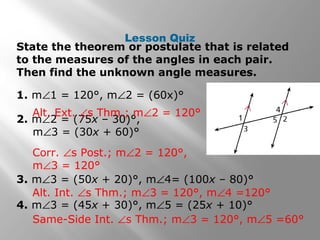
State the theorem or postulate that is related
to the measures of the angles in each pair.
Then find the unknown angle measures.
1. m∠1 = 120°, m∠2 = (60x)°
2. m∠2 = (75x – 30)°,
m∠3 = (30x + 60)°
Corr. ∠s Post.; m∠2 = 120°,
m∠3 = 120°
Alt. Ext. ∠s Thm.; m∠2 = 120°
3. m∠3 = (50x + 20)°, m∠4= (100x – 80)°
4. m∠3 = (45x + 30)°, m∠5 = (25x + 10)°
Alt. Int. ∠s Thm.; m∠3 = 120°, m∠4 =120°
Same-Side Int. ∠s Thm.; m∠3 = 120°, m∠5 =60°
All rights belong to their
respective owners.
Copyright Disclaimer Under
Section 107 of the
Copyright Act 1976,
allowance is made for "fair
use" for purposes such as
criticism, comment, news
reporting, TEACHING,
scholarship, and research.
Fair use is a use permitted
by copyright statute that
might otherwise be
infringing.
Non-profit, EDUCATIONAL
or personal use tips the
balance in favor of fair use.

Geometry 201 unit 3.2

  • 1.
    UNIT 3.2 PROPERTIESUNIT3.2 PROPERTIES OF PARALLEL LINESOF PARALLEL LINES
  • 2.
    Warm Up Identify eachangle pair. 1. ∠1 and ∠3 2. ∠3 and ∠6 3. ∠4 and ∠5 4. ∠6 and ∠7 same-side int ∠s corr. ∠s alt. int. ∠s alt. ext. ∠s
  • 3.
    Prove and usetheorems about the angles formed by parallel lines and a transversal. Objective
  • 5.
    Find each anglemeasure. Example 1: Using the Corresponding Angles Postulate A. m∠ECF x = 70 B. m∠DCE m∠ECF = 70° Corr. ∠s Post. 5x = 4x + 22 Corr. ∠s Post. x = 22 Subtract 4x from both sides. m∠DCE = 5x = 5(22) Substitute 22 for x. = 110°
  • 6.
    Check It Out!Example 1 Find m∠QRS. m∠QRS = 180° – x x = 118 m∠QRS + x = 180° Corr. ∠s Post. = 180° – 118° = 62° Subtract x from both sides. Substitute 118° for x. Def. of Linear Pair
  • 7.
    If a transversalis perpendicular to two parallel lines, all eight angles are congruent. Helpful Hint
  • 8.
    Remember that postulatesare statements that are accepted without proof. Since the Corresponding Angles Postulate is given as a postulate, it can be used to prove the next three theorems.
  • 9.
    Find each anglemeasure. Example 2: Finding Angle Measures A. m∠EDG B. m∠BDG m∠EDG = 75° Alt. Ext. ∠s Thm. m∠BDG = 105° x – 30° = 75° Alt. Ext. ∠s Thm. x = 105 Add 30 to both sides.
  • 10.
    Check It Out!Example 2 Find m∠ABD. m∠ABD = 2(25) + 10 = 60° 2x + 10° = 3x – 15° Alt. Int. ∠s Thm. Subtract 2x and add 15 to both sides. x = 25 Substitute 25 for x.
  • 11.
    Find x andy in the diagram. Example 3: Music Application By the Alternate Interior Angles Theorem, (5x + 4y)° = 55°. By the Corresponding Angles Postulate, (5x + 5y)° = 60°. 5x + 5y = 60 –(5x + 4y = 55) y = 5 5x + 5(5) = 60 Subtract the first equation from the second equation. x = 7, y = 5 Substitute 5 for y in 5x + 5y = 60. Simplify and solve for x.
  • 12.
    Check It Out!Example 3 Find the measures of the acute angles in the diagram. An acute angle will be 180° – 125°, or 55°. By the Alternate Exterior Angles Theorem, (25x + 5y)° = 125°. By the Corresponding Angles Postulate, (25x + 4y)° = 120°. The other acute angle will be 180° – 120°, or 60°.
  • 13.
    Lesson Quiz State thetheorem or postulate that is related to the measures of the angles in each pair. Then find the unknown angle measures. 1. m∠1 = 120°, m∠2 = (60x)° 2. m∠2 = (75x – 30)°, m∠3 = (30x + 60)° Corr. ∠s Post.; m∠2 = 120°, m∠3 = 120° Alt. Ext. ∠s Thm.; m∠2 = 120° 3. m∠3 = (50x + 20)°, m∠4= (100x – 80)° 4. m∠3 = (45x + 30)°, m∠5 = (25x + 10)° Alt. Int. ∠s Thm.; m∠3 = 120°, m∠4 =120° Same-Side Int. ∠s Thm.; m∠3 = 120°, m∠5 =60°
  • 14.
    All rights belongto their respective owners. Copyright Disclaimer Under Section 107 of the Copyright Act 1976, allowance is made for "fair use" for purposes such as criticism, comment, news reporting, TEACHING, scholarship, and research. Fair use is a use permitted by copyright statute that might otherwise be infringing. Non-profit, EDUCATIONAL or personal use tips the balance in favor of fair use.