Grade 8 - Mathematics
Reasoning and Proofs
•In inductive reasoning, conclusion is
obtained by observing a pattern or doing
several observations.
• In deductive reasoning, conclusion is
based on facts such as definition of terms
and properties.
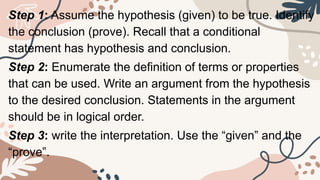
Step 1: Assume the hypothesis (given) to be true. Identify
the conclusion (prove). Recall that a conditional
statement has hypothesis and conclusion.
Step 2: Enumerate the definition of terms or properties
that can be used. Write an argument from the hypothesis
to the desired conclusion. Statements in the argument
should be in logical order.
Step 3: write the interpretation. Use the “given” and the
“prove”.
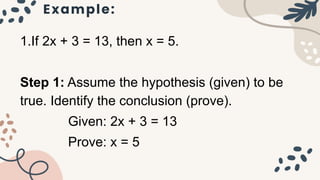
Example:
1.If 2x + 3 = 13, then x = 5.
Step 1: Assume the hypothesis (given) to be
true. Identify the conclusion (prove).
Given: 2x + 3 = 13
Prove: x = 5
Example:
Step 2: Enumerate the definition of terms or properties
that can be used.
In the given statement 2x + 3 = 13, the “+ 3”
(plus 3) can be undone by using “- 3” (minus 3). The
resulting equation is 2x = 10.
Using division property, we have x = 5.
Step 3: Write the interpretation.
If 2x + 3 = 13, then x = 5.
Example:
2. If ∠A and ∠B are complementary angles and m∠B
is 10 less than the measure of ∠A, then what are the
measures of m∠A = 50 and m∠B = 40.
Step 1:
Given: ∠A and ∠B are complementary.
m∠B = m∠A – 10
Prove: m∠A = 50
m∠B = 40
Example:
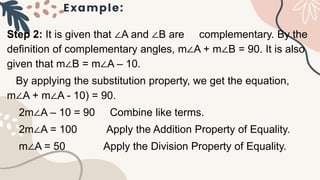
Step 2: It is given that ∠A and ∠B are complementary. By the
definition of complementary angles, m∠A + m∠B = 90. It is also
given that m∠B = m∠A – 10.
By applying the substitution property, we get the equation,
m∠A + m∠A - 10) = 90.
2m∠A – 10 = 90 Combine like terms.
2m∠A = 100 Apply the Addition Property of Equality.
m∠A = 50 Apply the Division Property of Equality.
Example:
Substitute in the equation.
m∠B = m∠A – 10,
m∠B = 50 – 10
m∠B = 40
Step 3: If ∠A and ∠B are complementary angles and
m∠B is 10 less than the measure of ∠A, then m∠A = 50
and m∠B = 40.
TAKE NOTE: Proofs in geometry
may be in paragraph form or
sentences may be arranged in
two columns; one for statements
and one for corresponding
reasons.
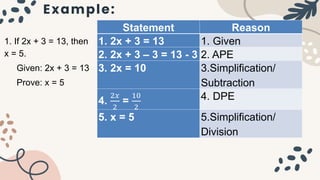
Example:
1. If 2x + 3 = 13, then
x = 5.
Given: 2x + 3 = 13
Prove: x = 5
Statement Reason
1. 2x + 3 = 13 1. Given
2. 2x + 3 – 3 = 13 - 3 2. APE
3. 2x = 10 3.Simplification/
Subtraction
4.
2𝑥
2
=
10
2
4. DPE
5. x = 5 5.Simplification/
Division
Example:
Step 2: Enumerate the definition of terms or properties
that can be used.
In the given statement 2x + 3 = 13, the “+ 3”
(plus 3) can be undone by using “- 3” (minus 3). The
resulting equation is 2x = 10.
Using division property, we have x = 5.
Step 3: Write the interpretation.
If 2x + 3 = 13, then x = 5.
Example:
Statement Reason
1. ∠A and ∠B are complementary. 1. Given
2. m∠A + m∠B = 90 2.Definition of complementary angles
3. m∠B = m∠A – 10 3. Given
4. m∠A + m∠A – 10 = 90 4.Substitution Property (statements 2 and
3)
5. 2m∠A – 10 = 90 5. Simplification/ Addition
6. 2m∠A – 10 + 10 = 90 + 10 6. APE
7. 2m∠A = 100 7. Simplification/ Addition
8.
2m∠A
2
=
100
2
8. DPE
9. m∠A = 50 9. Simplification/ Division
10. m∠B = 50 – 10 10. Substitution Property (statements 3
and 9)
11. m∠B = 40 11. Simplification/ Subtraction
Example:
Step 2: It is given that ∠A and ∠B are complementary. By the
definition of complementary angles, m∠A + m∠B = 90. It is also
given that m∠B = m∠A – 10.
By applying the substitution property, we get the equation,
m∠A + m∠A - 10) = 90.
2m∠A – 10 = 90 Combine like terms.
2m∠A = 100 Apply the Addition Property of Equality.
m∠A = 50 Apply the Division Property of Equality.
Example:
Substitute in the equation.
m∠B = m∠A – 10,
m∠B = 50 – 10
m∠B = 40
Step 3: If ∠A and ∠B are complementary angles and
m∠B is 10 less than the measure of ∠A, then m∠A = 50
and m∠B = 40.
SUMMARY:
DEDUCTIVE REASONING
•Conclusion is based on facts such as definitions and
properties.
•The conclusion from deductive reasoning is true when the
hypothesis is also true.
INDUCTIVE REASONING
•Conclusion is obtained by observing a pattern or doing
several observations.
•Conclusion is obtained by observing a pattern or doing
several observations.
QUIZ:
On a 1 whole sheet of paper, answer the following:
Identify the property of equality used in each of the
following:
1.3 (x + 5) = 3x + 15
2.If x = y and y = 1, then x = 1.
Use inductive reasoning and give a conjecture for
each of the following:
3. Students wear rubber shoes during PE days.
Manuel comes to school in rubber shoes today.
QUIZ:
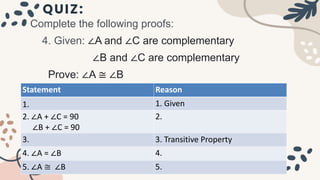
Complete the following proofs:
4. Given: ∠A and ∠C are complementary
∠B and ∠C are complementary
Prove: ∠A ≅ ∠B
Statement Reason
1. 1. Given
2. ∠A + ∠C = 90
∠B + ∠C = 90
2.
3. 3. Transitive Property
4. ∠A = ∠B 4.
5. ∠A ≅ ∠B 5.
ASSIGNMENT:
Answer the following in your notebook.
Identify the “given” and the “prove” in each of the following:
1. If m∠X + m∠Y = 180 and m∠X = 100, then m∠Y = 80.
2. If x + 6 = 10, then x = 4.
Complete the following proofs:
3. If 6 5𝑥 −
2
3
= 2x +
1
3
, then x =
13
84
.
Given: 6 5𝑥 −
2
3
= 2x +
1
3
Prove: x =
13
84
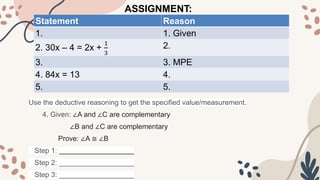
ASSIGNMENT:
Statement Reason
1. 1. Given
2. 30x – 4 = 2x +
1
3
2.
3. 3. MPE
4. 84x = 13 4.
5. 5.
Use the deductive reasoning to get the specified value/measurement.
4. Given: ∠A and ∠C are complementary
∠B and ∠C are complementary
Prove: ∠A ≅ ∠B
Step 1: ___________________
Step 2: ___________________
Step 3: ___________________
GOODBYE EVERYONE AND GODBLESS

PPT3.pptx

  • 1.
    Grade 8 -Mathematics
  • 2.
  • 3.
    •In inductive reasoning,conclusion is obtained by observing a pattern or doing several observations. • In deductive reasoning, conclusion is based on facts such as definition of terms and properties.
  • 4.
    Step 1: Assumethe hypothesis (given) to be true. Identify the conclusion (prove). Recall that a conditional statement has hypothesis and conclusion. Step 2: Enumerate the definition of terms or properties that can be used. Write an argument from the hypothesis to the desired conclusion. Statements in the argument should be in logical order. Step 3: write the interpretation. Use the “given” and the “prove”.
  • 5.
    Example: 1.If 2x +3 = 13, then x = 5. Step 1: Assume the hypothesis (given) to be true. Identify the conclusion (prove). Given: 2x + 3 = 13 Prove: x = 5
  • 6.
    Example: Step 2: Enumeratethe definition of terms or properties that can be used. In the given statement 2x + 3 = 13, the “+ 3” (plus 3) can be undone by using “- 3” (minus 3). The resulting equation is 2x = 10. Using division property, we have x = 5. Step 3: Write the interpretation. If 2x + 3 = 13, then x = 5.
  • 7.
    Example: 2. If ∠Aand ∠B are complementary angles and m∠B is 10 less than the measure of ∠A, then what are the measures of m∠A = 50 and m∠B = 40. Step 1: Given: ∠A and ∠B are complementary. m∠B = m∠A – 10 Prove: m∠A = 50 m∠B = 40
  • 8.
    Example: Step 2: Itis given that ∠A and ∠B are complementary. By the definition of complementary angles, m∠A + m∠B = 90. It is also given that m∠B = m∠A – 10. By applying the substitution property, we get the equation, m∠A + m∠A - 10) = 90. 2m∠A – 10 = 90 Combine like terms. 2m∠A = 100 Apply the Addition Property of Equality. m∠A = 50 Apply the Division Property of Equality.
  • 9.
    Example: Substitute in theequation. m∠B = m∠A – 10, m∠B = 50 – 10 m∠B = 40 Step 3: If ∠A and ∠B are complementary angles and m∠B is 10 less than the measure of ∠A, then m∠A = 50 and m∠B = 40.
  • 10.
    TAKE NOTE: Proofsin geometry may be in paragraph form or sentences may be arranged in two columns; one for statements and one for corresponding reasons.
  • 11.
    Example: 1. If 2x+ 3 = 13, then x = 5. Given: 2x + 3 = 13 Prove: x = 5 Statement Reason 1. 2x + 3 = 13 1. Given 2. 2x + 3 – 3 = 13 - 3 2. APE 3. 2x = 10 3.Simplification/ Subtraction 4. 2𝑥 2 = 10 2 4. DPE 5. x = 5 5.Simplification/ Division
  • 12.
    Example: Step 2: Enumeratethe definition of terms or properties that can be used. In the given statement 2x + 3 = 13, the “+ 3” (plus 3) can be undone by using “- 3” (minus 3). The resulting equation is 2x = 10. Using division property, we have x = 5. Step 3: Write the interpretation. If 2x + 3 = 13, then x = 5.
  • 13.
    Example: Statement Reason 1. ∠Aand ∠B are complementary. 1. Given 2. m∠A + m∠B = 90 2.Definition of complementary angles 3. m∠B = m∠A – 10 3. Given 4. m∠A + m∠A – 10 = 90 4.Substitution Property (statements 2 and 3) 5. 2m∠A – 10 = 90 5. Simplification/ Addition 6. 2m∠A – 10 + 10 = 90 + 10 6. APE 7. 2m∠A = 100 7. Simplification/ Addition 8. 2m∠A 2 = 100 2 8. DPE 9. m∠A = 50 9. Simplification/ Division 10. m∠B = 50 – 10 10. Substitution Property (statements 3 and 9) 11. m∠B = 40 11. Simplification/ Subtraction
  • 14.
    Example: Step 2: Itis given that ∠A and ∠B are complementary. By the definition of complementary angles, m∠A + m∠B = 90. It is also given that m∠B = m∠A – 10. By applying the substitution property, we get the equation, m∠A + m∠A - 10) = 90. 2m∠A – 10 = 90 Combine like terms. 2m∠A = 100 Apply the Addition Property of Equality. m∠A = 50 Apply the Division Property of Equality.
  • 15.
    Example: Substitute in theequation. m∠B = m∠A – 10, m∠B = 50 – 10 m∠B = 40 Step 3: If ∠A and ∠B are complementary angles and m∠B is 10 less than the measure of ∠A, then m∠A = 50 and m∠B = 40.
  • 16.
    SUMMARY: DEDUCTIVE REASONING •Conclusion isbased on facts such as definitions and properties. •The conclusion from deductive reasoning is true when the hypothesis is also true. INDUCTIVE REASONING •Conclusion is obtained by observing a pattern or doing several observations. •Conclusion is obtained by observing a pattern or doing several observations.
  • 17.
    QUIZ: On a 1whole sheet of paper, answer the following: Identify the property of equality used in each of the following: 1.3 (x + 5) = 3x + 15 2.If x = y and y = 1, then x = 1. Use inductive reasoning and give a conjecture for each of the following: 3. Students wear rubber shoes during PE days. Manuel comes to school in rubber shoes today.
  • 18.
    QUIZ: Complete the followingproofs: 4. Given: ∠A and ∠C are complementary ∠B and ∠C are complementary Prove: ∠A ≅ ∠B Statement Reason 1. 1. Given 2. ∠A + ∠C = 90 ∠B + ∠C = 90 2. 3. 3. Transitive Property 4. ∠A = ∠B 4. 5. ∠A ≅ ∠B 5.
  • 19.
    ASSIGNMENT: Answer the followingin your notebook. Identify the “given” and the “prove” in each of the following: 1. If m∠X + m∠Y = 180 and m∠X = 100, then m∠Y = 80. 2. If x + 6 = 10, then x = 4. Complete the following proofs: 3. If 6 5𝑥 − 2 3 = 2x + 1 3 , then x = 13 84 . Given: 6 5𝑥 − 2 3 = 2x + 1 3 Prove: x = 13 84
  • 20.
    ASSIGNMENT: Statement Reason 1. 1.Given 2. 30x – 4 = 2x + 1 3 2. 3. 3. MPE 4. 84x = 13 4. 5. 5. Use the deductive reasoning to get the specified value/measurement. 4. Given: ∠A and ∠C are complementary ∠B and ∠C are complementary Prove: ∠A ≅ ∠B Step 1: ___________________ Step 2: ___________________ Step 3: ___________________
  • 21.