Holt Geometry 
UUNNIITT 77..22 SSIIMMIILLAARRIITTYY
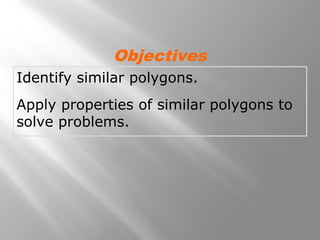
Warm Up 
1. If ΔQRS @ ΔZYX, identify the pairs of 
congruent angles and the pairs of congruent 
sides. 
ÐQ @ ÐZ; ÐR @ ÐY; ÐS @ ÐX; 
QR @ ZY; RS @ YX; QS @ ZX 
Solve each proportion. 
2. 3. 
x = 9 x = 18
Objectives 
Identify similar polygons. 
Apply properties of similar polygons to 
solve problems.
Vocabulary 
similar 
similar polygons 
similarity ratio
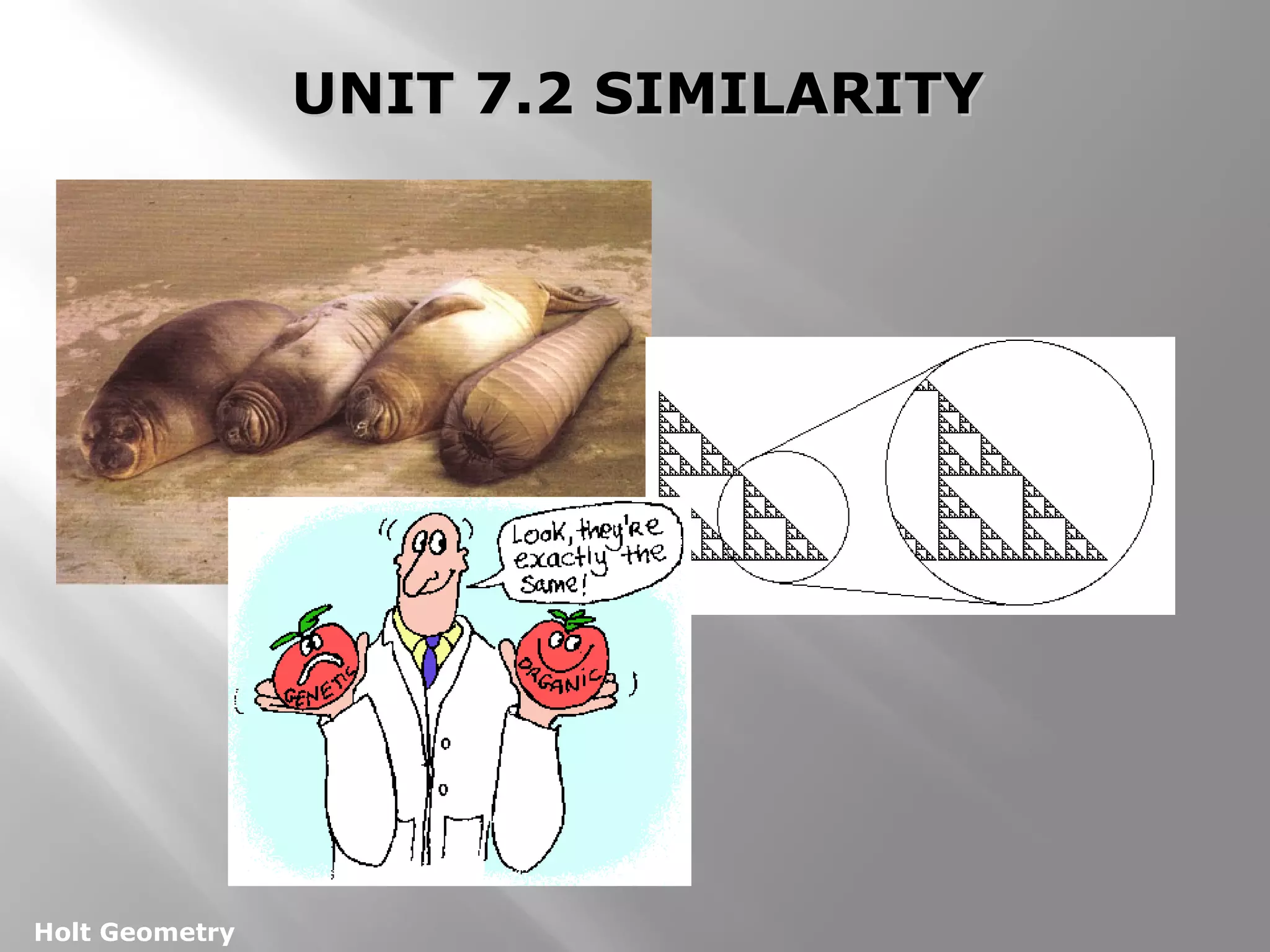
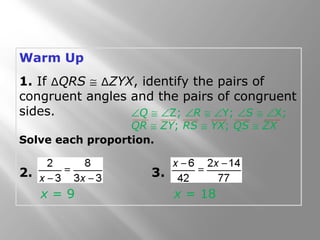
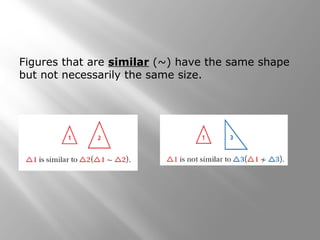
Figures that are similar (~) have the same shape 
but not necessarily the same size.
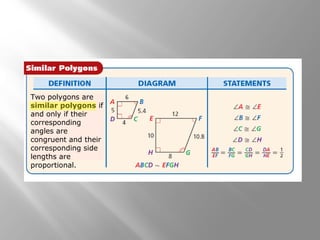
Two polygons are 
similar polygons if 
and only if their 
corresponding 
angles are 
congruent and their 
corresponding side 
lengths are 
proportional.
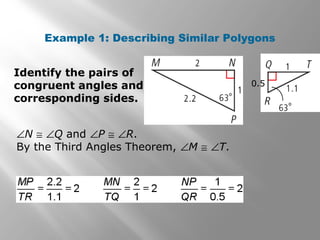
Example 1: Describing Similar Polygons 
Identify the pairs of 
congruent angles and 
corresponding sides. 
ÐN @ ÐQ and ÐP @ ÐR. 
By the Third Angles Theorem, ÐM @ ÐT. 
0.5
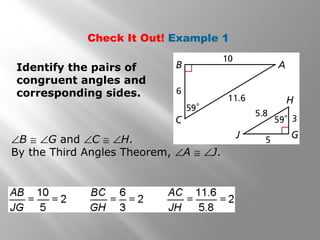
Check It Out! Example 1 
Identify the pairs of 
congruent angles and 
corresponding sides. 
ÐB @ ÐG and ÐC @ ÐH. 
By the Third Angles Theorem, ÐA @ ÐJ.
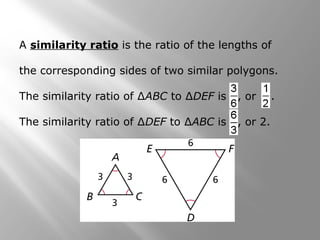
A similarity ratio is the ratio of the lengths of 
the corresponding sides of two similar polygons. 
The similarity ratio of ΔABC to ΔDEF is , or . 
The similarity ratio of ΔDEF to ΔABC is , or 2.
Writing Math 
Writing a similarity statement is like writing a 
congruence statement—be sure to list 
corresponding vertices in the same order.
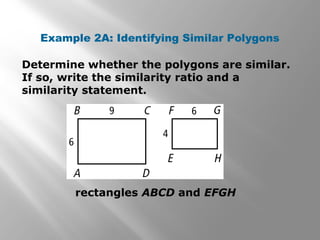
Example 2A: Identifying Similar Polygons 
Determine whether the polygons are similar. 
If so, write the similarity ratio and a 
similarity statement. 
rectangles ABCD and EFGH
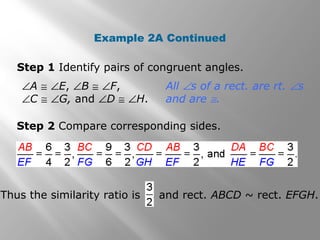
Example 2A Continued 
Step 1 Identify pairs of congruent angles. 
All Ðs of a rect. are rt. Ðs 
and are @. 
ÐA @ ÐE, ÐB @ ÐF, 
ÐC @ ÐG, and ÐD @ ÐH. 
Step 2 Compare corresponding sides. 
Thus the similarity ratio is , and rect. ABCD ~ rect. EFGH.
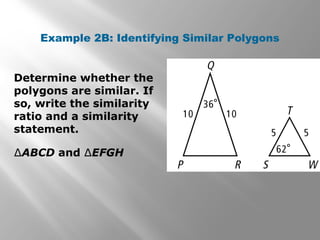
Example 2B: Identifying Similar Polygons 
Determine whether the 
polygons are similar. If 
so, write the similarity 
ratio and a similarity 
statement. 
ΔABCD and ΔEFGH
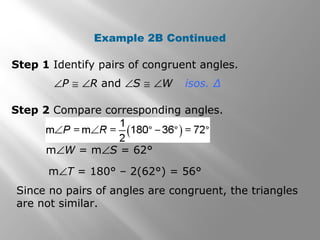
Example 2B Continued 
Step 1 Identify pairs of congruent angles. 
ÐP @ ÐR and ÐS @ ÐW isos. Δ 
Step 2 Compare corresponding angles. 
mÐW = mÐS = 62° 
mÐT = 180° – 2(62°) = 56° 
Since no pairs of angles are congruent, the triangles 
are not similar.
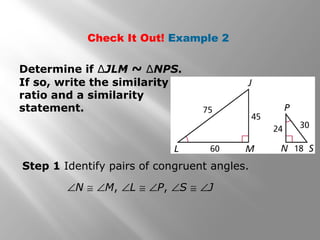
Check It Out! Example 2 
Determine if ΔJLM ~ ΔNPS. 
If so, write the similarity 
ratio and a similarity 
statement. 
Step 1 Identify pairs of congruent angles. 
ÐN @ ÐM, ÐL @ ÐP, ÐS @ ÐJ
Check It Out! Example 2 Continued 
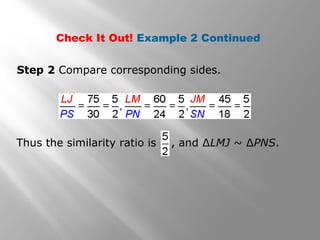
Step 2 Compare corresponding sides. 
Thus the similarity ratio is , and ΔLMJ ~ ΔPNS.
Helpful Hint 
When you work with proportions, be sure the 
ratios compare corresponding measures.
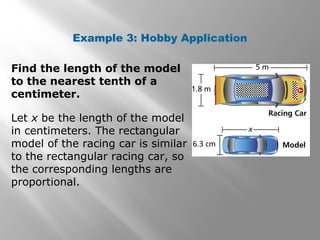
Example 3: Hobby Application 
Find the length of the model 
to the nearest tenth of a 
centimeter. 
Let x be the length of the model 
in centimeters. The rectangular 
model of the racing car is similar 
to the rectangular racing car, so 
the corresponding lengths are 
proportional.
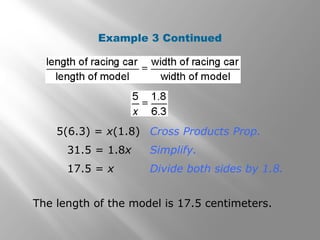
Example 3 Continued 
5(6.3) = x(1.8) Cross Products Prop. 
31.5 = 1.8x Simplify. 
17.5 = x Divide both sides by 1.8. 
The length of the model is 17.5 centimeters.
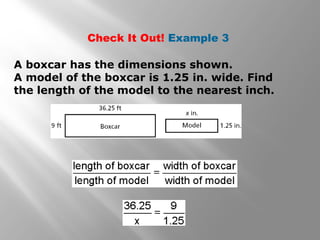
Check It Out! Example 3 
A boxcar has the dimensions shown. 
A model of the boxcar is 1.25 in. wide. Find 
the length of the model to the nearest inch.
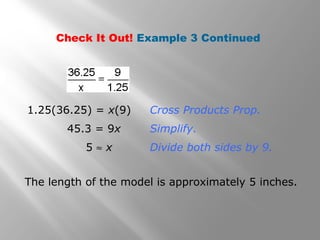
Check It Out! Example 3 Continued 
1.25(36.25) = x(9) Cross Products Prop. 
45.3 = 9x Simplify. 
5 » x Divide both sides by 9. 
The length of the model is approximately 5 inches.
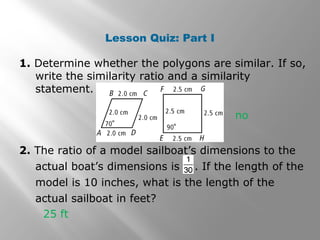
Lesson Quiz: Part I 
1. Determine whether the polygons are similar. If so, 
write the similarity ratio and a similarity 
statement. 
no 
2. The ratio of a model sailboat’s dimensions to the 
actual boat’s dimensions is . If the length of the 
model is 10 inches, what is the length of the 
actual sailboat in feet? 
25 ft
Lesson Quiz: Part II 
3. Tell whether the following statement is 
sometimes, always, or never true. Two equilateral 
triangles are similar. 
Always
All rights belong to their 
respective owners. 
Copyright Disclaimer Under 
Section 107 of the 
Copyright Act 1976, 
allowance is made for "fair 
use" for purposes such as 
criticism, comment, news 
reporting, TEACHING, 
scholarship, and research. 
Fair use is a use permitted 
by copyright statute that 
might otherwise be 
infringing. 
Non-profit, EDUCATIONAL 
or personal use tips the 
balance in favor of fair use.

Geometry unit 7.2

  • 1.
    Holt Geometry UUNNIITT77..22 SSIIMMIILLAARRIITTYY
  • 2.
    Warm Up 1.If ΔQRS @ ΔZYX, identify the pairs of congruent angles and the pairs of congruent sides. ÐQ @ ÐZ; ÐR @ ÐY; ÐS @ ÐX; QR @ ZY; RS @ YX; QS @ ZX Solve each proportion. 2. 3. x = 9 x = 18
  • 3.
    Objectives Identify similarpolygons. Apply properties of similar polygons to solve problems.
  • 4.
    Vocabulary similar similarpolygons similarity ratio
  • 5.
    Figures that aresimilar (~) have the same shape but not necessarily the same size.
  • 6.
    Two polygons are similar polygons if and only if their corresponding angles are congruent and their corresponding side lengths are proportional.
  • 7.
    Example 1: DescribingSimilar Polygons Identify the pairs of congruent angles and corresponding sides. ÐN @ ÐQ and ÐP @ ÐR. By the Third Angles Theorem, ÐM @ ÐT. 0.5
  • 8.
    Check It Out!Example 1 Identify the pairs of congruent angles and corresponding sides. ÐB @ ÐG and ÐC @ ÐH. By the Third Angles Theorem, ÐA @ ÐJ.
  • 9.
    A similarity ratiois the ratio of the lengths of the corresponding sides of two similar polygons. The similarity ratio of ΔABC to ΔDEF is , or . The similarity ratio of ΔDEF to ΔABC is , or 2.
  • 10.
    Writing Math Writinga similarity statement is like writing a congruence statement—be sure to list corresponding vertices in the same order.
  • 11.
    Example 2A: IdentifyingSimilar Polygons Determine whether the polygons are similar. If so, write the similarity ratio and a similarity statement. rectangles ABCD and EFGH
  • 12.
    Example 2A Continued Step 1 Identify pairs of congruent angles. All Ðs of a rect. are rt. Ðs and are @. ÐA @ ÐE, ÐB @ ÐF, ÐC @ ÐG, and ÐD @ ÐH. Step 2 Compare corresponding sides. Thus the similarity ratio is , and rect. ABCD ~ rect. EFGH.
  • 13.
    Example 2B: IdentifyingSimilar Polygons Determine whether the polygons are similar. If so, write the similarity ratio and a similarity statement. ΔABCD and ΔEFGH
  • 14.
    Example 2B Continued Step 1 Identify pairs of congruent angles. ÐP @ ÐR and ÐS @ ÐW isos. Δ Step 2 Compare corresponding angles. mÐW = mÐS = 62° mÐT = 180° – 2(62°) = 56° Since no pairs of angles are congruent, the triangles are not similar.
  • 15.
    Check It Out!Example 2 Determine if ΔJLM ~ ΔNPS. If so, write the similarity ratio and a similarity statement. Step 1 Identify pairs of congruent angles. ÐN @ ÐM, ÐL @ ÐP, ÐS @ ÐJ
  • 16.
    Check It Out!Example 2 Continued Step 2 Compare corresponding sides. Thus the similarity ratio is , and ΔLMJ ~ ΔPNS.
  • 17.
    Helpful Hint Whenyou work with proportions, be sure the ratios compare corresponding measures.
  • 18.
    Example 3: HobbyApplication Find the length of the model to the nearest tenth of a centimeter. Let x be the length of the model in centimeters. The rectangular model of the racing car is similar to the rectangular racing car, so the corresponding lengths are proportional.
  • 19.
    Example 3 Continued 5(6.3) = x(1.8) Cross Products Prop. 31.5 = 1.8x Simplify. 17.5 = x Divide both sides by 1.8. The length of the model is 17.5 centimeters.
  • 20.
    Check It Out!Example 3 A boxcar has the dimensions shown. A model of the boxcar is 1.25 in. wide. Find the length of the model to the nearest inch.
  • 21.
    Check It Out!Example 3 Continued 1.25(36.25) = x(9) Cross Products Prop. 45.3 = 9x Simplify. 5 » x Divide both sides by 9. The length of the model is approximately 5 inches.
  • 22.
    Lesson Quiz: PartI 1. Determine whether the polygons are similar. If so, write the similarity ratio and a similarity statement. no 2. The ratio of a model sailboat’s dimensions to the actual boat’s dimensions is . If the length of the model is 10 inches, what is the length of the actual sailboat in feet? 25 ft
  • 23.
    Lesson Quiz: PartII 3. Tell whether the following statement is sometimes, always, or never true. Two equilateral triangles are similar. Always
  • 24.
    All rights belongto their respective owners. Copyright Disclaimer Under Section 107 of the Copyright Act 1976, allowance is made for "fair use" for purposes such as criticism, comment, news reporting, TEACHING, scholarship, and research. Fair use is a use permitted by copyright statute that might otherwise be infringing. Non-profit, EDUCATIONAL or personal use tips the balance in favor of fair use.