

UUNNIITT 77..33 PPRROOVVIINNGG TTRRIIAANNGGLLEESS 
SSIIMMIILLAARR
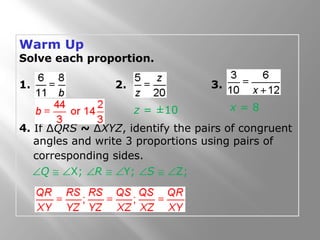
Warm Up 
Solve each proportion. 
1. 2. 3. 
z = ±10 x = 8 
4. If ΔQRS ~ ΔXYZ, identify the pairs of congruent 
angles and write 3 proportions using pairs of 
corresponding sides. 
ÐQ @ ÐX; ÐR @ ÐY; ÐS @ ÐZ;
Objectives 
Prove certain triangles are similar by 
using AA, SSS, and SAS. 
Use triangle similarity to solve problems.
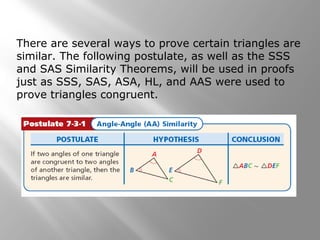
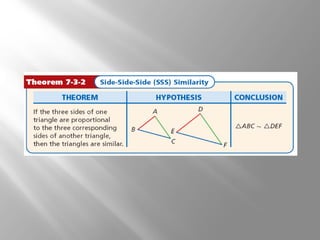
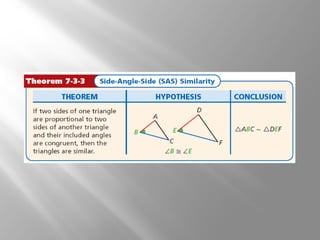
There are several ways to prove certain triangles are 
similar. The following postulate, as well as the SSS 
and SAS Similarity Theorems, will be used in proofs 
just as SSS, SAS, ASA, HL, and AAS were used to 
prove triangles congruent.
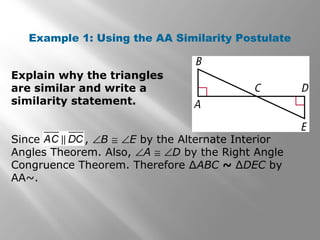
Example 1: Using the AA Similarity Postulate 
Explain why the triangles 
are similar and write a 
similarity statement. 
Since , ÐB @ ÐE by the Alternate Interior 
Angles Theorem. Also, ÐA @ ÐD by the Right Angle 
Congruence Theorem. Therefore ΔABC ~ ΔDEC by 
AA~.
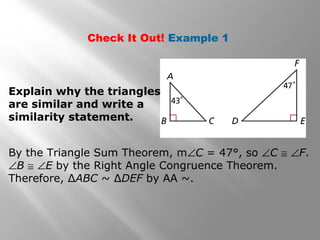
Check It Out! Example 1 
Explain why the triangles 
are similar and write a 
similarity statement. 
By the Triangle Sum Theorem, mÐC = 47°, so ÐC @ ÐF. 
ÐB @ ÐE by the Right Angle Congruence Theorem. 
Therefore, ΔABC ~ ΔDEF by AA ~.
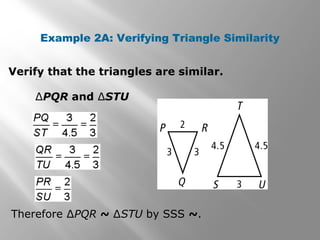
Example 2A: Verifying Triangle Similarity 
Verify that the triangles are similar. 
ΔPQR and ΔSTU 
Therefore ΔPQR ~ ΔSTU by SSS ~.
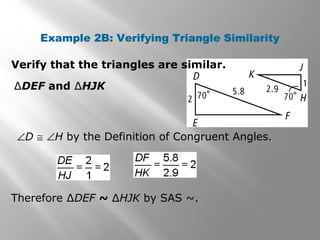
Example 2B: Verifying Triangle Similarity 
Verify that the triangles are similar. 
ΔDEF and ΔHJK 
ÐD @ ÐH by the Definition of Congruent Angles. 
Therefore ΔDEF ~ ΔHJK by SAS ~.
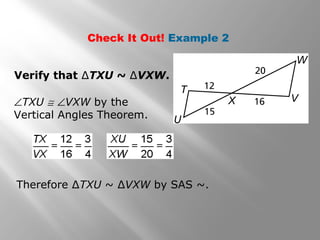
Check It Out! Example 2 
Verify that ΔTXU ~ ΔVXW. 
ÐTXU @ ÐVXW by the 
Vertical Angles Theorem. 
Therefore ΔTXU ~ ΔVXW by SAS ~.
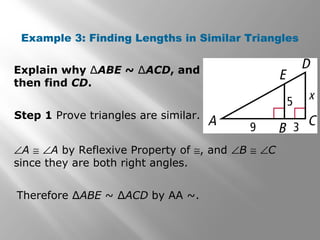
Example 3: Finding Lengths in Similar Triangles 
Explain why ΔABE ~ ΔACD, and 
then find CD. 
Step 1 Prove triangles are similar. 
ÐA @ ÐA by Reflexive Property of @, and ÐB @ ÐC 
since they are both right angles. 
Therefore ΔABE ~ ΔACD by AA ~.
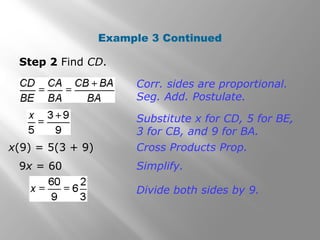
Example 3 Continued 
Step 2 Find CD. 
Corr. sides are proportional. 
Seg. Add. Postulate. 
Substitute x for CD, 5 for BE, 
3 for CB, and 9 for BA. 
x(9) = 5(3 + 9) Cross Products Prop. 
9x = 60 Simplify. 
Divide both sides by 9.
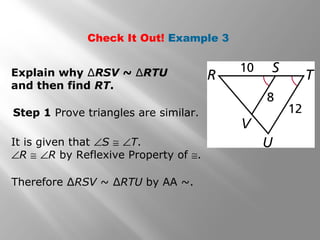
Check It Out! Example 3 
Explain why ΔRSV ~ ΔRTU 
and then find RT. 
Step 1 Prove triangles are similar. 
It is given that ÐS @ ÐT. 
ÐR @ ÐR by Reflexive Property of @. 
Therefore ΔRSV ~ ΔRTU by AA ~.
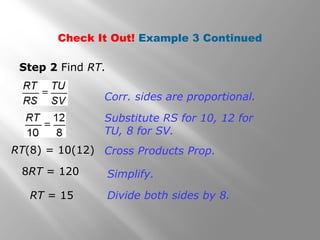
Check It Out! Example 3 Continued 
Step 2 Find RT. 
Corr. sides are proportional. 
Substitute RS for 10, 12 for 
TU, 8 for SV. 
Cross Products Prop. 
Simplify. 
Divide both sides by 8. 
RT(8) = 10(12) 
8RT = 120 
RT = 15
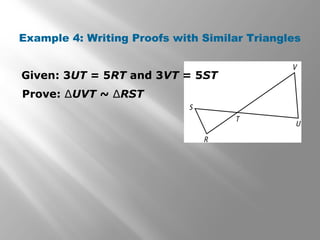
Example 4: Writing Proofs with Similar Triangles 
Given: 3UT = 5RT and 3VT = 5ST 
Prove: ΔUVT ~ ΔRST
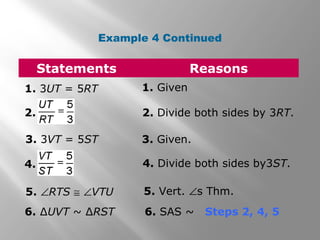
Example 4 Continued 
Statements Reasons 
1. 3UT = 5RT 1. Given 
2. 2. Divide both sides by 3RT. 
3. 3VT = 5ST 3. Given. 
4. 4. Divide both sides by3ST. 
5. ÐRTS @ ÐVTU 5. Vert. Ðs Thm. 
6. ΔUVT ~ ΔRST 6. SAS ~ Steps 2, 4, 5
Check It Out! Example 4 
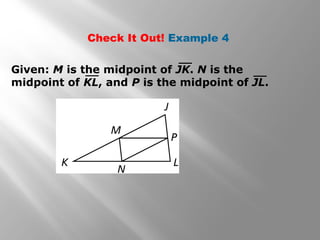
Given: M is the midpoint of JK. N is the 
midpoint of KL, and P is the midpoint of JL.
Check It Out! Example 4 Continued 
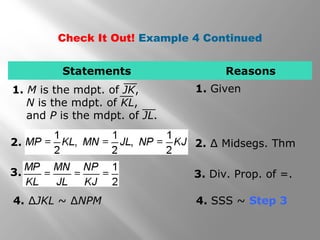
Statements Reasons 
1. M is the mdpt. of JK, 1. Given 
N is the mdpt. of KL, 
and P is the mdpt. of JL. 
2. 2. Δ Midsegs. Thm 
3. 3. Div. Prop. of =. 
4. ΔJKL ~ ΔNPM 4. SSS ~ Step 3
Example 5: Engineering Application 
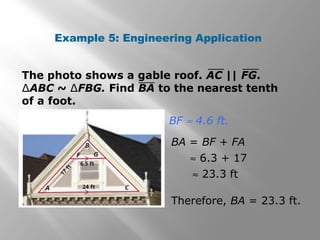
The photo shows a gable roof. AC || FG. 
ΔABC ~ ΔFBG. Find BA to the nearest tenth 
of a foot. 
BF » 4.6 ft. 
BA = BF + FA 
» 6.3 + 17 
» 23.3 ft 
Therefore, BA = 23.3 ft.
Check It Out! Example 5 
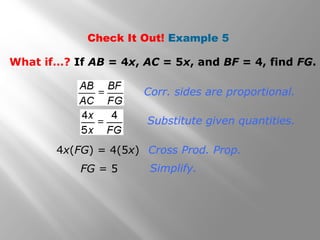
What if…? If AB = 4x, AC = 5x, and BF = 4, find FG. 
Corr. sides are proportional. 
Substitute given quantities. 
Cross Prod. Prop. 
Simplify. 
4x(FG) = 4(5x) 
FG = 5
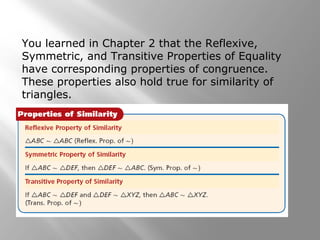
You learned in Chapter 2 that the Reflexive, 
Symmetric, and Transitive Properties of Equality 
have corresponding properties of congruence. 
These properties also hold true for similarity of 
triangles.
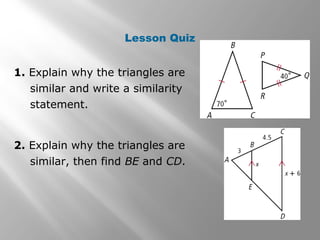
Lesson Quiz 
1. Explain why the triangles are 
similar and write a similarity 
statement. 
2. Explain why the triangles are 
similar, then find BE and CD.
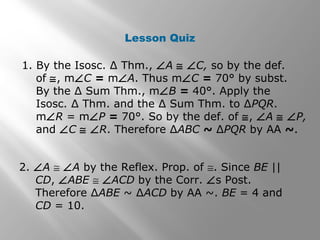
Lesson Quiz 
1. By the Isosc. Δ Thm., ÐA @ ÐC, so by the def. 
of @, mÐC = mÐA. Thus mÐC = 70° by subst. 
By the Δ Sum Thm., mÐB = 40°. Apply the 
Isosc. Δ Thm. and the Δ Sum Thm. to ΔPQR. 
mÐR = mÐP = 70°. So by the def. of @, ÐA @ ÐP, 
and ÐC @ ÐR. Therefore ΔABC ~ ΔPQR by AA ~. 
2. ÐA @ ÐA by the Reflex. Prop. of @. Since BE || 
CD, ÐABE @ ÐACD by the Corr. Ðs Post. 
Therefore ΔABE ~ ΔACD by AA ~. BE = 4 and 
CD = 10.
All rights belong to their 
respective owners. 
Copyright Disclaimer Under 
Section 107 of the 
Copyright Act 1976, 
allowance is made for "fair 
use" for purposes such as 
criticism, comment, news 
reporting, TEACHING, 
scholarship, and research. 
Fair use is a use permitted 
by copyright statute that 
might otherwise be 
infringing. 
Non-profit, EDUCATIONAL 
or personal use tips the 
balance in favor of fair use.

Geometry unit 7.3

  • 1.
    UUNNIITT 77..33 PPRROOVVIINNGGTTRRIIAANNGGLLEESS SSIIMMIILLAARR
  • 2.
    Warm Up Solveeach proportion. 1. 2. 3. z = ±10 x = 8 4. If ΔQRS ~ ΔXYZ, identify the pairs of congruent angles and write 3 proportions using pairs of corresponding sides. ÐQ @ ÐX; ÐR @ ÐY; ÐS @ ÐZ;
  • 3.
    Objectives Prove certaintriangles are similar by using AA, SSS, and SAS. Use triangle similarity to solve problems.
  • 4.
    There are severalways to prove certain triangles are similar. The following postulate, as well as the SSS and SAS Similarity Theorems, will be used in proofs just as SSS, SAS, ASA, HL, and AAS were used to prove triangles congruent.
  • 5.
    Example 1: Usingthe AA Similarity Postulate Explain why the triangles are similar and write a similarity statement. Since , ÐB @ ÐE by the Alternate Interior Angles Theorem. Also, ÐA @ ÐD by the Right Angle Congruence Theorem. Therefore ΔABC ~ ΔDEC by AA~.
  • 6.
    Check It Out!Example 1 Explain why the triangles are similar and write a similarity statement. By the Triangle Sum Theorem, mÐC = 47°, so ÐC @ ÐF. ÐB @ ÐE by the Right Angle Congruence Theorem. Therefore, ΔABC ~ ΔDEF by AA ~.
  • 9.
    Example 2A: VerifyingTriangle Similarity Verify that the triangles are similar. ΔPQR and ΔSTU Therefore ΔPQR ~ ΔSTU by SSS ~.
  • 10.
    Example 2B: VerifyingTriangle Similarity Verify that the triangles are similar. ΔDEF and ΔHJK ÐD @ ÐH by the Definition of Congruent Angles. Therefore ΔDEF ~ ΔHJK by SAS ~.
  • 11.
    Check It Out!Example 2 Verify that ΔTXU ~ ΔVXW. ÐTXU @ ÐVXW by the Vertical Angles Theorem. Therefore ΔTXU ~ ΔVXW by SAS ~.
  • 12.
    Example 3: FindingLengths in Similar Triangles Explain why ΔABE ~ ΔACD, and then find CD. Step 1 Prove triangles are similar. ÐA @ ÐA by Reflexive Property of @, and ÐB @ ÐC since they are both right angles. Therefore ΔABE ~ ΔACD by AA ~.
  • 13.
    Example 3 Continued Step 2 Find CD. Corr. sides are proportional. Seg. Add. Postulate. Substitute x for CD, 5 for BE, 3 for CB, and 9 for BA. x(9) = 5(3 + 9) Cross Products Prop. 9x = 60 Simplify. Divide both sides by 9.
  • 14.
    Check It Out!Example 3 Explain why ΔRSV ~ ΔRTU and then find RT. Step 1 Prove triangles are similar. It is given that ÐS @ ÐT. ÐR @ ÐR by Reflexive Property of @. Therefore ΔRSV ~ ΔRTU by AA ~.
  • 15.
    Check It Out!Example 3 Continued Step 2 Find RT. Corr. sides are proportional. Substitute RS for 10, 12 for TU, 8 for SV. Cross Products Prop. Simplify. Divide both sides by 8. RT(8) = 10(12) 8RT = 120 RT = 15
  • 16.
    Example 4: WritingProofs with Similar Triangles Given: 3UT = 5RT and 3VT = 5ST Prove: ΔUVT ~ ΔRST
  • 17.
    Example 4 Continued Statements Reasons 1. 3UT = 5RT 1. Given 2. 2. Divide both sides by 3RT. 3. 3VT = 5ST 3. Given. 4. 4. Divide both sides by3ST. 5. ÐRTS @ ÐVTU 5. Vert. Ðs Thm. 6. ΔUVT ~ ΔRST 6. SAS ~ Steps 2, 4, 5
  • 18.
    Check It Out!Example 4 Given: M is the midpoint of JK. N is the midpoint of KL, and P is the midpoint of JL.
  • 19.
    Check It Out!Example 4 Continued Statements Reasons 1. M is the mdpt. of JK, 1. Given N is the mdpt. of KL, and P is the mdpt. of JL. 2. 2. Δ Midsegs. Thm 3. 3. Div. Prop. of =. 4. ΔJKL ~ ΔNPM 4. SSS ~ Step 3
  • 20.
    Example 5: EngineeringApplication The photo shows a gable roof. AC || FG. ΔABC ~ ΔFBG. Find BA to the nearest tenth of a foot. BF » 4.6 ft. BA = BF + FA » 6.3 + 17 » 23.3 ft Therefore, BA = 23.3 ft.
  • 21.
    Check It Out!Example 5 What if…? If AB = 4x, AC = 5x, and BF = 4, find FG. Corr. sides are proportional. Substitute given quantities. Cross Prod. Prop. Simplify. 4x(FG) = 4(5x) FG = 5
  • 22.
    You learned inChapter 2 that the Reflexive, Symmetric, and Transitive Properties of Equality have corresponding properties of congruence. These properties also hold true for similarity of triangles.
  • 23.
    Lesson Quiz 1.Explain why the triangles are similar and write a similarity statement. 2. Explain why the triangles are similar, then find BE and CD.
  • 24.
    Lesson Quiz 1.By the Isosc. Δ Thm., ÐA @ ÐC, so by the def. of @, mÐC = mÐA. Thus mÐC = 70° by subst. By the Δ Sum Thm., mÐB = 40°. Apply the Isosc. Δ Thm. and the Δ Sum Thm. to ΔPQR. mÐR = mÐP = 70°. So by the def. of @, ÐA @ ÐP, and ÐC @ ÐR. Therefore ΔABC ~ ΔPQR by AA ~. 2. ÐA @ ÐA by the Reflex. Prop. of @. Since BE || CD, ÐABE @ ÐACD by the Corr. Ðs Post. Therefore ΔABE ~ ΔACD by AA ~. BE = 4 and CD = 10.
  • 25.
    All rights belongto their respective owners. Copyright Disclaimer Under Section 107 of the Copyright Act 1976, allowance is made for "fair use" for purposes such as criticism, comment, news reporting, TEACHING, scholarship, and research. Fair use is a use permitted by copyright statute that might otherwise be infringing. Non-profit, EDUCATIONAL or personal use tips the balance in favor of fair use.