Direct and Indirect
proofs
Dr Shaymaa Darwish
Structure of
mathematic
s
Undefined
terms
Propositio
ns and
Theorems
Definitions
Axioms
Nature of Mathematics
• Logical consistency: A set of sentences is logically consistent if and only if it is possible
for all the members of that set to be true.
• Theorem : A statement that has been proven to be true.
• Proposition : A declarative sentence that is true or false but
not both
Definitions
Example: Line segment is part of line
(True)
9=10 (False)
• Axiom: A basic assumption about a mathematical
situation. (a statement we assume to be true based on logic ).
Example: Line can be extended infinitely
0 is a natural number
What is the
proof?
• A proof is a sequence of logical statements, one implying another,
which gives an explanation of why a given statement is true
 Starting points are the axioms “rules” accepted by everyone.
 Previously established theorems may be used to deduce the
new ones
 Mathematical proof is absolute, which means that once a
theorem is proved, it is proved for ever.
Until proven though, the statement is never accepted as a true
one.
Remarks
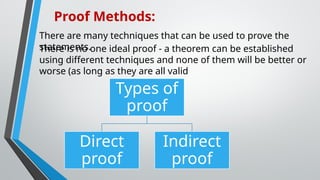
There are many techniques that can be used to prove the
statements.
Proof Methods:
There is no one ideal proof - a theorem can be established
using different techniques and none of them will be better or
worse (as long as they are all valid
Types of
proof
Direct
proof
Indirect
proof
Direct proof assumes a given hypothesis, or any other known
statement, and then logically deduces a conclusion.
Direct Proof :
1. State the given hypothesis
2. State what you need to prove
3. Draw a figure to guide you
4. Present the proof using
preferred method (Paragraph
or Two Column Methods)
Hypothesi
s
considere
d as True
Start from
assumptio
n
Come on
the
conclusio
n
Paragraph Proof :
The proof consists of a detailed paragraph explaining the proof
process.
The paragraph contains steps and supporting justifications which
prove the statement true.
The paragraph can be quite lengthy.
When using this method, it can be easy to overlook critical steps
and/or supporting reasons if you are not careful.
Be sure to list your steps in chronological order, and support each
step with a definition, theorem postulate and/or property.
Example 1.1…
Given : M is the midpoint of AB
Prove:
Proof in Paragraph form:
Given that the point M is the midpoint of the line segment AB, by the
definition of midpoint, the measurements of AM and BM are equal.
Since AM=BM then by definition of congruent segments, we can say
that the line segment AM is congruent to line segment BM. So
Example 1.2…
Given: is the midpoint of and .
Prove:
It is given that C is the midpoint of both and . Since C is the midpoint,
we now that and because the midpoint of the segment divides the
segment into two congruent segments. Knowing vertical angles are
congruent, we have We can now state that by SAS because if two sides
and included angle of one triangle are congruent to two sides and
included angle of another triangle, the two triangles are congruent
Two Column Proof :
The proof consists of two columns,
The first column contains a numbered chronological list of steps,
called Statements, leading to the desired conclusion.
The second column contains the justifications, called Reasons, to
support each step in the proof.
Remember that justifications are definitions, postulates, theorems
and/or properties.
This format clearly displays each step in your argument and keeps your
ideas organized.
Example 1.2…
Given: is the midpoint of and .
Prove:
Statements Reasons
1. is the midpoint of and . Given
2. and the midpoint of the segment
divides the segment into two
congruent segments
3. vertical angles are congruent
4. SAS: if two sides and included angle
of one triangle are congruent to
two sides and included angle of
another triangle, the two triangles
Prove that if n and m are both even, then n + m is even
Excersice 1.1…
Theorem: Sum of all four angles of a quadrilateral is
360°.
Excersice 1.2…
Indirect Proof ( Proof by
contradiction ):
Assumes the hypothesis (if given) together with a negation of a
conclusion to reach the contradictory statement.
1. Accept the given statement is true.
2. Assume the opposite of the statement to be
proved.
3. State the reasons directly until there is a
contradiction of the given or the other
statements.
4. State that the assumption of the opposite of the
statement to be proved must be false.
5. Follow Steps 3 and 4 of writing direct proofs.
Assume to
the contrary
that
conclusion is
false
Prove that
our
assumption
was wrong
Prove that
conclusion is
true
Example 1.3…
Given : M is not the midpoint of AB
Prove:
Proof in Two Column form:
Example 1.4…
Proof in Two Column form:
If ABC is isosceles, then the measure of the base angles cannot be 92 . Prove this indirectly.
∘
Remember, to start assume the opposite of the conclusion.
Statement Reason
1. ABC is isosceles Given
2. The measure of the base angles are 92∘ Assumption
3. If the base angles are 92 , then they
∘
add up to 184 .
∘
Addition of the two base angles
4. the three angle measures of the triangle
ABC more than 180∘
Addition of the three angles
4. The base angles cannot be 92∘ contradicts the Triangle Sum
Theorem that says the three angle
measures of all triangles add up to 180∘
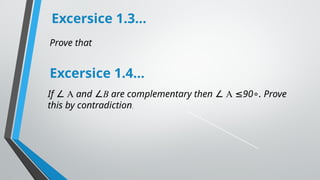
Prove that
Excersice 1.3…
Excersice 1.4…
If ∠ A and ∠B are complementary then ∠ A 90 . Prove
≤ ∘
this by contradiction.
• A counterexample is just one example showing the statement to be
false. While there may be many examples to choose from, all you
need is one.
Example 1.5 : For any positive integer m, if m is prime, then is
also prime
Counterexample: Assume m=2.
Direct Proof and Indirect proof: Meaning and examples