EXAM INFORMATION!
-

-

-

Don‟t be late! Come early, review and zen!
- Better to be an hour early than 15 mins late and
receive a ZERO. (If someone leaves after one
minute, one minute late will get you a zero.)
Bags, phones, books etc all to the front of the room
We will be seating you before the exam begins
Only thing you need is a PENCIL and an ERASER
- ANY kind of electronic device at all will get you a
zero!
Write your name on your exam paper and Scantron
You will need a photo ID & your V-number to turn in
your exam!
Hand your exam and Scantron in at the end
Answer keys will be posted (NO PICTURES!)
Grades will be posted ASAP

DO NOT CHEAT!
Genetics

CHAPTER 3 PART 2
3.3 The Chromosome Theory of Heredity
Proposes That Genes Are Carried on
Chromosomes
• Sutton and Boveri proposed
that chromosome behavior in
meiosis mirrors hereditary
transmission of genes
• The Boveri-Sutton Chromosome
Theory

• Correctly explains the
mechanism underlying
Mendelian Genetics by
identifying chromosomes as
the paired factors required by
Mendel’s Laws. States that
chromosomes are linear
structures with genes located
at specific sites called loci

Walter
Sutton

Theodor
Boveri
SOMEONE WAS SKEPTICAL
OF THE „GENE
HYPOTHESIS‟…
Thomas Hunt Morgan was skeptical:
Pea plants are domesticated, what happens in the real world? With
a wild, natural species?

What species did he find?
3.3 The Chromosome Theory of Heredity
Proposes That Genes Are Carried on
Chromosomes
• Morgan studied fruit flies, Drosophila melanogaster, to test Mendel’s rules
on a natural, rather than domesticated, species
• Hung buckets of rotting fruit in trees in the then rural Long Island to attract
fruit flies. Found them easy to work with, and have a life cycle of 12-14 days.

• The term “wild type” signifies the phenotype most common in a
population

http://www.youtube.com/watch?v=LOGeTdcnqFM
Thomas Hunt Morgan
• Although at first wild-type phenotypes
prevailed, over several years, Morgan’s
lab members found numerous phenotypic
variants and analyzed these in controlled
crosses
• He concluded from his results that genes
were carried on chromosomes
(independently proposed)
• Great mentor, encouraged the use of fruit
fly in students, several mentees went on
to win Nobel Prizes
• His graduate student, then wife and
mother of his four children, Lilian Mogand
made important contributions in the
laboratory (X-linked inheritance).
• Strongly against eugenics movement
• Unraveled many basic principles of
genetics and inheritance.
Chromosomal Basis of Sex
• Nettie Stevens (working with Tenebrio
molitor beetles): sex-dependent
hereditary differences are due to the
presence of two X chromosomes in
females and an X and a smaller Y
chromosome in males
• Diploid cells of females contained 20 large
chromosomes; males contained 19 large
chromosomes and one small one
• Half of the sperm of males contained 10
large chromosomes and the other half had 9
large and one small chromosome

• Sex-linked inheritance refers to
transmission of traits on sex
chromosomes

Mealworm
The White-Eye Mutant
• The first mutant identified
in Morgan’s lab was a male
with white eyes instead of
the normal red color
• The mutant white-eyed
male was crossed to a
normal red-eyed female,
producing many F1, all
with red eyes
• Thus the white-eyed
mutant allele was what?
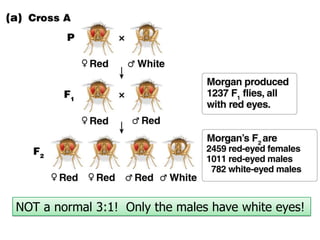
NOT a normal 3:1! Only the males have white eyes!
Continued crosses…

• When the original white-eyed male was crossed to one of the
F1 females, a 1:1 ratio of white eyes and red eyes was
observed in both male and female offspring
Reciprocal Cross

• A cross between a white-eyed female and red-eyed male produced
red-eyed female and white-eyed male F1; a cross between these
produced F1 with red and white eyes in equal frequencies among
both male and female progeny
The Gene for Eye Color Is on the X Chromosome
• The differences in phenotype
according to gender are not
anticipated according to
Mendel’s laws
• The transmission of the X
chromosome can account for the
results obtained by Morgan’s lab
• X-linked inheritance is the term
for traits carried on the X
chromosome; males have only
one X and so are called
hemizygous for X-linked traits
Figure 3.18
X & Y chromosome
segregation of cross A, B, C.
-Allele genotype is written as a
superscript to the X
chromosome (XW+, XW)
-Hemizygous Y chromomsomes
do not carry a genotype
-Use a Punnet square to cross
two sex chromosomes exactly
as one would for two alleles
Let’s draw one..
Heterozygous red female x white male
Exceptional phenotypes!
• Morgan’s work led him to propose
the chromosome theory of heredity
• Calvin Bridges studied “exceptional
phenotypes”; very rare cases of
unexpected eye color
• Observed exceptional
phenotypes: in a cross between a
white-eyed female and red-eyed
male, unexpected rare (1/2,000)
offspring were observed: females
with white eyes or males with red
eyes (only red females and white
males are predicted to occur)

• What was happening to

the X chromosome?
What is this
called?
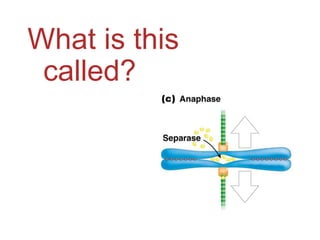
Nondisjuntion
• Bridges saw that the
exceptional females
had three X
chromosomes and one
Y; and the exceptional
males had just one X
chromosome

• Failed chromosome
separation is
nondisjunction
3.4 Sex Determination Is Chromosome and
Genetic
• Chromosomal sex is
the presence of
chromosomes
characteristic of each
sex and is determined
at the moment of
fertilization
• Phenotypic sex is the
internal and external
morphology of each
sex, and results from
differences in gene
expression

-Females have two X chromosomes
and males have one X chromosome
-Thus in flies;
Males: X0, XYY, or XY (normal)
Females are XXY or XX (normal)
• Sex is determined by
the X : A ratio
• -X =number of X
chromosomes;
A = number of haploid
sets of autosomes
This ratio influences the
actions of three sexdeterming genes:
Deadpan, Sisterless and
Sex-lethal genes
(complicated!)
Sex Determination in Humans
• XX = female, XY= male.
• The X chromosome contains genetic
information essential for both sexes; at
least one copy of an X is required.
• Absence of X is lethal

• The male-determining gene is located on
the Y chromosome. A single Y, even in the
presence of several X’s, will still produces a
male phenotype.
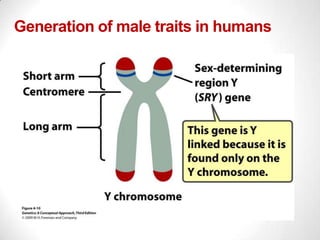
• SRY gene on the Y chromosome
determines maleness
• The absence of Y results in a female
phenotype.
Generation of male traits in humans
SRY Gene
(Sex-determing
Region Y)
• Expression of SRY
initiates testicular
development of the
undifferentiated
gonads
• The absence of
SRY expression
allows the default,
female state, to
develop

22
SRY is a transcription factor
• SRY is a transcription
factor needed for malespecific gene expression
• Issues with the sex genes
themselves can alter the
male phenotype
• Androgen-insensitivity
syndrome
• Caused by the defective androgen
receptor
• Can be mild to complete
androgen insensitivity
• XY ‘females’
• XX = female, XY= male.
• SRY gene on the Y chromosome determines maleness
• Turner syndrome: XO; 1/3000 female births
• Amenorrhea, sterility, web necked, horse shoe kidney

• Klinefelter syndrome: XXY, or XXXY, or XXXXY, or XXYY; 1/1000
male birth
• infertility, gynechomastia, hypogonadism

• Poly-X females: 1/1000 female births
• Tall stature, menstrual irregularity, possible reduction of fertility
Nondisjuntion in humans
• Aneuploidy: Uneven number of chromosomes

Cover in
Ch. 13!
Diversity of Sex Determination
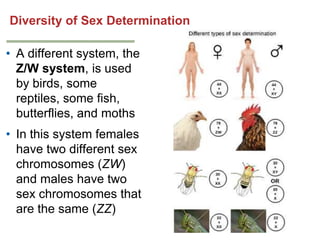
• A different system, the
Z/W system, is used
by birds, some
reptiles, some fish,
butterflies, and moths
• In this system females
have two different sex
chromosomes (ZW)
and males have two
sex chromosomes that
are the same (ZZ)
Z-Linked Inheritance
• Barred feathers: Zlinked dominant allele
(ZB)
• Non-barred feathers is
recessive (Zb)
• In sex-linked traits,
sexes are NOT
affected equally (F2)
• How do we verify
that sex is affecting
outcome?
Z-Linked Inheritance
• Reciprocal Cross
(reverse sexes)
yields different
results from the
previous cross.
This indicates that
feather form is
sex-linked.
Heterogametic vs Homogametic Sex
• Heterogametic sex: the sex
chromosomes do not match, and
thus the gametes produced by
that sex do not match.
http://www.cals.ncsu.edu/course/ent425/

In humans, the males (XY) are the
heterogametic sex. Males produce
both X and Y gametes

• Homogametic sex: sex
chromosomes match and will
produce the same sex-ed
gametes
• In many species (birds, fish,
reptiles) females can be
heterogametic sex (ZW system)

Gametes
X&Y

Gametes
X&X
Haplodiploidy
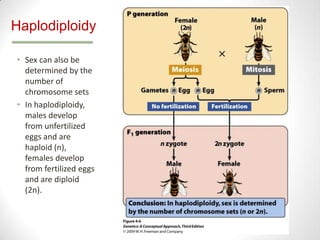
• Sex can also be
determined by the
number of
chromosome sets
• In haplodiploidy,
males develop
from unfertilized
eggs and are
haploid (n),
females develop
from fertilized eggs
and are diploid
(2n).
Environmental Sex
Determination
• Sex is determined by
the temperature the
eggs are incubated at
• In the red-eared slider
turtle, eggs above 30⁰
C produce all females
• In the snapping turtle,
eggs below 22⁰ C or
above 28⁰ C will be
female. Between 2527⁰ C males
predominate

Temperature-dependent sex determination in three reptile
species: the American alligator (Alligator mississippiensis),
the red-eared slider turtle (Trachemys scripta elegans), and
the alligator snapping turtle (Macroclemys temminckii). (After
Crain and Guillette 1998.)
Environmental Sex Determination
• Sex is determined in limpets (sea snails) by its position on the stack
3.5 Human Sex-Linked Transmission Follows
Distinct Patterns
• In X-linked recessive
inheritance, females
homozygoous for the
recessive allele or males
hemizygous for it display
the recessive phenotype
• In X-linked dominant
traits, heterozygous
females and males
hemizygous for the
dominant allele express
the dominant phenotype

• Hemizygous males
display any allele on their
single X whether the allele
is recessive or dominant in
females
Features of X-Linked Recessive Inheritance
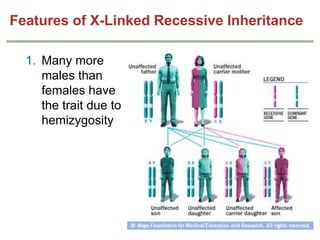
1. Many more
males than
females have
the trait due to
hemizygosity
X-Linked Recessive

#2

#3

#4

1.

Many more males than females
have the trait due to hemizygosity

2.

A recessive male mated to a
homozygous dominant female
produces all offspring with the
dominant phenotype, and all
female offspring are carriers

3.

Matings of recessive males with
carrier females
give half dominant and half recessive
offspring of both sexes

4.

Matings of homozygous recessive
females with dominant males produce
all dominant (carrier) female offspring
and all recessive male offspring
Hemophilia A Is an X-Linked Recessive Trait
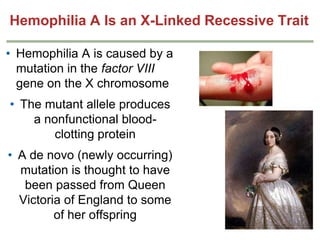
• Hemophilia A is caused by a
mutation in the factor VIII
gene on the X chromosome
• The mutant allele produces
a nonfunctional bloodclotting protein
• A de novo (newly occurring)
mutation is thought to have
been passed from Queen
Victoria of England to some
of her offspring
1. Many more males than females have the trait due to hemizygosity
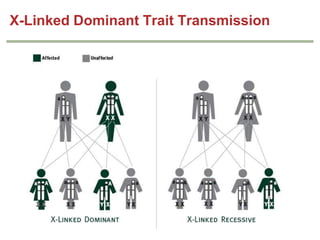
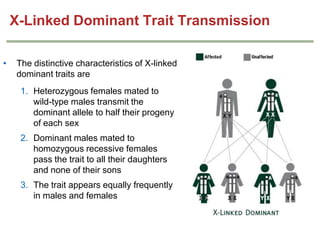
X-Linked Dominant Trait Transmission
•

The distinctive characteristics of X-linked
dominant traits are
1. Heterozygous females mated to
wild-type males transmit the
dominant allele to half their progeny
of each sex

2. Dominant males mated to
homozygous recessive females
pass the trait to all their daughters
and none of their sons
3. The trait appears equally frequently
in males and females
Congenital Hypertrichosis
• Congenital hypertrichosis
(CGH) is a rare X-linked
dominant disorder in
humans

• It leads to a large
increase in the number
of hair follicles on the
body, and males and
females have more body
hair than normal
Modified pedigree with CGH

#1?

#2

1. Heterozygous females mated to wild-type males transmit the
dominant allele to half their progeny of each sex
2. Dominant males mated to homozygous recessive females pass the
trait to all their daughters and none of their sons
3. The trait appears equally frequently in males and females
Y-Linked Inheritance
• Y-linked traits are transmitted
in an exclusively male-to-male
pattern
• In mammals, there are fewer
than 50 genes on the Y
chromosome; many play roles
in male sex determination or
development
• Though males have only one Y
chromosome, they are not
hemizygous for it, as most of
the genes on the Y are present
in two copies
The Pseudoautosomal Region
• Two small regions of homology,
the pseudoautosomal regions
(PAR1 and PAR2), exist
between the X and Y
chromosomes

• These allow homologous
pairing between the X and Y at
meiosis
• There is evidence that crossing
over occurs within these
regions during meiosis
http://php.med.unsw.edu.au/embryology
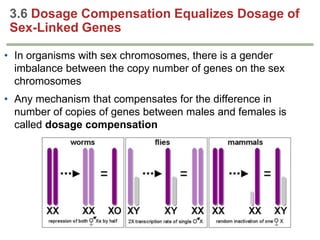
3.6 Dosage Compensation Equalizes Dosage of
Sex-Linked Genes
• In organisms with sex chromosomes, there is a gender
imbalance between the copy number of genes on the sex
chromosomes
• Any mechanism that compensates for the difference in
number of copies of genes between males and females is
called dosage compensation
Random X-Chromosome Inactivation in
Placental Mammals
• Early in mammalian
development, one of two X
chromosomes in each female
somatic cell is randomly
inactivated
• The random X inactivation
hypothesis is also called the
Lyon hypothesis, after Mary
Lyon, who first proposed it
(1962)
• The inactive X chromosome is
visible near the nuclear wall, as
a condensed Barr body, first
visualized by Murray Barr (1949)
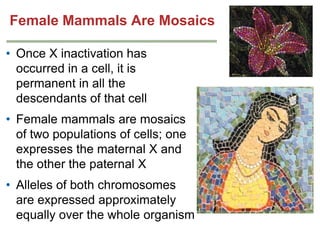
Female Mammals Are Mosaics
• Once X inactivation has
occurred in a cell, it is
permanent in all the
descendants of that cell

• Female mammals are mosaics
of two populations of cells; one
expresses the maternal X and
the other the paternal X
• Alleles of both chromosomes
are expressed approximately
equally over the whole organism
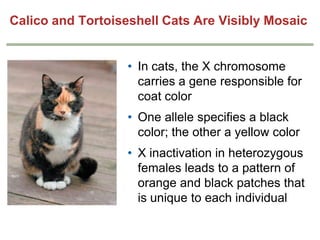
Calico and Tortoiseshell Cats Are Visibly Mosaic
• In cats, the X chromosome
carries a gene responsible for
coat color
• One allele specifies a black
color; the other a yellow color
• X inactivation in heterozygous
females leads to a pattern of
orange and black patches that
is unique to each individual
Mechanism of X Inactivation
• Random X inactivation
requires an X-linked gene
called Xist (X-inactivationspecific-transcript)
• The gene produces large
RNA molecules that spread
out and cover (or paint) the
chromosome to be
inactivated

• Xist can only act on the
chromosome from which it is
being transcribed and not
the homolog (i.e., it acts
in cis)

epigenie.com
Questions?

Genetics chapter 3 part 2

  • 1.
    EXAM INFORMATION! - - - Don‟t belate! Come early, review and zen! - Better to be an hour early than 15 mins late and receive a ZERO. (If someone leaves after one minute, one minute late will get you a zero.) Bags, phones, books etc all to the front of the room We will be seating you before the exam begins Only thing you need is a PENCIL and an ERASER - ANY kind of electronic device at all will get you a zero! Write your name on your exam paper and Scantron You will need a photo ID & your V-number to turn in your exam! Hand your exam and Scantron in at the end Answer keys will be posted (NO PICTURES!) Grades will be posted ASAP DO NOT CHEAT!
  • 2.
  • 3.
    3.3 The ChromosomeTheory of Heredity Proposes That Genes Are Carried on Chromosomes • Sutton and Boveri proposed that chromosome behavior in meiosis mirrors hereditary transmission of genes • The Boveri-Sutton Chromosome Theory • Correctly explains the mechanism underlying Mendelian Genetics by identifying chromosomes as the paired factors required by Mendel’s Laws. States that chromosomes are linear structures with genes located at specific sites called loci Walter Sutton Theodor Boveri
  • 4.
    SOMEONE WAS SKEPTICAL OFTHE „GENE HYPOTHESIS‟… Thomas Hunt Morgan was skeptical: Pea plants are domesticated, what happens in the real world? With a wild, natural species? What species did he find?
  • 5.
    3.3 The ChromosomeTheory of Heredity Proposes That Genes Are Carried on Chromosomes • Morgan studied fruit flies, Drosophila melanogaster, to test Mendel’s rules on a natural, rather than domesticated, species • Hung buckets of rotting fruit in trees in the then rural Long Island to attract fruit flies. Found them easy to work with, and have a life cycle of 12-14 days. • The term “wild type” signifies the phenotype most common in a population http://www.youtube.com/watch?v=LOGeTdcnqFM
  • 6.
    Thomas Hunt Morgan •Although at first wild-type phenotypes prevailed, over several years, Morgan’s lab members found numerous phenotypic variants and analyzed these in controlled crosses • He concluded from his results that genes were carried on chromosomes (independently proposed) • Great mentor, encouraged the use of fruit fly in students, several mentees went on to win Nobel Prizes • His graduate student, then wife and mother of his four children, Lilian Mogand made important contributions in the laboratory (X-linked inheritance). • Strongly against eugenics movement • Unraveled many basic principles of genetics and inheritance.
  • 8.
    Chromosomal Basis ofSex • Nettie Stevens (working with Tenebrio molitor beetles): sex-dependent hereditary differences are due to the presence of two X chromosomes in females and an X and a smaller Y chromosome in males • Diploid cells of females contained 20 large chromosomes; males contained 19 large chromosomes and one small one • Half of the sperm of males contained 10 large chromosomes and the other half had 9 large and one small chromosome • Sex-linked inheritance refers to transmission of traits on sex chromosomes Mealworm
  • 9.
    The White-Eye Mutant •The first mutant identified in Morgan’s lab was a male with white eyes instead of the normal red color • The mutant white-eyed male was crossed to a normal red-eyed female, producing many F1, all with red eyes • Thus the white-eyed mutant allele was what?
  • 10.
    NOT a normal3:1! Only the males have white eyes!
  • 11.
    Continued crosses… • Whenthe original white-eyed male was crossed to one of the F1 females, a 1:1 ratio of white eyes and red eyes was observed in both male and female offspring
  • 12.
    Reciprocal Cross • Across between a white-eyed female and red-eyed male produced red-eyed female and white-eyed male F1; a cross between these produced F1 with red and white eyes in equal frequencies among both male and female progeny
  • 13.
    The Gene forEye Color Is on the X Chromosome • The differences in phenotype according to gender are not anticipated according to Mendel’s laws • The transmission of the X chromosome can account for the results obtained by Morgan’s lab • X-linked inheritance is the term for traits carried on the X chromosome; males have only one X and so are called hemizygous for X-linked traits
  • 14.
    Figure 3.18 X &Y chromosome segregation of cross A, B, C. -Allele genotype is written as a superscript to the X chromosome (XW+, XW) -Hemizygous Y chromomsomes do not carry a genotype -Use a Punnet square to cross two sex chromosomes exactly as one would for two alleles Let’s draw one.. Heterozygous red female x white male
  • 15.
    Exceptional phenotypes! • Morgan’swork led him to propose the chromosome theory of heredity • Calvin Bridges studied “exceptional phenotypes”; very rare cases of unexpected eye color • Observed exceptional phenotypes: in a cross between a white-eyed female and red-eyed male, unexpected rare (1/2,000) offspring were observed: females with white eyes or males with red eyes (only red females and white males are predicted to occur) • What was happening to the X chromosome?
  • 16.
  • 17.
    Nondisjuntion • Bridges sawthat the exceptional females had three X chromosomes and one Y; and the exceptional males had just one X chromosome • Failed chromosome separation is nondisjunction
  • 18.
    3.4 Sex DeterminationIs Chromosome and Genetic • Chromosomal sex is the presence of chromosomes characteristic of each sex and is determined at the moment of fertilization • Phenotypic sex is the internal and external morphology of each sex, and results from differences in gene expression -Females have two X chromosomes and males have one X chromosome -Thus in flies; Males: X0, XYY, or XY (normal) Females are XXY or XX (normal)
  • 19.
    • Sex isdetermined by the X : A ratio • -X =number of X chromosomes; A = number of haploid sets of autosomes This ratio influences the actions of three sexdeterming genes: Deadpan, Sisterless and Sex-lethal genes (complicated!)
  • 20.
    Sex Determination inHumans • XX = female, XY= male. • The X chromosome contains genetic information essential for both sexes; at least one copy of an X is required. • Absence of X is lethal • The male-determining gene is located on the Y chromosome. A single Y, even in the presence of several X’s, will still produces a male phenotype. • SRY gene on the Y chromosome determines maleness • The absence of Y results in a female phenotype.
  • 21.
    Generation of maletraits in humans
  • 22.
    SRY Gene (Sex-determing Region Y) •Expression of SRY initiates testicular development of the undifferentiated gonads • The absence of SRY expression allows the default, female state, to develop 22
  • 23.
    SRY is atranscription factor • SRY is a transcription factor needed for malespecific gene expression • Issues with the sex genes themselves can alter the male phenotype • Androgen-insensitivity syndrome • Caused by the defective androgen receptor • Can be mild to complete androgen insensitivity • XY ‘females’
  • 24.
    • XX =female, XY= male. • SRY gene on the Y chromosome determines maleness • Turner syndrome: XO; 1/3000 female births • Amenorrhea, sterility, web necked, horse shoe kidney • Klinefelter syndrome: XXY, or XXXY, or XXXXY, or XXYY; 1/1000 male birth • infertility, gynechomastia, hypogonadism • Poly-X females: 1/1000 female births • Tall stature, menstrual irregularity, possible reduction of fertility
  • 25.
    Nondisjuntion in humans •Aneuploidy: Uneven number of chromosomes Cover in Ch. 13!
  • 26.
    Diversity of SexDetermination • A different system, the Z/W system, is used by birds, some reptiles, some fish, butterflies, and moths • In this system females have two different sex chromosomes (ZW) and males have two sex chromosomes that are the same (ZZ)
  • 27.
    Z-Linked Inheritance • Barredfeathers: Zlinked dominant allele (ZB) • Non-barred feathers is recessive (Zb) • In sex-linked traits, sexes are NOT affected equally (F2) • How do we verify that sex is affecting outcome?
  • 28.
    Z-Linked Inheritance • ReciprocalCross (reverse sexes) yields different results from the previous cross. This indicates that feather form is sex-linked.
  • 29.
    Heterogametic vs HomogameticSex • Heterogametic sex: the sex chromosomes do not match, and thus the gametes produced by that sex do not match. http://www.cals.ncsu.edu/course/ent425/ In humans, the males (XY) are the heterogametic sex. Males produce both X and Y gametes • Homogametic sex: sex chromosomes match and will produce the same sex-ed gametes • In many species (birds, fish, reptiles) females can be heterogametic sex (ZW system) Gametes X&Y Gametes X&X
  • 30.
    Haplodiploidy • Sex canalso be determined by the number of chromosome sets • In haplodiploidy, males develop from unfertilized eggs and are haploid (n), females develop from fertilized eggs and are diploid (2n).
  • 31.
    Environmental Sex Determination • Sexis determined by the temperature the eggs are incubated at • In the red-eared slider turtle, eggs above 30⁰ C produce all females • In the snapping turtle, eggs below 22⁰ C or above 28⁰ C will be female. Between 2527⁰ C males predominate Temperature-dependent sex determination in three reptile species: the American alligator (Alligator mississippiensis), the red-eared slider turtle (Trachemys scripta elegans), and the alligator snapping turtle (Macroclemys temminckii). (After Crain and Guillette 1998.)
  • 32.
    Environmental Sex Determination •Sex is determined in limpets (sea snails) by its position on the stack
  • 33.
    3.5 Human Sex-LinkedTransmission Follows Distinct Patterns • In X-linked recessive inheritance, females homozygoous for the recessive allele or males hemizygous for it display the recessive phenotype • In X-linked dominant traits, heterozygous females and males hemizygous for the dominant allele express the dominant phenotype • Hemizygous males display any allele on their single X whether the allele is recessive or dominant in females
  • 34.
    Features of X-LinkedRecessive Inheritance 1. Many more males than females have the trait due to hemizygosity
  • 35.
    X-Linked Recessive #2 #3 #4 1. Many moremales than females have the trait due to hemizygosity 2. A recessive male mated to a homozygous dominant female produces all offspring with the dominant phenotype, and all female offspring are carriers 3. Matings of recessive males with carrier females give half dominant and half recessive offspring of both sexes 4. Matings of homozygous recessive females with dominant males produce all dominant (carrier) female offspring and all recessive male offspring
  • 36.
    Hemophilia A Isan X-Linked Recessive Trait • Hemophilia A is caused by a mutation in the factor VIII gene on the X chromosome • The mutant allele produces a nonfunctional bloodclotting protein • A de novo (newly occurring) mutation is thought to have been passed from Queen Victoria of England to some of her offspring
  • 37.
    1. Many moremales than females have the trait due to hemizygosity
  • 38.
  • 39.
    X-Linked Dominant TraitTransmission • The distinctive characteristics of X-linked dominant traits are 1. Heterozygous females mated to wild-type males transmit the dominant allele to half their progeny of each sex 2. Dominant males mated to homozygous recessive females pass the trait to all their daughters and none of their sons 3. The trait appears equally frequently in males and females
  • 40.
    Congenital Hypertrichosis • Congenitalhypertrichosis (CGH) is a rare X-linked dominant disorder in humans • It leads to a large increase in the number of hair follicles on the body, and males and females have more body hair than normal
  • 41.
    Modified pedigree withCGH #1? #2 1. Heterozygous females mated to wild-type males transmit the dominant allele to half their progeny of each sex 2. Dominant males mated to homozygous recessive females pass the trait to all their daughters and none of their sons 3. The trait appears equally frequently in males and females
  • 43.
    Y-Linked Inheritance • Y-linkedtraits are transmitted in an exclusively male-to-male pattern • In mammals, there are fewer than 50 genes on the Y chromosome; many play roles in male sex determination or development • Though males have only one Y chromosome, they are not hemizygous for it, as most of the genes on the Y are present in two copies
  • 44.
    The Pseudoautosomal Region •Two small regions of homology, the pseudoautosomal regions (PAR1 and PAR2), exist between the X and Y chromosomes • These allow homologous pairing between the X and Y at meiosis • There is evidence that crossing over occurs within these regions during meiosis http://php.med.unsw.edu.au/embryology
  • 46.
    3.6 Dosage CompensationEqualizes Dosage of Sex-Linked Genes • In organisms with sex chromosomes, there is a gender imbalance between the copy number of genes on the sex chromosomes • Any mechanism that compensates for the difference in number of copies of genes between males and females is called dosage compensation
  • 48.
    Random X-Chromosome Inactivationin Placental Mammals • Early in mammalian development, one of two X chromosomes in each female somatic cell is randomly inactivated • The random X inactivation hypothesis is also called the Lyon hypothesis, after Mary Lyon, who first proposed it (1962) • The inactive X chromosome is visible near the nuclear wall, as a condensed Barr body, first visualized by Murray Barr (1949)
  • 49.
    Female Mammals AreMosaics • Once X inactivation has occurred in a cell, it is permanent in all the descendants of that cell • Female mammals are mosaics of two populations of cells; one expresses the maternal X and the other the paternal X • Alleles of both chromosomes are expressed approximately equally over the whole organism
  • 51.
    Calico and TortoiseshellCats Are Visibly Mosaic • In cats, the X chromosome carries a gene responsible for coat color • One allele specifies a black color; the other a yellow color • X inactivation in heterozygous females leads to a pattern of orange and black patches that is unique to each individual
  • 52.
    Mechanism of XInactivation • Random X inactivation requires an X-linked gene called Xist (X-inactivationspecific-transcript) • The gene produces large RNA molecules that spread out and cover (or paint) the chromosome to be inactivated • Xist can only act on the chromosome from which it is being transcribed and not the homolog (i.e., it acts in cis) epigenie.com
  • 53.