Gene structure and expression
Contents
• Introduction
Gene vs allele
 Genotype and Phenotype
 Homozygotes and heterozygotes
 Dominant and Recessive
 Wild and mutant alleles
A new Concept of Allelomorphism
 Recombination test
 Complementation test
Fine structure of gene
Cistron, Muton and Recon
Introduction
• Gene expression is the process by which
information from a gene is used in the synthesis
of a functional gene product.
• These products are often proteins, but in non-
protein coding genes such as ribosomal RNA (r
RNA) genes or transfer RNA (t RNA)genes, the
product is a functional RNA.
• The process of gene expression is used by all
known life – eukaryotes (including multicellular
organisms), prokaryotes (bacteria and archaea)
and viruses - to generate the macromolecular
machinery for life.
• The functional products of most known genes
are protein, or more accurately, polypeptides.
• Polypeptide is just another word for a chain of
amino acids.
Gene vs allele
 What is a gene ?
 A gene is a stretch of DNA or RNA that determines
a certain trains.
A gene is a basic unit of heredity.
Examples :- Blue eyes, green eyes, type A blood,
black skin, white skin.
 What is an alleles ?
 Each gene many exist in alternative forms known
as alleles.
An allele is a variation of a gene.
Example :- Eye color, blood type, skin color.
Genotype and Phenotype
 Genotype :-
• Genotype is the actual set of alleles carried by the
organism.
• Genotype is defined as the genetic constitution of
an individuals for any particular characters or traits.
• The genotype of an individual is usually expressed
by a symbol eg. tt,Tt,TT.
 Phenotype :-
• The phenotype is defined as the physical
appearance of an individual for any particular
traits.
• The phenotype of an individual is dependent on
its genetic constitution.
Homozygotes and Heterozygotes
 Homozygotes :-
• Each organism has two alleles for every gene , One
on each chromosome.
• If the two alleles are the same called Homozygous.
(both coding for blue eyes.)
 Heterozygotes :-
• If the two alleles are different they are
Heterozygous. (code for blue eyes and one for
brown eyes.)
Dominant and Recessive
 Dominant :-
• Alleles may be dominant or recessive.
• A dominant allele is one that will always be
expressed if present.
• It is represented by uppercase letter.
 Recessive :-
• A Recessive allele is an allele that express its
effect only in the Homozygous state, and in
Heterozygous is marked by a dominance allele.
• It is represented by lowercase letter.
Wild and Mutant Alleles
• Wild alleles are used to describe phenotypic
characters seen in “wild” population of subjects
like fruit flies.
• Alleles that are present at less than 1% in the
population and have been altered by mutation
are called mutant alleles.
A new Concept of Allelomorphism
• “The state of being or the passing On of
allelomorphism.
• The term genetics was first used by Bateson in
1905.
• The term gene was proposed in 1909 for the first
time by Johannsen.
• It was Subsequently also regarded as a unit of
function, unit of mutation and unit of
recombinations.
• According to the original classical Concept of genetics
that was in vogue for the first half of the last centuary, a
gene was believed to be particular allelomorphs were
envisaged as the alternative forms of a gene and no
intragenic crossing over could be Conceived.
• This concept had undergone a dramatic change during
1940s and 1950s with the discovery of intragenic
interallelic crossing over in several organisms.
• In classical genetics, a distinction was made between
gene and allele on the basis of following two criteria:-
1) Recombination test
2) Complementation test
Recombination test
• Recombination was believed to take place
between two genes but not between two
alleles.
• In other words, intragenic interallelic
recombination was not conceived.
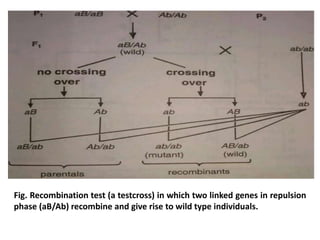
• For instance, a hybrid aB/ab between mutants
aa(aaBB) and bb(AAbb) for two linked genes A
and B could give rise to wild type progeny in a
testcross.
• Since A and B are linked, this would be possible
only due to recombination.
Fig. Recombination test (a testcross) in which two linked genes in repulsion
phase (aB/Ab) recombine and give rise to wild type individuals.
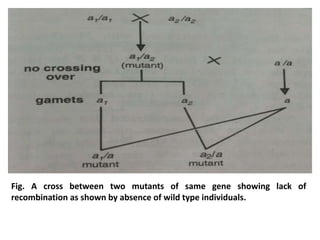
• On the other hand, if two mutants a1b1 and a2b2
belonging to same gene A were crossed and F1
(a1/a2) is testcrossed (a1/a2 x aa) no wild type
progeny would be expected.
• It was thus, earlier believed that different genes
or loci could recombine with each other by
crossing over but different alleles of a gene
could not.
• This test of allelism is illustrated in figure.
Complementation test
• It was also shown that mutan alleles of two
different genes coming from two parents, thus
being in replusion phase (also known as trans
configuration), will complement giving rise to
wild type in F1 generation.
• But the mutant forms allelic to each other, will
never complement.
• Thus, in its classical concept, the gene
recombined as a unit, functioned as a unit and
also changed (mutated) as a unit.
Fig. A cross between two mutants of same gene showing lack of
recombination as shown by absence of wild type individuals.
Fine structure of gene
• A gene is a molecular heredity unit of all living
organisms.
• Benzer in 1955 divided the gene into muton,
cistron & recon.
• Which are the units of mutation, function and
recombination within a gene.
• Several units of this type being in gene.
• In other words, each gene consists of several
units of mutation, function and recombination.
• The fine structure of gene deals with mapping of
individual gene locus.
Gene structure :-
• Gene structure is the Organisation of speciallised
sequence elements within a gene.
• Gene Contain the information necessary for living
cells to survive and reproduce.
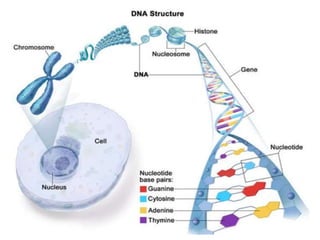
• In most Organisms, genes are made of DNA, where
the particular DNA sequence determines the
function of gene.
• This is parallel to the mapping of chromosome.
• In chromosome mapping, various genes are
assigned on a chromosome, whereas in case of a
gene several alleles are assigned to the same
locus.
• The individual gene maps are prepared with the
help of intragenic recombination.
• Since, the frequency of intragenic recombination
is extremely low, very large population has to be
grown to obtain such rare combination.
1. The gene is viewed as a fundamental unit of
structure, indivisible by Crossing-over.
2. The gene is viewed as the fundamental unit of
change , or mutation. It changes in toto from
one allelic from into another; there are no
smaller components within it that can change.
3. The gene is viewed as the fundamental unit of
function. Parts of a gene, if they exist, cannot
function.
1. Test of Allelism (Allelism and Pseudoalleles)
• If one wishes to find out whether two mutant
alleles in question are allelic to other or not,
then from their crosses it is expected that F1
individuals (which have mutant phenotypes)
should not give rise to the wild type in the f2
generation.
• This is called test of allelism.
• This classical concept of allelism has to be
modified due to experimental results of several
workers working on Drosophila.
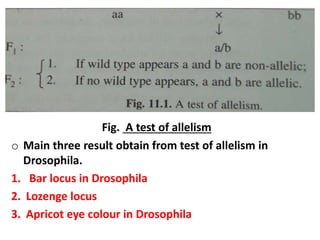
Fig. A test of allelism
o Main three result obtain from test of allelism in
Drosophila.
1. Bar locus in Drosophila
2. Lozenge locus
3. Apricot eye colour in Drosophila
Cistron, Muton & Recon
o Benzer divided into gene into Cistron, Muton and Recon.
1. Cistron (unit of function) :-
“Cistron is a section of DNA that contains the genetic
code for specific polypeptide & function as a hereditary
unit.”
• This also knocked down the bead theory according to
which entire gene was the unit of function.
2. Muton (unit of mutation) :-
“The smallest unit of DNA where a mutation can occur.”
• This disproved the bead theory accoding to which the
entire gene was to mutate or change.
3. Recon (unit of recombination) :-
“The smallest section of a chromosome
that is capable of recombination.”
• There is a minimum recombination distance
within a gene which separates recons.
• The map of gene is completely linear
sequence of recons.
References
 Cell Biology, Genetics, Molecular Biology
Evolution and Ecology -
Dr. P.S. VERMA
Dr. V.K. AGARWAL
 GENETICS - P. K. GUPTA
www.ncbi.nlm.nih.gov
www.biologydiscussion.com
THANK YOU

Gene structure and expression

  • 1.
  • 2.
    Contents • Introduction Gene vsallele  Genotype and Phenotype  Homozygotes and heterozygotes  Dominant and Recessive  Wild and mutant alleles A new Concept of Allelomorphism  Recombination test  Complementation test Fine structure of gene Cistron, Muton and Recon
  • 3.
    Introduction • Gene expressionis the process by which information from a gene is used in the synthesis of a functional gene product. • These products are often proteins, but in non- protein coding genes such as ribosomal RNA (r RNA) genes or transfer RNA (t RNA)genes, the product is a functional RNA.
  • 4.
    • The processof gene expression is used by all known life – eukaryotes (including multicellular organisms), prokaryotes (bacteria and archaea) and viruses - to generate the macromolecular machinery for life. • The functional products of most known genes are protein, or more accurately, polypeptides. • Polypeptide is just another word for a chain of amino acids.
  • 5.
    Gene vs allele What is a gene ?  A gene is a stretch of DNA or RNA that determines a certain trains. A gene is a basic unit of heredity. Examples :- Blue eyes, green eyes, type A blood, black skin, white skin.  What is an alleles ?  Each gene many exist in alternative forms known as alleles. An allele is a variation of a gene. Example :- Eye color, blood type, skin color.
  • 6.
    Genotype and Phenotype Genotype :- • Genotype is the actual set of alleles carried by the organism. • Genotype is defined as the genetic constitution of an individuals for any particular characters or traits. • The genotype of an individual is usually expressed by a symbol eg. tt,Tt,TT.  Phenotype :- • The phenotype is defined as the physical appearance of an individual for any particular traits. • The phenotype of an individual is dependent on its genetic constitution.
  • 7.
    Homozygotes and Heterozygotes Homozygotes :- • Each organism has two alleles for every gene , One on each chromosome. • If the two alleles are the same called Homozygous. (both coding for blue eyes.)  Heterozygotes :- • If the two alleles are different they are Heterozygous. (code for blue eyes and one for brown eyes.)
  • 8.
    Dominant and Recessive Dominant :- • Alleles may be dominant or recessive. • A dominant allele is one that will always be expressed if present. • It is represented by uppercase letter.  Recessive :- • A Recessive allele is an allele that express its effect only in the Homozygous state, and in Heterozygous is marked by a dominance allele. • It is represented by lowercase letter.
  • 9.
    Wild and MutantAlleles • Wild alleles are used to describe phenotypic characters seen in “wild” population of subjects like fruit flies. • Alleles that are present at less than 1% in the population and have been altered by mutation are called mutant alleles.
  • 10.
    A new Conceptof Allelomorphism • “The state of being or the passing On of allelomorphism. • The term genetics was first used by Bateson in 1905. • The term gene was proposed in 1909 for the first time by Johannsen. • It was Subsequently also regarded as a unit of function, unit of mutation and unit of recombinations.
  • 11.
    • According tothe original classical Concept of genetics that was in vogue for the first half of the last centuary, a gene was believed to be particular allelomorphs were envisaged as the alternative forms of a gene and no intragenic crossing over could be Conceived. • This concept had undergone a dramatic change during 1940s and 1950s with the discovery of intragenic interallelic crossing over in several organisms. • In classical genetics, a distinction was made between gene and allele on the basis of following two criteria:- 1) Recombination test 2) Complementation test
  • 12.
    Recombination test • Recombinationwas believed to take place between two genes but not between two alleles. • In other words, intragenic interallelic recombination was not conceived. • For instance, a hybrid aB/ab between mutants aa(aaBB) and bb(AAbb) for two linked genes A and B could give rise to wild type progeny in a testcross. • Since A and B are linked, this would be possible only due to recombination.
  • 13.
    Fig. Recombination test(a testcross) in which two linked genes in repulsion phase (aB/Ab) recombine and give rise to wild type individuals.
  • 14.
    • On theother hand, if two mutants a1b1 and a2b2 belonging to same gene A were crossed and F1 (a1/a2) is testcrossed (a1/a2 x aa) no wild type progeny would be expected. • It was thus, earlier believed that different genes or loci could recombine with each other by crossing over but different alleles of a gene could not. • This test of allelism is illustrated in figure.
  • 15.
    Complementation test • Itwas also shown that mutan alleles of two different genes coming from two parents, thus being in replusion phase (also known as trans configuration), will complement giving rise to wild type in F1 generation. • But the mutant forms allelic to each other, will never complement. • Thus, in its classical concept, the gene recombined as a unit, functioned as a unit and also changed (mutated) as a unit.
  • 16.
    Fig. A crossbetween two mutants of same gene showing lack of recombination as shown by absence of wild type individuals.
  • 17.
    Fine structure ofgene • A gene is a molecular heredity unit of all living organisms. • Benzer in 1955 divided the gene into muton, cistron & recon. • Which are the units of mutation, function and recombination within a gene. • Several units of this type being in gene. • In other words, each gene consists of several units of mutation, function and recombination. • The fine structure of gene deals with mapping of individual gene locus.
  • 18.
    Gene structure :- •Gene structure is the Organisation of speciallised sequence elements within a gene. • Gene Contain the information necessary for living cells to survive and reproduce. • In most Organisms, genes are made of DNA, where the particular DNA sequence determines the function of gene. • This is parallel to the mapping of chromosome.
  • 20.
    • In chromosomemapping, various genes are assigned on a chromosome, whereas in case of a gene several alleles are assigned to the same locus. • The individual gene maps are prepared with the help of intragenic recombination. • Since, the frequency of intragenic recombination is extremely low, very large population has to be grown to obtain such rare combination.
  • 21.
    1. The geneis viewed as a fundamental unit of structure, indivisible by Crossing-over. 2. The gene is viewed as the fundamental unit of change , or mutation. It changes in toto from one allelic from into another; there are no smaller components within it that can change. 3. The gene is viewed as the fundamental unit of function. Parts of a gene, if they exist, cannot function.
  • 22.
    1. Test ofAllelism (Allelism and Pseudoalleles) • If one wishes to find out whether two mutant alleles in question are allelic to other or not, then from their crosses it is expected that F1 individuals (which have mutant phenotypes) should not give rise to the wild type in the f2 generation. • This is called test of allelism. • This classical concept of allelism has to be modified due to experimental results of several workers working on Drosophila.
  • 23.
    Fig. A testof allelism o Main three result obtain from test of allelism in Drosophila. 1. Bar locus in Drosophila 2. Lozenge locus 3. Apricot eye colour in Drosophila
  • 24.
    Cistron, Muton &Recon o Benzer divided into gene into Cistron, Muton and Recon. 1. Cistron (unit of function) :- “Cistron is a section of DNA that contains the genetic code for specific polypeptide & function as a hereditary unit.” • This also knocked down the bead theory according to which entire gene was the unit of function. 2. Muton (unit of mutation) :- “The smallest unit of DNA where a mutation can occur.” • This disproved the bead theory accoding to which the entire gene was to mutate or change.
  • 25.
    3. Recon (unitof recombination) :- “The smallest section of a chromosome that is capable of recombination.” • There is a minimum recombination distance within a gene which separates recons. • The map of gene is completely linear sequence of recons.
  • 26.
    References  Cell Biology,Genetics, Molecular Biology Evolution and Ecology - Dr. P.S. VERMA Dr. V.K. AGARWAL  GENETICS - P. K. GUPTA www.ncbi.nlm.nih.gov www.biologydiscussion.com
  • 27.