Chromosomes and Heredity
Chromosomal Determination of Sex, Sex-linked Traits, Sex-
influenced Traits and Sex-limited Traits, Chromosome
Theory of Inheritance
Md. Atick Chowdhury
Introduction
• A chromosome is a structure that exists within cells and which
possesses the cell’s genetic material.
• In prokaryotes (cells without a nucleus) the chromosome is simply a
circle of DNA.
• In eukaryotes (cells with a separate nucleus) chromosomes are
much more composite in structure.
• Every chromosome is made up of DNA firmly coiled a lot of times
around proteins known as histones that support its structure.
• Every chromosome has a constriction point known as the
centromere, which divides the chromosome into two parts, or
“hands”.
Objective
• To define chromosome and heredity
• To explain chromosomal determination of sex
• To know about sex-linked, sex-influenced & sex-limited traits
• To justify chromosome theory of inheritance
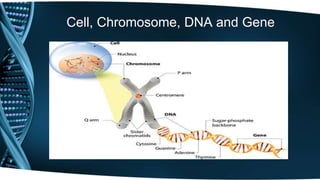
Chromosome
• A string of DNA wrapped around associated proteins that give the
connected nucleic acid bases a structure.
• Interphase of the cell cycle: in loose structure.
• During mitosis and meiosis: chromosome becomes condensed.
• Chromosome carries part of the genetic code necessary to produce
an organism.
Cell, Chromosome, DNA and Gene
Basic Function of a Chromosome
• Holds genetic code as well as many of the proteins responsible for
helping express it.
• Instruct how often genes can be translated into proteins and which
genes are translated (gene expression); responsible for creating
organisms.
• Less active genes will be more tightly packed than genes
undergoing active translation.
Heredity
• Passing on of traits from parents to their offspring, either through
asexual reproduction or sexual reproduction.
• The offspring cells or organisms acquire the genetic information of
their parents.
• Through heredity, variations between individuals can accumulate
and cause species to evolve by natural selection.
• Two organisms must combine their chromosome to create
offspring, which can increase their chances of success in a
changing world.
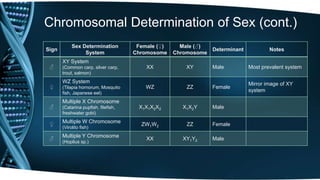
Chromosomal Determination of Sex
• Sex determination is a biological system that determines the
development of sexual characteristics in an organism.
• The means by which the development of the differences between
the sexes is initiated.
• Sex in fishes are distinguished either of two ways-
i. Chromosomal or genetic sex
ii. Gonadal or phenotypic sex
• The chromosomal sex of fish is determined at the time of
fertilization.
• Tave (1993) describes nine different sex determination
mechanisms in fish of which eight are based on sex chromosomes
and the rest one is based on autosome.
Chromosomal Determination of Sex (cont.)
Sign
Sex Determination
System
Female (♀)
Chromosome
Male (♂)
Chromosome
Determinant Notes
♂
XY System
(Common carp, silver carp,
trout, salmon)
XX XY Male Most prevalent system
♀
WZ System
(Tilapia hornorum, Mosquito
fish, Japanese eel)
WZ ZZ Female
Mirror image of XY
system
♂
Multiple X Chromosome
(Catarina pupfish, filefish,
freshwater gobi)
X1X1X2X2 X1X2Y Male
♀
Multiple W Chromosome
(Virolito fish)
ZW1W2 ZZ Female
♂
Multiple Y Chromosome
(Hoplius sp.)
XX XY1Y2 Male
Chromosomal Determination of Sex (cont.)
Sign
Sex Determination
System
Female (♀)
Chromosome
Male (♂)
Chromosome
Determinant Notes
♀+♂
WXY System
(Platyfish)
XX, WX, WY XY, YY Both
W blocks male
producing capacity of Y
♂
XO System
(Doller hatchetfish)
XX XO Male No Y chromosome
♀ ZO System ZO ZZ Female
Absence of W
chromosome
Autosomal Sex Determination
• The sex of an individual fish of that category can be influenced or
modified by genes located in the autosome.
• Some species may have additional autosomal sex influencing or
sex modifying gene (i.e. tilapia) and turn some male fish into
female.
Sex-linked Traits
• A sex-linked trait is a trait that is controlled by a gene or an allele
located on the sex chromosome.
• A trait that is determined by the allele on X chromosome is
particularly described as X-linked whereas that determined by the
allele on Y chromosome is said to be Y-linked.
• Some traits would therefore be linked to the sex or gender of an
individual.
• Sex- linked genes follow a criss-cross or skip-generation
inheritance where male transmits his sex-linked genes to his
grandsons through his daughters, never to or through his sons.
White Eyes in Drosophila
Cross I
Parents White-eyed female × Red-eyed male
w w +
X X X Y
F1 Red-eyed female × White-eyed male
+ w w
X X X Y
F2 Red-eyed female White-eyed female Red-eyed male White-eyed male
+ w w w + w
X X X X X Y X Y
White Eyes in Drosophila (cont.)
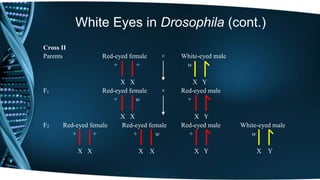
Cross II
Parents Red-eyed female × White-eyed male
+ + w
X X X Y
F1 Red-eyed female × Red-eyed male
+ w +
X X X Y
F2 Red-eyed female Red-eyed female Red-eyed male White-eyed male
+ + + w + w
X X X X X Y X Y
Sex-influenced Traits
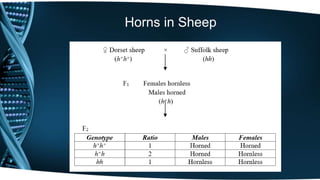
• Sex-influenced traits are autosomal traits that are influenced by
sex. If a male has one recessive allele, he will show that trait, but it
will take two recessive for the female to show that same trait.
• Thus a trait may be dominant in one sex and recessive in the other.
• Sex influenced traits are also known as sex-controlled traits or sex-
influenced dominance.
Horns in Sheep
Sex-limited Traits
• Genes for a particular character may be present in both sexes but
they are expressed only in one of the sexes.
• Sex-limited characters are those whose expression is determined
by the presence or absence of one of the sex hormones.
Sex-limited Traits (cont.)
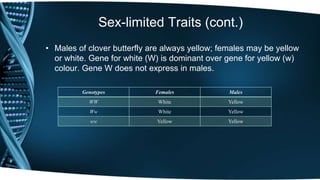
• Males of clover butterfly are always yellow; females may be yellow
or white. Gene for white (W) is dominant over gene for yellow (w)
colour. Gene W does not express in males.
Genotypes Females Males
WW White Yellow
Ww White Yellow
ww Yellow Yellow
Chromosome Theory of Inheritance
• Fundamental unifying theory of genetics which identifies
chromosomes as the carriers of genetic material.
• Sutton (1902) and Boveri (1902) independently suggested that
genes are the actual physical hereditary units located in the
chromosomes in a linear order. Since there are two chromosomes
of each kind, there must be two genes of each kind, one in each of
the homologous chromosomes.
• Thus the genes, which actually determine the traits, are carried by
chromosomes from parents to offspring.
• The chromosome theory of inheritance states that chromosomes
constitute the physical basis of the inheritance and that the genes
are located in the chromosomes.
Conclusion
• Cells are the basic unit of structure and function of all living things.
• Tiny biochemical structures inside each cell called genes carry traits
from one generation to the next.
• Genes are made of a chemical called DNA (deoxyribonucleic acid).
• Genes are strung together to form long chains of DNA in structures
known as chromosomes.
• Through heredity, living things inherit traits from their parents.

Chromosomes and Heredity

  • 1.
    Chromosomes and Heredity ChromosomalDetermination of Sex, Sex-linked Traits, Sex- influenced Traits and Sex-limited Traits, Chromosome Theory of Inheritance Md. Atick Chowdhury
  • 2.
    Introduction • A chromosomeis a structure that exists within cells and which possesses the cell’s genetic material. • In prokaryotes (cells without a nucleus) the chromosome is simply a circle of DNA. • In eukaryotes (cells with a separate nucleus) chromosomes are much more composite in structure. • Every chromosome is made up of DNA firmly coiled a lot of times around proteins known as histones that support its structure. • Every chromosome has a constriction point known as the centromere, which divides the chromosome into two parts, or “hands”.
  • 3.
    Objective • To definechromosome and heredity • To explain chromosomal determination of sex • To know about sex-linked, sex-influenced & sex-limited traits • To justify chromosome theory of inheritance
  • 4.
    Chromosome • A stringof DNA wrapped around associated proteins that give the connected nucleic acid bases a structure. • Interphase of the cell cycle: in loose structure. • During mitosis and meiosis: chromosome becomes condensed. • Chromosome carries part of the genetic code necessary to produce an organism.
  • 5.
  • 6.
    Basic Function ofa Chromosome • Holds genetic code as well as many of the proteins responsible for helping express it. • Instruct how often genes can be translated into proteins and which genes are translated (gene expression); responsible for creating organisms. • Less active genes will be more tightly packed than genes undergoing active translation.
  • 7.
    Heredity • Passing onof traits from parents to their offspring, either through asexual reproduction or sexual reproduction. • The offspring cells or organisms acquire the genetic information of their parents. • Through heredity, variations between individuals can accumulate and cause species to evolve by natural selection. • Two organisms must combine their chromosome to create offspring, which can increase their chances of success in a changing world.
  • 8.
    Chromosomal Determination ofSex • Sex determination is a biological system that determines the development of sexual characteristics in an organism. • The means by which the development of the differences between the sexes is initiated. • Sex in fishes are distinguished either of two ways- i. Chromosomal or genetic sex ii. Gonadal or phenotypic sex • The chromosomal sex of fish is determined at the time of fertilization. • Tave (1993) describes nine different sex determination mechanisms in fish of which eight are based on sex chromosomes and the rest one is based on autosome.
  • 9.
    Chromosomal Determination ofSex (cont.) Sign Sex Determination System Female (♀) Chromosome Male (♂) Chromosome Determinant Notes ♂ XY System (Common carp, silver carp, trout, salmon) XX XY Male Most prevalent system ♀ WZ System (Tilapia hornorum, Mosquito fish, Japanese eel) WZ ZZ Female Mirror image of XY system ♂ Multiple X Chromosome (Catarina pupfish, filefish, freshwater gobi) X1X1X2X2 X1X2Y Male ♀ Multiple W Chromosome (Virolito fish) ZW1W2 ZZ Female ♂ Multiple Y Chromosome (Hoplius sp.) XX XY1Y2 Male
  • 10.
    Chromosomal Determination ofSex (cont.) Sign Sex Determination System Female (♀) Chromosome Male (♂) Chromosome Determinant Notes ♀+♂ WXY System (Platyfish) XX, WX, WY XY, YY Both W blocks male producing capacity of Y ♂ XO System (Doller hatchetfish) XX XO Male No Y chromosome ♀ ZO System ZO ZZ Female Absence of W chromosome Autosomal Sex Determination • The sex of an individual fish of that category can be influenced or modified by genes located in the autosome. • Some species may have additional autosomal sex influencing or sex modifying gene (i.e. tilapia) and turn some male fish into female.
  • 11.
    Sex-linked Traits • Asex-linked trait is a trait that is controlled by a gene or an allele located on the sex chromosome. • A trait that is determined by the allele on X chromosome is particularly described as X-linked whereas that determined by the allele on Y chromosome is said to be Y-linked. • Some traits would therefore be linked to the sex or gender of an individual. • Sex- linked genes follow a criss-cross or skip-generation inheritance where male transmits his sex-linked genes to his grandsons through his daughters, never to or through his sons.
  • 12.
    White Eyes inDrosophila Cross I Parents White-eyed female × Red-eyed male w w + X X X Y F1 Red-eyed female × White-eyed male + w w X X X Y F2 Red-eyed female White-eyed female Red-eyed male White-eyed male + w w w + w X X X X X Y X Y
  • 13.
    White Eyes inDrosophila (cont.) Cross II Parents Red-eyed female × White-eyed male + + w X X X Y F1 Red-eyed female × Red-eyed male + w + X X X Y F2 Red-eyed female Red-eyed female Red-eyed male White-eyed male + + + w + w X X X X X Y X Y
  • 14.
    Sex-influenced Traits • Sex-influencedtraits are autosomal traits that are influenced by sex. If a male has one recessive allele, he will show that trait, but it will take two recessive for the female to show that same trait. • Thus a trait may be dominant in one sex and recessive in the other. • Sex influenced traits are also known as sex-controlled traits or sex- influenced dominance.
  • 15.
  • 16.
    Sex-limited Traits • Genesfor a particular character may be present in both sexes but they are expressed only in one of the sexes. • Sex-limited characters are those whose expression is determined by the presence or absence of one of the sex hormones.
  • 17.
    Sex-limited Traits (cont.) •Males of clover butterfly are always yellow; females may be yellow or white. Gene for white (W) is dominant over gene for yellow (w) colour. Gene W does not express in males. Genotypes Females Males WW White Yellow Ww White Yellow ww Yellow Yellow
  • 18.
    Chromosome Theory ofInheritance • Fundamental unifying theory of genetics which identifies chromosomes as the carriers of genetic material. • Sutton (1902) and Boveri (1902) independently suggested that genes are the actual physical hereditary units located in the chromosomes in a linear order. Since there are two chromosomes of each kind, there must be two genes of each kind, one in each of the homologous chromosomes. • Thus the genes, which actually determine the traits, are carried by chromosomes from parents to offspring. • The chromosome theory of inheritance states that chromosomes constitute the physical basis of the inheritance and that the genes are located in the chromosomes.
  • 19.
    Conclusion • Cells arethe basic unit of structure and function of all living things. • Tiny biochemical structures inside each cell called genes carry traits from one generation to the next. • Genes are made of a chemical called DNA (deoxyribonucleic acid). • Genes are strung together to form long chains of DNA in structures known as chromosomes. • Through heredity, living things inherit traits from their parents.