GENETIC
AN I NTE G RATE D APPR OAC H

A N A LY S I S

Chapter 5
Genetic Linkage and
Mapping in Eukaryotes

Lectures by Kathleen Fitzpatrick
Simon Fraser University

Mark F. Sanders
John L. Bowman

Copyright © 2012 Pearson Education Inc.
Genetics
CHAPTER 5, PART 1
Genetic Linkage and Mapping
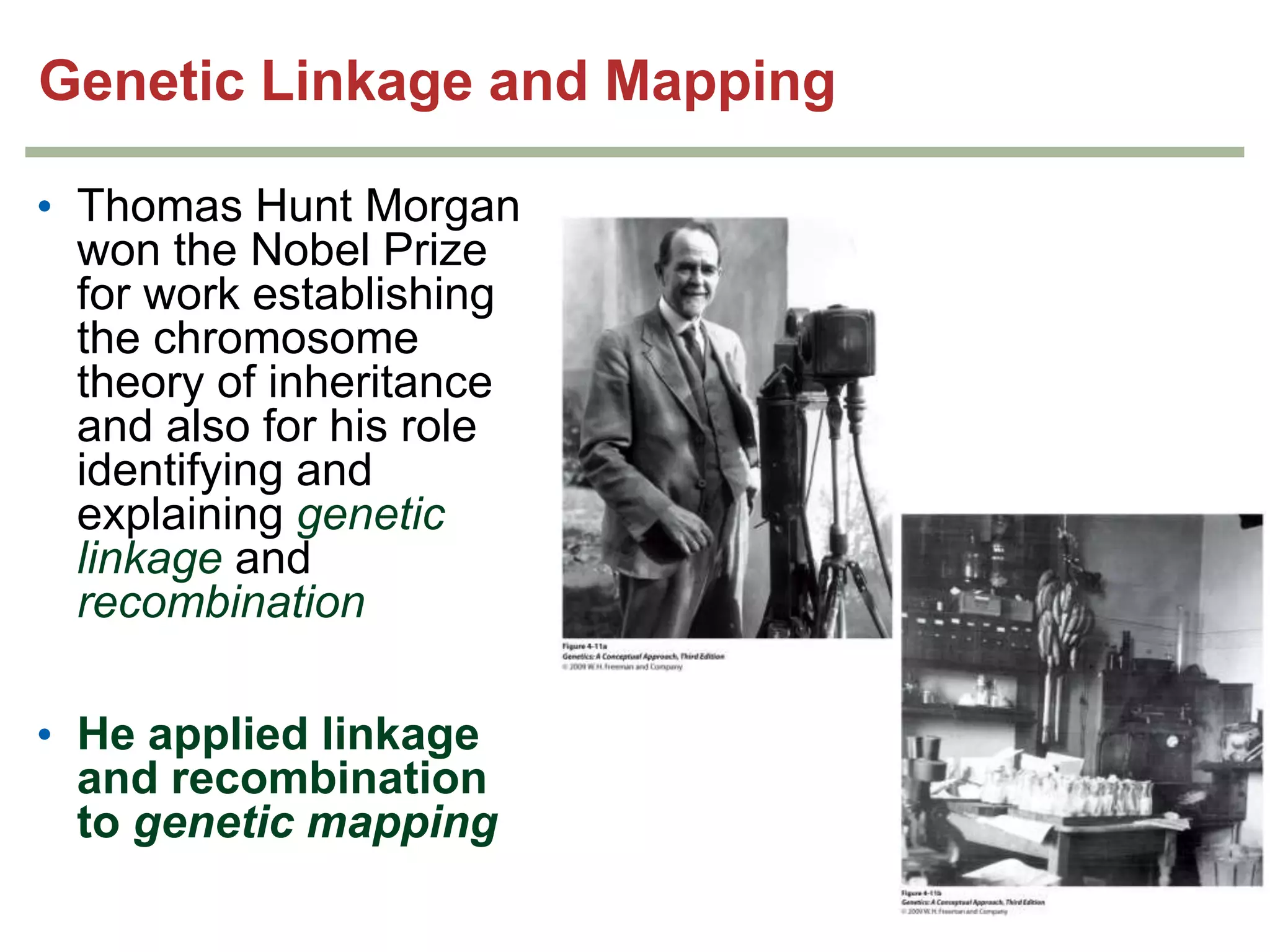
• Thomas Hunt Morgan
won the Nobel Prize
for work establishing
the chromosome
theory of inheritance
and also for his role
identifying and
explaining genetic
linkage and
recombination
• He applied linkage
and recombination
to genetic mapping
3
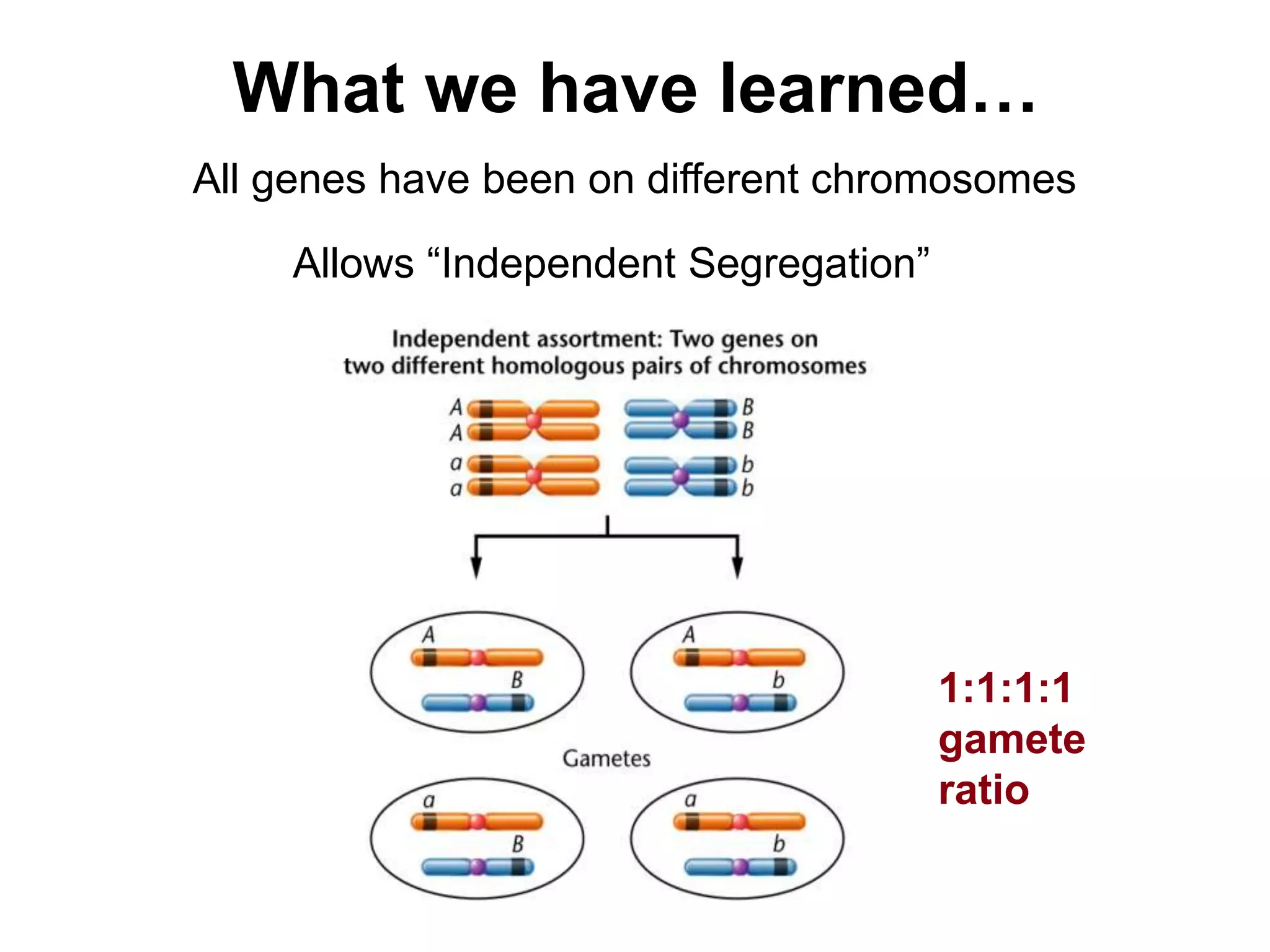
What we have learned…
All genes have been on different chromosomes
Allows “Independent Segregation”

1:1:1:1
gamete
ratio
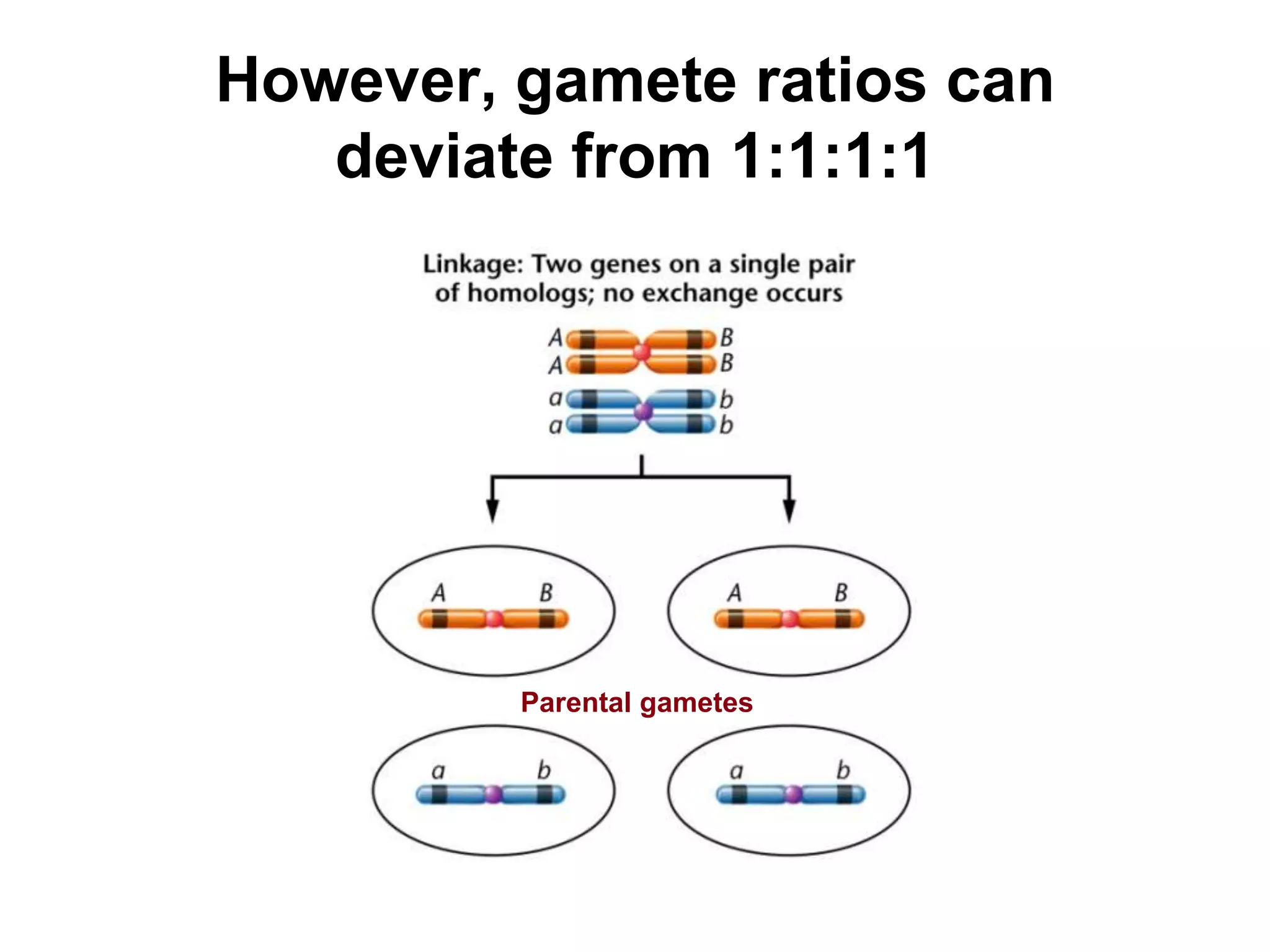
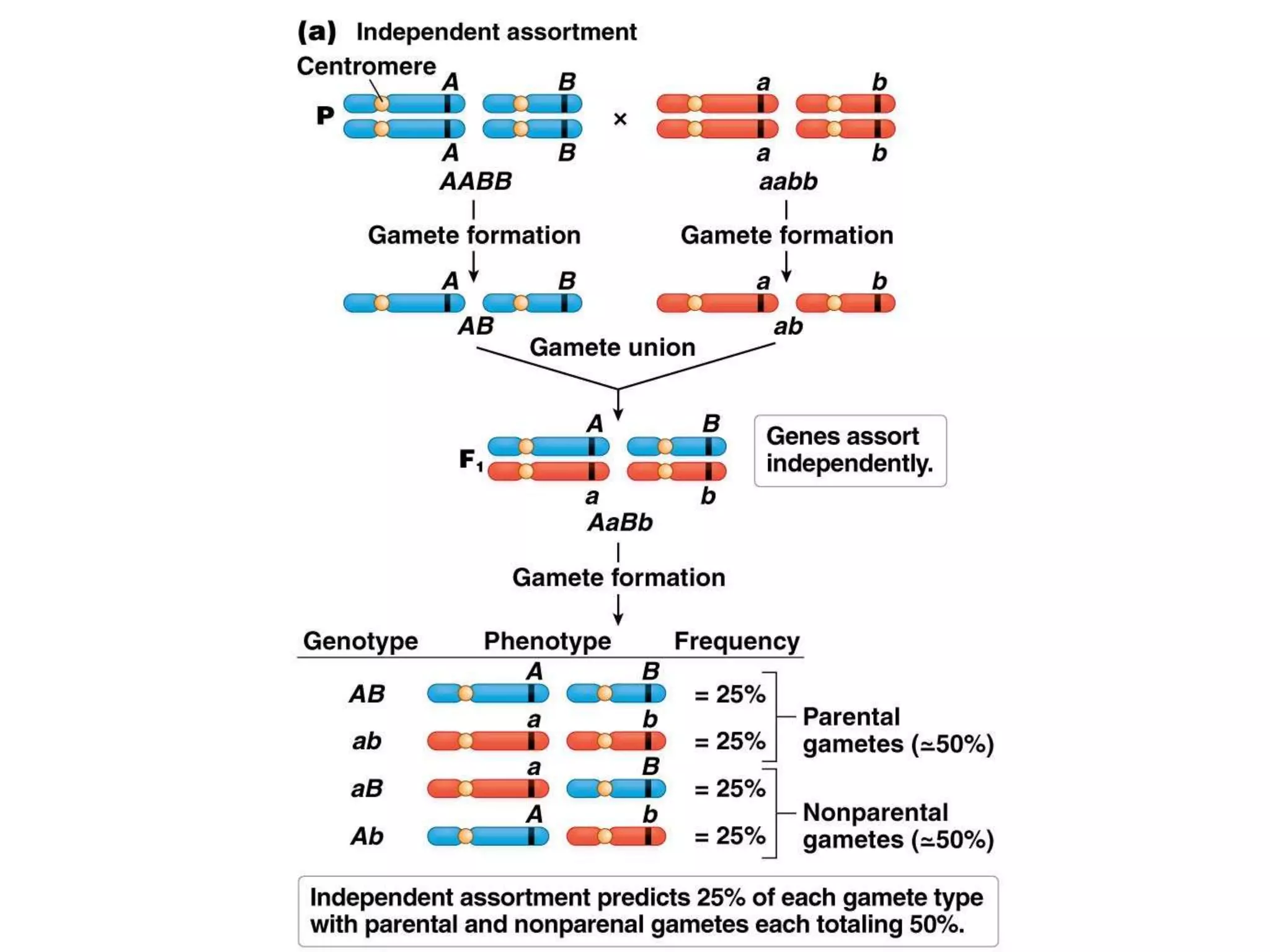
However, gamete ratios can
deviate from 1:1:1:1

Parental gametes
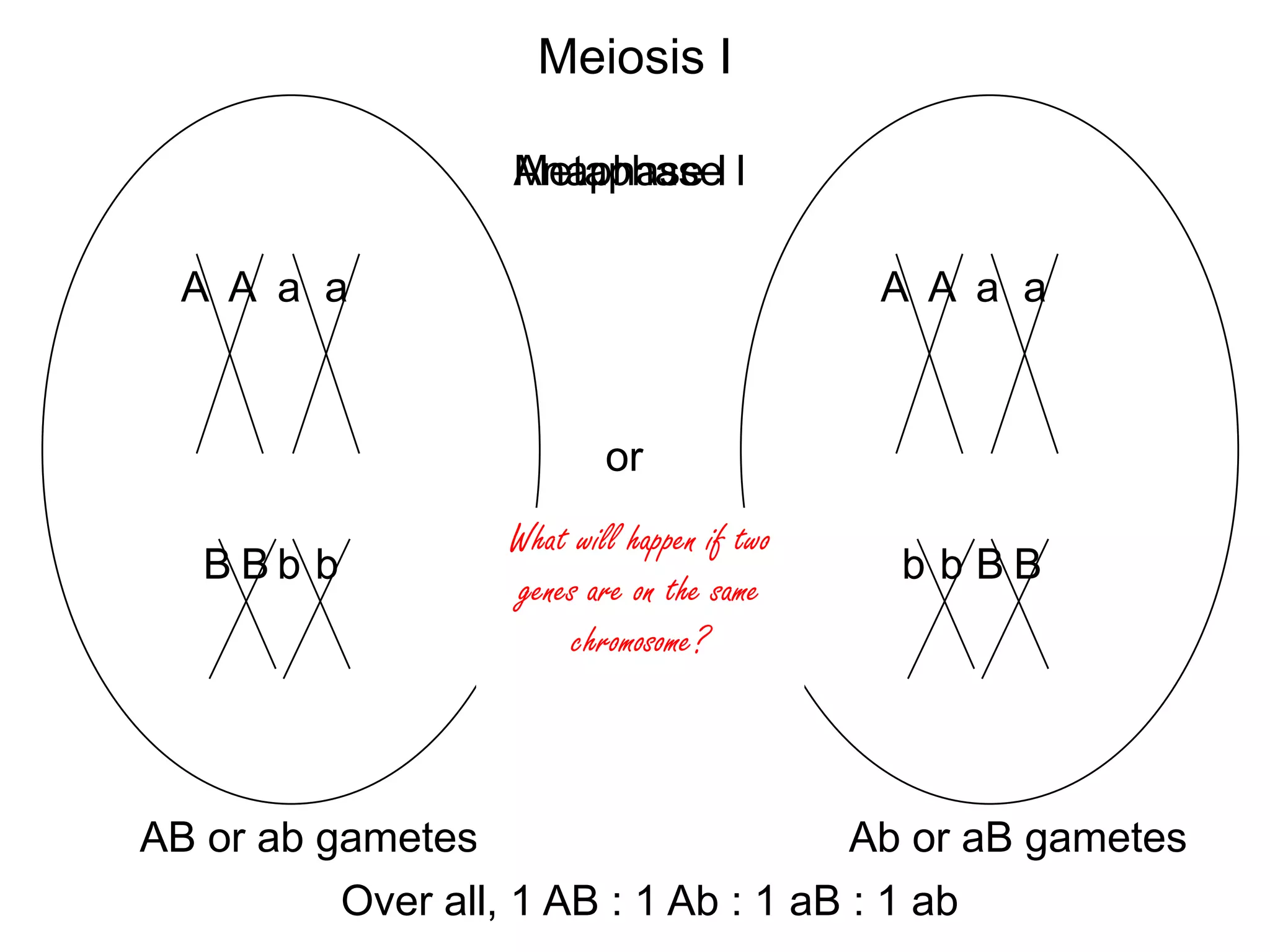
Meiosis I
Anaphase
MetaphaseI I
A A a a

A A a a

or

BBb b

What will happen if two
genes are on the same
chromosome?

b b BB

AB or ab gametes
Ab or aB gametes
Over all, 1 AB : 1 Ab : 1 aB : 1 ab
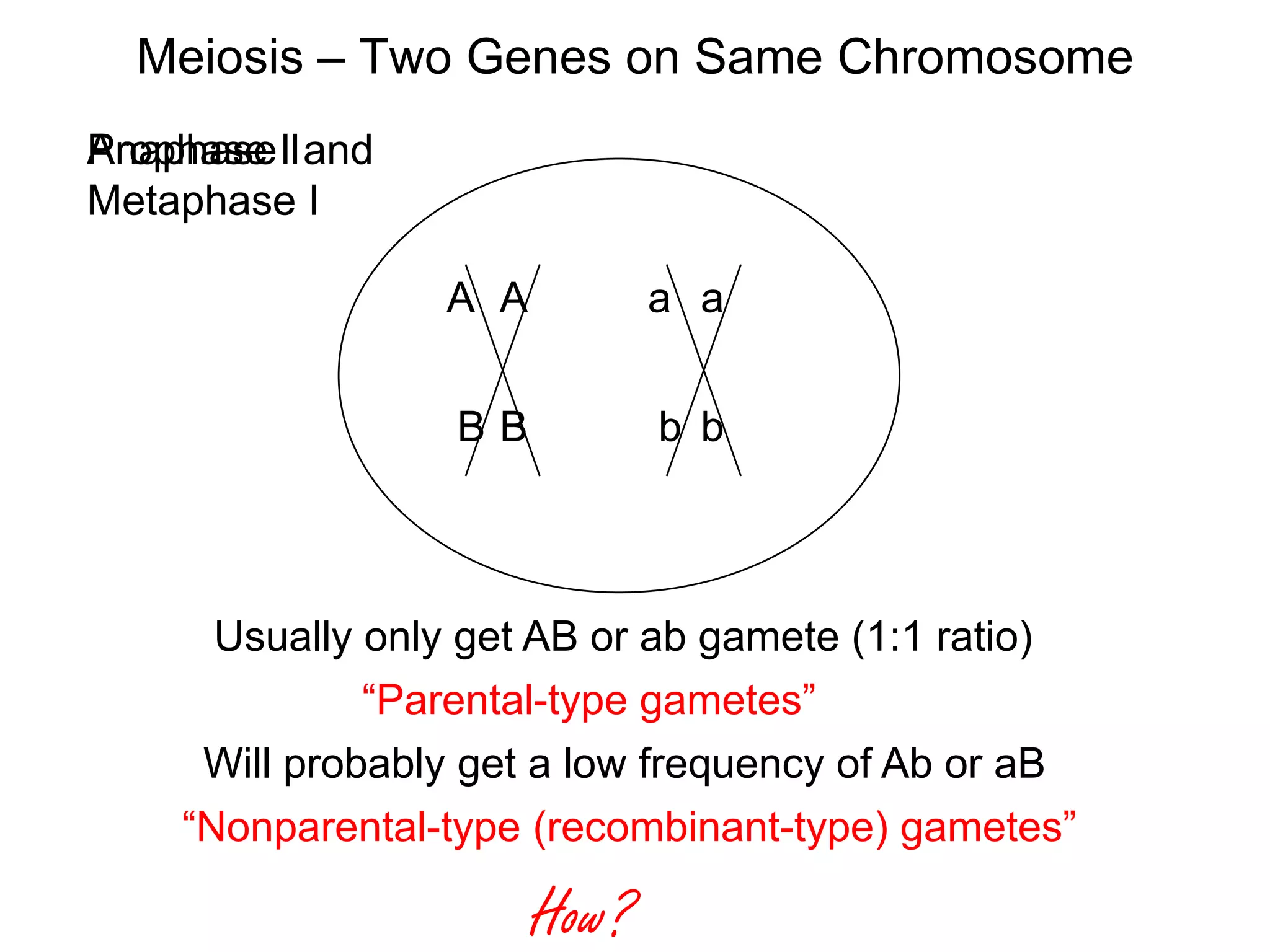
Meiosis – Two Genes on Same Chromosome
Anaphase
Prophase II and
Metaphase I
A A

a a

BB

b b

Usually only get AB or ab gamete (1:1 ratio)
“Parental-type gametes”

Will probably get a low frequency of Ab or aB
“Nonparental-type (recombinant-type) gametes”

How?
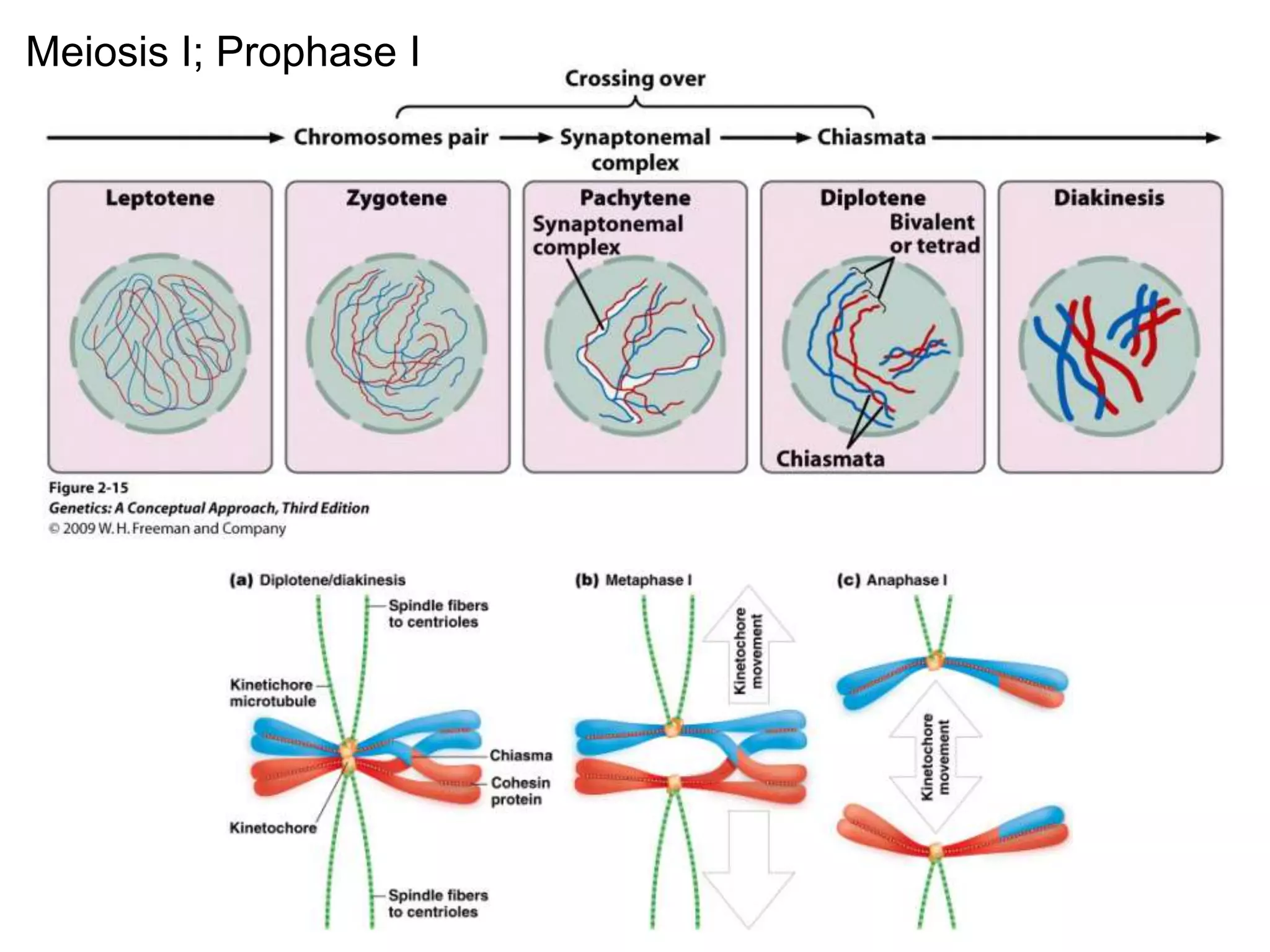
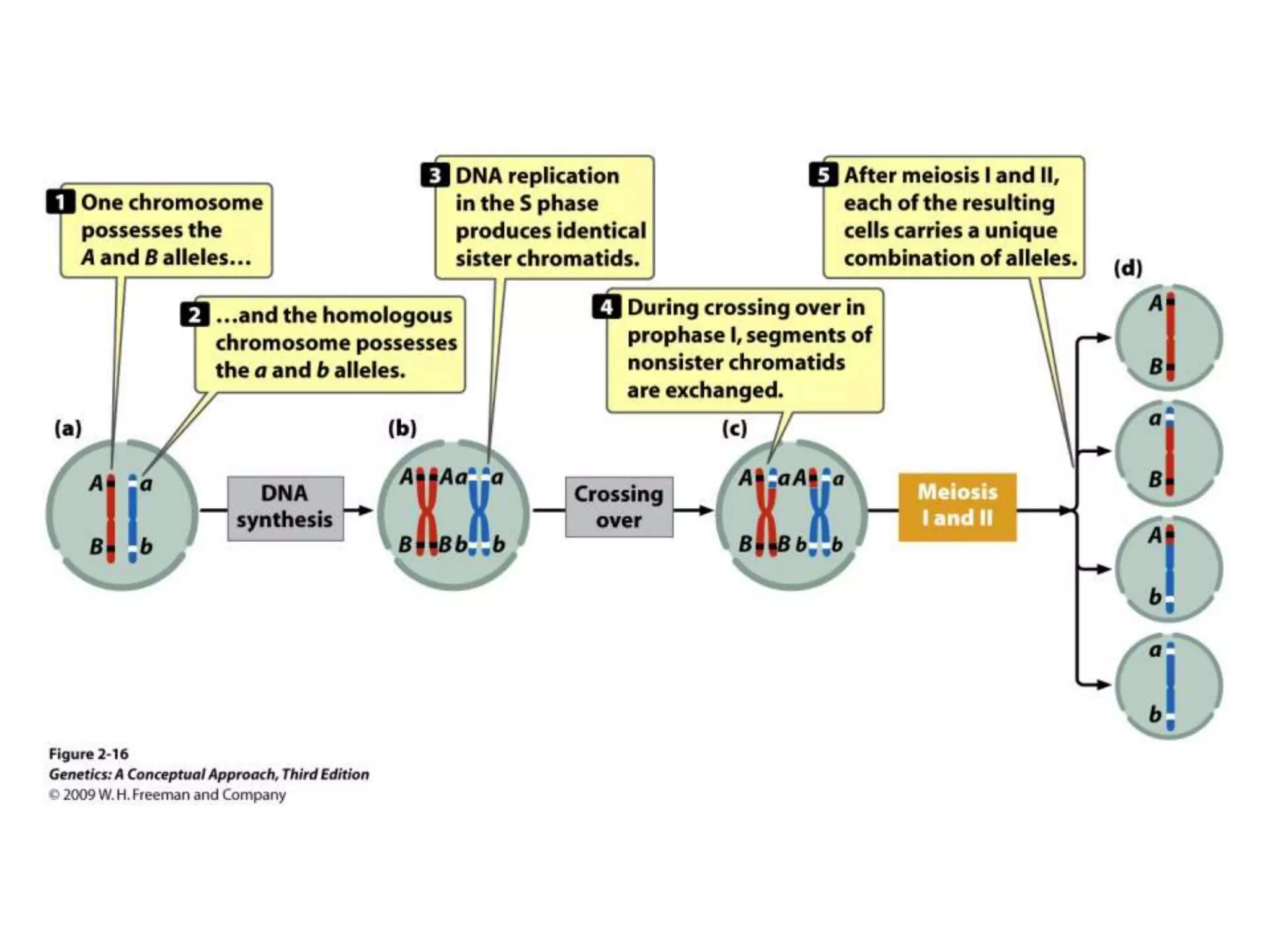
Meiosis I; Prophase I
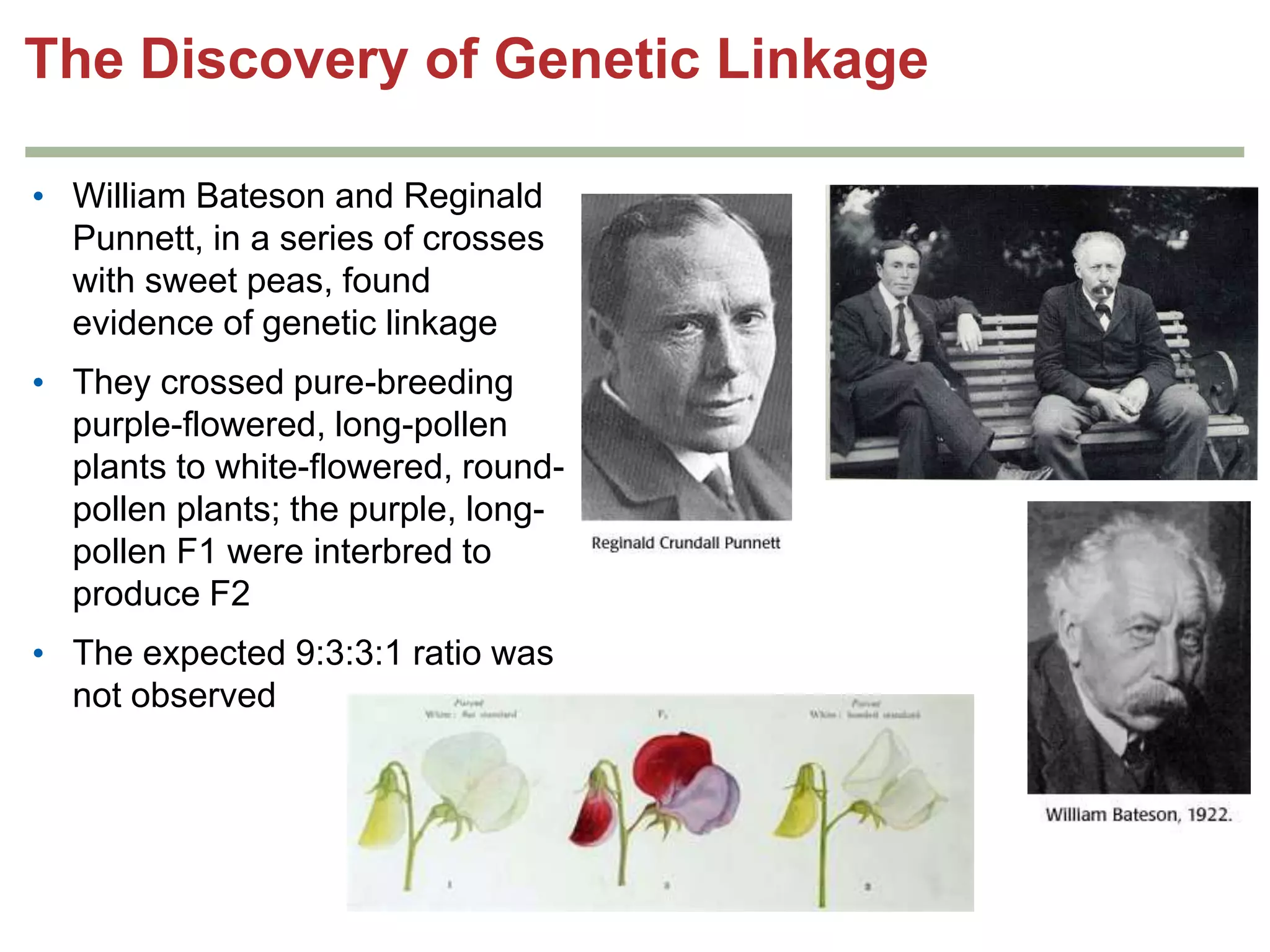
The Discovery of Genetic Linkage
• William Bateson and Reginald
Punnett, in a series of crosses
with sweet peas, found
evidence of genetic linkage
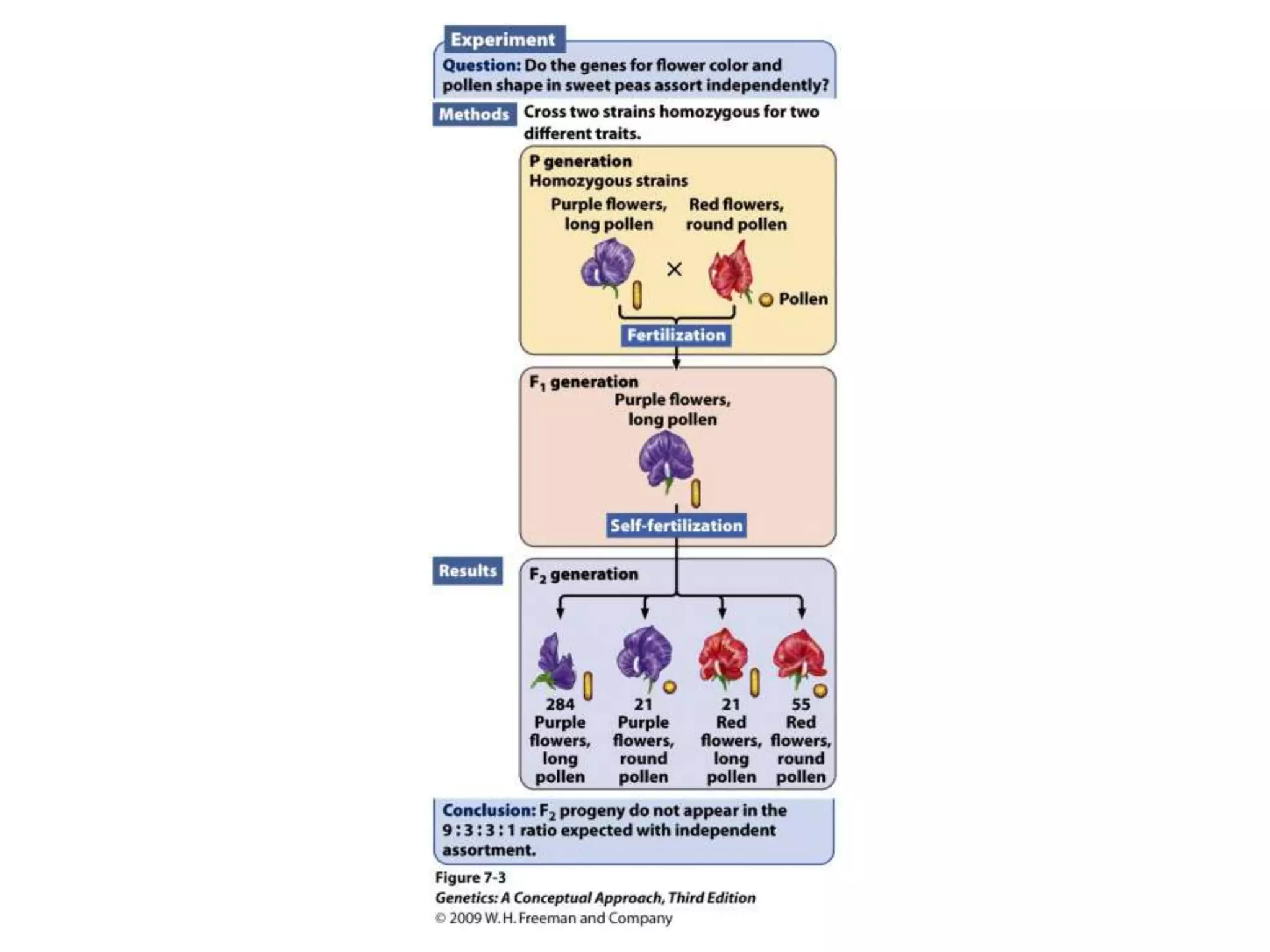
• They crossed pure-breeding
purple-flowered, long-pollen
plants to white-flowered, roundpollen plants; the purple, longpollen F1 were interbred to
produce F2
• The expected 9:3:3:1 ratio was
not observed
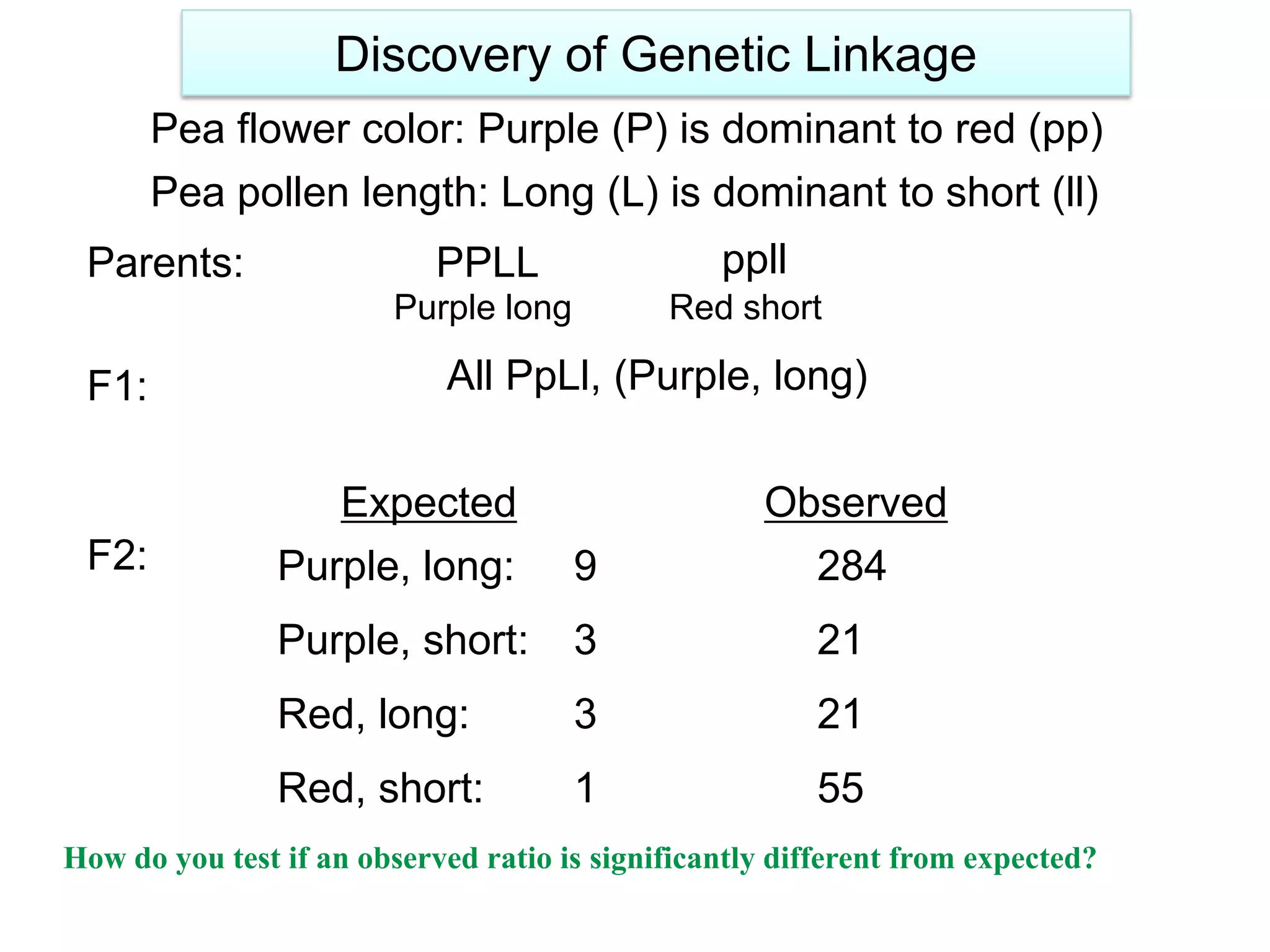
Discovery of Genetic Linkage
Pea flower color: Purple (P) is dominant to red (pp)
Pea pollen length: Long (L) is dominant to short (ll)

F1:

PPLL

ppll

Purple long

Parents:

Red short

All PpLl, (Purple, long)

9

Purple, short:

3

21

Red, long:

3

21

Red, short:

F2:

Expected
Purple, long:

Observed
284

1

55

How do you test if an observed ratio is significantly different from expected?
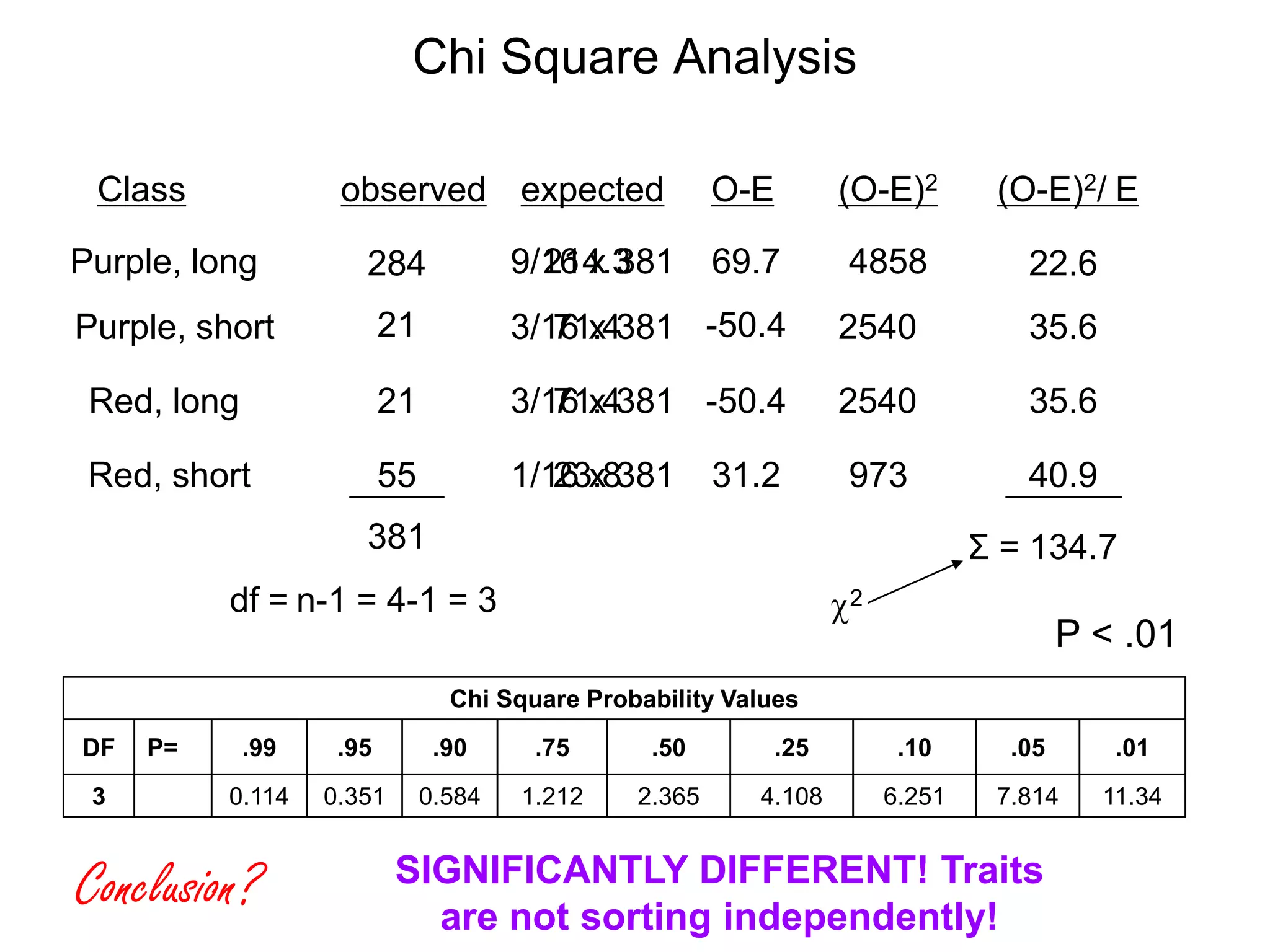
Chi Square Analysis
Class

observed expected

O-E

(O-E)2

(O-E)2/ E

Purple, long

284

9/16 x 381
214.3

69.7

4858

22.6

Purple, short

21

3/16 x 381 -50.4
71.4

2540

35.6

Red, long

21

3/16 x 381 -50.4
71.4

2540

35.6

Red, short

55

1/16 x 381
23.8

973

40.9

31.2

381

Σ = 134.7

df = n-1 = 4-1 = 3

2

P < .01
Chi Square Probability Values

DF
3

P=

.99

.95

.90

.75

.50

.25

.10

.05

.01

0.114

0.351

0.584

1.212

2.365

4.108

6.251

7.814

11.34

Conclusion?

SIGNIFICANTLY DIFFERENT! Traits
are not sorting independently!
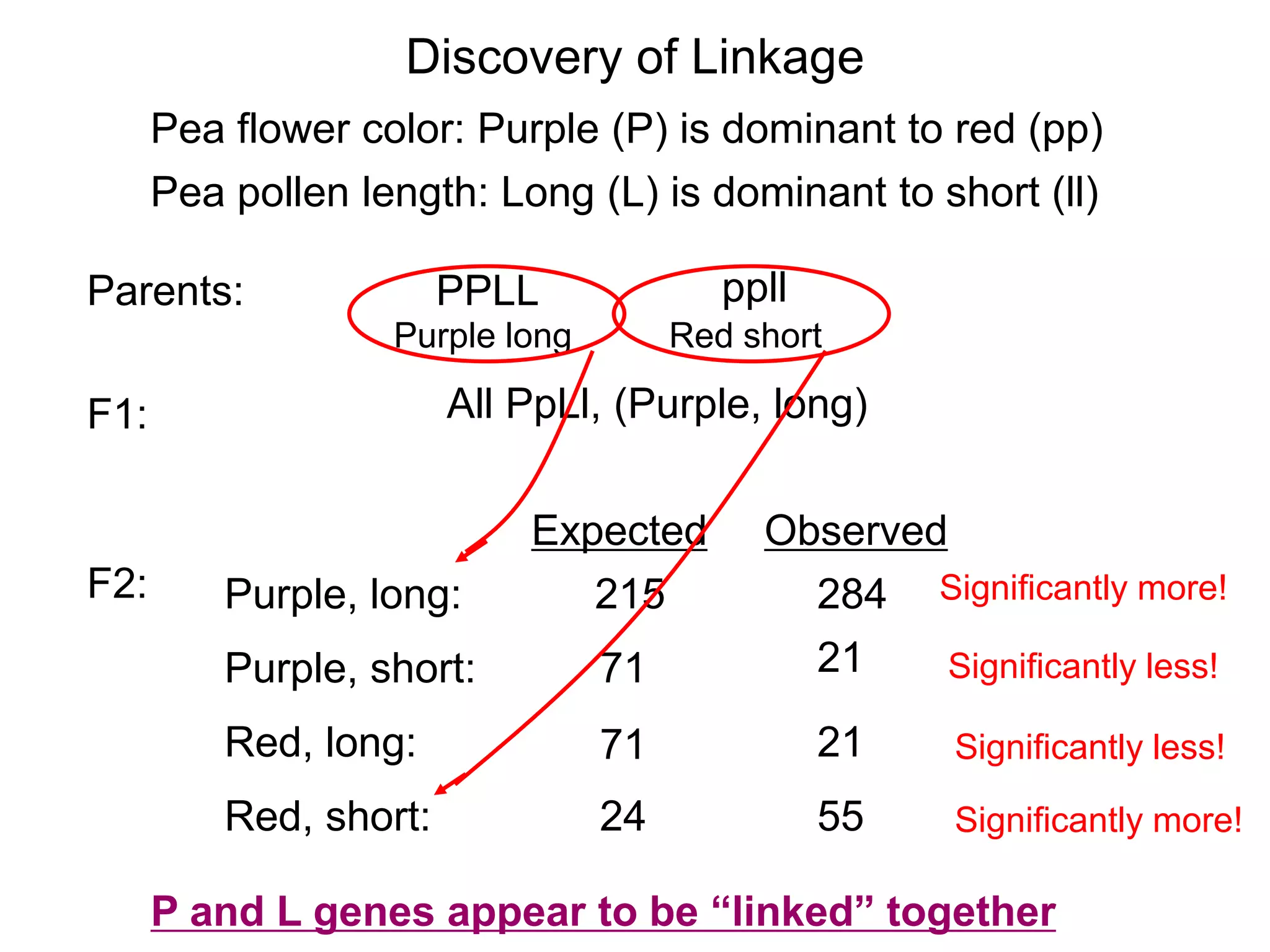
Discovery of Linkage
Pea flower color: Purple (P) is dominant to red (pp)
Pea pollen length: Long (L) is dominant to short (ll)
PPLL

ppll

Purple long

Red short

Parents:

All PpLl, (Purple, long)

F1:

F2:

Purple, long:

Expected
215

Observed
284 Significantly more!
21
Significantly less!

Purple, short:

71

Red, long:

71

21

Significantly less!

Red, short:

24

55

Significantly more!

P and L genes appear to be “linked” together
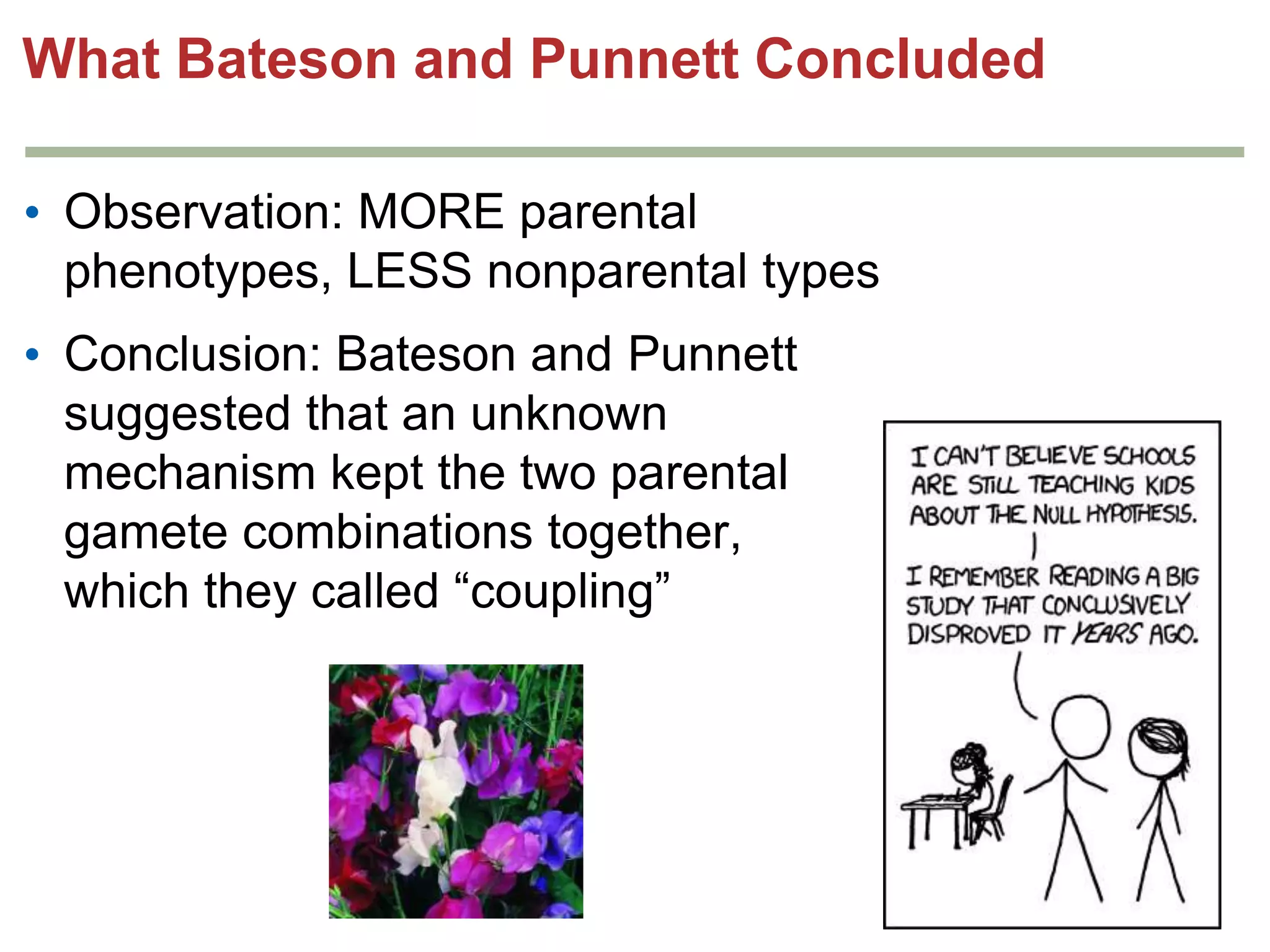
What Bateson and Punnett Concluded
• Observation: MORE parental
phenotypes, LESS nonparental types
• Conclusion: Bateson and Punnett
suggested that an unknown
mechanism kept the two parental
gamete combinations together,
which they called “coupling”
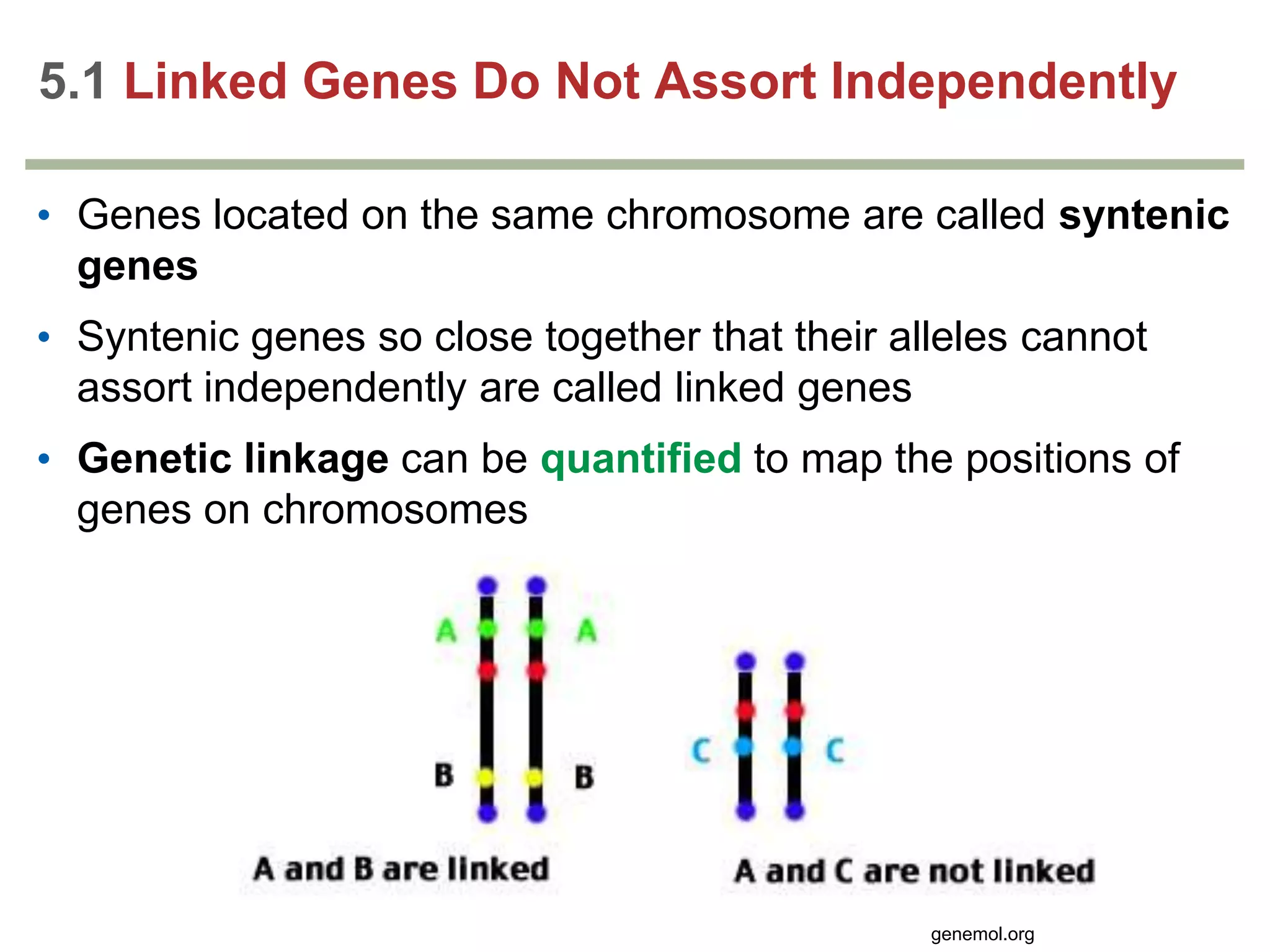
5.1 Linked Genes Do Not Assort Independently
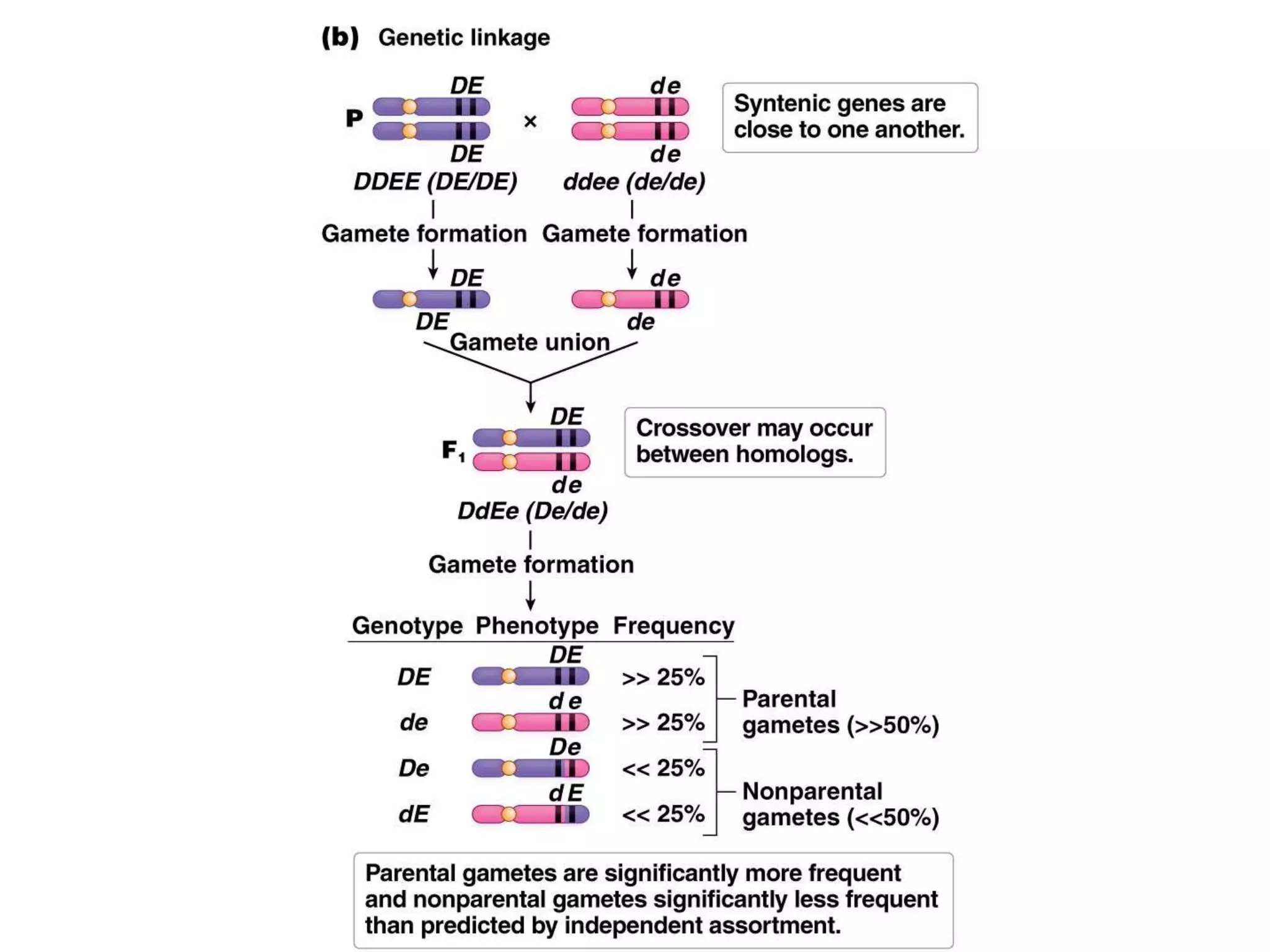
• Genes located on the same chromosome are called syntenic
genes
• Syntenic genes so close together that their alleles cannot
assort independently are called linked genes
• Genetic linkage can be quantified to map the positions of
genes on chromosomes

genemol.org
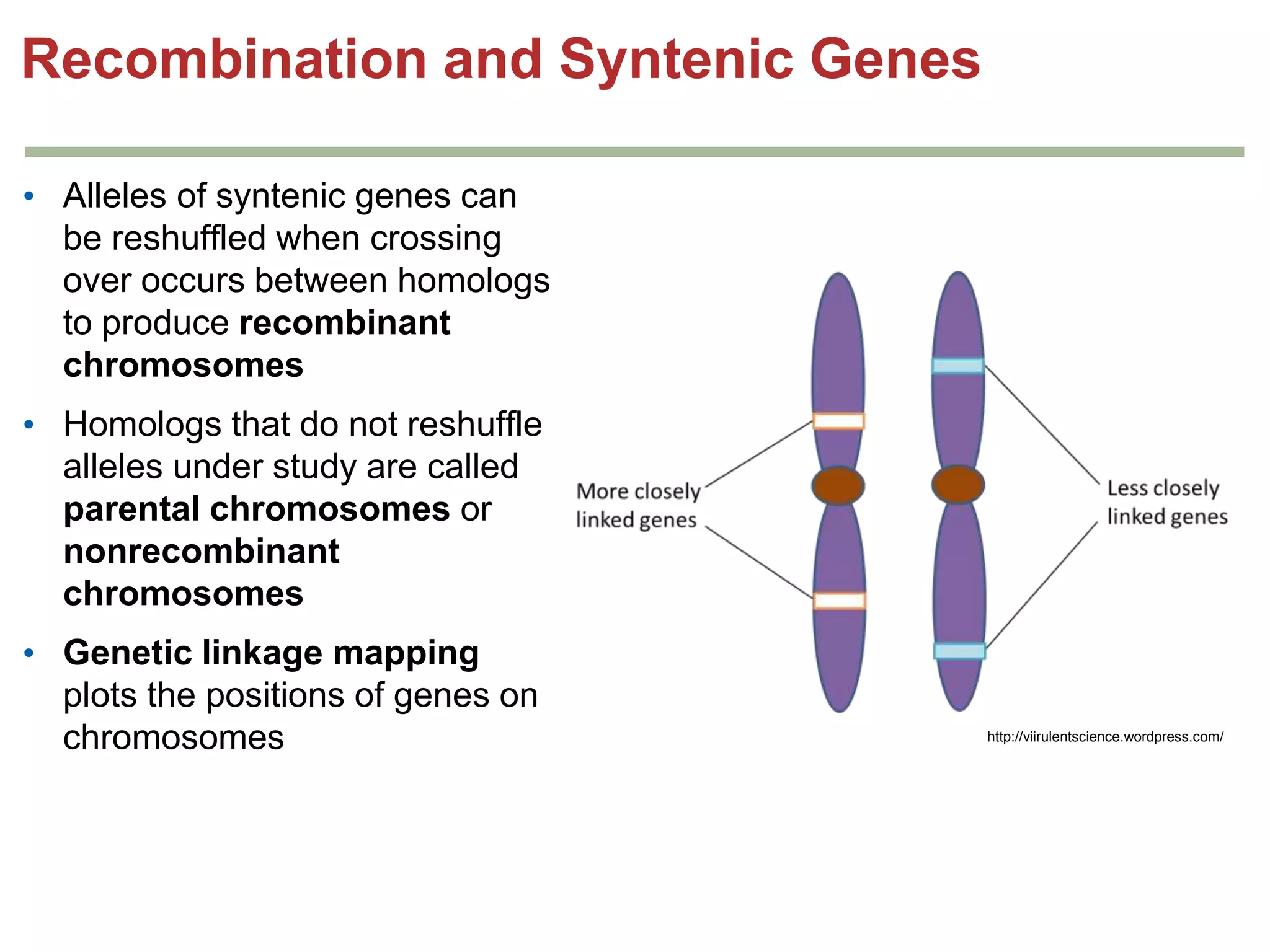
Recombination and Syntenic Genes
• Alleles of syntenic genes can
be reshuffled when crossing
over occurs between homologs
to produce recombinant
chromosomes
• Homologs that do not reshuffle
alleles under study are called
parental chromosomes or
nonrecombinant
chromosomes
• Genetic linkage mapping
plots the positions of genes on
chromosomes

http://viirulentscience.wordpress.com/
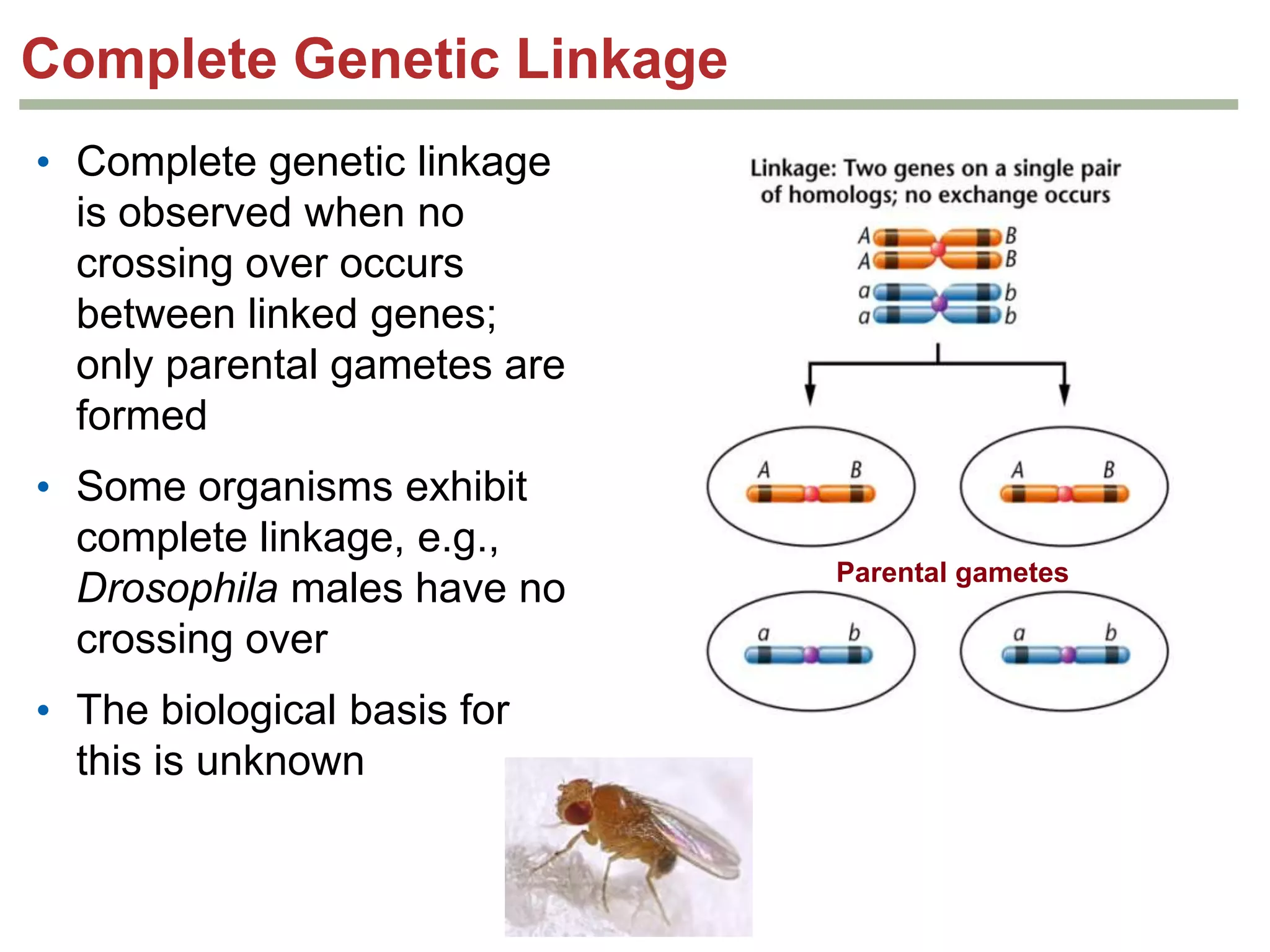
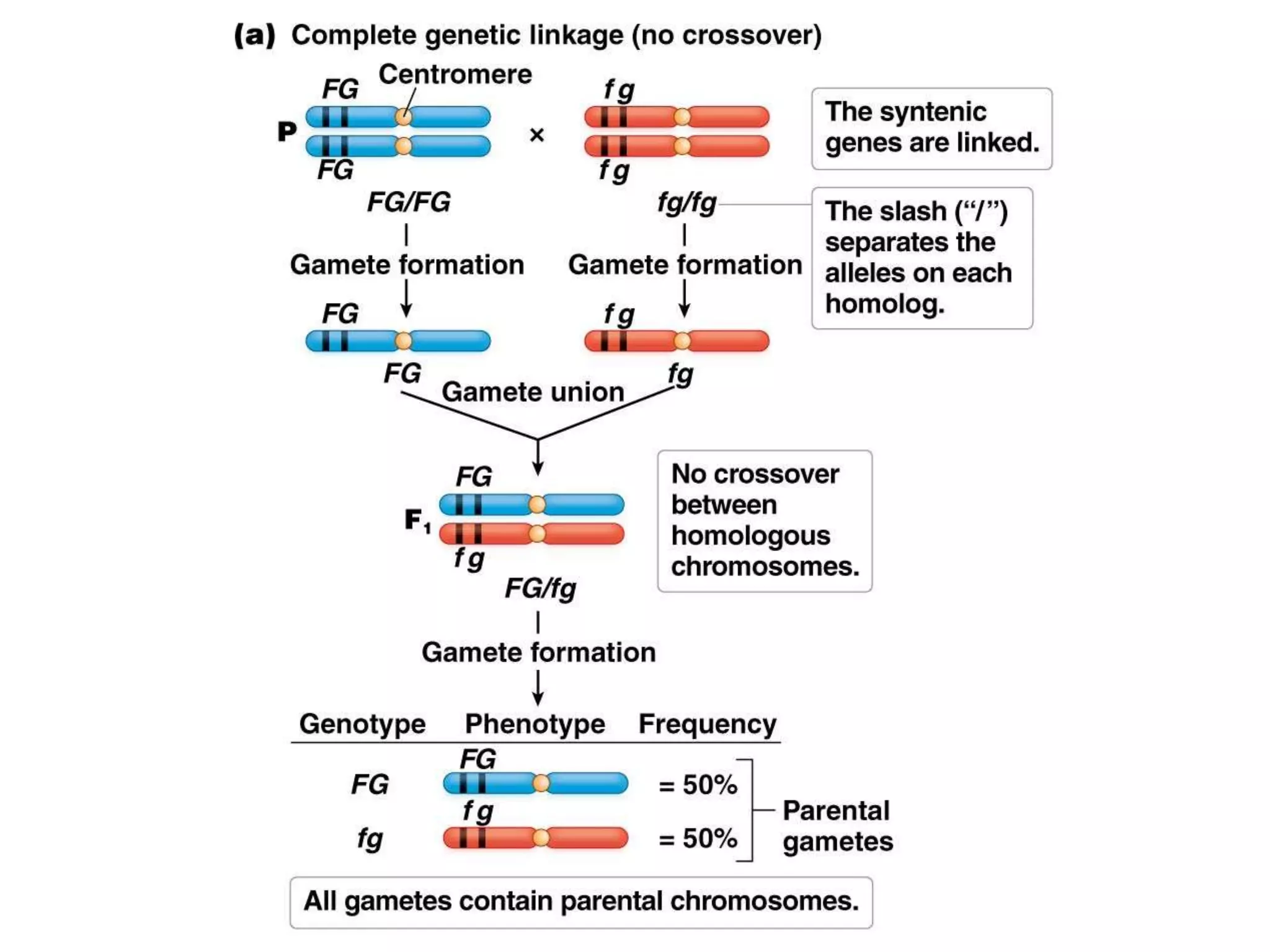
Complete Genetic Linkage
• Complete genetic linkage
is observed when no
crossing over occurs
between linked genes;
only parental gametes are
formed
• Some organisms exhibit
complete linkage, e.g.,
Drosophila males have no
crossing over
• The biological basis for
this is unknown

Parental gametes
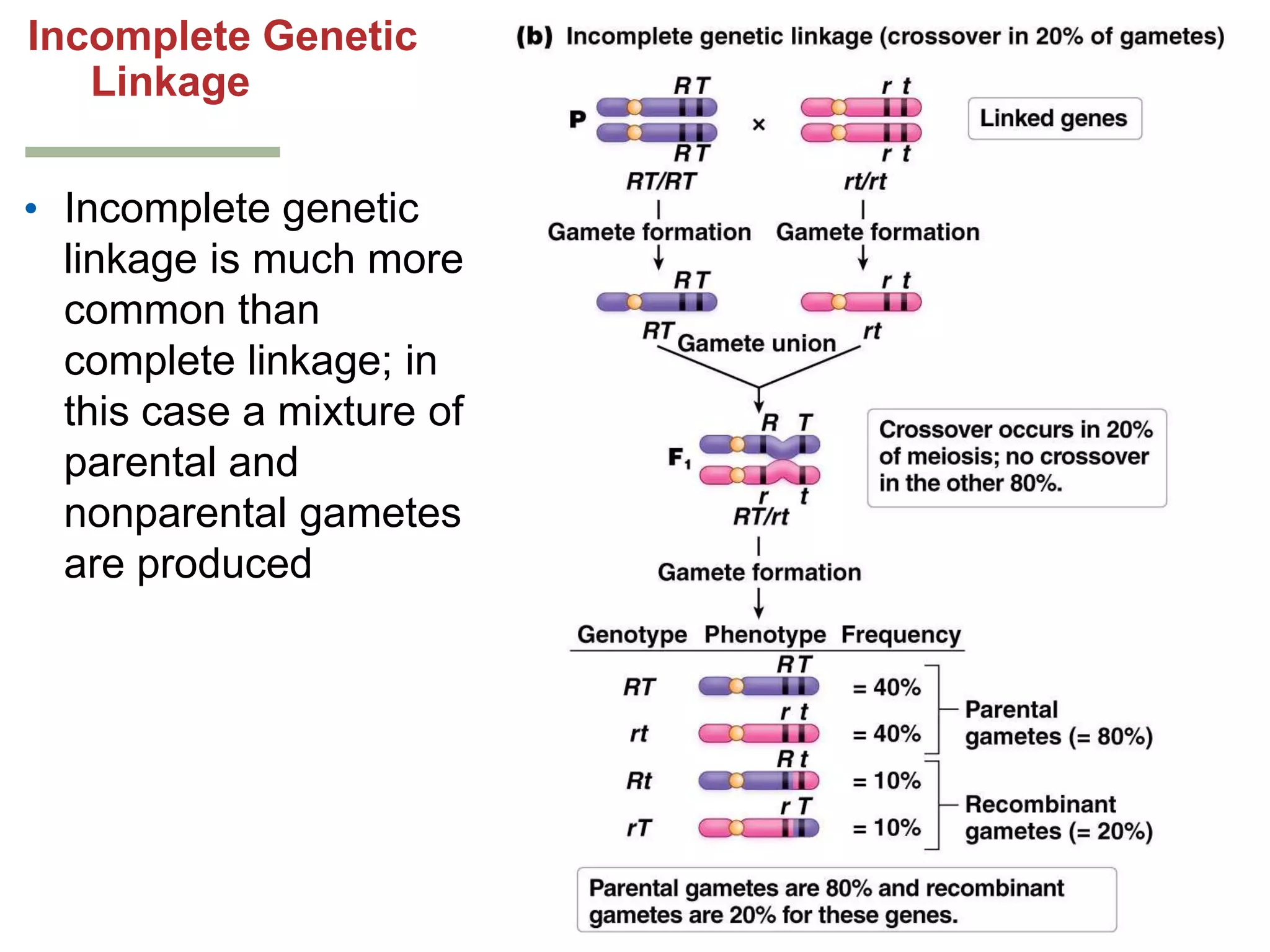
Incomplete Genetic
Linkage
• Incomplete genetic
linkage is much more
common than
complete linkage; in
this case a mixture of
parental and
nonparental gametes
are produced
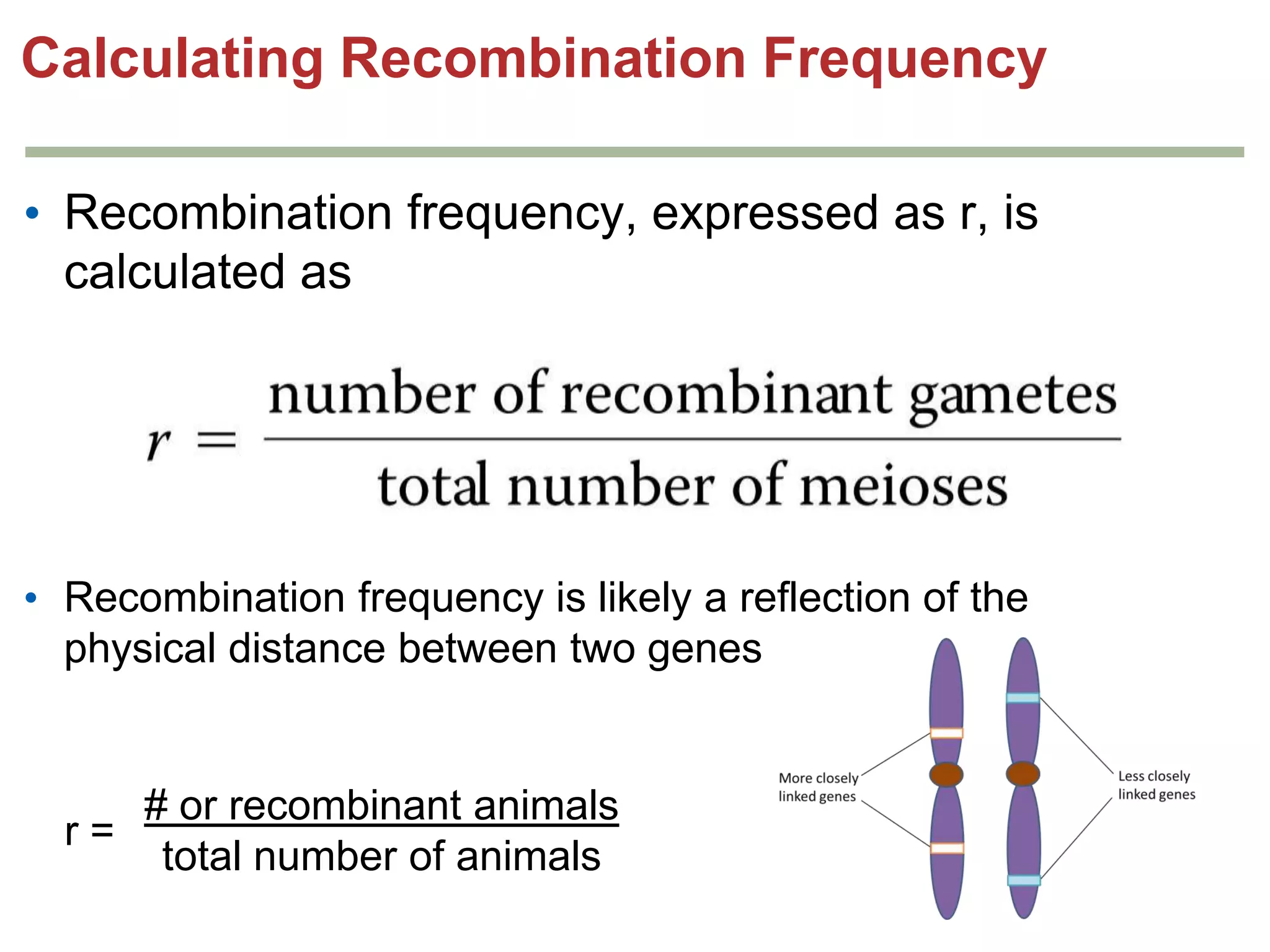
Calculating Recombination Frequency
• Recombination frequency, expressed as r, is
calculated as

• Recombination frequency is likely a reflection of the
physical distance between two genes

r=

# or recombinant animals
total number of animals
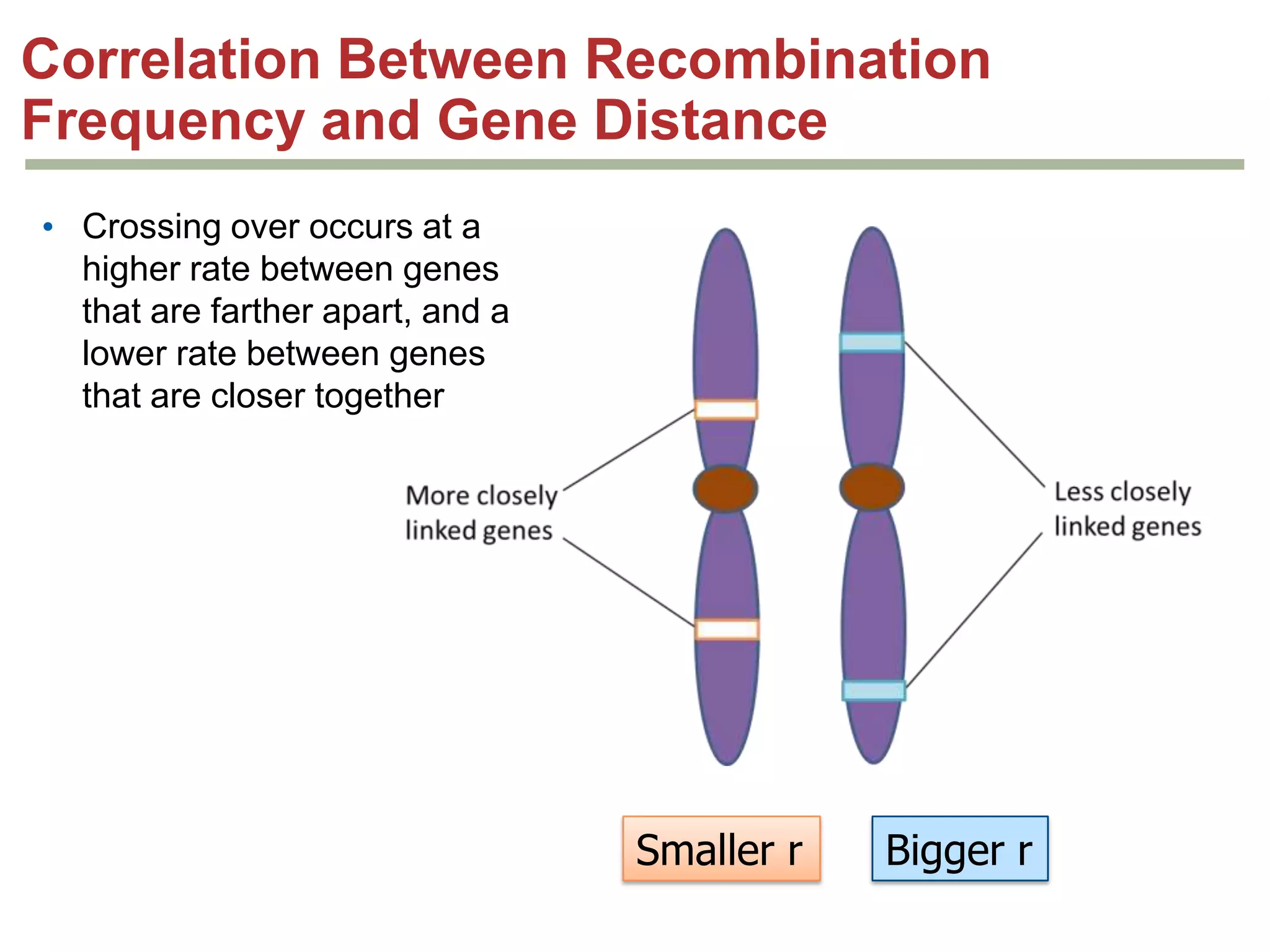
Correlation Between Recombination
Frequency and Gene Distance
• Crossing over occurs at a
higher rate between genes
that are farther apart, and a
lower rate between genes
that are closer together

Smaller r

Bigger r
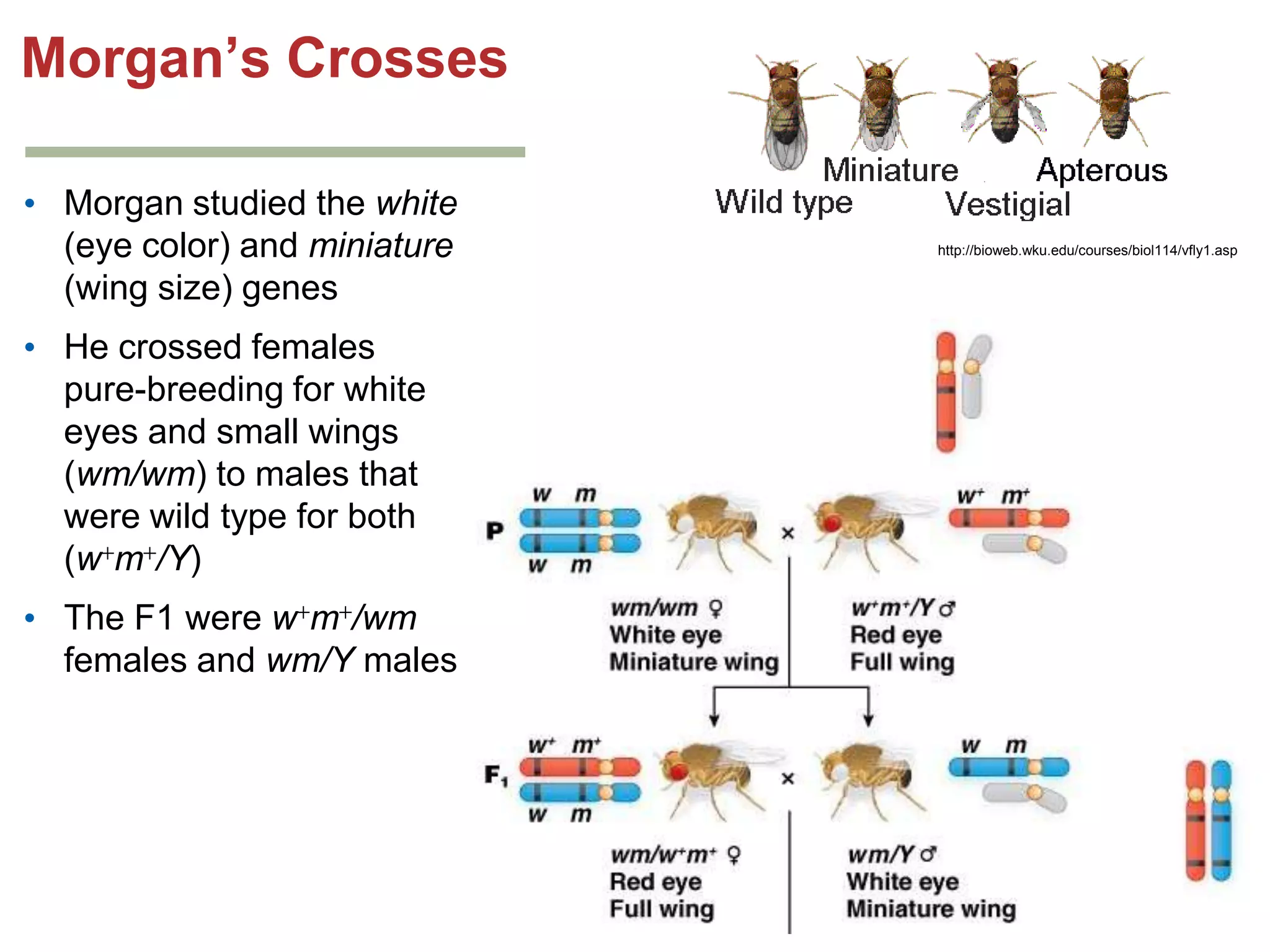
Morgan’s Crosses
• Morgan studied the white
(eye color) and miniature
(wing size) genes
• He crossed females
pure-breeding for white
eyes and small wings
(wm/wm) to males that
were wild type for both
(w m /Y)
• The F1 were w m /wm
females and wm/Y males

http://bioweb.wku.edu/courses/biol114/vfly1.asp
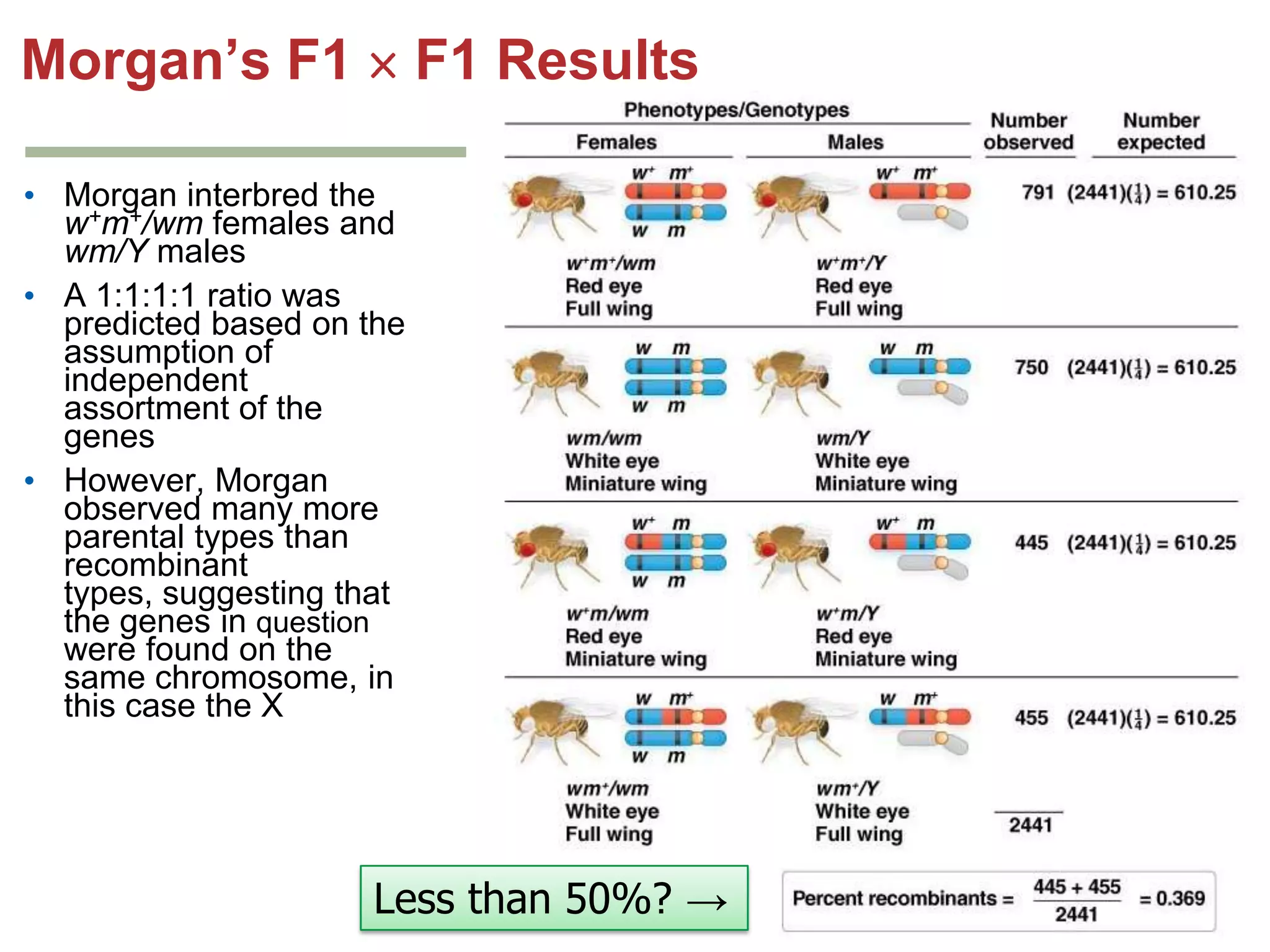
Morgan’s F1

F1 Results

• Morgan interbred the
w+m+/wm females and
wm/Y males
• A 1:1:1:1 ratio was
predicted based on the
assumption of
independent
assortment of the
genes
• However, Morgan
observed many more
parental types than
recombinant
types, suggesting that
the genes in question
were found on the
same chromosome, in
this case the X

Less than 50%? →
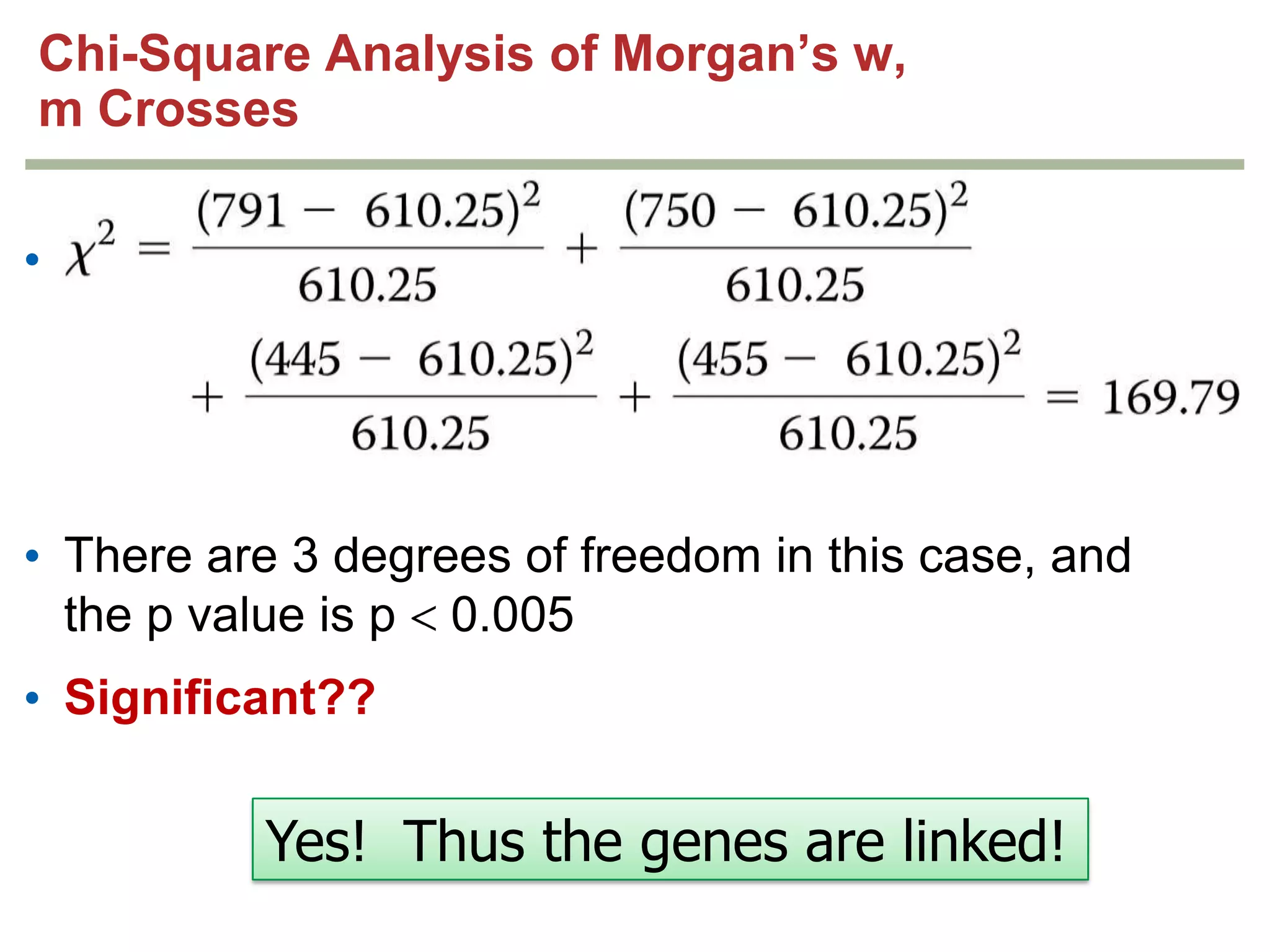
Chi-Square Analysis of Morgan’s w,
m Crosses
•

• There are 3 degrees of freedom in this case, and
the p value is p 0.005
• Significant??

Yes! Thus the genes are linked!
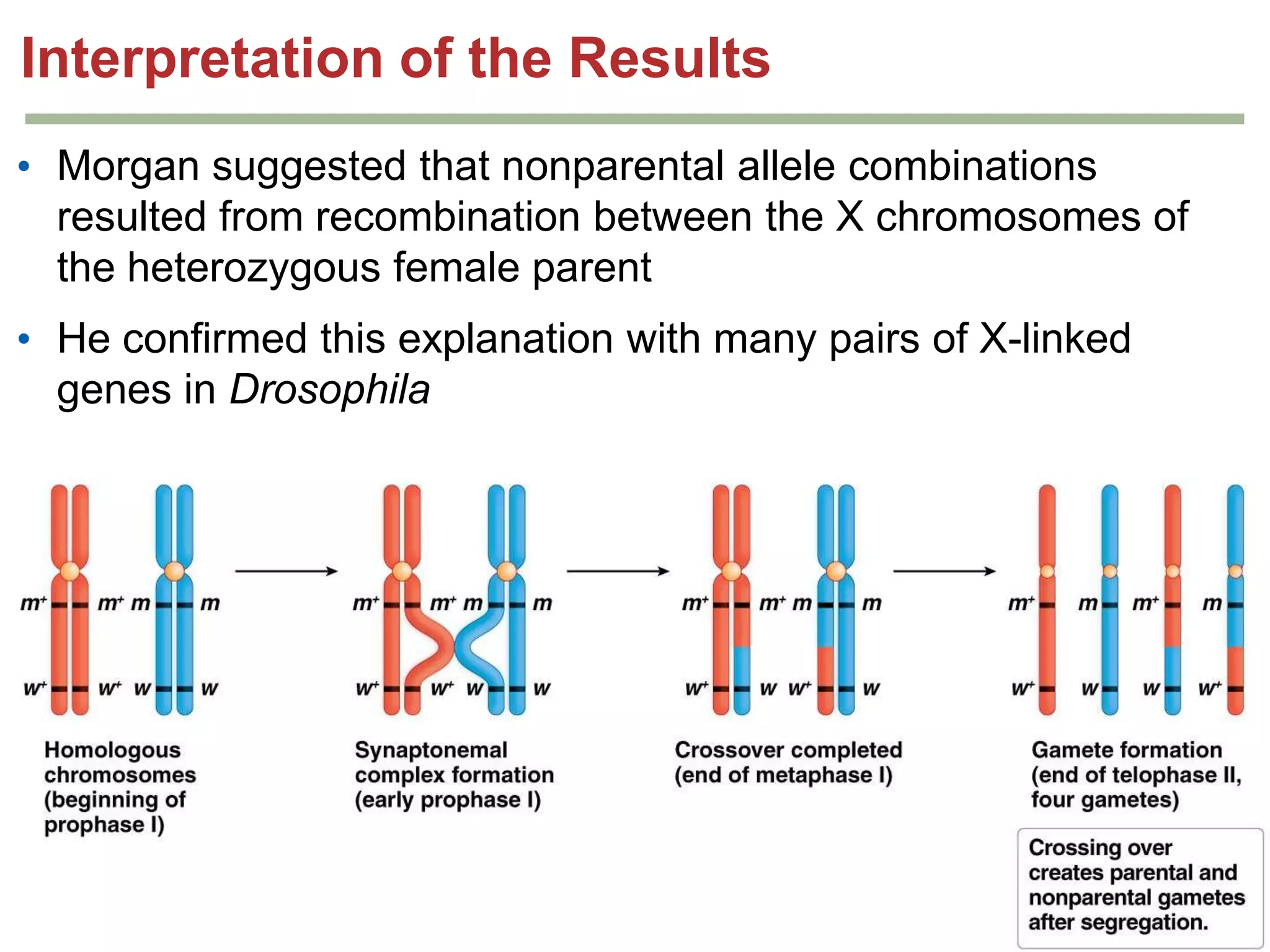
Interpretation of the Results
• Morgan suggested that nonparental allele combinations
resulted from recombination between the X chromosomes of
the heterozygous female parent

• He confirmed this explanation with many pairs of X-linked
genes in Drosophila

Genetics Analysis: An Integrated Approach

Copyright © 2012 Pearson Education Inc.
Detecting Autosomal Genetic Linkage
Through Test-Cross Analysis
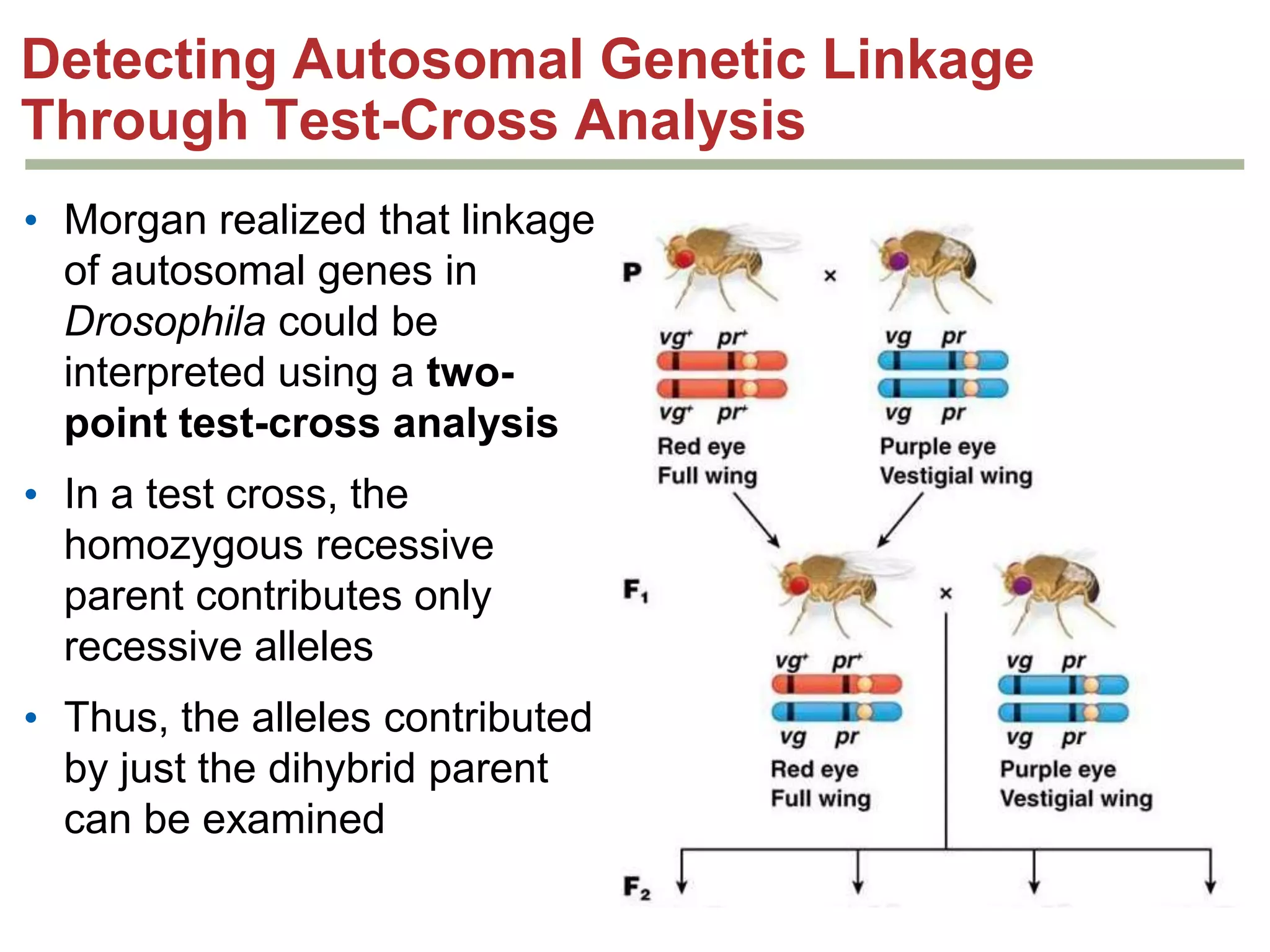
• Morgan realized that linkage
of autosomal genes in
Drosophila could be
interpreted using a twopoint test-cross analysis
• In a test cross, the
homozygous recessive
parent contributes only
recessive alleles
• Thus, the alleles contributed
by just the dihybrid parent
can be examined
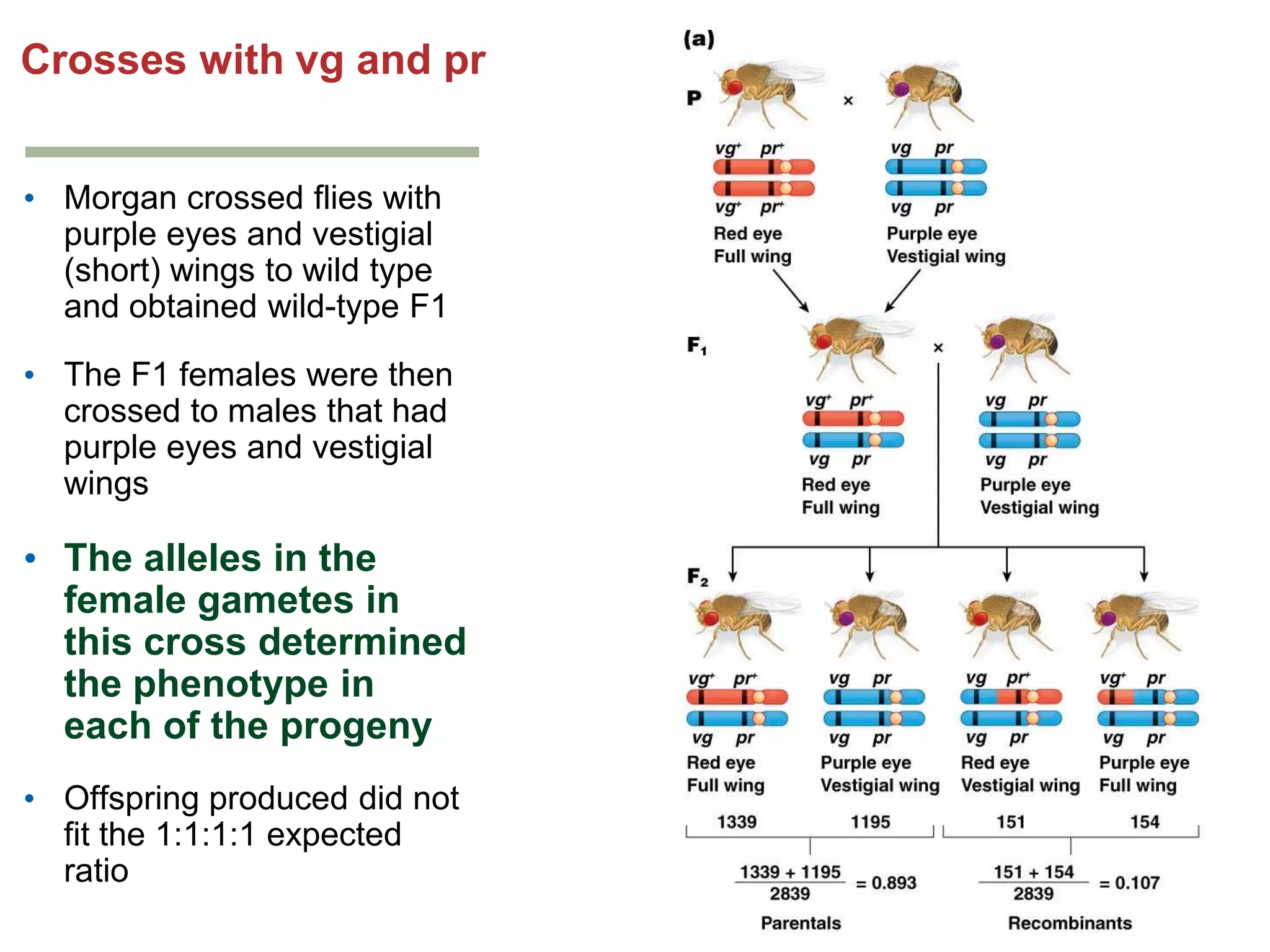
Crosses with vg and pr
• Morgan crossed flies with
purple eyes and vestigial
(short) wings to wild type
and obtained wild-type F1
• The F1 females were then
crossed to males that had
purple eyes and vestigial
wings

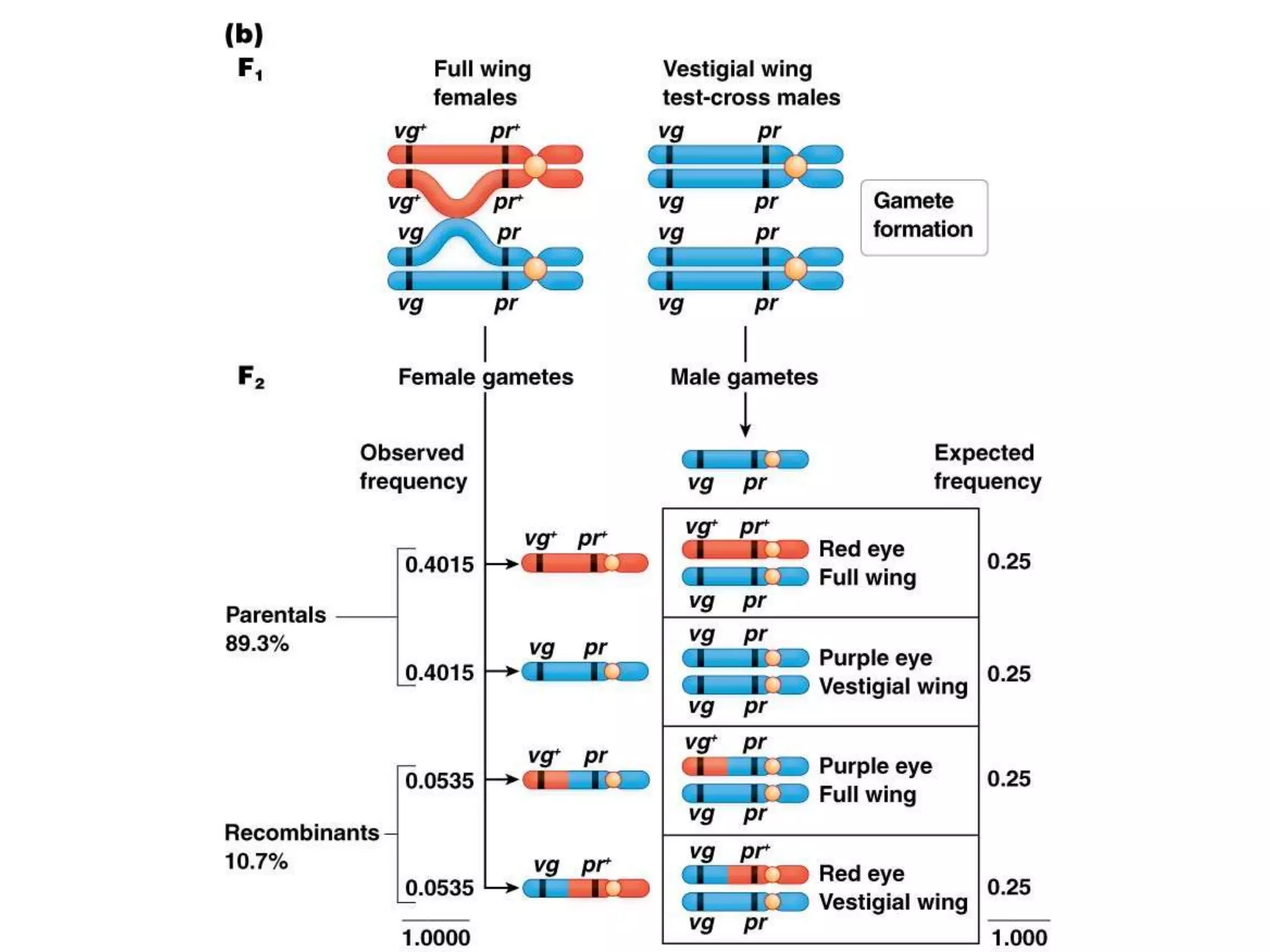
• The alleles in the
female gametes in
this cross determined
the phenotype in
each of the progeny
• Offspring produced did not
fit the 1:1:1:1 expected
ratio
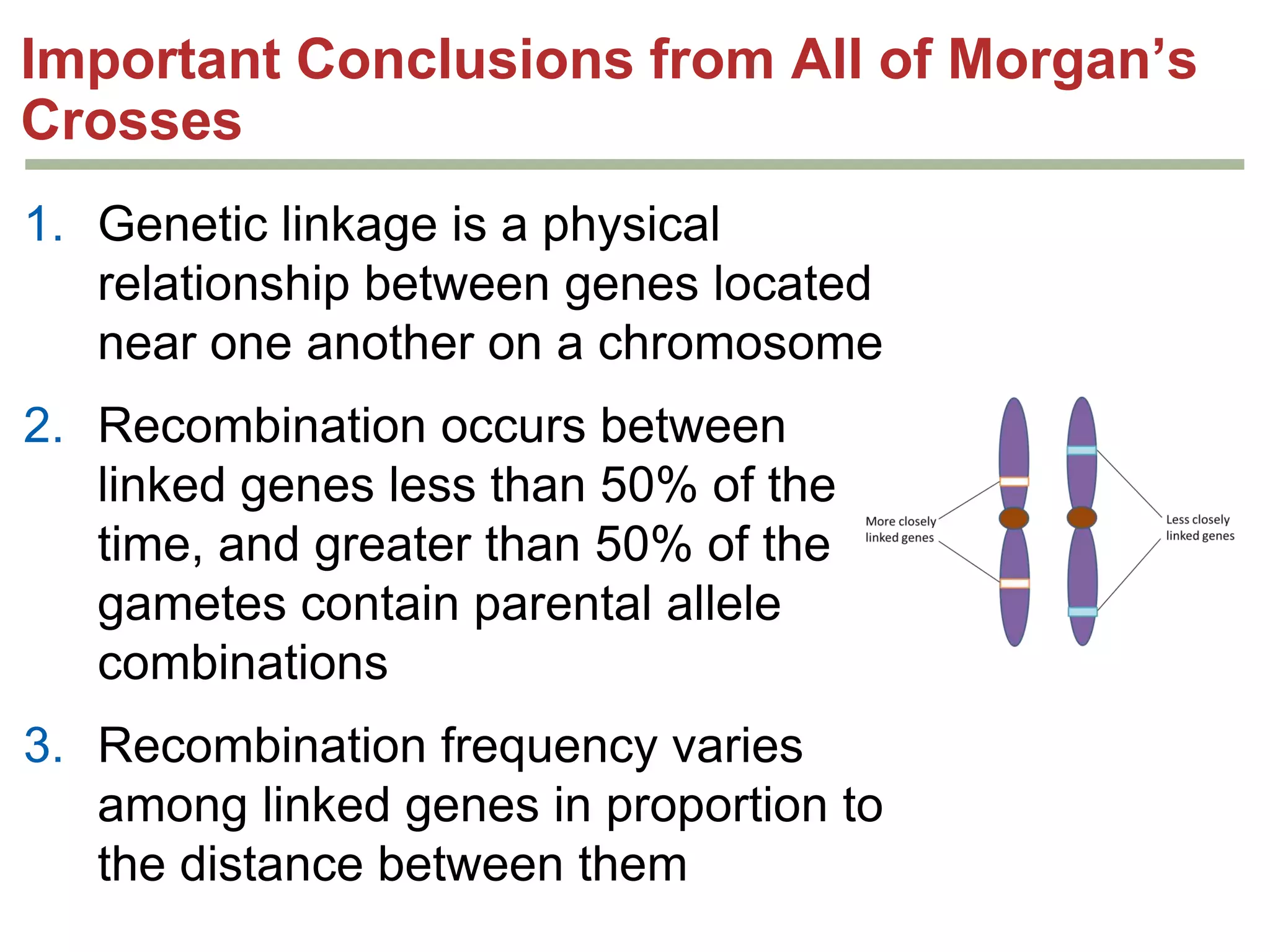
Important Conclusions from All of Morgan’s
Crosses
1. Genetic linkage is a physical
relationship between genes located
near one another on a chromosome
2. Recombination occurs between
linked genes less than 50% of the
time, and greater than 50% of the
gametes contain parental allele
combinations

3. Recombination frequency varies
among linked genes in proportion to
the distance between them
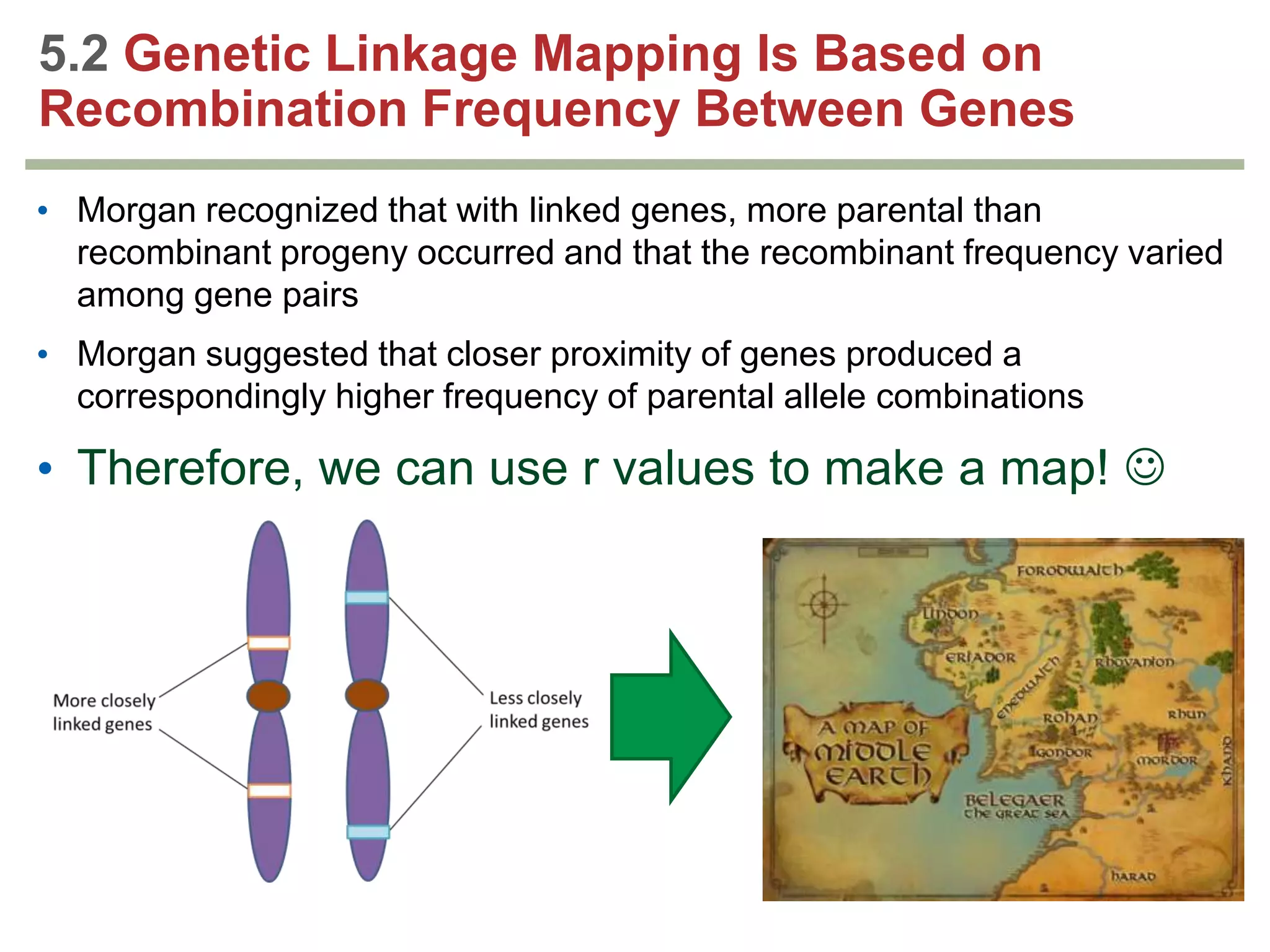
5.2 Genetic Linkage Mapping Is Based on
Recombination Frequency Between Genes
• Morgan recognized that with linked genes, more parental than
recombinant progeny occurred and that the recombinant frequency varied
among gene pairs
• Morgan suggested that closer proximity of genes produced a
correspondingly higher frequency of parental allele combinations

• Therefore, we can use r values to make a map! 
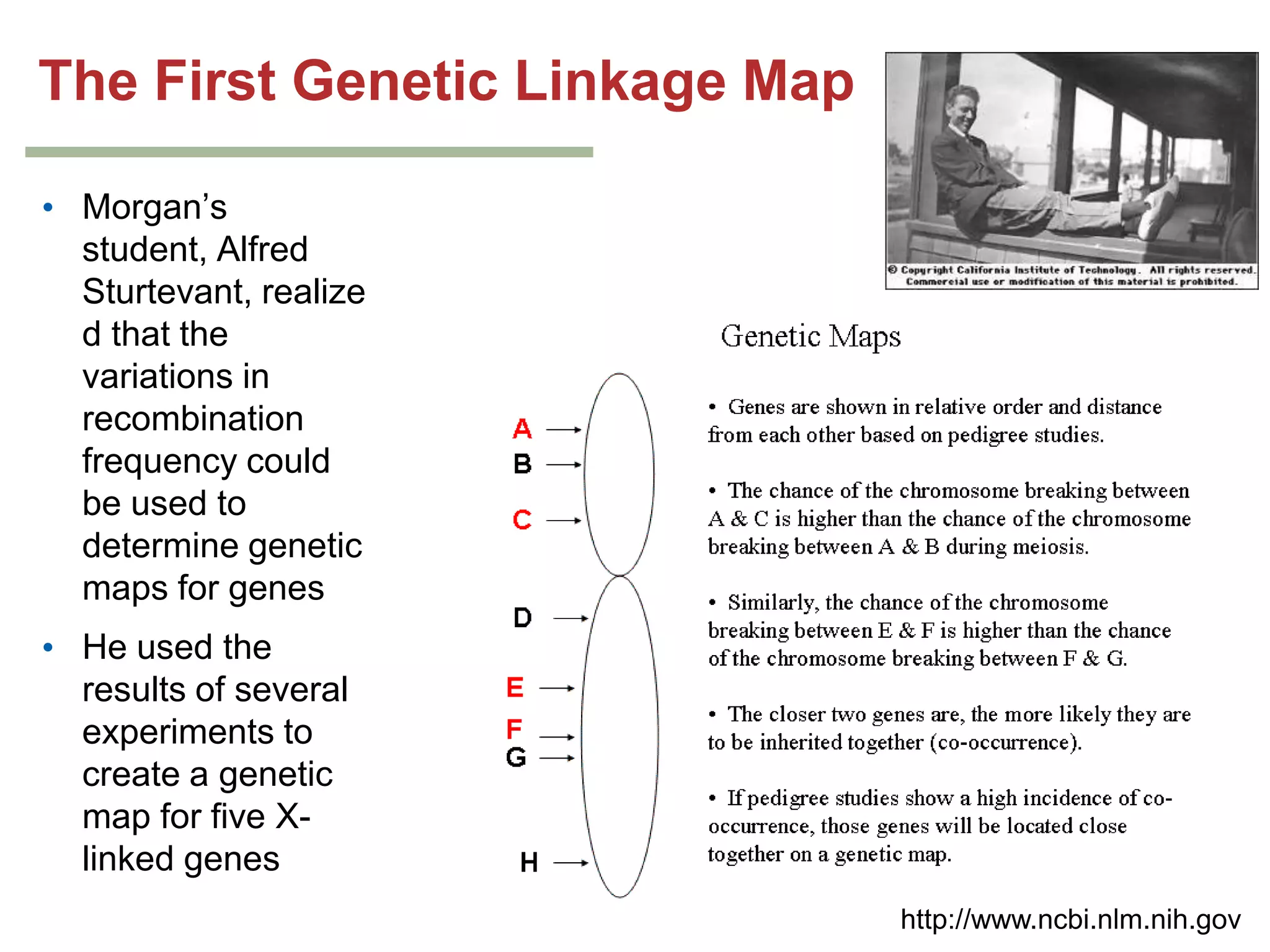
The First Genetic Linkage Map
• Morgan’s
student, Alfred
Sturtevant, realize
d that the
variations in
recombination
frequency could
be used to
determine genetic
maps for genes
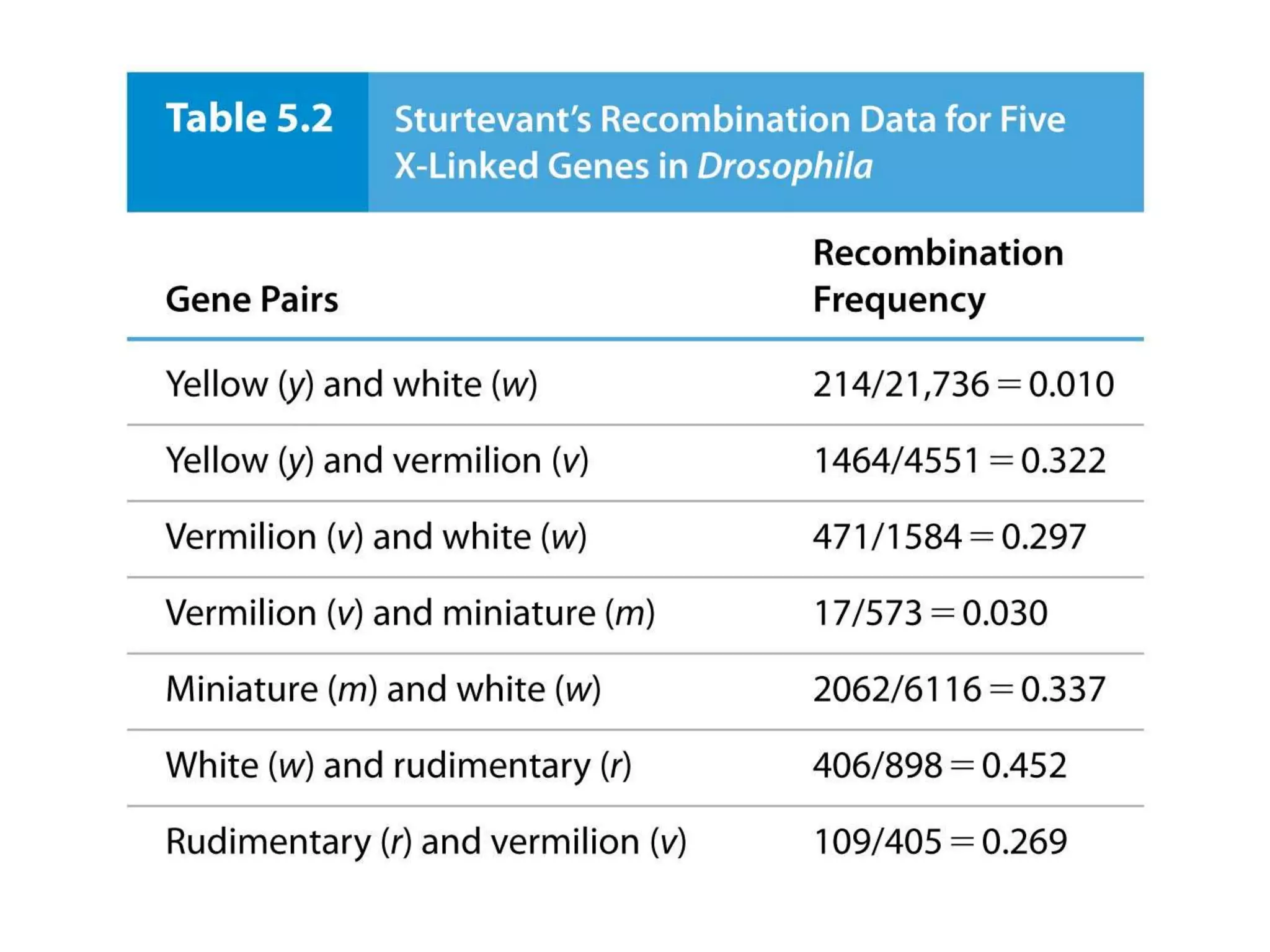
• He used the
results of several
experiments to
create a genetic
map for five Xlinked genes
http://www.ncbi.nlm.nih.gov
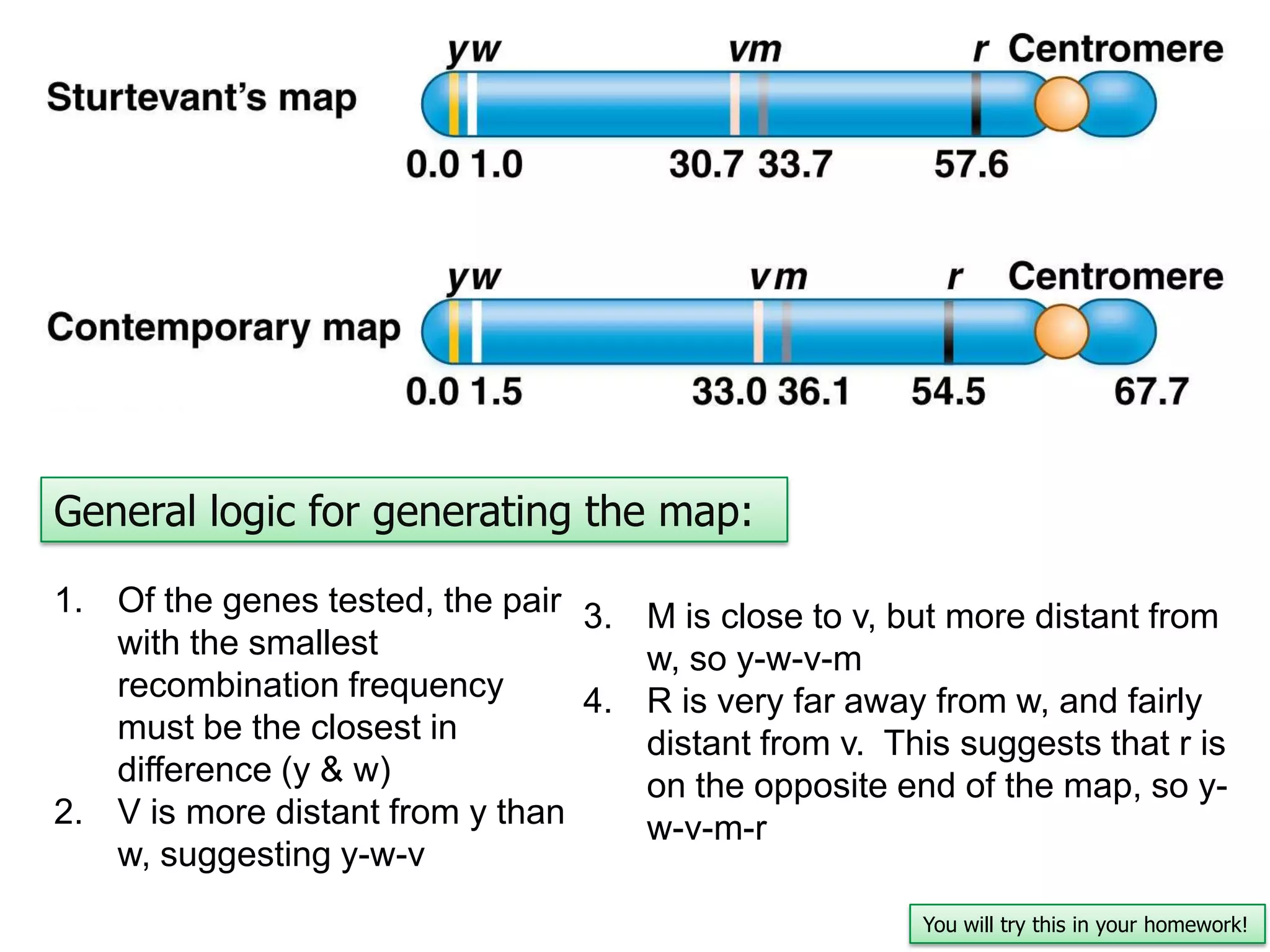
General logic for generating the map:
1. Of the genes tested, the pair 3. M is close to v, but more distant from
with the smallest
w, so y-w-v-m
recombination frequency
4. R is very far away from w, and fairly
must be the closest in
distant from v. This suggests that r is
difference (y & w)
on the opposite end of the map, so y2. V is more distant from y than
w-v-m-r
w, suggesting y-w-v
You will try this in your homework!
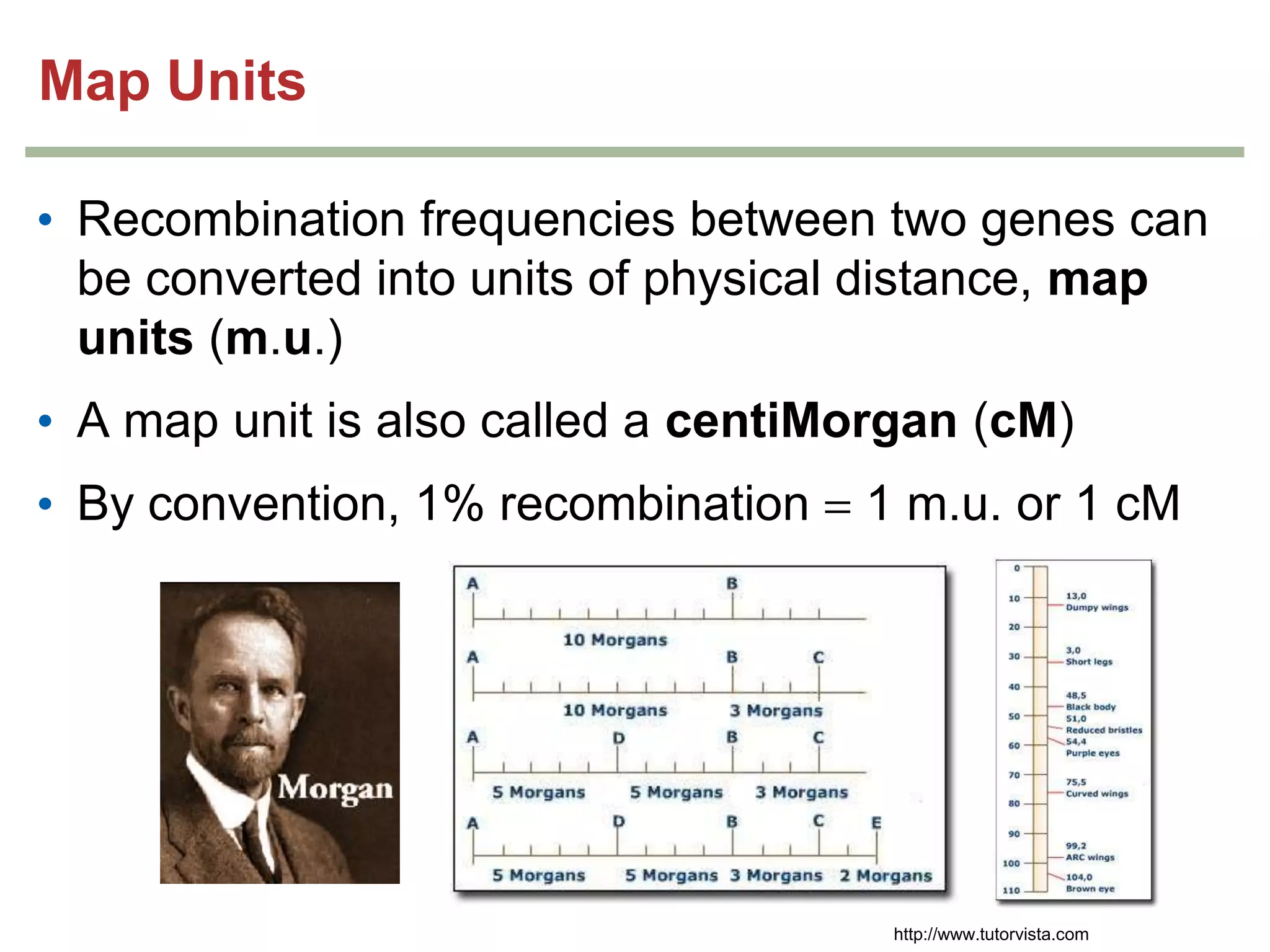
Map Units
• Recombination frequencies between two genes can
be converted into units of physical distance, map
units (m.u.)
• A map unit is also called a centiMorgan (cM)

• By convention, 1% recombination

1 m.u. or 1 cM

http://www.tutorvista.com
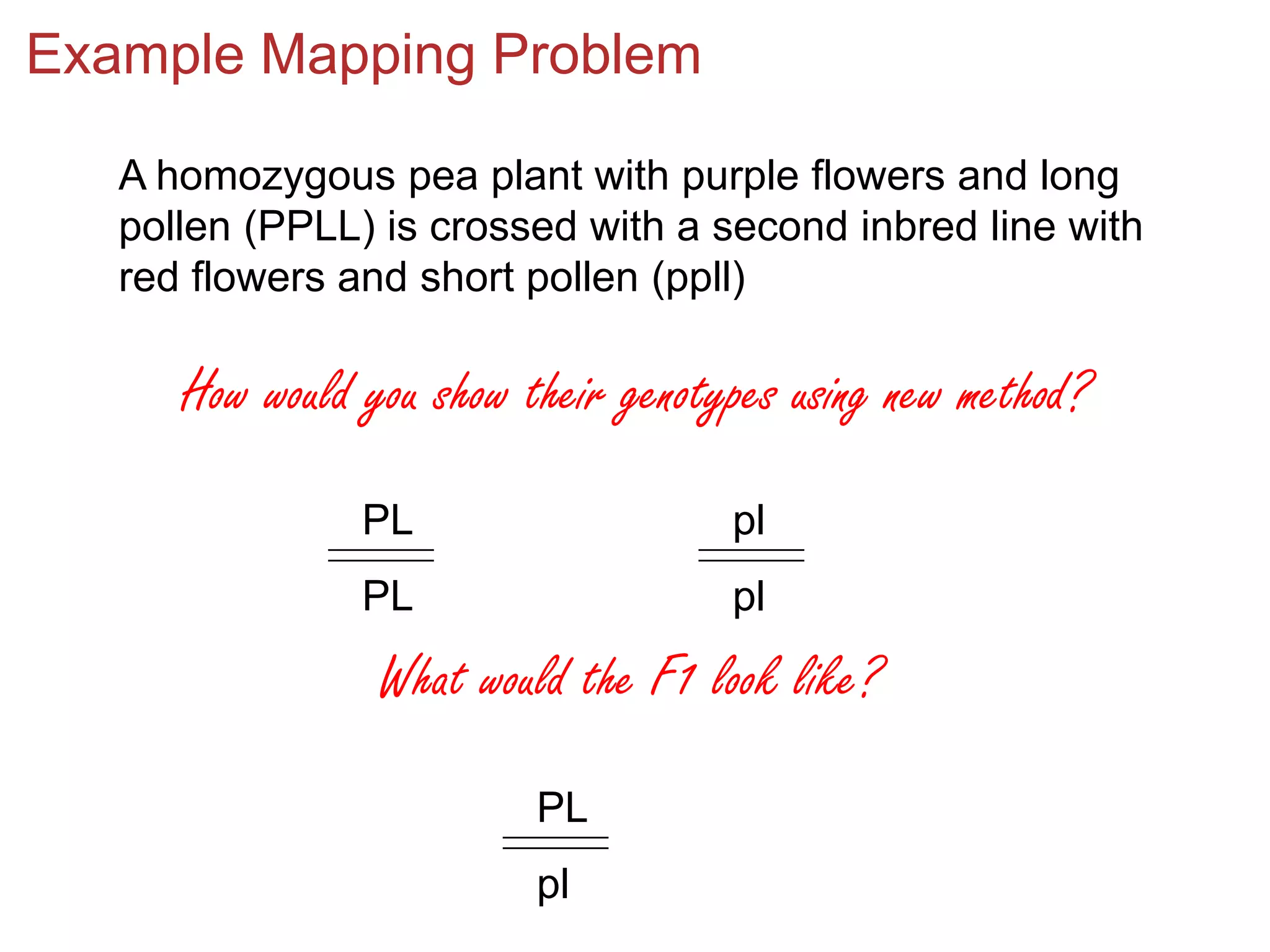
Example Mapping Problem
A homozygous pea plant with purple flowers and long
pollen (PPLL) is crossed with a second inbred line with
red flowers and short pollen (ppll)

How would you show their genotypes using new method?
PL

pl

PL

pl

What would the F1 look like?
PL
pl
Example Mapping Problem, Cont’
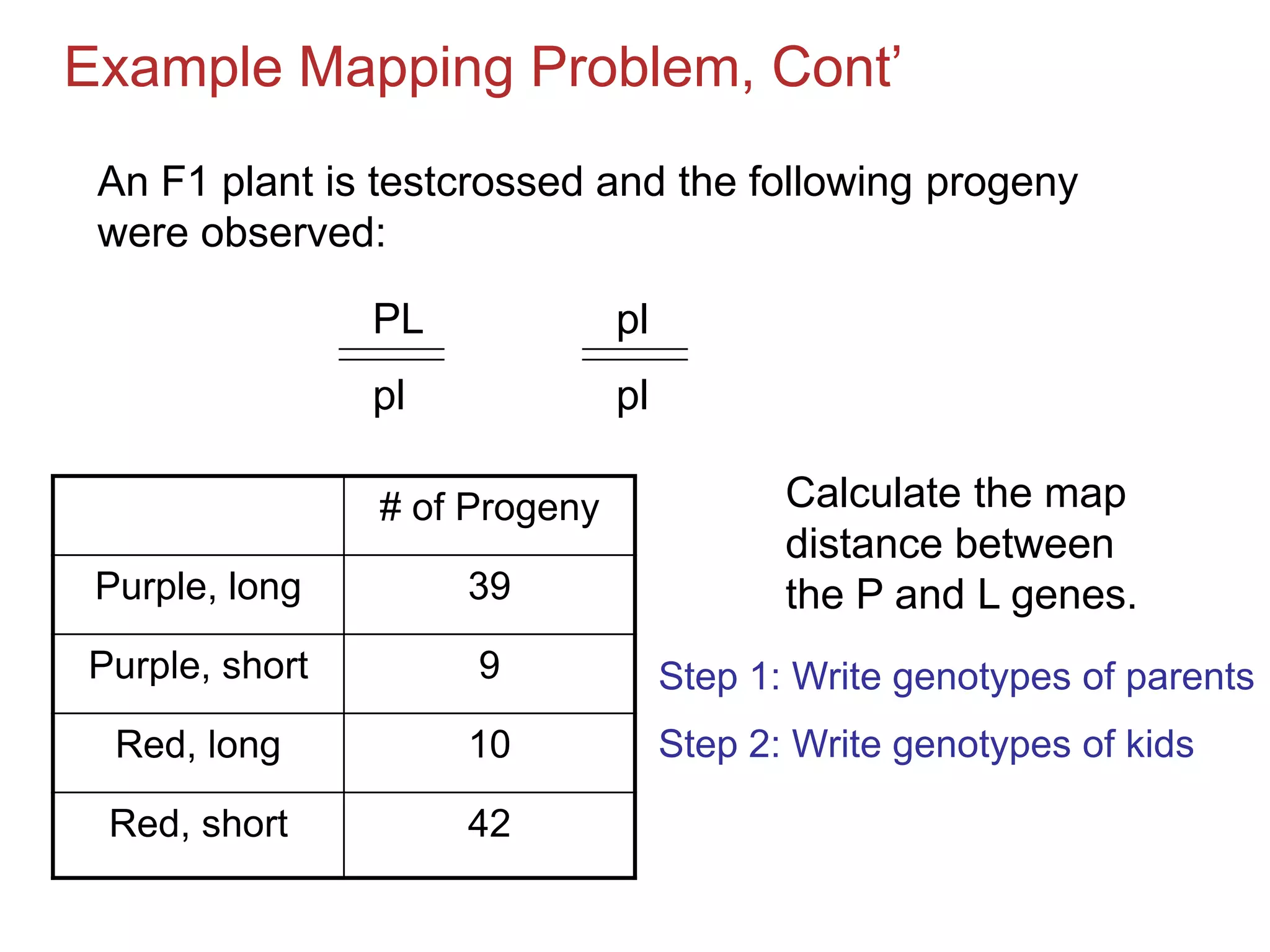
An F1 plant is testcrossed and the following progeny
were observed:

PL

pl

pl

pl

Purple, long

39

Calculate the map
distance between
the P and L genes.

Purple, short

9

Step 1: Write genotypes of parents

Red, long

10

Step 2: Write genotypes of kids

Red, short

42

# of Progeny
Example Mapping Problem, Cont’
PL

pl

pl

pl

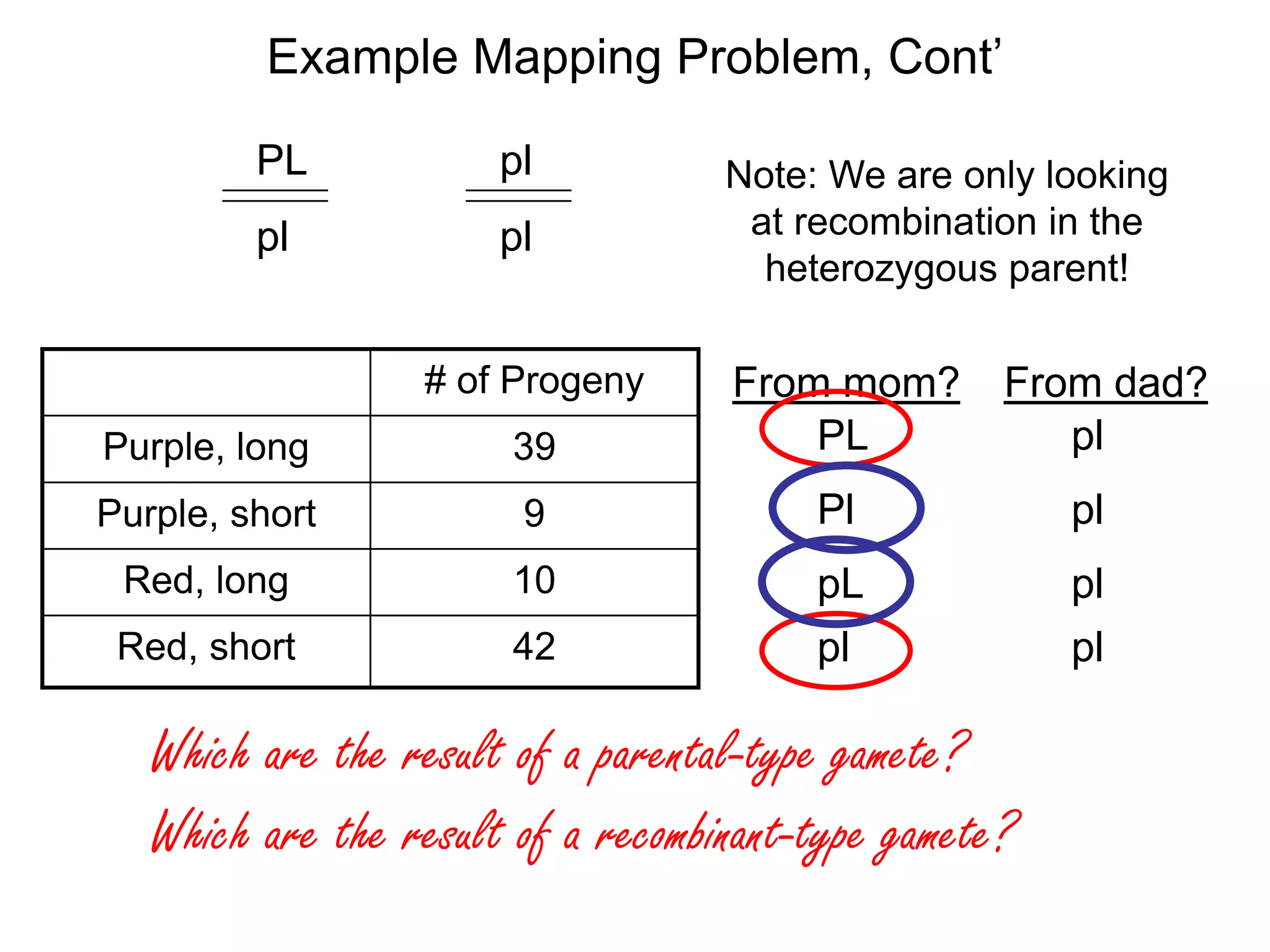
# of Progeny

Note: We are only looking
at recombination in the
heterozygous parent!

Purple, long

39

From mom?
PL

From dad?
pl

Purple, short

9

Pl

pl

Red, long

10

Red, short

42

pL
pl

pl
pl

Which are the result of a parental-type gamete?
Which are the result of a recombinant-type gamete?
Example Mapping Problem, Cont’
# of Progeny
Purple, long

39

Purple, short

9

Red, long

10

Red, short

42

These 19 progeny were the result of a recombination
between the “P” and “L” genes.
# Recombinants
Total # of progeny

What is the map distance?

Recombination % =

X 100

= [(9 + 10) / 100] x 100 = 19%
The P and L genes are 19 cM apart
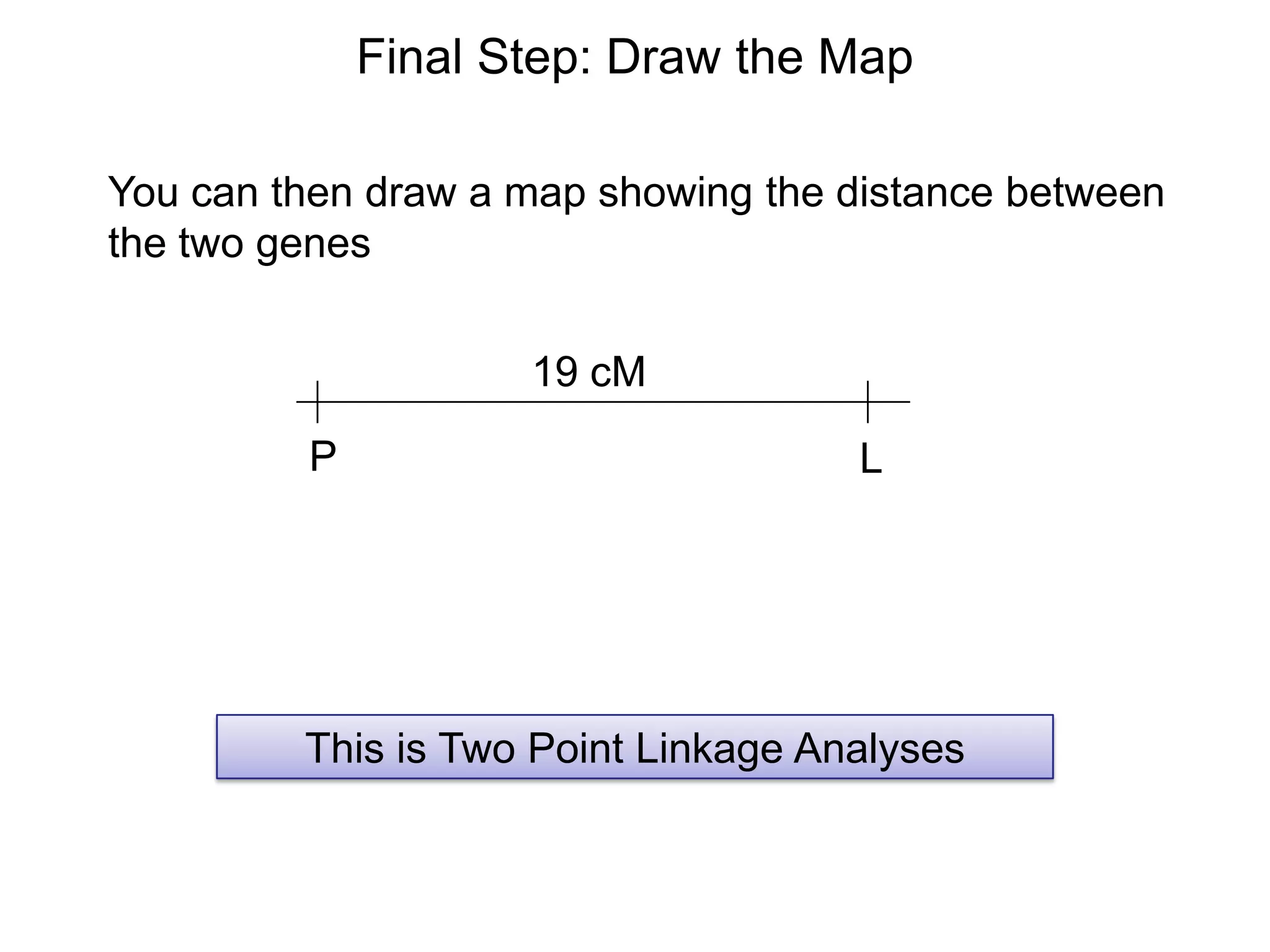
Final Step: Draw the Map
You can then draw a map showing the distance between
the two genes
19 cM
P

L

This is Two Point Linkage Analyses
Practice Problems!

• Chapter 5: 2 & 3
Questions?

Genetics chapter 5 part 1

  • 1.
    GENETIC AN I NTEG RATE D APPR OAC H A N A LY S I S Chapter 5 Genetic Linkage and Mapping in Eukaryotes Lectures by Kathleen Fitzpatrick Simon Fraser University Mark F. Sanders John L. Bowman Copyright © 2012 Pearson Education Inc.
  • 2.
  • 3.
    Genetic Linkage andMapping • Thomas Hunt Morgan won the Nobel Prize for work establishing the chromosome theory of inheritance and also for his role identifying and explaining genetic linkage and recombination • He applied linkage and recombination to genetic mapping 3
  • 4.
    What we havelearned… All genes have been on different chromosomes Allows “Independent Segregation” 1:1:1:1 gamete ratio
  • 5.
    However, gamete ratioscan deviate from 1:1:1:1 Parental gametes
  • 6.
    Meiosis I Anaphase MetaphaseI I AA a a A A a a or BBb b What will happen if two genes are on the same chromosome? b b BB AB or ab gametes Ab or aB gametes Over all, 1 AB : 1 Ab : 1 aB : 1 ab
  • 7.
    Meiosis – TwoGenes on Same Chromosome Anaphase Prophase II and Metaphase I A A a a BB b b Usually only get AB or ab gamete (1:1 ratio) “Parental-type gametes” Will probably get a low frequency of Ab or aB “Nonparental-type (recombinant-type) gametes” How?
  • 8.
  • 10.
    The Discovery ofGenetic Linkage • William Bateson and Reginald Punnett, in a series of crosses with sweet peas, found evidence of genetic linkage • They crossed pure-breeding purple-flowered, long-pollen plants to white-flowered, roundpollen plants; the purple, longpollen F1 were interbred to produce F2 • The expected 9:3:3:1 ratio was not observed
  • 12.
    Discovery of GeneticLinkage Pea flower color: Purple (P) is dominant to red (pp) Pea pollen length: Long (L) is dominant to short (ll) F1: PPLL ppll Purple long Parents: Red short All PpLl, (Purple, long) 9 Purple, short: 3 21 Red, long: 3 21 Red, short: F2: Expected Purple, long: Observed 284 1 55 How do you test if an observed ratio is significantly different from expected?
  • 13.
    Chi Square Analysis Class observedexpected O-E (O-E)2 (O-E)2/ E Purple, long 284 9/16 x 381 214.3 69.7 4858 22.6 Purple, short 21 3/16 x 381 -50.4 71.4 2540 35.6 Red, long 21 3/16 x 381 -50.4 71.4 2540 35.6 Red, short 55 1/16 x 381 23.8 973 40.9 31.2 381 Σ = 134.7 df = n-1 = 4-1 = 3 2 P < .01 Chi Square Probability Values DF 3 P= .99 .95 .90 .75 .50 .25 .10 .05 .01 0.114 0.351 0.584 1.212 2.365 4.108 6.251 7.814 11.34 Conclusion? SIGNIFICANTLY DIFFERENT! Traits are not sorting independently!
  • 14.
    Discovery of Linkage Peaflower color: Purple (P) is dominant to red (pp) Pea pollen length: Long (L) is dominant to short (ll) PPLL ppll Purple long Red short Parents: All PpLl, (Purple, long) F1: F2: Purple, long: Expected 215 Observed 284 Significantly more! 21 Significantly less! Purple, short: 71 Red, long: 71 21 Significantly less! Red, short: 24 55 Significantly more! P and L genes appear to be “linked” together
  • 15.
    What Bateson andPunnett Concluded • Observation: MORE parental phenotypes, LESS nonparental types • Conclusion: Bateson and Punnett suggested that an unknown mechanism kept the two parental gamete combinations together, which they called “coupling”
  • 16.
    5.1 Linked GenesDo Not Assort Independently • Genes located on the same chromosome are called syntenic genes • Syntenic genes so close together that their alleles cannot assort independently are called linked genes • Genetic linkage can be quantified to map the positions of genes on chromosomes genemol.org
  • 17.
    Recombination and SyntenicGenes • Alleles of syntenic genes can be reshuffled when crossing over occurs between homologs to produce recombinant chromosomes • Homologs that do not reshuffle alleles under study are called parental chromosomes or nonrecombinant chromosomes • Genetic linkage mapping plots the positions of genes on chromosomes http://viirulentscience.wordpress.com/
  • 20.
    Complete Genetic Linkage •Complete genetic linkage is observed when no crossing over occurs between linked genes; only parental gametes are formed • Some organisms exhibit complete linkage, e.g., Drosophila males have no crossing over • The biological basis for this is unknown Parental gametes
  • 22.
    Incomplete Genetic Linkage • Incompletegenetic linkage is much more common than complete linkage; in this case a mixture of parental and nonparental gametes are produced
  • 23.
    Calculating Recombination Frequency •Recombination frequency, expressed as r, is calculated as • Recombination frequency is likely a reflection of the physical distance between two genes r= # or recombinant animals total number of animals
  • 24.
    Correlation Between Recombination Frequencyand Gene Distance • Crossing over occurs at a higher rate between genes that are farther apart, and a lower rate between genes that are closer together Smaller r Bigger r
  • 25.
    Morgan’s Crosses • Morganstudied the white (eye color) and miniature (wing size) genes • He crossed females pure-breeding for white eyes and small wings (wm/wm) to males that were wild type for both (w m /Y) • The F1 were w m /wm females and wm/Y males http://bioweb.wku.edu/courses/biol114/vfly1.asp
  • 26.
    Morgan’s F1 F1 Results •Morgan interbred the w+m+/wm females and wm/Y males • A 1:1:1:1 ratio was predicted based on the assumption of independent assortment of the genes • However, Morgan observed many more parental types than recombinant types, suggesting that the genes in question were found on the same chromosome, in this case the X Less than 50%? →
  • 27.
    Chi-Square Analysis ofMorgan’s w, m Crosses • • There are 3 degrees of freedom in this case, and the p value is p 0.005 • Significant?? Yes! Thus the genes are linked!
  • 28.
    Interpretation of theResults • Morgan suggested that nonparental allele combinations resulted from recombination between the X chromosomes of the heterozygous female parent • He confirmed this explanation with many pairs of X-linked genes in Drosophila Genetics Analysis: An Integrated Approach Copyright © 2012 Pearson Education Inc.
  • 29.
    Detecting Autosomal GeneticLinkage Through Test-Cross Analysis • Morgan realized that linkage of autosomal genes in Drosophila could be interpreted using a twopoint test-cross analysis • In a test cross, the homozygous recessive parent contributes only recessive alleles • Thus, the alleles contributed by just the dihybrid parent can be examined
  • 30.
    Crosses with vgand pr • Morgan crossed flies with purple eyes and vestigial (short) wings to wild type and obtained wild-type F1 • The F1 females were then crossed to males that had purple eyes and vestigial wings • The alleles in the female gametes in this cross determined the phenotype in each of the progeny • Offspring produced did not fit the 1:1:1:1 expected ratio
  • 32.
    Important Conclusions fromAll of Morgan’s Crosses 1. Genetic linkage is a physical relationship between genes located near one another on a chromosome 2. Recombination occurs between linked genes less than 50% of the time, and greater than 50% of the gametes contain parental allele combinations 3. Recombination frequency varies among linked genes in proportion to the distance between them
  • 33.
    5.2 Genetic LinkageMapping Is Based on Recombination Frequency Between Genes • Morgan recognized that with linked genes, more parental than recombinant progeny occurred and that the recombinant frequency varied among gene pairs • Morgan suggested that closer proximity of genes produced a correspondingly higher frequency of parental allele combinations • Therefore, we can use r values to make a map! 
  • 34.
    The First GeneticLinkage Map • Morgan’s student, Alfred Sturtevant, realize d that the variations in recombination frequency could be used to determine genetic maps for genes • He used the results of several experiments to create a genetic map for five Xlinked genes http://www.ncbi.nlm.nih.gov
  • 36.
    General logic forgenerating the map: 1. Of the genes tested, the pair 3. M is close to v, but more distant from with the smallest w, so y-w-v-m recombination frequency 4. R is very far away from w, and fairly must be the closest in distant from v. This suggests that r is difference (y & w) on the opposite end of the map, so y2. V is more distant from y than w-v-m-r w, suggesting y-w-v You will try this in your homework!
  • 37.
    Map Units • Recombinationfrequencies between two genes can be converted into units of physical distance, map units (m.u.) • A map unit is also called a centiMorgan (cM) • By convention, 1% recombination 1 m.u. or 1 cM http://www.tutorvista.com
  • 38.
    Example Mapping Problem Ahomozygous pea plant with purple flowers and long pollen (PPLL) is crossed with a second inbred line with red flowers and short pollen (ppll) How would you show their genotypes using new method? PL pl PL pl What would the F1 look like? PL pl
  • 39.
    Example Mapping Problem,Cont’ An F1 plant is testcrossed and the following progeny were observed: PL pl pl pl Purple, long 39 Calculate the map distance between the P and L genes. Purple, short 9 Step 1: Write genotypes of parents Red, long 10 Step 2: Write genotypes of kids Red, short 42 # of Progeny
  • 40.
    Example Mapping Problem,Cont’ PL pl pl pl # of Progeny Note: We are only looking at recombination in the heterozygous parent! Purple, long 39 From mom? PL From dad? pl Purple, short 9 Pl pl Red, long 10 Red, short 42 pL pl pl pl Which are the result of a parental-type gamete? Which are the result of a recombinant-type gamete?
  • 41.
    Example Mapping Problem,Cont’ # of Progeny Purple, long 39 Purple, short 9 Red, long 10 Red, short 42 These 19 progeny were the result of a recombination between the “P” and “L” genes. # Recombinants Total # of progeny What is the map distance? Recombination % = X 100 = [(9 + 10) / 100] x 100 = 19% The P and L genes are 19 cM apart
  • 42.
    Final Step: Drawthe Map You can then draw a map showing the distance between the two genes 19 cM P L This is Two Point Linkage Analyses
  • 43.
  • 44.