DARSHANA A S
2018-11-039
SEX DETERMINATION IN
ANIMALS
INTRODUCTION
• Sex determination system is a biological system
that determines the development of sexual
characteristics in an organism.
• Most organisms that create offspring using
sexual reproduction have two sexes.
• There are hermaphrodites in place of one or
both sexes.
• There are also some species that have only one
sex due to parthenogenesis (female
reproducing without fertilization.)
HISTORY
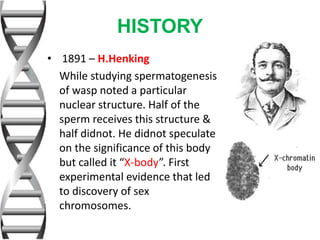
• 1891 – H.Henking
While studying spermatogenesis
of wasp noted a particular
nuclear structure. Half of the
sperm receives this structure &
half didnot. He didnot speculate
on the significance of this body
but called it “X-body”. First
experimental evidence that led
to discovery of sex
chromosomes.
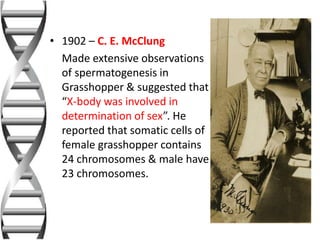
• 1902 – C. E. McClung
Made extensive observations
of spermatogenesis in
Grasshopper & suggested that
“X-body was involved in
determination of sex”. He
reported that somatic cells of
female grasshopper contains
24 chromosomes & male have
23 chromosomes.
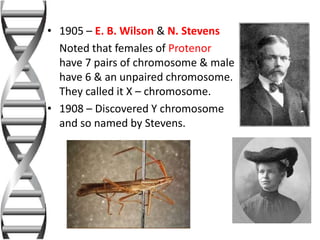
• 1905 – E. B. Wilson & N. Stevens
Noted that females of Protenor
have 7 pairs of chromosome & male
have 6 & an unpaired chromosome.
They called it X – chromosome.
• 1908 – Discovered Y chromosome
and so named by Stevens.
SEX DETERMINATION
• Establishment of male and female individuals or
male and female organs of an individual is called
sex determination.
• Mechanism of sex determination-3 types
Environmental
Chromosomal
Genic
• Zygotes do not differ genetically.
• Sex differentiation determined by environmental
factors.
• 2 types
Temperature dependent
Location dependent
1. ENVIRONMENTAL / NON-
GENETIC SEX DETERMINATION
1. Temperature-dependent sex
determination
In some animals (turtles, alligators, crocodiles,
some lizards etc.) the temperature at which eggs
are incubated has a decisive effect on sex of
animals that hatch from them. These effects are
of 3 types:
• Only females at high (30-35°C) and only males
at low (23-28°C). Incubation of eggs at
intermediate temperatures(28-30°C) produce
both males and females.
Eg: most species of turtles
• Only males at high(>33°C) and only females at
low(<30°C) temperatures. Intermediate
temperatures(30-33°C) produces both males and
females
Eg: many species of crocodiles and alligators and
in some species of lizards
• Only females at high(30-35°C) and low(<25°C)
temperatures. At intermediate temperatures,
both males and females are produced, but at
some intermediate temperatures, only males are
produced.
Eg: Australian crocodile, snapping turtles
2. Location-dependent sex
determination
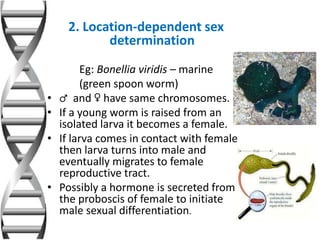
Eg: Bonellia viridis – marine
(green spoon worm)
• ♂ and ♀ have same chromosomes.
• If a young worm is raised from an
isolated larva it becomes a female.
• If larva comes in contact with female
then larva turns into male and
eventually migrates to female
reproductive tract.
• Possibly a hormone is secreted from
the proboscis of female to initiate
male sexual differentiation.
2. CHROMOSOMAL SEX
DETERMINATION
• Male and female individuals differ from each
other in respect to either the number or
morphology of the homologues of one
chromosome pair, referred to as sex
chromosome or allosome – X & Y
• X chromosome found in both males(only one)
and females(has two X chr.)
• Y chromosome occurs only in one of two sexes
of a species.
• Chromosomes whose number and morphology
do not differ between males and females of a
species are called autosomes.
Mechanisms of chromosomal sex determination:
1. XX-XO system [XX female, XO male
XO female, XX male]
2. XX-XY system [XX female, XY male
XY female, XX male]
3. ZZ-ZW system
4. Haplodiploidy system [Diploid (2n) female,
Haploid (n) male]
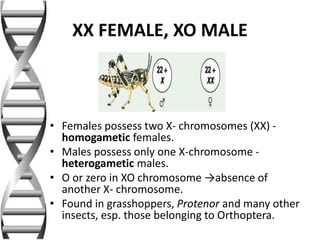
XX FEMALE, XO MALE
• Females possess two X- chromosomes (XX) -
homogametic females.
• Males possess only one X-chromosome -
heterogametic males.
• O or zero in XO chromosome →absence of
another X- chromosome.
• Found in grasshoppers, Protenor and many other
insects, esp. those belonging to Orthoptera.
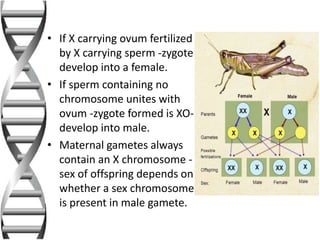
• If X carrying ovum fertilized
by X carrying sperm -zygote
develop into a female.
• If sperm containing no
chromosome unites with
ovum -zygote formed is XO-
develop into male.
• Maternal gametes always
contain an X chromosome -
sex of offspring depends on
whether a sex chromosome
is present in male gamete.
XO FEMALE, XX MALE
• Known in a few insect species, e.g., Fumea
• Females are heterogametic (producing two kinds
of eggs, half with a X chromosome and half
without any X chromosome) and males are
homogametic (producing single type of sperms,
each carrying a single X chromosome).
• Union of a sperm with X chromosome containing
egg -XX zygote -males.
• Fertilization of an egg devoid of X chromosome
with a sperm -XO zygote -females.
XX FEMALE, XY MALE
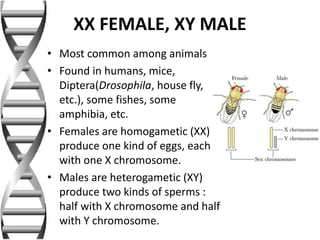
• Most common among animals
• Found in humans, mice,
Diptera(Drosophila, house fly,
etc.), some fishes, some
amphibia, etc.
• Females are homogametic (XX)
produce one kind of eggs, each
with one X chromosome.
• Males are heterogametic (XY)
produce two kinds of sperms :
half with X chromosome and half
with Y chromosome.
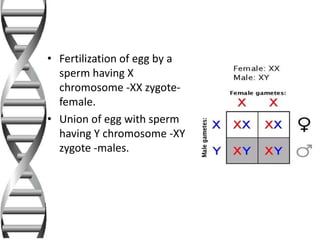
• Fertilization of egg by a
sperm having X
chromosome -XX zygote-
female.
• Union of egg with sperm
having Y chromosome -XY
zygote -males.
XY FEMALE, XX MALE
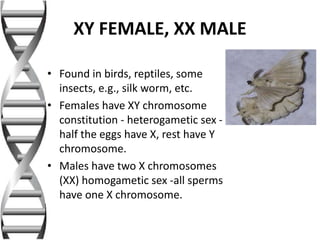
• Found in birds, reptiles, some
insects, e.g., silk worm, etc.
• Females have XY chromosome
constitution - heterogametic sex -
half the eggs have X, rest have Y
chromosome.
• Males have two X chromosomes
(XX) homogametic sex -all sperms
have one X chromosome.
• Fertilization of X containing egg with sperm -XX
zygote-male.
• XY zygote -when Y containing egg is fertilized by
a sperm-female.
ZW FEMALE, ZZ MALE
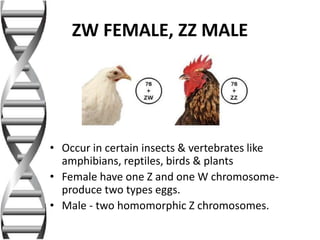
• Occur in certain insects & vertebrates like
amphibians, reptiles, birds & plants
• Female have one Z and one W chromosome-
produce two types eggs.
• Male - two homomorphic Z chromosomes.
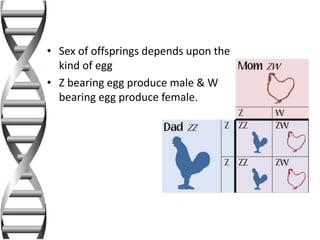
• Sex of offsprings depends upon the
kind of egg
• Z bearing egg produce male & W
bearing egg produce female.
• Found in Hymenoptera(honeybees, ants, termites,
etc)
• An individual’s sex determined by number of sets
of chromosomes.
• First demonstrated by Dzierzon in 1850
• Somatic chromosome no. of females is diploid,
males is only haploid
• When an egg is fertilized by a sperm, the
developed organism will be diploid (2n)- female
• If egg is not fertilized, organism is haploid(n) -
male.
DIPLOID FEMALE, HAPLOID MALE
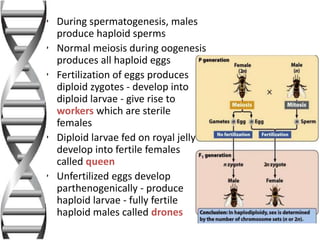
• During spermatogenesis, males
produce haploid sperms
• Normal meiosis during oogenesis
produces all haploid eggs
• Fertilization of eggs produces
diploid zygotes - develop into
diploid larvae - give rise to
workers which are sterile
females
• Diploid larvae fed on royal jelly
develop into fertile females
called queen
• Unfertilized eggs develop
parthenogenically - produce
haploid larvae - fully fertile
haploid males called drones
• Some specific genes located in X and Y
chromosomes are involved in sex determination.
• Explained by Genic balance theory of sex
determination in Drosophila proposed by Bridges
in 1921.
• Theory states that sex of an individual is
determined by a balance between the genes for
maleness and those for femaleness present in
the individual
• In Drosophila, genes for maleness are present in
autosomes and those of femaleness are located
in X chromosome
3. GENIC SEX DETERMINATION
• ie, sex of an individual is determined by the ratio
of no. of its X chromosome and that of its
autosomal sets, termed as sex index
Sex index = Number of X chromosomes(=X) = X/A
Number of autosomal sets (=A)
• Sex index = 1 normal females
= 0.5 normal males
= 1.0 – 0.5 intersex
= > 1.0 super females/meta females
= < 0.5 super males
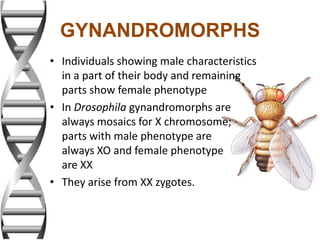
GYNANDROMORPHS
• Individuals showing male characteristics
in a part of their body and remaining
parts show female phenotype
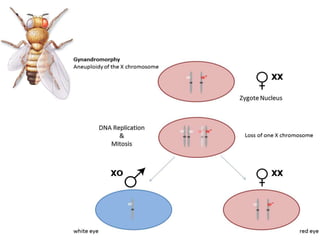
• In Drosophila gynandromorphs are
always mosaics for X chromosome;
parts with male phenotype are
always XO and female phenotype
are XX
• They arise from XX zygotes.
Sex determination in animals

Sex determination in animals

  • 1.
    DARSHANA A S 2018-11-039 SEXDETERMINATION IN ANIMALS
  • 2.
    INTRODUCTION • Sex determinationsystem is a biological system that determines the development of sexual characteristics in an organism. • Most organisms that create offspring using sexual reproduction have two sexes. • There are hermaphrodites in place of one or both sexes. • There are also some species that have only one sex due to parthenogenesis (female reproducing without fertilization.)
  • 3.
    HISTORY • 1891 –H.Henking While studying spermatogenesis of wasp noted a particular nuclear structure. Half of the sperm receives this structure & half didnot. He didnot speculate on the significance of this body but called it “X-body”. First experimental evidence that led to discovery of sex chromosomes.
  • 4.
    • 1902 –C. E. McClung Made extensive observations of spermatogenesis in Grasshopper & suggested that “X-body was involved in determination of sex”. He reported that somatic cells of female grasshopper contains 24 chromosomes & male have 23 chromosomes.
  • 5.
    • 1905 –E. B. Wilson & N. Stevens Noted that females of Protenor have 7 pairs of chromosome & male have 6 & an unpaired chromosome. They called it X – chromosome. • 1908 – Discovered Y chromosome and so named by Stevens.
  • 6.
    SEX DETERMINATION • Establishmentof male and female individuals or male and female organs of an individual is called sex determination. • Mechanism of sex determination-3 types Environmental Chromosomal Genic
  • 7.
    • Zygotes donot differ genetically. • Sex differentiation determined by environmental factors. • 2 types Temperature dependent Location dependent 1. ENVIRONMENTAL / NON- GENETIC SEX DETERMINATION
  • 8.
    1. Temperature-dependent sex determination Insome animals (turtles, alligators, crocodiles, some lizards etc.) the temperature at which eggs are incubated has a decisive effect on sex of animals that hatch from them. These effects are of 3 types: • Only females at high (30-35°C) and only males at low (23-28°C). Incubation of eggs at intermediate temperatures(28-30°C) produce both males and females. Eg: most species of turtles
  • 9.
    • Only malesat high(>33°C) and only females at low(<30°C) temperatures. Intermediate temperatures(30-33°C) produces both males and females Eg: many species of crocodiles and alligators and in some species of lizards • Only females at high(30-35°C) and low(<25°C) temperatures. At intermediate temperatures, both males and females are produced, but at some intermediate temperatures, only males are produced. Eg: Australian crocodile, snapping turtles
  • 10.
    2. Location-dependent sex determination Eg:Bonellia viridis – marine (green spoon worm) • ♂ and ♀ have same chromosomes. • If a young worm is raised from an isolated larva it becomes a female. • If larva comes in contact with female then larva turns into male and eventually migrates to female reproductive tract. • Possibly a hormone is secreted from the proboscis of female to initiate male sexual differentiation.
  • 11.
    2. CHROMOSOMAL SEX DETERMINATION •Male and female individuals differ from each other in respect to either the number or morphology of the homologues of one chromosome pair, referred to as sex chromosome or allosome – X & Y • X chromosome found in both males(only one) and females(has two X chr.) • Y chromosome occurs only in one of two sexes of a species. • Chromosomes whose number and morphology do not differ between males and females of a species are called autosomes.
  • 12.
    Mechanisms of chromosomalsex determination: 1. XX-XO system [XX female, XO male XO female, XX male] 2. XX-XY system [XX female, XY male XY female, XX male] 3. ZZ-ZW system 4. Haplodiploidy system [Diploid (2n) female, Haploid (n) male]
  • 13.
    XX FEMALE, XOMALE • Females possess two X- chromosomes (XX) - homogametic females. • Males possess only one X-chromosome - heterogametic males. • O or zero in XO chromosome →absence of another X- chromosome. • Found in grasshoppers, Protenor and many other insects, esp. those belonging to Orthoptera.
  • 14.
    • If Xcarrying ovum fertilized by X carrying sperm -zygote develop into a female. • If sperm containing no chromosome unites with ovum -zygote formed is XO- develop into male. • Maternal gametes always contain an X chromosome - sex of offspring depends on whether a sex chromosome is present in male gamete.
  • 15.
    XO FEMALE, XXMALE • Known in a few insect species, e.g., Fumea • Females are heterogametic (producing two kinds of eggs, half with a X chromosome and half without any X chromosome) and males are homogametic (producing single type of sperms, each carrying a single X chromosome). • Union of a sperm with X chromosome containing egg -XX zygote -males. • Fertilization of an egg devoid of X chromosome with a sperm -XO zygote -females.
  • 16.
    XX FEMALE, XYMALE • Most common among animals • Found in humans, mice, Diptera(Drosophila, house fly, etc.), some fishes, some amphibia, etc. • Females are homogametic (XX) produce one kind of eggs, each with one X chromosome. • Males are heterogametic (XY) produce two kinds of sperms : half with X chromosome and half with Y chromosome.
  • 17.
    • Fertilization ofegg by a sperm having X chromosome -XX zygote- female. • Union of egg with sperm having Y chromosome -XY zygote -males.
  • 18.
    XY FEMALE, XXMALE • Found in birds, reptiles, some insects, e.g., silk worm, etc. • Females have XY chromosome constitution - heterogametic sex - half the eggs have X, rest have Y chromosome. • Males have two X chromosomes (XX) homogametic sex -all sperms have one X chromosome.
  • 19.
    • Fertilization ofX containing egg with sperm -XX zygote-male. • XY zygote -when Y containing egg is fertilized by a sperm-female.
  • 20.
    ZW FEMALE, ZZMALE • Occur in certain insects & vertebrates like amphibians, reptiles, birds & plants • Female have one Z and one W chromosome- produce two types eggs. • Male - two homomorphic Z chromosomes.
  • 21.
    • Sex ofoffsprings depends upon the kind of egg • Z bearing egg produce male & W bearing egg produce female.
  • 22.
    • Found inHymenoptera(honeybees, ants, termites, etc) • An individual’s sex determined by number of sets of chromosomes. • First demonstrated by Dzierzon in 1850 • Somatic chromosome no. of females is diploid, males is only haploid • When an egg is fertilized by a sperm, the developed organism will be diploid (2n)- female • If egg is not fertilized, organism is haploid(n) - male. DIPLOID FEMALE, HAPLOID MALE
  • 23.
    • During spermatogenesis,males produce haploid sperms • Normal meiosis during oogenesis produces all haploid eggs • Fertilization of eggs produces diploid zygotes - develop into diploid larvae - give rise to workers which are sterile females • Diploid larvae fed on royal jelly develop into fertile females called queen • Unfertilized eggs develop parthenogenically - produce haploid larvae - fully fertile haploid males called drones
  • 24.
    • Some specificgenes located in X and Y chromosomes are involved in sex determination. • Explained by Genic balance theory of sex determination in Drosophila proposed by Bridges in 1921. • Theory states that sex of an individual is determined by a balance between the genes for maleness and those for femaleness present in the individual • In Drosophila, genes for maleness are present in autosomes and those of femaleness are located in X chromosome 3. GENIC SEX DETERMINATION
  • 25.
    • ie, sexof an individual is determined by the ratio of no. of its X chromosome and that of its autosomal sets, termed as sex index Sex index = Number of X chromosomes(=X) = X/A Number of autosomal sets (=A) • Sex index = 1 normal females = 0.5 normal males = 1.0 – 0.5 intersex = > 1.0 super females/meta females = < 0.5 super males
  • 26.
    GYNANDROMORPHS • Individuals showingmale characteristics in a part of their body and remaining parts show female phenotype • In Drosophila gynandromorphs are always mosaics for X chromosome; parts with male phenotype are always XO and female phenotype are XX • They arise from XX zygotes.

Editor's Notes

  • #26 Intersex – flies with sex expression (both primary and secondary sex characters) intermediate b/w males and females & completely sterile Super females- more pronounced female characteristics than normal females-weak, sterile and often inviable Supermales- more pronounced secondary sex characters then normal males-weak, sterile and inviable
  • #27 During embryonic developement in one or more cells one of the two X chromosomes does not pass away at anaphase and as a result is lost. Consequently one or more daughter cells having a single X chromosome are produced, these cells divide and give rise to male parts of gynandromorphs.