Lethal alleles
Lecture 4
Prepared by
Samira Fattah
Assis. Lec.
College of health sciences-HMU
What are Lethal alleles?
– Definition
• Genes which result in viability reduction of
individual or become a cause for death of
individuals carrying them.
• Some lethal genes cause death of zygote or
the early embryonic stage while some express
their effect in later stages of development.
• Certain genes are absolutely essential for survival. Mutation in
these genes creates lethal allele
• Lethal alleles are dominant or recessive
• Fully dominant lethal allele kills organism in both
homozygous and heterozygous condition
• Certain lethal alleles kills organisms in homozygous condition
only.
History
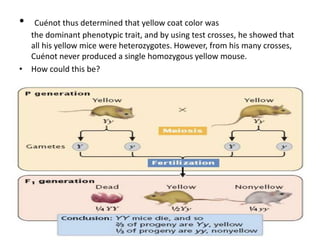
• Lethal genes were first discovered by Lucien Cuénot while
studying the inheritance of coat colour in mice.
• He expected a phenotype ratio from a cross of 3 yellow:1 white,
but the observed ratio was 2:1.
• Allele was lethal in homozygous dominant condition
• Cuénot thus determined that yellow coat color was
the dominant phenotypic trait, and by using test crosses, he showed that
all his yellow mice were heterozygotes. However, from his many crosses,
Cuénot never produced a single homozygous yellow mouse.
• How could this be?
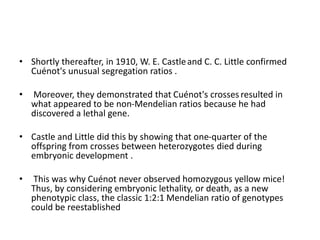
• Shortly thereafter, in 1910, W. E. Castleand C. C. Little confirmed
Cuénot's unusual segregation ratios .
• Moreover, they demonstrated that Cuénot's crosses resulted in
what appeared to be non-Mendelian ratios because he had
discovered a lethal gene.
• Castle and Little did this by showing that one-quarter of the
offspring from crosses between heterozygotes died during
embryonic development .
• This was why Cuénot never observed homozygous yellow mice!
Thus, by considering embryonic lethality, or death, as a new
phenotypic class, the classic 1:2:1 Mendelian ratio of genotypes
could be reestablished
• As this examples illustrate, lethal genes cause the
death of the organisms that carry them.
• Sometimes, death is not immediate; it may even
take years, depending on the gene.
• In any case, if a mutation results in lethality, then
this is indicative that the affected gene has a
fundamental function in the growth,
development, and survival of an organism.
Types of lethal genes
• Recessive Lethal Genes
• Cuénot and Baur discovered these first recessive lethal
genes because they altered Mendelian inheritance ratios.
• Recessive lethal genes can code for either dominant or
recessive traits, but they do not actually cause death unless
an organism carries two copies of the lethal allele.
• Examples of human diseases caused by recessive
lethal alleles include cystic fibrosis, sickle-cell anemia, and
achondroplasia
• Achondroplasia is an autosomal dominant bone
disorder that causes dwarfism. While the inheritance
of one achondroplasia allele can cause the disease,
the inheritance of two recessive lethal alleles is fatal.
• Dominant Lethal Genes
• Dominant lethal genes are expressed in both
homozygotes and heterozygotes. But how can
alleles like this be passed from one generation to
the next if they cause death?
• Dominant lethal genes are rarely detected due to
their rapid elimination from populations. One
example of a disease caused by a dominant lethal
allele is Huntington's disease
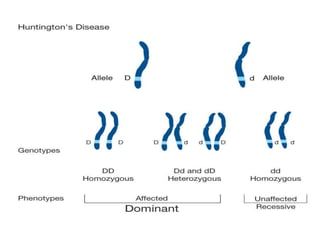
• Huntington's disease
• a neurological disorder in humans, which reduces
life expectancy.
• Because the onset of Huntington's disease is
slow, individuals carrying the allele can pass it on
to their offspring. This allows the allele to be
maintained in the population. Dominant traits
can also be maintained in the population through
recurrent mutations .
Conditional Lethal Genes
• an organism lives normally under one set of conditions, but
when certain changes are introduced in its environment,
lethality results.
• Favism is a sex-linked, inherited condition that results from
deficiency in an enzyme called glucose-6-phosphate
dehydrogenase.
• It is most common among people of Mediterranean, African,
Southeast Asian, and Sephardic Jewish descent .
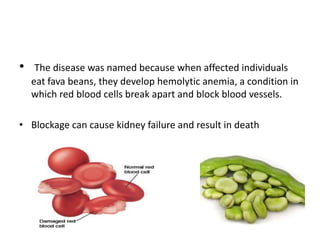
• The disease was named because when affected individuals
eat fava beans, they develop hemolytic anemia, a condition in
which red blood cells break apart and block blood vessels.
• Blockage can cause kidney failure and result in death
Sex-Linked Lethal Genes
• Semilethal or Sublethal Genes
• the lethal gene is carried on the sex chromosome, usually X.
• Hemophilia is a hereditary disease caused by deficiencies in clotting
factors, which results in impaired blood clotting and coagulation.
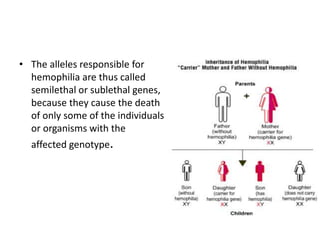
• Because the allele responsible for hemophilia is carried on the
X chromosome, affected individuals are predominantly males, and
they inherit the allele from their mothers.
• The alleles responsible for
hemophilia are thus called
semilethal or sublethal genes,
because they cause the death
of only some of the individuals
or organisms with the
affected genotype.
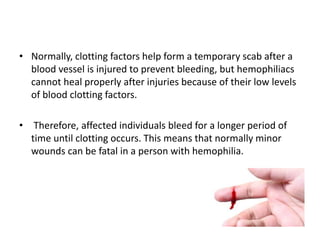
• Normally, clotting factors help form a temporary scab after a
blood vessel is injured to prevent bleeding, but hemophiliacs
cannot heal properly after injuries because of their low levels
of blood clotting factors.
• Therefore, affected individuals bleed for a longer period of
time until clotting occurs. This means that normally minor
wounds can be fatal in a person with hemophilia.
Synthetic Lethal Genes
• When an allele causes lethality, this is evidence that the
gene must have a critical function in an organism.
• The discoveries of many lethal alleles have provided
information on the functions of genes during
development.
• So scientists used conditional and synthetic lethal alleles
to study the physiological functions and relationships of
genes under specific conditions.
Breeding
• Inbreeding
• The process of mating of individuals which are more closely
related than the average of the population to which they
belong, is called inbreeding.
• Normally, inbreeding is affected by restrictions in population
size or area which brings about the mating between relatives.
• Since close relatives have similar genes because of common
heritage, inbreeding increases the frequency of homozygotes,
but does not bring about a change in overall gene
frequencies.
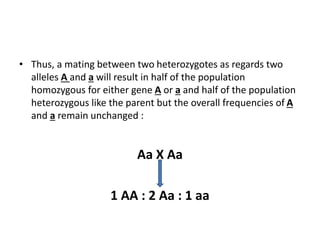
• Thus, a mating between two heterozygotes as regards two
alleles A and a will result in half of the population
homozygous for either gene A or a and half of the population
heterozygous like the parent but the overall frequencies of A
and a remain unchanged :
Aa X Aa
1 AA : 2 Aa : 1 aa
• Thus, inbreeding brings about the recessive gene
to appear in a homozygous state (aa).
• Once a recessive allele is in a homozygous state,
natural selection can operate upon the rare
recessives.
• Artificial selection is also possible as the
homozygous recessives are phenotypically
differentiated from the dominant population.
• Genetic Effects of Inbreeding
• The continuous inbreeding results, genetically,
in homozygosity. It produces homozygous
stocks of dominant or recessive genes and
eliminate heterozygosity from the inbred
population.
• The practical applications of inbreeding
are following:
1. Because inbreeding cause homozygosity
of deleterious recessive genes which may
result in defective phenotype, therefore, in human
society, the religious ethics unknowingly
and modern social norms consciously have condemned
and banned the marriages of brothers
and sisters.
2.Because inbreeding results in the homozygosity of
dominant alleles, therefore, the animal breeder have
employed the inbreeding to produce best races of
horses, dogs, bulls, cattles, etc.
The modern race horses, for example, are all
descendents of three Arabian stallions imported into
England between 1689 and 1730 and mated with
several local mares of the slow, heavy type .
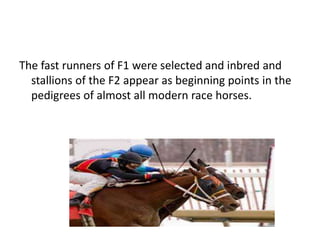
The fast runners of F1 were selected and inbred and
stallions of the F2 appear as beginning points in the
pedigrees of almost all modern race horses.
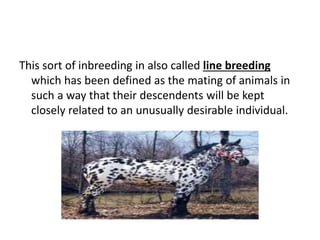
This sort of inbreeding in also called line breeding
which has been defined as the mating of animals in
such a way that their descendents will be kept
closely related to an unusually desirable individual.
• Outbreeding
• When a mating involves individuals that are
more distantly related than the average of the
selected group it is classified as outcrossing or
outbreeding
• Outbreeding involves crossing individuals
belonging to different families or crossing
different inbred varieties of plants or crossing
different breeds of livestock.
• Outbreeding increases heterozygosity.
• and enhances the vigour of the progeny, i.e.,
hybrid has superior phenotypic quality but often
has poor breeding value than the parental
populations.
• Cross Breeding and Mule Production
• Mating of individuals from entirely different
races or even different species is called cross
breeding.
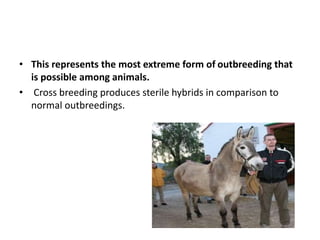
• This represents the most extreme form of outbreeding that
is possible among animals.
• Cross breeding produces sterile hybrids in comparison to
normal outbreedings.
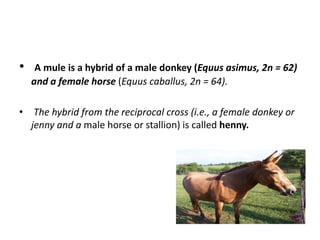
• A mule is a hybrid of a male donkey (Equus asimus, 2n = 62)
and a female horse (Equus caballus, 2n = 64).
• The hybrid from the reciprocal cross (i.e., a female donkey or
jenny and a male horse or stallion) is called henny.
EVOLUTIONARY SIGNIFICANCE OF INBREEDING
AND OUTBREEDING
• The inbreeding and outbreeding, both, provide raw
material to natural selection.
• Inbreeding allows natural selection to operate on
recessive genes, but does not permit the introduction
of good mutations from outside.
• While, outbreeding provides an opportunity for the
accumulation of good traits of different races in one
individual or line.
• It expresses good qualities of the races and
masked the deleterious recessive alleles.
• Thus, it can be concluded at last that
inbreeding and outbreeding, both, provide
new allelic combinations which may be good
or bad for the natural selection.

Lethal alleles

  • 1.
    Lethal alleles Lecture 4 Preparedby Samira Fattah Assis. Lec. College of health sciences-HMU
  • 2.
    What are Lethalalleles? – Definition • Genes which result in viability reduction of individual or become a cause for death of individuals carrying them.
  • 3.
    • Some lethalgenes cause death of zygote or the early embryonic stage while some express their effect in later stages of development.
  • 4.
    • Certain genesare absolutely essential for survival. Mutation in these genes creates lethal allele • Lethal alleles are dominant or recessive • Fully dominant lethal allele kills organism in both homozygous and heterozygous condition • Certain lethal alleles kills organisms in homozygous condition only.
  • 5.
    History • Lethal geneswere first discovered by Lucien Cuénot while studying the inheritance of coat colour in mice. • He expected a phenotype ratio from a cross of 3 yellow:1 white, but the observed ratio was 2:1. • Allele was lethal in homozygous dominant condition
  • 6.
    • Cuénot thusdetermined that yellow coat color was the dominant phenotypic trait, and by using test crosses, he showed that all his yellow mice were heterozygotes. However, from his many crosses, Cuénot never produced a single homozygous yellow mouse. • How could this be?
  • 7.
    • Shortly thereafter,in 1910, W. E. Castleand C. C. Little confirmed Cuénot's unusual segregation ratios . • Moreover, they demonstrated that Cuénot's crosses resulted in what appeared to be non-Mendelian ratios because he had discovered a lethal gene. • Castle and Little did this by showing that one-quarter of the offspring from crosses between heterozygotes died during embryonic development . • This was why Cuénot never observed homozygous yellow mice! Thus, by considering embryonic lethality, or death, as a new phenotypic class, the classic 1:2:1 Mendelian ratio of genotypes could be reestablished
  • 8.
    • As thisexamples illustrate, lethal genes cause the death of the organisms that carry them. • Sometimes, death is not immediate; it may even take years, depending on the gene. • In any case, if a mutation results in lethality, then this is indicative that the affected gene has a fundamental function in the growth, development, and survival of an organism.
  • 9.
    Types of lethalgenes • Recessive Lethal Genes • Cuénot and Baur discovered these first recessive lethal genes because they altered Mendelian inheritance ratios. • Recessive lethal genes can code for either dominant or recessive traits, but they do not actually cause death unless an organism carries two copies of the lethal allele. • Examples of human diseases caused by recessive lethal alleles include cystic fibrosis, sickle-cell anemia, and achondroplasia
  • 10.
    • Achondroplasia isan autosomal dominant bone disorder that causes dwarfism. While the inheritance of one achondroplasia allele can cause the disease, the inheritance of two recessive lethal alleles is fatal.
  • 11.
    • Dominant LethalGenes • Dominant lethal genes are expressed in both homozygotes and heterozygotes. But how can alleles like this be passed from one generation to the next if they cause death? • Dominant lethal genes are rarely detected due to their rapid elimination from populations. One example of a disease caused by a dominant lethal allele is Huntington's disease
  • 12.
    • Huntington's disease •a neurological disorder in humans, which reduces life expectancy. • Because the onset of Huntington's disease is slow, individuals carrying the allele can pass it on to their offspring. This allows the allele to be maintained in the population. Dominant traits can also be maintained in the population through recurrent mutations .
  • 14.
    Conditional Lethal Genes •an organism lives normally under one set of conditions, but when certain changes are introduced in its environment, lethality results. • Favism is a sex-linked, inherited condition that results from deficiency in an enzyme called glucose-6-phosphate dehydrogenase. • It is most common among people of Mediterranean, African, Southeast Asian, and Sephardic Jewish descent .
  • 15.
    • The diseasewas named because when affected individuals eat fava beans, they develop hemolytic anemia, a condition in which red blood cells break apart and block blood vessels. • Blockage can cause kidney failure and result in death
  • 16.
    Sex-Linked Lethal Genes •Semilethal or Sublethal Genes • the lethal gene is carried on the sex chromosome, usually X. • Hemophilia is a hereditary disease caused by deficiencies in clotting factors, which results in impaired blood clotting and coagulation. • Because the allele responsible for hemophilia is carried on the X chromosome, affected individuals are predominantly males, and they inherit the allele from their mothers.
  • 17.
    • The allelesresponsible for hemophilia are thus called semilethal or sublethal genes, because they cause the death of only some of the individuals or organisms with the affected genotype.
  • 18.
    • Normally, clottingfactors help form a temporary scab after a blood vessel is injured to prevent bleeding, but hemophiliacs cannot heal properly after injuries because of their low levels of blood clotting factors. • Therefore, affected individuals bleed for a longer period of time until clotting occurs. This means that normally minor wounds can be fatal in a person with hemophilia.
  • 19.
    Synthetic Lethal Genes •When an allele causes lethality, this is evidence that the gene must have a critical function in an organism. • The discoveries of many lethal alleles have provided information on the functions of genes during development. • So scientists used conditional and synthetic lethal alleles to study the physiological functions and relationships of genes under specific conditions.
  • 20.
    Breeding • Inbreeding • Theprocess of mating of individuals which are more closely related than the average of the population to which they belong, is called inbreeding.
  • 21.
    • Normally, inbreedingis affected by restrictions in population size or area which brings about the mating between relatives. • Since close relatives have similar genes because of common heritage, inbreeding increases the frequency of homozygotes, but does not bring about a change in overall gene frequencies.
  • 22.
    • Thus, amating between two heterozygotes as regards two alleles A and a will result in half of the population homozygous for either gene A or a and half of the population heterozygous like the parent but the overall frequencies of A and a remain unchanged : Aa X Aa 1 AA : 2 Aa : 1 aa
  • 23.
    • Thus, inbreedingbrings about the recessive gene to appear in a homozygous state (aa). • Once a recessive allele is in a homozygous state, natural selection can operate upon the rare recessives. • Artificial selection is also possible as the homozygous recessives are phenotypically differentiated from the dominant population.
  • 24.
    • Genetic Effectsof Inbreeding • The continuous inbreeding results, genetically, in homozygosity. It produces homozygous stocks of dominant or recessive genes and eliminate heterozygosity from the inbred population.
  • 25.
    • The practicalapplications of inbreeding are following: 1. Because inbreeding cause homozygosity of deleterious recessive genes which may result in defective phenotype, therefore, in human society, the religious ethics unknowingly and modern social norms consciously have condemned and banned the marriages of brothers and sisters.
  • 26.
    2.Because inbreeding resultsin the homozygosity of dominant alleles, therefore, the animal breeder have employed the inbreeding to produce best races of horses, dogs, bulls, cattles, etc. The modern race horses, for example, are all descendents of three Arabian stallions imported into England between 1689 and 1730 and mated with several local mares of the slow, heavy type .
  • 27.
    The fast runnersof F1 were selected and inbred and stallions of the F2 appear as beginning points in the pedigrees of almost all modern race horses.
  • 28.
    This sort ofinbreeding in also called line breeding which has been defined as the mating of animals in such a way that their descendents will be kept closely related to an unusually desirable individual.
  • 29.
    • Outbreeding • Whena mating involves individuals that are more distantly related than the average of the selected group it is classified as outcrossing or outbreeding
  • 30.
    • Outbreeding involvescrossing individuals belonging to different families or crossing different inbred varieties of plants or crossing different breeds of livestock. • Outbreeding increases heterozygosity. • and enhances the vigour of the progeny, i.e., hybrid has superior phenotypic quality but often has poor breeding value than the parental populations.
  • 31.
    • Cross Breedingand Mule Production • Mating of individuals from entirely different races or even different species is called cross breeding.
  • 32.
    • This representsthe most extreme form of outbreeding that is possible among animals. • Cross breeding produces sterile hybrids in comparison to normal outbreedings.
  • 33.
    • A muleis a hybrid of a male donkey (Equus asimus, 2n = 62) and a female horse (Equus caballus, 2n = 64). • The hybrid from the reciprocal cross (i.e., a female donkey or jenny and a male horse or stallion) is called henny.
  • 34.
    EVOLUTIONARY SIGNIFICANCE OFINBREEDING AND OUTBREEDING • The inbreeding and outbreeding, both, provide raw material to natural selection. • Inbreeding allows natural selection to operate on recessive genes, but does not permit the introduction of good mutations from outside. • While, outbreeding provides an opportunity for the accumulation of good traits of different races in one individual or line.
  • 35.
    • It expressesgood qualities of the races and masked the deleterious recessive alleles. • Thus, it can be concluded at last that inbreeding and outbreeding, both, provide new allelic combinations which may be good or bad for the natural selection.