The document discusses genetic linkage, a concept that explains how genes close together on the same chromosome tend to be inherited together during meiosis, which contradicts Mendel's law of independent assortment. Key discoveries include those by Bateson and Punnett in 1906 and Creighton and McClintock in 1931, who provided evidence for genetic linkage and recombination. The document also outlines the methods of chromosome mapping and factors that affect genetic linkage and recombination frequency.
Chromosomal theory ofinheritance
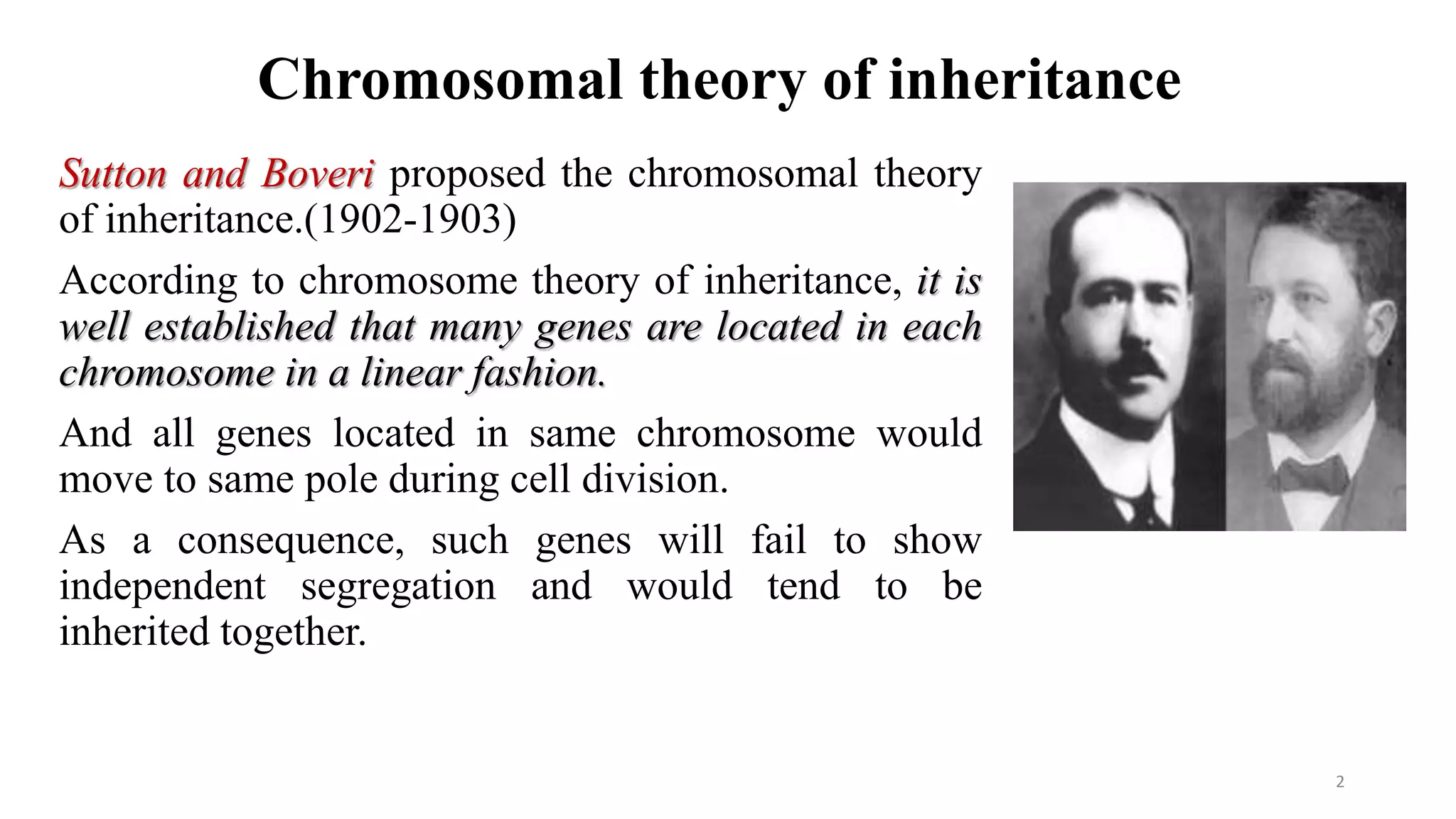
Sutton and Boveri proposed the chromosomal theory
of inheritance.(1902-1903)
According to chromosome theory of inheritance, it is
well established that many genes are located in each
chromosome in a linear fashion.
And all genes located in same chromosome would
move to same pole during cell division.
As a consequence, such genes will fail to show
independent segregation and would tend to be
inherited together.
2
3.
What is geneticlinkage???
Genetic linkage is the tendency of DNA sequences that are close together on
a chromosome to be inherited together during the meiosis phase of sexual
reproduction.
OR
“ The Tendency of genes to remain together in their original combination
during inheritance is called linkage”
The Two genes that are physically near to each other are unlikely to be separated
onto different chromatids during chromosomal crossover, and are therefore said to
be more linked than genes that are far apart. In other words, the nearer
two genes are on a chromosome, the lower the chance of recombination between
them, and the more likely they are to be inherited together. Genes on different
chromosomes are perfectly unlinked.
Term linkage was given by T H Morgan
3
4.
Why genetic linkage???
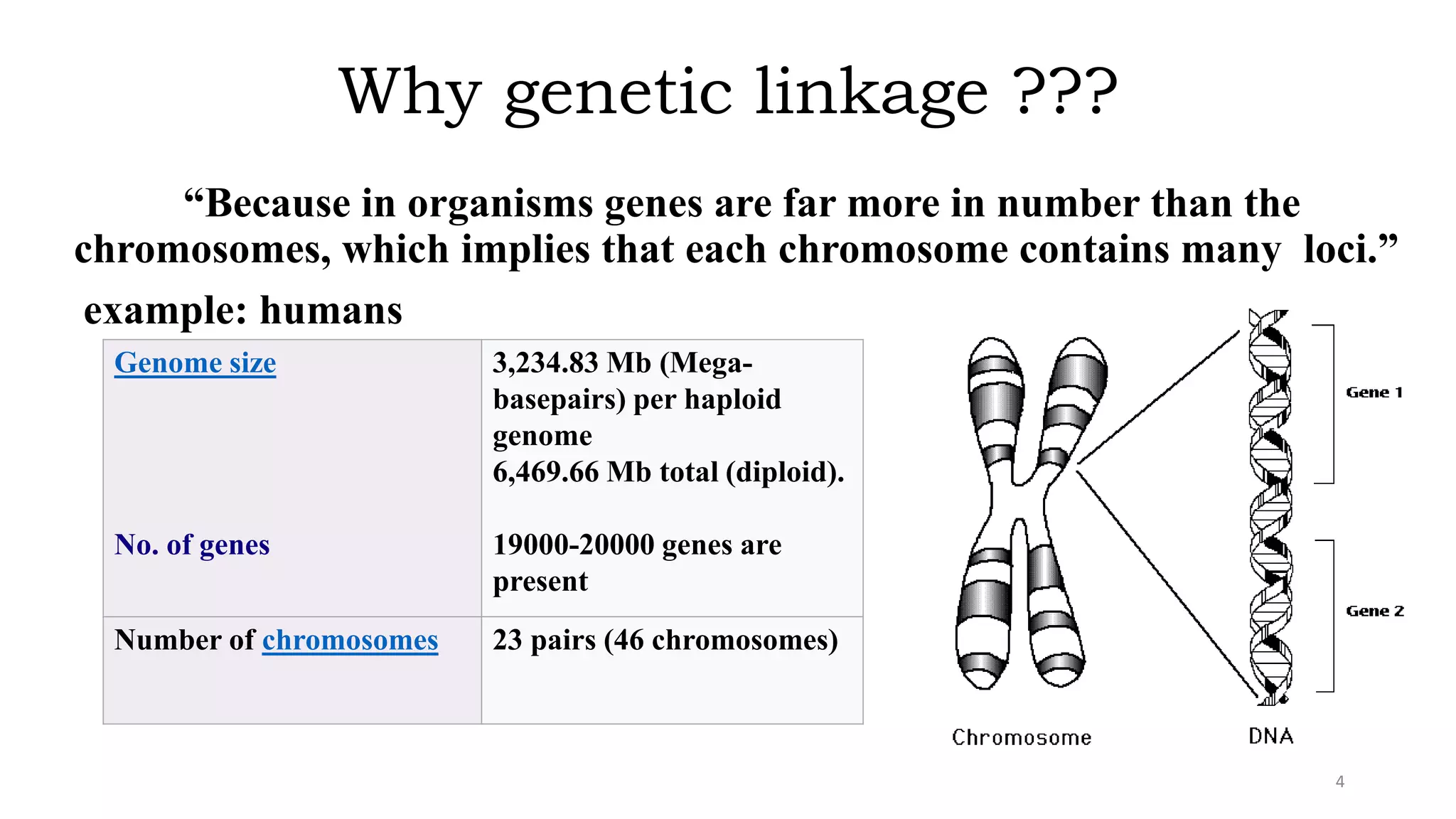
“Because in organisms genes are far more in number than the
chromosomes, which implies that each chromosome contains many loci.”
example: humans
Genome size
No. of genes
3,234.83 Mb (Mega-
basepairs) per haploid
genome
6,469.66 Mb total (diploid).
19000-20000 genes are
present
Number of chromosomes 23 pairs (46 chromosomes)
4
5.
When and whodiscovered???
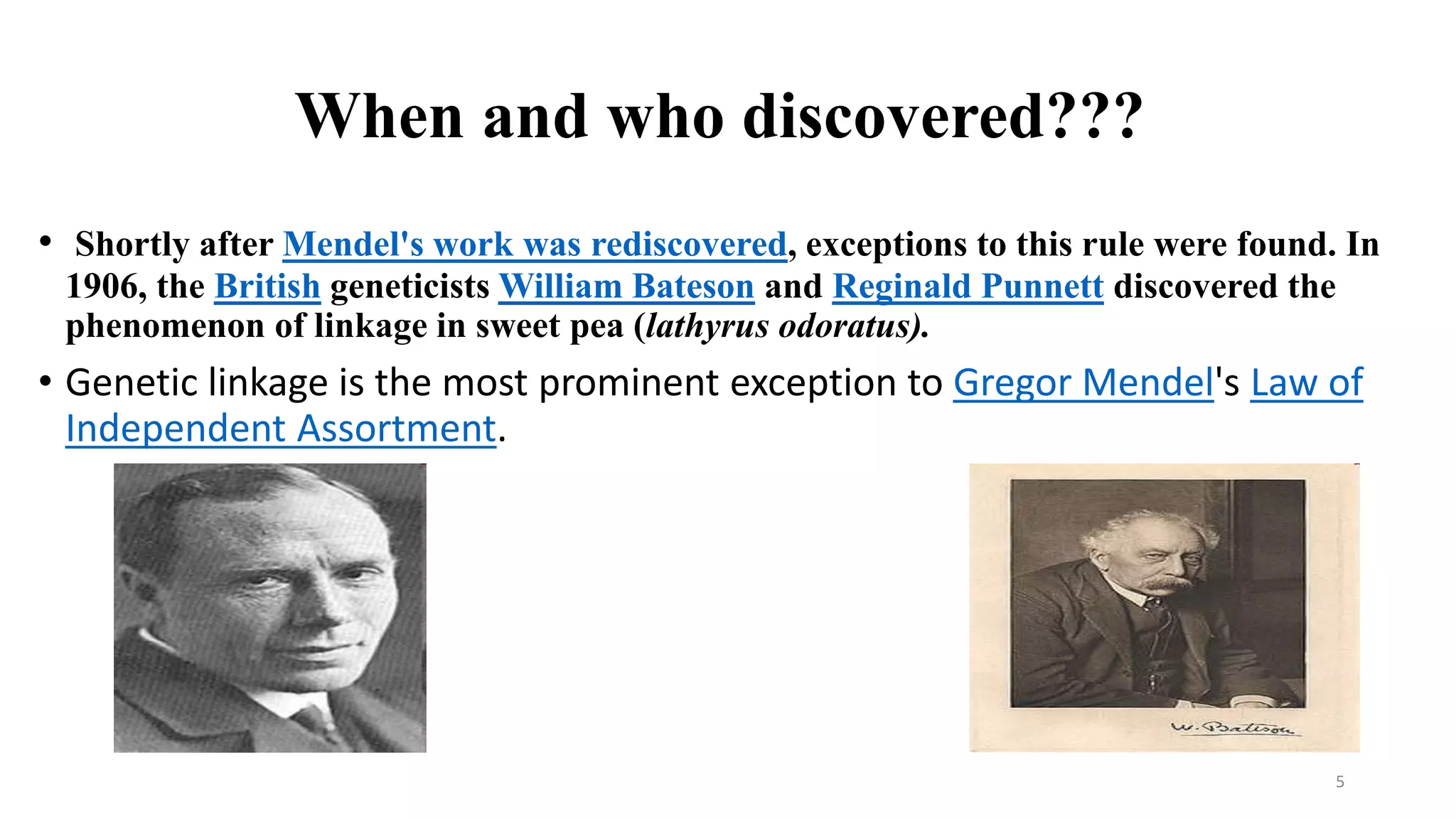
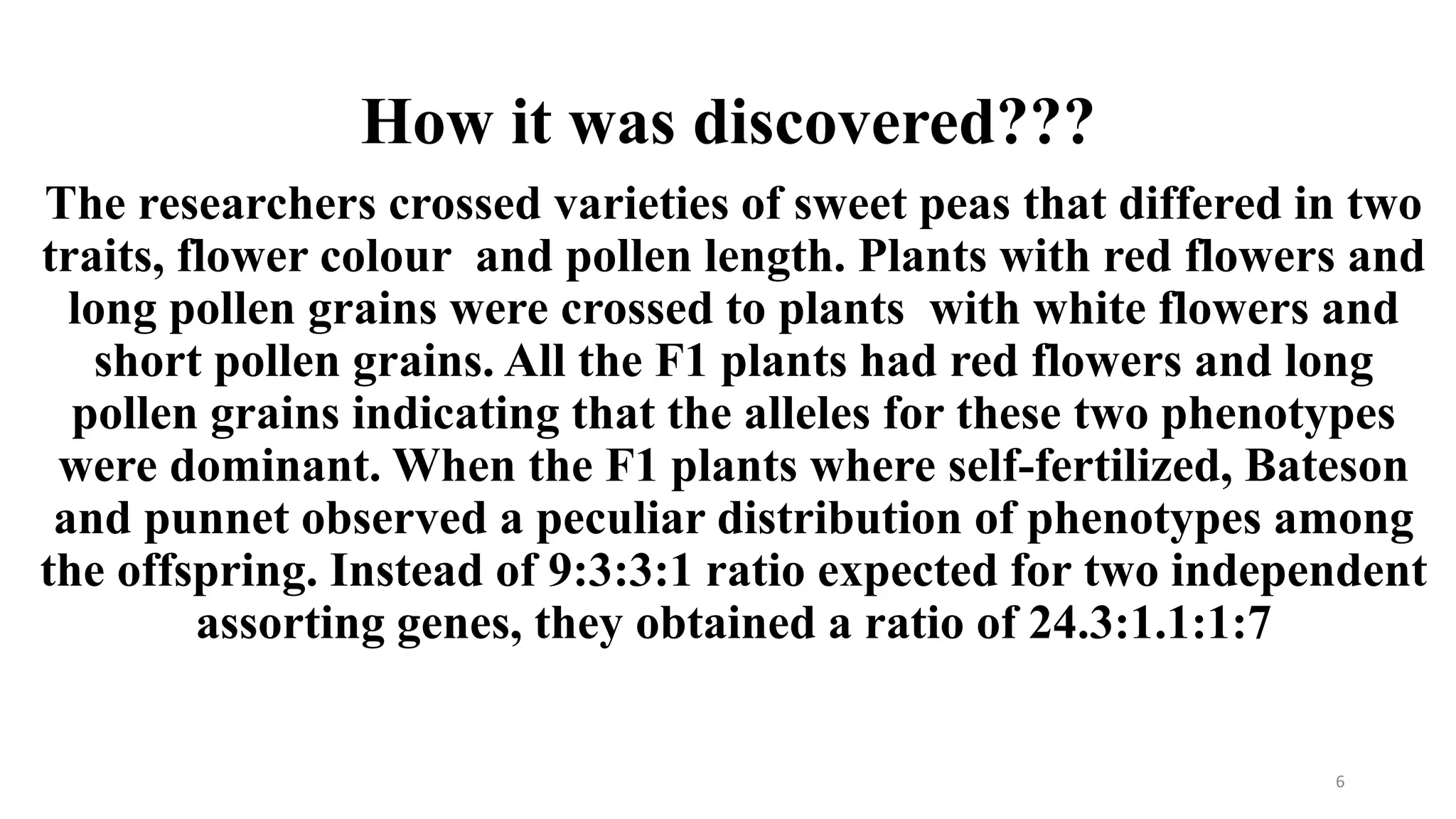
• Shortly after Mendel's work was rediscovered, exceptions to this rule were found. In
1906, the British geneticists William Bateson and Reginald Punnett discovered the
phenomenon of linkage in sweet pea (lathyrus odoratus).
• Genetic linkage is the most prominent exception to Gregor Mendel's Law of
Independent Assortment.
5
6.
How it wasdiscovered???
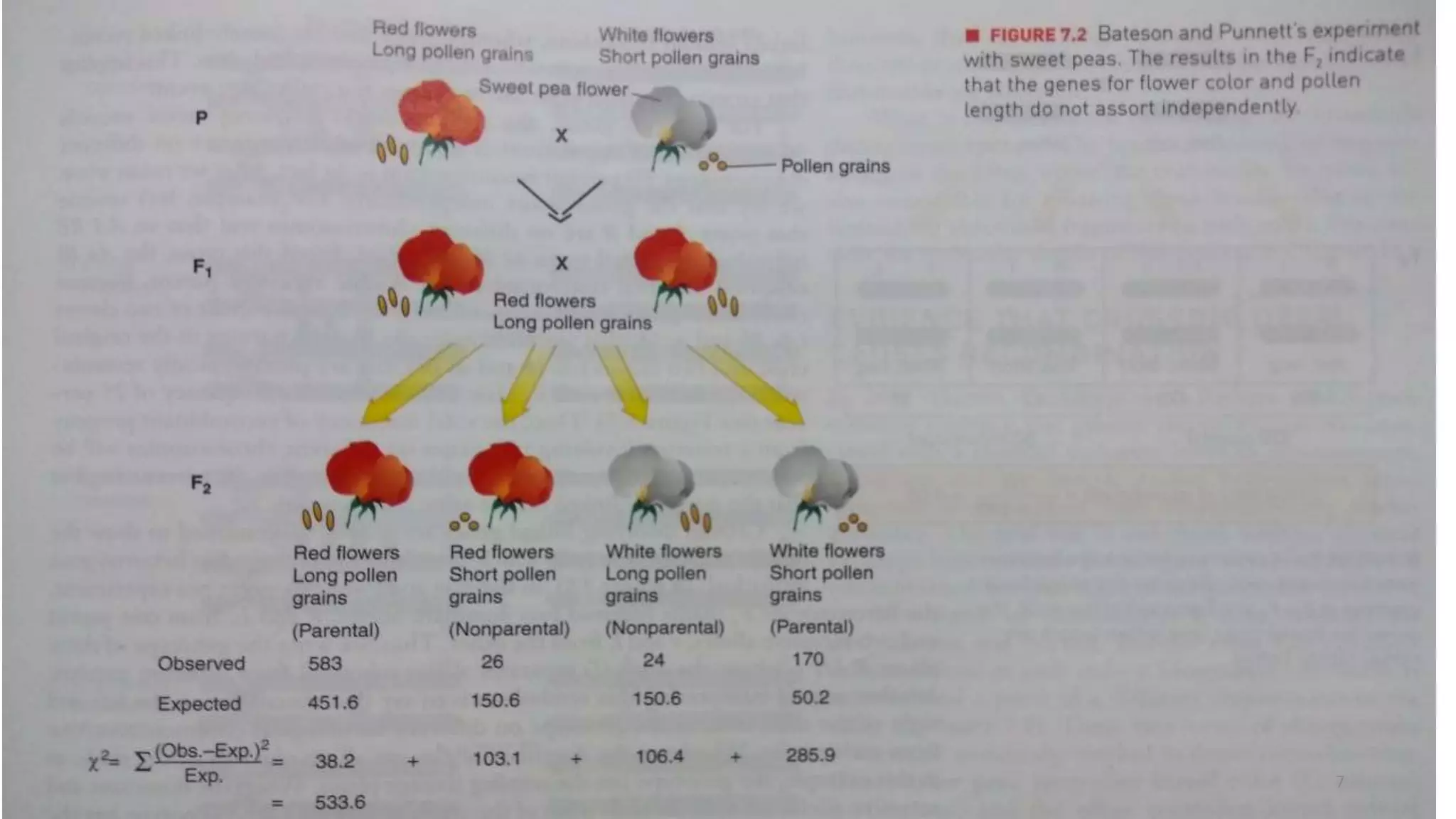
The researchers crossed varieties of sweet peas that differed in two
traits, flower colour and pollen length. Plants with red flowers and
long pollen grains were crossed to plants with white flowers and
short pollen grains. All the F1 plants had red flowers and long
pollen grains indicating that the alleles for these two phenotypes
were dominant. When the F1 plants where self-fertilized, Bateson
and punnet observed a peculiar distribution of phenotypes among
the offspring. Instead of 9:3:3:1 ratio expected for two independent
assorting genes, they obtained a ratio of 24.3:1.1:1:7
6
Can linked genesever
separate???
Yes they can , through recombination
8
9.
WHAT IS RECOMBINATION???
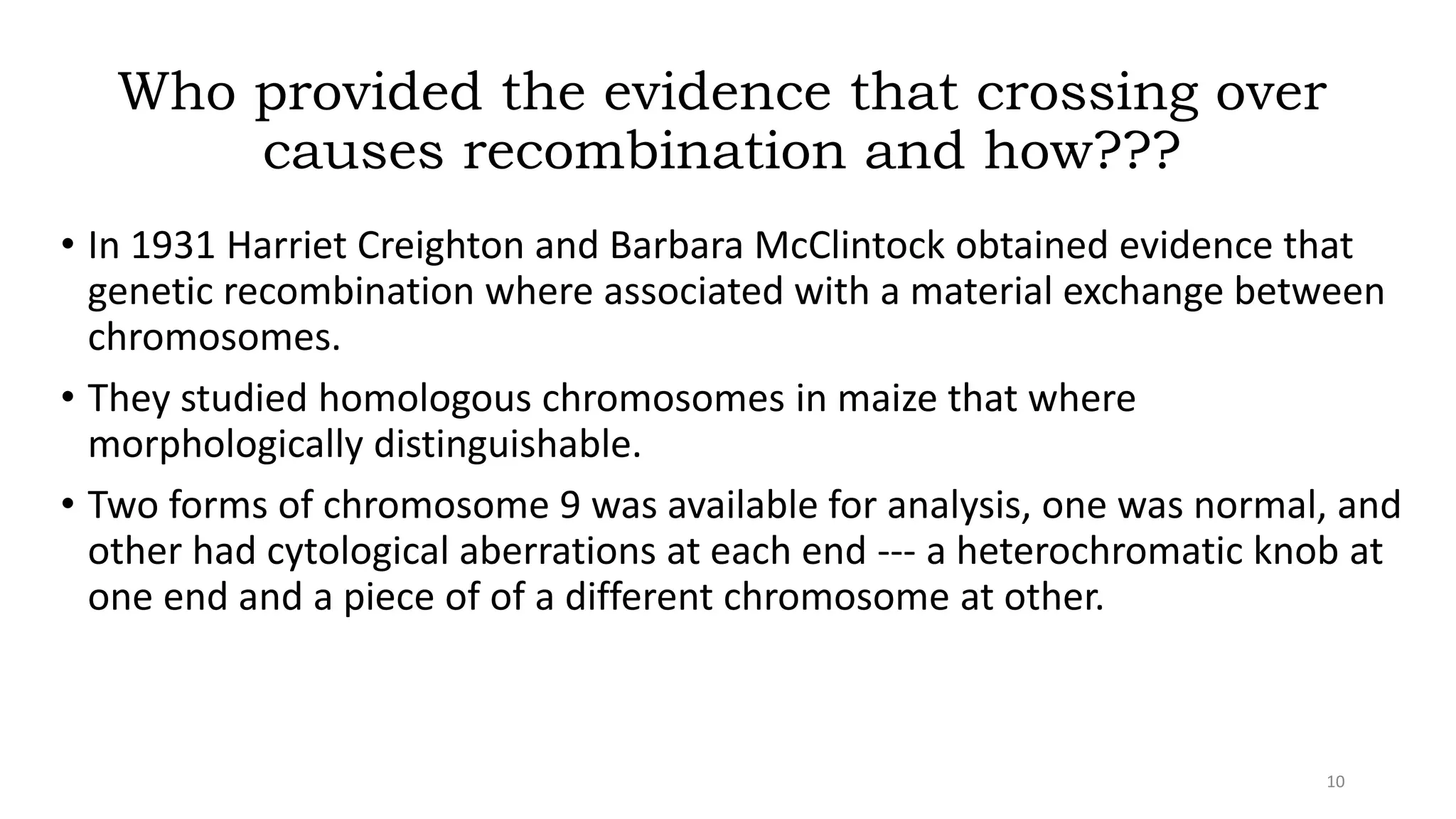
• Recombination is the process through which genes present on the
same chromosomes can be separated and new combination of genes
could be formed.
• Recombination is caused by a physical exchange between paired
homologous chromosomes early in prophase of the first meiotic
division after chromosomes have duplicated(crossing over).
• At any one point along a chromosome, the process of
exchange(crossing over) involves only two of four chromatids in a
meiotic tetrad.
• Late in prophase I, crossovers become visible as chiasmata
(chisamatype theory – janessens 1909).
9
10.
Who provided theevidence that crossing over
causes recombination and how???
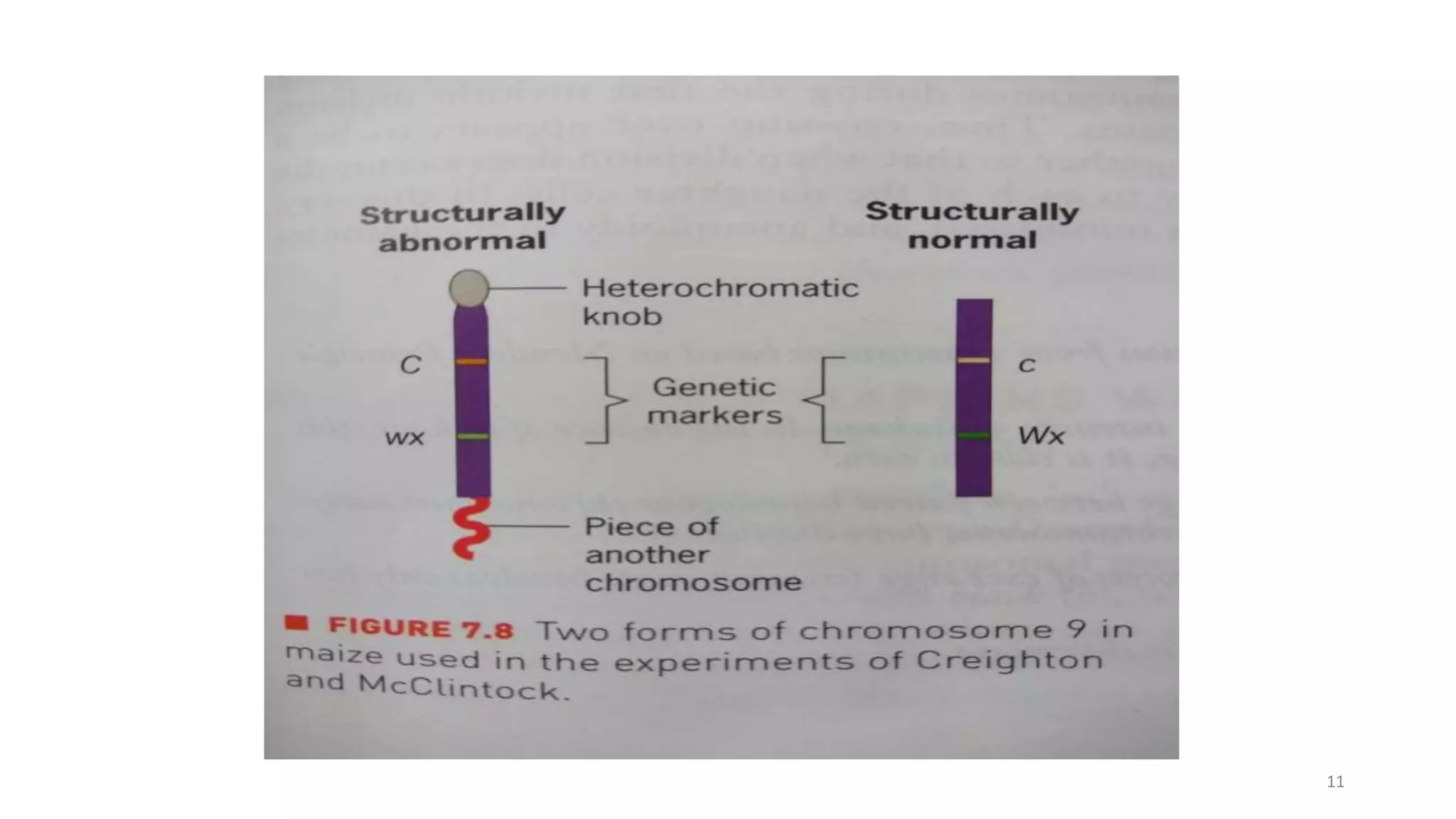
• In 1931 Harriet Creighton and Barbara McClintock obtained evidence that
genetic recombination where associated with a material exchange between
chromosomes.
• They studied homologous chromosomes in maize that where
morphologically distinguishable.
• Two forms of chromosome 9 was available for analysis, one was normal, and
other had cytological aberrations at each end --- a heterochromatic knob at
one end and a piece of of a different chromosome at other.
10
What is recombinationfrequency???
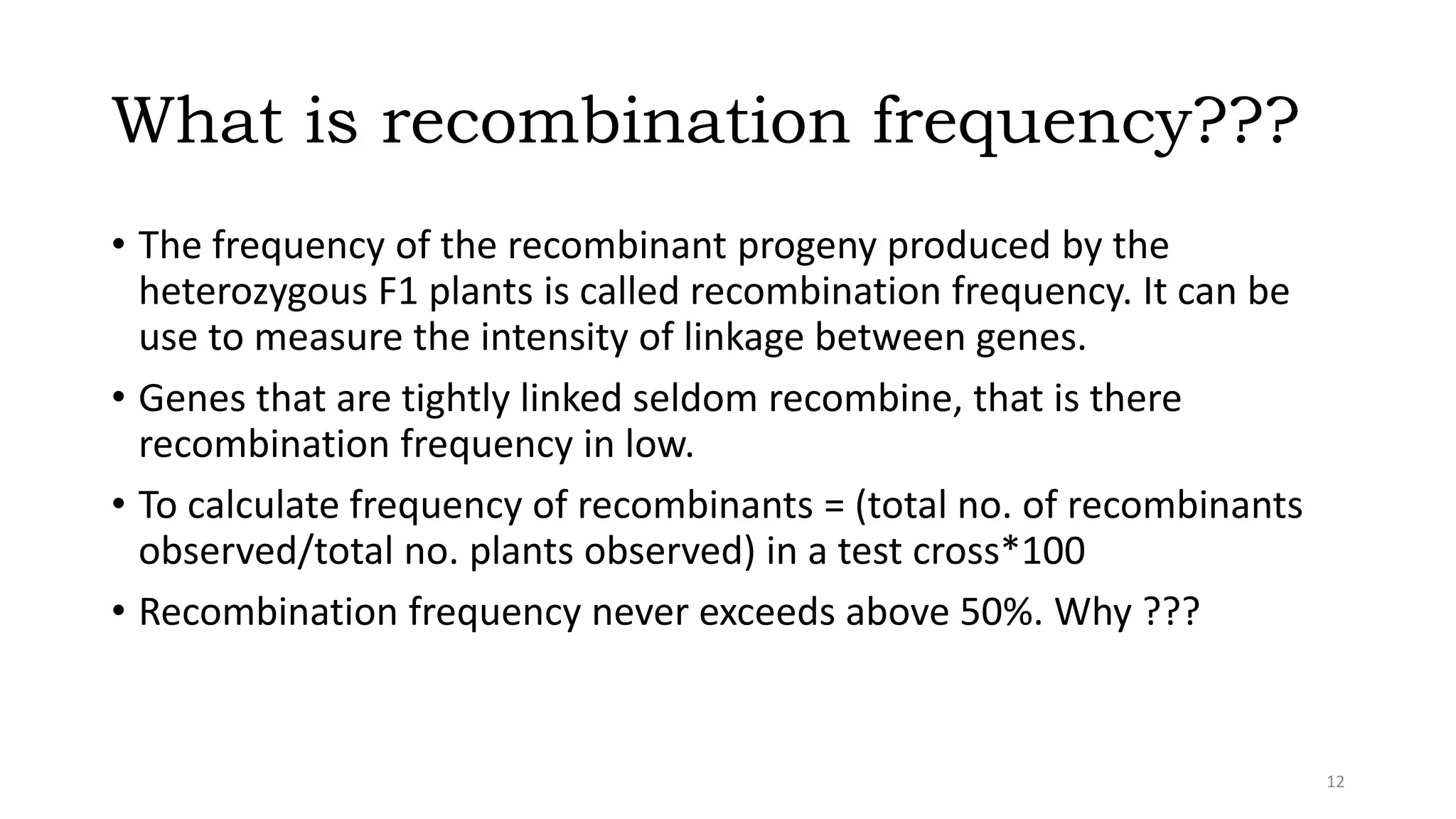
• The frequency of the recombinant progeny produced by the
heterozygous F1 plants is called recombination frequency. It can be
use to measure the intensity of linkage between genes.
• Genes that are tightly linked seldom recombine, that is there
recombination frequency in low.
• To calculate frequency of recombinants = (total no. of recombinants
observed/total no. plants observed) in a test cross*100
• Recombination frequency never exceeds above 50%. Why ???
12
13.
What are theFactors affecting
recombination frequency???
• Distance between the genes
• sex: heterogametic sex shows relatively lower recombinations (males) than homogametic
sex (females). Drosophila males present the extreme example as they show no
recombination between linked genes.
• age: progressive decline with age
• Temperature: lowest in drosophila 220C
• Nutrition
• Chemicals: antinomycin D promotes recombination
• Radiation: X-Rays and gamma rays increases recombination
• Chromosomal abbreviations: paracentric inversions, translocation, deletions
• Distance from centromere: centromere tends to suppress recombination while
recombination rates are much higher near telomeric regions. 13
14.
Types of linkage
•Complete linkage: when only parental character combinations are recovered
in test cross progeny, it is called complete linkage ex: male drosophila
• incomplete linkage: when recombinant types are also recovered with
parental types in test cross progeny it is called incomplete linkage
• A case of incomplete linkage is tight linkage in when genes are so closely
located that they may show very low frequency of recombination.
• Linkage is also classified as coupling phase (dominant alleles of linked genes
are present together) and repulsion phase linkage( dominant allele of gene is
linked with recessive allele of other gene).
• Sex linkage : linkage in genes present in sex chromosomes.
14
15.
What is alinkage group ???
• All genes that are linked together form a linkage group,
• The no. of different linkage groups in a species is, as a rule, equal to
its gametic chromosome no.
• Drosophila has 5 linkage group and human beings have 24 linkage
groups.
15
16.
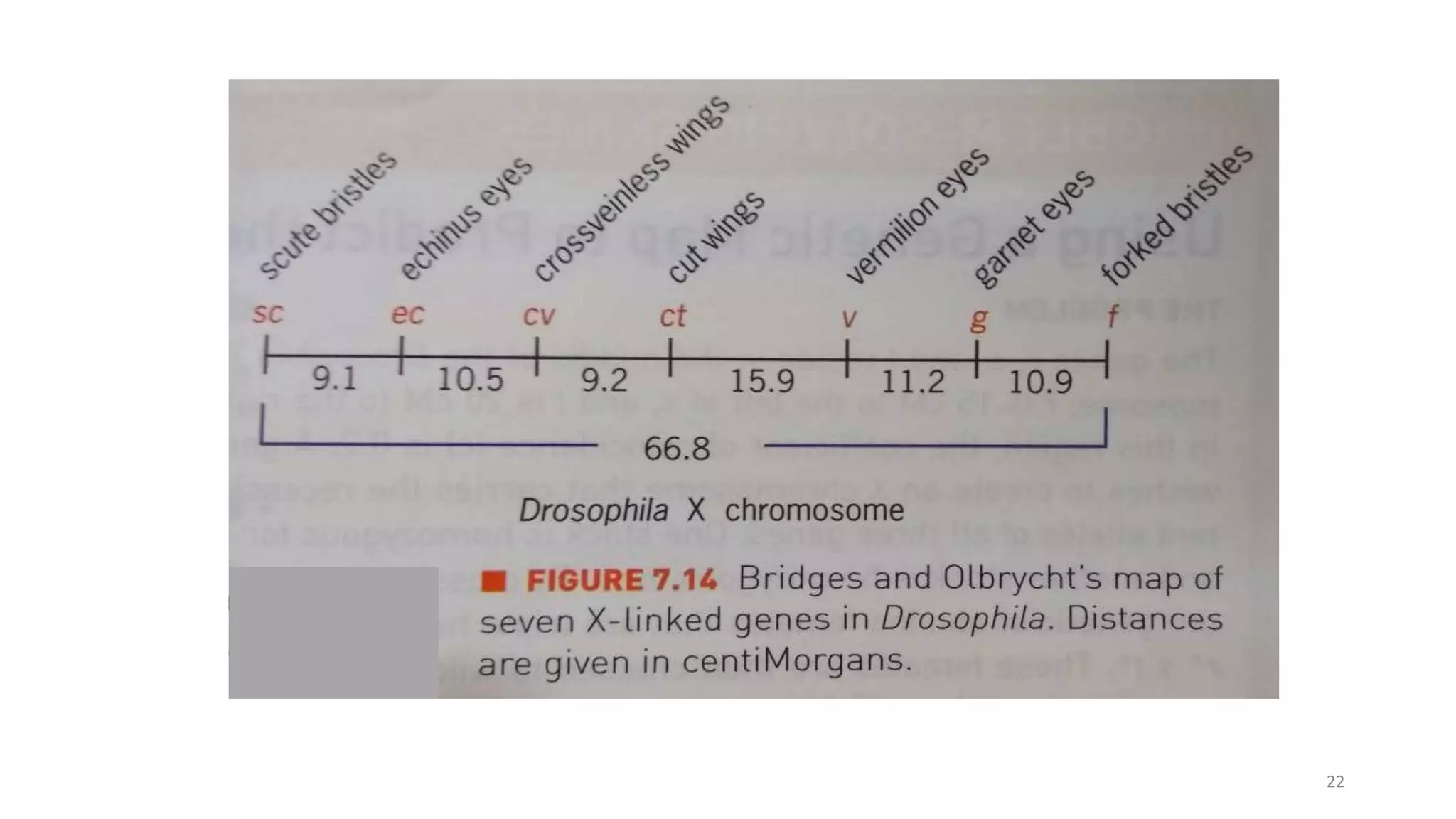
What is achromosome map how it is
created???
• A straight line drawing(supposing chromosome are linear), depicting the linked
genes and the distances (recombination frequencies) between them is known
as chromosome map.
• The procedure for chromosomal mapping was invented by Alfred H. Sturtvent
in 1911.
• Geneticists construct chromosome maps by counting the number of
crossovers that occur during meiosis. Since crossing over event can’t be seen
directly. So they must estimate the no. of crossovers have taken place by
counting either chiasmata(cytological analysis) or recombinant
chromosomes(genetic analysis).
• The distance between two points on genetic map of a chromosome is the
average number of crossovers between them.
16
17.
Recombinant mapping witha two
point testcross
• A two point test cross uses 2 loci to determine the distance between
them using the amount of average recombinants obtained from the
test cross.
How it is done ???
17
18.
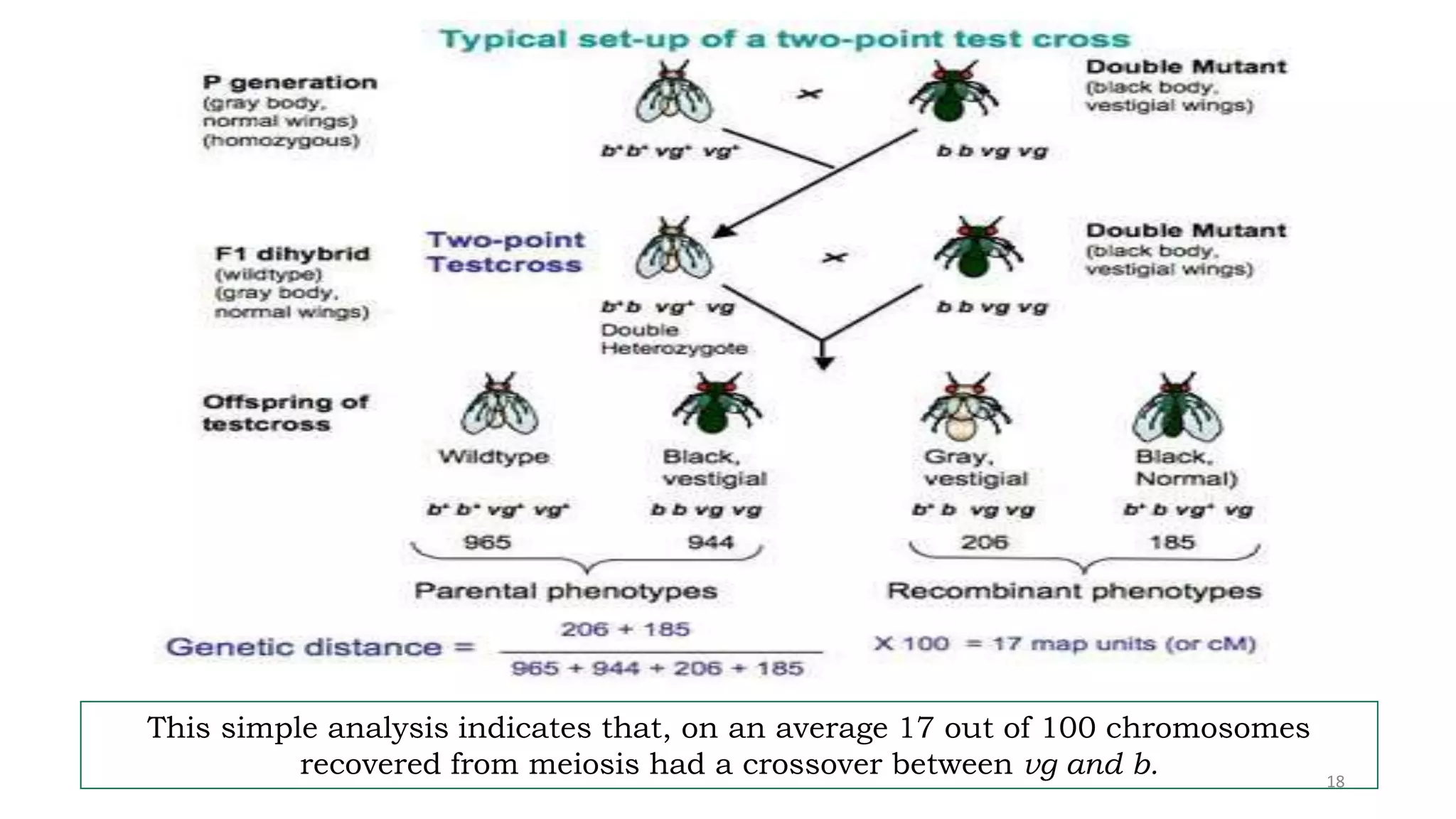
This simple analysisindicates that, on an average 17 out of 100 chromosomes
recovered from meiosis had a crossover between vg and b. 18
19.
What are limitationsof a two point
cross??
• We cant determine the relative order on the chromosome of the loci.
• As well as we cannot analyse the effect of multiple crossovers as two
crossovers between two loci can cause the chromosome to look as if
no cross overs took place, causing to underestimate map distances.
So what to do we do now???
Its simple, We take a third locus, between the first two, to
detect multiple cross over events.
19
20.
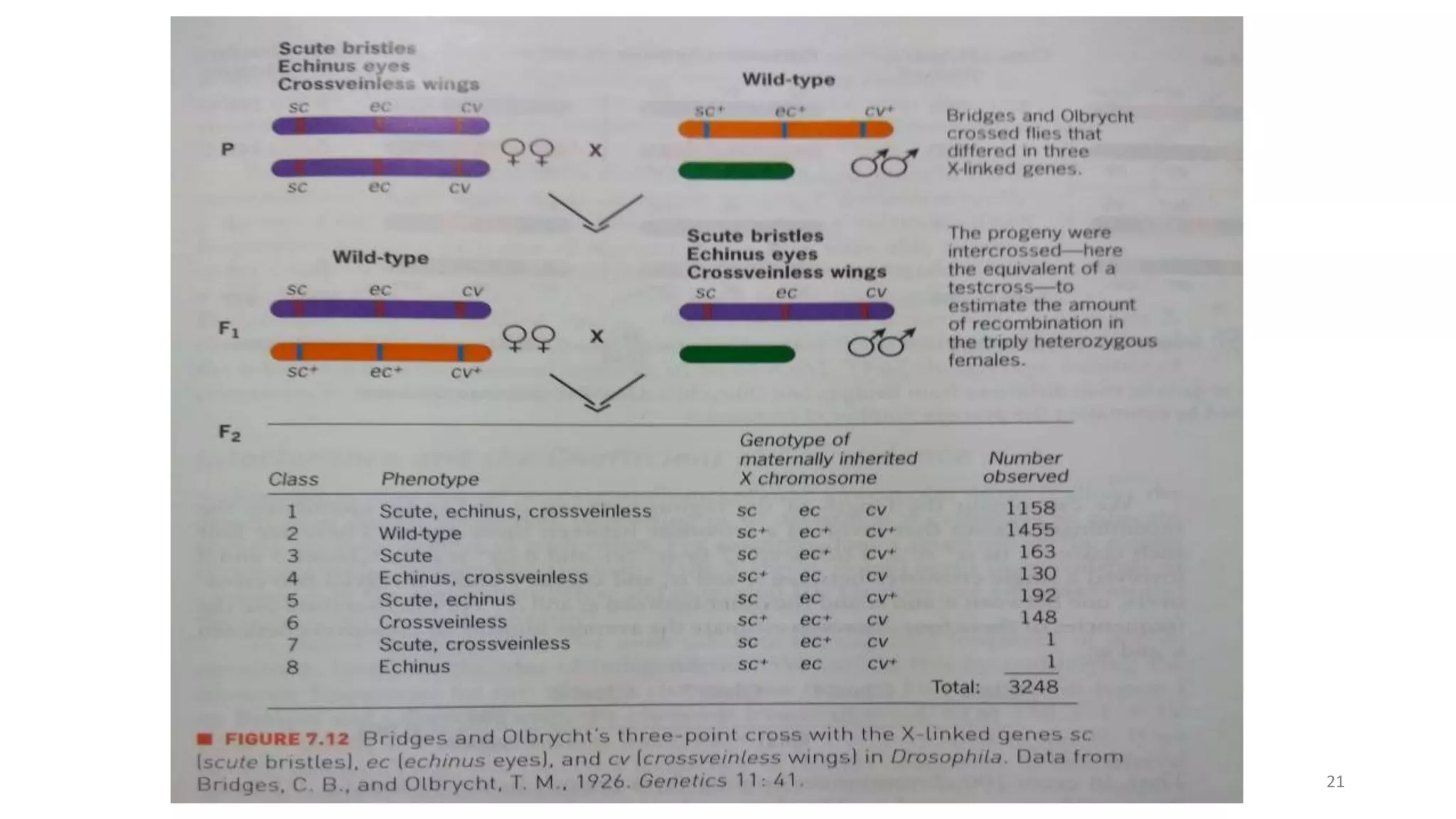
Recombination mapping witha three
point cross
• analysis of three loci, each segregating two alleles, is referred to as a
three-point cross.
• We can determine order of loci or genes in the chromosome.
• We can determine relative distance between the genes
• But we cannot distinguish right and left hand of chromosome.
How it is done ???
20
What is interference& Coefficient of
Coincidence ???
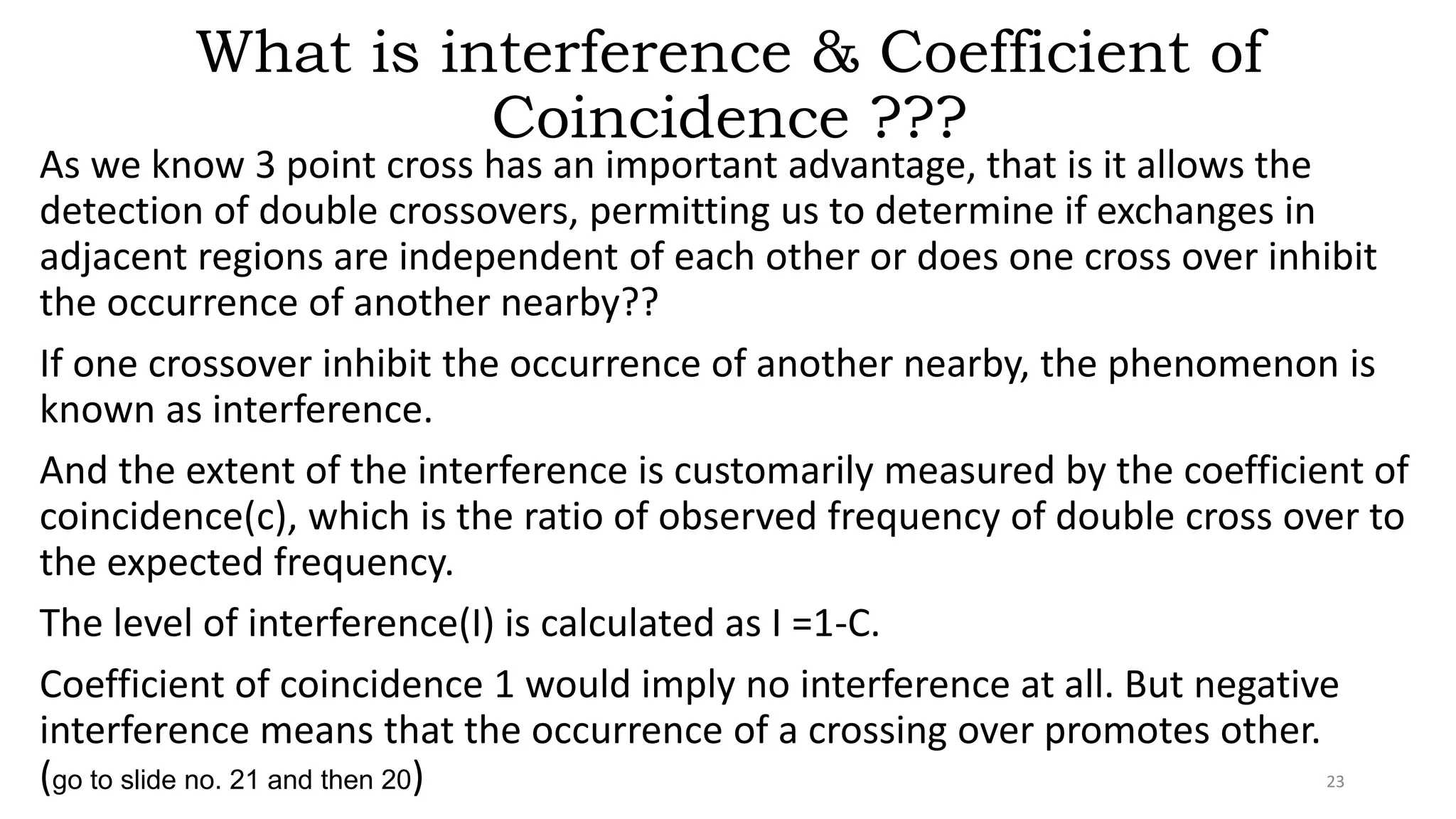
As we know 3 point cross has an important advantage, that is it allows the
detection of double crossovers, permitting us to determine if exchanges in
adjacent regions are independent of each other or does one cross over inhibit
the occurrence of another nearby??
If one crossover inhibit the occurrence of another nearby, the phenomenon is
known as interference.
And the extent of the interference is customarily measured by the coefficient of
coincidence(c), which is the ratio of observed frequency of double cross over to
the expected frequency.
The level of interference(I) is calculated as I =1-C.
Coefficient of coincidence 1 would imply no interference at all. But negative
interference means that the occurrence of a crossing over promotes other.
(go to slide no. 21 and then 20) 23
24.
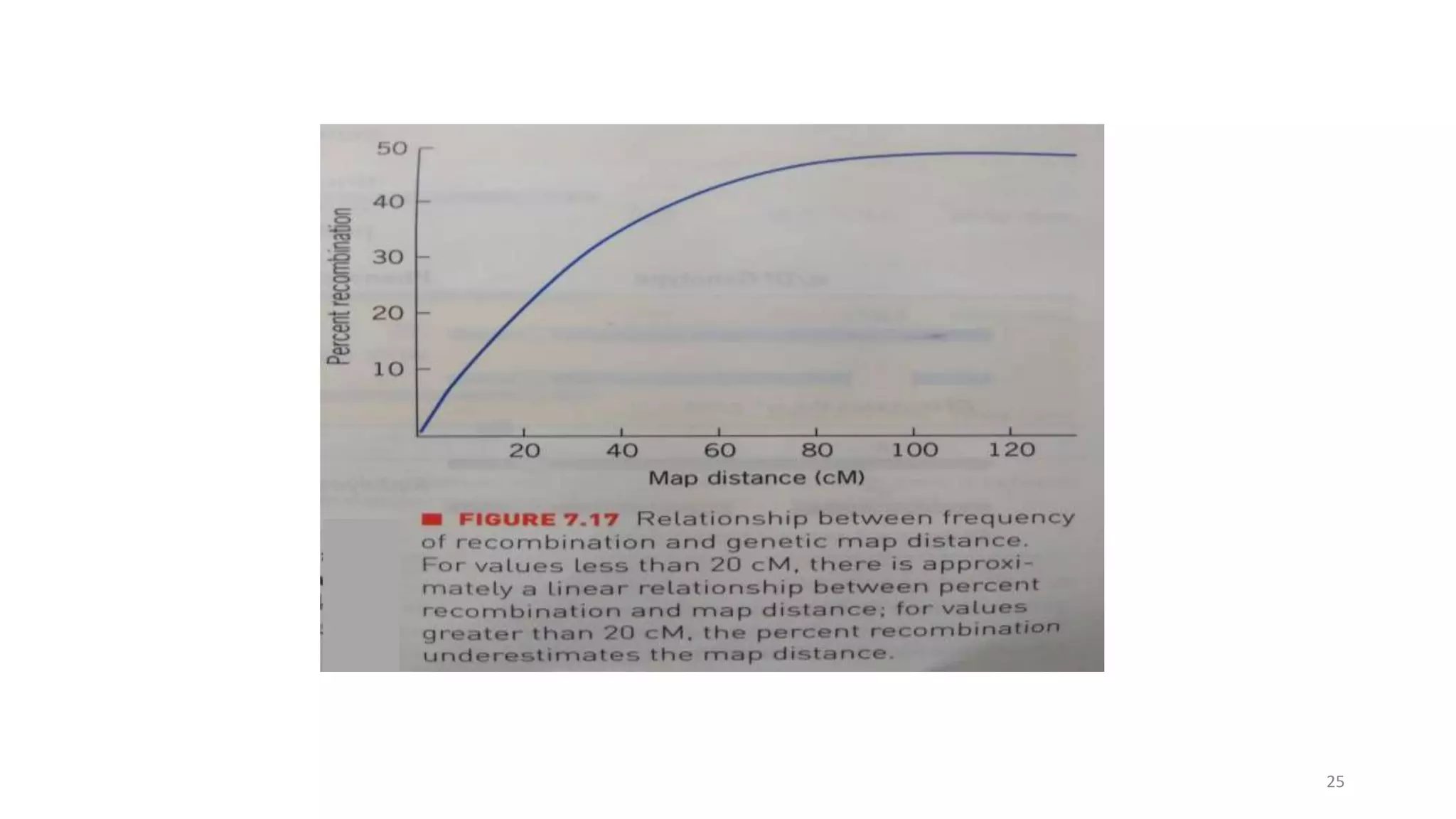
Does chromosome mapalways
tell true distances between
genes??
No, this method works well as long as genes are fairly close together.
However, when they are far apart, the frequency of recombination may not
reflect the true map distance
For example: go to slide no. 22
24
How are linkageanalysed in
humans???
• To detect and analyse linkage in humans, pedigree are used.
• A pedigree is a family tree tracing an trait of significance.
Various kinds traits include
sex linked dominant or recessive
sex limited ( secondary sexual characters in humans)
sex influenced ( baldness)
autosomal dominant or recessive
• pedigree analysis also provides estimates of recombination
frequencies to map genes on human chromosome.
26
27.
Is there aGenetic control for
recombination ??
yes, there is
• Recombination involves product of many genes, some of which play
role in chromosome pairing, others catalyse the process of exchange,
and still others help to rejoin broken chromatid segments.
• Inversions supress recombination as it supress crossing over
• Recombination can bring favourable mutation together.
27
28.
EXPERIMENT OF TH MORGAN
• In Drosophila, Both the white eye gene (w) and a
gene for miniature wings (m) are on the X
chromosome.
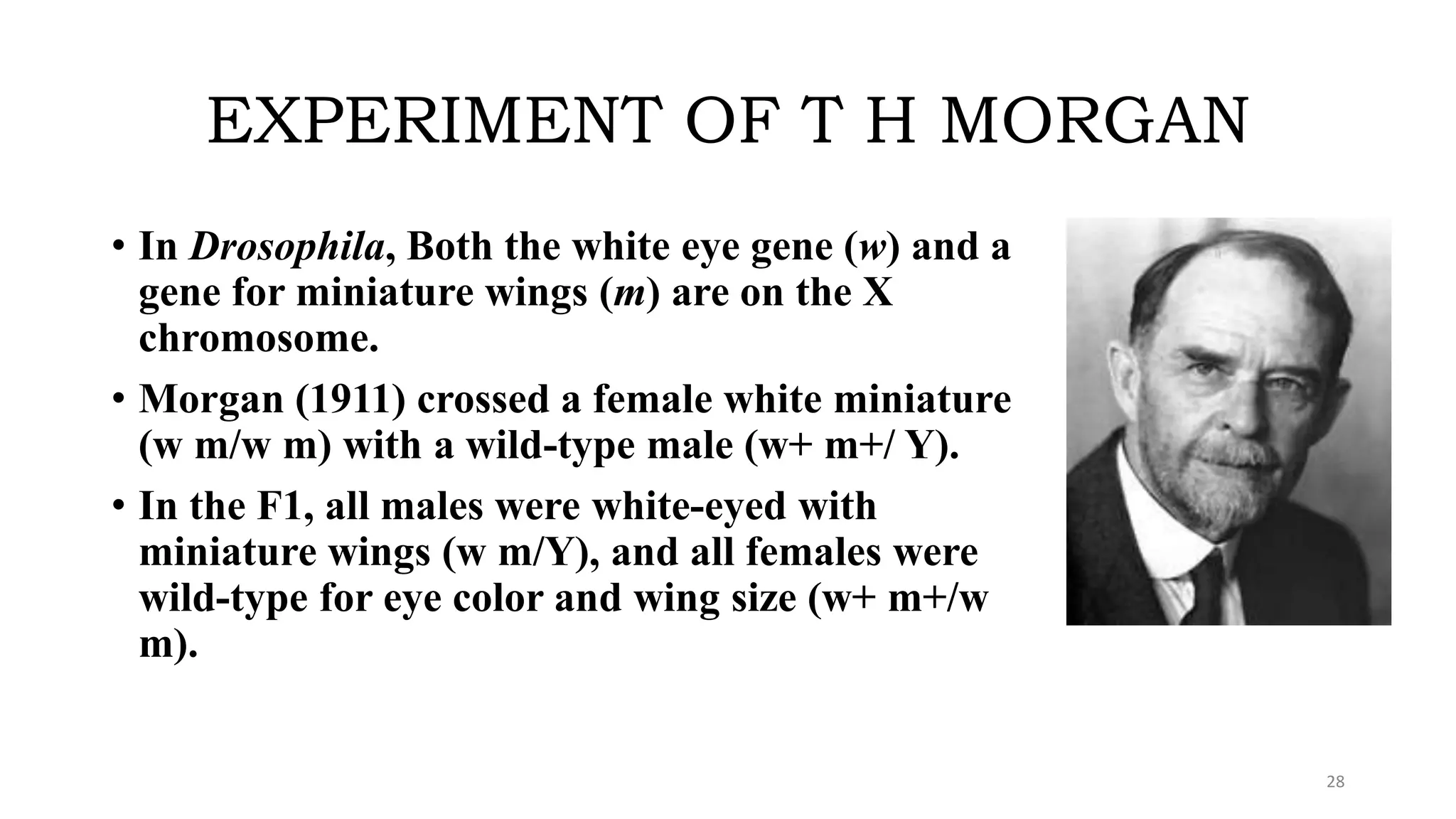
• Morgan (1911) crossed a female white miniature
(w m/w m) with a wild-type male (w+ m+/ Y).
• In the F1, all males were white-eyed with
miniature wings (w m/Y), and all females were
wild-type for eye color and wing size (w+ m+/w
m).
28
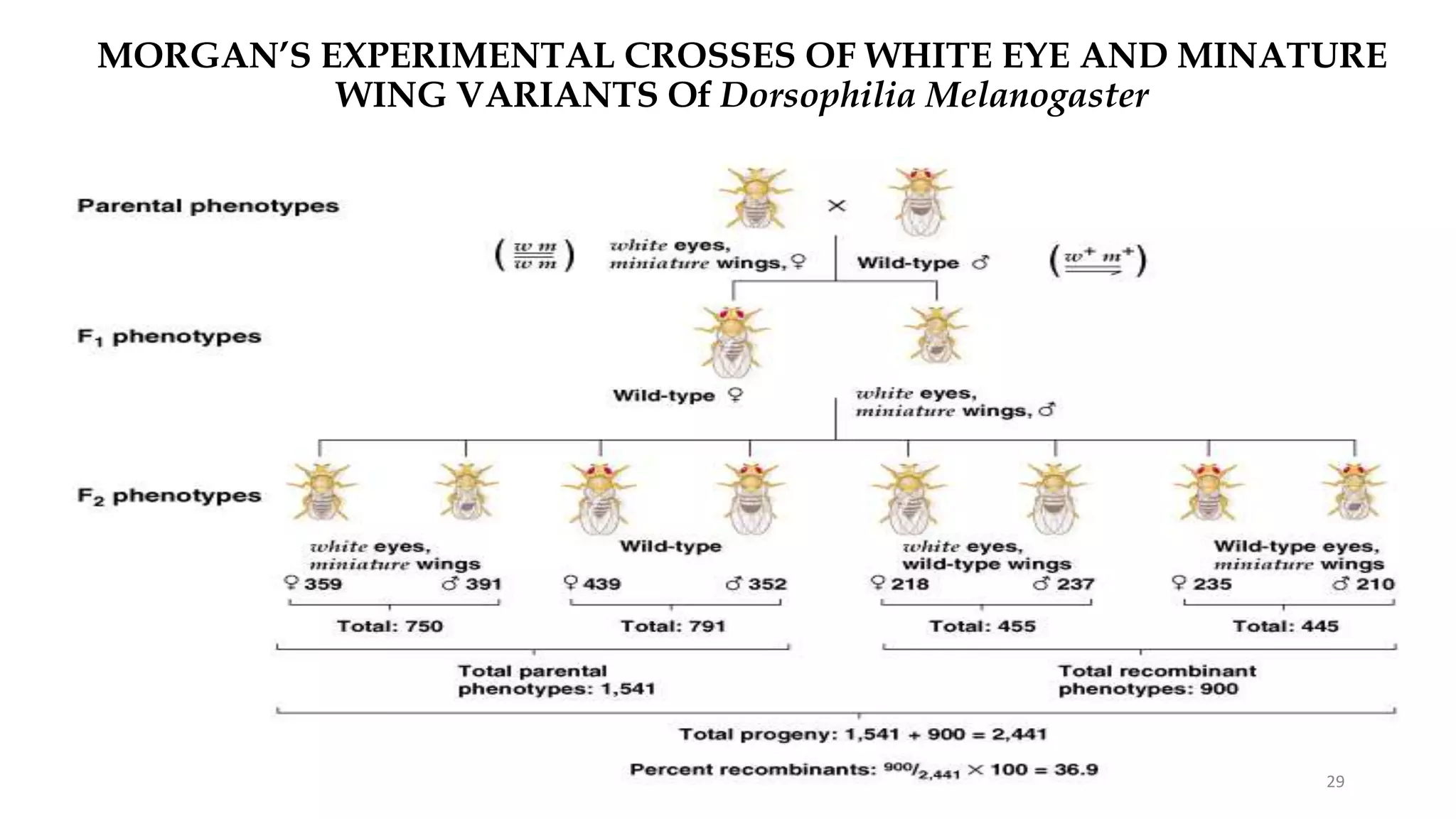
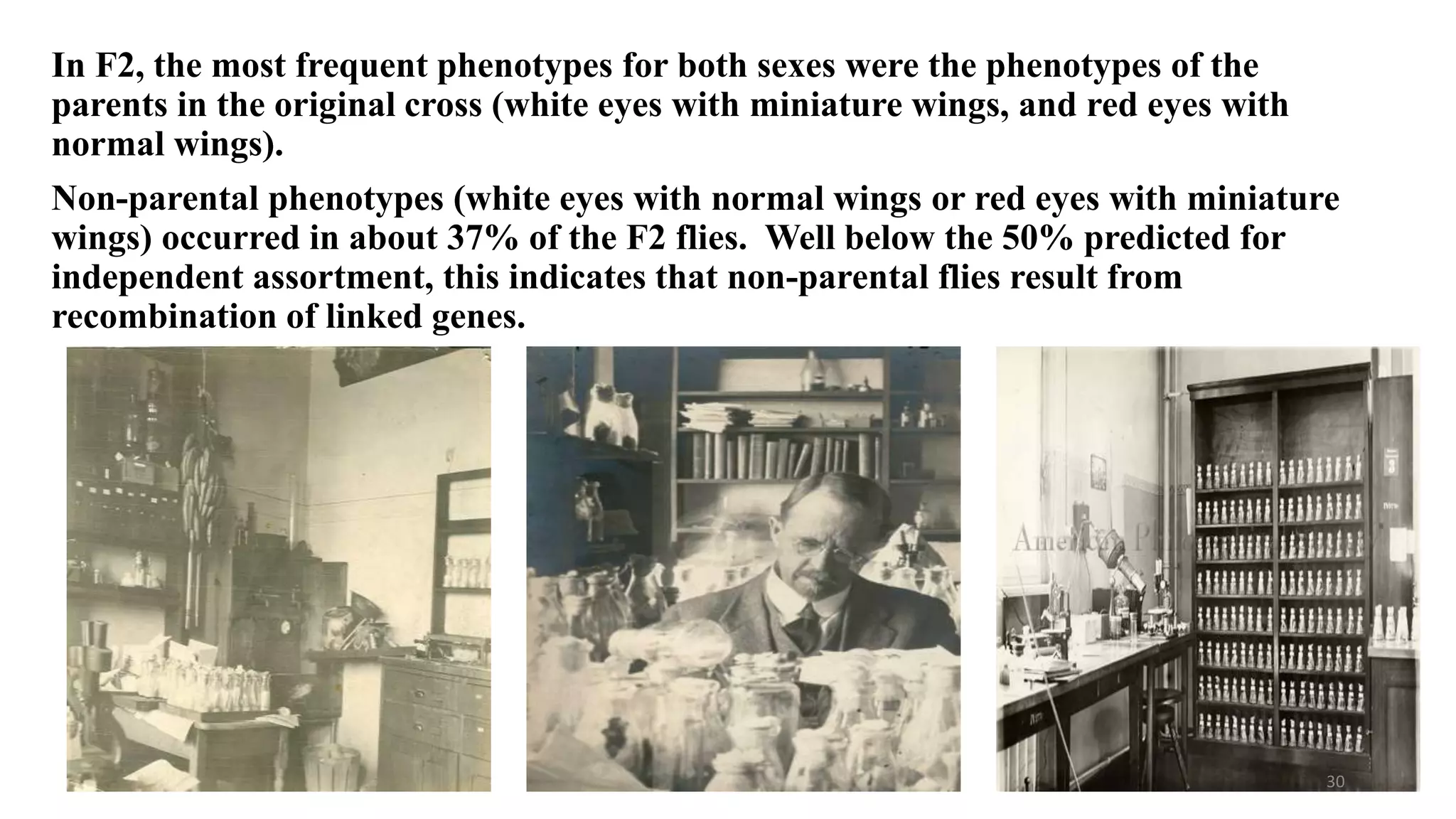
In F2, themost frequent phenotypes for both sexes were the phenotypes of the
parents in the original cross (white eyes with miniature wings, and red eyes with
normal wings).
Non-parental phenotypes (white eyes with normal wings or red eyes with miniature
wings) occurred in about 37% of the F2 flies. Well below the 50% predicted for
independent assortment, this indicates that non-parental flies result from
recombination of linked genes.
30