Linkage and Crossing Over
By
Dr. Krishna
Assistant Professor in Biotechnology
Tumkur University, Tumakuru
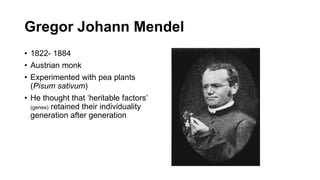
Gregor Johann Mendel
• 1822- 1884
• Austrian monk
• Experimented with pea plants
(Pisum sativum)
• He thought that ‘heritable factors’
(genes) retained their individuality
generation after generation
Terms to Know and Use
• Gene – A DNA blueprint controlling synthesis of a protein
• Trait - variant for a gene: i.e. a purple flower, determined by
alleles
• Dominant trait - expressed over recessive trait when both are
present
• Recessive trait - not expressed when the dominant trait is
present
• Co-Dominant – expressed as blended traits
• Allele - a variation of a gene responsible for different
traits, often represented as A or a
• Locus - location of a gene,or allele, on a chromosome
• Chromosome - strand of DNA containing the genes
• Haploid - one copy of a chromosome
• Diploid - two copies of a chromosome
• Gamete - a spermatozoa or oocyte (egg) cell, they are
haploid
• Zygote - cell resulting from the fusion of two gametes,
they are diploid
• Genotype - the type of alleles on a chromosome: genetic
makeup
• Phenotype - The way a genotype is expressed: i.e. the
color of a flower
• True breeding line - organisms that always pass the same
genotype to their offspring
• Hybrid - offspring resulting from crossbreeding two true
breeding lines: F1
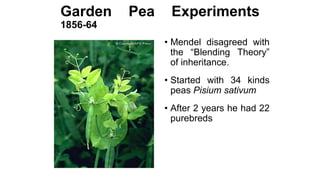
Garden Pea Experiments
1856-64
• Mendel disagreed with
the “Blending Theory”
of inheritance.
• Started with 34 kinds
peas Pisium sativum
• After 2 years he had 22
purebreds
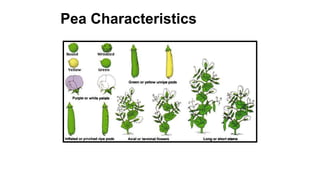
Pea Characteristics
Trait on the left is dominant. Trait on the right is recessive.
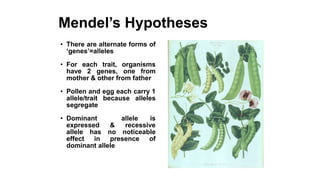
Mendel’s Hypotheses
• There are alternate forms of
‘genes’=alleles
• For each trait, organisms
have 2 genes, one from
mother & other from father
• Pollen and egg each carry 1
allele/trait because alleles
segregate
• Dominant allele is
expressed & recessive
allele has no noticeable
effect in presence of
dominant allele
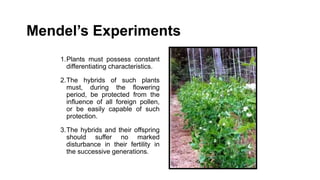
Mendel’s Experiments
1.Plants must possess constant
differentiating characteristics.
2.The hybrids of such plants
must, during the flowering
period, be protected from the
influence of all foreign pollen,
or be easily capable of such
protection.
3.The hybrids and their offspring
should suffer no marked
disturbance in their fertility in
the successive generations.
Mendel's Laws of Inheritance
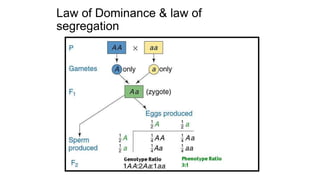
• Law of Dominance In F1 generation only
dominant allele is expressed
• Law of Segregation during gamete formation
allele pairs separate or segregate, into different
gametes
• Law of Independent Assortment suggested that
each allele pair segregates independently of
other gene pairs during gamete formation
(Demonstrated with a dihybrid cross).
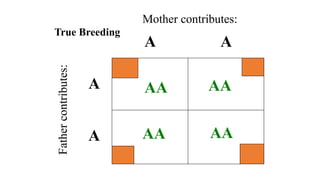
A A
A
A
AA
AA
AA
AA
Mother contributes:
or
True Breeding
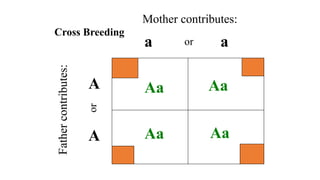
a a
A
A
Aa
Aa
Aa
Aa
Mother contributes:
or
Cross Breeding
Law of Dominance & law of
segregation
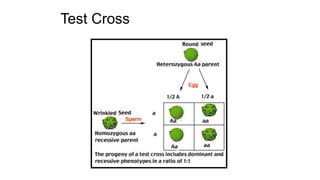
Test Cross
Dihybrid Cross
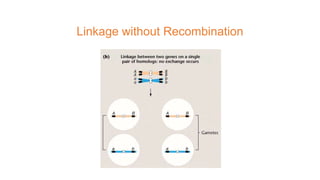
Linkage:
When two or more characters of parents are transmitted to the offsprings of few generations such as F1, F2, F3
etc. without any recombination, they are called as the linked characters and the phenomenon is called as
linkage.
• This is a deviation from the Mendelian principle of independent assortment.
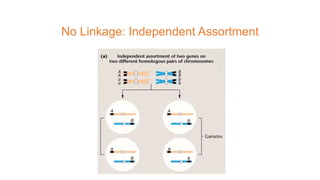
• Mendel’s law of independent assortment is applicable to the genes that are situated in separate
chromosomes. When genes for different characters are located in the same chromosome, they are tied to
one another and are said to be linked.
• They are inherited together by the offspring and will not be assorted independently. Thus, the tendency of
two or more genes of the same chromosome to remain together in the process of inheritance is called
linkage.
Coupling vs. Repulsion
• The original test cross we did was PL/pl x p l. Among the offspring, PL and pl were
parental types, and pL and Pl were the recombinant types. There was 24.3%
recombination between the genes.
• The condition of having the dominant alleles for both genes on the same parental
chromosome, with both recessives on the other parental chromosome, is called
“coupling”: the P and L genes are “in coupling phase”.
• The opposite condition, having one dominant and one recessive on each parental
chromosome, is called “repulsion”. Thus, if the original parents were P l x p L,
their offspring would have the genes in repulsion phase: Pl / pL.
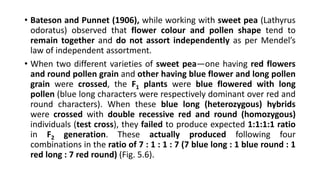
• Bateson and Punnet (1906), while working with sweet pea (Lathyrus
odoratus) observed that flower colour and pollen shape tend to
remain together and do not assort independently as per Mendel’s
law of independent assortment.
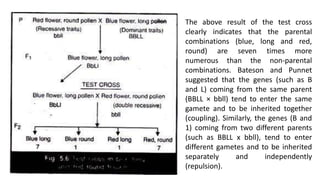
• When two different varieties of sweet pea—one having red flowers
and round pollen grain and other having blue flower and long pollen
grain were crossed, the F1 plants were blue flowered with long
pollen (blue long characters were respectively dominant over red and
round characters). When these blue long (heterozygous) hybrids
were crossed with double recessive red and round (homozygous)
individuals (test cross), they failed to produce expected 1:1:1:1 ratio
in F2 generation. These actually produced following four
combinations in the ratio of 7 : 1 : 1 : 7 (7 blue long : 1 blue round : 1
red long : 7 red round) (Fig. 5.6).
The above result of the test cross
clearly indicates that the parental
combinations (blue, long and red,
round) are seven times more
numerous than the non-parental
combinations. Bateson and Punnet
suggested that the genes (such as B
and L) coming from the same parent
(BBLL × bbll) tend to enter the same
gamete and to be inherited together
(coupling). Similarly, the genes (B and
1) coming from two different parents
(such as BBLL x bbll), tend to enter
different gametes and to be inherited
separately and independently
(repulsion).
Morgan’s View of Linkage:
• Morgan (1910), while working on Drosophila stated that coupling and
repulsion are two aspects of linkage. He defined linkage as the
tendency of genes, present in the same chromosome, to remain in
their original combination and to enter together in the same gamete.’
• The genes located on the same chromosome and are being inherited
together are known as linked genes, and the characters controlled by
these are known as linked characters. Their recombination frequency
is always less than 50%. All those genes which are located in the
single chromosome form one linkage group. The total number of
linkage group in an organism corresponds to the number of
chromosome pairs. For example, there are 23 linkage groups in man,
7 in sweet pea and 4 in Drosophila melanogaster.
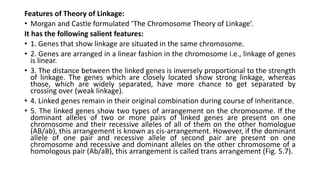
Features of Theory of Linkage:
• Morgan and Castle formulated ‘The Chromosome Theory of Linkage’.
It has the following salient features:
• 1. Genes that show linkage are situated in the same chromosome.
• 2. Genes are arranged in a linear fashion in the chromosome i.e., linkage of genes
is linear.
• 3. The distance between the linked genes is inversely proportional to the strength
of linkage. The genes which are closely located show strong linkage, whereas
those, which are widely separated, have more chance to get separated by
crossing over (weak linkage).
• 4. Linked genes remain in their original combination during course of inheritance.
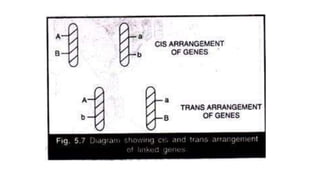
• 5. The linked genes show two types of arrangement on the chromosome. If the
dominant alleles of two or more pairs of linked genes are present on one
chromosome and their recessive alleles of all of them on the other homologue
(AB/ab), this arrangement is known as cis-arrangement. However, if the dominant
allele of one pair and recessive allele of second pair are present on one
chromosome and recessive and dominant alleles on the other chromosome of a
homologous pair (Ab/aB), this arrangement is called trans arrangement (Fig. 5.7).
No Linkage: Independent Assortment
Linkage without Recombination
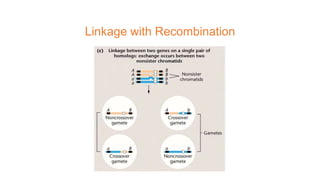
Linkage with Recombination
Examples of Linkage:
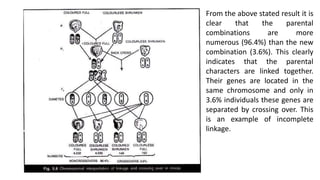
In MAIZE:
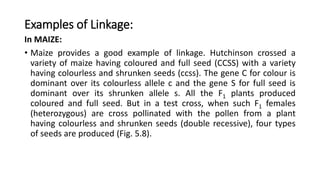
• Maize provides a good example of linkage. Hutchinson crossed a
variety of maize having coloured and full seed (CCSS) with a variety
having colourless and shrunken seeds (ccss). The gene C for colour is
dominant over its colourless allele c and the gene S for full seed is
dominant over its shrunken allele s. All the F1 plants produced
coloured and full seed. But in a test cross, when such F1 females
(heterozygous) are cross pollinated with the pollen from a plant
having colourless and shrunken seeds (double recessive), four types
of seeds are produced (Fig. 5.8).
From the above stated result it is
clear that the parental
combinations are more
numerous (96.4%) than the new
combination (3.6%). This clearly
indicates that the parental
characters are linked together.
Their genes are located in the
same chromosome and only in
3.6% individuals these genes are
separated by crossing over. This
is an example of incomplete
linkage.
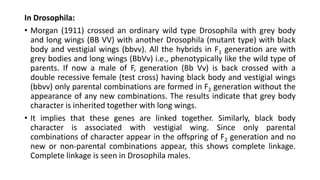
In Drosophila:
• Morgan (1911) crossed an ordinary wild type Drosophila with grey body
and long wings (BB VV) with another Drosophila (mutant type) with black
body and vestigial wings (bbvv). All the hybrids in F1 generation are with
grey bodies and long wings (BbVv) i.e., phenotypically like the wild type of
parents. If now a male of F, generation (Bb Vv) is back crossed with a
double recessive female (test cross) having black body and vestigial wings
(bbvv) only parental combinations are formed in F2 generation without the
appearance of any new combinations. The results indicate that grey body
character is inherited together with long wings.
• It implies that these genes are linked together. Similarly, black body
character is associated with vestigial wing. Since only parental
combinations of character appear in the offspring of F2 generation and no
new or non-parental combinations appear, this shows complete linkage.
Complete linkage is seen in Drosophila males.
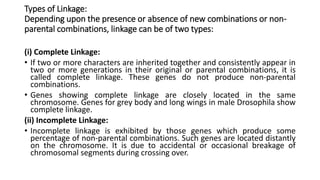
Types of Linkage:
Depending upon the presence or absence of new combinations or non-
parental combinations, linkage can be of two types:
(i) Complete Linkage:
• If two or more characters are inherited together and consistently appear in
two or more generations in their original or parental combinations, it is
called complete linkage. These genes do not produce non-parental
combinations.
• Genes showing complete linkage are closely located in the same
chromosome. Genes for grey body and long wings in male Drosophila show
complete linkage.
(ii) Incomplete Linkage:
• Incomplete linkage is exhibited by those genes which produce some
percentage of non-parental combinations. Such genes are located distantly
on the chromosome. It is due to accidental or occasional breakage of
chromosomal segments during crossing over.
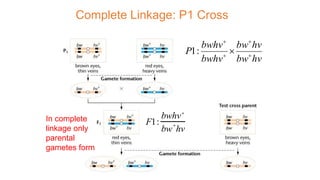
Complete Linkage: P1 Cross
In complete
linkage only
parental
gametes form
hvbw
hvbw
bwhv
bwhv
P 



:1
F1:
bwhv
bw

hv
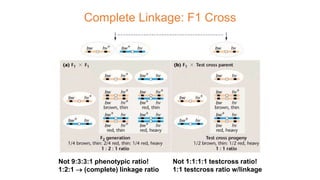
Not 9:3:3:1 phenotypic ratio!
1:2:1  (complete) linkage ratio
Not 1:1:1:1 testcross ratio!
1:1 testcross ratio w/linkage
Complete Linkage: F1 Cross
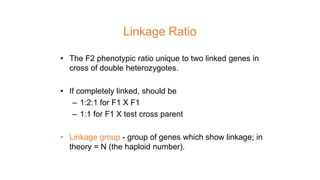
Linkage Ratio
• The F2 phenotypic ratio unique to two linked genes in
cross of double heterozygotes.
• If completely linked, should be
– 1:2:1 for F1 X F1
– 1:1 for F1 X test cross parent
• Linkage group - group of genes which show linkage; in
theory = N (the haploid number).
Significance of Linkage:
• (i) Linkage plays an important role in determining the nature of scope
of hybridization and selection programmes.
• (ii) Linkage reduces the chance of recombination of genes and thus
helps to hold parental characteristics together. It thus helps organism
to maintain its parental, racial and other characters. For this reason
plant and animal breeders find it difficult to combine various
characters.
Crossing Over or Recombination:
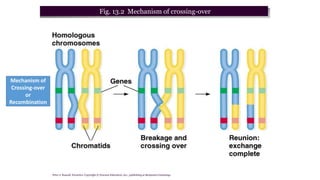
• Crossing over or recombination actually results from exchange of
chromosome segments which is believed to take place during
prophase I of meiosis. During prophase I of meiosis, homologous
chromosomes are brought together during synapsis at zygotene. Each
chromosome also divides longitudinally into two chromatids at this
stage. At pachytene, chromatids exchange segments. Homologous
centromeres then start separating away from one another
(terminalization) and figures of chiasmata are theTesult and not the
cause of crossing over.
Crossing over and chiasma formation
There are two theories to explain the relationship between crossing over and
chiasma formation. These two theories will be briefly discussed in this
section.
• Classical theory or two plane theory.
This theory was proposed by L.W. Sharp in his book Introduction to Cytology,
published in 1934. According to this theory, formation of chiasmata precedes
the act of genetic crossing over, so that chiasmata are not the result but the
cause of crossing over. Moreover in such an interpretation, it is not necessary
that there is one to one relationship between chiasmata and crossing over.
The chiasmata, in this theory, represent points of accidental physical crossing
of homologous, but non-sister chromatids. These chiasmata may or may not
lead to breakage and subsequent exchange of chromosome segments, but
whenever crossing over occurs, this results due to strain imposed by chiasma
formation. In such a hypothesis, adjacent loops will have equational (sister
chromatids separating) and reductional (sister chromatids not separating)
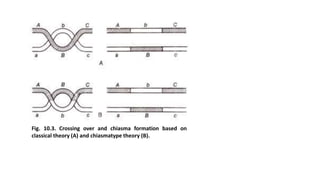
separation of chromatids (Fig. 10.3 A). This theory is also known as two
plane theory because it is assumed that adjacent loops would be present in
different planes at right angle to each other.
• Chiasma type theory or one plane theory.
1. Chiasmatype theory was proposed by F.A. Janssens in 1909 and was
extended in 1924. It was later fully developed by J. Belling and by CD.
Darlington. According to this theory, true chiasmata are the direct result
of crossing over so that crossing over really precedes chiasma formation.
As opposed to classical theory, in chiasmatype theory, crossing over
results from breakage followed by reunion or exchange of non-sister
chromatid segments from homologous chromosomes. Since in this
theory, chiasmata are the result of crossing over, there would be one to
one relationship between the chiasmata and crossing over. This theory is
also called one plane theory as against two plane theory discussed
above. In this theory, one would expect reductional separation of
chromatids on either side of a chiasma (Fig. 10.3 B).
2. The classical theory or the two plane theory is now of only historical
importance, since all available experimental evidence goes in favour of
'chiasmatype theory' or 'one plane theory.'
Fig. 10.3. Crossing over and chiasma formation based on
classical theory (A) and chiasmatype theory (B).
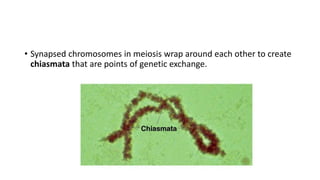
• Synapsed chromosomes in meiosis wrap around each other to create
chiasmata that are points of genetic exchange.
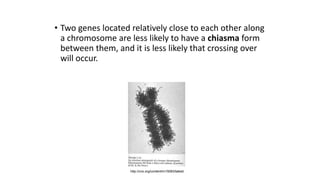
• Two genes located relatively close to each other along
a chromosome are less likely to have a chiasma form
between them, and it is less likely that crossing over
will occur.
http://cnx.org/content/m15083/latest/
Peter J. Russell, iGenetics: Copyright © Pearson Education, Inc., publishing as Benjamin Cummings.
Fig. 13.2 Mechanism of crossing-over
Mechanism of
Crossing-over
or
Recombination
• Crossing Over In classical theory and chiasmatype theory discussed
above, there was an emphasis on causal relationship between
chiasmata and crossing over. It has, however, been difficult to explain
how exchange of segments or recombination of gene clusters is
brought about. There were at least two theories available initially to
explain this, but newer hypotheses were proposed later. Only these
two earlier theories and the more recent hybrid DNA models will be
discussed here in brief. Molecular Mechanisms of Recombination
should be consulted for a more detailed study of the mechanism of
genetic recombination at the molecular level. Such a detailed account
is also available in the book 'Towards an Understanding of the
Mechanism of Heredity' by H.L.K. Whitehouse, who had himself put
forward a popular Polaron Hybrid DNA Model to explain the
mechanism of crossing over at the molecular level.
Mechanism of genetic recombination
• Precocity theory. Precocity theory of CD. Darlington is ordinarily discussed in context
with meiotic chromosome pairing. However, Darlington extended this theory to explain
recombination also. The theory assumes that prophase is precocious in meiotic cell
division and therefore involves homologous pairing to satisfy the pairing need, which is
achieved in mitosis due to duplication of chromosomes. This theory is now untenable in
the light of recent information that DNA synthesis really takes place before the onset of
prophase I in meiosis, although synthesis of a very small fraction of DNA called zygotene
DNA (zyg DNA) (0.1 to 0.2%) is delayed till zygotene. Precocity theory presumes that
DNA synthesis or chromosome duplication takes place later in pachytene or diplotene
and then results in separation of homologous chromosomes (terminalization). On the
basis of precocity theory, Darlington explained crossing over to be the result of strain or
torsion produced due to coiling of homologous chromosomes and sister chromatids.
Belling's hypothesis and copy choice model. In making a distinction between chiasmata
and crossing over, we concluded earlier that crossing over or exchange of chromosome
segments (which leads to genetic recombination) is the result of a breakage and reunion
process. One may ask the question, whether it is actually a breakage-reunion process or
only appear to be so, as envisaged in a hypothesis proposed by John Belling in 1928.
While studying meiosis in some plant species, Belling visualized genes as beads
(described as chromomeres), connected by nongenic inter-chromomeric regions.
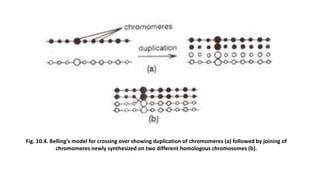
• During duplication of chromosomes, the chromomeres are duplicated first
and the newly formed chromomeres remain tightly juxtaposed, to the old
ones, without any interchromomeric regions found between them (Fig.
10.4a). When these interchromomeric regions or linking elements are
synthesized, they may switch from a newly made chromomere on one
homologous chromosome to an adjacent chromomere on the other newly
synthesized homologue. One can now visualize how it can generate a
crossover chromatid that would only seem to have arisen from a physical
breakage and reunion of chromosomes (Fig. 10.4b). Bellirtg's hypothesis,
from its very nature also suggests that the events producing recombinant
chromosomes can take place only between newly made chromatids, so
that only two strand double and multiple crossovers are possible and no
three strand or four strand multiple crossovers are possible.
Fig. 10.4. Belling's model for crossing over showing duplication of chromomeres (a) followed by joining of
chromomeres newly synthesized on two different homologous chromosomes (b).
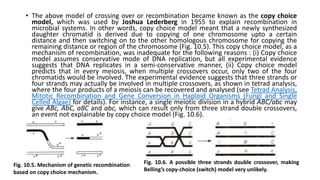
• The above model of crossing over or recombination became known as the copy choice
model, which was used by Joshua Lederberg in 1955 to explain recombination in
microbial systems. In other words, copy choice model meant that a newly synthesized
daughter chromatid is derived due to copying of one chromosome upto a certain
distance and then switching on to the other homologous chromosome for copying the
remaining distance or region of the chromosome (Fig. 10.5). This copy choice model, as a
mechanism of recombination, was inadequate for the following reasons : (i) Copy choice
model assumes conservative mode of DNA replication, but all experimental evidence
suggests that DNA replicates in a semi-conservative manner, (ii) Copy choice model
predicts that in every meiosis, when multiple crossovers occur, only two of the four
chromatids would be involved. The experimental evidence suggests that three strands or
four strands may actually be involved in multiple crossovers, as shown in tetrad analysis,
where the four products of a meiosis can be recovered and analysed (see Tetrad Analysis,
Mitotic Recombination and Gene Conversion in Haploid Organisms (Fungi and Single
Celled Algae) for details). For instance, a single meiotic division in a hybrid ABC/abc may
give ABc, AbC, aBC and abc, which can result only from three strand double crossovers,
an event not explainable by copy choice model (Fig. 10.6).
Fig. 10.5. Mechanism of genetic recombination
based on copy choice mechanism.
Fig. 10.6. A possible three strands double crossover, making
Belling’s copy-choice (switch) model very unlikely.
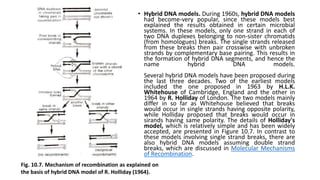
• Hybrid DNA models. During 1960s, hybrid DNA models
had become-very popular, since these models best
explained the results obtained in certain microbial
systems. In these models, only one strand in each of
two DNA duplexes belonging to non-sister chromatids
(from homologues) breaks. The single strands released
from these breaks then pair crosswise with unbroken
strands by complementary base pairing. This results in
the formation of hybrid DNA segments, and hence the
name hybrid DNA models.
Several hybrid DNA models have been proposed during
the last three decades. Two of the earliest models
included the one proposed in 1963 by H.L.K.
Whitehouse of Cambridge, England and the other in
1964 by R. Holliday of London. The two models mainly
differ in so far as Whitehouse believed that breaks
would occur in single strands having opposite polarity,
while Holliday proposed that breaks would occur in
sirands having same polarity. The details of Holliday's
model, which is relatively simple and has been widely
accepted, are presented in Figure 10.7. In contrast to
these models involving single strand breaks, there are
also hybrid DNA models assuming double strand
breaks, which are discussed in Molecular Mechanisms
of Recombination.
Fig. 10.7. Mechanism of recombination as explained on
the basis of hybrid DNA model of R. Holliday (1964).
II. Morgan and Crossing Over
• Morgan discovered crossing over when studying two
genes on X chromosome in Drosophila.
• Morgan proposed that the chiasmata visible on
chromosomes were regions of crossing over.
• Occurs between nonsister chromatids.
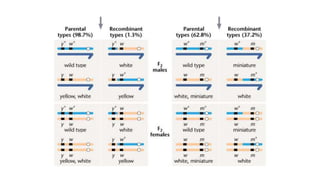
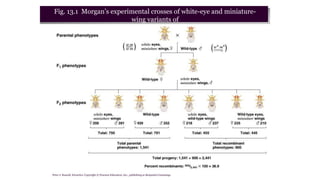
Crosses of Two X-linked genes
Expect only parental types if no crossing over occurs
- Confirm this for yourself with a Punnett square.
Peter J. Russell, iGenetics: Copyright © Pearson Education, Inc., publishing as Benjamin Cummings.
Fig. 13.1 Morgan’s experimental crosses of white-eye and miniature-
wing variants of
Drosophila melanogaster
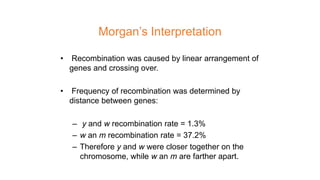
Morgan’s Interpretation
• Recombination was caused by linear arrangement of
genes and crossing over.
• Frequency of recombination was determined by
distance between genes:
– y and w recombination rate = 1.3%
– w an m recombination rate = 37.2%
– Therefore y and w were closer together on the
chromosome, while w an m are farther apart.
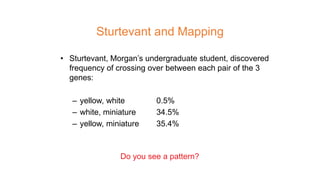
Sturtevant and Mapping
• Sturtevant, Morgan’s undergraduate student, discovered
frequency of crossing over between each pair of the 3
genes:
– yellow, white 0.5%
– white, miniature 34.5%
– yellow, miniature 35.4%
Do you see a pattern?
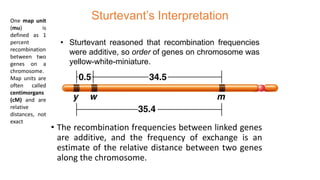
Sturtevant’s Interpretation
• Sturtevant reasoned that recombination frequencies
were additive, so order of genes on chromosome was
yellow-white-miniature.
• The recombination frequencies between linked genes
are additive, and the frequency of exchange is an
estimate of the relative distance between two genes
along the chromosome.
One map unit
(mu) is
defined as 1
percent
recombination
between two
genes on a
chromosome.
Map units are
often called
centimorgans
(cM) and are
relative
distances, not
exact
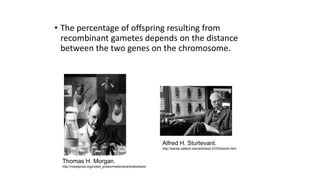
• The percentage of offspring resulting from
recombinant gametes depends on the distance
between the two genes on the chromosome.
Thomas H. Morgan.
http://nobelprize.org/nobel_prizes/medicine/articles/lewis/
Alfred H. Sturtevant.
http://eands.caltech.edu/articles/LXVII2/bomb.html
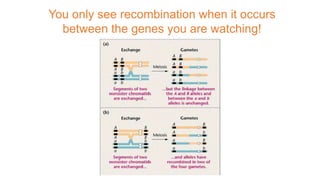
You only see recombination when it occurs
between the genes you are watching!
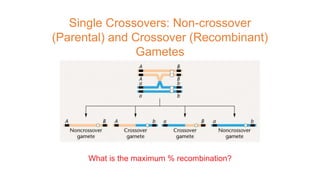
Single Crossovers: Non-crossover
(Parental) and Crossover (Recombinant)
Gametes
What is the maximum % recombination?
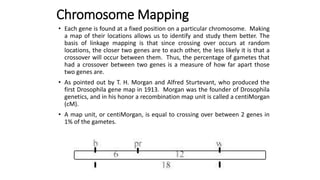
Chromosome Mapping
• Each gene is found at a fixed position on a particular chromosome. Making
a map of their locations allows us to identify and study them better. The
basis of linkage mapping is that since crossing over occurs at random
locations, the closer two genes are to each other, the less likely it is that a
crossover will occur between them. Thus, the percentage of gametes that
had a crossover between two genes is a measure of how far apart those
two genes are.
• As pointed out by T. H. Morgan and Alfred Sturtevant, who produced the
first Drosophila gene map in 1913. Morgan was the founder of Drosophila
genetics, and in his honor a recombination map unit is called a centiMorgan
(cM).
• A map unit, or centiMorgan, is equal to crossing over between 2 genes in
1% of the gametes.
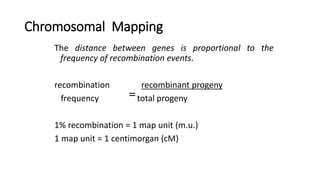
Chromosomal Mapping
The distance between genes is proportional to the
frequency of recombination events.
recombination recombinant progeny
frequency total progeny
1% recombination = 1 map unit (m.u.)
1 map unit = 1 centimorgan (cM)
=
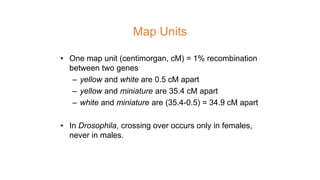
Map Units
• One map unit (centimorgan, cM) = 1% recombination
between two genes
– yellow and white are 0.5 cM apart
– yellow and miniature are 35.4 cM apart
– white and miniature are (35.4-0.5) = 34.9 cM apart
• In Drosophila, crossing over occurs only in females,
never in males.
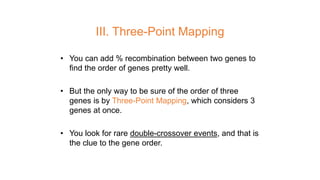
III. Three-Point Mapping
• You can add % recombination between two genes to
find the order of genes pretty well.
• But the only way to be sure of the order of three
genes is by Three-Point Mapping, which considers 3
genes at once.
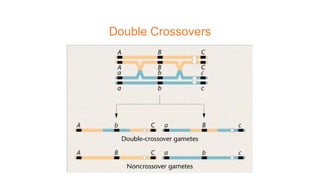
• You look for rare double-crossover events, and that is
the clue to the gene order.
Double Crossovers
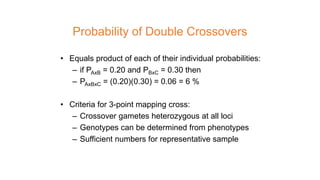
Probability of Double Crossovers
• Equals product of each of their individual probabilities:
– if PAxB = 0.20 and PBxC = 0.30 then
– PAxBxC = (0.20)(0.30) = 0.06 = 6 %
• Criteria for 3-point mapping cross:
– Crossover gametes heterozygous at all loci
– Genotypes can be determined from phenotypes
– Sufficient numbers for representative sample
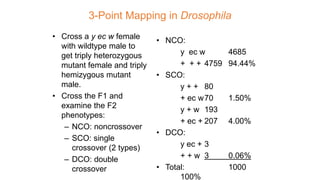
3-Point Mapping in Drosophila
• Cross a y ec w female
with wildtype male to
get triply heterozygous
mutant female and triply
hemizygous mutant
male.
• Cross the F1 and
examine the F2
phenotypes:
– NCO: noncrossover
– SCO: single
crossover (2 types)
– DCO: double
crossover
• NCO:
y ec w 4685
+ + + 4759 94.44%
• SCO:
y + + 80
+ ec w70 1.50%
y + w 193
+ ec + 207 4.00%
• DCO:
y ec + 3
+ + w 3 0.06%
• Total: 1000
100%
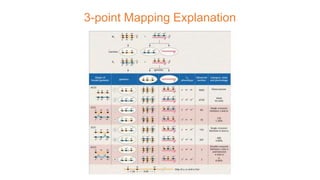
3-point Mapping Explanation
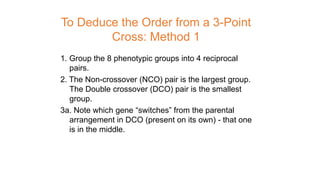
To Deduce the Order from a 3-Point
Cross: Method 1
1. Group the 8 phenotypic groups into 4 reciprocal
pairs.
2. The Non-crossover (NCO) pair is the largest group.
The Double crossover (DCO) pair is the smallest
group.
3a. Note which gene “switches” from the parental
arrangement in DCO (present on its own) - that one
is in the middle.
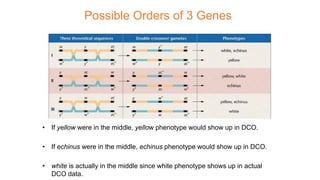
Possible Orders of 3 Genes
• If yellow were in the middle, yellow phenotype would show up in DCO.
• If echinus were in the middle, echinus phenotype would show up in DCO.
• white is actually in the middle since white phenotype shows up in actual
DCO data.
To Deduce the Order from a 3-Point Cross:
Method 2
3b. Assume one of the 3 possible gene orders and work
the problem. If you later find a contradiction, try one of
the other orders.
4b. Determine whether a DCO with your arrangement will
produce the observed DCO phenotypes.
– You will encounter a contradiction unless you have
chosen the correct gene order. Keep trying until you
get the right one.
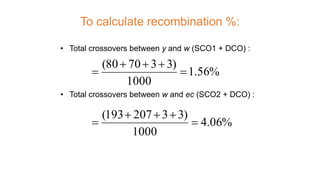
To calculate recombination %:
• Total crossovers between y and w (SCO1 + DCO) :
• Total crossovers between w and ec (SCO2 + DCO) :
%06.4
1000
)33207193(
%56.1
1000
)337080(






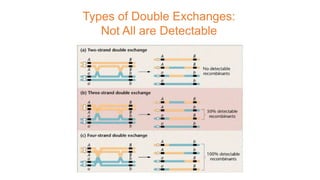
Types of Double Exchanges:
Not All are Detectable
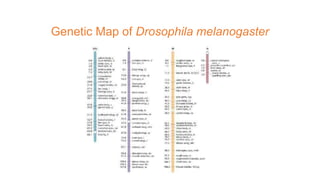
Genetic Map of Drosophila melanogaster
Creighton and McClintock Experiment
Proved Crossing Over was a Physical Event
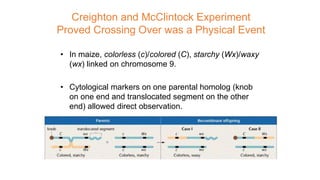
• In maize, colorless (c)/colored (C), starchy (Wx)/waxy
(wx) linked on chromosome 9.
• Cytological markers on one parental homolog (knob
on one end and translocated segment on the other
end) allowed direct observation.
Crossovers Between Sister
Chromatids (SCEs)
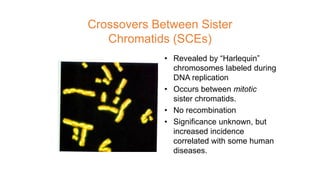
• Revealed by “Harlequin”
chromosomes labeled during
DNA replication
• Occurs between mitotic
sister chromatids.
• No recombination
• Significance unknown, but
increased incidence
correlated with some human
diseases.
• Somatic cell hybridization involves fusion of two cells in culture to
form a single hybrid cell, called a heterokaryon.
• Synkaryon – nuclei eventually fuse in cell
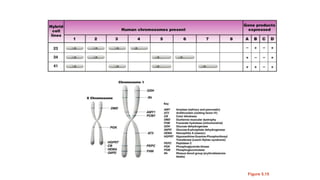
• Upon continued culturing of the hybrid cell, chromosomes from one
of the two parental species are gradually lost until only a few
chromosomes of one species remain and most chromosomes are
from the other species
Figure 5.15
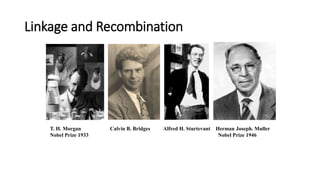
Linkage and Recombination
T. H. Morgan Calvin B. Bridges Alfred H. Sturtevant Herman Joseph. Muller
Nobel Prize 1933 Nobel Prize 1946

Linkage and crossing over.. Dr. krishna

  • 1.
    Linkage and CrossingOver By Dr. Krishna Assistant Professor in Biotechnology Tumkur University, Tumakuru
  • 2.
    Gregor Johann Mendel •1822- 1884 • Austrian monk • Experimented with pea plants (Pisum sativum) • He thought that ‘heritable factors’ (genes) retained their individuality generation after generation
  • 3.
    Terms to Knowand Use • Gene – A DNA blueprint controlling synthesis of a protein • Trait - variant for a gene: i.e. a purple flower, determined by alleles • Dominant trait - expressed over recessive trait when both are present • Recessive trait - not expressed when the dominant trait is present • Co-Dominant – expressed as blended traits
  • 4.
    • Allele -a variation of a gene responsible for different traits, often represented as A or a • Locus - location of a gene,or allele, on a chromosome • Chromosome - strand of DNA containing the genes • Haploid - one copy of a chromosome • Diploid - two copies of a chromosome • Gamete - a spermatozoa or oocyte (egg) cell, they are haploid
  • 5.
    • Zygote -cell resulting from the fusion of two gametes, they are diploid • Genotype - the type of alleles on a chromosome: genetic makeup • Phenotype - The way a genotype is expressed: i.e. the color of a flower • True breeding line - organisms that always pass the same genotype to their offspring • Hybrid - offspring resulting from crossbreeding two true breeding lines: F1
  • 6.
    Garden Pea Experiments 1856-64 •Mendel disagreed with the “Blending Theory” of inheritance. • Started with 34 kinds peas Pisium sativum • After 2 years he had 22 purebreds
  • 7.
    Pea Characteristics Trait onthe left is dominant. Trait on the right is recessive.
  • 8.
    Mendel’s Hypotheses • Thereare alternate forms of ‘genes’=alleles • For each trait, organisms have 2 genes, one from mother & other from father • Pollen and egg each carry 1 allele/trait because alleles segregate • Dominant allele is expressed & recessive allele has no noticeable effect in presence of dominant allele
  • 9.
    Mendel’s Experiments 1.Plants mustpossess constant differentiating characteristics. 2.The hybrids of such plants must, during the flowering period, be protected from the influence of all foreign pollen, or be easily capable of such protection. 3.The hybrids and their offspring should suffer no marked disturbance in their fertility in the successive generations.
  • 10.
    Mendel's Laws ofInheritance • Law of Dominance In F1 generation only dominant allele is expressed • Law of Segregation during gamete formation allele pairs separate or segregate, into different gametes • Law of Independent Assortment suggested that each allele pair segregates independently of other gene pairs during gamete formation (Demonstrated with a dihybrid cross).
  • 11.
  • 12.
  • 13.
    Law of Dominance& law of segregation
  • 14.
  • 15.
  • 16.
    Linkage: When two ormore characters of parents are transmitted to the offsprings of few generations such as F1, F2, F3 etc. without any recombination, they are called as the linked characters and the phenomenon is called as linkage. • This is a deviation from the Mendelian principle of independent assortment. • Mendel’s law of independent assortment is applicable to the genes that are situated in separate chromosomes. When genes for different characters are located in the same chromosome, they are tied to one another and are said to be linked. • They are inherited together by the offspring and will not be assorted independently. Thus, the tendency of two or more genes of the same chromosome to remain together in the process of inheritance is called linkage.
  • 17.
    Coupling vs. Repulsion •The original test cross we did was PL/pl x p l. Among the offspring, PL and pl were parental types, and pL and Pl were the recombinant types. There was 24.3% recombination between the genes. • The condition of having the dominant alleles for both genes on the same parental chromosome, with both recessives on the other parental chromosome, is called “coupling”: the P and L genes are “in coupling phase”. • The opposite condition, having one dominant and one recessive on each parental chromosome, is called “repulsion”. Thus, if the original parents were P l x p L, their offspring would have the genes in repulsion phase: Pl / pL.
  • 18.
    • Bateson andPunnet (1906), while working with sweet pea (Lathyrus odoratus) observed that flower colour and pollen shape tend to remain together and do not assort independently as per Mendel’s law of independent assortment. • When two different varieties of sweet pea—one having red flowers and round pollen grain and other having blue flower and long pollen grain were crossed, the F1 plants were blue flowered with long pollen (blue long characters were respectively dominant over red and round characters). When these blue long (heterozygous) hybrids were crossed with double recessive red and round (homozygous) individuals (test cross), they failed to produce expected 1:1:1:1 ratio in F2 generation. These actually produced following four combinations in the ratio of 7 : 1 : 1 : 7 (7 blue long : 1 blue round : 1 red long : 7 red round) (Fig. 5.6).
  • 19.
    The above resultof the test cross clearly indicates that the parental combinations (blue, long and red, round) are seven times more numerous than the non-parental combinations. Bateson and Punnet suggested that the genes (such as B and L) coming from the same parent (BBLL × bbll) tend to enter the same gamete and to be inherited together (coupling). Similarly, the genes (B and 1) coming from two different parents (such as BBLL x bbll), tend to enter different gametes and to be inherited separately and independently (repulsion).
  • 20.
    Morgan’s View ofLinkage: • Morgan (1910), while working on Drosophila stated that coupling and repulsion are two aspects of linkage. He defined linkage as the tendency of genes, present in the same chromosome, to remain in their original combination and to enter together in the same gamete.’ • The genes located on the same chromosome and are being inherited together are known as linked genes, and the characters controlled by these are known as linked characters. Their recombination frequency is always less than 50%. All those genes which are located in the single chromosome form one linkage group. The total number of linkage group in an organism corresponds to the number of chromosome pairs. For example, there are 23 linkage groups in man, 7 in sweet pea and 4 in Drosophila melanogaster.
  • 21.
    Features of Theoryof Linkage: • Morgan and Castle formulated ‘The Chromosome Theory of Linkage’. It has the following salient features: • 1. Genes that show linkage are situated in the same chromosome. • 2. Genes are arranged in a linear fashion in the chromosome i.e., linkage of genes is linear. • 3. The distance between the linked genes is inversely proportional to the strength of linkage. The genes which are closely located show strong linkage, whereas those, which are widely separated, have more chance to get separated by crossing over (weak linkage). • 4. Linked genes remain in their original combination during course of inheritance. • 5. The linked genes show two types of arrangement on the chromosome. If the dominant alleles of two or more pairs of linked genes are present on one chromosome and their recessive alleles of all of them on the other homologue (AB/ab), this arrangement is known as cis-arrangement. However, if the dominant allele of one pair and recessive allele of second pair are present on one chromosome and recessive and dominant alleles on the other chromosome of a homologous pair (Ab/aB), this arrangement is called trans arrangement (Fig. 5.7).
  • 22.
  • 23.
  • 24.
  • 26.
    Examples of Linkage: InMAIZE: • Maize provides a good example of linkage. Hutchinson crossed a variety of maize having coloured and full seed (CCSS) with a variety having colourless and shrunken seeds (ccss). The gene C for colour is dominant over its colourless allele c and the gene S for full seed is dominant over its shrunken allele s. All the F1 plants produced coloured and full seed. But in a test cross, when such F1 females (heterozygous) are cross pollinated with the pollen from a plant having colourless and shrunken seeds (double recessive), four types of seeds are produced (Fig. 5.8).
  • 27.
    From the abovestated result it is clear that the parental combinations are more numerous (96.4%) than the new combination (3.6%). This clearly indicates that the parental characters are linked together. Their genes are located in the same chromosome and only in 3.6% individuals these genes are separated by crossing over. This is an example of incomplete linkage.
  • 28.
    In Drosophila: • Morgan(1911) crossed an ordinary wild type Drosophila with grey body and long wings (BB VV) with another Drosophila (mutant type) with black body and vestigial wings (bbvv). All the hybrids in F1 generation are with grey bodies and long wings (BbVv) i.e., phenotypically like the wild type of parents. If now a male of F, generation (Bb Vv) is back crossed with a double recessive female (test cross) having black body and vestigial wings (bbvv) only parental combinations are formed in F2 generation without the appearance of any new combinations. The results indicate that grey body character is inherited together with long wings. • It implies that these genes are linked together. Similarly, black body character is associated with vestigial wing. Since only parental combinations of character appear in the offspring of F2 generation and no new or non-parental combinations appear, this shows complete linkage. Complete linkage is seen in Drosophila males.
  • 29.
    Types of Linkage: Dependingupon the presence or absence of new combinations or non- parental combinations, linkage can be of two types: (i) Complete Linkage: • If two or more characters are inherited together and consistently appear in two or more generations in their original or parental combinations, it is called complete linkage. These genes do not produce non-parental combinations. • Genes showing complete linkage are closely located in the same chromosome. Genes for grey body and long wings in male Drosophila show complete linkage. (ii) Incomplete Linkage: • Incomplete linkage is exhibited by those genes which produce some percentage of non-parental combinations. Such genes are located distantly on the chromosome. It is due to accidental or occasional breakage of chromosomal segments during crossing over.
  • 30.
    Complete Linkage: P1Cross In complete linkage only parental gametes form hvbw hvbw bwhv bwhv P     :1 F1: bwhv bw  hv
  • 31.
    Not 9:3:3:1 phenotypicratio! 1:2:1  (complete) linkage ratio Not 1:1:1:1 testcross ratio! 1:1 testcross ratio w/linkage Complete Linkage: F1 Cross
  • 32.
    Linkage Ratio • TheF2 phenotypic ratio unique to two linked genes in cross of double heterozygotes. • If completely linked, should be – 1:2:1 for F1 X F1 – 1:1 for F1 X test cross parent • Linkage group - group of genes which show linkage; in theory = N (the haploid number).
  • 33.
    Significance of Linkage: •(i) Linkage plays an important role in determining the nature of scope of hybridization and selection programmes. • (ii) Linkage reduces the chance of recombination of genes and thus helps to hold parental characteristics together. It thus helps organism to maintain its parental, racial and other characters. For this reason plant and animal breeders find it difficult to combine various characters.
  • 34.
    Crossing Over orRecombination: • Crossing over or recombination actually results from exchange of chromosome segments which is believed to take place during prophase I of meiosis. During prophase I of meiosis, homologous chromosomes are brought together during synapsis at zygotene. Each chromosome also divides longitudinally into two chromatids at this stage. At pachytene, chromatids exchange segments. Homologous centromeres then start separating away from one another (terminalization) and figures of chiasmata are theTesult and not the cause of crossing over.
  • 35.
    Crossing over andchiasma formation There are two theories to explain the relationship between crossing over and chiasma formation. These two theories will be briefly discussed in this section. • Classical theory or two plane theory. This theory was proposed by L.W. Sharp in his book Introduction to Cytology, published in 1934. According to this theory, formation of chiasmata precedes the act of genetic crossing over, so that chiasmata are not the result but the cause of crossing over. Moreover in such an interpretation, it is not necessary that there is one to one relationship between chiasmata and crossing over. The chiasmata, in this theory, represent points of accidental physical crossing of homologous, but non-sister chromatids. These chiasmata may or may not lead to breakage and subsequent exchange of chromosome segments, but whenever crossing over occurs, this results due to strain imposed by chiasma formation. In such a hypothesis, adjacent loops will have equational (sister chromatids separating) and reductional (sister chromatids not separating) separation of chromatids (Fig. 10.3 A). This theory is also known as two plane theory because it is assumed that adjacent loops would be present in different planes at right angle to each other.
  • 36.
    • Chiasma typetheory or one plane theory. 1. Chiasmatype theory was proposed by F.A. Janssens in 1909 and was extended in 1924. It was later fully developed by J. Belling and by CD. Darlington. According to this theory, true chiasmata are the direct result of crossing over so that crossing over really precedes chiasma formation. As opposed to classical theory, in chiasmatype theory, crossing over results from breakage followed by reunion or exchange of non-sister chromatid segments from homologous chromosomes. Since in this theory, chiasmata are the result of crossing over, there would be one to one relationship between the chiasmata and crossing over. This theory is also called one plane theory as against two plane theory discussed above. In this theory, one would expect reductional separation of chromatids on either side of a chiasma (Fig. 10.3 B). 2. The classical theory or the two plane theory is now of only historical importance, since all available experimental evidence goes in favour of 'chiasmatype theory' or 'one plane theory.'
  • 37.
    Fig. 10.3. Crossingover and chiasma formation based on classical theory (A) and chiasmatype theory (B).
  • 38.
    • Synapsed chromosomesin meiosis wrap around each other to create chiasmata that are points of genetic exchange.
  • 39.
    • Two geneslocated relatively close to each other along a chromosome are less likely to have a chiasma form between them, and it is less likely that crossing over will occur. http://cnx.org/content/m15083/latest/
  • 40.
    Peter J. Russell,iGenetics: Copyright © Pearson Education, Inc., publishing as Benjamin Cummings. Fig. 13.2 Mechanism of crossing-over Mechanism of Crossing-over or Recombination
  • 41.
    • Crossing OverIn classical theory and chiasmatype theory discussed above, there was an emphasis on causal relationship between chiasmata and crossing over. It has, however, been difficult to explain how exchange of segments or recombination of gene clusters is brought about. There were at least two theories available initially to explain this, but newer hypotheses were proposed later. Only these two earlier theories and the more recent hybrid DNA models will be discussed here in brief. Molecular Mechanisms of Recombination should be consulted for a more detailed study of the mechanism of genetic recombination at the molecular level. Such a detailed account is also available in the book 'Towards an Understanding of the Mechanism of Heredity' by H.L.K. Whitehouse, who had himself put forward a popular Polaron Hybrid DNA Model to explain the mechanism of crossing over at the molecular level. Mechanism of genetic recombination
  • 42.
    • Precocity theory.Precocity theory of CD. Darlington is ordinarily discussed in context with meiotic chromosome pairing. However, Darlington extended this theory to explain recombination also. The theory assumes that prophase is precocious in meiotic cell division and therefore involves homologous pairing to satisfy the pairing need, which is achieved in mitosis due to duplication of chromosomes. This theory is now untenable in the light of recent information that DNA synthesis really takes place before the onset of prophase I in meiosis, although synthesis of a very small fraction of DNA called zygotene DNA (zyg DNA) (0.1 to 0.2%) is delayed till zygotene. Precocity theory presumes that DNA synthesis or chromosome duplication takes place later in pachytene or diplotene and then results in separation of homologous chromosomes (terminalization). On the basis of precocity theory, Darlington explained crossing over to be the result of strain or torsion produced due to coiling of homologous chromosomes and sister chromatids. Belling's hypothesis and copy choice model. In making a distinction between chiasmata and crossing over, we concluded earlier that crossing over or exchange of chromosome segments (which leads to genetic recombination) is the result of a breakage and reunion process. One may ask the question, whether it is actually a breakage-reunion process or only appear to be so, as envisaged in a hypothesis proposed by John Belling in 1928. While studying meiosis in some plant species, Belling visualized genes as beads (described as chromomeres), connected by nongenic inter-chromomeric regions.
  • 43.
    • During duplicationof chromosomes, the chromomeres are duplicated first and the newly formed chromomeres remain tightly juxtaposed, to the old ones, without any interchromomeric regions found between them (Fig. 10.4a). When these interchromomeric regions or linking elements are synthesized, they may switch from a newly made chromomere on one homologous chromosome to an adjacent chromomere on the other newly synthesized homologue. One can now visualize how it can generate a crossover chromatid that would only seem to have arisen from a physical breakage and reunion of chromosomes (Fig. 10.4b). Bellirtg's hypothesis, from its very nature also suggests that the events producing recombinant chromosomes can take place only between newly made chromatids, so that only two strand double and multiple crossovers are possible and no three strand or four strand multiple crossovers are possible.
  • 44.
    Fig. 10.4. Belling'smodel for crossing over showing duplication of chromomeres (a) followed by joining of chromomeres newly synthesized on two different homologous chromosomes (b).
  • 45.
    • The abovemodel of crossing over or recombination became known as the copy choice model, which was used by Joshua Lederberg in 1955 to explain recombination in microbial systems. In other words, copy choice model meant that a newly synthesized daughter chromatid is derived due to copying of one chromosome upto a certain distance and then switching on to the other homologous chromosome for copying the remaining distance or region of the chromosome (Fig. 10.5). This copy choice model, as a mechanism of recombination, was inadequate for the following reasons : (i) Copy choice model assumes conservative mode of DNA replication, but all experimental evidence suggests that DNA replicates in a semi-conservative manner, (ii) Copy choice model predicts that in every meiosis, when multiple crossovers occur, only two of the four chromatids would be involved. The experimental evidence suggests that three strands or four strands may actually be involved in multiple crossovers, as shown in tetrad analysis, where the four products of a meiosis can be recovered and analysed (see Tetrad Analysis, Mitotic Recombination and Gene Conversion in Haploid Organisms (Fungi and Single Celled Algae) for details). For instance, a single meiotic division in a hybrid ABC/abc may give ABc, AbC, aBC and abc, which can result only from three strand double crossovers, an event not explainable by copy choice model (Fig. 10.6). Fig. 10.5. Mechanism of genetic recombination based on copy choice mechanism. Fig. 10.6. A possible three strands double crossover, making Belling’s copy-choice (switch) model very unlikely.
  • 46.
    • Hybrid DNAmodels. During 1960s, hybrid DNA models had become-very popular, since these models best explained the results obtained in certain microbial systems. In these models, only one strand in each of two DNA duplexes belonging to non-sister chromatids (from homologues) breaks. The single strands released from these breaks then pair crosswise with unbroken strands by complementary base pairing. This results in the formation of hybrid DNA segments, and hence the name hybrid DNA models. Several hybrid DNA models have been proposed during the last three decades. Two of the earliest models included the one proposed in 1963 by H.L.K. Whitehouse of Cambridge, England and the other in 1964 by R. Holliday of London. The two models mainly differ in so far as Whitehouse believed that breaks would occur in single strands having opposite polarity, while Holliday proposed that breaks would occur in sirands having same polarity. The details of Holliday's model, which is relatively simple and has been widely accepted, are presented in Figure 10.7. In contrast to these models involving single strand breaks, there are also hybrid DNA models assuming double strand breaks, which are discussed in Molecular Mechanisms of Recombination. Fig. 10.7. Mechanism of recombination as explained on the basis of hybrid DNA model of R. Holliday (1964).
  • 47.
    II. Morgan andCrossing Over • Morgan discovered crossing over when studying two genes on X chromosome in Drosophila. • Morgan proposed that the chiasmata visible on chromosomes were regions of crossing over. • Occurs between nonsister chromatids.
  • 48.
    Crosses of TwoX-linked genes Expect only parental types if no crossing over occurs - Confirm this for yourself with a Punnett square.
  • 50.
    Peter J. Russell,iGenetics: Copyright © Pearson Education, Inc., publishing as Benjamin Cummings. Fig. 13.1 Morgan’s experimental crosses of white-eye and miniature- wing variants of Drosophila melanogaster
  • 51.
    Morgan’s Interpretation • Recombinationwas caused by linear arrangement of genes and crossing over. • Frequency of recombination was determined by distance between genes: – y and w recombination rate = 1.3% – w an m recombination rate = 37.2% – Therefore y and w were closer together on the chromosome, while w an m are farther apart.
  • 52.
    Sturtevant and Mapping •Sturtevant, Morgan’s undergraduate student, discovered frequency of crossing over between each pair of the 3 genes: – yellow, white 0.5% – white, miniature 34.5% – yellow, miniature 35.4% Do you see a pattern?
  • 53.
    Sturtevant’s Interpretation • Sturtevantreasoned that recombination frequencies were additive, so order of genes on chromosome was yellow-white-miniature. • The recombination frequencies between linked genes are additive, and the frequency of exchange is an estimate of the relative distance between two genes along the chromosome. One map unit (mu) is defined as 1 percent recombination between two genes on a chromosome. Map units are often called centimorgans (cM) and are relative distances, not exact
  • 54.
    • The percentageof offspring resulting from recombinant gametes depends on the distance between the two genes on the chromosome. Thomas H. Morgan. http://nobelprize.org/nobel_prizes/medicine/articles/lewis/ Alfred H. Sturtevant. http://eands.caltech.edu/articles/LXVII2/bomb.html
  • 55.
    You only seerecombination when it occurs between the genes you are watching!
  • 56.
    Single Crossovers: Non-crossover (Parental)and Crossover (Recombinant) Gametes What is the maximum % recombination?
  • 57.
    Chromosome Mapping • Eachgene is found at a fixed position on a particular chromosome. Making a map of their locations allows us to identify and study them better. The basis of linkage mapping is that since crossing over occurs at random locations, the closer two genes are to each other, the less likely it is that a crossover will occur between them. Thus, the percentage of gametes that had a crossover between two genes is a measure of how far apart those two genes are. • As pointed out by T. H. Morgan and Alfred Sturtevant, who produced the first Drosophila gene map in 1913. Morgan was the founder of Drosophila genetics, and in his honor a recombination map unit is called a centiMorgan (cM). • A map unit, or centiMorgan, is equal to crossing over between 2 genes in 1% of the gametes.
  • 58.
    Chromosomal Mapping The distancebetween genes is proportional to the frequency of recombination events. recombination recombinant progeny frequency total progeny 1% recombination = 1 map unit (m.u.) 1 map unit = 1 centimorgan (cM) =
  • 59.
    Map Units • Onemap unit (centimorgan, cM) = 1% recombination between two genes – yellow and white are 0.5 cM apart – yellow and miniature are 35.4 cM apart – white and miniature are (35.4-0.5) = 34.9 cM apart • In Drosophila, crossing over occurs only in females, never in males.
  • 60.
    III. Three-Point Mapping •You can add % recombination between two genes to find the order of genes pretty well. • But the only way to be sure of the order of three genes is by Three-Point Mapping, which considers 3 genes at once. • You look for rare double-crossover events, and that is the clue to the gene order.
  • 61.
  • 62.
    Probability of DoubleCrossovers • Equals product of each of their individual probabilities: – if PAxB = 0.20 and PBxC = 0.30 then – PAxBxC = (0.20)(0.30) = 0.06 = 6 % • Criteria for 3-point mapping cross: – Crossover gametes heterozygous at all loci – Genotypes can be determined from phenotypes – Sufficient numbers for representative sample
  • 63.
    3-Point Mapping inDrosophila • Cross a y ec w female with wildtype male to get triply heterozygous mutant female and triply hemizygous mutant male. • Cross the F1 and examine the F2 phenotypes: – NCO: noncrossover – SCO: single crossover (2 types) – DCO: double crossover • NCO: y ec w 4685 + + + 4759 94.44% • SCO: y + + 80 + ec w70 1.50% y + w 193 + ec + 207 4.00% • DCO: y ec + 3 + + w 3 0.06% • Total: 1000 100%
  • 64.
  • 65.
    To Deduce theOrder from a 3-Point Cross: Method 1 1. Group the 8 phenotypic groups into 4 reciprocal pairs. 2. The Non-crossover (NCO) pair is the largest group. The Double crossover (DCO) pair is the smallest group. 3a. Note which gene “switches” from the parental arrangement in DCO (present on its own) - that one is in the middle.
  • 66.
    Possible Orders of3 Genes • If yellow were in the middle, yellow phenotype would show up in DCO. • If echinus were in the middle, echinus phenotype would show up in DCO. • white is actually in the middle since white phenotype shows up in actual DCO data.
  • 67.
    To Deduce theOrder from a 3-Point Cross: Method 2 3b. Assume one of the 3 possible gene orders and work the problem. If you later find a contradiction, try one of the other orders. 4b. Determine whether a DCO with your arrangement will produce the observed DCO phenotypes. – You will encounter a contradiction unless you have chosen the correct gene order. Keep trying until you get the right one.
  • 68.
    To calculate recombination%: • Total crossovers between y and w (SCO1 + DCO) : • Total crossovers between w and ec (SCO2 + DCO) : %06.4 1000 )33207193( %56.1 1000 )337080(      
  • 69.
    Types of DoubleExchanges: Not All are Detectable
  • 70.
    Genetic Map ofDrosophila melanogaster
  • 71.
    Creighton and McClintockExperiment Proved Crossing Over was a Physical Event • In maize, colorless (c)/colored (C), starchy (Wx)/waxy (wx) linked on chromosome 9. • Cytological markers on one parental homolog (knob on one end and translocated segment on the other end) allowed direct observation.
  • 72.
    Crossovers Between Sister Chromatids(SCEs) • Revealed by “Harlequin” chromosomes labeled during DNA replication • Occurs between mitotic sister chromatids. • No recombination • Significance unknown, but increased incidence correlated with some human diseases.
  • 73.
    • Somatic cellhybridization involves fusion of two cells in culture to form a single hybrid cell, called a heterokaryon. • Synkaryon – nuclei eventually fuse in cell • Upon continued culturing of the hybrid cell, chromosomes from one of the two parental species are gradually lost until only a few chromosomes of one species remain and most chromosomes are from the other species
  • 74.
  • 75.
    Linkage and Recombination T.H. Morgan Calvin B. Bridges Alfred H. Sturtevant Herman Joseph. Muller Nobel Prize 1933 Nobel Prize 1946