Presented by:
Haider Azeem(BAGF19M006)
Waqar Ali (BAGF19M001)
Tayyab Mateen(BAGF19M18)
Submitted To:
Prof. NAEEM AKHTAR
 The inheritance of a trait (phenotype) that is determined
by a gene located on one of the sex chromosomes is
called sex linked inheritance . It has one X chromosome
and one Y chromosome. But females are homogametic.
 Chromosomes in humans can be divided into two types:
Auto-somes (body chromosomes) and Allo-some (sex
chromosomes). There are two different sex chromosomes:
the X chromosome and the Y chromosome. A girl will
have two X chromosomes (written as XX), but a boy will
have one X and one Y chromosome (written as XY). This
means that no matter your gender, you will always have at
least one X chromosome
 Thomas Hunt Morgan, the first person to define sex
linked trait or inheritance to a specific chromosome .
One day in 1910, American geneticist Thomas Hunt
Morgan peered through a hand lens at a male fruit fly,
and he noticed it didn't look right.
 Instead of having the normally brilliant red eyes of
wild-type Drosophila melanogaster, this fly had white
eyes.
 Firstly, In Mendelian pattern of inheritance, the genes
for contrasting characters were located on autosomes
but not on the sex chromosomes.
 Secondly, the result of reciprocal cross is same as
normal cross which is not the case with sex linked
inheritance.
 Finally, Sex makes no difference in Mendel’s crosses.
But the Mendel’s laws are not applicable on those
genes which are exclusively located either in X or Y
chromosome.
 The genes which occur exclusively on the X
chromosome or on the analogous Z chromosome (in
birds and other species) are called X- or Z -linked
genes while the genes which exclusively occur in Y
chromosome are called holandric genes.
 The inheritance of such X- or Z-linked and holandric
genes is called sex-linked inheritance.
 Such genes which are always associated with sex
chromosomes are called sex-linked genes.
 In man and Drosophila the sex chromosomes (X and
Y) are unequal in size and shape, X being larger and
rod shaped whereas Y is small and slightly curved.
 In birds and butterflies the sex chromosomes (Z and
W) are also unequal in shape and size, Z being larger
than W.
 There are three types of sex-linked genes depending
upon their association with particular chromosome.
 They are as follows:
 (i) The genes which are located on X-chromosomes are
called X-linked genes or sex linked genes.
 (ii) The genes which are located on Y chromosomes are
called Y-linked genes or holandric genes.
 (iii) Certain genes are found to occur in both X and Y
chromosomes. Such genes are called incomplete sex-
linked genes.
 The X-linked recessive genes show criss-cross pattern
of inheritance.
 In criss-cross inheritance, an X-linked recessive gene is
transmitted from P1 male parent (father) to F2 male
progeny (grandsons) through its F1 heterozygous
females (daughters), which are called carriers and
different F1 and F2 results (ratios) in the reciprocal
crosses.
 The X-linked recessive phenotype is usually found
more frequently in the male than in the female. This is
because an affected female can result only when both
mother and father bear the X-linked recessive allele
(e.g., XA Xa × Xa Y), whereas an affected male can
result when only the mother carries the gene.
 Usually none of the offspring of an affected male will
be affected, but all his daughters will carry the gene in
masked heterozygous condition, so one half of their
sons (i.e., grandsons of F1 father) will be affected.
 None of the sons of an affected male will inherit the X-
linked recessive gene, so not only will they be free of
the defective phenotype; but they will not pass the
gene along to their offspring
 In order to understand the inheritance of character
present in sex chromosomes, let us understand
transmission of X-chromosome from male individual
in Drosophila or in man.
 The X-chromosome from male individual will always
pass to the daughter, while X-chromosomes from
female individual will be distributed equally among
the daughter and sons.
 A character from the father goes to the daughter (F1)
and then from daughter to grandson in the next
generation (F2). Such type of inheritance is also called
as criss-cross inheritance.
 In this type of inheritance result of the reciprocal
crosses are not identical as in case with Mendelian
crosses.
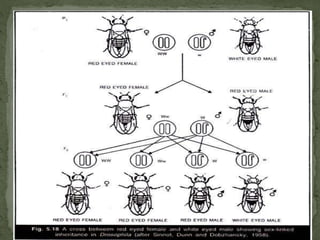
 T.H. Morgan (1910) for the first time discovered sex-
linkage in Drosophila melanogaster. Morgan when
experimenting noted the sudden appearance of one
white-eyed male (mutant form) in the culture of
normal red-eyed Drosophila. This white-eyed male
was crossed with red eyed female. The F1 flies (both
male and female) were all red-eyed indicating that
white eye colour is recessive to the normal red eye
colour.
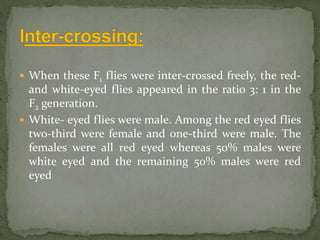
 When these F1 flies were inter-crossed freely, the red-
and white-eyed flies appeared in the ratio 3: 1 in the
F2 generation.
 White- eyed flies were male. Among the red eyed flies
two-third were female and one-third were male. The
females were all red eyed whereas 50% males were
white eyed and the remaining 50% males were red
eyed
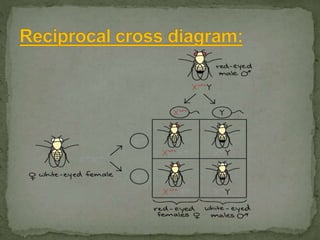
 If a reciprocal cross is performed between white eyed
female and red eyed male individual, all female
individuals in Ft generation are red eyed and all male
individuals, are white eyed. When these two types of
individuals from F1 generation are inter crossed, female
population in F2 generation will consist of 50% red
eyed and 50% white eyed individuals. Similarly the
male population in this generation consists of 50% red
eyed and 50% white eyed individual
 The inheritance of white-eye color in Drosophila can be
explained on the basis of the following assumptions:
 (i) Gene for white eye colour in male Drosophila is located in
X-chromosome and Y chromosome is empty, carrying no
normal allele for eye colour.
 (ii) In white eyed female Drosophila there are two X
chromosomes, each one bearing a gene for white eye colour
(w). It transmits one gene for white eye colour (w) to each
offspring.
 (iii) As we can see in the above reciprocal crosses, the gene
for recessive white eye colour (w) passes by father on to
daughter (F1 generation). The daughter in turn passes this
gene to her sons (F2 generation). The character thus seems to
alter or cross from one sex to the other in its passage from
generation to generation. In other words, character is
transferred from mother to son and never from father to the
son.
The common
sex-linked
disorders that
are mostly found
in humans are
mostly recessive.
They include
disorders like
Color-blindness
and
Haemophilia.
Sex linkage in
humans:
 Haemophila is another popular example of sex linked
inheritance in human beings. It is caused by a mutant
gene (h) present in X chromosome and recessive to
normal gene and is, therefore, suppressed in
heterozygous condition.
 Individuals suffering from this disease lack a factor
responsible for clotting of blood. So in the absence of
blood clotting substance, a minor cut or injury may
cause prolonged bleeding leading to death. This
disease in man is generally restricted to male
members.
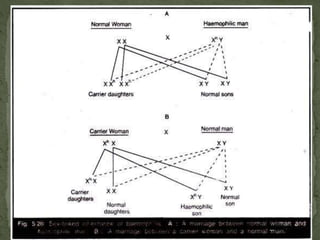
 If a haemophilic man marries a normal woman, the
daughter are all carriers (phenotypically normal but
carries haemophilic gene in one on her X
chromosome) but sons are normal.
 Such a carrier daughter, when marries a normal man
transmits the haemophilic gene to half of her son.
 A haemophilic woman is produced only if a carrier
woman is married to a haemophilic man.
 (a) It is a criss-cross inheritance as the father passes its
sex-linked character to his daughter who in turn
passes it to the grandson.
 (b) Daughter does not express the recessive trait but
act as carrier in the heterozygous condition.
 (c) Female homozygous for recessive trait expresses
the trait.
 (d) Any recessive gene borne by the X chromosome of
male is immediately expressed as Y chromosome has
no allele to counteract.
 Dominant X-linked genes are detected more
frequently found in the female than in the male of the
species.
 The affected males pass the condition on to all of their
daughters but to none of their sons.
 Females usually pass the condition (defective
phenotype) on to one-half of their sons and daughters.
 A X-linked dominant gene fails to be transmitted to
any son from a mother which did not exhibit the trait
itself.
 In humans, X-linked dominant conditions are
relatively rare.
 One example is hypophosphatemia (vitamin D-
resistant rickets).
 Another example includes hereditary enamel
hypoplasia (hypoplastic amelogenesis imperfecta), in
which tooth enamel is abnormally thin so that teeth
appear small and wear rapidly down to the gums.
 Genes in the non-homologous region of the Y
chromosome pass directly from male to male.
 In man, the Y-linked or holandric genes are
transmitted directly from father to son.
 Example
 Genes for ichthyosis hystrix gravis hypertrichosis
(excessive development of hairs on pinna of ear)
 Genes for H-Y antigen, histocompatibility antigen,
spermatogenesis, height(stature) and slower
maturation of individual.
sex linked inheritance

sex linked inheritance

  • 1.
    Presented by: Haider Azeem(BAGF19M006) WaqarAli (BAGF19M001) Tayyab Mateen(BAGF19M18) Submitted To: Prof. NAEEM AKHTAR
  • 2.
     The inheritanceof a trait (phenotype) that is determined by a gene located on one of the sex chromosomes is called sex linked inheritance . It has one X chromosome and one Y chromosome. But females are homogametic.  Chromosomes in humans can be divided into two types: Auto-somes (body chromosomes) and Allo-some (sex chromosomes). There are two different sex chromosomes: the X chromosome and the Y chromosome. A girl will have two X chromosomes (written as XX), but a boy will have one X and one Y chromosome (written as XY). This means that no matter your gender, you will always have at least one X chromosome
  • 3.
     Thomas HuntMorgan, the first person to define sex linked trait or inheritance to a specific chromosome . One day in 1910, American geneticist Thomas Hunt Morgan peered through a hand lens at a male fruit fly, and he noticed it didn't look right.  Instead of having the normally brilliant red eyes of wild-type Drosophila melanogaster, this fly had white eyes.
  • 4.
     Firstly, InMendelian pattern of inheritance, the genes for contrasting characters were located on autosomes but not on the sex chromosomes.  Secondly, the result of reciprocal cross is same as normal cross which is not the case with sex linked inheritance.  Finally, Sex makes no difference in Mendel’s crosses. But the Mendel’s laws are not applicable on those genes which are exclusively located either in X or Y chromosome.
  • 5.
     The geneswhich occur exclusively on the X chromosome or on the analogous Z chromosome (in birds and other species) are called X- or Z -linked genes while the genes which exclusively occur in Y chromosome are called holandric genes.  The inheritance of such X- or Z-linked and holandric genes is called sex-linked inheritance.
  • 6.
     Such geneswhich are always associated with sex chromosomes are called sex-linked genes.  In man and Drosophila the sex chromosomes (X and Y) are unequal in size and shape, X being larger and rod shaped whereas Y is small and slightly curved.  In birds and butterflies the sex chromosomes (Z and W) are also unequal in shape and size, Z being larger than W.
  • 7.
     There arethree types of sex-linked genes depending upon their association with particular chromosome.  They are as follows:  (i) The genes which are located on X-chromosomes are called X-linked genes or sex linked genes.  (ii) The genes which are located on Y chromosomes are called Y-linked genes or holandric genes.  (iii) Certain genes are found to occur in both X and Y chromosomes. Such genes are called incomplete sex- linked genes.
  • 8.
     The X-linkedrecessive genes show criss-cross pattern of inheritance.  In criss-cross inheritance, an X-linked recessive gene is transmitted from P1 male parent (father) to F2 male progeny (grandsons) through its F1 heterozygous females (daughters), which are called carriers and different F1 and F2 results (ratios) in the reciprocal crosses.
  • 9.
     The X-linkedrecessive phenotype is usually found more frequently in the male than in the female. This is because an affected female can result only when both mother and father bear the X-linked recessive allele (e.g., XA Xa × Xa Y), whereas an affected male can result when only the mother carries the gene.
  • 10.
     Usually noneof the offspring of an affected male will be affected, but all his daughters will carry the gene in masked heterozygous condition, so one half of their sons (i.e., grandsons of F1 father) will be affected.  None of the sons of an affected male will inherit the X- linked recessive gene, so not only will they be free of the defective phenotype; but they will not pass the gene along to their offspring
  • 11.
     In orderto understand the inheritance of character present in sex chromosomes, let us understand transmission of X-chromosome from male individual in Drosophila or in man.  The X-chromosome from male individual will always pass to the daughter, while X-chromosomes from female individual will be distributed equally among the daughter and sons.
  • 12.
     A characterfrom the father goes to the daughter (F1) and then from daughter to grandson in the next generation (F2). Such type of inheritance is also called as criss-cross inheritance.  In this type of inheritance result of the reciprocal crosses are not identical as in case with Mendelian crosses.
  • 13.
     T.H. Morgan(1910) for the first time discovered sex- linkage in Drosophila melanogaster. Morgan when experimenting noted the sudden appearance of one white-eyed male (mutant form) in the culture of normal red-eyed Drosophila. This white-eyed male was crossed with red eyed female. The F1 flies (both male and female) were all red-eyed indicating that white eye colour is recessive to the normal red eye colour.
  • 15.
     When theseF1 flies were inter-crossed freely, the red- and white-eyed flies appeared in the ratio 3: 1 in the F2 generation.  White- eyed flies were male. Among the red eyed flies two-third were female and one-third were male. The females were all red eyed whereas 50% males were white eyed and the remaining 50% males were red eyed
  • 19.
     If areciprocal cross is performed between white eyed female and red eyed male individual, all female individuals in Ft generation are red eyed and all male individuals, are white eyed. When these two types of individuals from F1 generation are inter crossed, female population in F2 generation will consist of 50% red eyed and 50% white eyed individuals. Similarly the male population in this generation consists of 50% red eyed and 50% white eyed individual
  • 21.
     The inheritanceof white-eye color in Drosophila can be explained on the basis of the following assumptions:  (i) Gene for white eye colour in male Drosophila is located in X-chromosome and Y chromosome is empty, carrying no normal allele for eye colour.  (ii) In white eyed female Drosophila there are two X chromosomes, each one bearing a gene for white eye colour (w). It transmits one gene for white eye colour (w) to each offspring.  (iii) As we can see in the above reciprocal crosses, the gene for recessive white eye colour (w) passes by father on to daughter (F1 generation). The daughter in turn passes this gene to her sons (F2 generation). The character thus seems to alter or cross from one sex to the other in its passage from generation to generation. In other words, character is transferred from mother to son and never from father to the son.
  • 22.
    The common sex-linked disorders that aremostly found in humans are mostly recessive. They include disorders like Color-blindness and Haemophilia. Sex linkage in humans:
  • 23.
     Haemophila isanother popular example of sex linked inheritance in human beings. It is caused by a mutant gene (h) present in X chromosome and recessive to normal gene and is, therefore, suppressed in heterozygous condition.  Individuals suffering from this disease lack a factor responsible for clotting of blood. So in the absence of blood clotting substance, a minor cut or injury may cause prolonged bleeding leading to death. This disease in man is generally restricted to male members.
  • 24.
     If ahaemophilic man marries a normal woman, the daughter are all carriers (phenotypically normal but carries haemophilic gene in one on her X chromosome) but sons are normal.  Such a carrier daughter, when marries a normal man transmits the haemophilic gene to half of her son.  A haemophilic woman is produced only if a carrier woman is married to a haemophilic man.
  • 26.
     (a) Itis a criss-cross inheritance as the father passes its sex-linked character to his daughter who in turn passes it to the grandson.  (b) Daughter does not express the recessive trait but act as carrier in the heterozygous condition.  (c) Female homozygous for recessive trait expresses the trait.  (d) Any recessive gene borne by the X chromosome of male is immediately expressed as Y chromosome has no allele to counteract.
  • 27.
     Dominant X-linkedgenes are detected more frequently found in the female than in the male of the species.  The affected males pass the condition on to all of their daughters but to none of their sons.  Females usually pass the condition (defective phenotype) on to one-half of their sons and daughters.  A X-linked dominant gene fails to be transmitted to any son from a mother which did not exhibit the trait itself.
  • 28.
     In humans,X-linked dominant conditions are relatively rare.  One example is hypophosphatemia (vitamin D- resistant rickets).  Another example includes hereditary enamel hypoplasia (hypoplastic amelogenesis imperfecta), in which tooth enamel is abnormally thin so that teeth appear small and wear rapidly down to the gums.
  • 29.
     Genes inthe non-homologous region of the Y chromosome pass directly from male to male.  In man, the Y-linked or holandric genes are transmitted directly from father to son.  Example  Genes for ichthyosis hystrix gravis hypertrichosis (excessive development of hairs on pinna of ear)  Genes for H-Y antigen, histocompatibility antigen, spermatogenesis, height(stature) and slower maturation of individual.