Functional Bowel Disorders
Zaryab Ghauri
Batch E
Definition
Functional bowel disorders are functional
gastrointestinal disorders with symptoms
attributable to the middle or lower
gastrointestinal tract.
Classification
These include the following:
1.IBS (Irritable Bowel Syndrome)
2.Functional bloating
3.Functional constipation
4.Functional diarrhea
5.Unspecified functional bowel disorder
When to label a bowel disorder as
Functional Bowel Disorder…
Symptoms must have occurred for the first time
> 6 months before the patient presents, and
their presence on >3 days a month during the
last 3 months.
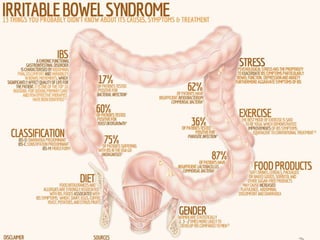
1.IBS (Irritable bowel Syndrome)
IBS is a functional bowel disorder in which
abdominal pain or discomfort is associated with
defecation or a change in bowel habit.
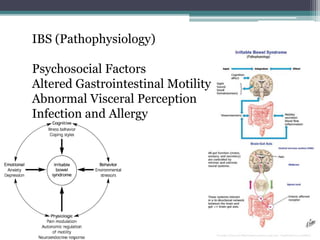
IBS (Pathophysiology)
Psychosocial Factors
Altered Gastrointestinal Motility
Abnormal Visceral Perception
Infection and Allergy
IBS (Clinical Features)
Colicky Abdominal Pain(lower Abdomen
relieved by defecation)
Abdominal Distention (worsens throughout the
day)
Altered Bowel Habit
Defecation straining or urgency
Rectal Mucus
Feeling of incomplete defecation
IBS (Diagnostic Criteria)
Recurrent abdominal pain or discomfort at least
>3 days per month in the last >3 months
associated with 2 or more of the following:
1. Improvement with defecation
2. Onset associated with a change in frequency
of stool
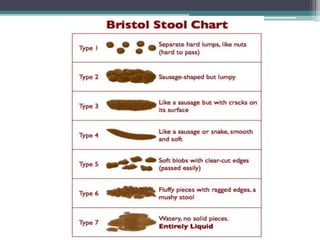
3. Onset associated with a change in form
(appearance) of stool
IBS-C
Infrequent pellety stools, usually in association with
abdominal pain or proctalgia
IBS-D
Frequent defecation but produce low volume stools +
mucus
Mixed IBS (IBS-M)
hard or lumpy stools and loose (mushy) or watery stools
Unsubtyped IBS
Insufficient abnormality of stool consistency to meet
criteria for IBS-C, D, or M.
IBS(Diagnosis Supporting Features)
Symptoms >6months
Previous medically unexplained symptoms
Frequent Consultation for non-GI problems
Stress worsen symptoms
IBS (Associated Problems)
Heartburn(Non ulcer dyspepsia)
Fibromyalgia
Chronic Fatigue Syndrome
No weight loss
Unremarkable physical Examination but abdominal
tenderness may be present.
Tensing the abdominal wall increases local
tenderness associated with abdominal wall pain,
whereas it lessens visceral tenderness by protecting
the abdominal organs (Carnett test).
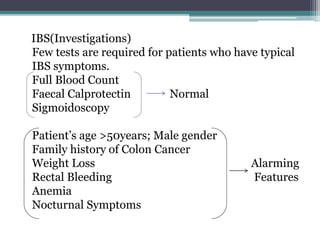
IBS(Investigations)
Few tests are required for patients who have typical
IBS symptoms.
Full Blood Count
Faecal Calprotectin Normal
Sigmoidoscopy
Patient’s age >50years; Male gender
Family history of Colon Cancer
Weight Loss Alarming
Rectal Bleeding Features
Anemia
Nocturnal Symptoms
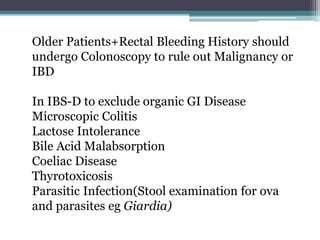
Older Patients+Rectal Bleeding History should
undergo Colonoscopy to rule out Malignancy or
IBD
In IBS-D to exclude organic GI Disease
Microscopic Colitis
Lactose Intolerance
Bile Acid Malabsorption
Coeliac Disease
Thyrotoxicosis
Parasitic Infection(Stool examination for ova
and parasites eg Giardia)
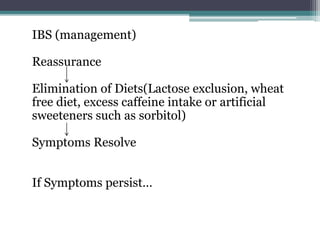
IBS (management)
Reassurance
Elimination of Diets(Lactose exclusion, wheat
free diet, excess caffeine intake or artificial
sweeteners such as sorbitol)
Symptoms Resolve
If Symptoms persist…
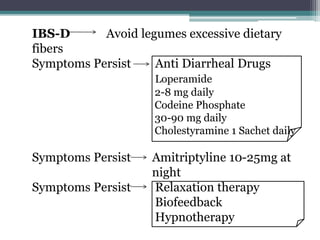
IBS-D Avoid legumes excessive dietary
fibers
Symptoms Persist Anti Diarrheal Drugs
Loperamide
2-8 mg daily
Codeine Phosphate
30-90 mg daily
Cholestyramine 1 Sachet daily
Symptoms Persist Amitriptyline 10-25mg at
night
Symptoms Persist Relaxation therapy
Biofeedback
Hypnotherapy
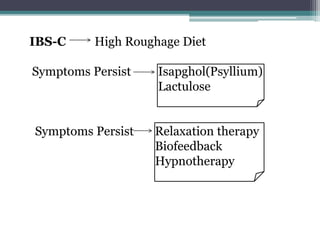
IBS-C High Roughage Diet
Symptoms Persist Isapghol(Psyllium)
Lactulose
Symptoms Persist Relaxation therapy
Biofeedback
Hypnotherapy
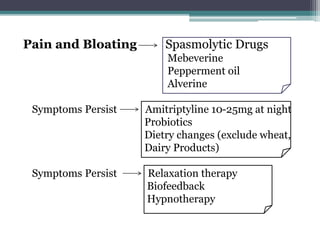
Pain and Bloating Spasmolytic Drugs
Mebeverine
Pepperment oil
Alverine
Symptoms Persist Amitriptyline 10-25mg at night
Probiotics
Dietry changes (exclude wheat,
Dairy Products)
Symptoms Persist Relaxation therapy

Biofeedback
Hypnotherapy
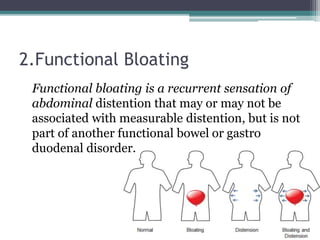
2.Functional Bloating
Functional bloating is a recurrent sensation of
abdominal distention that may or may not be
associated with measurable distention, but is not
part of another functional bowel or gastro
duodenal disorder.
It is about twice as common in women as men and
is often associated with menstruation. Typically, it
worsens after meals and throughout the day and
improves or disappears overnight.
IBS associated.
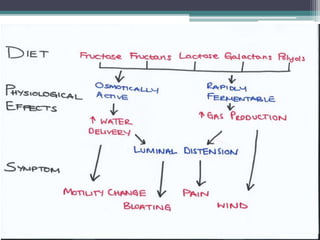
Both increased intestinal gas accumulation and
abnormal gas transit.
Functional Bloating(Symptoms)
Diurnal Pattern
Due to ingestion of specific food
Excessive burping or flatus
Diarrhea, weight loss, or nutritional deficiency
should prompt investigation for intestinal disease.
Functional Bloating(Diagnostic Criteria)
Must include both of the following:
1. Recurrent feeling of bloating or visible
distention
at least 3 days/month in 3 months
2. Insufficient criteria for a diagnosis of
functional
dyspepsia, IBS, or other functional GI disorder.
Functional Bloating(Treatment)
Associated gut syndrome such as IBS or
constipation is improved.
If bloating is accompanied by diarrhea and
worsens after ingesting dairy products, fresh
fruits, or juices, further investigation or a dietary
exclusion trial is worthwhile.
3.Functional Constipation
Functional constipation is a functional bowel
disorder that presents as persistently difficult,
infrequent, or seemingly incomplete defecation,
which do not meet IBS criteria.
Also known as chronic idiopathic constipation.
It is due to colonic inertia or anorectal
dyssynergia.
Depressed patients may have constipation.
Functional Constipation(Diagnostic Criteria)
1. Must include 2 or more of the following:
a. Straining during defecations
b. Lumpy or hard stools
c. Sensation of incomplete evacuation
d. Sensation of anorectal obstruction/blockage
e. Manual maneuvers to facilitate defecations
(e.g., support of the pelvic floor)
f. Fewer than 3 defecations per week
2. Loose stools are rarely present without the use
of laxatives
3. There are insufficient criteria for IBS
Functional Constipation(Clinical Evaluation)
Patient’s gut symptoms
General health
Psychological status
Use of constipating medications
Dietary fiber intake
Signs of medical illnesses (e.g., hypothyroidism) should
guide investigation.
Perianal and anal examination to detect fecal impaction,
anal stricture, rectal prolapse, mass, or abnormal
perineal descent with straining.
Laboratory tests are rarely helpful. Endoscopic
evaluation of the colon may be justified for patients 50
with new symptoms or patients with alarm features or a
family history of colon cancer.
Functional Constipation(Investigation-Transit
studies)
If fiber supplementation fails to help or worsens
the constipation, measurements of whole gut
transit time may identify cases of anorectal
dysfunction or colonic inertia.
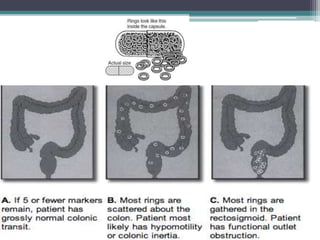
Using radiopaque markers, measurement of
whole gut transit time (primarily colon transit)
is inexpensive, simple, and safe. Retention of
markers in the proximal or transverse colon
suggests colonic dysfunction, and retention in
the recto sigmoid area suggests obstructed
defecation.
Functional Constipation(Treatment)
Physicians should stop or reduce any
constipating medication the patient may be
taking and treat depression and hypothyroidism
when present.
Pharmacologic therapy is not advisable until
general and dietary measures are exhausted.
Bulking agents(Psyllium, methyl cellulose and
calcium polycarbophil)
Laxatives(Bisacodyl, sodium picosulphate, or
sennosides)
4.Functional Diarrhea
Functional diarrhea is a continuous or recurrent
syndrome characterized by the passage of loose
(mushy) or watery stools without abdominal pain or
discomfort.
Functional Diarrhea(Diagnostic Criteria)
Loose (mushy) or watery stools without pain
Decreased non-propagating colonic
contractions(ring contractions) and increased
propagating colonic contractions.
Accelerated colonic transit inducible by acute stress.
Functional Diarrhea(Clinical Evaluation)
Dietary history can disclose poorly absorbed
carbohydrate intake, such as lactose or “sugar-
free” products containing fructose, sorbitol, or
mannitol.
Alcohol can cause diarrhea by impairing sodium
and water absorption from the small bowel.
Physical examination should seek signs of
anemia or malnutrition.
An abdominal mass suggests Crohn’s disease in
the young patient and cancer in the elderly
patient.
Rectal examination, colonoscopy, and biopsy can
exclude microscopic colitis, and IBD.
Abnormal results of blood or stool tests or other
alarm features necessitate further tests. Features
of malabsorption (malnutrition, weight loss,
non–blood-loss anemia, or electrolyte
abnormalities) should provoke the appropriate
antibody tests and/or duodenal biopsy for celiac
disease. Where relevant, giardiasis and tropical
sprue should be excluded.
Barium small bowel radiography may be
necessary. Rarely, persistent diarrhea may
require tests for bile acid malabsorption or,
more practically, a trial of the bile acid-binding
resin Colestyramine.
Functional Diarrhea(Treatment)
Reassurance is important.
Restriction of foods, such as those containing
sorbitol or caffeine, which seem provocative, may
help.
Antidiarrheal therapy (e.g., diphenoxylate or
Loperamide) is usually effective, especially if taken
prophylacticaly, such as before meals.
Cholestyramine, an ion-exchange resin that binds
bile acids and renders them biologically inactive, is
occasionally very effective.
The prognosis of functional diarrhea is uncertain,
but it is often self-limited
5.Unspecified Functional Bowel
Disorders
Individual symptoms discussed in the previous sections
are very common in the population. These occasionally
lead to medical consultation, yet are unaccompanied by
other symptoms that satisfy criteria for a syndrome. Such
symptoms are best classified as unspecified.
Unspecified Functional Bowel Disorder
Bowel symptoms not attributable to an organic
etiology that do not meet criteria for the
previously defined categories.
Thank You
References
Davidson
http://www.fascrs.org/physicians/education/co
re_subjects/2005/functional_bowel_disorders/
http://www.romecriteria.org/
http://www.medscape.com/viewarticle/717346_
3

Funtional Bowel Disease

  • 1.
  • 2.
    Definition Functional bowel disordersare functional gastrointestinal disorders with symptoms attributable to the middle or lower gastrointestinal tract.
  • 3.
    Classification These include thefollowing: 1.IBS (Irritable Bowel Syndrome) 2.Functional bloating 3.Functional constipation 4.Functional diarrhea 5.Unspecified functional bowel disorder
  • 4.
    When to labela bowel disorder as Functional Bowel Disorder… Symptoms must have occurred for the first time > 6 months before the patient presents, and their presence on >3 days a month during the last 3 months.
  • 5.
    1.IBS (Irritable bowelSyndrome) IBS is a functional bowel disorder in which abdominal pain or discomfort is associated with defecation or a change in bowel habit.
  • 6.
    IBS (Pathophysiology) Psychosocial Factors AlteredGastrointestinal Motility Abnormal Visceral Perception Infection and Allergy
  • 9.
    IBS (Clinical Features) ColickyAbdominal Pain(lower Abdomen relieved by defecation) Abdominal Distention (worsens throughout the day) Altered Bowel Habit Defecation straining or urgency Rectal Mucus Feeling of incomplete defecation
  • 10.
    IBS (Diagnostic Criteria) Recurrentabdominal pain or discomfort at least >3 days per month in the last >3 months associated with 2 or more of the following: 1. Improvement with defecation 2. Onset associated with a change in frequency of stool 3. Onset associated with a change in form (appearance) of stool
  • 11.
    IBS-C Infrequent pellety stools,usually in association with abdominal pain or proctalgia IBS-D Frequent defecation but produce low volume stools + mucus Mixed IBS (IBS-M) hard or lumpy stools and loose (mushy) or watery stools Unsubtyped IBS Insufficient abnormality of stool consistency to meet criteria for IBS-C, D, or M.
  • 13.
    IBS(Diagnosis Supporting Features) Symptoms>6months Previous medically unexplained symptoms Frequent Consultation for non-GI problems Stress worsen symptoms
  • 14.
    IBS (Associated Problems) Heartburn(Nonulcer dyspepsia) Fibromyalgia Chronic Fatigue Syndrome No weight loss Unremarkable physical Examination but abdominal tenderness may be present. Tensing the abdominal wall increases local tenderness associated with abdominal wall pain, whereas it lessens visceral tenderness by protecting the abdominal organs (Carnett test).
  • 15.
    IBS(Investigations) Few tests arerequired for patients who have typical IBS symptoms. Full Blood Count Faecal Calprotectin Normal Sigmoidoscopy Patient’s age >50years; Male gender Family history of Colon Cancer Weight Loss Alarming Rectal Bleeding Features Anemia Nocturnal Symptoms
  • 16.
    Older Patients+Rectal BleedingHistory should undergo Colonoscopy to rule out Malignancy or IBD In IBS-D to exclude organic GI Disease Microscopic Colitis Lactose Intolerance Bile Acid Malabsorption Coeliac Disease Thyrotoxicosis Parasitic Infection(Stool examination for ova and parasites eg Giardia)
  • 17.
    IBS (management) Reassurance Elimination ofDiets(Lactose exclusion, wheat free diet, excess caffeine intake or artificial sweeteners such as sorbitol) Symptoms Resolve If Symptoms persist…
  • 18.
    IBS-D Avoid legumesexcessive dietary fibers Symptoms Persist Anti Diarrheal Drugs Loperamide 2-8 mg daily Codeine Phosphate 30-90 mg daily Cholestyramine 1 Sachet daily Symptoms Persist Amitriptyline 10-25mg at night Symptoms Persist Relaxation therapy Biofeedback Hypnotherapy
  • 19.
    IBS-C High RoughageDiet Symptoms Persist Isapghol(Psyllium) Lactulose Symptoms Persist Relaxation therapy Biofeedback Hypnotherapy
  • 20.
    Pain and BloatingSpasmolytic Drugs Mebeverine Pepperment oil Alverine Symptoms Persist Amitriptyline 10-25mg at night Probiotics Dietry changes (exclude wheat, Dairy Products) Symptoms Persist Relaxation therapy Biofeedback Hypnotherapy
  • 22.
    2.Functional Bloating Functional bloatingis a recurrent sensation of abdominal distention that may or may not be associated with measurable distention, but is not part of another functional bowel or gastro duodenal disorder.
  • 23.
    It is abouttwice as common in women as men and is often associated with menstruation. Typically, it worsens after meals and throughout the day and improves or disappears overnight. IBS associated. Both increased intestinal gas accumulation and abnormal gas transit. Functional Bloating(Symptoms) Diurnal Pattern Due to ingestion of specific food Excessive burping or flatus Diarrhea, weight loss, or nutritional deficiency should prompt investigation for intestinal disease.
  • 24.
    Functional Bloating(Diagnostic Criteria) Mustinclude both of the following: 1. Recurrent feeling of bloating or visible distention at least 3 days/month in 3 months 2. Insufficient criteria for a diagnosis of functional dyspepsia, IBS, or other functional GI disorder.
  • 25.
    Functional Bloating(Treatment) Associated gutsyndrome such as IBS or constipation is improved. If bloating is accompanied by diarrhea and worsens after ingesting dairy products, fresh fruits, or juices, further investigation or a dietary exclusion trial is worthwhile.
  • 26.
    3.Functional Constipation Functional constipationis a functional bowel disorder that presents as persistently difficult, infrequent, or seemingly incomplete defecation, which do not meet IBS criteria. Also known as chronic idiopathic constipation. It is due to colonic inertia or anorectal dyssynergia. Depressed patients may have constipation.
  • 27.
    Functional Constipation(Diagnostic Criteria) 1.Must include 2 or more of the following: a. Straining during defecations b. Lumpy or hard stools c. Sensation of incomplete evacuation d. Sensation of anorectal obstruction/blockage e. Manual maneuvers to facilitate defecations (e.g., support of the pelvic floor) f. Fewer than 3 defecations per week 2. Loose stools are rarely present without the use of laxatives 3. There are insufficient criteria for IBS
  • 28.
    Functional Constipation(Clinical Evaluation) Patient’sgut symptoms General health Psychological status Use of constipating medications Dietary fiber intake Signs of medical illnesses (e.g., hypothyroidism) should guide investigation. Perianal and anal examination to detect fecal impaction, anal stricture, rectal prolapse, mass, or abnormal perineal descent with straining. Laboratory tests are rarely helpful. Endoscopic evaluation of the colon may be justified for patients 50 with new symptoms or patients with alarm features or a family history of colon cancer.
  • 29.
    Functional Constipation(Investigation-Transit studies) If fibersupplementation fails to help or worsens the constipation, measurements of whole gut transit time may identify cases of anorectal dysfunction or colonic inertia. Using radiopaque markers, measurement of whole gut transit time (primarily colon transit) is inexpensive, simple, and safe. Retention of markers in the proximal or transverse colon suggests colonic dysfunction, and retention in the recto sigmoid area suggests obstructed defecation.
  • 31.
    Functional Constipation(Treatment) Physicians shouldstop or reduce any constipating medication the patient may be taking and treat depression and hypothyroidism when present. Pharmacologic therapy is not advisable until general and dietary measures are exhausted. Bulking agents(Psyllium, methyl cellulose and calcium polycarbophil) Laxatives(Bisacodyl, sodium picosulphate, or sennosides)
  • 32.
    4.Functional Diarrhea Functional diarrheais a continuous or recurrent syndrome characterized by the passage of loose (mushy) or watery stools without abdominal pain or discomfort. Functional Diarrhea(Diagnostic Criteria) Loose (mushy) or watery stools without pain Decreased non-propagating colonic contractions(ring contractions) and increased propagating colonic contractions. Accelerated colonic transit inducible by acute stress.
  • 33.
    Functional Diarrhea(Clinical Evaluation) Dietaryhistory can disclose poorly absorbed carbohydrate intake, such as lactose or “sugar- free” products containing fructose, sorbitol, or mannitol. Alcohol can cause diarrhea by impairing sodium and water absorption from the small bowel.
  • 34.
    Physical examination shouldseek signs of anemia or malnutrition. An abdominal mass suggests Crohn’s disease in the young patient and cancer in the elderly patient. Rectal examination, colonoscopy, and biopsy can exclude microscopic colitis, and IBD.
  • 35.
    Abnormal results ofblood or stool tests or other alarm features necessitate further tests. Features of malabsorption (malnutrition, weight loss, non–blood-loss anemia, or electrolyte abnormalities) should provoke the appropriate antibody tests and/or duodenal biopsy for celiac disease. Where relevant, giardiasis and tropical sprue should be excluded. Barium small bowel radiography may be necessary. Rarely, persistent diarrhea may require tests for bile acid malabsorption or, more practically, a trial of the bile acid-binding resin Colestyramine.
  • 36.
    Functional Diarrhea(Treatment) Reassurance isimportant. Restriction of foods, such as those containing sorbitol or caffeine, which seem provocative, may help. Antidiarrheal therapy (e.g., diphenoxylate or Loperamide) is usually effective, especially if taken prophylacticaly, such as before meals. Cholestyramine, an ion-exchange resin that binds bile acids and renders them biologically inactive, is occasionally very effective. The prognosis of functional diarrhea is uncertain, but it is often self-limited
  • 37.
    5.Unspecified Functional Bowel Disorders Individualsymptoms discussed in the previous sections are very common in the population. These occasionally lead to medical consultation, yet are unaccompanied by other symptoms that satisfy criteria for a syndrome. Such symptoms are best classified as unspecified. Unspecified Functional Bowel Disorder Bowel symptoms not attributable to an organic etiology that do not meet criteria for the previously defined categories.
  • 38.
  • 39.