BENIGN NEOPLASM OF COLON
AND RECTUM
Abdul Mughni
Digestive Surgery Dept ,
Medical Faculty of Diponegoro Univ. –
Kariadi Hospital
OBJECTIVE
 Definition
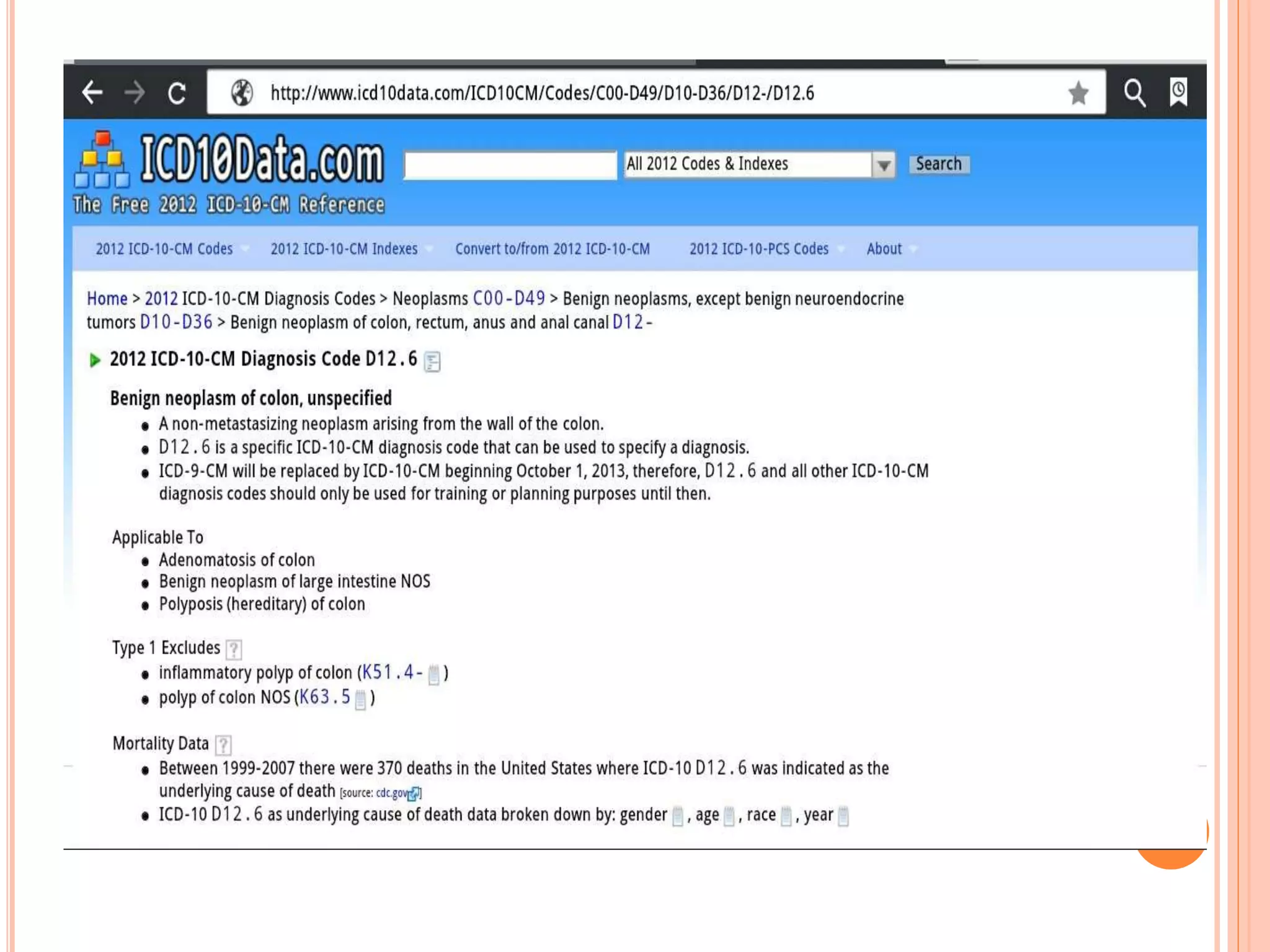
 ICD 9 / ICD 10
 Classification
 Diagnosis
 Treatment
 Follow Up and Surveillance
DEFINITION
 Benign : (L, benignus) : Not malignant; not
recurrent, favorable for recovery
 Neoplasm : any new and abnormal growth;
specifically a new growth of tissue in wich the
growth is uncontrolled and progressive
 Dorland’s Illustrated Medical Dictionary, 30th Edition,
Philadelphia, Saunders, 2000
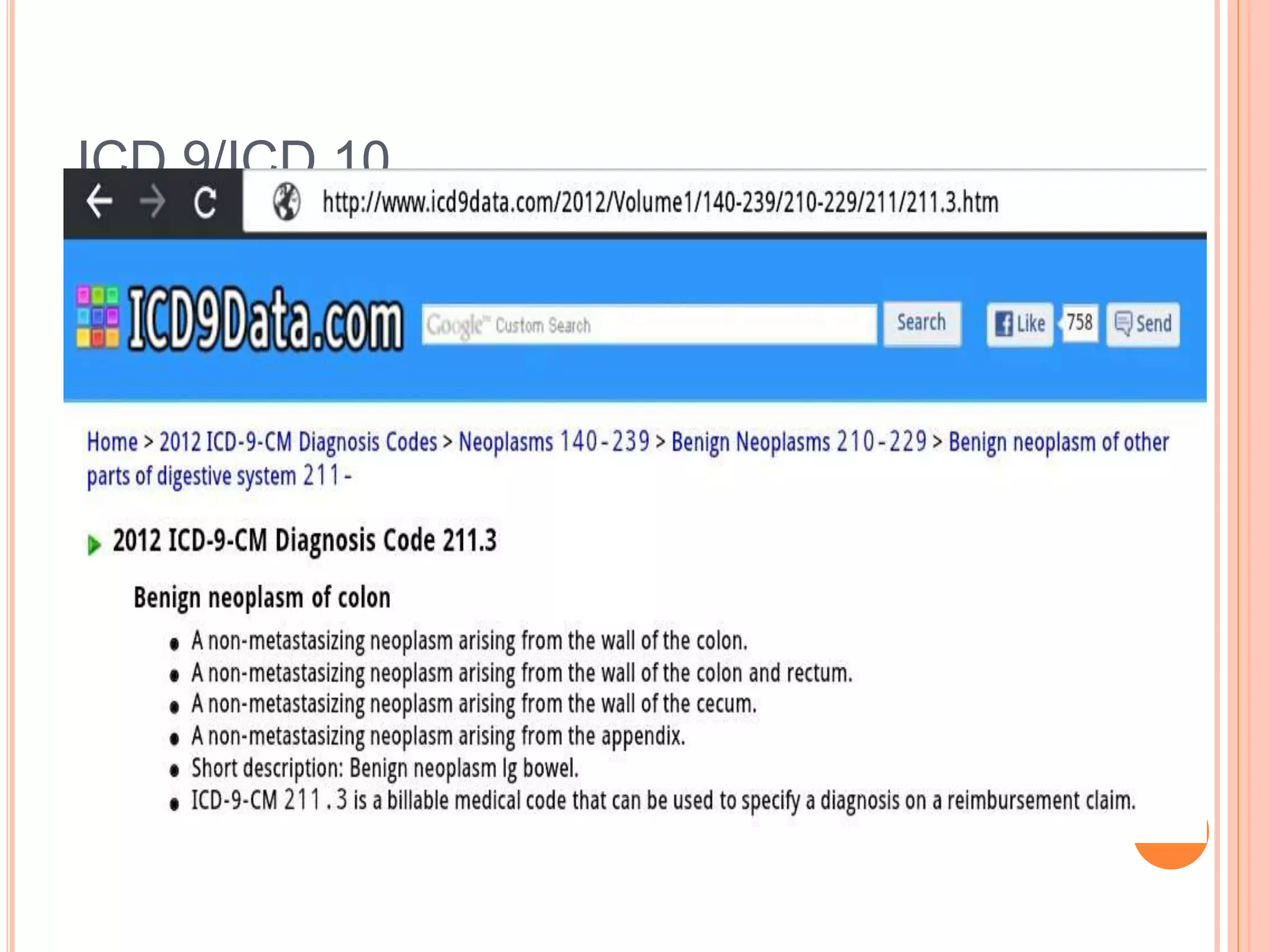
ICD 9/ICD 10
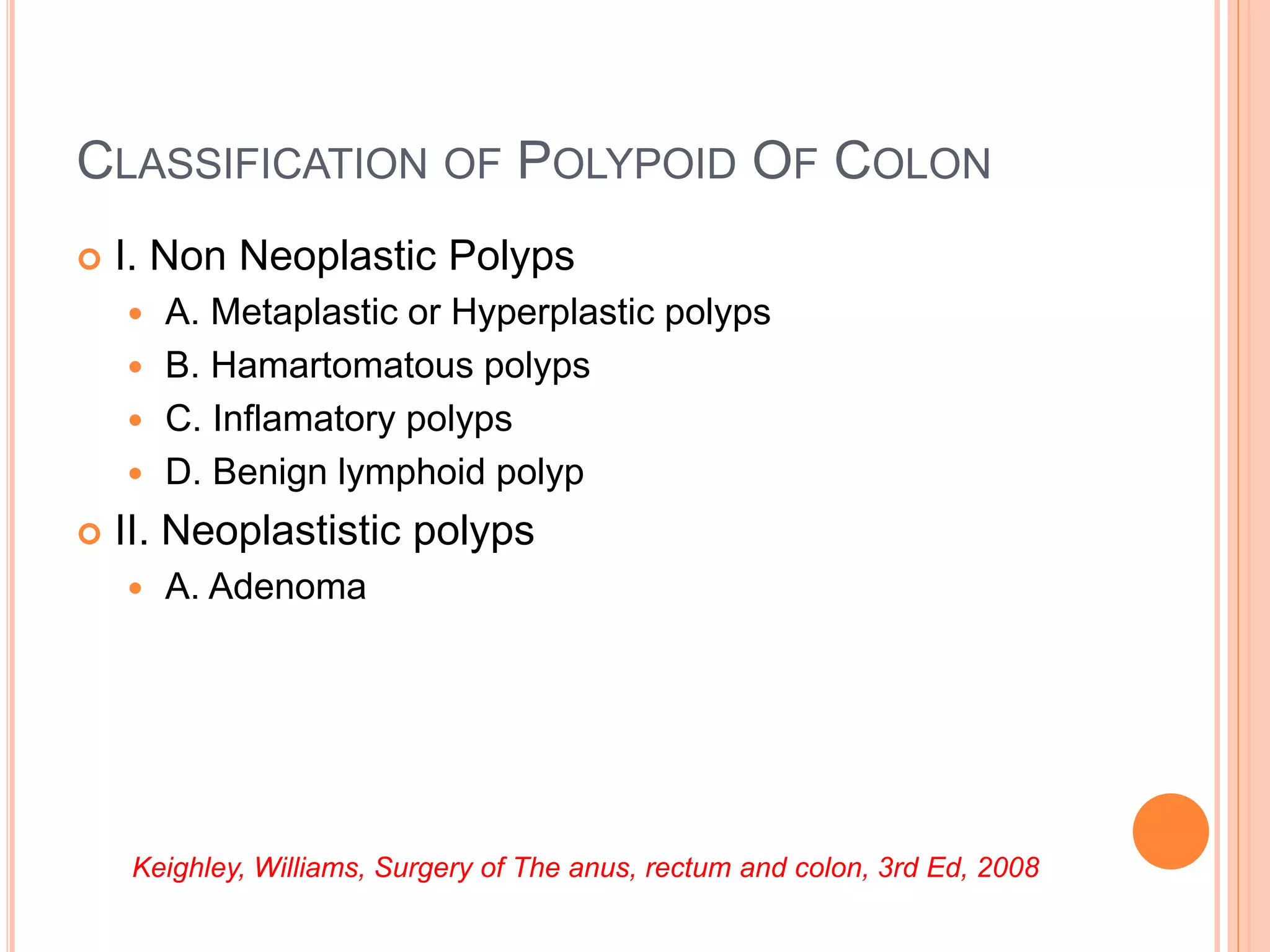
CLASSIFICATION OF POLYPOID OF COLON
 I. Non Neoplastic Polyps
 A. Metaplastic or Hyperplastic polyps
 B. Hamartomatous polyps
 C. Inflamatory polyps
 D. Benign lymphoid polyp
 II. Neoplastistic polyps
 A. Adenoma
Keighley, Williams, Surgery of The anus, rectum and colon, 3rd Ed, 2008
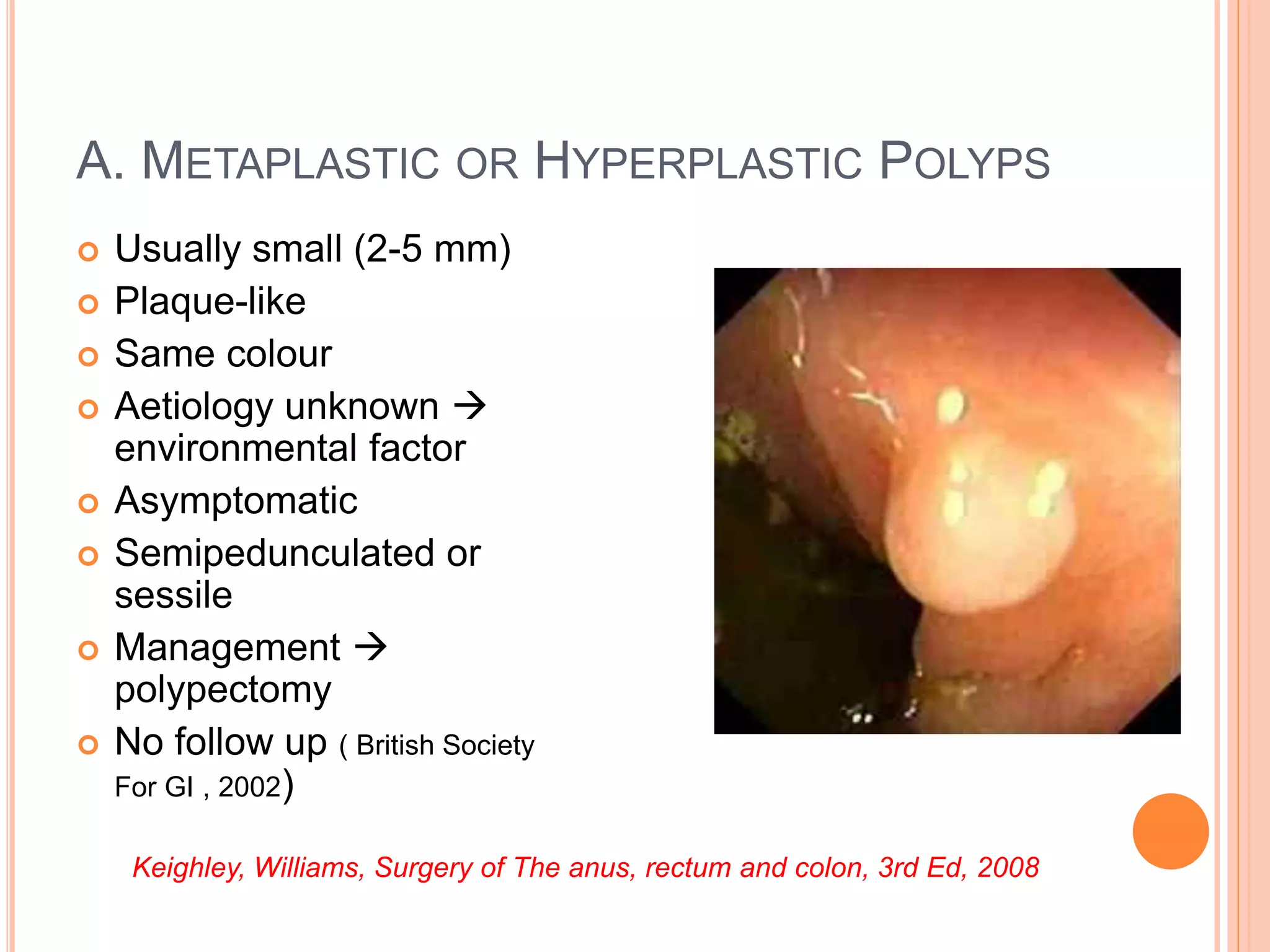
A. METAPLASTIC OR HYPERPLASTIC POLYPS
 Usually small (2-5 mm)
 Plaque-like
 Same colour
 Aetiology unknown 
environmental factor
 Asymptomatic
 Semipedunculated or
sessile
 Management 
polypectomy
 No follow up ( British Society
For GI , 2002)
Keighley, Williams, Surgery of The anus, rectum and colon, 3rd Ed, 2008
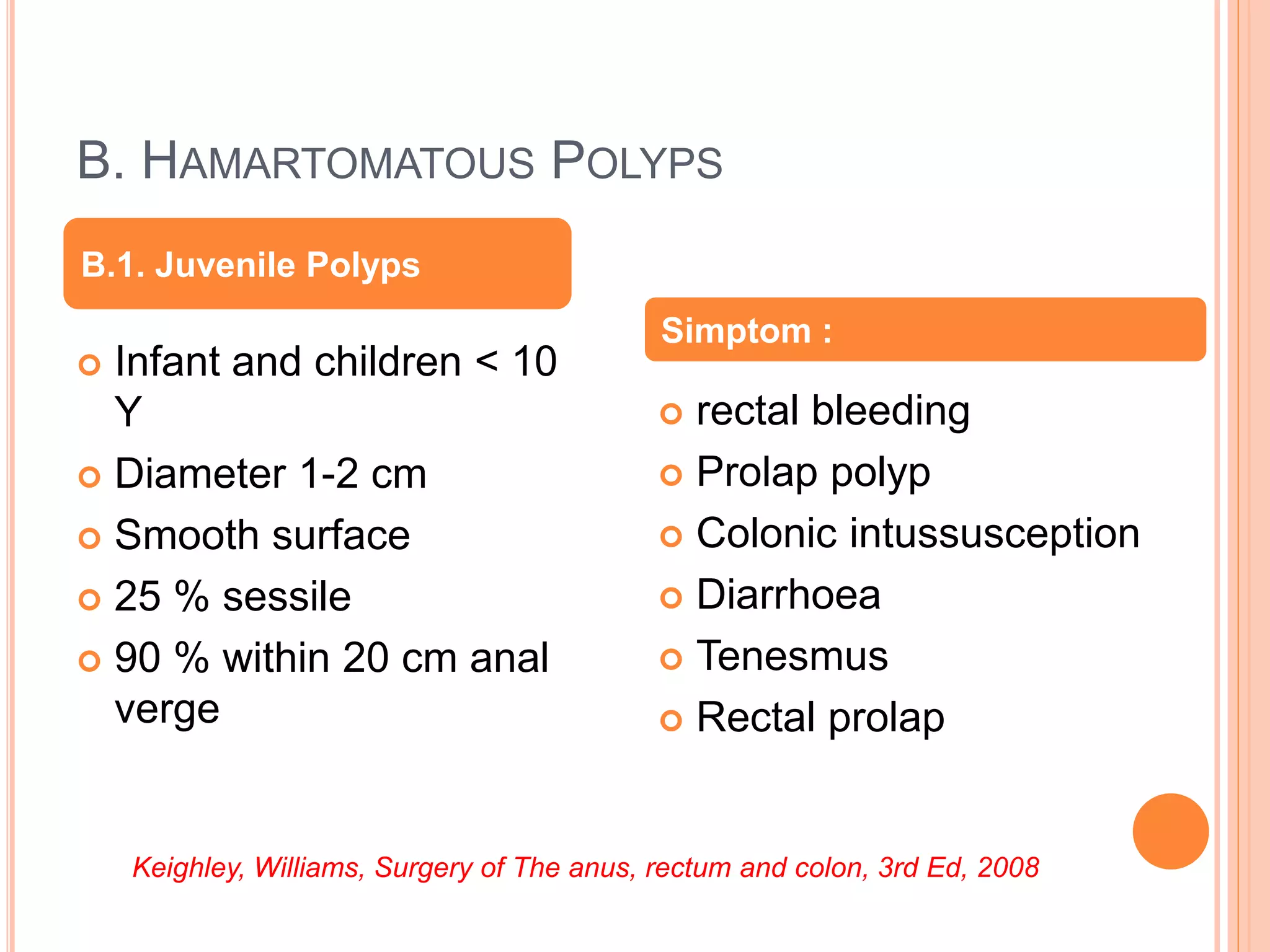
B. HAMARTOMATOUS POLYPS
 Infant and children < 10
Y
 Diameter 1-2 cm
 Smooth surface
 25 % sessile
 90 % within 20 cm anal
verge
 rectal bleeding
 Prolap polyp
 Colonic intussusception
 Diarrhoea
 Tenesmus
 Rectal prolap
B.1. Juvenile Polyps
Simptom :
Keighley, Williams, Surgery of The anus, rectum and colon, 3rd Ed, 2008
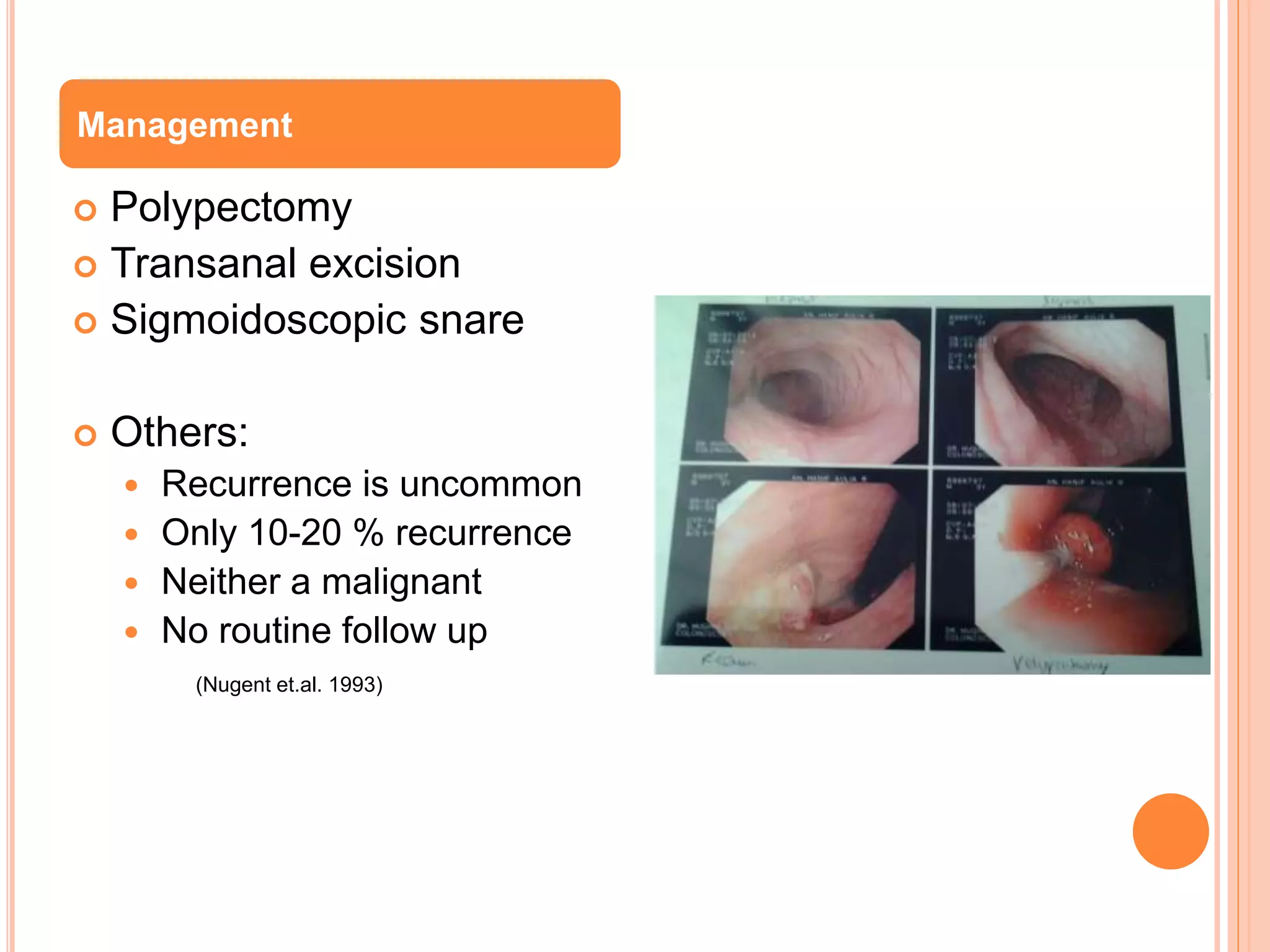
 Polypectomy
 Transanal excision
 Sigmoidoscopic snare
 Others:
 Recurrence is uncommon
 Only 10-20 % recurrence
 Neither a malignant
 No routine follow up
(Nugent et.al. 1993)
Management
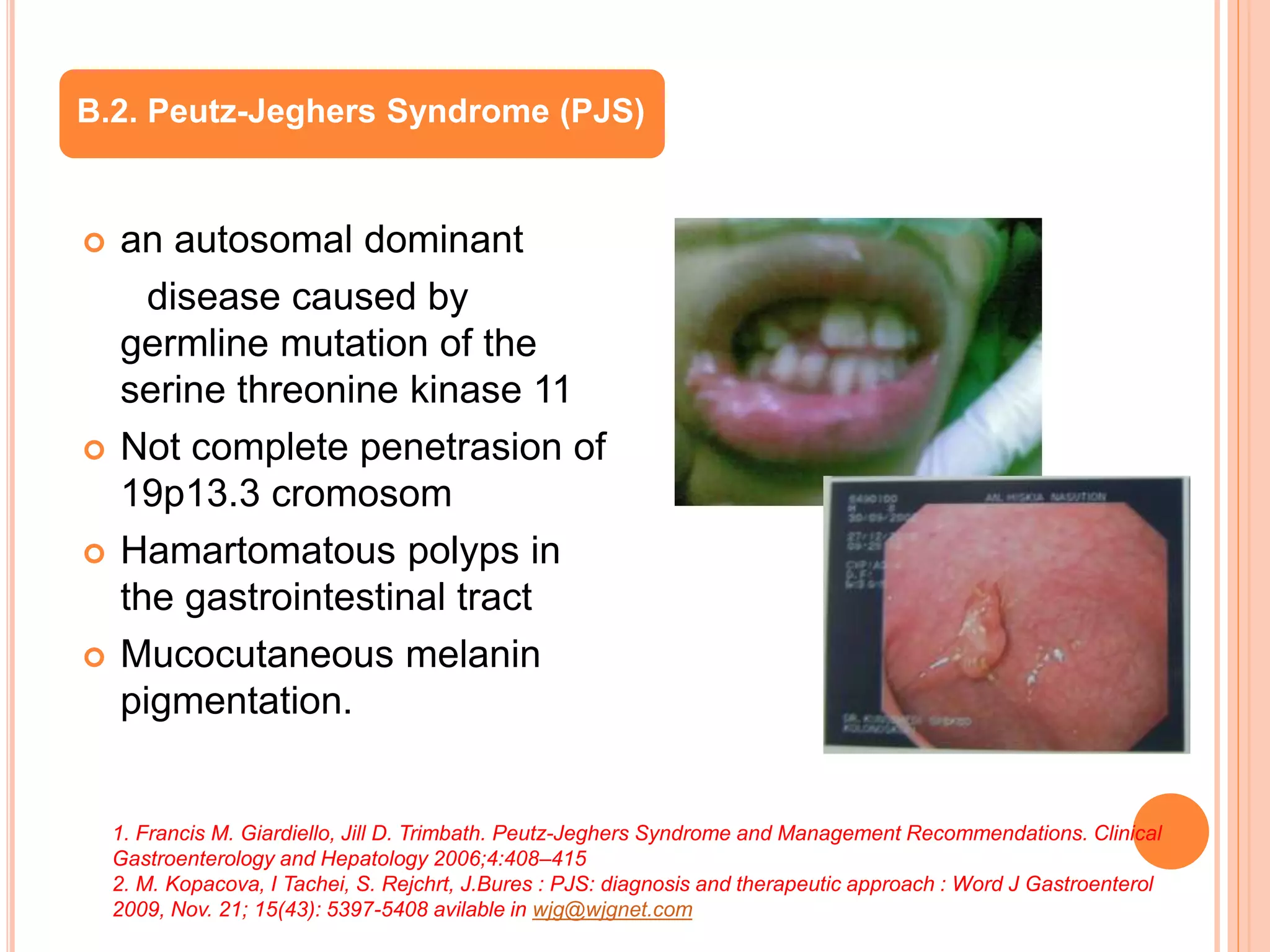
 an autosomal dominant
disease caused by
germline mutation of the
serine threonine kinase 11
 Not complete penetrasion of
19p13.3 cromosom
 Hamartomatous polyps in
the gastrointestinal tract
 Mucocutaneous melanin
pigmentation.
B.2. Peutz-Jeghers Syndrome (PJS)
1. Francis M. Giardiello, Jill D. Trimbath. Peutz-Jeghers Syndrome and Management Recommendations. Clinical
Gastroenterology and Hepatology 2006;4:408–415
2. M. Kopacova, I Tachei, S. Rejchrt, J.Bures : PJS: diagnosis and therapeutic approach : Word J Gastroenterol
2009, Nov. 21; 15(43): 5397-5408 avilable in wjg@wjgnet.com
RISK OF PJS
 increased risk for :
 common and unusual types of gastrointestinal tumor (
colon :39 %)
 nongastrointestinal tumors (Breast : 54%)
 Morbidity and complication
 Bleeding and anemia
 Invagination.
(Francis M. Giardiello, Jill D. Trimbath. Peutz-Jeghers Syndrome and
Management Recommendations. Clinical Gastroenterology and
Hepatology 2006;4:408–415)
Francis M. Giardiello, Jill D. Trimbath. Peutz-Jeghers Syndrome
and Management Recommendations. Clinical Gastroenterology
and Hepatology 2006;4:408–415
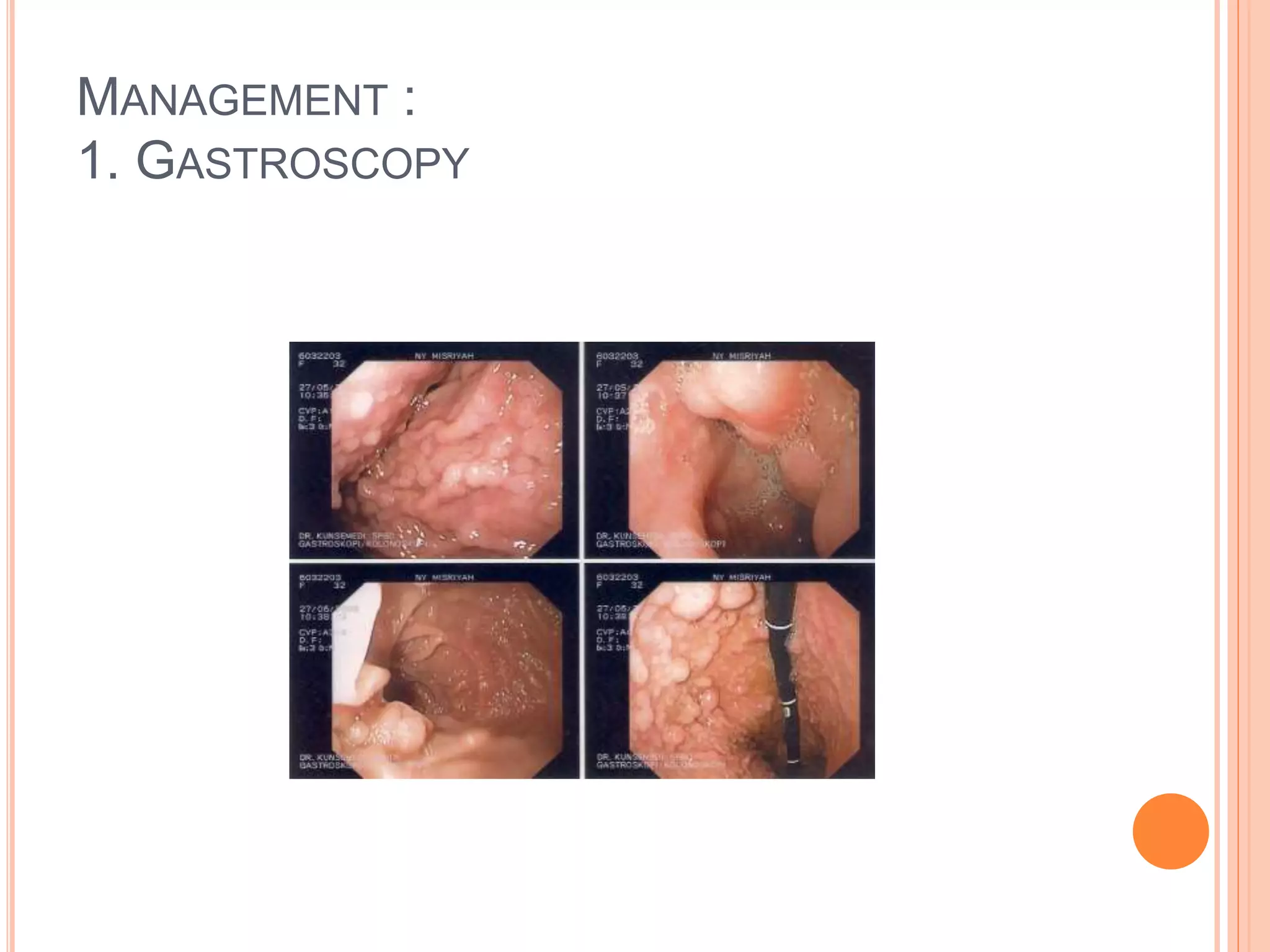
MANAGEMENT :
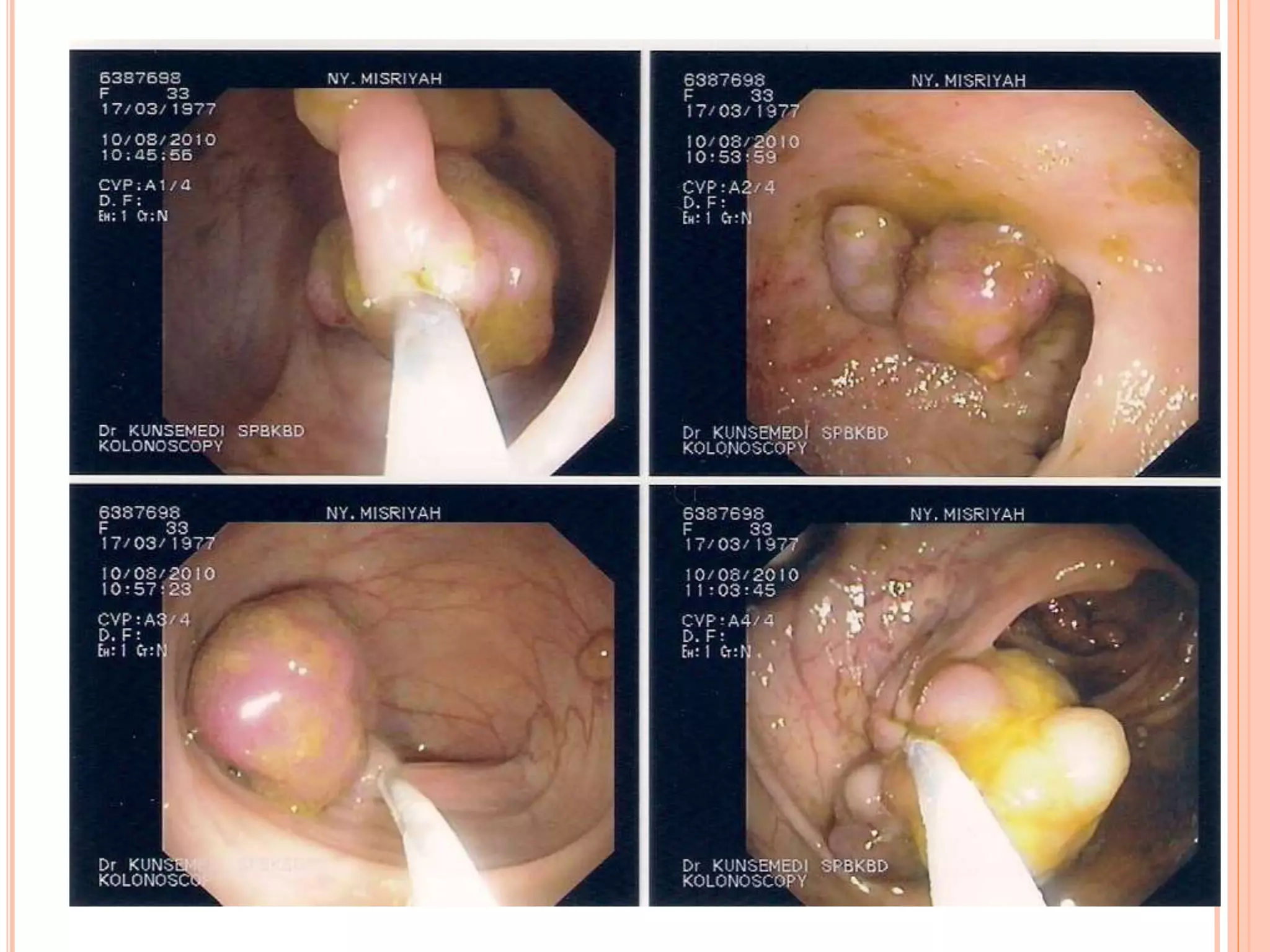
1. GASTROSCOPY
COLONOSCOPY
Caecum Ileum terminal Kolon Transversum
Desenden Sigmoid Rectum
MULTIPLE PEDUNCULATED POLYPS
THERAPY : SNARE POLYPECTOMY FOR
POLYPS WITH Ø>1CM
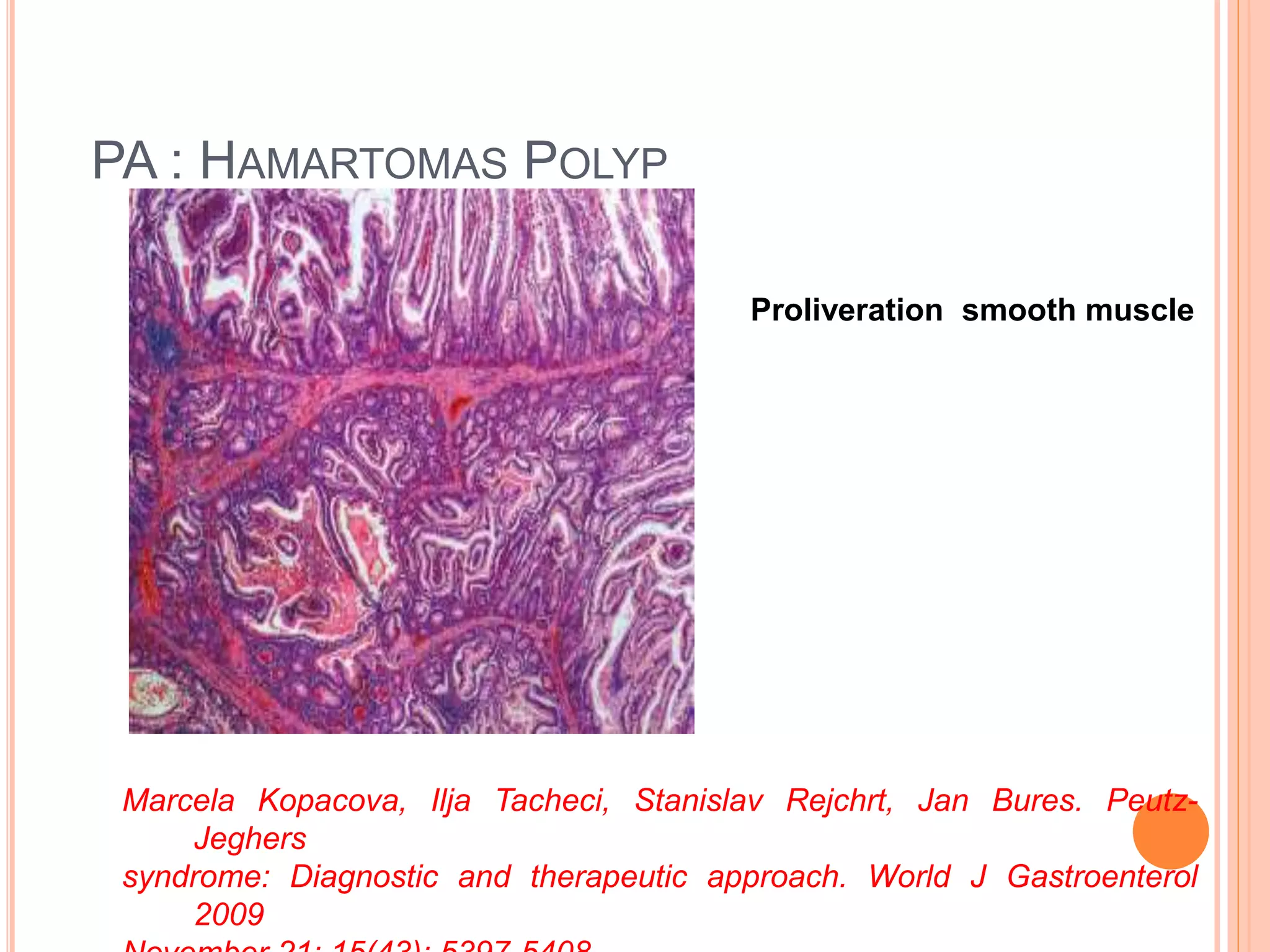
PA : HAMARTOMAS POLYP
Proliveration smooth muscle
Marcela Kopacova, Ilja Tacheci, Stanislav Rejchrt, Jan Bures. Peutz-
Jeghers
syndrome: Diagnostic and therapeutic approach. World J Gastroenterol
2009
INFLAMATORY POLYPS
 scattered worm
 Or thread-like (Filiform)
 Adjacent mucosa and
formation of mucosal tag
of various shapes and
sizes
 Superficial ulceration
white slough
 Not a malignant
BENING LYMPHOID POLYPS
 Lymphoid hyperplasia
 Most present in 1/3
distal of rectum
 Smooth, round,
submucosal lession
 Majority are sessile
 Usually Single
Keighley, Williams, Surgery of The anus, rectum and colon, 3rd Ed, 2008
NEOPLASTIC POLYPS
 ADENOMA
 Most important polyp
 Main precursor colorectal cancer
 Catagories on basis of size:
 Early (type I) : Small , ≤ 0,5 cm, APC mutation, 10 % LOH on
Cromosome 18q
 Intermediate (II) : Medium, 0,6- 1 cm , 50 % K-ras mutation
 late(III), Large > 1 cm, 50 % LOH on cromosome 18q
 Catagories on basis of shape:
 Tubular
 Tubulovillous
 villous
Keighley, Williams, Surgery of The anus, rectum and colon, 3rd Ed, 2008
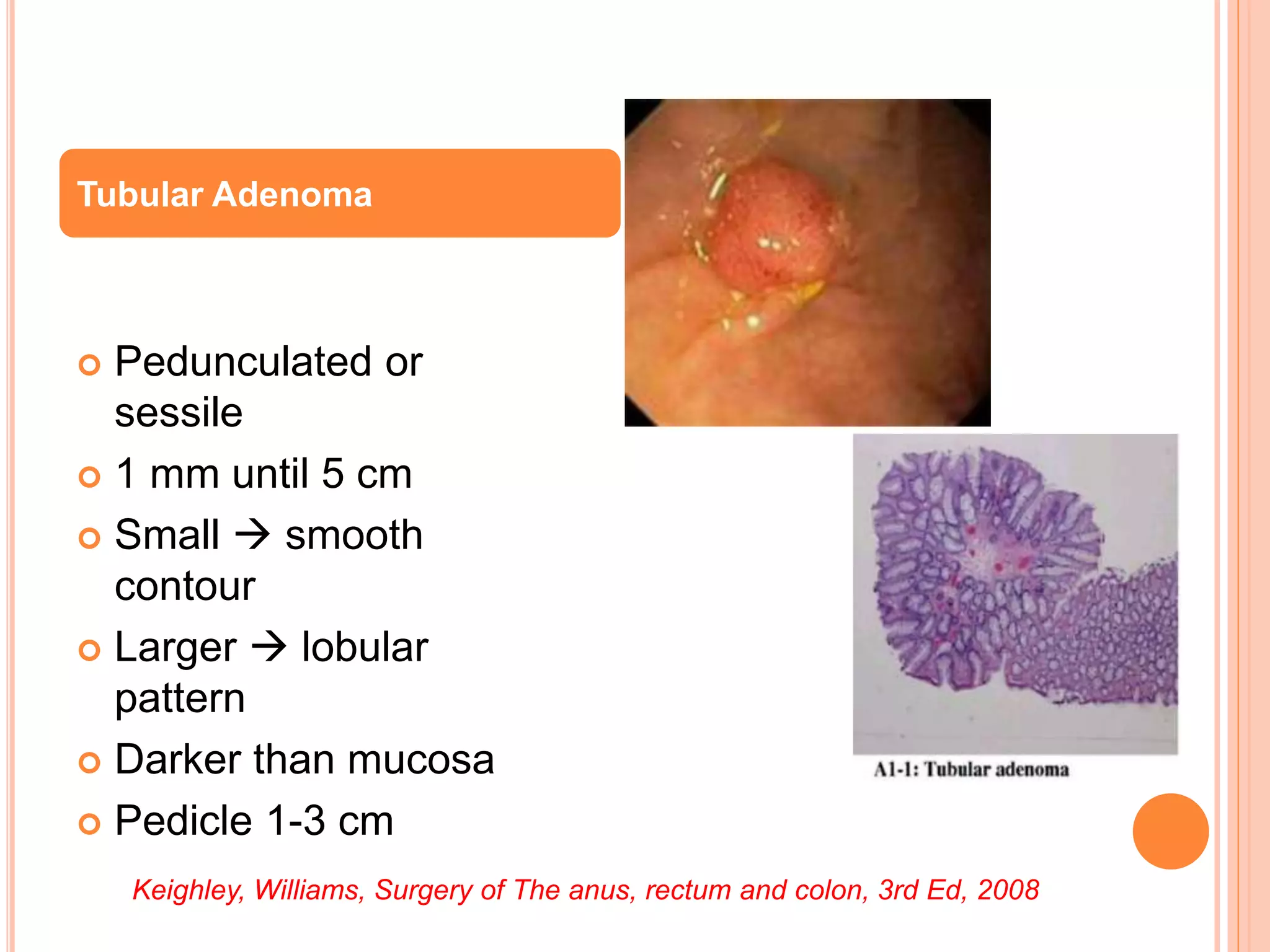
 Pedunculated or
sessile
 1 mm until 5 cm
 Small  smooth
contour
 Larger  lobular
pattern
 Darker than mucosa
 Pedicle 1-3 cm
Tubular Adenoma
Keighley, Williams, Surgery of The anus, rectum and colon, 3rd Ed, 2008
 Usually large and sessile
 Shaggy surface
 Soft
 Edge are ill-define
 Flat or protude
 Extends  carpet like
lession
 Often circumferential
 Darker than surrounding
mucosa
Villous Adenoma
Keighley, Williams, Surgery of The anus, rectum and colon, 3rd Ed, 2008
DIAGNOSIS
 Bleeding
 Diarrhoea and passage
of mucous
 Prolaps
 Abdominal colic
 Must be done
 Soft  difficult to
palpate
 Velvety
 pedunculated
Simptom and Sign Rectal Examination
 Anemia
 Mucous diarrhoea 
Fluid and electrolid
depletion Syndrome
 Hypokalaemia
 Hyponatraemia
 Acidosis
 Ureaemia
 Rigid Sigmodoscopy
 Flexible sigmoidoscopy
 Colonoscopy
 Chromoscopic
colonoscopy
 Double contras barium
enema
Laboratorium Finding Instrument
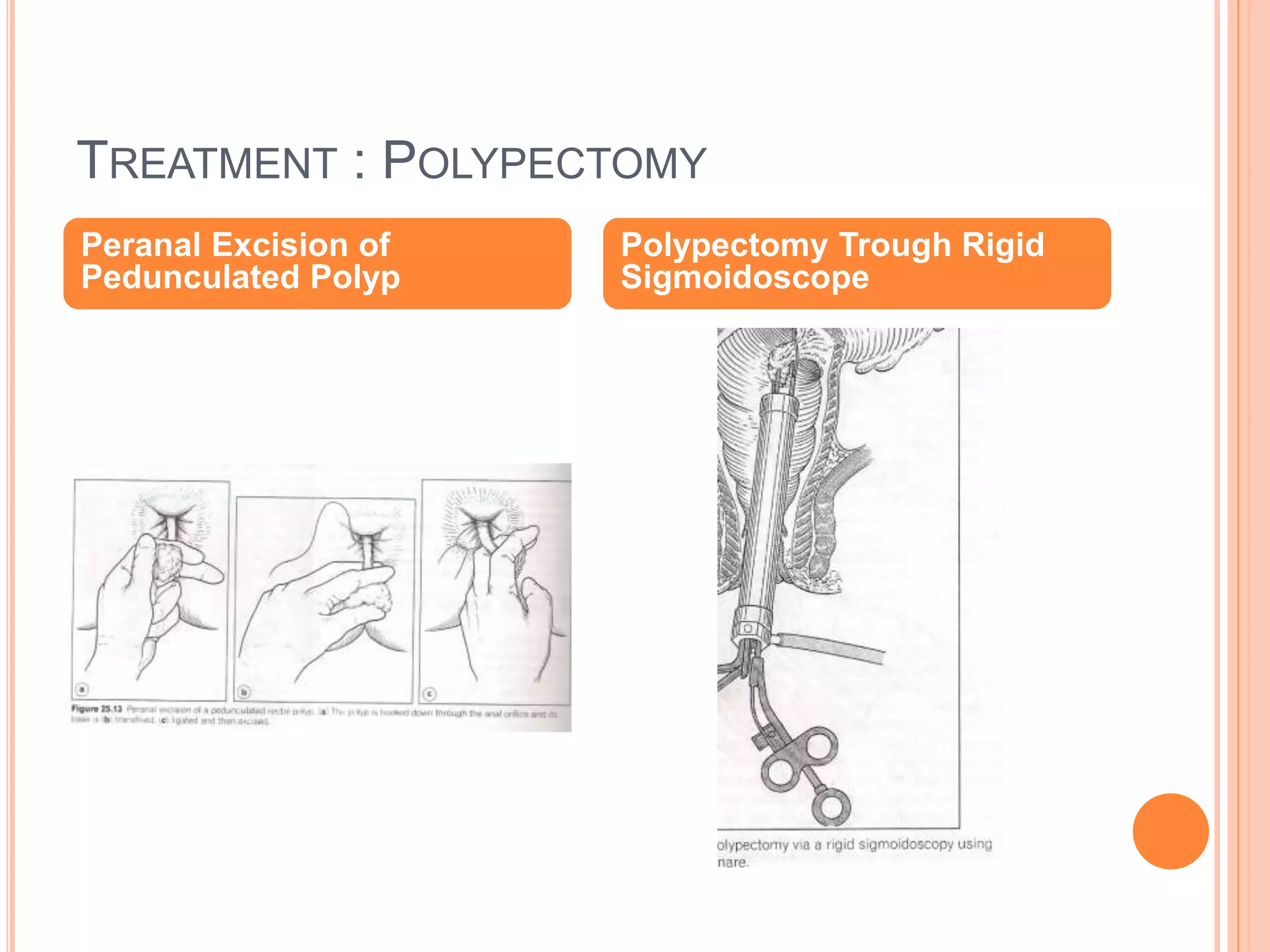
TREATMENT : POLYPECTOMY
Peranal Excision of
Pedunculated Polyp
Polypectomy Trough Rigid
Sigmoidoscope
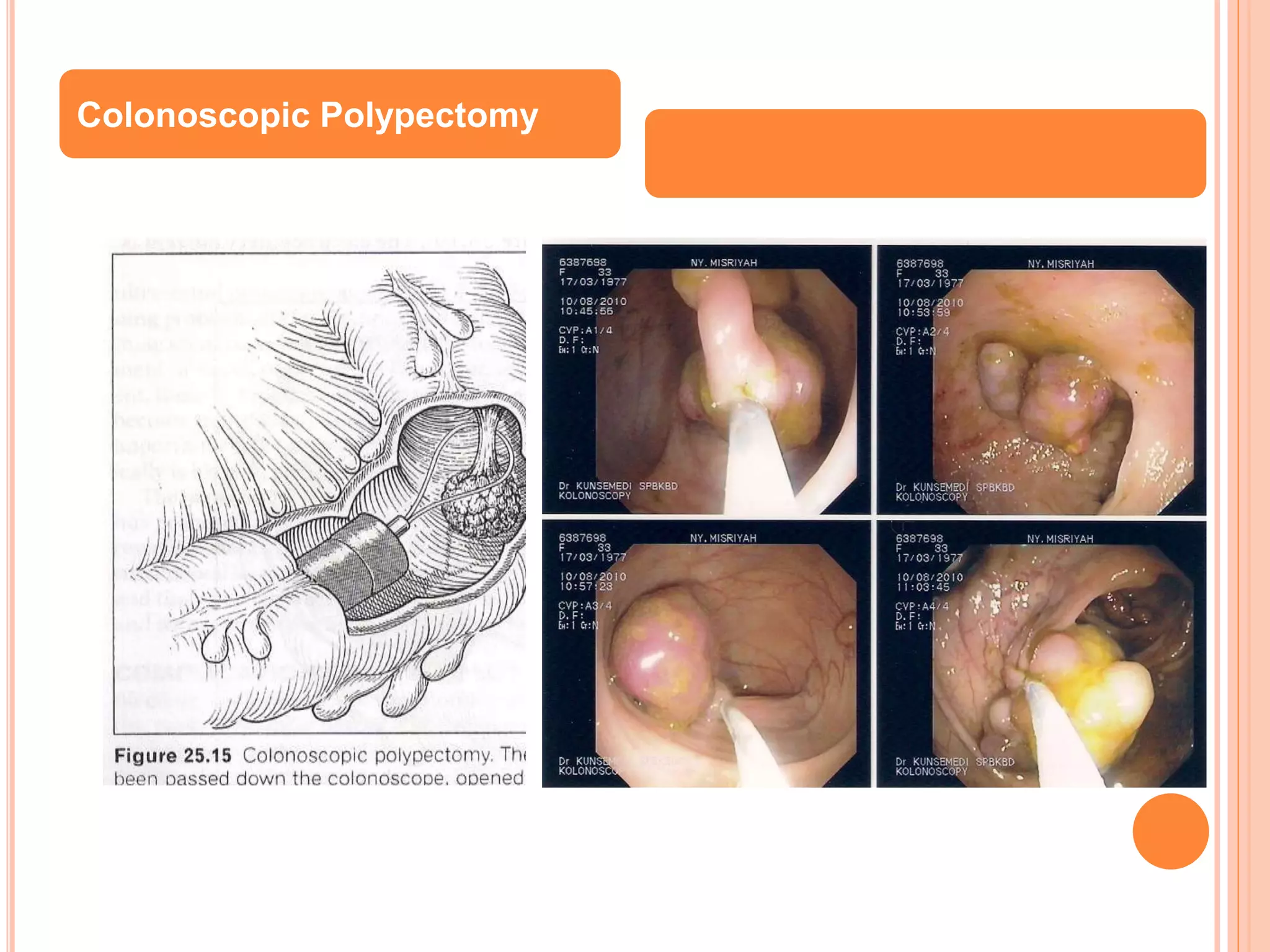
Colonoscopic Polypectomy
Tran Anal Incision
Trananal Endoscopic
Microsurgery (TEM)
COMPLICATION OF POLYPECTOMY
 Hemorrage
 Minor : 53%
 Major : 1-2 %
 Perforation : 1-3 %
 Gas Explotion
 After prepared using mannitol
 Polypectomy Syndrome
 Abdominal pain
 Distension
 Brief period fever
 Mortality 0,05%
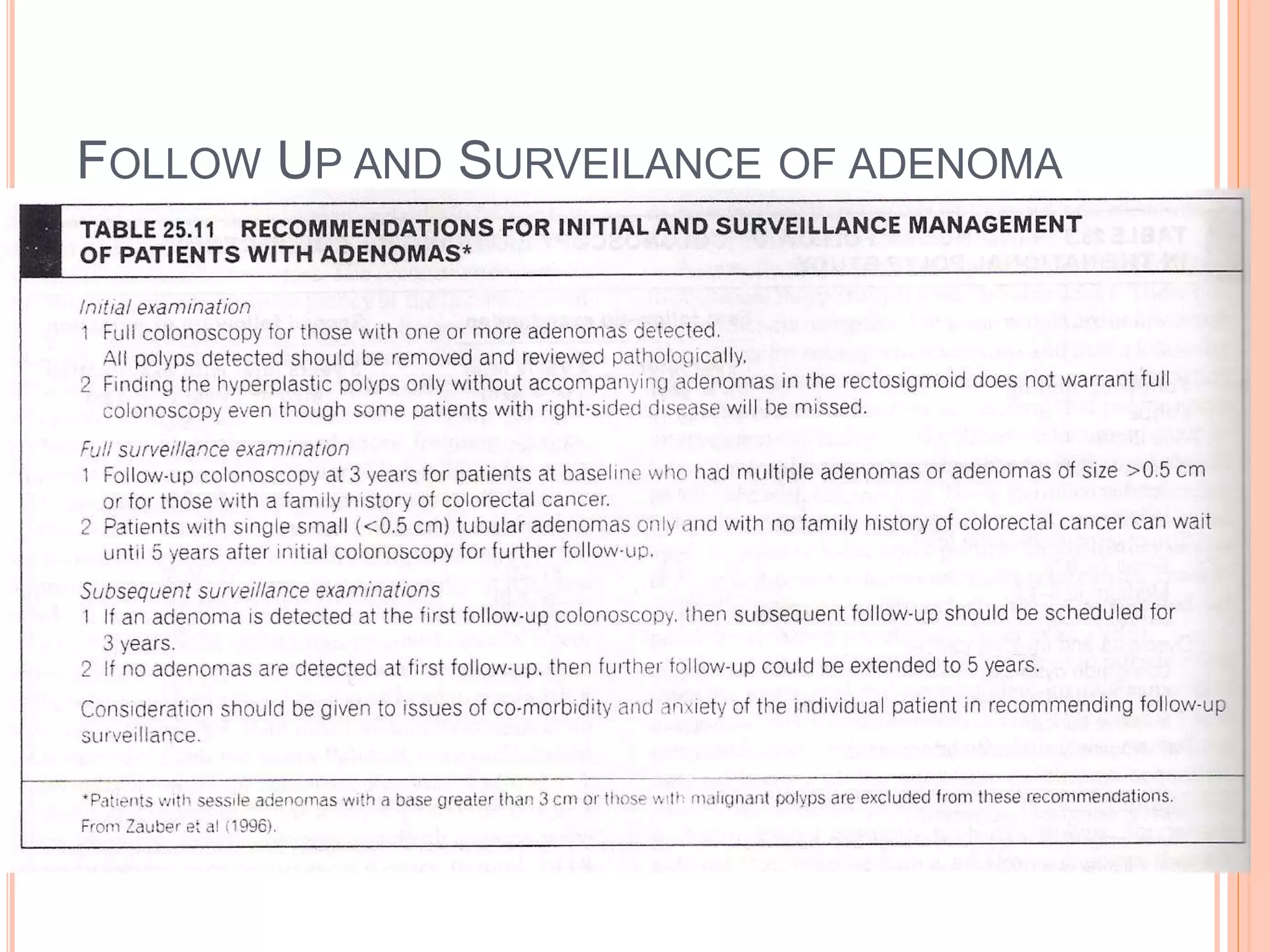
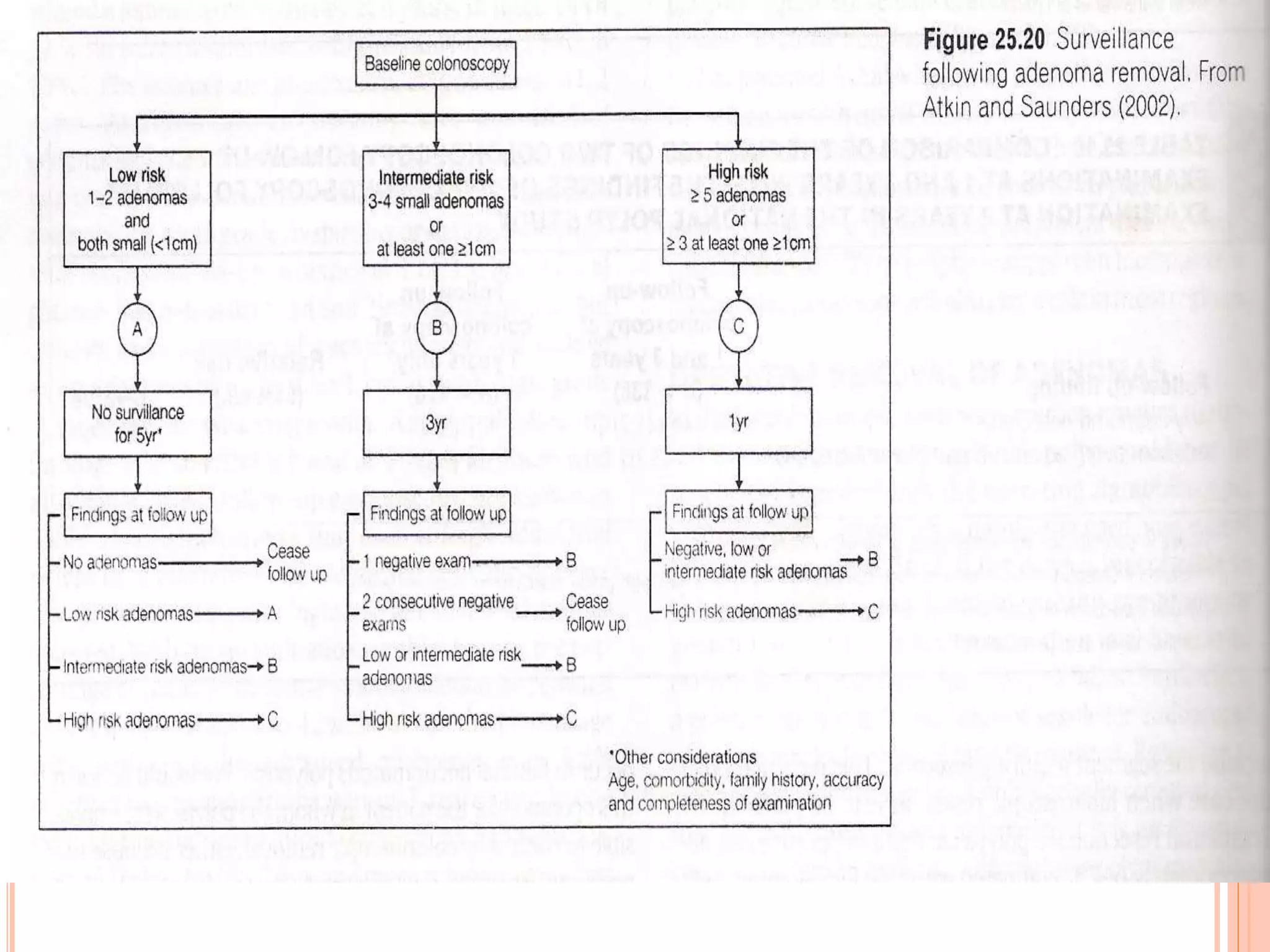
FOLLOW UP AND SURVEILANCE OF ADENOMA
TERIMAKASIH
Semoga Bermanfaat

Benign Neoplasm of Colon and Rectum

  • 1.
    BENIGN NEOPLASM OFCOLON AND RECTUM Abdul Mughni Digestive Surgery Dept , Medical Faculty of Diponegoro Univ. – Kariadi Hospital
  • 2.
    OBJECTIVE  Definition  ICD9 / ICD 10  Classification  Diagnosis  Treatment  Follow Up and Surveillance
  • 3.
    DEFINITION  Benign :(L, benignus) : Not malignant; not recurrent, favorable for recovery  Neoplasm : any new and abnormal growth; specifically a new growth of tissue in wich the growth is uncontrolled and progressive  Dorland’s Illustrated Medical Dictionary, 30th Edition, Philadelphia, Saunders, 2000
  • 4.
  • 6.
    CLASSIFICATION OF POLYPOIDOF COLON  I. Non Neoplastic Polyps  A. Metaplastic or Hyperplastic polyps  B. Hamartomatous polyps  C. Inflamatory polyps  D. Benign lymphoid polyp  II. Neoplastistic polyps  A. Adenoma Keighley, Williams, Surgery of The anus, rectum and colon, 3rd Ed, 2008
  • 7.
    A. METAPLASTIC ORHYPERPLASTIC POLYPS  Usually small (2-5 mm)  Plaque-like  Same colour  Aetiology unknown  environmental factor  Asymptomatic  Semipedunculated or sessile  Management  polypectomy  No follow up ( British Society For GI , 2002) Keighley, Williams, Surgery of The anus, rectum and colon, 3rd Ed, 2008
  • 8.
    B. HAMARTOMATOUS POLYPS Infant and children < 10 Y  Diameter 1-2 cm  Smooth surface  25 % sessile  90 % within 20 cm anal verge  rectal bleeding  Prolap polyp  Colonic intussusception  Diarrhoea  Tenesmus  Rectal prolap B.1. Juvenile Polyps Simptom : Keighley, Williams, Surgery of The anus, rectum and colon, 3rd Ed, 2008
  • 9.
     Polypectomy  Transanalexcision  Sigmoidoscopic snare  Others:  Recurrence is uncommon  Only 10-20 % recurrence  Neither a malignant  No routine follow up (Nugent et.al. 1993) Management
  • 10.
     an autosomaldominant disease caused by germline mutation of the serine threonine kinase 11  Not complete penetrasion of 19p13.3 cromosom  Hamartomatous polyps in the gastrointestinal tract  Mucocutaneous melanin pigmentation. B.2. Peutz-Jeghers Syndrome (PJS) 1. Francis M. Giardiello, Jill D. Trimbath. Peutz-Jeghers Syndrome and Management Recommendations. Clinical Gastroenterology and Hepatology 2006;4:408–415 2. M. Kopacova, I Tachei, S. Rejchrt, J.Bures : PJS: diagnosis and therapeutic approach : Word J Gastroenterol 2009, Nov. 21; 15(43): 5397-5408 avilable in wjg@wjgnet.com
  • 11.
    RISK OF PJS increased risk for :  common and unusual types of gastrointestinal tumor ( colon :39 %)  nongastrointestinal tumors (Breast : 54%)  Morbidity and complication  Bleeding and anemia  Invagination. (Francis M. Giardiello, Jill D. Trimbath. Peutz-Jeghers Syndrome and Management Recommendations. Clinical Gastroenterology and Hepatology 2006;4:408–415)
  • 12.
    Francis M. Giardiello,Jill D. Trimbath. Peutz-Jeghers Syndrome and Management Recommendations. Clinical Gastroenterology and Hepatology 2006;4:408–415
  • 13.
  • 14.
    COLONOSCOPY Caecum Ileum terminalKolon Transversum Desenden Sigmoid Rectum
  • 15.
  • 16.
    THERAPY : SNAREPOLYPECTOMY FOR POLYPS WITH Ø>1CM
  • 18.
    PA : HAMARTOMASPOLYP Proliveration smooth muscle Marcela Kopacova, Ilja Tacheci, Stanislav Rejchrt, Jan Bures. Peutz- Jeghers syndrome: Diagnostic and therapeutic approach. World J Gastroenterol 2009
  • 19.
    INFLAMATORY POLYPS  scatteredworm  Or thread-like (Filiform)  Adjacent mucosa and formation of mucosal tag of various shapes and sizes  Superficial ulceration white slough  Not a malignant
  • 20.
    BENING LYMPHOID POLYPS Lymphoid hyperplasia  Most present in 1/3 distal of rectum  Smooth, round, submucosal lession  Majority are sessile  Usually Single Keighley, Williams, Surgery of The anus, rectum and colon, 3rd Ed, 2008
  • 21.
    NEOPLASTIC POLYPS  ADENOMA Most important polyp  Main precursor colorectal cancer  Catagories on basis of size:  Early (type I) : Small , ≤ 0,5 cm, APC mutation, 10 % LOH on Cromosome 18q  Intermediate (II) : Medium, 0,6- 1 cm , 50 % K-ras mutation  late(III), Large > 1 cm, 50 % LOH on cromosome 18q  Catagories on basis of shape:  Tubular  Tubulovillous  villous Keighley, Williams, Surgery of The anus, rectum and colon, 3rd Ed, 2008
  • 22.
     Pedunculated or sessile 1 mm until 5 cm  Small  smooth contour  Larger  lobular pattern  Darker than mucosa  Pedicle 1-3 cm Tubular Adenoma Keighley, Williams, Surgery of The anus, rectum and colon, 3rd Ed, 2008
  • 23.
     Usually largeand sessile  Shaggy surface  Soft  Edge are ill-define  Flat or protude  Extends  carpet like lession  Often circumferential  Darker than surrounding mucosa Villous Adenoma Keighley, Williams, Surgery of The anus, rectum and colon, 3rd Ed, 2008
  • 24.
    DIAGNOSIS  Bleeding  Diarrhoeaand passage of mucous  Prolaps  Abdominal colic  Must be done  Soft  difficult to palpate  Velvety  pedunculated Simptom and Sign Rectal Examination
  • 25.
     Anemia  Mucousdiarrhoea  Fluid and electrolid depletion Syndrome  Hypokalaemia  Hyponatraemia  Acidosis  Ureaemia  Rigid Sigmodoscopy  Flexible sigmoidoscopy  Colonoscopy  Chromoscopic colonoscopy  Double contras barium enema Laboratorium Finding Instrument
  • 26.
    TREATMENT : POLYPECTOMY PeranalExcision of Pedunculated Polyp Polypectomy Trough Rigid Sigmoidoscope
  • 27.
  • 28.
    Tran Anal Incision TrananalEndoscopic Microsurgery (TEM)
  • 29.
    COMPLICATION OF POLYPECTOMY Hemorrage  Minor : 53%  Major : 1-2 %  Perforation : 1-3 %  Gas Explotion  After prepared using mannitol  Polypectomy Syndrome  Abdominal pain  Distension  Brief period fever  Mortality 0,05%
  • 30.
    FOLLOW UP ANDSURVEILANCE OF ADENOMA
  • 32.