DELIRIANT POISONS
 Dhatura
 Atropa belladonna
 Hyoscyamus niger
 Cannabis indica
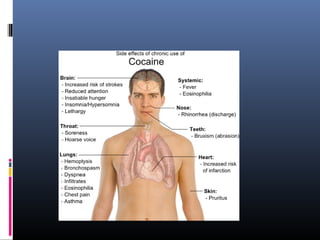
 Cocaine
DHATURA
(THORN APPLE)
 Two Types
 Dhatura Alba (Safed Dhatura) White
Flowered
 Dhatura Niger (Kala Dhatura) Black or Purple
Flowers
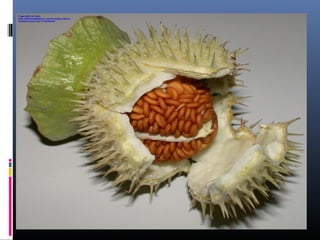
Characteristics
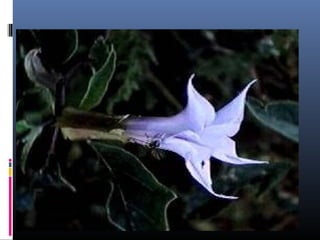
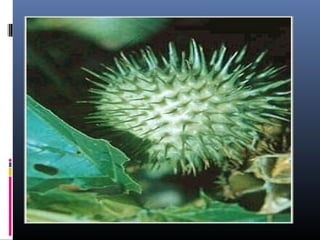
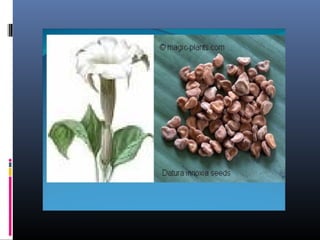
 Flowers: Bell shaped
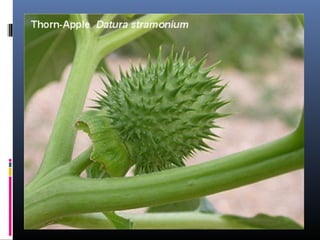
 Fruits: Spherical, having sharp
spines
 Seeds: Brown kidney shaped resembling
chilli seeds
450 to 500 seeds in a fruit
100 seeds weight about 1 gram
 Seeds & fruit most noxious
Active Principle
 Contains Alkaloids:
 Laevo-hyoscyamine
 Hyoscine or scopolamine
 Traces of atropine
 Absorption
 Distribution
 Metabolism
 Crushed seeds Absorption of alkaloids
from small intestine blood body
tissues partial oxidation
 Analyst may not detect them due to their
oxidation
Same for all alkaloids
Mode of Action
 Stimulate the higher centers of brain
 Followed by the motor areas
 Depression and paralysis – vital center of
medulla
 Respiration – stimulated then depressed
Signs & Symptoms
 Symptoms described as:
 “ Dry as a bone, red as a beet, blind as a bat,
hot as a hare and mad as a wet hen”
 Alkaloids : Immediately
 Seeds: Within half an hour
 Decoction: Within few minutes
(concentrated water extract)
 Powered seeds given in food
 Earliest symptom: Bitter taste in mouth
 Inhibition of salivation: Dryness of mouth
and throat (dry as a bone)
 Difficulty in talking
 Dysphagia
 Unquenchable thirst
 Dilatation of cutaneous blood vessels
 Face is flushed (red as a beet)
 Pupils:
 Dilated
 Insensitive to light
 Power of accommodation near vision
paralyzed
(Blind as a bat)
 Inhibition of sweat secretion & stimulation of
heat regulating center:
 Body temp. raised
 Skin dry and hot (hot as a hare)
 Vomiting
 Giddiness, unsteady gait (drunken individual)
 Initially restless and confused
 Later delirious, mutters indistinct words (mad
as a wet hen)
 Visual and auditory hallucinations:
 Grasps at imaginary objects
 Picks at his clothings
 Tries to pull imaginary threads from tips of
fingers
 Scarlatiniform rash
 Delirium passes off in an hour
 Drowsiness Stupor or coma
 Death…..Respiratory paralysis
 Secondary delirium: After recovery
9 Ds
1. Dryness of the mouth and throat
2. Difficulty in talking
3. Dysphagia
4. Dilatation of cutaneous blood vessels
5. Dilatation of pupils
6. Dry hot skin
7. Drunken gait
8. Delirium
9. Drowsiness
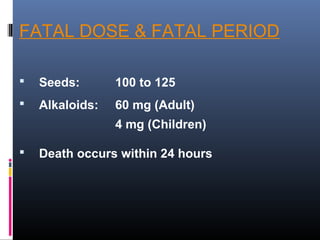
FATAL DOSE & FATAL PERIOD
 Seeds: 100 to 125
 Alkaloids: 60 mg (Adult)
4 mg (Children)
 Death occurs within 24 hours
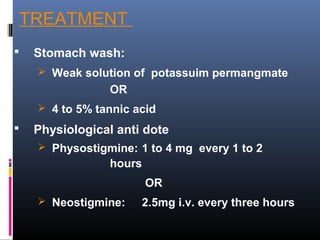
TREATMENT
 Stomach wash:
 Weak solution of potassuim permangmate
OR
 4 to 5% tannic acid
 Physiological anti dote
 Physostigmine: 1 to 4 mg every 1 to 2
hours
OR
 Neostigmine: 2.5mg i.v. every three hours
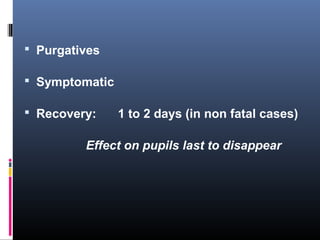
 Purgatives
 Symptomatic
 Recovery: 1 to 2 days (in non fatal cases)
Effect on pupils last to disappear
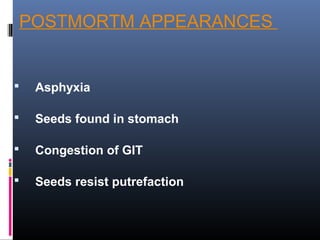
POSTMORTM APPEARANCES
 Asphyxia
 Seeds found in stomach
 Congestion of GIT
 Seeds resist putrefaction
 Poisons resisting putrefaction
1. Phosphorus
2. Arsenic
3. Antimony
4. Hyoscine
5. Strychinne
6. Nicotine
MEDICOLEGAL ASPECTS
 Stupefying Poison: Robbery
Kidnapping
Rape
 Road Poison: Powered seeds mixed
with food, tea or drinks or pan & given to
travelers
 Small dose due to smoking or ingestion causes
loss of reasoning ability
 By mixing Dhatura with tobacco in cigarettes
 Children kidnapped by giving candy mixed
with Dhatura. They comply with the
instructions of the poisoner to follow him
 Accidental Cases: Children & Adults
 Eat raw fruits or seeds mistaking them for
edible fruits or capsicum seeds
 Quacks for treatment of various ailments
 Aphrodisiac
 Added to country liquor
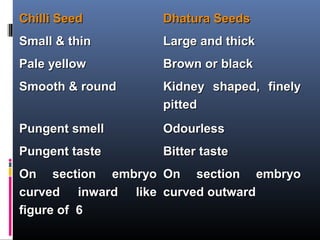
Chilli SeedChilli Seed Dhatura SeedsDhatura Seeds
Small & thinSmall & thin Large and thickLarge and thick
Pale yellowPale yellow Brown or blackBrown or black
Smooth & roundSmooth & round Kidney shaped, finelyKidney shaped, finely
pittedpitted
Pungent smellPungent smell OdourlessOdourless
Pungent tastePungent taste Bitter tasteBitter taste
On section embryoOn section embryo
curved inward likecurved inward like
figure of 6figure of 6
On section embryoOn section embryo
curved outwardcurved outward
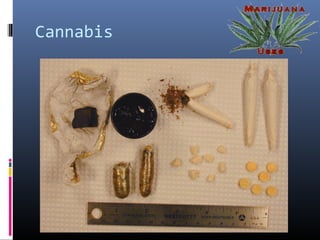
Cannabis
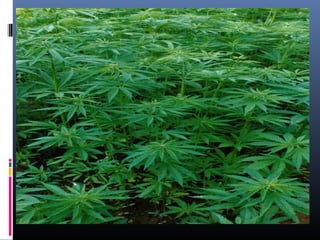
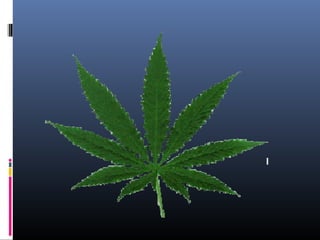
CANNABIS INDICA (hemp)
 It is a CNS stimulant
 Cultivation is restricted by Law
 All parts of the plant are poisonous
Cannabis
Origins & History of use
 Psychoactive properties were first recorded
about 2800 BC in China and 2000 BC in India
 Early uses included rheumatic pains,
constipation, malaria, ‘absentmindedness’,
menstral cramps, and for its anxiolytic and
euphoric properties
ACTIVE PRINCIPLE
 Fat soluble oleoresin- cannabinol
 Stored in fat cells of body and acts like
time release capsule
 The effect of a single dose lasts for 7 days
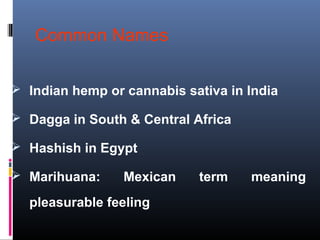
Common Names
 Indian hemp or cannabis sativa in India
 Dagga in South & Central Africa
 Hashish in Egypt
 Marihuana: Mexican term meaning
pleasurable feeling
Routes of Absorption
 GIT
 Respiratory tract
Forms of hemp
 Common forms of hemp
 BHANG
 MAJOON
 GANJA
 CHARAS
 MARIJUANA
BHANG
 Least potent form
 Also called siddhi, patti, sabji
 Prepared from dried leaves & fruit shoots
 Used as an infusion in the form of a
beverage
 Suspension (Sardai) also mixed in ice cream,
sweets, pakauras
 Mildest and contains 15% of active
principle
 Produces a feeling of happiness
 Person sings and dances
 Effect lasts for about 3 hours & followed
by sleep
MAJOON
 Sweet prepared with bhang
 Produces grandiose delusion in addition
to all effects of drug
GANJA
 Consists of flowering tops of the female
plant
 It is mixed with tobacco and smoked in
pipe
 Contains active principle in conc. of 25%
 Smoker feels lazy & indulges in day
dreaming
 Used by sadhus and fakirs
MARIHUANA OR MARIJUANA
 Common names are pot, grass tea, Mary Jane
 Similar to Ganja
 Eaten alone or as part of confection or drunk
in beer
 Smoked in pipe or rolled in cigarette called
reefers or weed
 Their use leads to consumption of more
dangerous drugs & in particular to heroin
addiction
Cannabis
Origins & History of use
 Marijuana (the name for the dried and
crushed flowers) comes from the spanish
maraguanaquo (meaning an inebriant plant)
 Cannabis became an illegal substance in
North America in the 1920’s
 Revival in marijuana interest occurred in the
60’s
Cannabis
Origins & History of use
 Claims for medicinal and psychiatric uses
expanded in the 1800’s and 1900’s as for all
drugs
 Hash (the name for the resin) comes from the
arabic word hashsha shim (meaning hash
eaters- it also spawned the word assasin)
CHARAS OR HASHISH
 Resin exuding from leaves and stems
 Dark green or brown color
 Smoked with tobacco in a pipe ‘hookah’
 Active principle is in con of 25- 40%
 It is the most powerful of all cannabis
preparations
 Main effects are:-
Aphrodisiac, hypnotic and analgesic
Psychological dependence
Fatal Dose Charas 2gm/ kg body wt
Ganga 8.0gms/ kg body wt
Bhang 10 gm/ kilo body wt
Fatal Period Death is rare, but may occur in
12hrs in case of acute
poisoning.
Sign & Symptoms
 With Small Doses
 Euphoria
 Feeling of well being, talkative
 appetite
 With Moderate Doses
 Impaired immediate memory function
 Disturbed thought patterns
 Lapses of attention
 With High Doses
 Loss of perception of time and space
 Visual hallucinations
 Changes in body image
 Depersonalization
 Marked sensory distortion
HASHISH INSANITY (Chronic
Poisoning)
(Often attributed to chronic use)
 Patient suffers from hallucinations and
delusions of a persecuting nature
 Irresistible desire to destroy willfully life and
property of which he has no recollection
after wards
 Likely to commit sexual jealousy crimes
 Chronic use reduces serum testosterone
and sperm count
 Loss of appetite
 Weakness
 Wasting
 Tremors
 Sleepy facial expression
 Vacant look
 Red eyes
 Impotence
 Moral & mental deterioration
 May suffer from hallucinations & delusions of
persecution
RUN AMOK
 It is a psychotic disturbance caused by the
continued use or even first time use of
cannabis
 It is characterized by a frenzied desire of the
person to commit murders
 He first kills a person against whom he may
have real or imaginary enmity and then kills
anyone who comes in his way until the
homicidal tendency lasts.
 Then he may commit suicide or surrender
himself.
TOLERANCE & PSYCHOLOGICAL
DEPENDENCE
 Develops when the drug is consumed
over a prolonged period of time
TREATMENT
 Stomach wash with warm water
 100ml of 50% glucose
 2mg naloxone
 5-10mg diazepam if aggressive
 Hypodermic injection of strychnine
 Strong tea or coffee by mouth
 If necessary saline purgatives
POST- MORTEM APPEARANCES
 Not characteristic
 Usual appearance of asphyxia
Medicolegal Aspects
 Accidental ingestion or inhalation
 Overindulgence
 Majun and charas used by road poisoners
 To strengthen the nerves before committing
a crime or a bold act
 Aphrodisiac
 Used by fakirs and poojaris to get into a
religious mood
Deliriant poisons
Deliriant poisons
Deliriant poisons
Deliriant poisons
Deliriant poisons
Deliriant poisons
Deliriant poisons
Deliriant poisons

Deliriant poisons

  • 1.
    DELIRIANT POISONS  Dhatura Atropa belladonna  Hyoscyamus niger  Cannabis indica  Cocaine
  • 2.
    DHATURA (THORN APPLE)  TwoTypes  Dhatura Alba (Safed Dhatura) White Flowered  Dhatura Niger (Kala Dhatura) Black or Purple Flowers
  • 3.
    Characteristics  Flowers: Bellshaped  Fruits: Spherical, having sharp spines  Seeds: Brown kidney shaped resembling chilli seeds 450 to 500 seeds in a fruit 100 seeds weight about 1 gram  Seeds & fruit most noxious
  • 8.
    Active Principle  ContainsAlkaloids:  Laevo-hyoscyamine  Hyoscine or scopolamine  Traces of atropine
  • 9.
     Absorption  Distribution Metabolism  Crushed seeds Absorption of alkaloids from small intestine blood body tissues partial oxidation  Analyst may not detect them due to their oxidation Same for all alkaloids
  • 10.
    Mode of Action Stimulate the higher centers of brain  Followed by the motor areas  Depression and paralysis – vital center of medulla  Respiration – stimulated then depressed
  • 11.
    Signs & Symptoms Symptoms described as:  “ Dry as a bone, red as a beet, blind as a bat, hot as a hare and mad as a wet hen”
  • 12.
     Alkaloids :Immediately  Seeds: Within half an hour  Decoction: Within few minutes (concentrated water extract)  Powered seeds given in food
  • 13.
     Earliest symptom:Bitter taste in mouth  Inhibition of salivation: Dryness of mouth and throat (dry as a bone)  Difficulty in talking  Dysphagia  Unquenchable thirst  Dilatation of cutaneous blood vessels  Face is flushed (red as a beet)
  • 14.
     Pupils:  Dilated Insensitive to light  Power of accommodation near vision paralyzed (Blind as a bat)
  • 15.
     Inhibition ofsweat secretion & stimulation of heat regulating center:  Body temp. raised  Skin dry and hot (hot as a hare)  Vomiting  Giddiness, unsteady gait (drunken individual)  Initially restless and confused  Later delirious, mutters indistinct words (mad as a wet hen)
  • 16.
     Visual andauditory hallucinations:  Grasps at imaginary objects  Picks at his clothings  Tries to pull imaginary threads from tips of fingers  Scarlatiniform rash  Delirium passes off in an hour  Drowsiness Stupor or coma  Death…..Respiratory paralysis  Secondary delirium: After recovery
  • 17.
    9 Ds 1. Drynessof the mouth and throat 2. Difficulty in talking 3. Dysphagia 4. Dilatation of cutaneous blood vessels 5. Dilatation of pupils 6. Dry hot skin 7. Drunken gait 8. Delirium 9. Drowsiness
  • 18.
    FATAL DOSE &FATAL PERIOD  Seeds: 100 to 125  Alkaloids: 60 mg (Adult) 4 mg (Children)  Death occurs within 24 hours
  • 19.
    TREATMENT  Stomach wash: Weak solution of potassuim permangmate OR  4 to 5% tannic acid  Physiological anti dote  Physostigmine: 1 to 4 mg every 1 to 2 hours OR  Neostigmine: 2.5mg i.v. every three hours
  • 20.
     Purgatives  Symptomatic Recovery: 1 to 2 days (in non fatal cases) Effect on pupils last to disappear
  • 21.
    POSTMORTM APPEARANCES  Asphyxia Seeds found in stomach  Congestion of GIT  Seeds resist putrefaction
  • 22.
     Poisons resistingputrefaction 1. Phosphorus 2. Arsenic 3. Antimony 4. Hyoscine 5. Strychinne 6. Nicotine
  • 23.
    MEDICOLEGAL ASPECTS  StupefyingPoison: Robbery Kidnapping Rape  Road Poison: Powered seeds mixed with food, tea or drinks or pan & given to travelers
  • 24.
     Small dosedue to smoking or ingestion causes loss of reasoning ability  By mixing Dhatura with tobacco in cigarettes  Children kidnapped by giving candy mixed with Dhatura. They comply with the instructions of the poisoner to follow him
  • 25.
     Accidental Cases:Children & Adults  Eat raw fruits or seeds mistaking them for edible fruits or capsicum seeds  Quacks for treatment of various ailments  Aphrodisiac  Added to country liquor
  • 26.
    Chilli SeedChilli SeedDhatura SeedsDhatura Seeds Small & thinSmall & thin Large and thickLarge and thick Pale yellowPale yellow Brown or blackBrown or black Smooth & roundSmooth & round Kidney shaped, finelyKidney shaped, finely pittedpitted Pungent smellPungent smell OdourlessOdourless Pungent tastePungent taste Bitter tasteBitter taste On section embryoOn section embryo curved inward likecurved inward like figure of 6figure of 6 On section embryoOn section embryo curved outwardcurved outward
  • 31.
  • 32.
    CANNABIS INDICA (hemp) It is a CNS stimulant  Cultivation is restricted by Law  All parts of the plant are poisonous
  • 33.
    Cannabis Origins & Historyof use  Psychoactive properties were first recorded about 2800 BC in China and 2000 BC in India  Early uses included rheumatic pains, constipation, malaria, ‘absentmindedness’, menstral cramps, and for its anxiolytic and euphoric properties
  • 34.
    ACTIVE PRINCIPLE  Fatsoluble oleoresin- cannabinol  Stored in fat cells of body and acts like time release capsule  The effect of a single dose lasts for 7 days
  • 35.
    Common Names  Indianhemp or cannabis sativa in India  Dagga in South & Central Africa  Hashish in Egypt  Marihuana: Mexican term meaning pleasurable feeling
  • 36.
    Routes of Absorption GIT  Respiratory tract
  • 37.
    Forms of hemp Common forms of hemp  BHANG  MAJOON  GANJA  CHARAS  MARIJUANA
  • 38.
    BHANG  Least potentform  Also called siddhi, patti, sabji  Prepared from dried leaves & fruit shoots  Used as an infusion in the form of a beverage  Suspension (Sardai) also mixed in ice cream, sweets, pakauras
  • 39.
     Mildest andcontains 15% of active principle  Produces a feeling of happiness  Person sings and dances  Effect lasts for about 3 hours & followed by sleep
  • 40.
    MAJOON  Sweet preparedwith bhang  Produces grandiose delusion in addition to all effects of drug
  • 41.
    GANJA  Consists offlowering tops of the female plant  It is mixed with tobacco and smoked in pipe  Contains active principle in conc. of 25%  Smoker feels lazy & indulges in day dreaming  Used by sadhus and fakirs
  • 42.
    MARIHUANA OR MARIJUANA Common names are pot, grass tea, Mary Jane  Similar to Ganja  Eaten alone or as part of confection or drunk in beer  Smoked in pipe or rolled in cigarette called reefers or weed  Their use leads to consumption of more dangerous drugs & in particular to heroin addiction
  • 43.
    Cannabis Origins & Historyof use  Marijuana (the name for the dried and crushed flowers) comes from the spanish maraguanaquo (meaning an inebriant plant)  Cannabis became an illegal substance in North America in the 1920’s  Revival in marijuana interest occurred in the 60’s
  • 44.
    Cannabis Origins & Historyof use  Claims for medicinal and psychiatric uses expanded in the 1800’s and 1900’s as for all drugs  Hash (the name for the resin) comes from the arabic word hashsha shim (meaning hash eaters- it also spawned the word assasin)
  • 45.
    CHARAS OR HASHISH Resin exuding from leaves and stems  Dark green or brown color  Smoked with tobacco in a pipe ‘hookah’  Active principle is in con of 25- 40%  It is the most powerful of all cannabis preparations
  • 46.
     Main effectsare:- Aphrodisiac, hypnotic and analgesic Psychological dependence Fatal Dose Charas 2gm/ kg body wt Ganga 8.0gms/ kg body wt Bhang 10 gm/ kilo body wt Fatal Period Death is rare, but may occur in 12hrs in case of acute poisoning.
  • 47.
    Sign & Symptoms With Small Doses  Euphoria  Feeling of well being, talkative  appetite  With Moderate Doses  Impaired immediate memory function  Disturbed thought patterns  Lapses of attention
  • 48.
     With HighDoses  Loss of perception of time and space  Visual hallucinations  Changes in body image  Depersonalization  Marked sensory distortion
  • 49.
    HASHISH INSANITY (Chronic Poisoning) (Oftenattributed to chronic use)  Patient suffers from hallucinations and delusions of a persecuting nature  Irresistible desire to destroy willfully life and property of which he has no recollection after wards  Likely to commit sexual jealousy crimes  Chronic use reduces serum testosterone and sperm count
  • 50.
     Loss ofappetite  Weakness  Wasting  Tremors  Sleepy facial expression  Vacant look  Red eyes  Impotence  Moral & mental deterioration  May suffer from hallucinations & delusions of persecution
  • 51.
    RUN AMOK  Itis a psychotic disturbance caused by the continued use or even first time use of cannabis  It is characterized by a frenzied desire of the person to commit murders  He first kills a person against whom he may have real or imaginary enmity and then kills anyone who comes in his way until the homicidal tendency lasts.  Then he may commit suicide or surrender himself.
  • 52.
    TOLERANCE & PSYCHOLOGICAL DEPENDENCE Develops when the drug is consumed over a prolonged period of time
  • 53.
    TREATMENT  Stomach washwith warm water  100ml of 50% glucose  2mg naloxone  5-10mg diazepam if aggressive  Hypodermic injection of strychnine  Strong tea or coffee by mouth  If necessary saline purgatives
  • 54.
    POST- MORTEM APPEARANCES Not characteristic  Usual appearance of asphyxia
  • 55.
    Medicolegal Aspects  Accidentalingestion or inhalation  Overindulgence  Majun and charas used by road poisoners  To strengthen the nerves before committing a crime or a bold act  Aphrodisiac  Used by fakirs and poojaris to get into a religious mood