Downloaded 278 times
![Diagnostic:
Symptoms
Symptoms in Crohn's disease vs. ulcerative colitis
Crohn's disease Ulcerative colitis
Often porridge-like[6], Often mucus-like
Defecation
sometimes steatorrhea and with blood[6]
Tenesmus Less common[6] More common[6]
Fever Common[6] Indicates severe disease[6]
Fistulae Common[7] Seldom
Weight loss Often More seldom
All Rights Reserved by M Sufian
1/13/2012 9
m_sufian@behestandarou.com](https://image.slidesharecdn.com/presentationofibdsufian-120113152105-phpapp01/85/IBD-9-320.jpg)
![Diagnostic:
Signs
Findings in diagnostic workup in Crohn's disease vs. ulcerative colitis
Sign Crohn's disease Ulcerative colitis
Terminal ileum involvement Commonly Seldom
Colon involvement Usually Always
Rectum involvement Seldom Usually[8]
Involvement around
Common[7] Seldom
the anus
No increase in rate of primary
Bile duct involvement Higher rate[9]
sclerosing cholangitis
All Rights Reserved by M Sufian
1/13/2012 10
m_sufian@behestandarou.com](https://image.slidesharecdn.com/presentationofibdsufian-120113152105-phpapp01/85/IBD-10-320.jpg)
![Diagnostic:
Signs
Findings in diagnostic workup in Crohn's disease vs. ulcerative colitis
Sign Crohn's disease Ulcerative colitis
Patchy areas of inflammation Continuous area of
Distribution of Disease
(Skip lesions) inflammation[8]
Deep geographic and
Endoscopy Continuous ulcer
serpiginous (snake-like) ulcers
May be transmural, deep into
Depth of inflammation Shallow, mucosal
tissues[2][7]
Stenosis Common Seldom
May have non- necrotizing
Non-peri-intestinal crypt
Granulomas on biopsy non-peri- intestinal crypt
granulomas not seen[8]
granulomas[7][10][11]
All Rights Reserved by M Sufian
1/13/2012 11
m_sufian@behestandarou.com](https://image.slidesharecdn.com/presentationofibdsufian-120113152105-phpapp01/85/IBD-11-320.jpg)
![Treatment
Management in Crohn's disease vs. ulcerative colitis
Crohn’s disease Ulcerative colitis
Mesalazine less useful[12] More useful[12]
Antibiotics Effective in long-term[13] Generally not useful[14]
Often returns following Usually cured by
Surgery
removal of affected part removal of colon
All Rights Reserved by M Sufian
1/13/2012 45
m_sufian@behestandarou.com](https://image.slidesharecdn.com/presentationofibdsufian-120113152105-phpapp01/85/IBD-13-320.jpg)
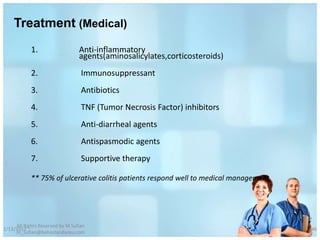
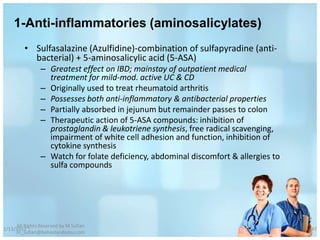
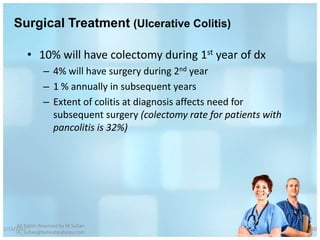
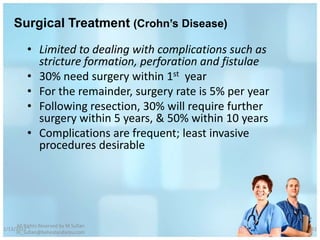
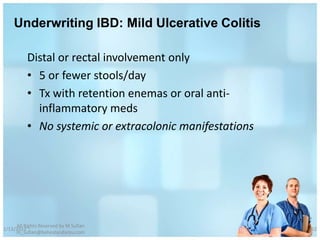
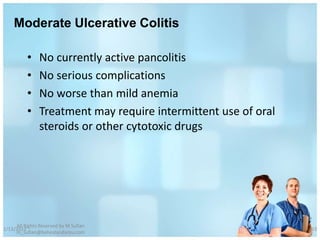

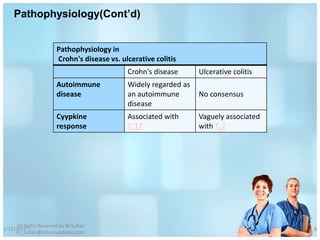
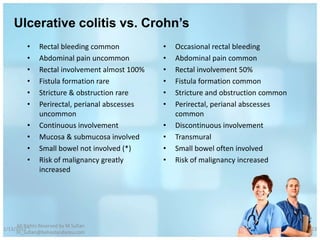
This document provides an overview of inflammatory bowel disease (IBD), including ulcerative colitis and Crohn's disease. It discusses the pathophysiology, symptoms, diagnostic signs, complications, and treatments for both conditions. IBD is caused by an immune system defect in the gastrointestinal tract that leads to chronic inflammation. Ulcerative colitis only affects the large intestine, while Crohn's disease can impact any part of the GI tract. Diagnosis involves clinical, endoscopic, and histologic evaluation. Common treatments include medications to reduce inflammation, immunosuppressants, antibiotics, biologics, and sometimes surgery.


![PERI-PROSTHETIC FRACTURE NAIL-PLATE CONSTRUCT [NPC].pptx](https://cdn.slidesharecdn.com/ss_thumbnails/drarunkumardrmohamedashrafperiprostheticfrasturenail-plateconstructnpc-260209164459-7e9d15a1-thumbnail.jpg?width=640&height=640&fit=bounds)


