CNS tumors
LEARNING OBJECTIVES
• Classify CNS tumors
• Describe general characteristics of CNS
tumors
• Identify tumor type in relation to age and
site of tumor
• Describe primary peripheral nerve sheath
neoplasms with clinical relevance
FACTS
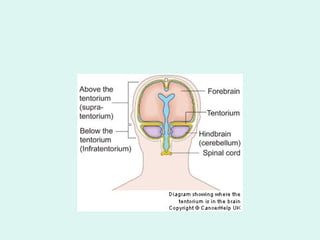
• Tumors in adults are more commonly
based in anterior fossa/ supratentorial
location whereas childhood tumors are
more commonly posterior fossa/
infratentorial in location
• CNS tumors do not metastasize outside
the brain and spinal cord.
• Even benign tumors can be sinister
according to location.
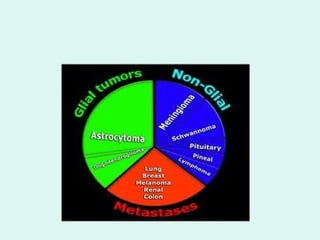
Tumor origin
Tumor origin
• Neuronal
• Glial
• Nerve sheath
• Meningeal
• Others
• Metastatic
CNS TUMOR CLASSIFICATION
• Primary tumors- 1/2 --3/4th
• Metastatic tumors- 1/4 – ½
• In primary tumors,WHO grading is done
according to biologic behaviour into
grade I to IV (depending on risk of
recurrence)
Under current classification scheme, lesions
of different grades are given distinct
names
CNS TUMOR CLASSIFICATION
• PRIMARY TUMORS
– Gliomas
– Neuronal and glioneuronal tumors
– Poorly differentiated tumors
– Other parenchymal tumors
Primary lymphomas 1% of intracranial tumors
Germ cell tumors 0.2-1%
Pineal tumors
Tumors of meninges
Meningiomas
Nerve sheath tumors
Schwannomas
Neurofibromas
PRIMARY TUMORS
1-Gliomas
Astrocytomas (80% adult primary tumors)
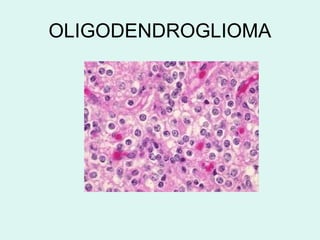
Oligodendrogliomas
Ependymomas and other paraventricular lesions
Grading
Astrocytomas
Pilocytic astrocytoma(Non infiltrating)Grade I
Diffuse astrocytoma- Grade II
Anaplastic astrocytoma- Grade III
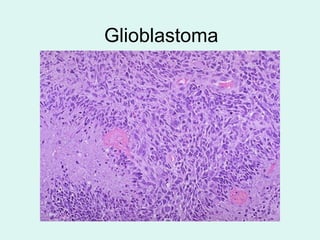
Glioblastoma multiforme- Grade IV
Oligodendrogliomas
Most Grade II
Anaplastic Grade III
Ependymomas
Most Grade II
Anaplastic Grade III
Gliomas
• SITES and AGE group
– Astrocytoma
• Pilocytic (Children , posterior fossa)
• Infiltrating (Adults, Cerebral hemispheres)
– Oligodendroglioma
• Adults 4th
-5th
decade, cerebral hemispheres
– Ependymoma (2 groups)
• 4th
ventricle, children
• Intraspinal, adults
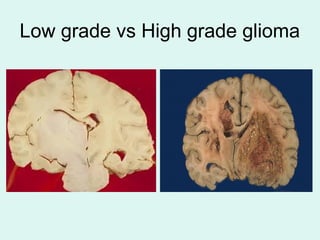
Low grade vs High grade glioma
Glioblastoma
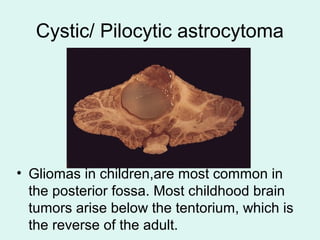
Cystic/ Pilocytic astrocytoma
• Gliomas in children,are most common in
the posterior fossa. Most childhood brain
tumors arise below the tentorium, which is
the reverse of the adult.
OLIGODENDROGLIOMA
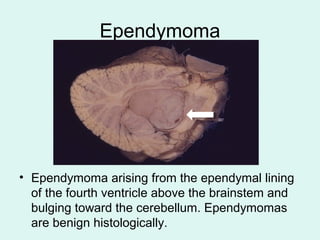
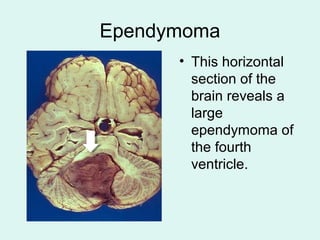
Ependymoma
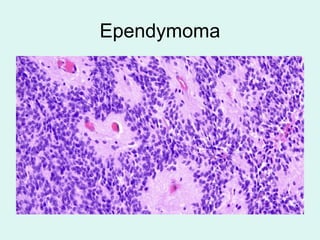
• Ependymoma arising from the ependymal lining
of the fourth ventricle above the brainstem and
bulging toward the cerebellum. Ependymomas
are benign histologically.
Ependymoma
• This horizontal
section of the
brain reveals a
large
ependymoma of
the fourth
ventricle.
Ependymoma
Undifferentiated tumors
• Medulloblastoma
– Predominantly in children (20% of brain
tumors in children)
– Posterior fossa/ cerebellum
– Highly malignant but radiosensitive
• Atypical teratoid/ rhabdoid tumor
– Children less than 5 yrs
– Dismal prognosis
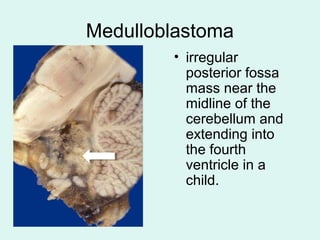
Medulloblastoma
• irregular
posterior fossa
mass near the
midline of the
cerebellum and
extending into
the fourth
ventricle in a
child.
CNS TUMOR CLASSIFICATION
• METASTATIC TUMORS
¼ to ½ of brain tumors
Mainly mtastatic carcinomas
5 common primaries accounting for 80% mets
– Breast
– Lung
– Skin (melanoma)
– Kidney
– GIT
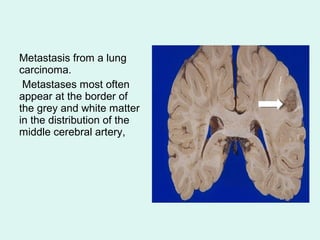
Metastasis from a lung
carcinoma.
Metastases most often
appear at the border of
the grey and white matter
in the distribution of the
middle cerebral artery,
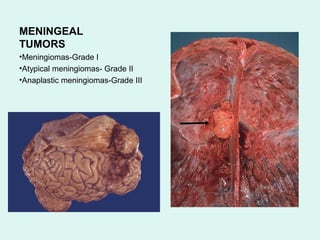
MENINGEAL
TUMORS
•Meningiomas-Grade I
•Atypical meningiomas- Grade II
•Anaplastic meningiomas-Grade III
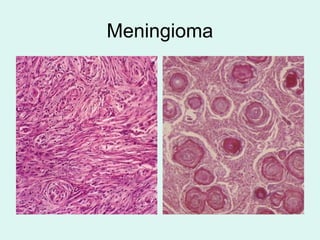
Meningioma
Peripheral nerve sheath tumors
• Schwaanomas
• Neurofibromas
• Malignant peripheral nerve sheath tumors/
MPNST
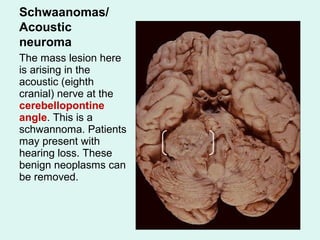
Schwaanomas/
Acoustic
neuroma
The mass lesion here
is arising in the
acoustic (eighth
cranial) nerve at the
cerebellopontine
angle. This is a
schwannoma. Patients
may present with
hearing loss. These
benign neoplasms can
be removed.
SUMMARY (Common tumors)
• Childhood tumors
– Medulloblastomas, high grade
– Pilocytic astrocytomas, Grade I
– Ependymomas, posterior fossa(4th
ventricle)
– Choroid plexus papillomas, lateral ventricles
• Adult tumors
• Gliomas
• Spinal ependymomas, oligodendrogliomas
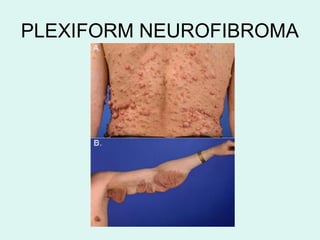
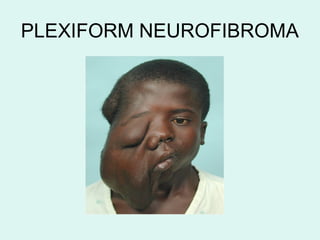
TUMORS of PNS
• Neurofibroma
Cutaneous
Plexiform
• Schwaanoma
• Malignant peripheral nerve sheath tumors
NEUROFIBROMA
PLEXIFORM NEUROFIBROMA

CNS Tumors

  • 1.
  • 2.
    LEARNING OBJECTIVES • ClassifyCNS tumors • Describe general characteristics of CNS tumors • Identify tumor type in relation to age and site of tumor • Describe primary peripheral nerve sheath neoplasms with clinical relevance
  • 5.
    FACTS • Tumors inadults are more commonly based in anterior fossa/ supratentorial location whereas childhood tumors are more commonly posterior fossa/ infratentorial in location • CNS tumors do not metastasize outside the brain and spinal cord. • Even benign tumors can be sinister according to location.
  • 6.
  • 7.
    Tumor origin • Neuronal •Glial • Nerve sheath • Meningeal • Others • Metastatic
  • 9.
    CNS TUMOR CLASSIFICATION •Primary tumors- 1/2 --3/4th • Metastatic tumors- 1/4 – ½ • In primary tumors,WHO grading is done according to biologic behaviour into grade I to IV (depending on risk of recurrence) Under current classification scheme, lesions of different grades are given distinct names
  • 10.
    CNS TUMOR CLASSIFICATION •PRIMARY TUMORS – Gliomas – Neuronal and glioneuronal tumors – Poorly differentiated tumors – Other parenchymal tumors Primary lymphomas 1% of intracranial tumors Germ cell tumors 0.2-1% Pineal tumors Tumors of meninges Meningiomas Nerve sheath tumors Schwannomas Neurofibromas
  • 11.
    PRIMARY TUMORS 1-Gliomas Astrocytomas (80%adult primary tumors) Oligodendrogliomas Ependymomas and other paraventricular lesions Grading Astrocytomas Pilocytic astrocytoma(Non infiltrating)Grade I Diffuse astrocytoma- Grade II Anaplastic astrocytoma- Grade III Glioblastoma multiforme- Grade IV Oligodendrogliomas Most Grade II Anaplastic Grade III Ependymomas Most Grade II Anaplastic Grade III
  • 12.
    Gliomas • SITES andAGE group – Astrocytoma • Pilocytic (Children , posterior fossa) • Infiltrating (Adults, Cerebral hemispheres) – Oligodendroglioma • Adults 4th -5th decade, cerebral hemispheres – Ependymoma (2 groups) • 4th ventricle, children • Intraspinal, adults
  • 13.
    Low grade vsHigh grade glioma
  • 14.
  • 15.
    Cystic/ Pilocytic astrocytoma •Gliomas in children,are most common in the posterior fossa. Most childhood brain tumors arise below the tentorium, which is the reverse of the adult.
  • 16.
  • 17.
    Ependymoma • Ependymoma arisingfrom the ependymal lining of the fourth ventricle above the brainstem and bulging toward the cerebellum. Ependymomas are benign histologically.
  • 18.
    Ependymoma • This horizontal sectionof the brain reveals a large ependymoma of the fourth ventricle.
  • 19.
  • 20.
    Undifferentiated tumors • Medulloblastoma –Predominantly in children (20% of brain tumors in children) – Posterior fossa/ cerebellum – Highly malignant but radiosensitive • Atypical teratoid/ rhabdoid tumor – Children less than 5 yrs – Dismal prognosis
  • 21.
    Medulloblastoma • irregular posterior fossa massnear the midline of the cerebellum and extending into the fourth ventricle in a child.
  • 22.
    CNS TUMOR CLASSIFICATION •METASTATIC TUMORS ¼ to ½ of brain tumors Mainly mtastatic carcinomas 5 common primaries accounting for 80% mets – Breast – Lung – Skin (melanoma) – Kidney – GIT
  • 23.
    Metastasis from alung carcinoma. Metastases most often appear at the border of the grey and white matter in the distribution of the middle cerebral artery,
  • 24.
    MENINGEAL TUMORS •Meningiomas-Grade I •Atypical meningiomas-Grade II •Anaplastic meningiomas-Grade III
  • 25.
  • 26.
    Peripheral nerve sheathtumors • Schwaanomas • Neurofibromas • Malignant peripheral nerve sheath tumors/ MPNST
  • 27.
    Schwaanomas/ Acoustic neuroma The mass lesionhere is arising in the acoustic (eighth cranial) nerve at the cerebellopontine angle. This is a schwannoma. Patients may present with hearing loss. These benign neoplasms can be removed.
  • 28.
    SUMMARY (Common tumors) •Childhood tumors – Medulloblastomas, high grade – Pilocytic astrocytomas, Grade I – Ependymomas, posterior fossa(4th ventricle) – Choroid plexus papillomas, lateral ventricles • Adult tumors • Gliomas • Spinal ependymomas, oligodendrogliomas
  • 29.
    TUMORS of PNS •Neurofibroma Cutaneous Plexiform • Schwaanoma • Malignant peripheral nerve sheath tumors
  • 30.
  • 31.
  • 32.