Dr. ShabanaAli
IIMC
 Divisipn
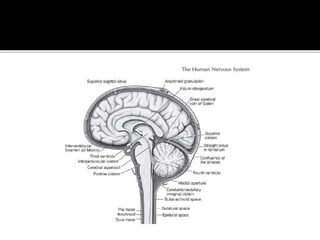
 Meninges
 Nervous system is dividedAnatomically into:
 1. Central Nervous System.
 2. Peripheral Nervous System.
Functionally it is divided into:
 1. Somatic Nervous System .
 2. Autonomic Nervous System .
 1.Brain and
 2.spinal cord
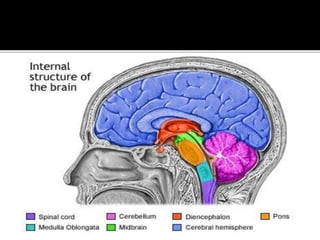
 Parts of brain
 Forebrain or prosencephalon
 Midbrain or mesencephalon
 Hindbrain or rhombencephalon
 Parts of hindbrain
▪ Pons
▪ Medulla oblongata
▪ Cerebellum
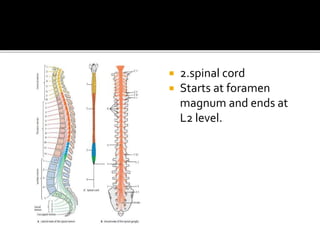
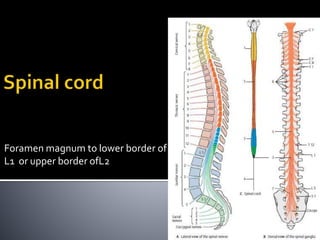
 2.spinal cord
 Starts at foramen
magnum and ends at
L2 level.
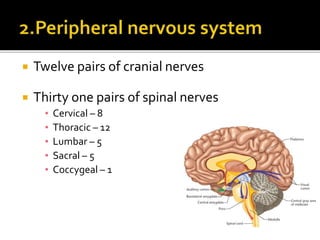
 Twelve pairs of cranial nerves
 Thirty one pairs of spinal nerves
▪ Cervical – 8
▪ Thoracic – 12
▪ Lumbar – 5
▪ Sacral – 5
▪ Coccygeal – 1
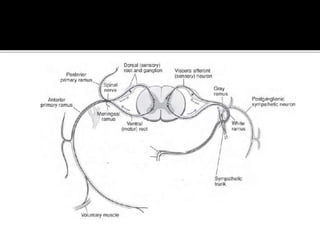
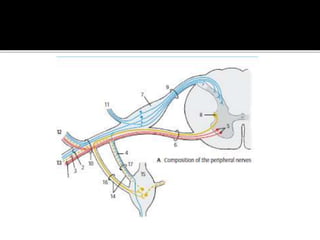
 Composition of a spinal nerve
▪ Sensory fibres
▪ Motor fibres
▪ Autonomic fibres
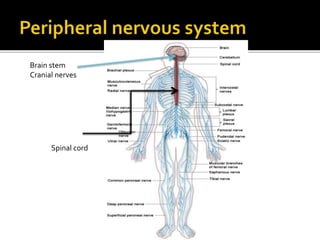
Brain stem
Cranial nerves
Spinal cord
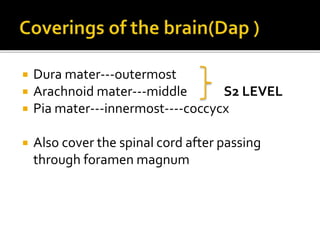
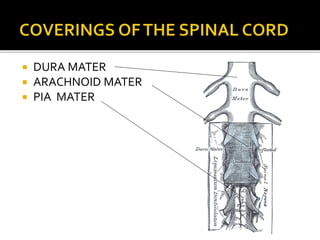
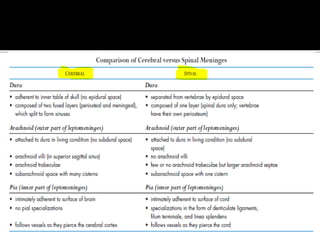
 Dura mater---outermost
 Arachnoid mater---middle S2 LEVEL
 Pia mater---innermost----coccycx
 Also cover the spinal cord after passing
through foramen magnum
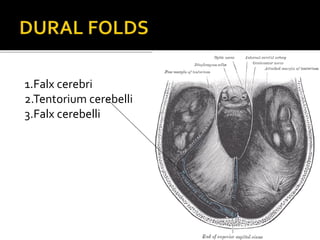
1.Falx cerebri
2.Tentorium cerebelli
3.Falx cerebelli
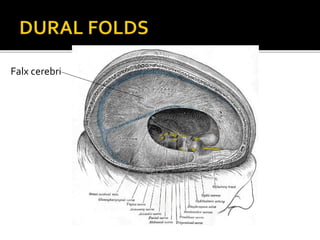
Falx cerebri
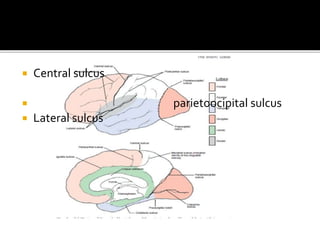
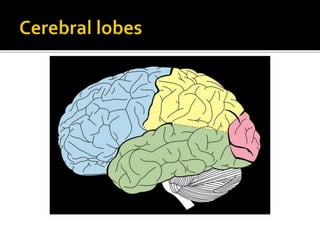
 Central sulcus
 parietoocipital sulcus
 Lateral sulcus
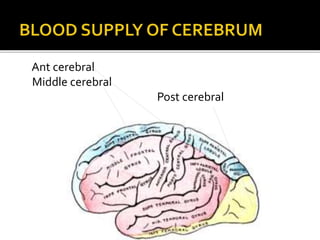
Ant cerebral
Middle cerebral
Post cerebral
Foramen magnum to lower border of
L1 or upper border ofL2
 DURA MATER
 ARACHNOID MATER
 PIA MATER
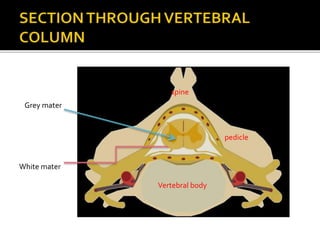
Vertebral body
pedicle
spine
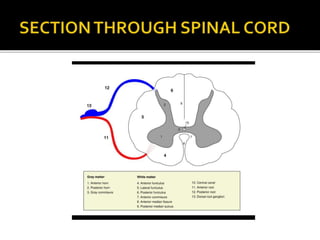
laminaGrey mater
White mater
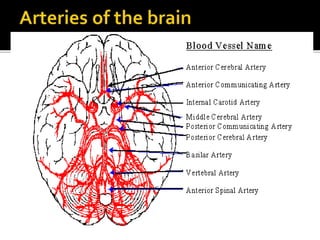
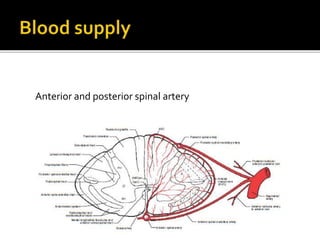
Anterior and posterior spinal artery
 Ventral ramus and dorsal ramus
 Spinal nerve
 Divides into anterior and posterior rami
 Anterior --- -- body nerve plexus
 Posterior rami—sensory innervation to a
skin segment known as a
dermatome
 Ventral Roots
 The ventral (motor) roots consist of efferent
fibers that convey output from the spinal
cord.
There are two components:
(1) innervate voluntary striated muscles,
(2) influences to involuntary smooth
muscles,cardiac muscle, and glands
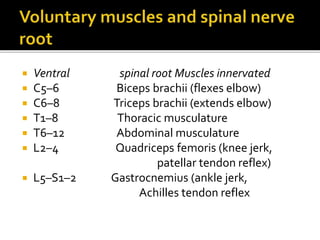
 Ventral spinal root Muscles innervated
 C5–6 Biceps brachii (flexes elbow)
 C6–8 Triceps brachii (extends elbow)
 T1–8 Thoracic musculature
 T6–12 Abdominal musculature
 L2–4 Quadriceps femoris (knee jerk,
patellar tendon reflex)
 L5–S1–2 Gastrocnemius (ankle jerk,
Achilles tendon reflex
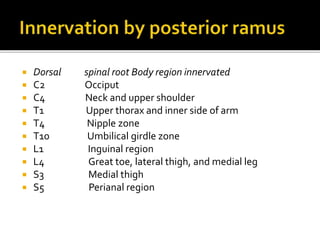
 Dorsal spinal root Body region innervated
 C2 Occiput
 C4 Neck and upper shoulder
 T1 Upper thorax and inner side of arm
 T4 Nipple zone
 T10 Umbilical girdle zone
 L1 Inguinal region
 L4 Great toe, lateral thigh, and medial leg
 S3 Medial thigh
 S5 Perianal region
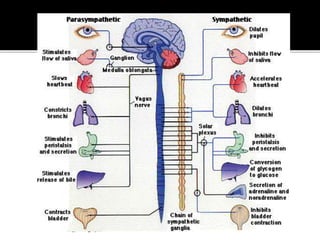
 Two parts
▪ Sympathetic
▪ Parasympathetic
 Functions of autonomic N S
 Involuntary
 Controls activities of heart, smooth muscles of
GIT, blood vessels & glands
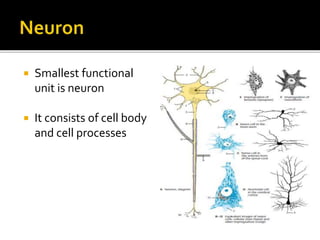
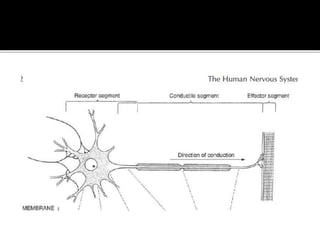
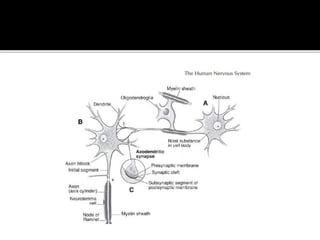
 Smallest functional
unit is neuron
 It consists of cell body
and cell processes
 Unipolar
 Bipolar
 Pseudo uni polar
 Multipolar
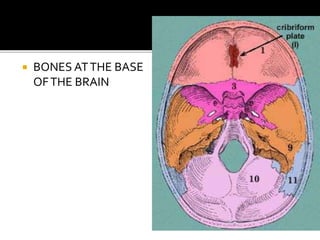
 BONES ATTHE BASE
OFTHE BRAIN

Central nervous system introduction