BY
ANIEDU, UGOCHUKWU .I.
CR1
HIATAL HERNIA
PREAMBLE
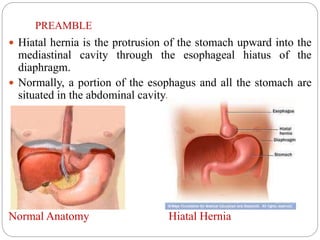
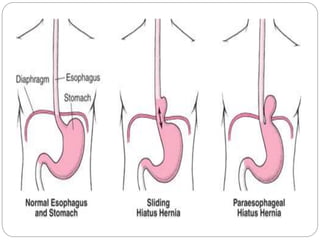
 Hiatal hernia is the protrusion of the stomach upward into the
mediastinal cavity through the esophageal hiatus of the
diaphragm.
 Normally, a portion of the esophagus and all the stomach are
situated in the abdominal cavity.
Normal Anatomy Hiatal Hernia
PATHOPHYSIOLOGY
 Size of hiatus not fixed, narrows with increase in intra-
abdominal pressure
 Tear of Phrenoesophageal ligament :
is a fibrous layer of connective tissue and maintains the LES
within the abdominal cavity
 A hiatal hernia compromises reflux barrier
 Reduced LES pressure
 Reduced esophageal acid clearance
 Transient LES relaxation episodes particularly at night time
Types of Hiatal Hernia
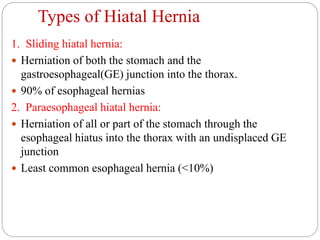
1. Sliding hiatal hernia:
 Herniation of both the stomach and the
gastroesophageal(GE) junction into the thorax.
 90% of esophageal hernias
2. Paraesophageal hiatal hernia:
 Herniation of all or part of the stomach through the
esophageal hiatus into the thorax with an undisplaced GE
junction
 Least common esophageal hernia (<10%)
Risk factors for Sliding Hiatal Hernia
 Age
 Increased intra-abdominal pressure (e.g. Obesity, pregnancy,
coughing, heavy lifting).
 Smoking
Clinical features of Sliding Hiatal Hernia
 Majority are asymptomatic
 Larger hernias frequently associated with Gastroesophageal
reflux disease(GERD) due to decreased competence of the
Lower esophageal sphincter (LES) .
Complications of Sliding Hiatal Hernia
 Most common complication is GERD.
 Other complications are rare and are related to reflux
 Esophagitis (dysphagia, heartburn)
 Consequences of esophagitis ( peptic stricture, Barrett’s
esophagus, esophageal carcinoma)
 Extra-esophageal complications ( pneumonitis/
pneumonia, asthma, cough, laryngitis)
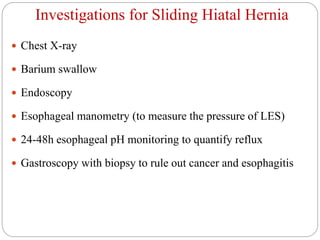
Investigations for Sliding Hiatal Hernia
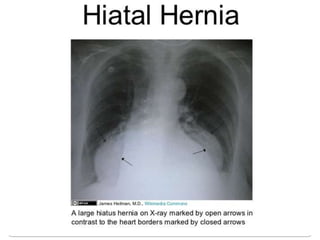
 Chest X-ray
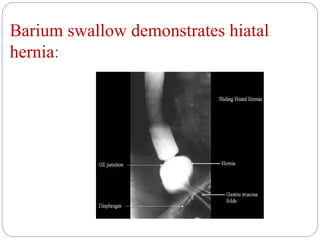
 Barium swallow
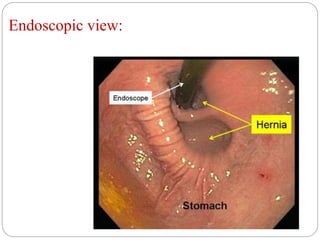
 Endoscopy
 Esophageal manometry (to measure the pressure of LES)
 24-48h esophageal pH monitoring to quantify reflux
 Gastroscopy with biopsy to rule out cancer and esophagitis
Endoscopic view:
Barium swallow demonstrates hiatal
hernia:
Treatment of Sliding Hiatal Hernia
 LIFESTYLE MODIFICATION
 Stop smoking,
 weight loss,
 elevate head of bed,
 no meals <3h prior to sleeping,
 smaller and more frequent meals,
 avoid too much alcohol, coffee, mint and fat.
 MEDICAL THERAPY
 Antacids
 H2 receptor antagonists e.g. Cimetidine
 Proton pump inhibitors e.g. Omeprazole
 Prokinetic agents e.g. Metoclopramide
 SURGICAL THERAPY
 Indications:
 Failure of medical therapy
 Esophageal stricture
 Severe nocturnal aspiration
 Barrett’s esophagus
 Anti-reflux procedure e.g Fundoplication
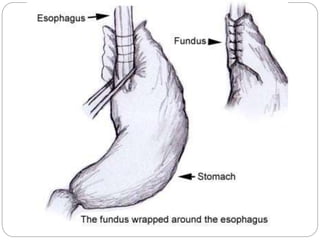
A laparoscopic procedure in which the fundus of the stomach is
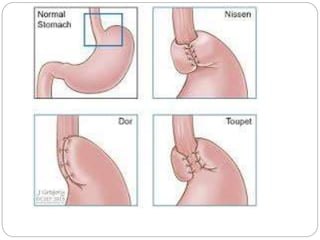
wrapped around lower end of esophagus. The types of fundoplication
include:
i. The Nissen fundoplication is total (360°),
ii. Partial fundoplication known as Thal (270° anterior),
iii. Belsey (270° anterior transthoracic)
iv. Dor (anterior 180-200°)
v. Lind (300° posterior)
vi. Toupet fundoplication (posterior 270°) are alternative procedures
with somewhat different indications and outcomes.
Risk factors for Paraesophageal Hiatal Hernia
 Age
 Increased intra-abdominal pressure
 Women > Men
 Fiber-depleted diet
 Chronic esophagitis
Clinical features of paraesophageal hiatal
hernia
 Usually asymptomatic due to normal GE junction
 Pressure sensation in lower chest, dysphagia
 Nausea and vomitting
Complications of paraesophageal hiatal
hernia
 Hemorrhage
 Strangulation ( Gastric volvulus)
 Obstruction
 Gastric stasis ulcer ( Cameron lesions- causes iron
deficiency anemia)
Investigation of Paraesophageal Hiatal Hernia
 Upper Gastrointestinal Series
Contrast solution is swallowed and X-rays
are used to identify the presence of a hiatal hernia.
 Upper Endoscopy
A gastroscope is used to evaluate the esophagus and stomach
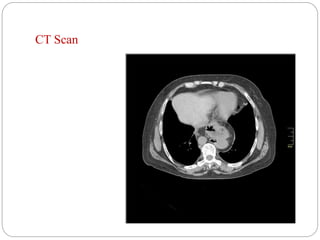
 CT Scan
Useful especially for evaluation of a paraesophageal hernias to
identify the size of the hernia and other organs which may be
involved.
CT Scan
Treatment Of Paraesophageal Hiatal Hernia
Paraesophageal hiatal hernia is treated surgically.
Indications for surgery
 Nausea/ Vomiting
 No bowel movement
 Gastric volvulus/ Strangulation
 Severely incompetent LES
 Paraesophageal hernia
Surgical procedures for P.H.H
 Hiatal Hernia repair
The Surgeon will;
i. Reduce the stomach and other content of the hernia
into the abdominal cavity
ii. Excise the hernia sac
iii. Repair the defect on the diaphragm
 Anti-reflux procedure e.g Fundoplication
 Gastropexy: Suturing the stomach to anterior abdominal wall
 PEG (Percutaneous endoscopic gastrostomy): Usually in
elderly patients at high surgical risk.
Complications Of Surgical treatment
 Intraabdominal infection
 Esophageal perforation
 Dysphagia
 Belching difficulty
 Bloating (gas bloat syndrome)
 Self limiting within 2-4 wks, but may persist
Summary
 Protrusion of intra-abdominal contents through an enlarged
esophageal hiatus of the diaphragm.
 Risk factors include obesity, increased intra-abdominal pressure, and
a previous hiatal operation.
 May be asymptomatic or may present with heartburn, dysphagia,
odynophagia, hoarseness, asthma, shortness of breath, chest pain,
anemia or hematemesis, or some combination of these.
 Contrasted upper GI series (also known as an upper GI or as a
barium esophagram) is the key investigation.
 Treatment depends on the patient's symptoms and the anatomic
configuration of the hernia.
 Uncomplicated sliding hiatal hernias are treated symptomatically
with medical therapy, although some patients may select surgical
therapy. Complicated hiatal hernias (those with bleeding, volvulus,
or obstruction) have a stronger indication for surgical repair.
 Complications include obstruction, bleeding, volvulus with and
without strangulation or necrosis, and Barrett esophagus.
References
 Renee C. Minjarez, M.D. and Blair A. Jobe, M.D. (2006).
"[Surgical therapy for gastroesophageal reflux disease.]". GI
Motility online
 http://emedicine.medscape.com/article/178393-overview.
Retrieved on 22nd February, 2016
 https://en.wikipedia.org/wiki/Esophageal_hiatus. Retrieved on
22nd February, 2016
 Hall, J. and Premji, A (2015). The Toronto notes 2015:
Comprehensive medical reference and review for the Medical
Council of Canada Qualifying Exam Part 1 and the United
States Medical Licensing Exam Step 2. Toronto: Toronto Notes
for Medical Students, Inc.
Hiatal hernia

Hiatal hernia

  • 1.
  • 2.
    PREAMBLE  Hiatal herniais the protrusion of the stomach upward into the mediastinal cavity through the esophageal hiatus of the diaphragm.  Normally, a portion of the esophagus and all the stomach are situated in the abdominal cavity. Normal Anatomy Hiatal Hernia
  • 3.
    PATHOPHYSIOLOGY  Size ofhiatus not fixed, narrows with increase in intra- abdominal pressure  Tear of Phrenoesophageal ligament : is a fibrous layer of connective tissue and maintains the LES within the abdominal cavity  A hiatal hernia compromises reflux barrier  Reduced LES pressure  Reduced esophageal acid clearance  Transient LES relaxation episodes particularly at night time
  • 4.
    Types of HiatalHernia 1. Sliding hiatal hernia:  Herniation of both the stomach and the gastroesophageal(GE) junction into the thorax.  90% of esophageal hernias 2. Paraesophageal hiatal hernia:  Herniation of all or part of the stomach through the esophageal hiatus into the thorax with an undisplaced GE junction  Least common esophageal hernia (<10%)
  • 6.
    Risk factors forSliding Hiatal Hernia  Age  Increased intra-abdominal pressure (e.g. Obesity, pregnancy, coughing, heavy lifting).  Smoking
  • 7.
    Clinical features ofSliding Hiatal Hernia  Majority are asymptomatic  Larger hernias frequently associated with Gastroesophageal reflux disease(GERD) due to decreased competence of the Lower esophageal sphincter (LES) .
  • 8.
    Complications of SlidingHiatal Hernia  Most common complication is GERD.  Other complications are rare and are related to reflux  Esophagitis (dysphagia, heartburn)  Consequences of esophagitis ( peptic stricture, Barrett’s esophagus, esophageal carcinoma)  Extra-esophageal complications ( pneumonitis/ pneumonia, asthma, cough, laryngitis)
  • 9.
    Investigations for SlidingHiatal Hernia  Chest X-ray  Barium swallow  Endoscopy  Esophageal manometry (to measure the pressure of LES)  24-48h esophageal pH monitoring to quantify reflux  Gastroscopy with biopsy to rule out cancer and esophagitis
  • 11.
  • 12.
  • 13.
    Treatment of SlidingHiatal Hernia  LIFESTYLE MODIFICATION  Stop smoking,  weight loss,  elevate head of bed,  no meals <3h prior to sleeping,  smaller and more frequent meals,  avoid too much alcohol, coffee, mint and fat.
  • 14.
     MEDICAL THERAPY Antacids  H2 receptor antagonists e.g. Cimetidine  Proton pump inhibitors e.g. Omeprazole  Prokinetic agents e.g. Metoclopramide
  • 15.
     SURGICAL THERAPY Indications:  Failure of medical therapy  Esophageal stricture  Severe nocturnal aspiration  Barrett’s esophagus
  • 16.
     Anti-reflux proceduree.g Fundoplication A laparoscopic procedure in which the fundus of the stomach is wrapped around lower end of esophagus. The types of fundoplication include: i. The Nissen fundoplication is total (360°), ii. Partial fundoplication known as Thal (270° anterior), iii. Belsey (270° anterior transthoracic) iv. Dor (anterior 180-200°) v. Lind (300° posterior) vi. Toupet fundoplication (posterior 270°) are alternative procedures with somewhat different indications and outcomes.
  • 19.
    Risk factors forParaesophageal Hiatal Hernia  Age  Increased intra-abdominal pressure  Women > Men  Fiber-depleted diet  Chronic esophagitis
  • 20.
    Clinical features ofparaesophageal hiatal hernia  Usually asymptomatic due to normal GE junction  Pressure sensation in lower chest, dysphagia  Nausea and vomitting
  • 21.
    Complications of paraesophagealhiatal hernia  Hemorrhage  Strangulation ( Gastric volvulus)  Obstruction  Gastric stasis ulcer ( Cameron lesions- causes iron deficiency anemia)
  • 22.
    Investigation of ParaesophagealHiatal Hernia  Upper Gastrointestinal Series Contrast solution is swallowed and X-rays are used to identify the presence of a hiatal hernia.  Upper Endoscopy A gastroscope is used to evaluate the esophagus and stomach  CT Scan Useful especially for evaluation of a paraesophageal hernias to identify the size of the hernia and other organs which may be involved.
  • 23.
  • 24.
    Treatment Of ParaesophagealHiatal Hernia Paraesophageal hiatal hernia is treated surgically. Indications for surgery  Nausea/ Vomiting  No bowel movement  Gastric volvulus/ Strangulation  Severely incompetent LES  Paraesophageal hernia
  • 25.
    Surgical procedures forP.H.H  Hiatal Hernia repair The Surgeon will; i. Reduce the stomach and other content of the hernia into the abdominal cavity ii. Excise the hernia sac iii. Repair the defect on the diaphragm
  • 26.
     Anti-reflux proceduree.g Fundoplication  Gastropexy: Suturing the stomach to anterior abdominal wall  PEG (Percutaneous endoscopic gastrostomy): Usually in elderly patients at high surgical risk.
  • 27.
    Complications Of Surgicaltreatment  Intraabdominal infection  Esophageal perforation  Dysphagia  Belching difficulty  Bloating (gas bloat syndrome)  Self limiting within 2-4 wks, but may persist
  • 28.
    Summary  Protrusion ofintra-abdominal contents through an enlarged esophageal hiatus of the diaphragm.  Risk factors include obesity, increased intra-abdominal pressure, and a previous hiatal operation.  May be asymptomatic or may present with heartburn, dysphagia, odynophagia, hoarseness, asthma, shortness of breath, chest pain, anemia or hematemesis, or some combination of these.  Contrasted upper GI series (also known as an upper GI or as a barium esophagram) is the key investigation.  Treatment depends on the patient's symptoms and the anatomic configuration of the hernia.  Uncomplicated sliding hiatal hernias are treated symptomatically with medical therapy, although some patients may select surgical therapy. Complicated hiatal hernias (those with bleeding, volvulus, or obstruction) have a stronger indication for surgical repair.  Complications include obstruction, bleeding, volvulus with and without strangulation or necrosis, and Barrett esophagus.
  • 29.
    References  Renee C.Minjarez, M.D. and Blair A. Jobe, M.D. (2006). "[Surgical therapy for gastroesophageal reflux disease.]". GI Motility online  http://emedicine.medscape.com/article/178393-overview. Retrieved on 22nd February, 2016  https://en.wikipedia.org/wiki/Esophageal_hiatus. Retrieved on 22nd February, 2016  Hall, J. and Premji, A (2015). The Toronto notes 2015: Comprehensive medical reference and review for the Medical Council of Canada Qualifying Exam Part 1 and the United States Medical Licensing Exam Step 2. Toronto: Toronto Notes for Medical Students, Inc.

Editor's Notes

  • #4 The phrenoesophageal ligament is formed by fusion by endothoracic and endoabdominal fascia at the esophageal hiatus
  • #7 Worse when patient supine/leaning Lump or feeling that food is stuck beneath the xiphoid Late symptoms of dysphagia and vomitting may suggest stricture
  • #20 Muscle weakening and loss of elasticity as people age is thought to predispose to hiatus hernia, Conditions such as chronic esophagitis may cause shortening of the esophagus by causing fibrosis of the longitudinal muscles and, therefore, predispose to hiatal hernia. However, which comes first, the hiatal hernia worsening the reflux or the reflux-induced shortening of the esophagus, remains unknown.
  • #25  However, young patients with severe or recurrent complications of GERD, such as strictures, ulcers, and bleeding, who cannot afford lifelong PPI treatment or would prefer to avoid taking medications long term, may be surgical candidates.