Cholinergic Antagonist
Agents
By: Dr. Sara Sam
Yuzuncu Yil University
2015
Cholinergic Blocking Agents:
Chemical Class
Natural
Cholinergic Blocking Agents
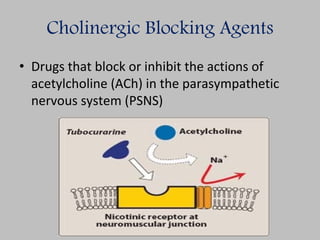
• Drugs that block or inhibit the actions of
acetylcholine (ACh) in the parasympathetic
nervous system (PSNS)
USES:
• As miotic
• Myasthenia gravis
• Postoperative paralytic ileus/urinary retention
• Postoperative decurarization
• Cobra bite
• Belladona poisoning
• Alzheimer’s diseases
• Other drug overdosages
Cholinergic Blocking Agents:
Mechanism of Action
• Competitive antagonists
• Complete with ACh
• Block ACh at the muscarinic receptors
in the PSNS
– As a result, ACh is unable to bind to the
receptor site and cause a cholinergic effect.
Cholinergic Blocking Agents:
Mechanism of Action
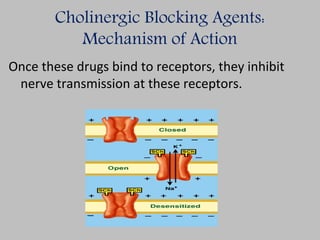
Once these drugs bind to receptors, they inhibit
nerve transmission at these receptors.
Drug Effects of
Cholinergic Blocking Agents
• Cardiovascular
– Small doses: decrease heart rate
– Large doses: increase heart rate
• CNS
– Small doses: decrease muscle rigidity
and tremors
– Large doses: drowsiness, disorientation,
hallucinations
Drug Effects of
Cholinergic Blocking Agents
• Eye
– Dilated pupils (mydriasis)
– Decreased accommodation due to paralysis
of ciliary muscles (cycloplegia)
• Gastrointestinal
– Relax smooth muscle tone of GI tract
– Decrease intestinal and gastric secretions
– Decrease motility and peristalsis
Drug Effects of
Cholinergic Blocking Agents
• Genitourinary
– Relaxed detrusor muscle
– Increased constriction of internal sphincter
– Result: urinary retention
• Glandular
– Decreased bronchial secretions, salivation,
sweating
• Respiratory
– Decreased bronchial secretions
– Dilated bronchial airways
Cholinergic Blocking Agents:
Therapeutic Uses
CNS
Decreased muscle rigidity and muscle
tremors
• Parkinson’s disease
• Drug-induced extrapyramidal reactions
Cholinergic Blocking Agents:
Therapeutic Uses
Cardiovascular
Affect the heart’s conduction system
• Low doses: slow the heart rate
• High doses: block inhibitory vagal effects on
the SA and AV node pacemaker cells
– Result: increased heart rate
Cholinergic Blocking Agents:
Therapeutic Uses
Atropine
Used primarily for cardiovascular disorders
• Sinus node dysfunction
• Symptomatic second-degree heart block
• Sinus bradycardia with hemodynamic compromise
(advanced life support)
Cholinergic Blocking Agents:
Therapeutic Uses
Respiratory
Blocking the cholinergic stimulation of the PSNS
allows unopposed action of the SNS.
• Results:
– Decreased secretions from nose, mouth,
pharynx, bronchi
– Relaxed smooth muscles in bronchi
and bronchioles
– Decreased airway resistance
– Bronchodilation
Cholinergic Blocking Agents:
Therapeutic Uses
Respiratory agents are used to treat:
• Exercise-induced bronchospasms
• Chronic bronchitis
• Asthma
• Chronic obstructive pulmonary disease
Cholinergic Blocking Agents:
Therapeutic Uses
Gastrointestinal
PSNS controls gastric secretions and smooth
muscles that produce gastric motility.
• Blockade of PSNS results in:
– Decreased secretions
– Relaxation of smooth muscle
– Decreased GI motility and peristalsis
Cholinergic Blocking Agents:
Therapeutic Uses
Gastrointestinal agents are used to treat:
• Peptic ulcer disease
• Irritable bowel disease
• GI hypersecretory states
Cholinergic Blocking Agents:
Therapeutic Uses
Genitourinary
• Relaxed detrusor muscles of the bladder
• Increased constriction of the internal
sphincter
• Reflex neurogenic bladder
• Incontinence
Cholinergic Blocking Agents:
Side Effects
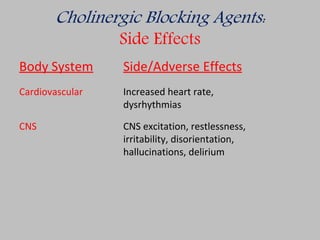
Body System Side/Adverse Effects
Cardiovascular Increased heart rate,
dysrhythmias
CNS CNS excitation, restlessness,
irritability, disorientation,
hallucinations, delirium
Cholinergic Blocking Agents:
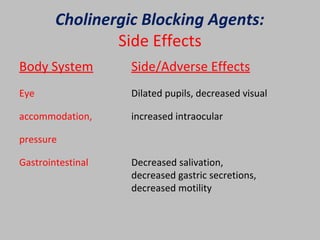
Side Effects
Body System Side/Adverse Effects
Eye Dilated pupils, decreased visual
accommodation, increased intraocular
pressure
Gastrointestinal Decreased salivation,
decreased gastric secretions,
decreased motility
Cholinergic Blocking Agents:
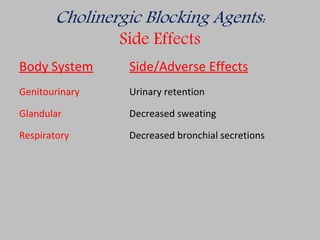
Side Effects
Body System Side/Adverse Effects
Genitourinary Urinary retention
Glandular Decreased sweating
Respiratory Decreased bronchial secretions
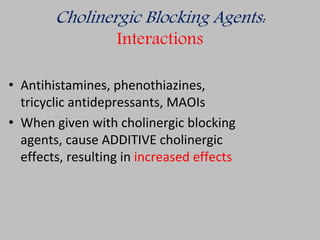
Cholinergic Blocking Agents:
Interactions
• Antihistamines, phenothiazines,
tricyclic antidepressants, MAOIs
• When given with cholinergic blocking
agents, cause ADDITIVE cholinergic
effects, resulting in increased effects
Thank you for
Washing

Cholinergic Antagonist Agents

  • 1.
    Cholinergic Antagonist Agents By: Dr.Sara Sam Yuzuncu Yil University 2015
  • 2.
  • 3.
    Cholinergic Blocking Agents •Drugs that block or inhibit the actions of acetylcholine (ACh) in the parasympathetic nervous system (PSNS)
  • 4.
    USES: • As miotic •Myasthenia gravis • Postoperative paralytic ileus/urinary retention • Postoperative decurarization • Cobra bite • Belladona poisoning • Alzheimer’s diseases • Other drug overdosages
  • 5.
    Cholinergic Blocking Agents: Mechanismof Action • Competitive antagonists • Complete with ACh • Block ACh at the muscarinic receptors in the PSNS – As a result, ACh is unable to bind to the receptor site and cause a cholinergic effect.
  • 6.
    Cholinergic Blocking Agents: Mechanismof Action Once these drugs bind to receptors, they inhibit nerve transmission at these receptors.
  • 7.
    Drug Effects of CholinergicBlocking Agents • Cardiovascular – Small doses: decrease heart rate – Large doses: increase heart rate • CNS – Small doses: decrease muscle rigidity and tremors – Large doses: drowsiness, disorientation, hallucinations
  • 8.
    Drug Effects of CholinergicBlocking Agents • Eye – Dilated pupils (mydriasis) – Decreased accommodation due to paralysis of ciliary muscles (cycloplegia) • Gastrointestinal – Relax smooth muscle tone of GI tract – Decrease intestinal and gastric secretions – Decrease motility and peristalsis
  • 9.
    Drug Effects of CholinergicBlocking Agents • Genitourinary – Relaxed detrusor muscle – Increased constriction of internal sphincter – Result: urinary retention • Glandular – Decreased bronchial secretions, salivation, sweating • Respiratory – Decreased bronchial secretions – Dilated bronchial airways
  • 10.
    Cholinergic Blocking Agents: TherapeuticUses CNS Decreased muscle rigidity and muscle tremors • Parkinson’s disease • Drug-induced extrapyramidal reactions
  • 11.
    Cholinergic Blocking Agents: TherapeuticUses Cardiovascular Affect the heart’s conduction system • Low doses: slow the heart rate • High doses: block inhibitory vagal effects on the SA and AV node pacemaker cells – Result: increased heart rate
  • 12.
    Cholinergic Blocking Agents: TherapeuticUses Atropine Used primarily for cardiovascular disorders • Sinus node dysfunction • Symptomatic second-degree heart block • Sinus bradycardia with hemodynamic compromise (advanced life support)
  • 13.
    Cholinergic Blocking Agents: TherapeuticUses Respiratory Blocking the cholinergic stimulation of the PSNS allows unopposed action of the SNS. • Results: – Decreased secretions from nose, mouth, pharynx, bronchi – Relaxed smooth muscles in bronchi and bronchioles – Decreased airway resistance – Bronchodilation
  • 14.
    Cholinergic Blocking Agents: TherapeuticUses Respiratory agents are used to treat: • Exercise-induced bronchospasms • Chronic bronchitis • Asthma • Chronic obstructive pulmonary disease
  • 15.
    Cholinergic Blocking Agents: TherapeuticUses Gastrointestinal PSNS controls gastric secretions and smooth muscles that produce gastric motility. • Blockade of PSNS results in: – Decreased secretions – Relaxation of smooth muscle – Decreased GI motility and peristalsis
  • 16.
    Cholinergic Blocking Agents: TherapeuticUses Gastrointestinal agents are used to treat: • Peptic ulcer disease • Irritable bowel disease • GI hypersecretory states
  • 17.
    Cholinergic Blocking Agents: TherapeuticUses Genitourinary • Relaxed detrusor muscles of the bladder • Increased constriction of the internal sphincter • Reflex neurogenic bladder • Incontinence
  • 18.
    Cholinergic Blocking Agents: SideEffects Body System Side/Adverse Effects Cardiovascular Increased heart rate, dysrhythmias CNS CNS excitation, restlessness, irritability, disorientation, hallucinations, delirium
  • 19.
    Cholinergic Blocking Agents: SideEffects Body System Side/Adverse Effects Eye Dilated pupils, decreased visual accommodation, increased intraocular pressure Gastrointestinal Decreased salivation, decreased gastric secretions, decreased motility
  • 20.
    Cholinergic Blocking Agents: SideEffects Body System Side/Adverse Effects Genitourinary Urinary retention Glandular Decreased sweating Respiratory Decreased bronchial secretions
  • 21.
    Cholinergic Blocking Agents: Interactions •Antihistamines, phenothiazines, tricyclic antidepressants, MAOIs • When given with cholinergic blocking agents, cause ADDITIVE cholinergic effects, resulting in increased effects
  • 22.