Intestinal Obstruction
PRESENTED BY:
ANISH DHAKAL
(ARYAN)
Causes
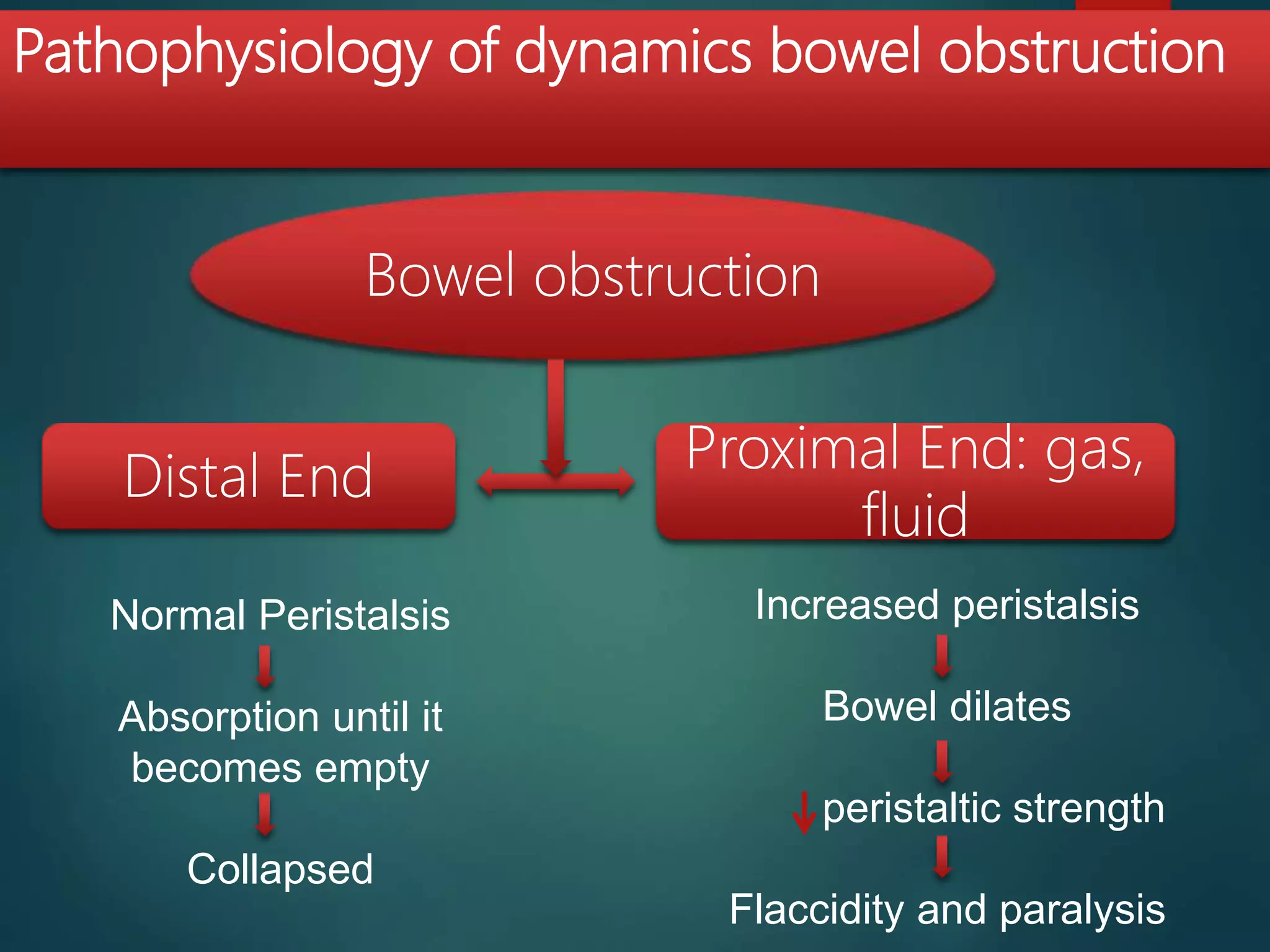
Pathophysiology of dynamics bowel obstruction
Bowel obstruction
Distal End
Proximal End: gas,
fluid
Normal Peristalsis
Absorption until it
becomes empty
Collapsed
Increased peristalsis
Bowel dilates
peristaltic strength
Flaccidity and paralysis
 Cardinal clinical features of acute bowel obstruction
 Pain
 Distension
 Vomiting &
 Absolute constipation
 Others
 Dehydration
 Hypokalemia (due to strangulation)
 Pyrexia
 Tenderness
• Small bowel obstruction
– high or low;
•large bowel obstruction
Nature of presentation
 Simple obstruction
 Blood supply intact
 Strangulating/ strangulated
 Direct interference to blood flow
By hernial rings or intraperitoneal
adhesions/bands
 Clinical features vary according to
 Location of obstruction
 duration of obstruction
 Underlying pathology
 Presence or absence of intestinal ischaemia
Straight segments that are generally central and lie
transversely. No gas is seen in the colon
 Jejunum
 Valvulae conniventes
 Ileum
 the distal ileum featureless
 Large bowel
 Haustral folds,
 Caecum
 Rounded gas shadow
in the right iliac fossa
Principal of Treatment of acute
intestinal obstruction
 There are three main measures:
 Gastrointestinal drainage via NG tube
 Fluid and electrolyte replacement
 Relief of obstruction
Supportive Treatment
 Nasogastric decompression
 Fluid and electrolyte replacement
 Analgesics
 Antibiotics
 Urine output monitoring
 Vital Monitoring
Surgical Treatment
 Indications for early surgery
 Obstructed or strangulated external hernia
 Internal intestinal strangulation
 Acute obstruction
 Principles are to manage :
 the segment at the site of obstruction
 the distended proximal bowel
 the underlying cause of obstruction
Surgical Treatment
 Un-known obstruction site
 Midline incision for adequate exposure
 Operative decompression (proper exposure)
 Reduces pressure on abdominal wound
 Reduces pain
 Improving diaphragmatic movement
 Surgical procedures
 Depends on etiology
 Division of adhesions, Excision, bypass or proximal decompression
Checking Viability of Involved Gut
after Relief of Obstruction
Viable Non-viable
Circulation •Dark colour
becomes lighter
•Mesentery bleeds
if pricked
•Dark colour
remains
•No bleeding if
mesentery is
pricked
Peritoneum •Shiny •Dull and lusterless
Intestinal
Musculature
•Firm
•Pressure rings
or may not
disappear
•Peristalsis may be
observed
•Flabby, thin and
friable
•Pressure rings
persist
• No peristalsis
Management of acute large bowel obstruction
 Resuscitation
 Midline incision
 Distension of the caecum  confirmation of large
bowel involvement
 Removeable lesion
Eg. In caecum, ascending colon, hepatic flexure or
proximal transverse colon
 Emergency right hemicolectomy
Management
 Lesion irremovable
 Colostomy or ileosotomy (incompetent ileocaecal
valve)
 Ileotransverse bypass
 Caecal perforation: Emergency caecostomy
 Obstructive lesion at the splenic flexure :extended right
hemicolestomy
 Obstructive lesion at left colon or rectosigmoid
junction: left hemicolectomy
Chronic large bowel obstruction
 Organic causes
 Functional causes
Clinical features: constipation( 1st symptoms)
Investigation : DRE, water-soluble enema, CT scan,
endoscopy
Functional cause management  colonoscopic decompression
and conservative management
Organic cause management laparotomy or stent
 Constriction of a tubular structure of the body that prevents function
or impedes circulation: Constant pain , Tenderness with
rigidity, Shock
Strangulation (Surgical emergency)
Bowel Obstruction by Adhesions
 Common cause of intestinal
obstruction where abdominal
operation are common
Peritoneal irritation
Local fibrin production
Adhesion between apposed
surfaces
May become vascularized and
replaced by mature fibrous
tissue
Types
Early fibrinous adhesions
Late mature fibrous tissue
Usually involve small bowel
Causes
Factors that may limit adhesion formation include:
 Good surgical technique
 Washing of the peritoneal cavity with saline to remove clots,
etc.
 Minimising contact with gauze
 Covering anastomosis and raw peritoneal surfaces
Treatment of adhesive obstruction
■ Initially conservative treatment no longer than 72 hours
■ At operation, divide only the causative adhesion(s) and limit
dissection
■ Repair serosal tears; invaginate (or resect) areas of doubtful
viability
■ Laparoscopic adhesiolysis
Intussusception
 One portion of gut invaginated within immediately adjacent
segment
 Proximal to distal
 Common in children (5-10 month)
Clinical feature:
• Episodes of screaming & drawing up legs
• During attacks pale
• Between episodes listless
• Vomit with time conspicuous & bile stained
• “red currant jelly” stool
Barium enema ileocolic intussception (claw sign)
Abdominal ultrasound scan
Doughnut appearance of concentric rings in
transverse section
CT scan
Target or sausage shaped soft tissue mass with
layering effect
Imaging in intussusception
 Resuscitation with IV fluids
 Broad spectrum antibiotics
 Naso gastric drainage
 Non operative reduction - barium or air enema but C/I if
the sign of perforation or peritonitis and shock.
 Surgery
 When non-operative reduction failed or contraindicated
 After resuscitation transverse right sided abdominal incision
 Reduction  Compressing the most distal part of
intussusception towards its origin
 Irreducible/infracted/pathological lead point  resection and
primary anastomosis
Managements
Volvulus
 Is a twisting or axial rotation of a portion of bowel about
its mesentery.
 The rotation causes obstruction to the lumen (>180˚
torsion) and if tight enough causes vascular occlusion in
the mesentery (>360˚)
 When complete closed loop of obstruction ischemia
occurs due to vascular occlusion
 Primary or secondary volvulus
Clinical features of volvulus
 Volvulus of small intestine
 Usually occurs in the lower ileum
 Caecal volvulus
 Usually clockwise twist,
 palpable tympanic swelling in the midline or left line
of abdomen
 Females > males
 Sigmoid volvulus
 Abdominal distension
Early & progressive sign associated with hiccough
and retching
 Constipation absolute
Ceacal volvulus
 Radiography small bowel dilatation
 Absence of gas in distal colon
Barium enema to confirm diagnosis
Absence of barium in caecum & bird beak
deformity
Sigmoid volvulus
 Plain radiography massive colonic distension
 Classic appearance
 Dilated loop of bowel running diagonally across
abdomen from right to left
Imaging in volvulus
Volvulus neonatorium
Abdominal radiograph
Evidence of duodenal obstruction
Later intestinal strangulation progress abdomen
relatively gasless
Reduce volvulus at operation [decompression using
needle]
Caecopexy (fixation of caecum to right iliac fossa)
Caecostomy
If ischaemic or gangrenous caecum  right
hemicolectomy
A. Management of Caecal
Volvulus
 Reduce volvulus at operation [decompression using
needle]
 Caecopexy (fixation of caecum to right iliac fossa)
 Caecostomy
 If ischaemic or gangrenous caecum  right
hemicolectomy
Management of Sigmoid
Volvulus
 Flexible sigmoidoscopy or rigid sigmoidoscopy and
insertion of flatus tube
 Success  distension reduces and we can resuscitate
and do elective procedure
 Failure  laparotomy  untwisting of loop and per
anum decompression
 Fixation of sigmoid colon to the posterior abdominal
wall
 Resection
 If gangrenous  Paul Mikulicz procedure
 Alternative: Hartman’s procedure with subsequent re-
anastamosis
Adynamic Obstruction:
Paralytic ileus
Pseudo-obstruction
PARALYTIC ILEUS
 Neuromuscular failure ( Averbach’s --myenteric & Meissner’s--
submuscosal)
 Failure of transmission of peristaltic waves
 Stasis leading to fluid and gas accumulation within bowel
 Distension, vomiting, absence of bowel sounds & absolute
constipation
Types
 Postoperative
 Self-limiting (24-72 hrs)
 Infection
 Intra-abdominal sepsis
 Reflex ileus
 After fracture of spine or
ribs
 Metabolic
 Uraemia and
hypokalemia
 If 72 hours after laparotomy:
• No return of bowel sounds on
auscultation
• No passage of flatus
 Abdominal distension more
marked and tympanic
 In absence of gastric
aspiration  effortless
vomiting
Clinical features
Management
 Nasogastric suction and restriction of oral intake until bowel
sounds return and passage of flatus
 Gastrointestinal distension relieved by decompression
 Electrolyte and fluid balance
 Primary cause should be removed
 If prolonged and life-threatening  laparotomy  to exclude
hidden cause and facilitate bowel decompression
Pseudo-obstruction
 Usually of the colon, that occurs in the absence of
mechanical cause or acute intra-abdominal disease
Factors associated with pseudo-obstruction
■ Metabolic
■ Severe trauma
■ Shock
■ Retroperitoneal irritation
■ Drugs Tricyclic antidepressants
■ Secondary gastrointestinal involvement
Small Intestine
Pseudo
-Obstruction
 Primary (idiopathic) or
secondary
 Treatment
 Correction of
underlying cause
Colonic Pseudo-
Obstruction
 Abdominal X-Ray: Marked caecal
distension
 Treatment
 Colonoscopic decompression
 Colonoscopy and placement of
flatus tube if recurrence
 Tube caecostomy when colonscopy
fails or is unavailable
 Subtotal colectomy and ileorectal
anastomosis
Reference
 Bailey & Love’s Short Practice of Surgery, 26th Edition

Intestinal obstruction

  • 1.
  • 2.
  • 3.
    Pathophysiology of dynamicsbowel obstruction Bowel obstruction Distal End Proximal End: gas, fluid Normal Peristalsis Absorption until it becomes empty Collapsed Increased peristalsis Bowel dilates peristaltic strength Flaccidity and paralysis
  • 4.
     Cardinal clinicalfeatures of acute bowel obstruction  Pain  Distension  Vomiting &  Absolute constipation  Others  Dehydration  Hypokalemia (due to strangulation)  Pyrexia  Tenderness • Small bowel obstruction – high or low; •large bowel obstruction
  • 5.
    Nature of presentation Simple obstruction  Blood supply intact  Strangulating/ strangulated  Direct interference to blood flow By hernial rings or intraperitoneal adhesions/bands  Clinical features vary according to  Location of obstruction  duration of obstruction  Underlying pathology  Presence or absence of intestinal ischaemia
  • 6.
    Straight segments thatare generally central and lie transversely. No gas is seen in the colon  Jejunum  Valvulae conniventes  Ileum  the distal ileum featureless  Large bowel  Haustral folds,  Caecum  Rounded gas shadow in the right iliac fossa
  • 7.
    Principal of Treatmentof acute intestinal obstruction  There are three main measures:  Gastrointestinal drainage via NG tube  Fluid and electrolyte replacement  Relief of obstruction
  • 8.
    Supportive Treatment  Nasogastricdecompression  Fluid and electrolyte replacement  Analgesics  Antibiotics  Urine output monitoring  Vital Monitoring
  • 9.
    Surgical Treatment  Indicationsfor early surgery  Obstructed or strangulated external hernia  Internal intestinal strangulation  Acute obstruction  Principles are to manage :  the segment at the site of obstruction  the distended proximal bowel  the underlying cause of obstruction
  • 10.
    Surgical Treatment  Un-knownobstruction site  Midline incision for adequate exposure  Operative decompression (proper exposure)  Reduces pressure on abdominal wound  Reduces pain  Improving diaphragmatic movement  Surgical procedures  Depends on etiology  Division of adhesions, Excision, bypass or proximal decompression
  • 11.
    Checking Viability ofInvolved Gut after Relief of Obstruction Viable Non-viable Circulation •Dark colour becomes lighter •Mesentery bleeds if pricked •Dark colour remains •No bleeding if mesentery is pricked Peritoneum •Shiny •Dull and lusterless Intestinal Musculature •Firm •Pressure rings or may not disappear •Peristalsis may be observed •Flabby, thin and friable •Pressure rings persist • No peristalsis
  • 12.
    Management of acutelarge bowel obstruction  Resuscitation  Midline incision  Distension of the caecum  confirmation of large bowel involvement  Removeable lesion Eg. In caecum, ascending colon, hepatic flexure or proximal transverse colon  Emergency right hemicolectomy
  • 13.
    Management  Lesion irremovable Colostomy or ileosotomy (incompetent ileocaecal valve)  Ileotransverse bypass  Caecal perforation: Emergency caecostomy  Obstructive lesion at the splenic flexure :extended right hemicolestomy  Obstructive lesion at left colon or rectosigmoid junction: left hemicolectomy
  • 14.
    Chronic large bowelobstruction  Organic causes  Functional causes Clinical features: constipation( 1st symptoms) Investigation : DRE, water-soluble enema, CT scan, endoscopy Functional cause management  colonoscopic decompression and conservative management Organic cause management laparotomy or stent
  • 15.
     Constriction ofa tubular structure of the body that prevents function or impedes circulation: Constant pain , Tenderness with rigidity, Shock Strangulation (Surgical emergency)
  • 16.
    Bowel Obstruction byAdhesions  Common cause of intestinal obstruction where abdominal operation are common Peritoneal irritation Local fibrin production Adhesion between apposed surfaces May become vascularized and replaced by mature fibrous tissue Types Early fibrinous adhesions Late mature fibrous tissue Usually involve small bowel Causes
  • 17.
    Factors that maylimit adhesion formation include:  Good surgical technique  Washing of the peritoneal cavity with saline to remove clots, etc.  Minimising contact with gauze  Covering anastomosis and raw peritoneal surfaces Treatment of adhesive obstruction ■ Initially conservative treatment no longer than 72 hours ■ At operation, divide only the causative adhesion(s) and limit dissection ■ Repair serosal tears; invaginate (or resect) areas of doubtful viability ■ Laparoscopic adhesiolysis
  • 18.
    Intussusception  One portionof gut invaginated within immediately adjacent segment  Proximal to distal  Common in children (5-10 month) Clinical feature: • Episodes of screaming & drawing up legs • During attacks pale • Between episodes listless • Vomit with time conspicuous & bile stained • “red currant jelly” stool
  • 19.
    Barium enema ileocolicintussception (claw sign) Abdominal ultrasound scan Doughnut appearance of concentric rings in transverse section CT scan Target or sausage shaped soft tissue mass with layering effect Imaging in intussusception
  • 20.
     Resuscitation withIV fluids  Broad spectrum antibiotics  Naso gastric drainage  Non operative reduction - barium or air enema but C/I if the sign of perforation or peritonitis and shock.  Surgery  When non-operative reduction failed or contraindicated  After resuscitation transverse right sided abdominal incision  Reduction  Compressing the most distal part of intussusception towards its origin  Irreducible/infracted/pathological lead point  resection and primary anastomosis Managements
  • 21.
    Volvulus  Is atwisting or axial rotation of a portion of bowel about its mesentery.  The rotation causes obstruction to the lumen (>180˚ torsion) and if tight enough causes vascular occlusion in the mesentery (>360˚)  When complete closed loop of obstruction ischemia occurs due to vascular occlusion  Primary or secondary volvulus
  • 22.
    Clinical features ofvolvulus  Volvulus of small intestine  Usually occurs in the lower ileum  Caecal volvulus  Usually clockwise twist,  palpable tympanic swelling in the midline or left line of abdomen  Females > males  Sigmoid volvulus  Abdominal distension Early & progressive sign associated with hiccough and retching  Constipation absolute
  • 23.
    Ceacal volvulus  Radiographysmall bowel dilatation  Absence of gas in distal colon Barium enema to confirm diagnosis Absence of barium in caecum & bird beak deformity Sigmoid volvulus  Plain radiography massive colonic distension  Classic appearance  Dilated loop of bowel running diagonally across abdomen from right to left Imaging in volvulus
  • 24.
    Volvulus neonatorium Abdominal radiograph Evidenceof duodenal obstruction Later intestinal strangulation progress abdomen relatively gasless Reduce volvulus at operation [decompression using needle] Caecopexy (fixation of caecum to right iliac fossa) Caecostomy If ischaemic or gangrenous caecum  right hemicolectomy
  • 25.
    A. Management ofCaecal Volvulus  Reduce volvulus at operation [decompression using needle]  Caecopexy (fixation of caecum to right iliac fossa)  Caecostomy  If ischaemic or gangrenous caecum  right hemicolectomy
  • 26.
    Management of Sigmoid Volvulus Flexible sigmoidoscopy or rigid sigmoidoscopy and insertion of flatus tube  Success  distension reduces and we can resuscitate and do elective procedure  Failure  laparotomy  untwisting of loop and per anum decompression  Fixation of sigmoid colon to the posterior abdominal wall  Resection  If gangrenous  Paul Mikulicz procedure  Alternative: Hartman’s procedure with subsequent re- anastamosis
  • 27.
    Adynamic Obstruction: Paralytic ileus Pseudo-obstruction PARALYTICILEUS  Neuromuscular failure ( Averbach’s --myenteric & Meissner’s-- submuscosal)  Failure of transmission of peristaltic waves  Stasis leading to fluid and gas accumulation within bowel  Distension, vomiting, absence of bowel sounds & absolute constipation
  • 28.
    Types  Postoperative  Self-limiting(24-72 hrs)  Infection  Intra-abdominal sepsis  Reflex ileus  After fracture of spine or ribs  Metabolic  Uraemia and hypokalemia  If 72 hours after laparotomy: • No return of bowel sounds on auscultation • No passage of flatus  Abdominal distension more marked and tympanic  In absence of gastric aspiration  effortless vomiting Clinical features
  • 29.
    Management  Nasogastric suctionand restriction of oral intake until bowel sounds return and passage of flatus  Gastrointestinal distension relieved by decompression  Electrolyte and fluid balance  Primary cause should be removed  If prolonged and life-threatening  laparotomy  to exclude hidden cause and facilitate bowel decompression
  • 30.
    Pseudo-obstruction  Usually ofthe colon, that occurs in the absence of mechanical cause or acute intra-abdominal disease Factors associated with pseudo-obstruction ■ Metabolic ■ Severe trauma ■ Shock ■ Retroperitoneal irritation ■ Drugs Tricyclic antidepressants ■ Secondary gastrointestinal involvement
  • 31.
    Small Intestine Pseudo -Obstruction  Primary(idiopathic) or secondary  Treatment  Correction of underlying cause Colonic Pseudo- Obstruction  Abdominal X-Ray: Marked caecal distension  Treatment  Colonoscopic decompression  Colonoscopy and placement of flatus tube if recurrence  Tube caecostomy when colonscopy fails or is unavailable  Subtotal colectomy and ileorectal anastomosis
  • 32.
    Reference  Bailey &Love’s Short Practice of Surgery, 26th Edition