Gastrointestinal
System
By.
Aveen M
1st sem Mtech
BMSP&I
RVCE
Introduction
• GI System is the route through which the food enters the body.
• Normal young healthy adult consumes 1 kg of solid diet and
1-2 L of liquid diet every day.
• The food consumed cannot be utilized by the body directly.
• The process of conversion of complex food substances into
simple food substances that can be absorbed by the body is
known as Digestion.
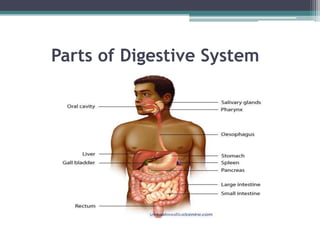
Parts of Digestive System
• Made up of:
- GI Tract and the accessory organs
• GI Tract:
Mouth-Pharynx-Esophagus-Stomach-Small Intestine-Large
Intestine
• Accessory Organs:
Teeth,Tongue,Salivary Glands,Exocrine part of the
Pancreas,Liver,Gall Bladder.
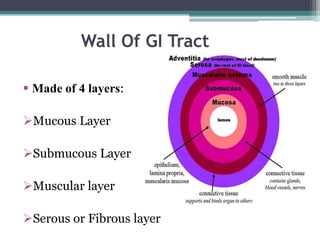
Wall Of GI Tract
 Made of 4 layers:
Mucous Layer
Submucous Layer
Muscular layer
Serous or Fibrous layer
Nerve Supply to the GI Tract
• Two types of nerve Supply
- Intrinsic Nerve supply
- Extrinsic nerve supply
1). Intrinsic nerve supply:
- Present within the wall of GI Tract
- Fibers are interconnected and form a network called nerve
plexus. Two types :Auerbach’s Plexus and Meissner’s Plexus
2) Extrinsic Nerve Supply. :
- It is from the Autonomic Nerve System
- Both sympathetic and the parasympathetic division of the ANS
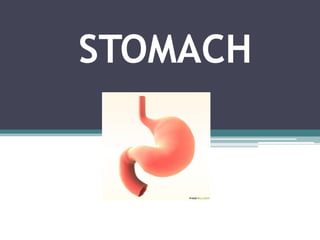
STOMACH
Introduction
• Stomach is a hollow organ situated just below the diaphragm
on the left side of the abdominal cavity.
• Specialized for accumulation of food
▫ Capable of considerable expansion (can hold 2-3L)
• Gastric juice converts food into semi solid material called
chyme

• 4 Parts of stomach:
▫ Cardia
▫ Fundus
▫ Body
▫ Pylorus
Stomach
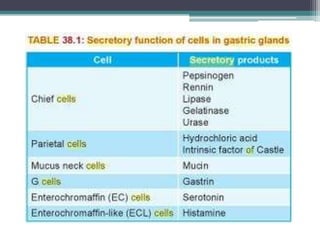
• Gastric glands are the glands of the stomach.
• Gastric mucosa has numerous openings called gastric pits
• Gastric glands empty into bottom of pits
• The gastric glands are of three types:
-Fundic gland
-pyloric gland
-cardiac gland.
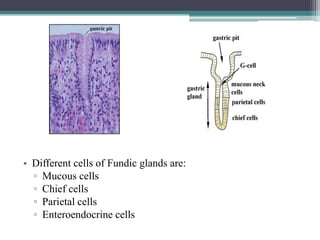
• Different cells of Fundic glands are:
▫ Mucous cells
▫ Chief cells
▫ Parietal cells
▫ Enteroendocrine cells
Functions of stomach
1).Mechanical Function:
-Storage Function: Food is stores in stomach for 3-4 hrs
-Formation of chyme: Peristalic movement of stomach mixes the
bolus with the gastric juice and forms a semislid material called
chyme.
2).Digestive Function:
-Gastric juice mainly acts on proteins.
-Proteolytic enzymes –pepsin and renin
• Pepsin:
-Major proteolytic enzyme .
-secreted as pepsinogen which is inactive
-Products: Proteoses,Peptones,Polypeptides.
• Gastric Lipase:
- Weak lipatic enzyme
- Hydrolyses fats into fatty acids and glycerols
• Others are:
-urase(acts on urea,produces ammonia)
-Rennin(curdles milk)
- Gelatinase-(converts gelatin to peptides)

-Gastric Amylase(Digestion of carbohydrates)
Functions
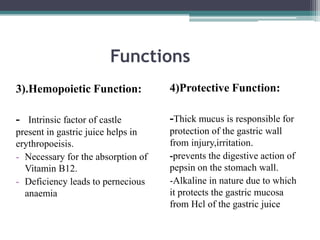
3).Hemopoietic Function:

4)Protective Function:

- Intrinsic factor of castle

-Thick mucus is responsible for

present in gastric juice helps in
erythropoeisis.
- Necessary for the absorption of
Vitamin B12.
- Deficiency leads to pernecious
anaemia

protection of the gastric wall
from injury,irritation.
-prevents the digestive action of
pepsin on the stomach wall.
-Alkaline in nature due to which
it protects the gastric mucosa
from Hcl of the gastric juice
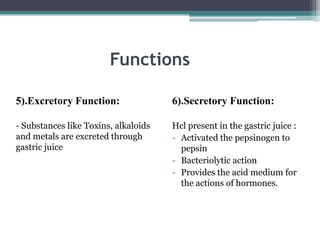
Functions
5).Excretory Function:

6).Secretory Function:

- Substances like Toxins, alkaloids
and metals are excreted through
gastric juice

Hcl present in the gastric juice :
- Activated the pepsinogen to
pepsin
- Bacteriolytic action
- Provides the acid medium for
the actions of hormones.
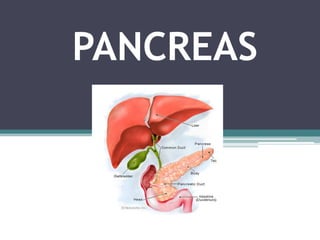
PANCREAS
Introduction
• Pancreas is a glandular organ in digestive system
• Pancreas is an organ having Dual functions:
- Endocrine function (Islets of Langerhans)-production of Hormones,
secretion of insulin and glucagon onto the blood.
- Exocrine function(Acinar cells)-secretion of digestive juice called as
pancreatic juice
- Most cells make up pancreatic acini, which produce pancreatic
juice
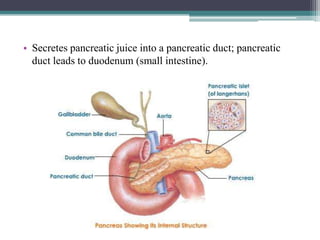
• Secretes pancreatic juice into a pancreatic duct; pancreatic
duct leads to duodenum (small intestine).
Functions of pancreas
1). Digestive Functions of pancreatic juice:
a. Digestion of Proteins :
- Proteolytic enzymes: trypsin, chymotrypsin, carboxypeptidase ,
nucleases , elastase , collagenase
proteins

peptides;

• stored and released as inactive form in zymogen granules
• trypsinogen is activated to trypsin by enterokinase
• trypsin then activates chymotrypsin and carboxypeptidase
b. Digestion of Carbohydrates:
• (Starch and Glycogen)
maltose and dextrin
With the help of pancreatic amylase .
c. Digestion of Fats/Triglycerides :
• Fats/Triglycerides
2 fatty acids + monoglyceride
With the help of pancreatic lipase,colipase,cholestrol ester
hydrolase, phospholipase A and B,Bile salt-lipase.
d. Digestion of Nucleic Acids:
• Nucleic acids
nucleotides.
With the help of nucleases
3).Endocrine Function:
Consists of Islets of langerhans.(alpha cells,Beta cells and delta
cells).
2). Neutralizing action of pancreatic Juice:
- Bicarbonate ions are also released to neutralize acidic chyme
entering from the stomach.
- This protects the intestine from destructive action of the acidic
chyme.
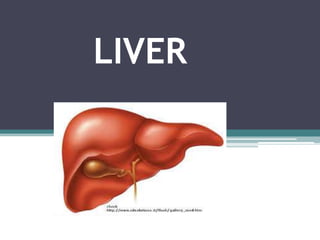
LIVER
Introduction
•
•
•
•

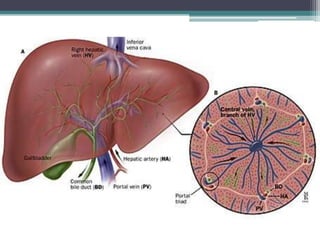
Largest internal organ.
Location: below diaphragm / right side
Contains hepatocytes
also contains Kupffer’s cells (macrophages)
remove and destroy:
-microbes;
-foreign matter.
-worn platelets and erythrocytes
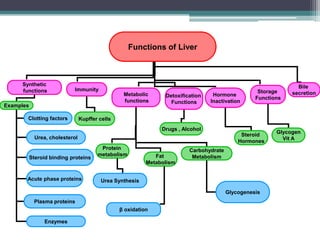
Functions Of Liver


Metabolism of monosaccharides, lipoproteins, amino
acids.

Storage (glycogen, Vitamin A, B12, D, iron),
 Filtering of blood (worn blood cells and debris),
 Destruction of toxic chemicals (alcohol and drugs),
 Production/secretion of bile.

Heat Production

Hemopoetic Function

Inactivation of Hormones and drugs(catabolism)

Hemolytic Function (kupffer’s cells)

Synthesis of glucose, few proteins
Functions of Liver

Synthetic
functions

Immunity

Metabolic
functions

Examples
Clotting factors

Detoxification
Functions

Hormone
Inactivation

Storage
Functions

Kupffer cells
Drugs , Alcohol
Steroid
Hormones

Urea, cholesterol

Steroid binding proteins

Acute phase proteins

Protein
metabolism

Fat
Metabolism

Carbohydrate
Metabolism

Urea Synthesis
Glycogenesis

Plasma proteins
β oxidation
Enzymes

Bile
secretion

Glycogen
Vit A
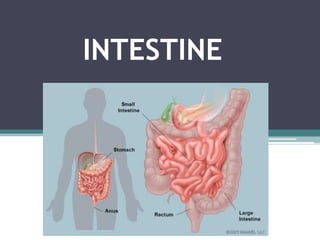
INTESTINE
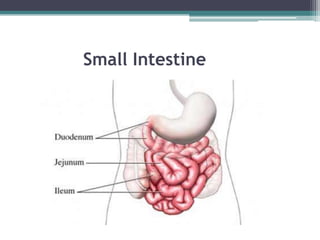
Small Intestine
• 3 Parts:

-Duodenum-nearest stomach
-Jejunum- mid-region
-Ileum- near large intestine
• Mucous membrane of SI is covered by minute projections
called as villi
• Primary site for digestion and absorption of nutrients
• Bile duct and pancreatic duct empty into duodenum
Functions of Small Intestine
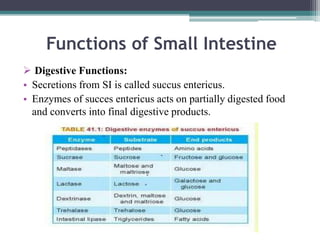
 Digestive Functions:
• Secretions from SI is called succus entericus.
• Enzymes of succes entericus acts on partially digested food
and converts into final digestive products.
Functions
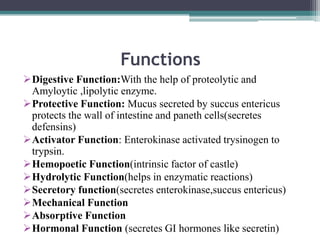
Digestive Function:With the help of proteolytic and
Amyloytic ,lipolytic enzyme.
Protective Function: Mucus secreted by succus entericus
protects the wall of intestine and paneth cells(secretes
defensins)
Activator Function: Enterokinase activated trysinogen to
trypsin.
Hemopoetic Function(intrinsic factor of castle)
Hydrolytic Function(helps in enzymatic reactions)
Secretory function(secretes enterokinase,succus entericus)
Mechanical Function
Absorptive Function
Hormonal Function (secretes GI hormones like secretin)
Large Intestine
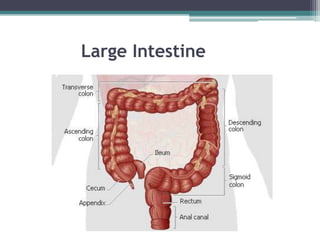
• Parts of Large Intestine:
o
cecum - nearest ileum of small intestine; (appendix is a
blind pouch in this region);
o
colon –
majority of length;(ascending,transverse,Descending,sigmoid)
o
rectum - distal region of colon;
o
anal canal - narrowing of rectum & opening to outside;
•
•
•
•

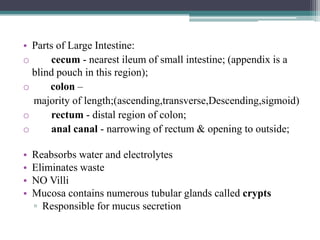
Reabsorbs water and electrolytes
Eliminates waste
NO Villi
Mucosa contains numerous tubular glands called crypts
▫ Responsible for mucus secretion
Functions of Large Intestine
Secretion - only mucin and other inorganic substances(cl)
Absorption of water , electrolytes.
Formation of Feces –unwanted substances form feces
Bacterial flora of LI - synthesises vit B12,folic acid,vit K.
Excretory Function-Excretes heavy metals like
bismuth,mercury,lead through faeces.
Function TestsEndoscopies
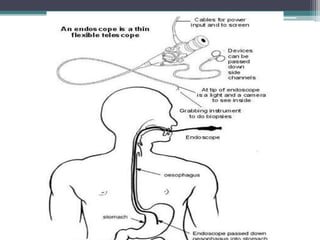
Endoscope
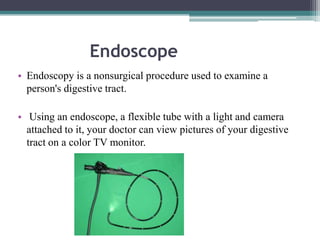
• Endoscopy is a nonsurgical procedure used to examine a
person's digestive tract.
• Using an endoscope, a flexible tube with a light and camera
attached to it, your doctor can view pictures of your digestive
tract on a color TV monitor.
• An endoscopy is often used to confirm a diagnosis when other
devices, such as an MRI , X-ray, or CT scan are considered
inappropriate.

•
•
•
•
•

- The following conditions and illnesses are most commonly
investigated or diagnosed with an endoscopy:
Breathing disorders
Chronic diarrhea
Incontinence
Internal bleeding
Irritable bowel syndrome
Thank you

Functions of Gastrointestinal system

  • 1.
  • 2.
    Introduction • GI Systemis the route through which the food enters the body. • Normal young healthy adult consumes 1 kg of solid diet and 1-2 L of liquid diet every day. • The food consumed cannot be utilized by the body directly. • The process of conversion of complex food substances into simple food substances that can be absorbed by the body is known as Digestion.
  • 3.
  • 4.
    • Made upof: - GI Tract and the accessory organs • GI Tract: Mouth-Pharynx-Esophagus-Stomach-Small Intestine-Large Intestine • Accessory Organs: Teeth,Tongue,Salivary Glands,Exocrine part of the Pancreas,Liver,Gall Bladder.
  • 5.
    Wall Of GITract  Made of 4 layers: Mucous Layer Submucous Layer Muscular layer Serous or Fibrous layer
  • 6.
    Nerve Supply tothe GI Tract • Two types of nerve Supply - Intrinsic Nerve supply - Extrinsic nerve supply 1). Intrinsic nerve supply: - Present within the wall of GI Tract - Fibers are interconnected and form a network called nerve plexus. Two types :Auerbach’s Plexus and Meissner’s Plexus 2) Extrinsic Nerve Supply. : - It is from the Autonomic Nerve System - Both sympathetic and the parasympathetic division of the ANS
  • 7.
  • 8.
    Introduction • Stomach isa hollow organ situated just below the diaphragm on the left side of the abdominal cavity.
  • 9.
    • Specialized foraccumulation of food ▫ Capable of considerable expansion (can hold 2-3L) • Gastric juice converts food into semi solid material called chyme • 4 Parts of stomach: ▫ Cardia ▫ Fundus ▫ Body ▫ Pylorus
  • 10.
    Stomach • Gastric glandsare the glands of the stomach. • Gastric mucosa has numerous openings called gastric pits • Gastric glands empty into bottom of pits • The gastric glands are of three types: -Fundic gland -pyloric gland -cardiac gland.
  • 11.
    • Different cellsof Fundic glands are: ▫ Mucous cells ▫ Chief cells ▫ Parietal cells ▫ Enteroendocrine cells
  • 12.
    Functions of stomach 1).MechanicalFunction: -Storage Function: Food is stores in stomach for 3-4 hrs -Formation of chyme: Peristalic movement of stomach mixes the bolus with the gastric juice and forms a semislid material called chyme. 2).Digestive Function: -Gastric juice mainly acts on proteins. -Proteolytic enzymes –pepsin and renin
  • 13.
    • Pepsin: -Major proteolyticenzyme . -secreted as pepsinogen which is inactive -Products: Proteoses,Peptones,Polypeptides. • Gastric Lipase: - Weak lipatic enzyme - Hydrolyses fats into fatty acids and glycerols • Others are: -urase(acts on urea,produces ammonia) -Rennin(curdles milk) - Gelatinase-(converts gelatin to peptides) -Gastric Amylase(Digestion of carbohydrates)
  • 15.
    Functions 3).Hemopoietic Function: 4)Protective Function: -Intrinsic factor of castle -Thick mucus is responsible for present in gastric juice helps in erythropoeisis. - Necessary for the absorption of Vitamin B12. - Deficiency leads to pernecious anaemia protection of the gastric wall from injury,irritation. -prevents the digestive action of pepsin on the stomach wall. -Alkaline in nature due to which it protects the gastric mucosa from Hcl of the gastric juice
  • 16.
    Functions 5).Excretory Function: 6).Secretory Function: -Substances like Toxins, alkaloids and metals are excreted through gastric juice Hcl present in the gastric juice : - Activated the pepsinogen to pepsin - Bacteriolytic action - Provides the acid medium for the actions of hormones.
  • 17.
  • 18.
    Introduction • Pancreas isa glandular organ in digestive system • Pancreas is an organ having Dual functions: - Endocrine function (Islets of Langerhans)-production of Hormones, secretion of insulin and glucagon onto the blood. - Exocrine function(Acinar cells)-secretion of digestive juice called as pancreatic juice - Most cells make up pancreatic acini, which produce pancreatic juice
  • 19.
    • Secretes pancreaticjuice into a pancreatic duct; pancreatic duct leads to duodenum (small intestine).
  • 20.
    Functions of pancreas 1).Digestive Functions of pancreatic juice: a. Digestion of Proteins : - Proteolytic enzymes: trypsin, chymotrypsin, carboxypeptidase , nucleases , elastase , collagenase proteins peptides; • stored and released as inactive form in zymogen granules • trypsinogen is activated to trypsin by enterokinase • trypsin then activates chymotrypsin and carboxypeptidase
  • 21.
    b. Digestion ofCarbohydrates: • (Starch and Glycogen) maltose and dextrin With the help of pancreatic amylase . c. Digestion of Fats/Triglycerides : • Fats/Triglycerides 2 fatty acids + monoglyceride With the help of pancreatic lipase,colipase,cholestrol ester hydrolase, phospholipase A and B,Bile salt-lipase. d. Digestion of Nucleic Acids: • Nucleic acids nucleotides. With the help of nucleases
  • 22.
    3).Endocrine Function: Consists ofIslets of langerhans.(alpha cells,Beta cells and delta cells). 2). Neutralizing action of pancreatic Juice: - Bicarbonate ions are also released to neutralize acidic chyme entering from the stomach. - This protects the intestine from destructive action of the acidic chyme.
  • 23.
  • 24.
    Introduction • • • • Largest internal organ. Location:below diaphragm / right side Contains hepatocytes also contains Kupffer’s cells (macrophages) remove and destroy: -microbes; -foreign matter. -worn platelets and erythrocytes
  • 26.
    Functions Of Liver  Metabolismof monosaccharides, lipoproteins, amino acids.  Storage (glycogen, Vitamin A, B12, D, iron),  Filtering of blood (worn blood cells and debris),  Destruction of toxic chemicals (alcohol and drugs),  Production/secretion of bile.  Heat Production  Hemopoetic Function  Inactivation of Hormones and drugs(catabolism)  Hemolytic Function (kupffer’s cells)  Synthesis of glucose, few proteins
  • 27.
    Functions of Liver Synthetic functions Immunity Metabolic functions Examples Clottingfactors Detoxification Functions Hormone Inactivation Storage Functions Kupffer cells Drugs , Alcohol Steroid Hormones Urea, cholesterol Steroid binding proteins Acute phase proteins Protein metabolism Fat Metabolism Carbohydrate Metabolism Urea Synthesis Glycogenesis Plasma proteins β oxidation Enzymes Bile secretion Glycogen Vit A
  • 28.
  • 29.
  • 30.
    • 3 Parts: -Duodenum-neareststomach -Jejunum- mid-region -Ileum- near large intestine • Mucous membrane of SI is covered by minute projections called as villi • Primary site for digestion and absorption of nutrients • Bile duct and pancreatic duct empty into duodenum
  • 31.
    Functions of SmallIntestine  Digestive Functions: • Secretions from SI is called succus entericus. • Enzymes of succes entericus acts on partially digested food and converts into final digestive products.
  • 32.
    Functions Digestive Function:With thehelp of proteolytic and Amyloytic ,lipolytic enzyme. Protective Function: Mucus secreted by succus entericus protects the wall of intestine and paneth cells(secretes defensins) Activator Function: Enterokinase activated trysinogen to trypsin. Hemopoetic Function(intrinsic factor of castle) Hydrolytic Function(helps in enzymatic reactions) Secretory function(secretes enterokinase,succus entericus) Mechanical Function Absorptive Function Hormonal Function (secretes GI hormones like secretin)
  • 33.
  • 34.
    • Parts ofLarge Intestine: o cecum - nearest ileum of small intestine; (appendix is a blind pouch in this region); o colon – majority of length;(ascending,transverse,Descending,sigmoid) o rectum - distal region of colon; o anal canal - narrowing of rectum & opening to outside; • • • • Reabsorbs water and electrolytes Eliminates waste NO Villi Mucosa contains numerous tubular glands called crypts ▫ Responsible for mucus secretion
  • 35.
    Functions of LargeIntestine Secretion - only mucin and other inorganic substances(cl) Absorption of water , electrolytes. Formation of Feces –unwanted substances form feces Bacterial flora of LI - synthesises vit B12,folic acid,vit K. Excretory Function-Excretes heavy metals like bismuth,mercury,lead through faeces.
  • 36.
  • 37.
    Endoscope • Endoscopy isa nonsurgical procedure used to examine a person's digestive tract. • Using an endoscope, a flexible tube with a light and camera attached to it, your doctor can view pictures of your digestive tract on a color TV monitor.
  • 39.
    • An endoscopyis often used to confirm a diagnosis when other devices, such as an MRI , X-ray, or CT scan are considered inappropriate. • • • • • - The following conditions and illnesses are most commonly investigated or diagnosed with an endoscopy: Breathing disorders Chronic diarrhea Incontinence Internal bleeding Irritable bowel syndrome
  • 40.