Coxsackievirus
LEARNING OBJECTIVES
1. Enumerate the viruses causing aseptic
meningitis
2. Describe the important characteristics &
virulence factor of Coxackie and echoviruses and
their clinical significance
3. Enumerate the diseases caused by
coxackie viruses & echoviruses
4. Describe the pathogenicity and lab
diagnosis of coxackie viruses & echoviruses
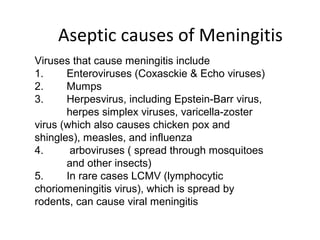
Aseptic causes of Meningitis
Viruses that cause meningitis include
1. Enteroviruses (Coxasckie & Echo viruses)
2. Mumps
3. Herpesvirus, including Epstein-Barr virus,
herpes simplex viruses, varicella-zoster
virus (which also causes chicken pox and
shingles), measles, and influenza
4. arboviruses ( spread through mosquitoes
and other insects)
5. In rare cases LCMV (lymphocytic
choriomeningitis virus), which is spread by
rodents, can cause viral meningitis
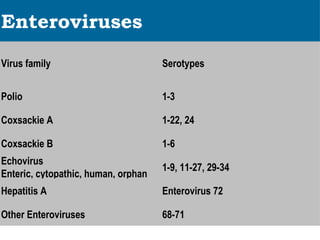
Enteroviruses
Virus family Serotypes
Polio 1-3
Coxsackie A 1-22, 24
Coxsackie B 1-6
Echovirus
Enteric, cytopathic, human, orphan
1-9, 11-27, 29-34
Hepatitis A Enterovirus 72
Other Enteroviruses  68-71
 
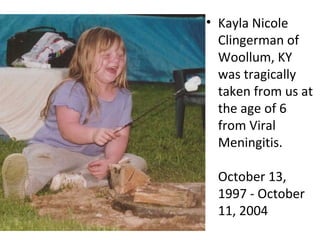
• Kayla Nicole
Clingerman of
Woollum, KY
was tragically
taken from us at
the age of 6
from Viral
Meningitis.
October 13,
1997 - October
11, 2004
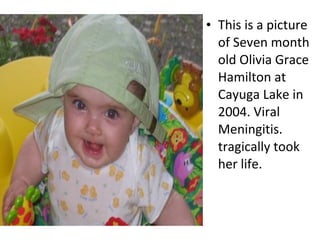
• This is a picture
of Seven month
old Olivia Grace
Hamilton at
Cayuga Lake in
2004. Viral
Meningitis.
tragically took
her life.
Introduction
• Late summer or early fall…It’s not yet cold or flu
season, but your child is sick. Consider coxsackie
virus.
• It’s often the culprit when parents leave a
doctor’s appointment without knowing what
disease their child has.
Definition
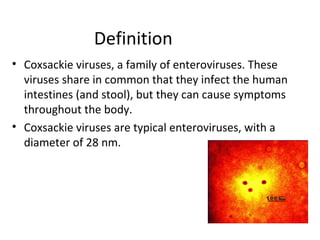
• Coxsackie viruses, a family of enteroviruses. These
viruses share in common that they infect the human
intestines (and stool), but they can cause symptoms
throughout the body.
• Coxsackie viruses are typical enteroviruses, with a
diameter of 28 nm.
Common biological properties
• 24-30nm
• spherical
• naked, icosahedral
• +ssRNA
• multiply in the cytoplasm
• Resistance
– resistant -- ether, acid (tolerate pH3-5)
– sensitive -- drying, heat and UV
– survive for a long period in water and sewage
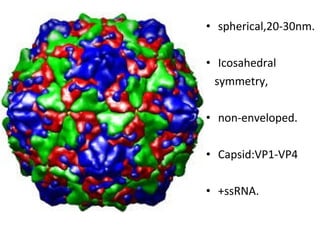
• spherical,20-30nm.
• Icosahedral
symmetry,
• non-enveloped.
• Capsid:VP1-VP4
• +ssRNA.
Features of coxsackievirus infection
in man
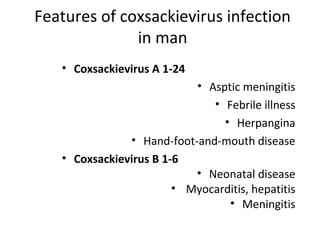
• Coxsackievirus A 1-24
• Asptic meningitis
• Febrile illness
• Herpangina
• Hand-foot-and-mouth disease
• Coxsackievirus B 1-6
• Neonatal disease
• Myocarditis, hepatitis
• Meningitis
COXSACKIE VIRUSES
They produce a variety of ill­nesses in human beings,
including aseptic meningitis, herpangina, pleurodynia,
hand, foot, and mouth disease, myo­ and pericarditis,
common colds, and possibly diabetes.
Coxsackie viruses have been divided into 2 groups,
A and B, having different pathogenic potentials for
mice. Coxsackie B viruses are the most commonly
identified causative agents of viral heart disease in
humans.
Group A viruses produce widespread myositis
in the skeletal muscles of newborn mice,
resulting in flaccid paralysis without other
observable lesions.
Group B viruses may produce focal myositis,
encephalitis, and, most typically, necrotizing
steatitis involving mainly fetal fat lobules.
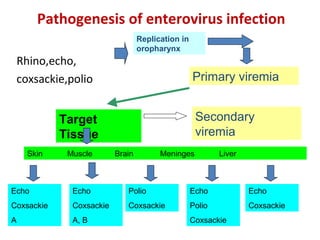
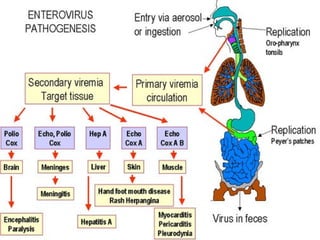
Pathogenesis of enterovirus infection
Rhino,echo,
coxsackie,polio
Replication in
oropharynx
Primary viremia
Target
Tissue
Secondary
viremia
Skin Muscle Brain Meninges Liver
Echo
Coxsackie
A
Echo
Coxsackie
A, B
Polio
Coxsackie
Echo
Polio
Coxsackie
Echo
Coxsackie
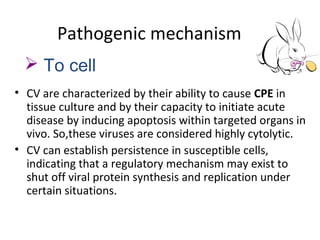
Pathogenic mechanism
• CV are characterized by their ability to cause CPE in
tissue culture and by their capacity to initiate acute
disease by inducing apoptosis within targeted organs in
vivo. So,these viruses are considered highly cytolytic.
• CV can establish persistence in susceptible cells,
indicating that a regulatory mechanism may exist to
shut off viral protein synthesis and replication under
certain situations.
 To cell
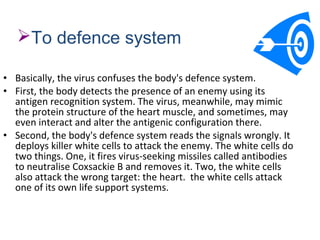
• Basically, the virus confuses the body's defence system.
• First, the body detects the presence of an enemy using its
antigen recognition system. The virus, meanwhile, may mimic
the protein structure of the heart muscle, and sometimes, may
even interact and alter the antigenic configuration there.
• Second, the body's defence system reads the signals wrongly. It
deploys killer white cells to attack the enemy. The white cells do
two things. One, it fires virus-seeking missiles called antibodies
to neutralise Coxsackie B and removes it. Two, the white cells
also attack the wrong target: the heart. the white cells attack
one of its own life support systems.
To defence system
Immunity
• Serum IgA is very important to resist
absorption and replication of virus in
alimentery tract.
• Neutralizing Ab in serum can prevent the
diffusion of virus,which can last for several
years,even all the life.
• .
Incubation
• The incubation period (the time between
infection and the onset of symptoms) for most
coxackie virus infections is about 2 to 10 days
Transmission
• Coxsackieviruses are present both in the stool
and in the respiratory secretions
Fecal-oral transmission
Droplet transmission
Contact transmission
symptoms
• Hand-foot-and-mouth disease
mainly affecting young children
• Rash.
• Nonspecific fever, headache
• Herpangina.
• Respiratory Infection.
• Gastrointestinal Infection.
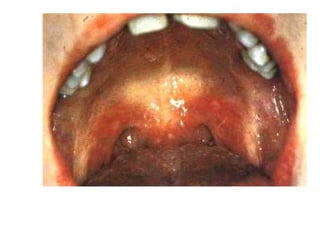
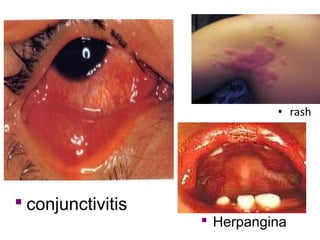
Herpangina:
There is an abrupt onset of fever, sore throat,
anorexia, dysphagia, vomiting, or abdominal
pain. The pharynx is usually hyperaemic, and
characteristic discrete vesicles occur on the
anterior pillars of the fauces, the palate,
uvula, tonsils, or tongue. The illness is self-
limited and most frequent in small children.
Summer Minor Illnesses:
It occur during the summer or fall and are
without distinctive features.
Pleurodynia (Epidemic Myalgia, Bornholm
Disease): by group B viruses--- Fever,
malaise, head-ache, and anorexia. chest pain
(substernal), is intensified by movement,
Abdominal pain occurs in approximately half
of cases, and in children this may be the chief
complaint.
Aseptic Meningitis and Mild Paresis:
Fever, malaise, headache, nausea, and
abdominal pain are common early symptoms.
Signs of meningeal irritation, stiff neck or
back, and vomiting may appear 1-2 days
later.
Neonatal Disease: Neonatal disease may be
caused by group B coxsackieviruses. with
lethargy, feeding difficulty, and vomiting, with
or without fever.
Colds: A number of the enteroviruses have
been associated with common colds; among
these are coxsackieviruses A10, A21, A24,
and B3.
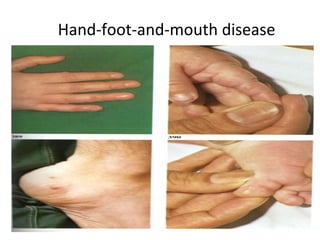
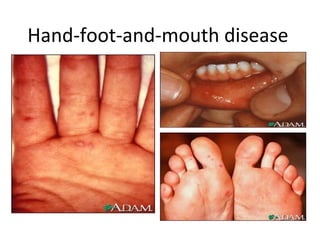
Hand, Foot, and Mouth Disease:
The syndrome is characterized by oral and
pharyngeal ulcerations and a vesicular rash
of the palms and soles that may spread to
the arms and legs
Hand-foot-and-mouth disease
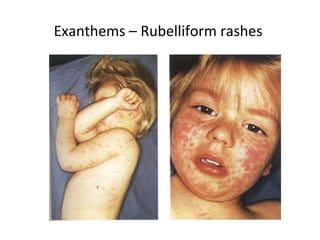
Exanthems – Rubelliform rashes
Hand-foot-and-mouth disease
• rash
 conjunctivitis
 Herpangina
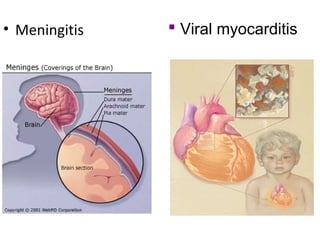
• Meningitis  Viral myocarditis
Duration
• The duration usually varies, depending on the
specific type.
• Coxsackie fever often asymptoms, a child's
temperature may return to normal within 24 hours,
although the average fever lasts 3 to 4 days. In
pleurodynia, fever and muscle pain usually last 1 to 2
days, and in herpangina, symptoms generally last 3
to 6 days.
Myocardiopathy: Coxsackie virus B infections
are increasingly recognized as a cause of
primary myocardial disease in adults as well as
children.
Acute Hemorrhagic Conjunctivitis:
Coxsackievirus A24 is one of the agents that
can cause this disease (see below).
Diabetes Mellitus: Serologic studies suggest
an association of diabetes of abrupt onset with
past infection by Coxsackievirus B4 and
perhaps other members of the B group.
Diagnose
• Diagnosis is made based on the history and physical
exam
• Lab tests are available
test stool or fluids from the back of the throat
• Serum test for specific Ab
• PCR for viral nucleic acid
Treatment
• Antibiotics do not help with coxsackievirus
infections
• Plenty of fluids is useful
• Acetaminophen (such as Tylenol) may be
given to relieve any minor aches and pains
• Most children with a simple coxsackie
infection recover completely after a few days
at home.
ECHOVIRUSES
The echoviruses (enteric cytopathogenic human
orphan viruses) are grouped together because they
infect the human enteric tract and because they can
be recovered from humans only by inoculation of
certain tissue cultures.
Over 30 serotypes are known, but not all cause
human illness. Aseptic meningitis, febrile illnesses
with or without rash, common colds, and acute
hemorrhagic conjunctivitis are among the diseases
caused by echoviruses.
Important Characteristics
• Echoviruses are typical enteroviruses
measuring 24-30 nm.
• Not produce diseases in sucking mice, rabbits,
or monkeys;
• Cause aseptic meningitis, infantile diarrhea,
• Monkey kidney and human embryonated
kidney cell culture
Coxsackie Virus
Coxsackie Virus

Coxsackie Virus

  • 1.
  • 2.
    LEARNING OBJECTIVES 1. Enumeratethe viruses causing aseptic meningitis 2. Describe the important characteristics & virulence factor of Coxackie and echoviruses and their clinical significance 3. Enumerate the diseases caused by coxackie viruses & echoviruses 4. Describe the pathogenicity and lab diagnosis of coxackie viruses & echoviruses
  • 3.
    Aseptic causes ofMeningitis Viruses that cause meningitis include 1. Enteroviruses (Coxasckie & Echo viruses) 2. Mumps 3. Herpesvirus, including Epstein-Barr virus, herpes simplex viruses, varicella-zoster virus (which also causes chicken pox and shingles), measles, and influenza 4. arboviruses ( spread through mosquitoes and other insects) 5. In rare cases LCMV (lymphocytic choriomeningitis virus), which is spread by rodents, can cause viral meningitis
  • 4.
    Enteroviruses Virus family Serotypes Polio1-3 Coxsackie A 1-22, 24 Coxsackie B 1-6 Echovirus Enteric, cytopathic, human, orphan 1-9, 11-27, 29-34 Hepatitis A Enterovirus 72 Other Enteroviruses  68-71  
  • 5.
    • Kayla Nicole Clingermanof Woollum, KY was tragically taken from us at the age of 6 from Viral Meningitis. October 13, 1997 - October 11, 2004
  • 6.
    • This isa picture of Seven month old Olivia Grace Hamilton at Cayuga Lake in 2004. Viral Meningitis. tragically took her life.
  • 7.
    Introduction • Late summeror early fall…It’s not yet cold or flu season, but your child is sick. Consider coxsackie virus. • It’s often the culprit when parents leave a doctor’s appointment without knowing what disease their child has.
  • 8.
    Definition • Coxsackie viruses,a family of enteroviruses. These viruses share in common that they infect the human intestines (and stool), but they can cause symptoms throughout the body. • Coxsackie viruses are typical enteroviruses, with a diameter of 28 nm.
  • 9.
    Common biological properties •24-30nm • spherical • naked, icosahedral • +ssRNA • multiply in the cytoplasm • Resistance – resistant -- ether, acid (tolerate pH3-5) – sensitive -- drying, heat and UV – survive for a long period in water and sewage
  • 10.
    • spherical,20-30nm. • Icosahedral symmetry, •non-enveloped. • Capsid:VP1-VP4 • +ssRNA.
  • 11.
    Features of coxsackievirusinfection in man • Coxsackievirus A 1-24 • Asptic meningitis • Febrile illness • Herpangina • Hand-foot-and-mouth disease • Coxsackievirus B 1-6 • Neonatal disease • Myocarditis, hepatitis • Meningitis
  • 12.
    COXSACKIE VIRUSES They producea variety of ill­nesses in human beings, including aseptic meningitis, herpangina, pleurodynia, hand, foot, and mouth disease, myo­ and pericarditis, common colds, and possibly diabetes. Coxsackie viruses have been divided into 2 groups, A and B, having different pathogenic potentials for mice. Coxsackie B viruses are the most commonly identified causative agents of viral heart disease in humans.
  • 13.
    Group A virusesproduce widespread myositis in the skeletal muscles of newborn mice, resulting in flaccid paralysis without other observable lesions. Group B viruses may produce focal myositis, encephalitis, and, most typically, necrotizing steatitis involving mainly fetal fat lobules.
  • 14.
    Pathogenesis of enterovirusinfection Rhino,echo, coxsackie,polio Replication in oropharynx Primary viremia Target Tissue Secondary viremia Skin Muscle Brain Meninges Liver Echo Coxsackie A Echo Coxsackie A, B Polio Coxsackie Echo Polio Coxsackie Echo Coxsackie
  • 16.
    Pathogenic mechanism • CVare characterized by their ability to cause CPE in tissue culture and by their capacity to initiate acute disease by inducing apoptosis within targeted organs in vivo. So,these viruses are considered highly cytolytic. • CV can establish persistence in susceptible cells, indicating that a regulatory mechanism may exist to shut off viral protein synthesis and replication under certain situations.  To cell
  • 17.
    • Basically, thevirus confuses the body's defence system. • First, the body detects the presence of an enemy using its antigen recognition system. The virus, meanwhile, may mimic the protein structure of the heart muscle, and sometimes, may even interact and alter the antigenic configuration there. • Second, the body's defence system reads the signals wrongly. It deploys killer white cells to attack the enemy. The white cells do two things. One, it fires virus-seeking missiles called antibodies to neutralise Coxsackie B and removes it. Two, the white cells also attack the wrong target: the heart. the white cells attack one of its own life support systems. To defence system
  • 18.
    Immunity • Serum IgAis very important to resist absorption and replication of virus in alimentery tract. • Neutralizing Ab in serum can prevent the diffusion of virus,which can last for several years,even all the life. • .
  • 19.
    Incubation • The incubationperiod (the time between infection and the onset of symptoms) for most coxackie virus infections is about 2 to 10 days
  • 20.
    Transmission • Coxsackieviruses arepresent both in the stool and in the respiratory secretions Fecal-oral transmission Droplet transmission Contact transmission
  • 21.
    symptoms • Hand-foot-and-mouth disease mainlyaffecting young children • Rash. • Nonspecific fever, headache • Herpangina. • Respiratory Infection. • Gastrointestinal Infection.
  • 22.
    Herpangina: There is anabrupt onset of fever, sore throat, anorexia, dysphagia, vomiting, or abdominal pain. The pharynx is usually hyperaemic, and characteristic discrete vesicles occur on the anterior pillars of the fauces, the palate, uvula, tonsils, or tongue. The illness is self- limited and most frequent in small children. Summer Minor Illnesses: It occur during the summer or fall and are without distinctive features.
  • 23.
    Pleurodynia (Epidemic Myalgia,Bornholm Disease): by group B viruses--- Fever, malaise, head-ache, and anorexia. chest pain (substernal), is intensified by movement, Abdominal pain occurs in approximately half of cases, and in children this may be the chief complaint.
  • 24.
    Aseptic Meningitis andMild Paresis: Fever, malaise, headache, nausea, and abdominal pain are common early symptoms. Signs of meningeal irritation, stiff neck or back, and vomiting may appear 1-2 days later. Neonatal Disease: Neonatal disease may be caused by group B coxsackieviruses. with lethargy, feeding difficulty, and vomiting, with or without fever.
  • 25.
    Colds: A numberof the enteroviruses have been associated with common colds; among these are coxsackieviruses A10, A21, A24, and B3. Hand, Foot, and Mouth Disease: The syndrome is characterized by oral and pharyngeal ulcerations and a vesicular rash of the palms and soles that may spread to the arms and legs
  • 26.
  • 28.
  • 29.
  • 30.
  • 31.
    • Meningitis Viral myocarditis
  • 32.
    Duration • The durationusually varies, depending on the specific type. • Coxsackie fever often asymptoms, a child's temperature may return to normal within 24 hours, although the average fever lasts 3 to 4 days. In pleurodynia, fever and muscle pain usually last 1 to 2 days, and in herpangina, symptoms generally last 3 to 6 days.
  • 33.
    Myocardiopathy: Coxsackie virusB infections are increasingly recognized as a cause of primary myocardial disease in adults as well as children. Acute Hemorrhagic Conjunctivitis: Coxsackievirus A24 is one of the agents that can cause this disease (see below). Diabetes Mellitus: Serologic studies suggest an association of diabetes of abrupt onset with past infection by Coxsackievirus B4 and perhaps other members of the B group.
  • 34.
    Diagnose • Diagnosis ismade based on the history and physical exam • Lab tests are available test stool or fluids from the back of the throat • Serum test for specific Ab • PCR for viral nucleic acid
  • 35.
    Treatment • Antibiotics donot help with coxsackievirus infections • Plenty of fluids is useful • Acetaminophen (such as Tylenol) may be given to relieve any minor aches and pains • Most children with a simple coxsackie infection recover completely after a few days at home.
  • 36.
    ECHOVIRUSES The echoviruses (entericcytopathogenic human orphan viruses) are grouped together because they infect the human enteric tract and because they can be recovered from humans only by inoculation of certain tissue cultures. Over 30 serotypes are known, but not all cause human illness. Aseptic meningitis, febrile illnesses with or without rash, common colds, and acute hemorrhagic conjunctivitis are among the diseases caused by echoviruses.
  • 37.
    Important Characteristics • Echovirusesare typical enteroviruses measuring 24-30 nm. • Not produce diseases in sucking mice, rabbits, or monkeys; • Cause aseptic meningitis, infantile diarrhea, • Monkey kidney and human embryonated kidney cell culture

Editor's Notes

  • #28 Герпангіна, Коксаки-А
  • #39 ЕСНО9, висипка