Data Mining
Spring 2007
• Frequent-Pattern Tree Approach
Towards ARM
Lecture 11-12
2
In this lecture
The lecture is based on
• Jiawei Han, Jian Pei, Yiwen Yin And Runying Mao Data,
“Mining Frequent Patterns without Candidate
Generation: A Frequent-Pattern Tree Approach”,
Mining and Knowledge Discovery, Kluwer Academic
Publishers, 2004
• Jiawei Han, Jian Pei, Yiwen Yin, “Mining Frequent
Patterns without Candidate Generation”, In Proc. 2000
ACM SIGMOD Int. Conf. Management of Data (SIGMOD’00), Dallas,
TX, pp. 1–12.
Some slides are adapted from official text book slides of
• Jiawei Han and Micheline Kamber, “Data Mining: Concepts and
Techniques”, Morgan Kaufmann Publishers, August 2000
3
Is Apriori Fast Enough? — Performance
Bottlenecks
• The core of the Apriori algorithm:
– Use frequent (k – 1)-itemsets to generate candidate frequent k-
itemsets
– Use database scan and pattern matching to collect counts for the
candidate itemsets
• The bottleneck of Apriori: candidate generation
– Huge candidate sets:
• 104
frequent 1-itemset will generate 107
candidate 2-itemsets
• To discover a frequent pattern of size 100, e.g., {a1, a2, …, a100},
one needs to generate 2100
≈ 1030
candidates.
– Multiple scans of database:
• Needs (n +1 ) scans, n is the length of the longest pattern
4
Mining Frequent Patterns Without
Candidate Generation
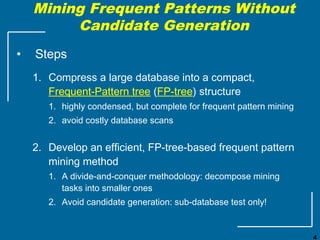
• Steps
1. Compress a large database into a compact,
Frequent-Pattern tree (FP-tree) structure
1. highly condensed, but complete for frequent pattern mining
2. avoid costly database scans
2. Develop an efficient, FP-tree-based frequent pattern
mining method
1. A divide-and-conquer methodology: decompose mining
tasks into smaller ones
2. Avoid candidate generation: sub-database test only!
5
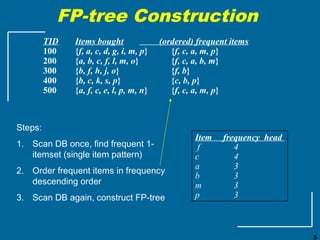
FP-tree Construction
Item frequency head
f 4
c 4
a 3
b 3
m 3
p 3
TID Items bought (ordered) frequent items
100 {f, a, c, d, g, i, m, p} {f, c, a, m, p}
200 {a, b, c, f, l, m, o} {f, c, a, b, m}
300 {b, f, h, j, o} {f, b}
400 {b, c, k, s, p} {c, b, p}
500 {a, f, c, e, l, p, m, n} {f, c, a, m, p}
Steps:
1. Scan DB once, find frequent 1-
itemset (single item pattern)
2. Order frequent items in frequency
descending order
3. Scan DB again, construct FP-tree
6
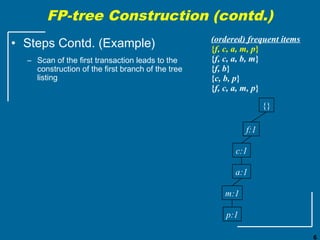
• Steps Contd. (Example)
– Scan of the first transaction leads to the
construction of the first branch of the tree
listing
{}
f:1
c:1
a:1
m:1
p:1
FP-tree Construction (contd.)
(ordered) frequent items
{f, c, a, m, p}
{f, c, a, b, m}
{f, b}
{c, b, p}
{f, c, a, m, p}
7
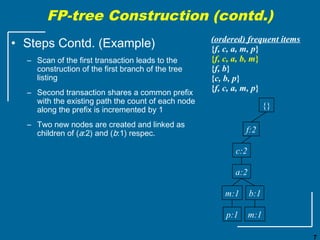
{}
f:2
c:2
a:2
b:1m:1
p:1 m:1
FP-tree Construction (contd.)
(ordered) frequent items
{f, c, a, m, p}
{f, c, a, b, m}
{f, b}
{c, b, p}
{f, c, a, m, p}
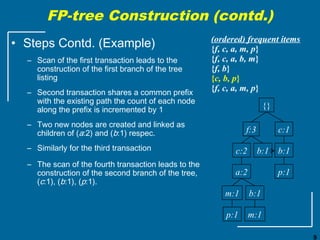
• Steps Contd. (Example)
– Scan of the first transaction leads to the
construction of the first branch of the tree
listing
– Second transaction shares a common prefix
with the existing path the count of each node
along the prefix is incremented by 1
– Two new nodes are created and linked as
children of (a:2) and (b:1) respec.
8
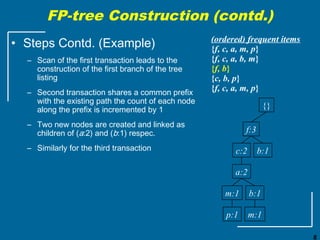
• Steps Contd. (Example)
– Scan of the first transaction leads to the
construction of the first branch of the tree
listing
– Second transaction shares a common prefix
with the existing path the count of each node
along the prefix is incremented by 1
– Two new nodes are created and linked as
children of (a:2) and (b:1) respec.
– Similarly for the third transaction
{}
f:3
b:1c:2
a:2
b:1m:1
p:1 m:1
FP-tree Construction (contd.)
(ordered) frequent items
{f, c, a, m, p}
{f, c, a, b, m}
{f, b}
{c, b, p}
{f, c, a, m, p}
9
• Steps Contd. (Example)
– Scan of the first transaction leads to the
construction of the first branch of the tree
listing
– Second transaction shares a common prefix
with the existing path the count of each node
along the prefix is incremented by 1
– Two new nodes are created and linked as
children of (a:2) and (b:1) respec.
– Similarly for the third transaction
– The scan of the fourth transaction leads to the
construction of the second branch of the tree,
(c:1), (b:1), (p:1).
{}
f:3 c:1
b:1
p:1
b:1c:2
a:2
b:1m:1
p:1 m:1
FP-tree Construction (contd.)
(ordered) frequent items
{f, c, a, m, p}
{f, c, a, b, m}
{f, b}
{c, b, p}
{f, c, a, m, p}
10
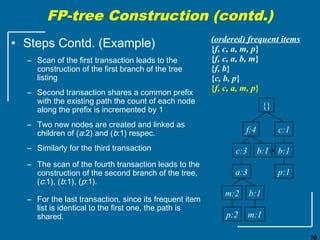
• Steps Contd. (Example)
– Scan of the first transaction leads to the
construction of the first branch of the tree
listing
– Second transaction shares a common prefix
with the existing path the count of each node
along the prefix is incremented by 1
– Two new nodes are created and linked as
children of (a:2) and (b:1) respec.
– Similarly for the third transaction
– The scan of the fourth transaction leads to the
construction of the second branch of the tree,
(c:1), (b:1), (p:1).
– For the last transaction, since its frequent item
list is identical to the first one, the path is
shared.
{}
f:4 c:1
b:1
p:1
b:1c:3
a:3
b:1m:2
p:2 m:1
FP-tree Construction (contd.)
(ordered) frequent items
{f, c, a, m, p}
{f, c, a, b, m}
{f, b}
{c, b, p}
{f, c, a, m, p}
11
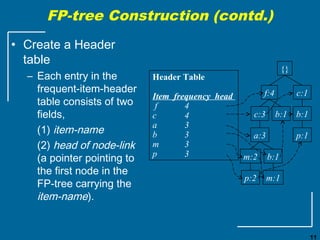
• Create a Header
table
– Each entry in the
frequent-item-header
table consists of two
fields,
(1) item-name
(2) head of node-link
(a pointer pointing to
the first node in the
FP-tree carrying the
item-name).
FP-tree Construction (contd.)
{}
f:4 c:1
b:1
p:1
b:1c:3
a:3
b:1m:2
p:2 m:1
Header Table
Item frequency head
f 4
c 4
a 3
b 3
m 3
p 3
12
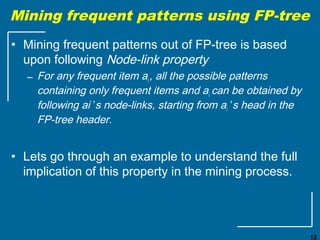
Mining frequent patterns using FP-tree
• Mining frequent patterns out of FP-tree is based
upon following Node-link property
– For any frequent item ai , all the possible patterns
containing only frequent items and ai can be obtained by
following ai ’s node-links, starting from ai ’s head in the
FP-tree header.
• Lets go through an example to understand the full
implication of this property in the mining process.
13
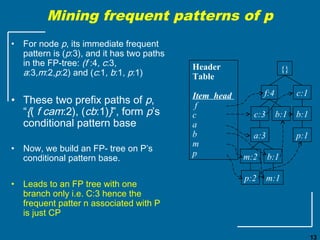
• For node p, its immediate frequent
pattern is (p:3), and it has two paths
in the FP-tree: (f :4, c:3,
a:3,m:2,p:2) and (c:1, b:1, p:1)
• These two prefix paths of p,
“{( f cam:2), (cb:1)}”, form p’s
conditional pattern base
• Now, we build an FP- tree on P’s
conditional pattern base.
• Leads to an FP tree with one
branch only i.e. C:3 hence the
frequent patter n associated with P
is just CP
{}
f:4 c:1
b:1
p:1
b:1c:3
a:3
b:1m:2
p:2 m:1
Header
Table
Item head
f
c
a
b
m
p
Mining frequent patterns of p
14
Mining frequent patterns of m
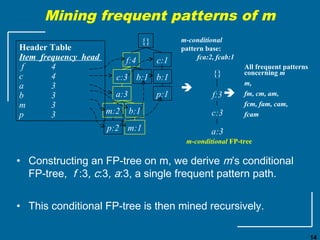
• Constructing an FP-tree on m, we derive m’s conditional
FP-tree, f :3, c:3, a:3, a single frequent pattern path.
• This conditional FP-tree is then mined recursively.
m-conditional
pattern base:
fca:2, fcab:1
{}
f:3
c:3
a:3
m-conditional FP-tree
All frequent patterns
concerning m
m,
fm, cm, am,
fcm, fam, cam,
fcam


{}
f:4 c:1
b:1
p:1
b:1c:3
a:3
b:1m:2
p:2 m:1
Header Table
Item frequency head
f 4
c 4
a 3
b 3
m 3
p 3
15
Mining frequent patterns of m
{}
f:3
c:3
a:3
m-conditional FP-tree
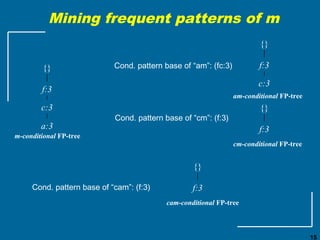
Cond. pattern base of “am”: (fc:3)
{}
f:3
c:3
am-conditional FP-tree
Cond. pattern base of “cm”: (f:3)
{}
f:3
cm-conditional FP-tree
Cond. pattern base of “cam”: (f:3)
{}
f:3
cam-conditional FP-tree
16
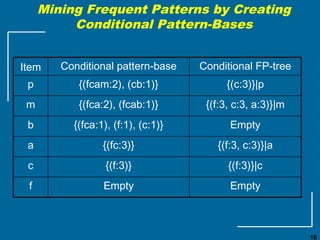
Mining Frequent Patterns by Creating
Conditional Pattern-Bases
EmptyEmptyf
{(f:3)}|c{(f:3)}c
{(f:3, c:3)}|a{(fc:3)}a
Empty{(fca:1), (f:1), (c:1)}b
{(f:3, c:3, a:3)}|m{(fca:2), (fcab:1)}m
{(c:3)}|p{(fcam:2), (cb:1)}p
Conditional FP-treeConditional pattern-baseItem
17
Single FP-tree Path Generation
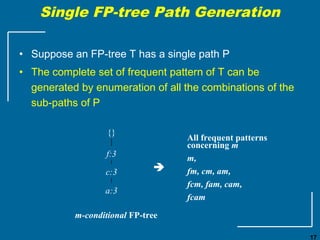
• Suppose an FP-tree T has a single path P
• The complete set of frequent pattern of T can be
generated by enumeration of all the combinations of the
sub-paths of P
{}
f:3
c:3
a:3
m-conditional FP-tree
All frequent patterns
concerning m
m,
fm, cm, am,
fcm, fam, cam,
fcam

18
Why Is Frequent Pattern Growth
Fast?
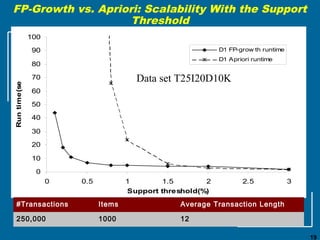
• Our performance study shows
– FP-growth is an order of magnitude faster than Apriori, and is
also faster than tree-projection
• Reasoning
– No candidate generation, no candidate test
– Use compact data structure
– Eliminate repeated database scan
– Basic operation is counting and FP-tree building
19
FP-Growth vs. Apriori: Scalability With the Support
Threshold
0
10
20
30
40
50
60
70
80
90
100
0 0.5 1 1.5 2 2.5 3
Support threshold(%)
Runtime(sec.)
D1 FP-grow th runtime
D1 Apriori runtime
Data set T25I20D10K
#Transactions Items Average Transaction Length
250,000 1000 12
20
null
A:7
B:5
B:3
C:3
D:1
C:1
D:1
C:3
D:1
D:1
E:1
E:1
TID Items
1 {A,B}
2 {B,C,D}
3 {A,C,D,E}
4 {A,D,E}
5 {A,B,C}
6 {A,B,C,D}
7 {B,C}
8 {A,B,C}
9 {A,B,D}
10 {B,C,E}
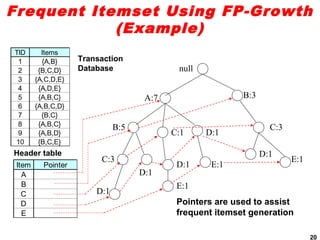
Pointers are used to assist
frequent itemset generation
D:1
E:1
Transaction
Database
Item Pointer
A
B
C
D
E
Header table
Frequent Itemset Using FP-Growth
(Example)
21
null
A:7
B:5
B:3
C:3
D:1
C:1
D:1
C:3
D:1
E:1
D:1
E:1
Build conditional pattern
base for E:
P = {(A:1,C:1,D:1),
(A:1,D:1),
(B:1,C:1)}
Recursively apply FP-
growth on P
E:1
D:1
FP Growth Algorithm: FP Tree Mining
Frequent Itemset Using FP-Growth
(Example)
22
AA BB CC DD EE
AB AC AD AE BC BD BE CD CE DEAB AC AD AE BC BD BE CD CE DE
ABC ABD ABE ACD ACE ADE BCD BCE BDE CDEABC ABD ABE ACD ACE ADE BCD BCE BDE CDE
ABCDABCD ABCEABCE ABDEABDE ACDE BCDEACDE BCDE
ABCDEABCDE
Frequent Itemset Using FP-Growth
(Example)
23
null
A:2 B:1
C:1
C:1
D:1
D:1
E:1
E:1
Conditional Pattern base
for E:
P = {(A:1,C:1,D:1,E:1),
(A:1,D:1,E:1),
(B:1,C:1,E:1)}
Count for E is 3: {E} is
frequent itemset
Recursively apply FP-
growth on P (Conditional
tree for D within
conditional tree for E)
E:1
Conditional tree for E:
FP Growth Algorithm: FP Tree Mining
Frequent Itemset Using FP-Growth
(Example)
24
AA BB CC DD EE
AB AC AD AE BC BD BE CD CE DEAB AC AD AE BC BD BE CD CE DE
ABC ABD ABE ACD ACE ADE BCD BCE BDE CDEABC ABD ABE ACD ACE ADE BCD BCE BDE CDE
ABCDABCD ABCEABCE ABDEABDE ACDE BCDEACDE BCDE
ABCDEABCDE
Frequent Itemset Using FP-Growth
(Example)
25
Conditional pattern base
for D within conditional
base for E:
P = {(A:1,C:1,D:1),
(A:1,D:1)}
Count for D is 2: {D,E} is
frequent itemset
Recursively apply FP-
growth on P (Conditional
tree for C within
conditional tree D within
conditional tree for E)
Conditional tree for D
within conditional tree
for E:
null
A:2
C:1
D:1
D:1
FP Growth Algorithm: FP Tree Mining
Frequent Itemset Using FP-Growth
(Example)
26
Conditional pattern base
for C within D within E:
P = {(A:1,C:1)}
Count for C is 1: {C,D,E}
is NOT frequent itemset
Recursively apply FP-
growth on P
(Conditional tree for A
within conditional tree D
within conditional tree
for E)
Conditional tree for C
within D within E:
null
A:1
C:1
FP Growth Algorithm: FP Tree Mining
Frequent Itemset Using FP-Growth
(Example)
27
Count for A is 2: {A,D,E}
is frequent itemset
Next step:
Construct conditional tree
C within conditional tree
E
Conditional tree for A
within D within E:
null
A:2
FP Growth Algorithm: FP Tree Mining
Frequent Itemset Using FP-Growth
(Example)
28
null
A:2 B:1
C:1
C:1
D:1
D:1
E:1
E:1
Recursively apply FP-
growth on P (Conditional
tree for C within
conditional tree for E)
E:1
Conditional tree for E:
FP Growth Algorithm: FP Tree Mining
Frequent Itemset Using FP-Growth
(Example)
29
null
A:1 B:1
C:1
C:1
E:1 E:1
FP Growth Algorithm: FP Tree Mining
Conditional pattern base
for C within conditional
base for E:
P = {(B:1,C:1),
(A:1,C:1)}
Count for C is 2: {C,E} is
frequent itemset
Recursively apply FP-
growth on P (Conditional
tree for B within
conditional tree C within
conditional tree for E)Conditional tree for C within conditional
tree for E:
Frequent Itemset Using FP-Growth
(Example)
30
null
A:7
B:5
B:3
C:3
D:1
C:1
D:1
C:3
D:1
D:1
E:1
E:1
TID Items
1 {A,B}
2 {B,C,D}
3 {A,C,D,E}
4 {A,D,E}
5 {A,B,C}
6 {A,B,C,D}
7 {B,C}
8 {A,B,C}
9 {A,B,D}
10 {B,C,E}
D:1
E:1
Transaction
Database
Item Pointer
A
B
C
D
E
Header table
FP Growth Algorithm: FP Tree Mining
Frequent Itemset Using FP-Growth
(Example)
31
AA BB CC DD EE
AB AC AD AE BC BD BE CD CE DEAB AC AD AE BC BD BE CD CE DE
ABC ABD ABE ACD ACE ADE BCD BCE BDE CDEABC ABD ABE ACD ACE ADE BCD BCE BDE CDE
ABCDABCD ABCEABCE ABDEABDE ACDE BCDEACDE BCDE
ABCDEABCDE
Frequent Itemset Using FP-Growth
(Example)
32
AA BB CC DD EE
AB AC AD AE BC BD BE CD CE DEAB AC AD AE BC BD BE CD CE DE
ABC ABD ABE ACD ACE ADE BCD BCE BDE CDEABC ABD ABE ACD ACE ADE BCD BCE BDE CDE
ABCDABCD ABCEABCE ABDEABDE ACDE BCDEACDE BCDE
ABCDEABCDE
Frequent Itemset Using FP-Growth
(Example)

Frequent itemset mining using pattern growth method

  • 1.
    Data Mining Spring 2007 •Frequent-Pattern Tree Approach Towards ARM Lecture 11-12
  • 2.
    2 In this lecture Thelecture is based on • Jiawei Han, Jian Pei, Yiwen Yin And Runying Mao Data, “Mining Frequent Patterns without Candidate Generation: A Frequent-Pattern Tree Approach”, Mining and Knowledge Discovery, Kluwer Academic Publishers, 2004 • Jiawei Han, Jian Pei, Yiwen Yin, “Mining Frequent Patterns without Candidate Generation”, In Proc. 2000 ACM SIGMOD Int. Conf. Management of Data (SIGMOD’00), Dallas, TX, pp. 1–12. Some slides are adapted from official text book slides of • Jiawei Han and Micheline Kamber, “Data Mining: Concepts and Techniques”, Morgan Kaufmann Publishers, August 2000
  • 3.
    3 Is Apriori FastEnough? — Performance Bottlenecks • The core of the Apriori algorithm: – Use frequent (k – 1)-itemsets to generate candidate frequent k- itemsets – Use database scan and pattern matching to collect counts for the candidate itemsets • The bottleneck of Apriori: candidate generation – Huge candidate sets: • 104 frequent 1-itemset will generate 107 candidate 2-itemsets • To discover a frequent pattern of size 100, e.g., {a1, a2, …, a100}, one needs to generate 2100 ≈ 1030 candidates. – Multiple scans of database: • Needs (n +1 ) scans, n is the length of the longest pattern
  • 4.
    4 Mining Frequent PatternsWithout Candidate Generation • Steps 1. Compress a large database into a compact, Frequent-Pattern tree (FP-tree) structure 1. highly condensed, but complete for frequent pattern mining 2. avoid costly database scans 2. Develop an efficient, FP-tree-based frequent pattern mining method 1. A divide-and-conquer methodology: decompose mining tasks into smaller ones 2. Avoid candidate generation: sub-database test only!
  • 5.
    5 FP-tree Construction Item frequencyhead f 4 c 4 a 3 b 3 m 3 p 3 TID Items bought (ordered) frequent items 100 {f, a, c, d, g, i, m, p} {f, c, a, m, p} 200 {a, b, c, f, l, m, o} {f, c, a, b, m} 300 {b, f, h, j, o} {f, b} 400 {b, c, k, s, p} {c, b, p} 500 {a, f, c, e, l, p, m, n} {f, c, a, m, p} Steps: 1. Scan DB once, find frequent 1- itemset (single item pattern) 2. Order frequent items in frequency descending order 3. Scan DB again, construct FP-tree
  • 6.
    6 • Steps Contd.(Example) – Scan of the first transaction leads to the construction of the first branch of the tree listing {} f:1 c:1 a:1 m:1 p:1 FP-tree Construction (contd.) (ordered) frequent items {f, c, a, m, p} {f, c, a, b, m} {f, b} {c, b, p} {f, c, a, m, p}
  • 7.
    7 {} f:2 c:2 a:2 b:1m:1 p:1 m:1 FP-tree Construction(contd.) (ordered) frequent items {f, c, a, m, p} {f, c, a, b, m} {f, b} {c, b, p} {f, c, a, m, p} • Steps Contd. (Example) – Scan of the first transaction leads to the construction of the first branch of the tree listing – Second transaction shares a common prefix with the existing path the count of each node along the prefix is incremented by 1 – Two new nodes are created and linked as children of (a:2) and (b:1) respec.
  • 8.
    8 • Steps Contd.(Example) – Scan of the first transaction leads to the construction of the first branch of the tree listing – Second transaction shares a common prefix with the existing path the count of each node along the prefix is incremented by 1 – Two new nodes are created and linked as children of (a:2) and (b:1) respec. – Similarly for the third transaction {} f:3 b:1c:2 a:2 b:1m:1 p:1 m:1 FP-tree Construction (contd.) (ordered) frequent items {f, c, a, m, p} {f, c, a, b, m} {f, b} {c, b, p} {f, c, a, m, p}
  • 9.
    9 • Steps Contd.(Example) – Scan of the first transaction leads to the construction of the first branch of the tree listing – Second transaction shares a common prefix with the existing path the count of each node along the prefix is incremented by 1 – Two new nodes are created and linked as children of (a:2) and (b:1) respec. – Similarly for the third transaction – The scan of the fourth transaction leads to the construction of the second branch of the tree, (c:1), (b:1), (p:1). {} f:3 c:1 b:1 p:1 b:1c:2 a:2 b:1m:1 p:1 m:1 FP-tree Construction (contd.) (ordered) frequent items {f, c, a, m, p} {f, c, a, b, m} {f, b} {c, b, p} {f, c, a, m, p}
  • 10.
    10 • Steps Contd.(Example) – Scan of the first transaction leads to the construction of the first branch of the tree listing – Second transaction shares a common prefix with the existing path the count of each node along the prefix is incremented by 1 – Two new nodes are created and linked as children of (a:2) and (b:1) respec. – Similarly for the third transaction – The scan of the fourth transaction leads to the construction of the second branch of the tree, (c:1), (b:1), (p:1). – For the last transaction, since its frequent item list is identical to the first one, the path is shared. {} f:4 c:1 b:1 p:1 b:1c:3 a:3 b:1m:2 p:2 m:1 FP-tree Construction (contd.) (ordered) frequent items {f, c, a, m, p} {f, c, a, b, m} {f, b} {c, b, p} {f, c, a, m, p}
  • 11.
    11 • Create aHeader table – Each entry in the frequent-item-header table consists of two fields, (1) item-name (2) head of node-link (a pointer pointing to the first node in the FP-tree carrying the item-name). FP-tree Construction (contd.) {} f:4 c:1 b:1 p:1 b:1c:3 a:3 b:1m:2 p:2 m:1 Header Table Item frequency head f 4 c 4 a 3 b 3 m 3 p 3
  • 12.
    12 Mining frequent patternsusing FP-tree • Mining frequent patterns out of FP-tree is based upon following Node-link property – For any frequent item ai , all the possible patterns containing only frequent items and ai can be obtained by following ai ’s node-links, starting from ai ’s head in the FP-tree header. • Lets go through an example to understand the full implication of this property in the mining process.
  • 13.
    13 • For nodep, its immediate frequent pattern is (p:3), and it has two paths in the FP-tree: (f :4, c:3, a:3,m:2,p:2) and (c:1, b:1, p:1) • These two prefix paths of p, “{( f cam:2), (cb:1)}”, form p’s conditional pattern base • Now, we build an FP- tree on P’s conditional pattern base. • Leads to an FP tree with one branch only i.e. C:3 hence the frequent patter n associated with P is just CP {} f:4 c:1 b:1 p:1 b:1c:3 a:3 b:1m:2 p:2 m:1 Header Table Item head f c a b m p Mining frequent patterns of p
  • 14.
    14 Mining frequent patternsof m • Constructing an FP-tree on m, we derive m’s conditional FP-tree, f :3, c:3, a:3, a single frequent pattern path. • This conditional FP-tree is then mined recursively. m-conditional pattern base: fca:2, fcab:1 {} f:3 c:3 a:3 m-conditional FP-tree All frequent patterns concerning m m, fm, cm, am, fcm, fam, cam, fcam   {} f:4 c:1 b:1 p:1 b:1c:3 a:3 b:1m:2 p:2 m:1 Header Table Item frequency head f 4 c 4 a 3 b 3 m 3 p 3
  • 15.
    15 Mining frequent patternsof m {} f:3 c:3 a:3 m-conditional FP-tree Cond. pattern base of “am”: (fc:3) {} f:3 c:3 am-conditional FP-tree Cond. pattern base of “cm”: (f:3) {} f:3 cm-conditional FP-tree Cond. pattern base of “cam”: (f:3) {} f:3 cam-conditional FP-tree
  • 16.
    16 Mining Frequent Patternsby Creating Conditional Pattern-Bases EmptyEmptyf {(f:3)}|c{(f:3)}c {(f:3, c:3)}|a{(fc:3)}a Empty{(fca:1), (f:1), (c:1)}b {(f:3, c:3, a:3)}|m{(fca:2), (fcab:1)}m {(c:3)}|p{(fcam:2), (cb:1)}p Conditional FP-treeConditional pattern-baseItem
  • 17.
    17 Single FP-tree PathGeneration • Suppose an FP-tree T has a single path P • The complete set of frequent pattern of T can be generated by enumeration of all the combinations of the sub-paths of P {} f:3 c:3 a:3 m-conditional FP-tree All frequent patterns concerning m m, fm, cm, am, fcm, fam, cam, fcam 
  • 18.
    18 Why Is FrequentPattern Growth Fast? • Our performance study shows – FP-growth is an order of magnitude faster than Apriori, and is also faster than tree-projection • Reasoning – No candidate generation, no candidate test – Use compact data structure – Eliminate repeated database scan – Basic operation is counting and FP-tree building
  • 19.
    19 FP-Growth vs. Apriori:Scalability With the Support Threshold 0 10 20 30 40 50 60 70 80 90 100 0 0.5 1 1.5 2 2.5 3 Support threshold(%) Runtime(sec.) D1 FP-grow th runtime D1 Apriori runtime Data set T25I20D10K #Transactions Items Average Transaction Length 250,000 1000 12
  • 20.
    20 null A:7 B:5 B:3 C:3 D:1 C:1 D:1 C:3 D:1 D:1 E:1 E:1 TID Items 1 {A,B} 2{B,C,D} 3 {A,C,D,E} 4 {A,D,E} 5 {A,B,C} 6 {A,B,C,D} 7 {B,C} 8 {A,B,C} 9 {A,B,D} 10 {B,C,E} Pointers are used to assist frequent itemset generation D:1 E:1 Transaction Database Item Pointer A B C D E Header table Frequent Itemset Using FP-Growth (Example)
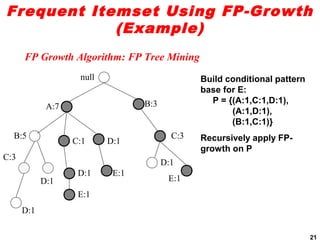
  • 21.
    21 null A:7 B:5 B:3 C:3 D:1 C:1 D:1 C:3 D:1 E:1 D:1 E:1 Build conditional pattern basefor E: P = {(A:1,C:1,D:1), (A:1,D:1), (B:1,C:1)} Recursively apply FP- growth on P E:1 D:1 FP Growth Algorithm: FP Tree Mining Frequent Itemset Using FP-Growth (Example)
  • 22.
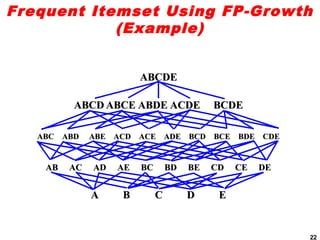
    22 AA BB CCDD EE AB AC AD AE BC BD BE CD CE DEAB AC AD AE BC BD BE CD CE DE ABC ABD ABE ACD ACE ADE BCD BCE BDE CDEABC ABD ABE ACD ACE ADE BCD BCE BDE CDE ABCDABCD ABCEABCE ABDEABDE ACDE BCDEACDE BCDE ABCDEABCDE Frequent Itemset Using FP-Growth (Example)
  • 23.
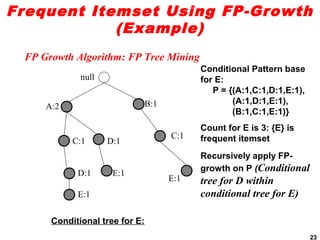
    23 null A:2 B:1 C:1 C:1 D:1 D:1 E:1 E:1 Conditional Patternbase for E: P = {(A:1,C:1,D:1,E:1), (A:1,D:1,E:1), (B:1,C:1,E:1)} Count for E is 3: {E} is frequent itemset Recursively apply FP- growth on P (Conditional tree for D within conditional tree for E) E:1 Conditional tree for E: FP Growth Algorithm: FP Tree Mining Frequent Itemset Using FP-Growth (Example)
  • 24.
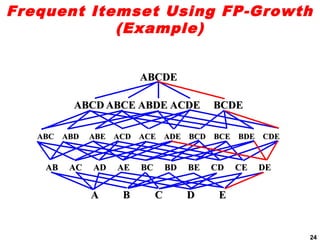
    24 AA BB CCDD EE AB AC AD AE BC BD BE CD CE DEAB AC AD AE BC BD BE CD CE DE ABC ABD ABE ACD ACE ADE BCD BCE BDE CDEABC ABD ABE ACD ACE ADE BCD BCE BDE CDE ABCDABCD ABCEABCE ABDEABDE ACDE BCDEACDE BCDE ABCDEABCDE Frequent Itemset Using FP-Growth (Example)
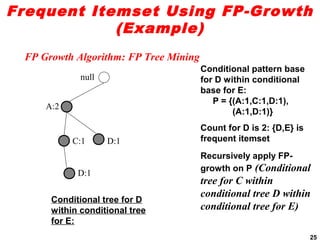
  • 25.
    25 Conditional pattern base forD within conditional base for E: P = {(A:1,C:1,D:1), (A:1,D:1)} Count for D is 2: {D,E} is frequent itemset Recursively apply FP- growth on P (Conditional tree for C within conditional tree D within conditional tree for E) Conditional tree for D within conditional tree for E: null A:2 C:1 D:1 D:1 FP Growth Algorithm: FP Tree Mining Frequent Itemset Using FP-Growth (Example)
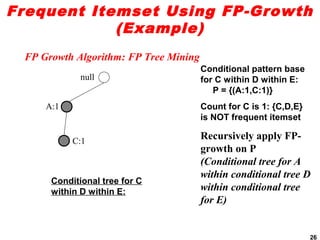
  • 26.
    26 Conditional pattern base forC within D within E: P = {(A:1,C:1)} Count for C is 1: {C,D,E} is NOT frequent itemset Recursively apply FP- growth on P (Conditional tree for A within conditional tree D within conditional tree for E) Conditional tree for C within D within E: null A:1 C:1 FP Growth Algorithm: FP Tree Mining Frequent Itemset Using FP-Growth (Example)
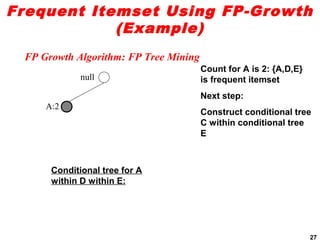
  • 27.
    27 Count for Ais 2: {A,D,E} is frequent itemset Next step: Construct conditional tree C within conditional tree E Conditional tree for A within D within E: null A:2 FP Growth Algorithm: FP Tree Mining Frequent Itemset Using FP-Growth (Example)
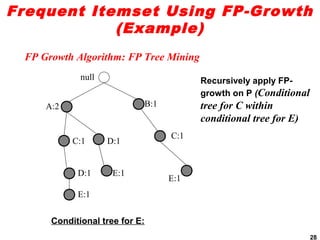
  • 28.
    28 null A:2 B:1 C:1 C:1 D:1 D:1 E:1 E:1 Recursively applyFP- growth on P (Conditional tree for C within conditional tree for E) E:1 Conditional tree for E: FP Growth Algorithm: FP Tree Mining Frequent Itemset Using FP-Growth (Example)
  • 29.
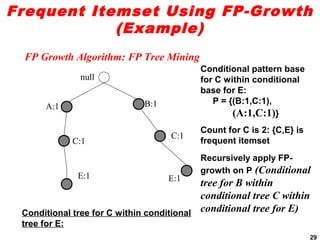
    29 null A:1 B:1 C:1 C:1 E:1 E:1 FPGrowth Algorithm: FP Tree Mining Conditional pattern base for C within conditional base for E: P = {(B:1,C:1), (A:1,C:1)} Count for C is 2: {C,E} is frequent itemset Recursively apply FP- growth on P (Conditional tree for B within conditional tree C within conditional tree for E)Conditional tree for C within conditional tree for E: Frequent Itemset Using FP-Growth (Example)
  • 30.
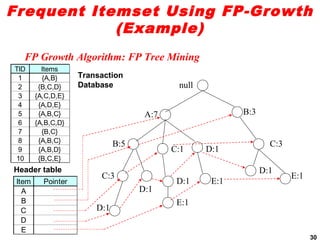
    30 null A:7 B:5 B:3 C:3 D:1 C:1 D:1 C:3 D:1 D:1 E:1 E:1 TID Items 1 {A,B} 2{B,C,D} 3 {A,C,D,E} 4 {A,D,E} 5 {A,B,C} 6 {A,B,C,D} 7 {B,C} 8 {A,B,C} 9 {A,B,D} 10 {B,C,E} D:1 E:1 Transaction Database Item Pointer A B C D E Header table FP Growth Algorithm: FP Tree Mining Frequent Itemset Using FP-Growth (Example)
  • 31.
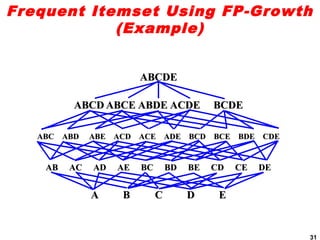
    31 AA BB CCDD EE AB AC AD AE BC BD BE CD CE DEAB AC AD AE BC BD BE CD CE DE ABC ABD ABE ACD ACE ADE BCD BCE BDE CDEABC ABD ABE ACD ACE ADE BCD BCE BDE CDE ABCDABCD ABCEABCE ABDEABDE ACDE BCDEACDE BCDE ABCDEABCDE Frequent Itemset Using FP-Growth (Example)
  • 32.
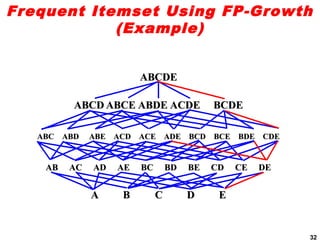
    32 AA BB CCDD EE AB AC AD AE BC BD BE CD CE DEAB AC AD AE BC BD BE CD CE DE ABC ABD ABE ACD ACE ADE BCD BCE BDE CDEABC ABD ABE ACD ACE ADE BCD BCE BDE CDE ABCDABCD ABCEABCE ABDEABDE ACDE BCDEACDE BCDE ABCDEABCDE Frequent Itemset Using FP-Growth (Example)