Frequent-Pattern Tree
2
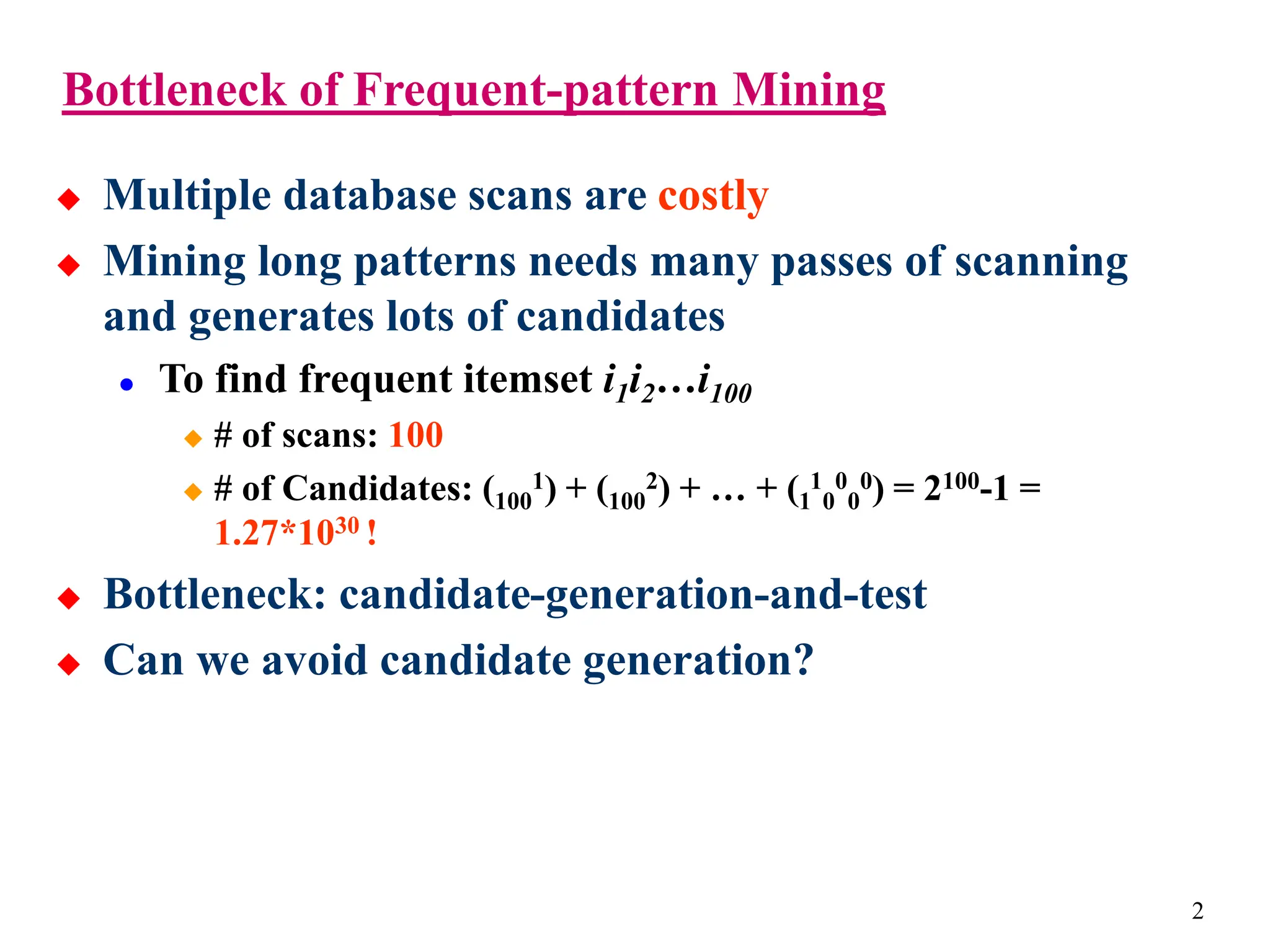
Bottleneck of Frequent-pattern Mining
 Multiple database scans are costly
 Mining long patterns needs many passes of scanning
and generates lots of candidates
 To find frequent itemset i1i2…i100
 # of scans: 100
 # of Candidates: (100
1) + (100
2) + … + (1
1
0
0
0
0) = 2100-1 =
1.27*1030 !
 Bottleneck: candidate-generation-and-test
 Can we avoid candidate generation?
3
 Grow long patterns from short ones using local frequent
items
 “abc” is a frequent pattern
 Get all transactions having “abc”: DB|abc (projected
database on abc)
 “d” is a local frequent item in DB|abc  abcd is a frequent
pattern
 Get all transactions having “abcd” (projected database on
“abcd”) and find longer itemsets
Mining Freq Patterns w/o Candidate Generation
4
Mining Freq Patterns w/o Candidate Generation
 Compress a large database into a compact, Frequent-
Pattern tree (FP-tree) structure
 Highly condensed, but complete for frequent pattern
mining
 Avoid costly database scans
 Develop an efficient, FP-tree-based frequent pattern
mining method
 A divide-and-conquer methodology: decompose mining
tasks into smaller ones
 Avoid candidate generation: examine sub-database
(conditional pattern base) only!
5
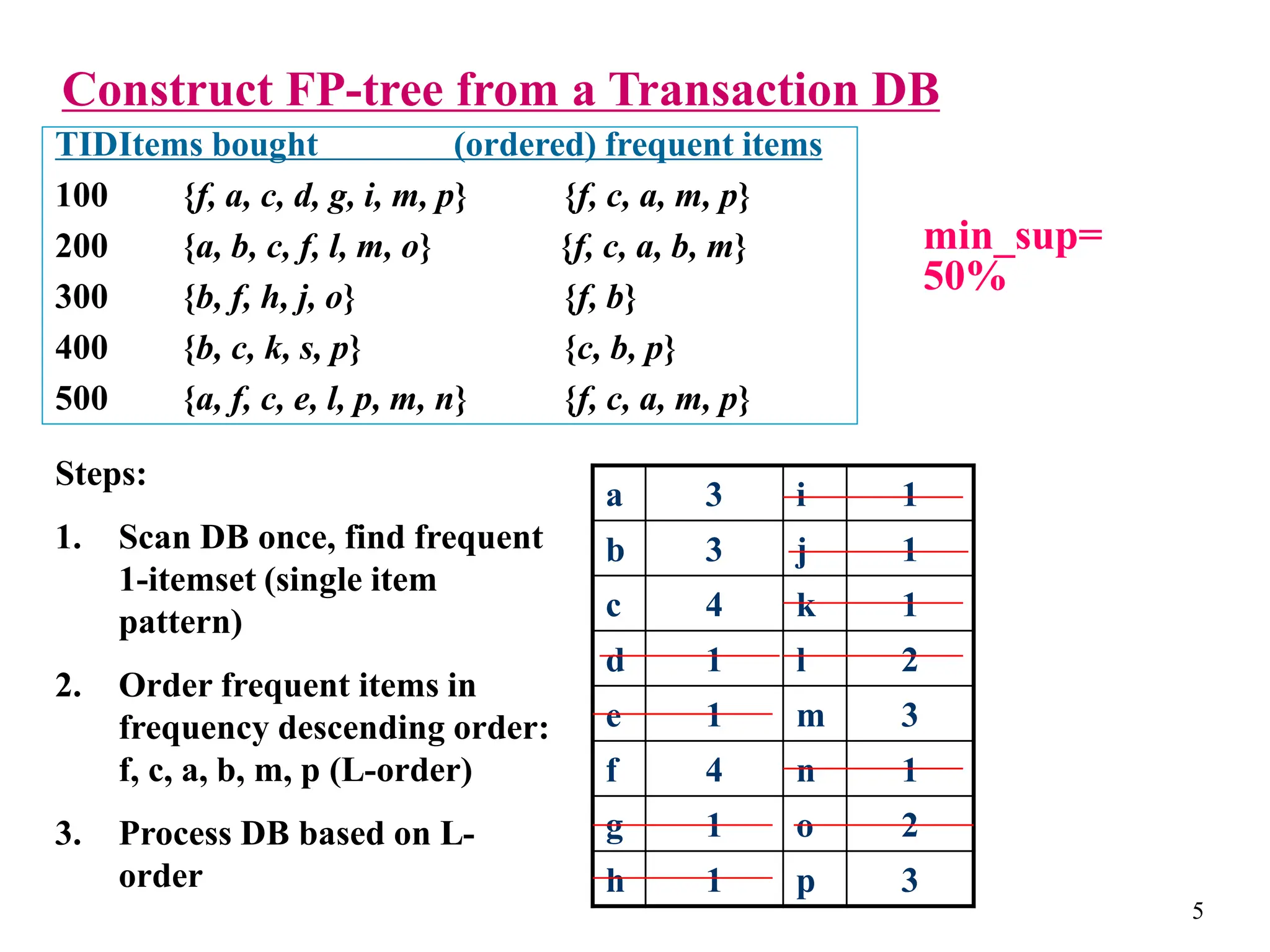
Construct FP-tree from a Transaction DB
min_sup=
50%
TIDItems bought (ordered) frequent items
100 {f, a, c, d, g, i, m, p} {f, c, a, m, p}
200 {a, b, c, f, l, m, o} {f, c, a, b, m}
300 {b, f, h, j, o} {f, b}
400 {b, c, k, s, p} {c, b, p}
500 {a, f, c, e, l, p, m, n} {f, c, a, m, p}
Steps:
1. Scan DB once, find frequent
1-itemset (single item
pattern)
2. Order frequent items in
frequency descending order:
f, c, a, b, m, p (L-order)
3. Process DB based on L-
order
a 3 i 1
b 3 j 1
c 4 k 1
d 1 l 2
e 1 m 3
f 4 n 1
g 1 o 2
h 1 p 3
6
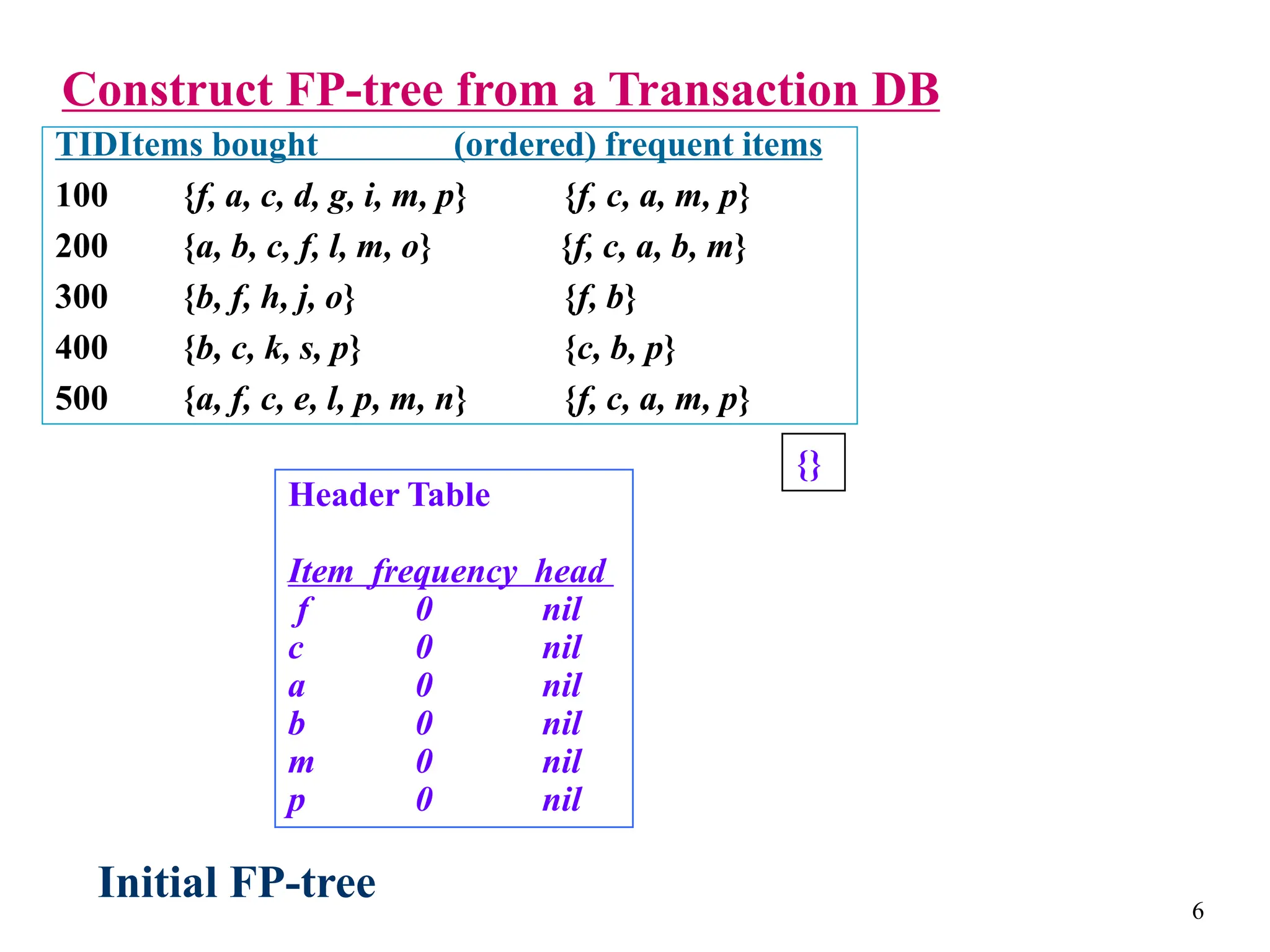
Construct FP-tree from a Transaction DB
{}
Header Table
Item frequency head
f 0 nil
c 0 nil
a 0 nil
b 0 nil
m 0 nil
p 0 nil
TIDItems bought (ordered) frequent items
100 {f, a, c, d, g, i, m, p} {f, c, a, m, p}
200 {a, b, c, f, l, m, o} {f, c, a, b, m}
300 {b, f, h, j, o} {f, b}
400 {b, c, k, s, p} {c, b, p}
500 {a, f, c, e, l, p, m, n} {f, c, a, m, p}
Initial FP-tree
7
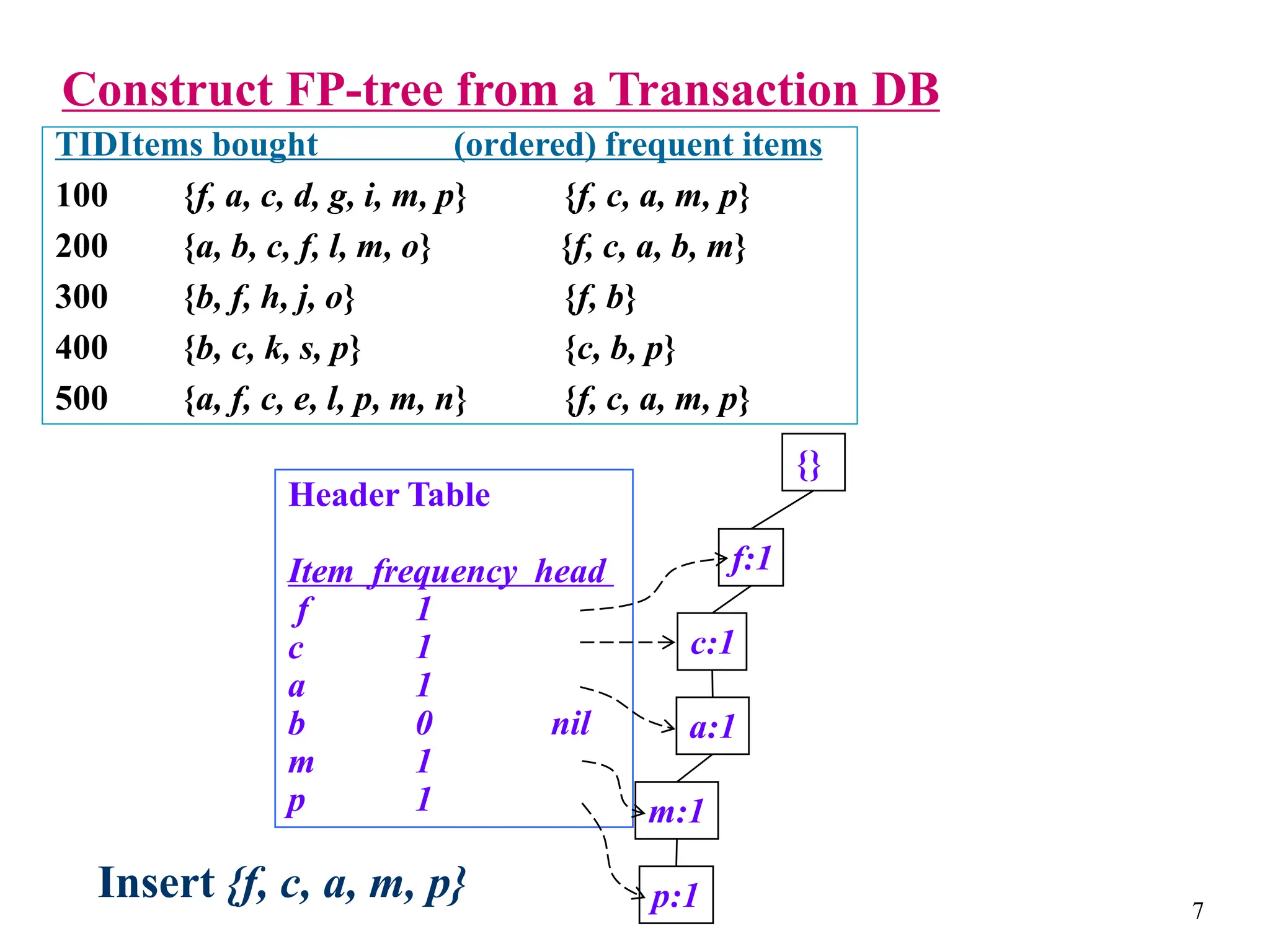
Construct FP-tree from a Transaction DB
{}
f:1
c:1
a:1
m:1
p:1
Header Table
Item frequency head
f 1
c 1
a 1
b 0 nil
m 1
p 1
TIDItems bought (ordered) frequent items
100 {f, a, c, d, g, i, m, p} {f, c, a, m, p}
200 {a, b, c, f, l, m, o} {f, c, a, b, m}
300 {b, f, h, j, o} {f, b}
400 {b, c, k, s, p} {c, b, p}
500 {a, f, c, e, l, p, m, n} {f, c, a, m, p}
Insert {f, c, a, m, p}
8
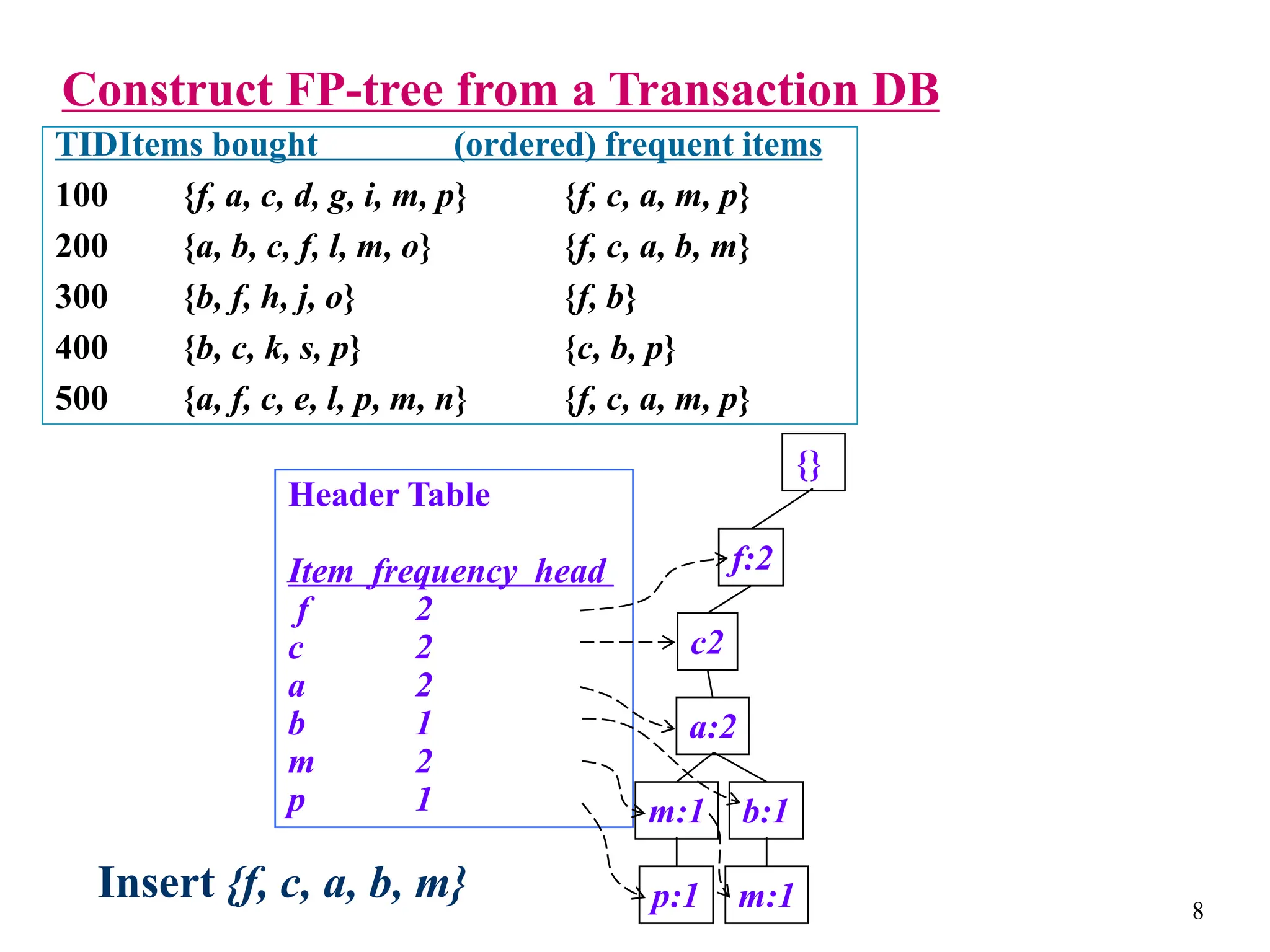
Construct FP-tree from a Transaction DB
{}
f:2
c2
a:2
b:1
m:1
p:1 m:1
Header Table
Item frequency head
f 2
c 2
a 2
b 1
m 2
p 1
TIDItems bought (ordered) frequent items
100 {f, a, c, d, g, i, m, p} {f, c, a, m, p}
200 {a, b, c, f, l, m, o} {f, c, a, b, m}
300 {b, f, h, j, o} {f, b}
400 {b, c, k, s, p} {c, b, p}
500 {a, f, c, e, l, p, m, n} {f, c, a, m, p}
Insert {f, c, a, b, m}
9
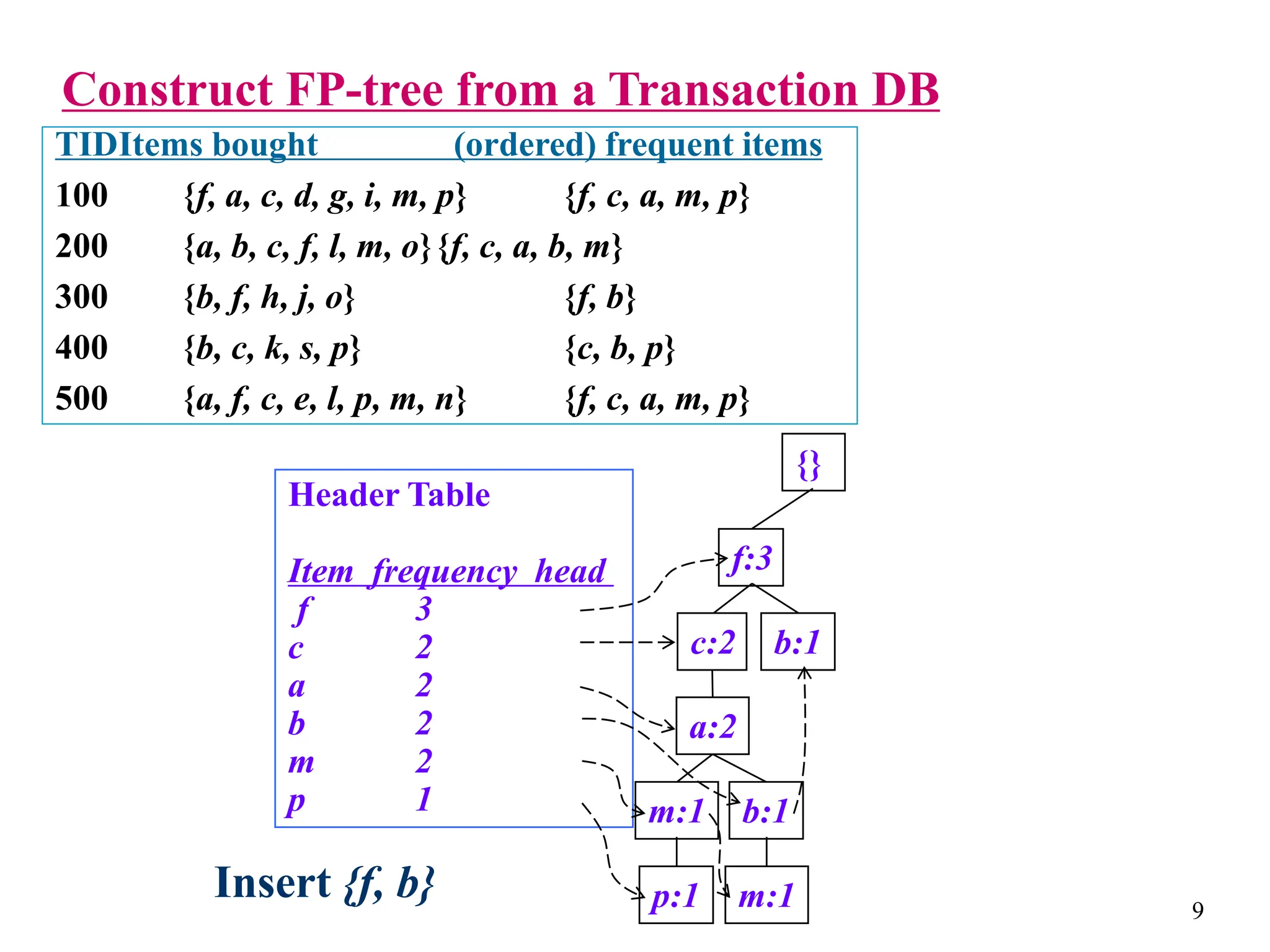
Construct FP-tree from a Transaction DB
{}
f:3
b:1
c:2
a:2
b:1
m:1
p:1 m:1
Header Table
Item frequency head
f 3
c 2
a 2
b 2
m 2
p 1
TIDItems bought (ordered) frequent items
100 {f, a, c, d, g, i, m, p} {f, c, a, m, p}
200 {a, b, c, f, l, m, o}{f, c, a, b, m}
300 {b, f, h, j, o} {f, b}
400 {b, c, k, s, p} {c, b, p}
500 {a, f, c, e, l, p, m, n} {f, c, a, m, p}
Insert {f, b}
10
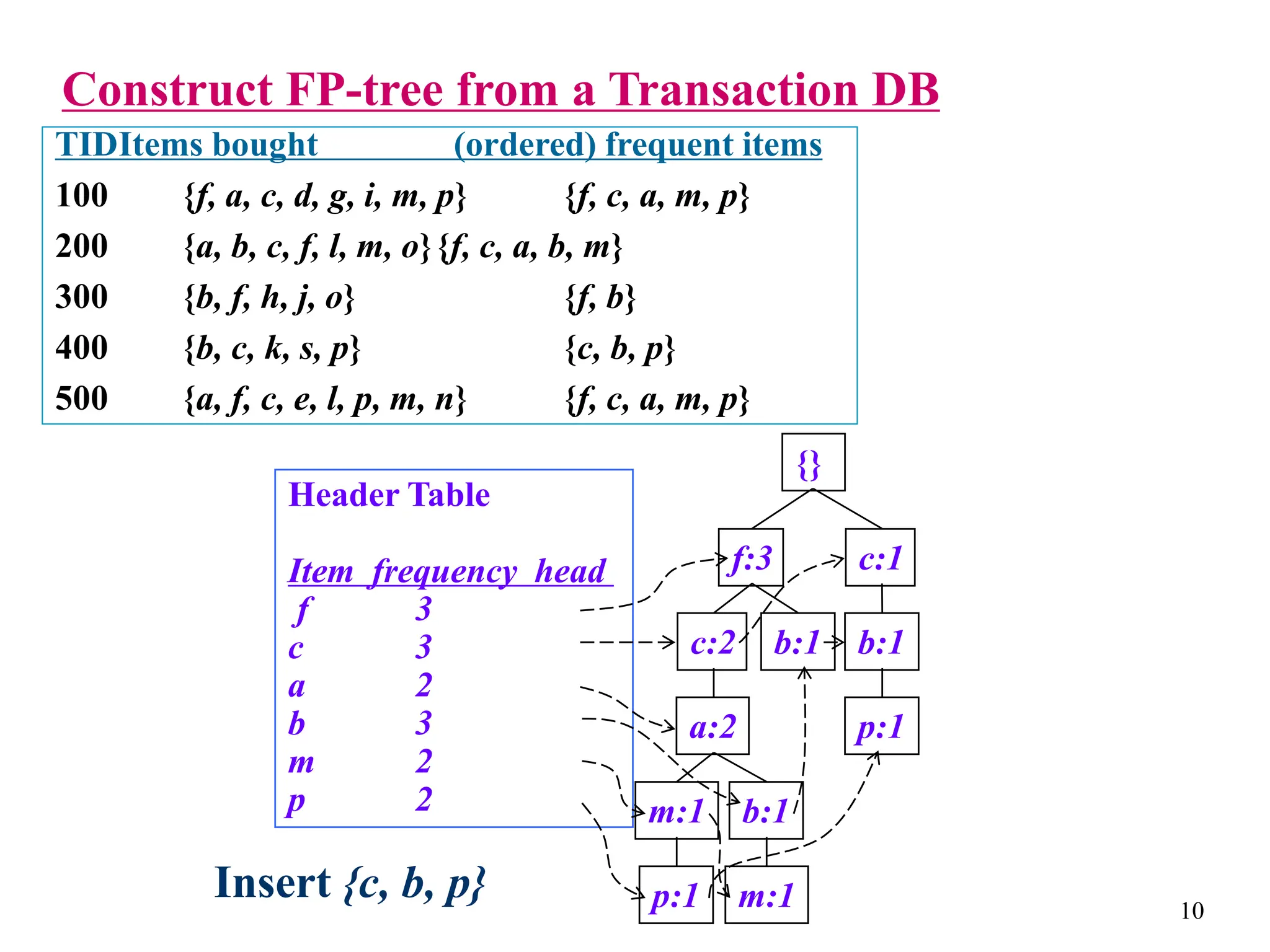
Construct FP-tree from a Transaction DB
{}
f:3 c:1
b:1
p:1
b:1
c:2
a:2
b:1
m:1
p:1 m:1
Header Table
Item frequency head
f 3
c 3
a 2
b 3
m 2
p 2
TIDItems bought (ordered) frequent items
100 {f, a, c, d, g, i, m, p} {f, c, a, m, p}
200 {a, b, c, f, l, m, o}{f, c, a, b, m}
300 {b, f, h, j, o} {f, b}
400 {b, c, k, s, p} {c, b, p}
500 {a, f, c, e, l, p, m, n} {f, c, a, m, p}
Insert {c, b, p}
11
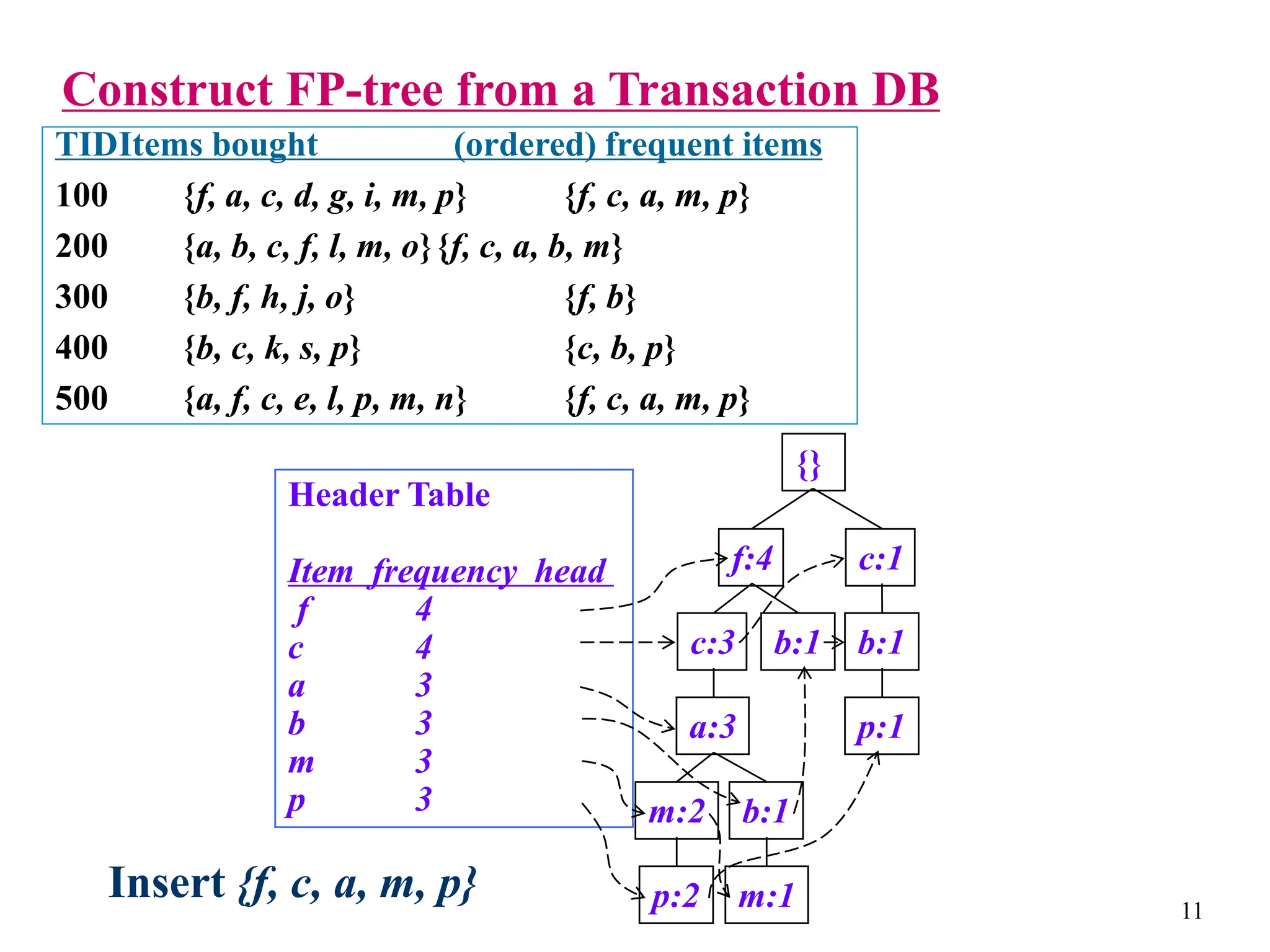
Construct FP-tree from a Transaction DB
{}
f:4 c:1
b:1
p:1
b:1
c:3
a:3
b:1
m:2
p:2 m:1
Header Table
Item frequency head
f 4
c 4
a 3
b 3
m 3
p 3
TIDItems bought (ordered) frequent items
100 {f, a, c, d, g, i, m, p} {f, c, a, m, p}
200 {a, b, c, f, l, m, o}{f, c, a, b, m}
300 {b, f, h, j, o} {f, b}
400 {b, c, k, s, p} {c, b, p}
500 {a, f, c, e, l, p, m, n} {f, c, a, m, p}
Insert {f, c, a, m, p}
12
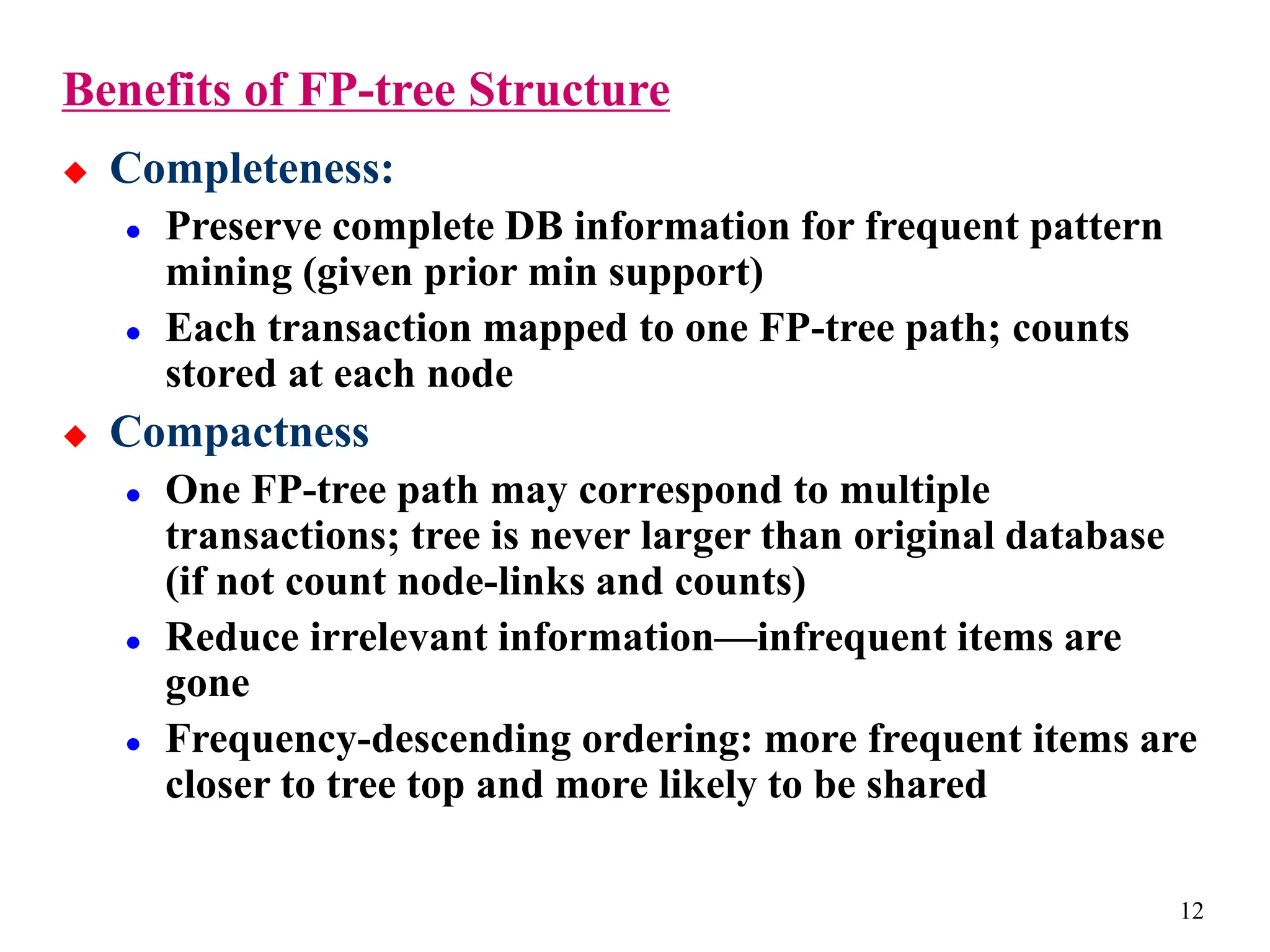
Benefits of FP-tree Structure
 Completeness:
 Preserve complete DB information for frequent pattern
mining (given prior min support)
 Each transaction mapped to one FP-tree path; counts
stored at each node
 Compactness
 One FP-tree path may correspond to multiple
transactions; tree is never larger than original database
(if not count node-links and counts)
 Reduce irrelevant information—infrequent items are
gone
 Frequency-descending ordering: more frequent items are
closer to tree top and more likely to be shared
13
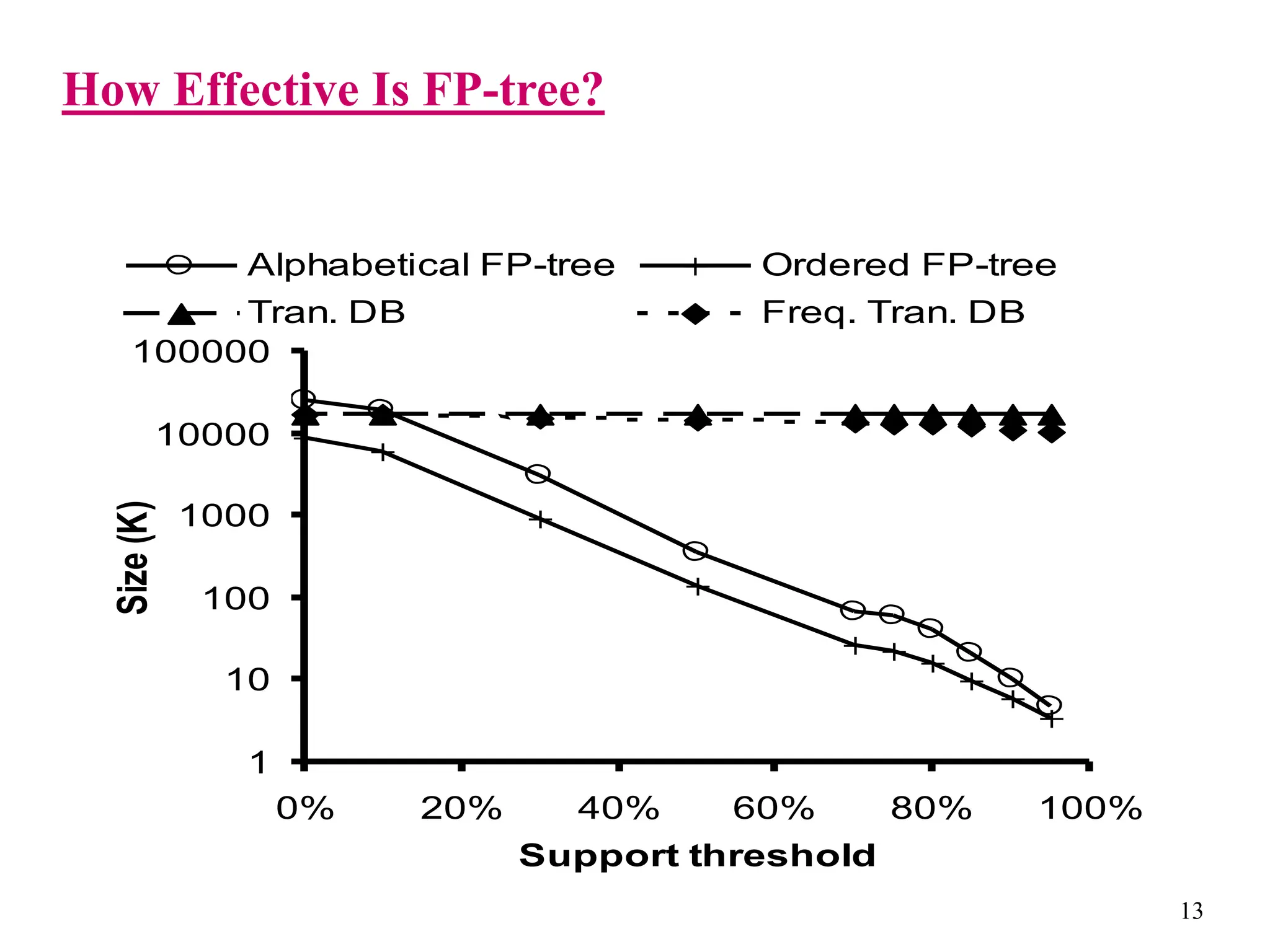
How Effective Is FP-tree?
1
10
100
1000
10000
100000
0% 20% 40% 60% 80% 100%
Support threshold
Size
(K)
Alphabetical FP-tree Ordered FP-tree
Tran. DB Freq. Tran. DB
Dataset: Connect-4
(a dense dataset)
14
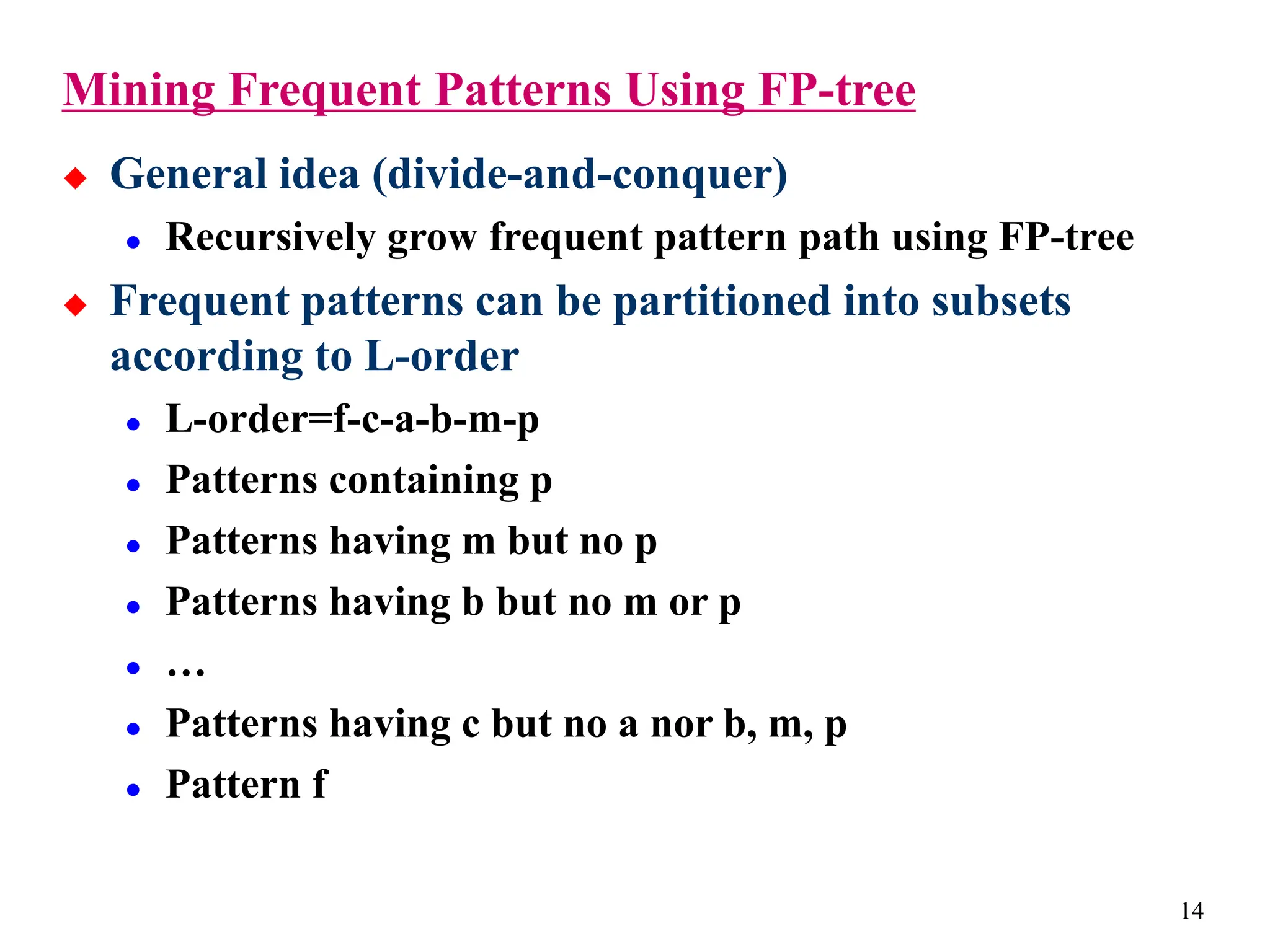
Mining Frequent Patterns Using FP-tree
 General idea (divide-and-conquer)
 Recursively grow frequent pattern path using FP-tree
 Frequent patterns can be partitioned into subsets
according to L-order
 L-order=f-c-a-b-m-p
 Patterns containing p
 Patterns having m but no p
 Patterns having b but no m or p
 …
 Patterns having c but no a nor b, m, p
 Pattern f
15
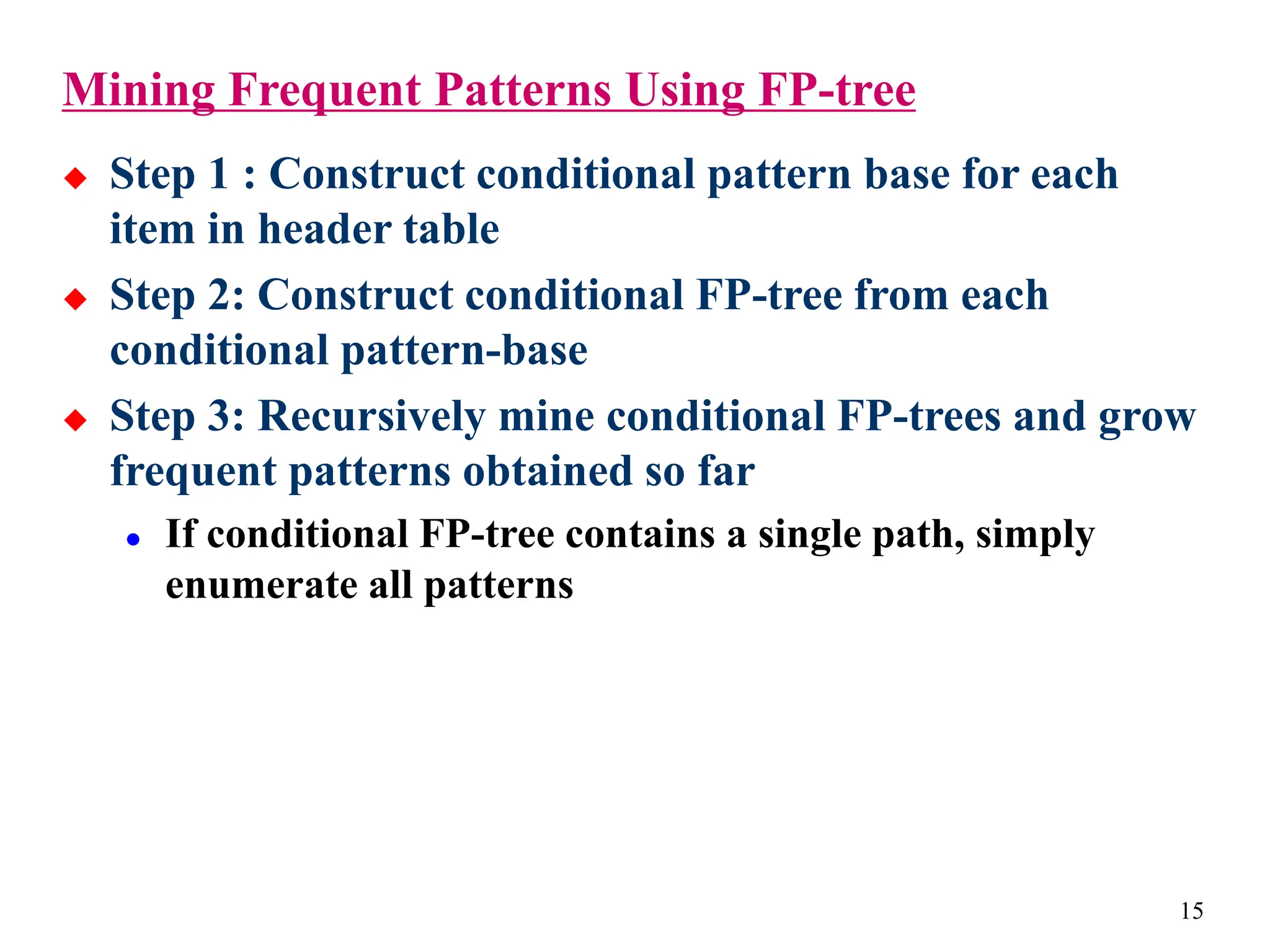
Mining Frequent Patterns Using FP-tree
 Step 1 : Construct conditional pattern base for each
item in header table
 Step 2: Construct conditional FP-tree from each
conditional pattern-base
 Step 3: Recursively mine conditional FP-trees and grow
frequent patterns obtained so far
 If conditional FP-tree contains a single path, simply
enumerate all patterns
16
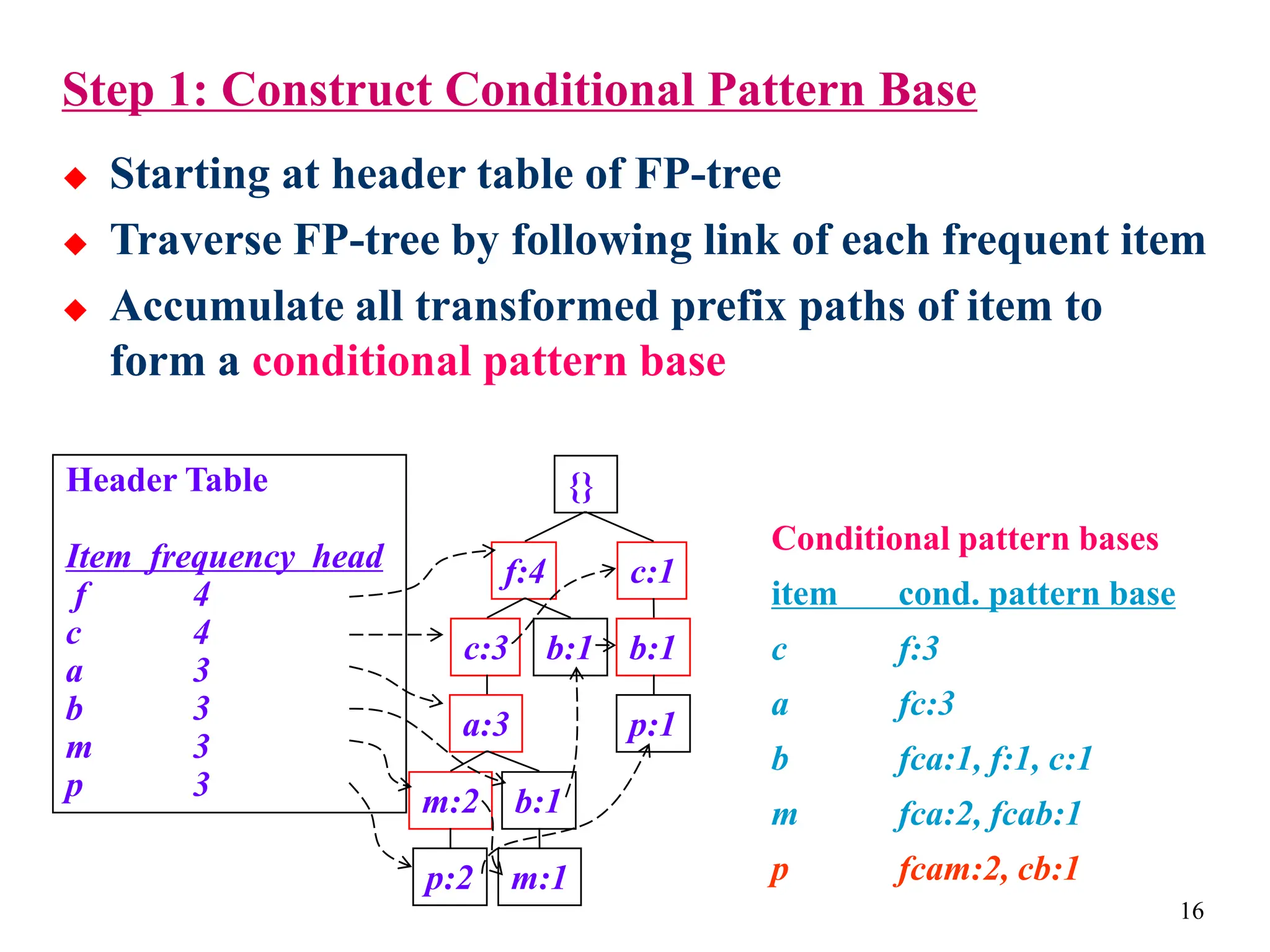
Step 1: Construct Conditional Pattern Base
 Starting at header table of FP-tree
 Traverse FP-tree by following link of each frequent item
 Accumulate all transformed prefix paths of item to
form a conditional pattern base
Conditional pattern bases
item cond. pattern base
c f:3
a fc:3
b fca:1, f:1, c:1
m fca:2, fcab:1
p fcam:2, cb:1
{}
f:4 c:1
b:1
p:1
b:1
c:3
a:3
b:1
m:2
p:2 m:1
Header Table
Item frequency head
f 4
c 4
a 3
b 3
m 3
p 3
17
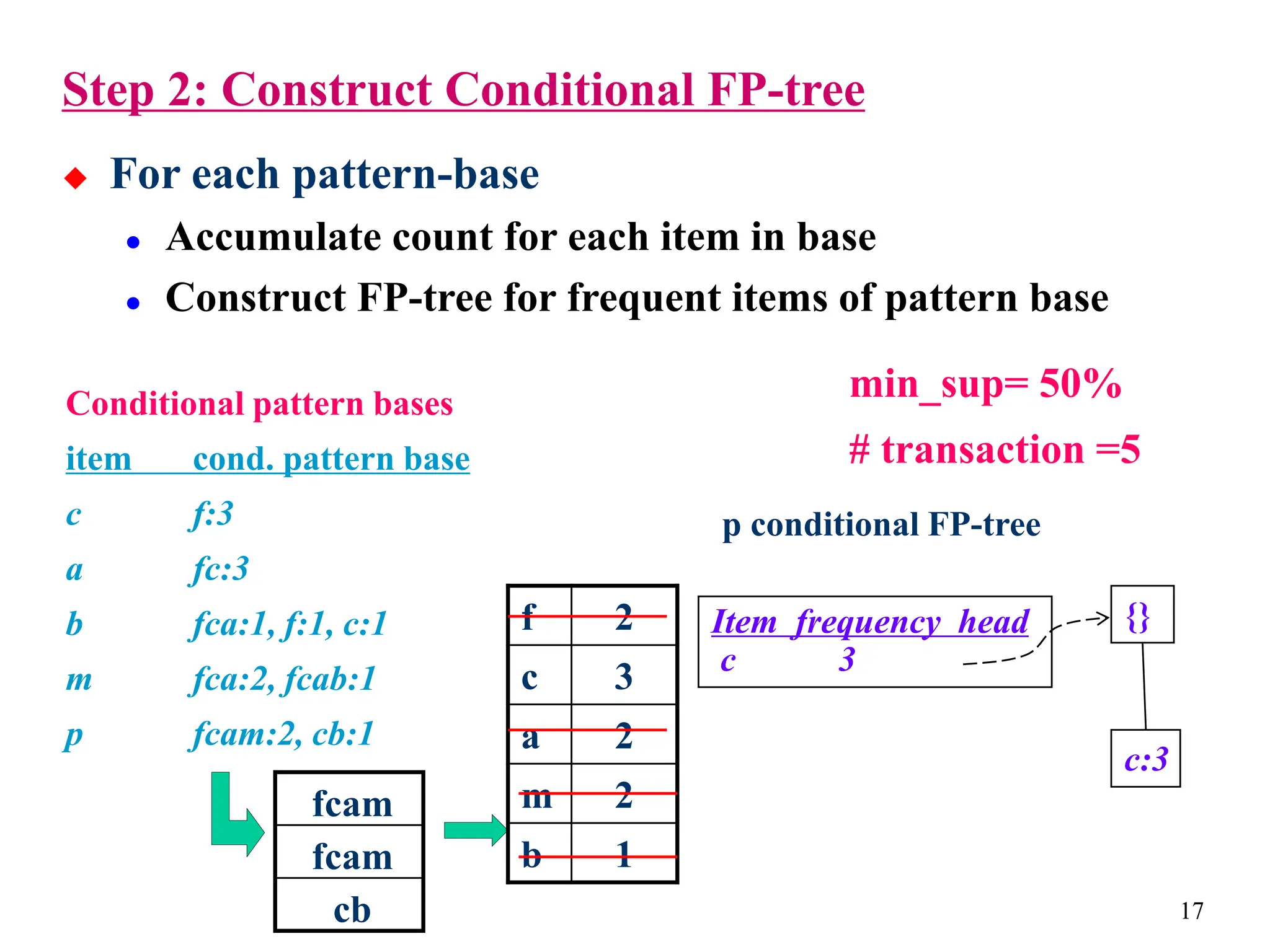
Step 2: Construct Conditional FP-tree
 For each pattern-base
 Accumulate count for each item in base
 Construct FP-tree for frequent items of pattern base
Conditional pattern bases
item cond. pattern base
c f:3
a fc:3
b fca:1, f:1, c:1
m fca:2, fcab:1
p fcam:2, cb:1
p conditional FP-tree
f 2
c 3
a 2
m 2
b 1
{}
c:3
Item frequency head
c 3
min_sup= 50%
# transaction =5
fcam
fcam
cb
18
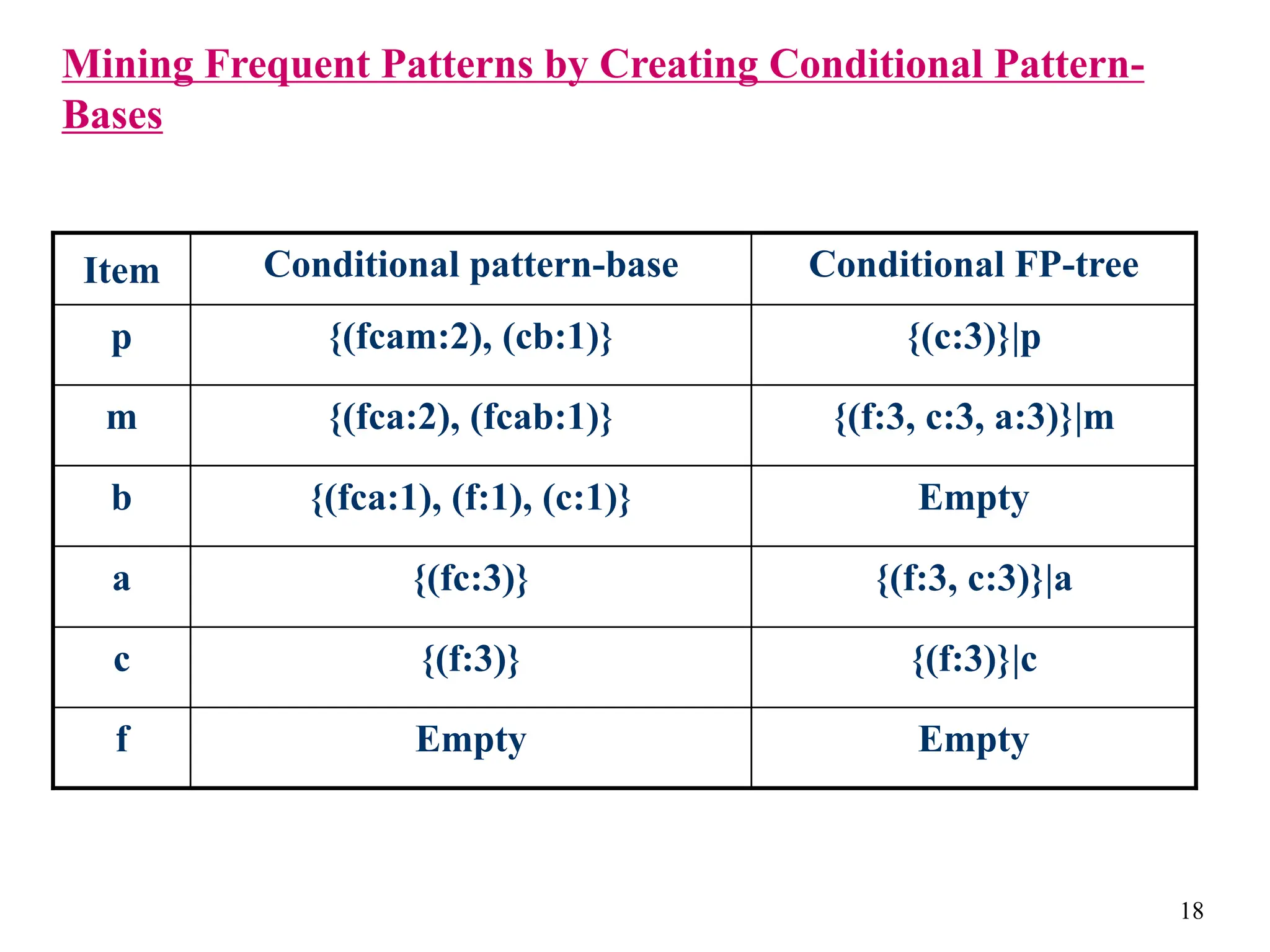
Mining Frequent Patterns by Creating Conditional Pattern-
Bases
Empty
Empty
f
{(f:3)}|c
{(f:3)}
c
{(f:3, c:3)}|a
{(fc:3)}
a
Empty
{(fca:1), (f:1), (c:1)}
b
{(f:3, c:3, a:3)}|m
{(fca:2), (fcab:1)}
m
{(c:3)}|p
{(fcam:2), (cb:1)}
p
Conditional FP-tree
Conditional pattern-base
Item
19
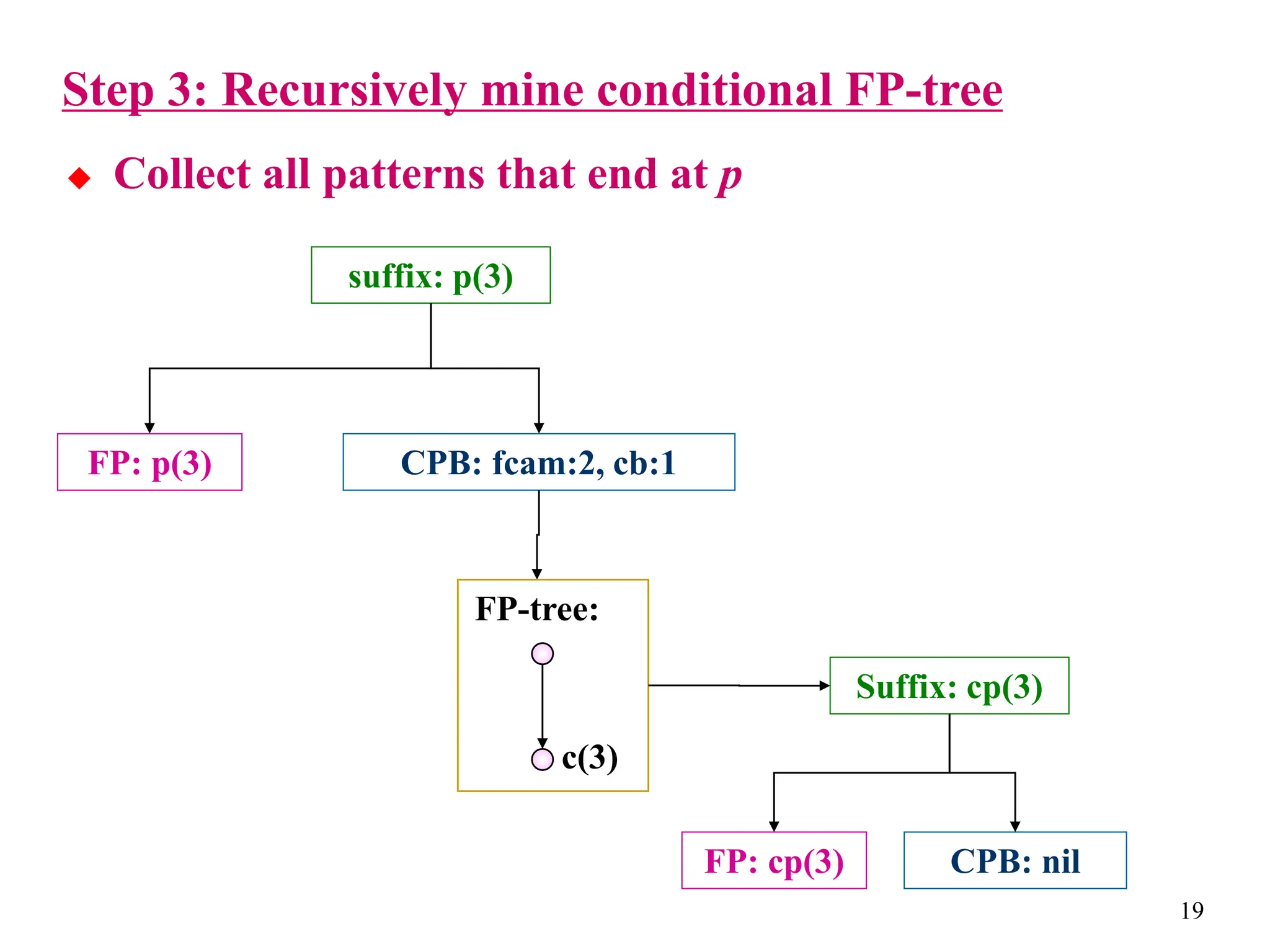
Step 3: Recursively mine conditional FP-tree
suffix: p(3)
FP: p(3) CPB: fcam:2, cb:1
c(3)
FP-tree:
Suffix: cp(3)
FP: cp(3) CPB: nil
 Collect all patterns that end at p
20
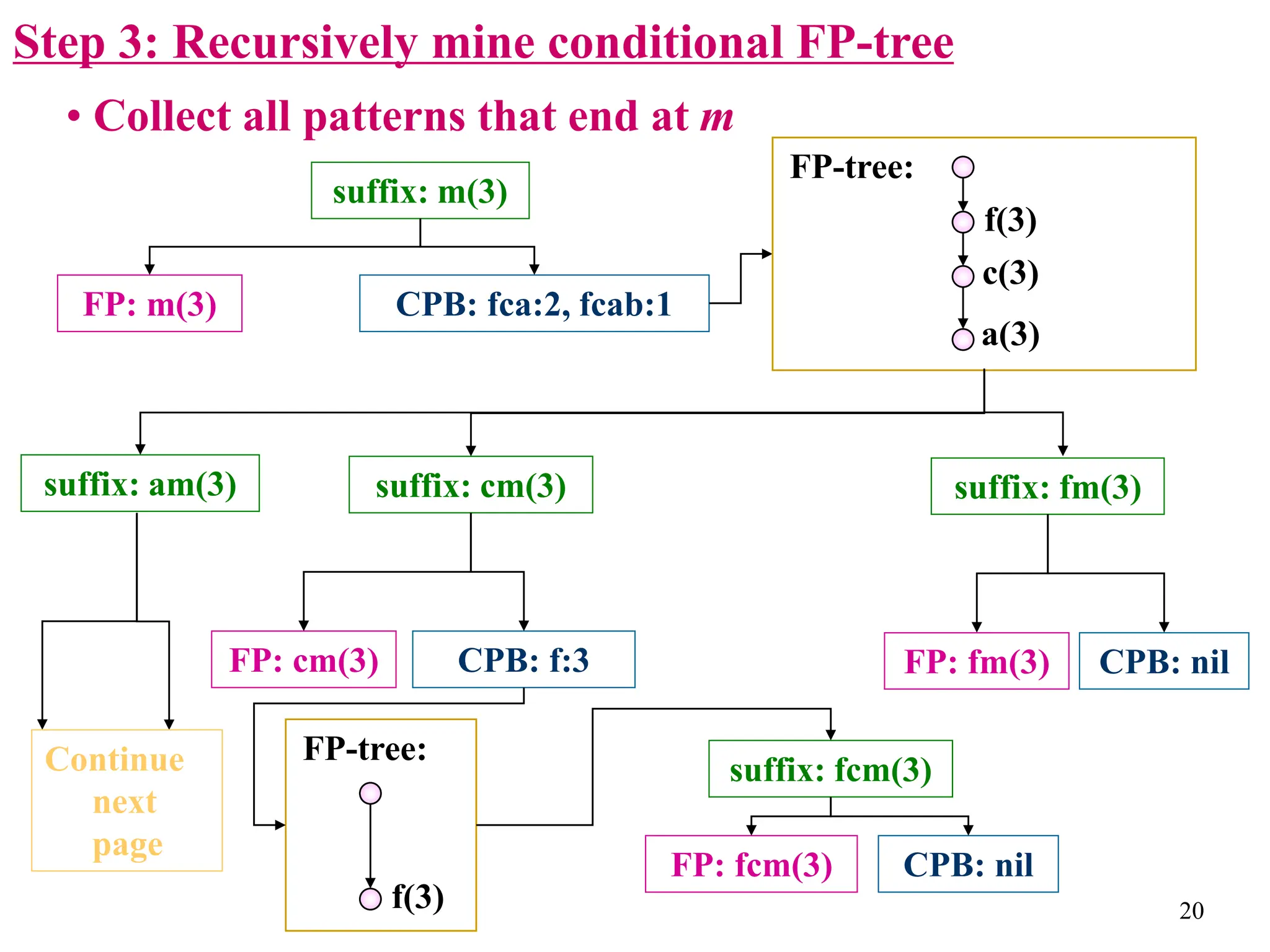
• Collect all patterns that end at m
suffix: m(3)
FP: m(3) CPB: fca:2, fcab:1
suffix: cm(3)
FP: cm(3) CPB: f:3
f(3)
FP-tree:
c(3)
suffix: fm(3)
FP: fm(3) CPB: nil
f(3)
FP-tree:
suffix: fcm(3)
FP: fcm(3) CPB: nil
a(3)
suffix: am(3)
Continue
next
page
Step 3: Recursively mine conditional FP-tree
21
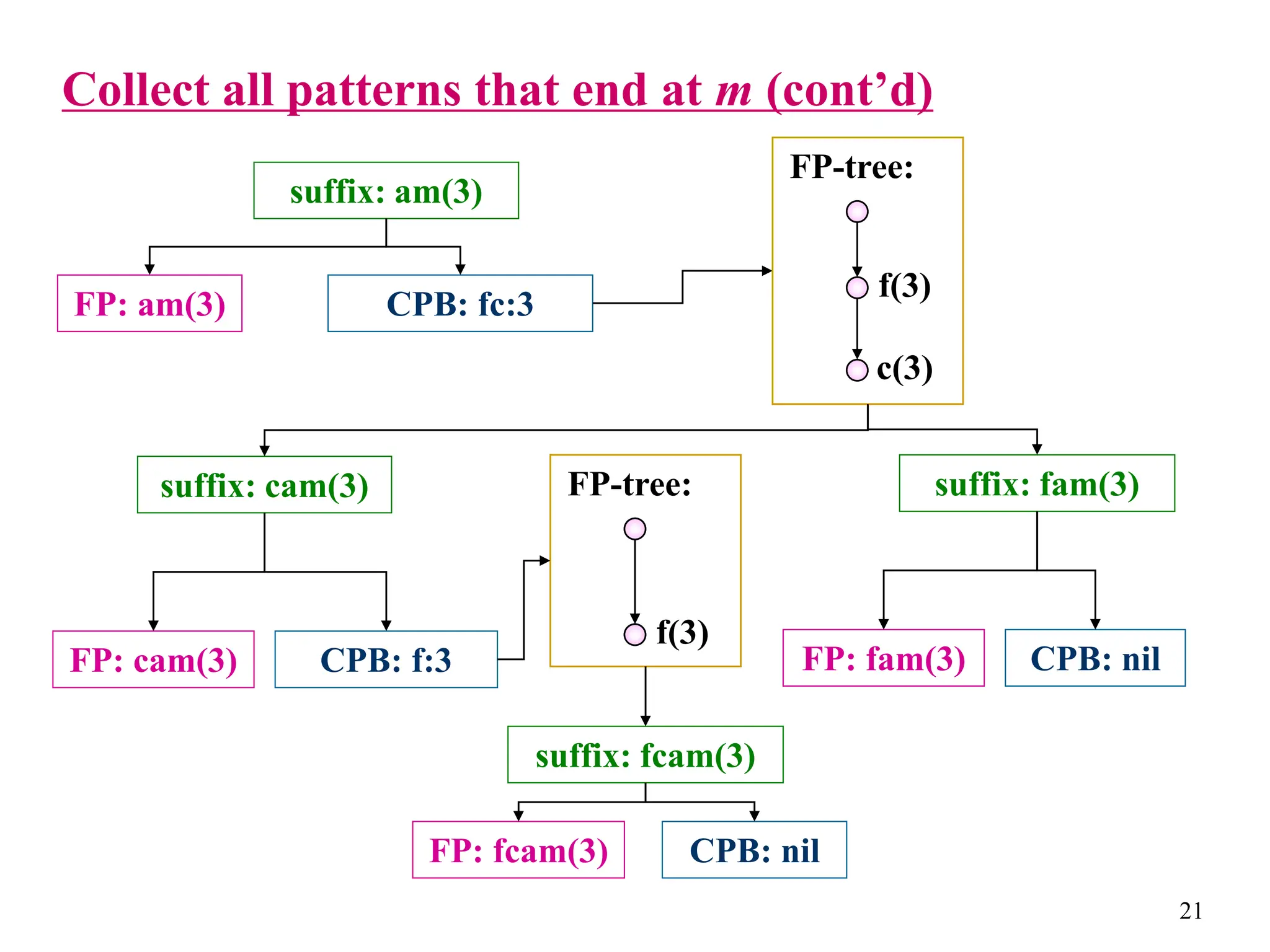
Collect all patterns that end at m (cont’d)
suffix: am(3)
FP: am(3) CPB: fc:3
suffix: cam(3)
FP: cam(3) CPB: f:3
f(3)
FP-tree:
c(3)
suffix: fam(3)
FP: fam(3) CPB: nil
f(3)
FP-tree:
suffix: fcam(3)
FP: fcam(3) CPB: nil
22
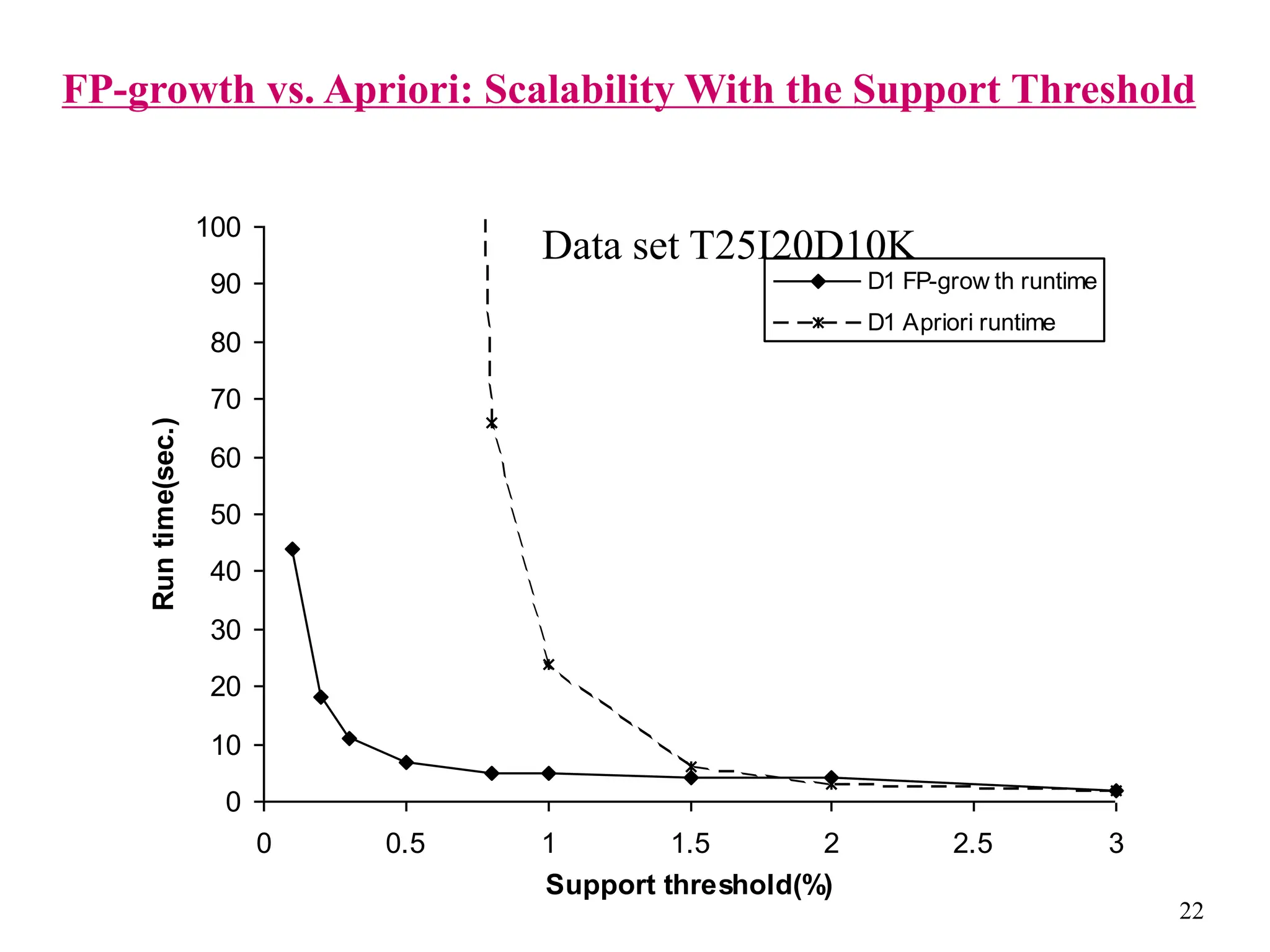
FP-growth vs. Apriori: Scalability With the Support Threshold
0
10
20
30
40
50
60
70
80
90
100
0 0.5 1 1.5 2 2.5 3
Support threshold(%)
Run
time(sec.)
D1 FP-grow th runtime
D1 Apriori runtime
Data set T25I20D10K
23
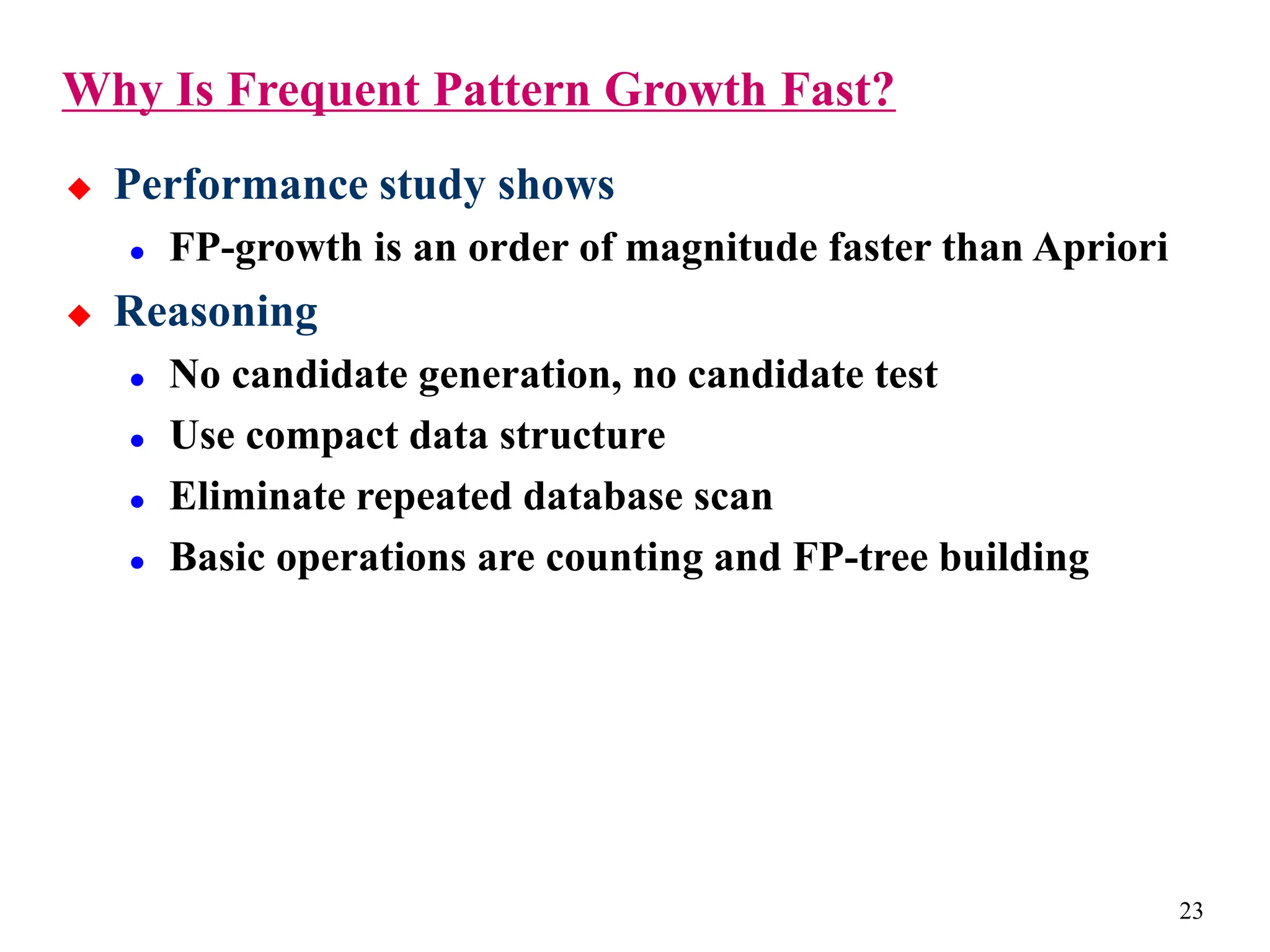
Why Is Frequent Pattern Growth Fast?
 Performance study shows
 FP-growth is an order of magnitude faster than Apriori
 Reasoning
 No candidate generation, no candidate test
 Use compact data structure
 Eliminate repeated database scan
 Basic operations are counting and FP-tree building
24
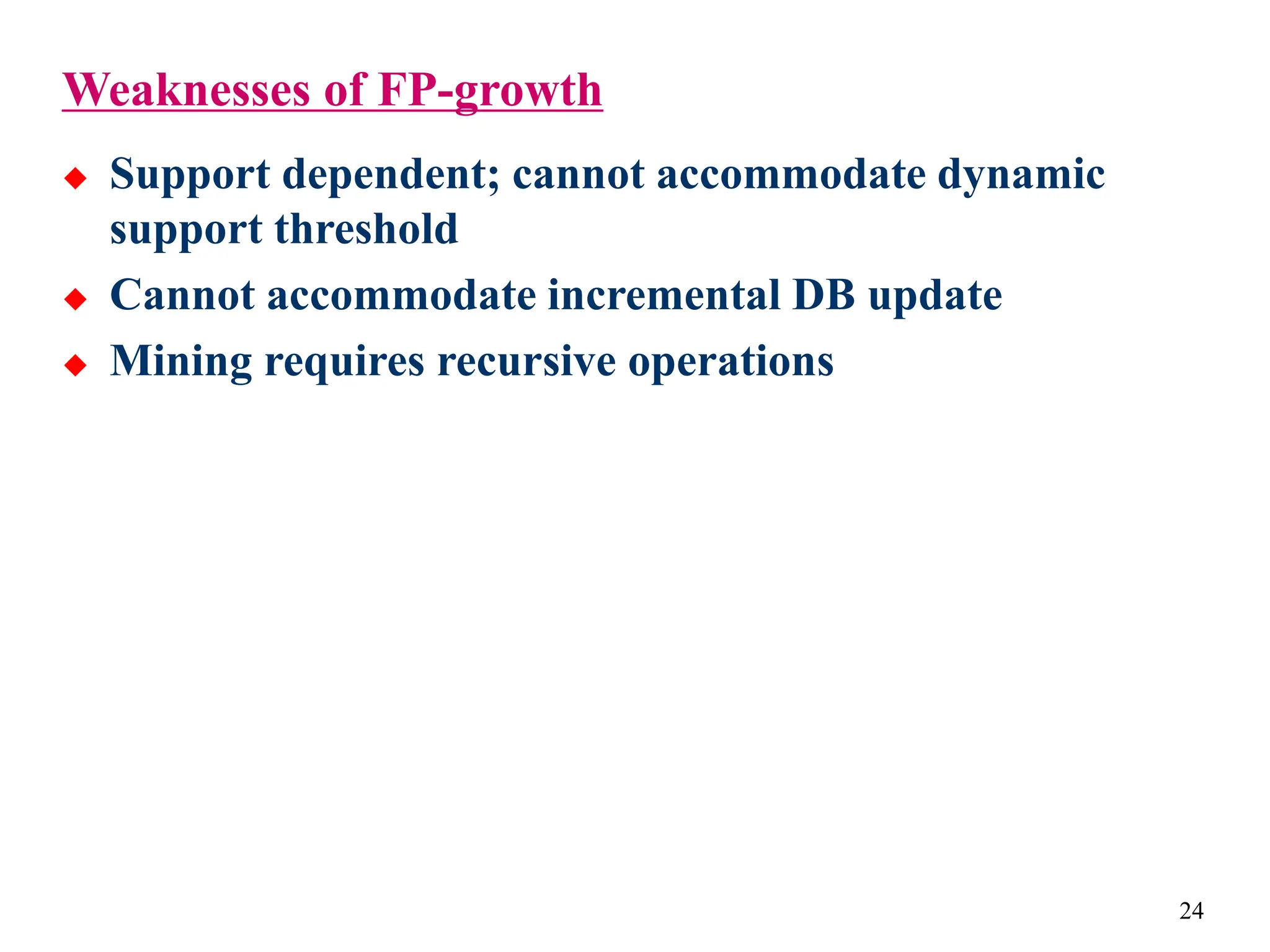
Weaknesses of FP-growth
 Support dependent; cannot accommodate dynamic
support threshold
 Cannot accommodate incremental DB update
 Mining requires recursive operations
25
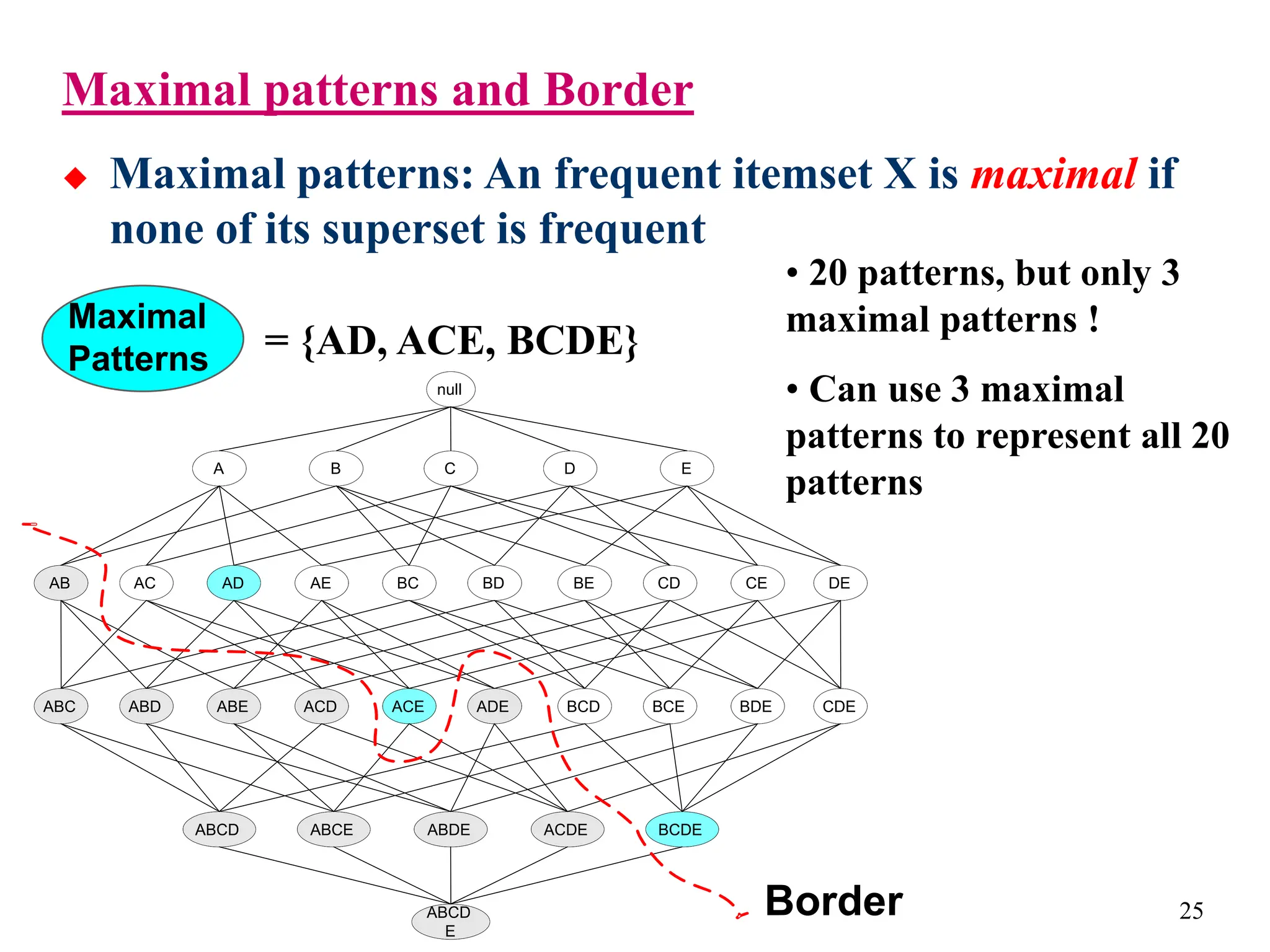
Maximal patterns and Border
 Maximal patterns: An frequent itemset X is maximal if
none of its superset is frequent
Maximal
Patterns
null
AB AC AD AE BC BD BE CD CE DE
A B C D E
ABC ABD ABE ACD ACE ADE BCD BCE BDE CDE
ABCD ABCE ABDE ACDE BCDE
ABCD
E
Border
= {AD, ACE, BCDE}
• 20 patterns, but only 3
maximal patterns !
• Can use 3 maximal
patterns to represent all 20
patterns
26
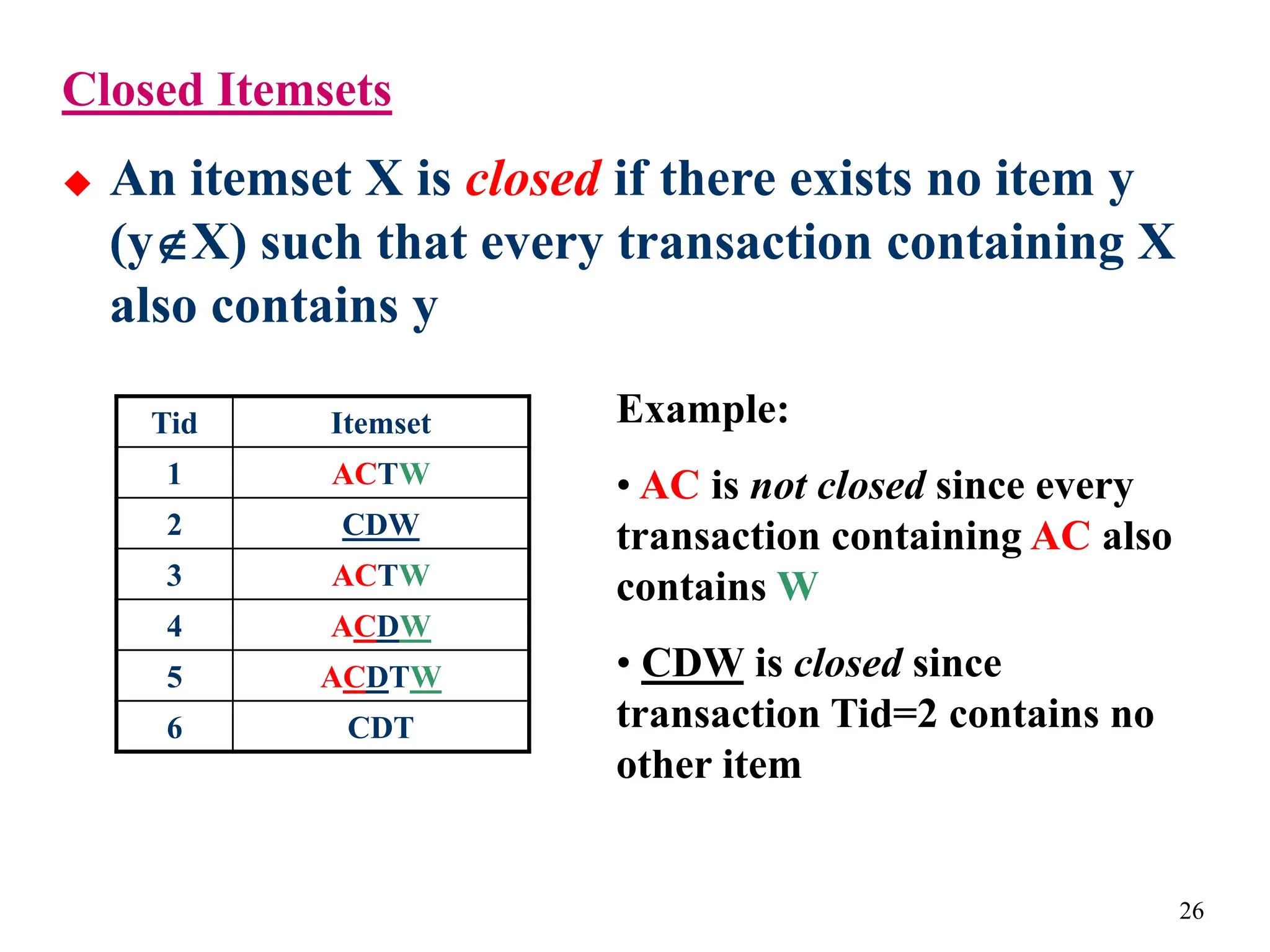
Closed Itemsets
 An itemset X is closed if there exists no item y
(yX) such that every transaction containing X
also contains y
Tid Itemset
1 ACTW
2 CDW
3 ACTW
4 ACDW
5 ACDTW
6 CDT
Example:
• AC is not closed since every
transaction containing AC also
contains W
• CDW is closed since
transaction Tid=2 contains no
other item
27
Frequent Closed Patterns
 For frequent itemset X, if there exists no item y s.t.
every transaction containing X also contains y, then X is
a frequent closed pattern
 “acdf” is a frequent closed pattern
 Concise rep. of freq pats
 Reduce # of patterns and rules
 N. Pasquier et al. In ICDT’99
TID Items
10 a, c, d, e, f
20 a, b, e
30 c, e, f
40 a, c, d, f
50 c, e, f
Min_sup=2

ARM_03_FPtreefrequency pattern data warehousing .ppt

  • 1.
  • 2.
    2 Bottleneck of Frequent-patternMining  Multiple database scans are costly  Mining long patterns needs many passes of scanning and generates lots of candidates  To find frequent itemset i1i2…i100  # of scans: 100  # of Candidates: (100 1) + (100 2) + … + (1 1 0 0 0 0) = 2100-1 = 1.27*1030 !  Bottleneck: candidate-generation-and-test  Can we avoid candidate generation?
  • 3.
    3  Grow longpatterns from short ones using local frequent items  “abc” is a frequent pattern  Get all transactions having “abc”: DB|abc (projected database on abc)  “d” is a local frequent item in DB|abc  abcd is a frequent pattern  Get all transactions having “abcd” (projected database on “abcd”) and find longer itemsets Mining Freq Patterns w/o Candidate Generation
  • 4.
    4 Mining Freq Patternsw/o Candidate Generation  Compress a large database into a compact, Frequent- Pattern tree (FP-tree) structure  Highly condensed, but complete for frequent pattern mining  Avoid costly database scans  Develop an efficient, FP-tree-based frequent pattern mining method  A divide-and-conquer methodology: decompose mining tasks into smaller ones  Avoid candidate generation: examine sub-database (conditional pattern base) only!
  • 5.
    5 Construct FP-tree froma Transaction DB min_sup= 50% TIDItems bought (ordered) frequent items 100 {f, a, c, d, g, i, m, p} {f, c, a, m, p} 200 {a, b, c, f, l, m, o} {f, c, a, b, m} 300 {b, f, h, j, o} {f, b} 400 {b, c, k, s, p} {c, b, p} 500 {a, f, c, e, l, p, m, n} {f, c, a, m, p} Steps: 1. Scan DB once, find frequent 1-itemset (single item pattern) 2. Order frequent items in frequency descending order: f, c, a, b, m, p (L-order) 3. Process DB based on L- order a 3 i 1 b 3 j 1 c 4 k 1 d 1 l 2 e 1 m 3 f 4 n 1 g 1 o 2 h 1 p 3
  • 6.
    6 Construct FP-tree froma Transaction DB {} Header Table Item frequency head f 0 nil c 0 nil a 0 nil b 0 nil m 0 nil p 0 nil TIDItems bought (ordered) frequent items 100 {f, a, c, d, g, i, m, p} {f, c, a, m, p} 200 {a, b, c, f, l, m, o} {f, c, a, b, m} 300 {b, f, h, j, o} {f, b} 400 {b, c, k, s, p} {c, b, p} 500 {a, f, c, e, l, p, m, n} {f, c, a, m, p} Initial FP-tree
  • 7.
    7 Construct FP-tree froma Transaction DB {} f:1 c:1 a:1 m:1 p:1 Header Table Item frequency head f 1 c 1 a 1 b 0 nil m 1 p 1 TIDItems bought (ordered) frequent items 100 {f, a, c, d, g, i, m, p} {f, c, a, m, p} 200 {a, b, c, f, l, m, o} {f, c, a, b, m} 300 {b, f, h, j, o} {f, b} 400 {b, c, k, s, p} {c, b, p} 500 {a, f, c, e, l, p, m, n} {f, c, a, m, p} Insert {f, c, a, m, p}
  • 8.
    8 Construct FP-tree froma Transaction DB {} f:2 c2 a:2 b:1 m:1 p:1 m:1 Header Table Item frequency head f 2 c 2 a 2 b 1 m 2 p 1 TIDItems bought (ordered) frequent items 100 {f, a, c, d, g, i, m, p} {f, c, a, m, p} 200 {a, b, c, f, l, m, o} {f, c, a, b, m} 300 {b, f, h, j, o} {f, b} 400 {b, c, k, s, p} {c, b, p} 500 {a, f, c, e, l, p, m, n} {f, c, a, m, p} Insert {f, c, a, b, m}
  • 9.
    9 Construct FP-tree froma Transaction DB {} f:3 b:1 c:2 a:2 b:1 m:1 p:1 m:1 Header Table Item frequency head f 3 c 2 a 2 b 2 m 2 p 1 TIDItems bought (ordered) frequent items 100 {f, a, c, d, g, i, m, p} {f, c, a, m, p} 200 {a, b, c, f, l, m, o}{f, c, a, b, m} 300 {b, f, h, j, o} {f, b} 400 {b, c, k, s, p} {c, b, p} 500 {a, f, c, e, l, p, m, n} {f, c, a, m, p} Insert {f, b}
  • 10.
    10 Construct FP-tree froma Transaction DB {} f:3 c:1 b:1 p:1 b:1 c:2 a:2 b:1 m:1 p:1 m:1 Header Table Item frequency head f 3 c 3 a 2 b 3 m 2 p 2 TIDItems bought (ordered) frequent items 100 {f, a, c, d, g, i, m, p} {f, c, a, m, p} 200 {a, b, c, f, l, m, o}{f, c, a, b, m} 300 {b, f, h, j, o} {f, b} 400 {b, c, k, s, p} {c, b, p} 500 {a, f, c, e, l, p, m, n} {f, c, a, m, p} Insert {c, b, p}
  • 11.
    11 Construct FP-tree froma Transaction DB {} f:4 c:1 b:1 p:1 b:1 c:3 a:3 b:1 m:2 p:2 m:1 Header Table Item frequency head f 4 c 4 a 3 b 3 m 3 p 3 TIDItems bought (ordered) frequent items 100 {f, a, c, d, g, i, m, p} {f, c, a, m, p} 200 {a, b, c, f, l, m, o}{f, c, a, b, m} 300 {b, f, h, j, o} {f, b} 400 {b, c, k, s, p} {c, b, p} 500 {a, f, c, e, l, p, m, n} {f, c, a, m, p} Insert {f, c, a, m, p}
  • 12.
    12 Benefits of FP-treeStructure  Completeness:  Preserve complete DB information for frequent pattern mining (given prior min support)  Each transaction mapped to one FP-tree path; counts stored at each node  Compactness  One FP-tree path may correspond to multiple transactions; tree is never larger than original database (if not count node-links and counts)  Reduce irrelevant information—infrequent items are gone  Frequency-descending ordering: more frequent items are closer to tree top and more likely to be shared
  • 13.
    13 How Effective IsFP-tree? 1 10 100 1000 10000 100000 0% 20% 40% 60% 80% 100% Support threshold Size (K) Alphabetical FP-tree Ordered FP-tree Tran. DB Freq. Tran. DB Dataset: Connect-4 (a dense dataset)
  • 14.
    14 Mining Frequent PatternsUsing FP-tree  General idea (divide-and-conquer)  Recursively grow frequent pattern path using FP-tree  Frequent patterns can be partitioned into subsets according to L-order  L-order=f-c-a-b-m-p  Patterns containing p  Patterns having m but no p  Patterns having b but no m or p  …  Patterns having c but no a nor b, m, p  Pattern f
  • 15.
    15 Mining Frequent PatternsUsing FP-tree  Step 1 : Construct conditional pattern base for each item in header table  Step 2: Construct conditional FP-tree from each conditional pattern-base  Step 3: Recursively mine conditional FP-trees and grow frequent patterns obtained so far  If conditional FP-tree contains a single path, simply enumerate all patterns
  • 16.
    16 Step 1: ConstructConditional Pattern Base  Starting at header table of FP-tree  Traverse FP-tree by following link of each frequent item  Accumulate all transformed prefix paths of item to form a conditional pattern base Conditional pattern bases item cond. pattern base c f:3 a fc:3 b fca:1, f:1, c:1 m fca:2, fcab:1 p fcam:2, cb:1 {} f:4 c:1 b:1 p:1 b:1 c:3 a:3 b:1 m:2 p:2 m:1 Header Table Item frequency head f 4 c 4 a 3 b 3 m 3 p 3
  • 17.
    17 Step 2: ConstructConditional FP-tree  For each pattern-base  Accumulate count for each item in base  Construct FP-tree for frequent items of pattern base Conditional pattern bases item cond. pattern base c f:3 a fc:3 b fca:1, f:1, c:1 m fca:2, fcab:1 p fcam:2, cb:1 p conditional FP-tree f 2 c 3 a 2 m 2 b 1 {} c:3 Item frequency head c 3 min_sup= 50% # transaction =5 fcam fcam cb
  • 18.
    18 Mining Frequent Patternsby Creating Conditional Pattern- Bases Empty Empty f {(f:3)}|c {(f:3)} c {(f:3, c:3)}|a {(fc:3)} a Empty {(fca:1), (f:1), (c:1)} b {(f:3, c:3, a:3)}|m {(fca:2), (fcab:1)} m {(c:3)}|p {(fcam:2), (cb:1)} p Conditional FP-tree Conditional pattern-base Item
  • 19.
    19 Step 3: Recursivelymine conditional FP-tree suffix: p(3) FP: p(3) CPB: fcam:2, cb:1 c(3) FP-tree: Suffix: cp(3) FP: cp(3) CPB: nil  Collect all patterns that end at p
  • 20.
    20 • Collect allpatterns that end at m suffix: m(3) FP: m(3) CPB: fca:2, fcab:1 suffix: cm(3) FP: cm(3) CPB: f:3 f(3) FP-tree: c(3) suffix: fm(3) FP: fm(3) CPB: nil f(3) FP-tree: suffix: fcm(3) FP: fcm(3) CPB: nil a(3) suffix: am(3) Continue next page Step 3: Recursively mine conditional FP-tree
  • 21.
    21 Collect all patternsthat end at m (cont’d) suffix: am(3) FP: am(3) CPB: fc:3 suffix: cam(3) FP: cam(3) CPB: f:3 f(3) FP-tree: c(3) suffix: fam(3) FP: fam(3) CPB: nil f(3) FP-tree: suffix: fcam(3) FP: fcam(3) CPB: nil
  • 22.
    22 FP-growth vs. Apriori:Scalability With the Support Threshold 0 10 20 30 40 50 60 70 80 90 100 0 0.5 1 1.5 2 2.5 3 Support threshold(%) Run time(sec.) D1 FP-grow th runtime D1 Apriori runtime Data set T25I20D10K
  • 23.
    23 Why Is FrequentPattern Growth Fast?  Performance study shows  FP-growth is an order of magnitude faster than Apriori  Reasoning  No candidate generation, no candidate test  Use compact data structure  Eliminate repeated database scan  Basic operations are counting and FP-tree building
  • 24.
    24 Weaknesses of FP-growth Support dependent; cannot accommodate dynamic support threshold  Cannot accommodate incremental DB update  Mining requires recursive operations
  • 25.
    25 Maximal patterns andBorder  Maximal patterns: An frequent itemset X is maximal if none of its superset is frequent Maximal Patterns null AB AC AD AE BC BD BE CD CE DE A B C D E ABC ABD ABE ACD ACE ADE BCD BCE BDE CDE ABCD ABCE ABDE ACDE BCDE ABCD E Border = {AD, ACE, BCDE} • 20 patterns, but only 3 maximal patterns ! • Can use 3 maximal patterns to represent all 20 patterns
  • 26.
    26 Closed Itemsets  Anitemset X is closed if there exists no item y (yX) such that every transaction containing X also contains y Tid Itemset 1 ACTW 2 CDW 3 ACTW 4 ACDW 5 ACDTW 6 CDT Example: • AC is not closed since every transaction containing AC also contains W • CDW is closed since transaction Tid=2 contains no other item
  • 27.
    27 Frequent Closed Patterns For frequent itemset X, if there exists no item y s.t. every transaction containing X also contains y, then X is a frequent closed pattern  “acdf” is a frequent closed pattern  Concise rep. of freq pats  Reduce # of patterns and rules  N. Pasquier et al. In ICDT’99 TID Items 10 a, c, d, e, f 20 a, b, e 30 c, e, f 40 a, c, d, f 50 c, e, f Min_sup=2