Prof. Neeraj Bhargava
Vishal Dutt
Department of Computer Science, School of
Engineering & System Sciences
MDS University, Ajmer
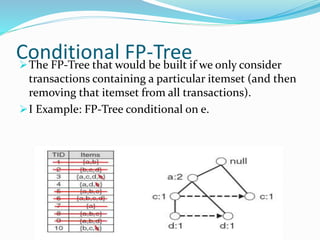
Conditional FP-TreeThe FP-Tree that would be built if we only consider
transactions containing a particular itemset (and then
removing that itemset from all transactions).
I Example: FP-Tree conditional on e.
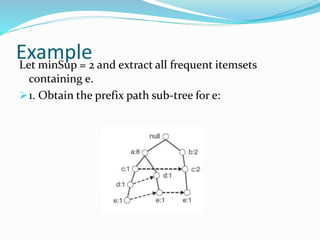
ExampleLet minSup = 2 and extract all frequent itemsets
containing e.
1. Obtain the prefix path sub-tree for e:
Example
2. Check if e is a frequent item by adding the counts
along the linked list (dotted line). If so, extract it.
 Yes, count =3 so {e} is extracted as a frequent itemset.
3. As e is frequent, find frequent itemsets ending in e.
i.e. de, ce, be and ae.
Example
4. Use the the conditional FP-tree for e to find
frequent itemsets ending in de, ce and ae
 Note that be is not considered as b is not in the
conditional FP-tree for e.
 I For each of them (e.g. de), find the prefix paths from
the conditional tree for e, extract frequent itemsets,
generate conditional FP-tree, etc... (recursive)
Example
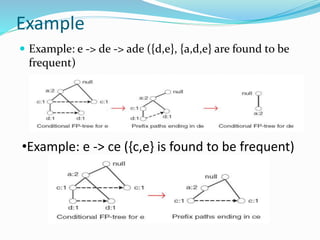
 Example: e -> de -> ade ({d,e}, {a,d,e} are found to be
frequent)
•Example: e -> ce ({c,e} is found to be frequent)
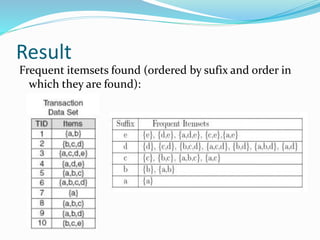
Result
Frequent itemsets found (ordered by sufix and order in
which they are found):
Discusion
Advantages of FP-Growth
 only 2 passes over data-set
 “compresses” data-set
 no candidate generation
 much faster than Apriori
Disadvantages of FP-Growth
 FP-Tree may not fit in memory!!
 FP-Tree is expensive to build

22 FP Tree

  • 1.
    Prof. Neeraj Bhargava VishalDutt Department of Computer Science, School of Engineering & System Sciences MDS University, Ajmer
  • 2.
    Conditional FP-TreeThe FP-Treethat would be built if we only consider transactions containing a particular itemset (and then removing that itemset from all transactions). I Example: FP-Tree conditional on e.
  • 3.
    ExampleLet minSup =2 and extract all frequent itemsets containing e. 1. Obtain the prefix path sub-tree for e:
  • 4.
    Example 2. Check ife is a frequent item by adding the counts along the linked list (dotted line). If so, extract it.  Yes, count =3 so {e} is extracted as a frequent itemset. 3. As e is frequent, find frequent itemsets ending in e. i.e. de, ce, be and ae.
  • 5.
    Example 4. Use thethe conditional FP-tree for e to find frequent itemsets ending in de, ce and ae  Note that be is not considered as b is not in the conditional FP-tree for e.  I For each of them (e.g. de), find the prefix paths from the conditional tree for e, extract frequent itemsets, generate conditional FP-tree, etc... (recursive)
  • 6.
    Example  Example: e-> de -> ade ({d,e}, {a,d,e} are found to be frequent) •Example: e -> ce ({c,e} is found to be frequent)
  • 7.
    Result Frequent itemsets found(ordered by sufix and order in which they are found):
  • 8.
    Discusion Advantages of FP-Growth only 2 passes over data-set  “compresses” data-set  no candidate generation  much faster than Apriori Disadvantages of FP-Growth  FP-Tree may not fit in memory!!  FP-Tree is expensive to build