1
Decision Tree Induction
2
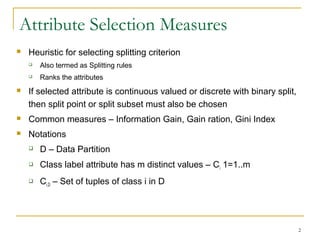
Attribute Selection Measures
 Heuristic for selecting splitting criterion
 Also termed as Splitting rules
 Ranks the attributes
 If selected attribute is continuous valued or discrete with binary split,
then split point or split subset must also be chosen
 Common measures – Information Gain, Gain ration, Gini Index
 Notations
 D – Data Partition
 Class label attribute has m distinct values – Ci 1=1..m
 Ci,D – Set of tuples of class i in D
3
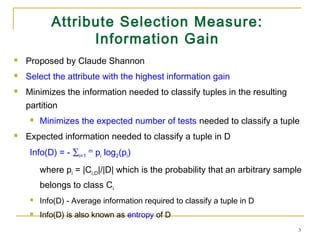
Attribute Selection Measure:
Information Gain
 Proposed by Claude Shannon
 Select the attribute with the highest information gain
 Minimizes the information needed to classify tuples in the resulting
partition
 Minimizes the expected number of tests needed to classify a tuple
 Expected information needed to classify a tuple in D
Info(D) = - ∑i=1
m
pi log2(pi)
where pi = |Ci,D|/|D| which is the probability that an arbitrary sample
belongs to class Ci
 Info(D) - Average information required to classify a tuple in D
 Info(D) is also known as entropy of D
4
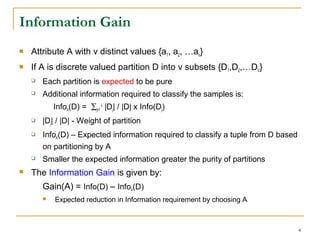
Information Gain
 Attribute A with v distinct values {a1, a2, …av}
 If A is discrete valued partition D into v subsets {D1,D2,…DV}
 Each partition is expected to be pure
 Additional information required to classify the samples is:
InfoA(D) = ∑j=1
v
|Dj| / |D| x Info(Dj)
 |Dj| / |D| - Weight of partition
 InfoA(D) – Expected information required to classify a tuple from D based
on partitioning by A
 Smaller the expected information greater the purity of partitions
 The Information Gain is given by:
Gain(A) = Info(D) – InfoA(D)
 Expected reduction in Information requirement by choosing A
5
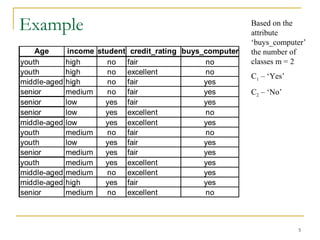
Example
Age income student credit_rating buys_computer
youth high no fair no
youth high no excellent no
middle-aged high no fair yes
senior medium no fair yes
senior low yes fair yes
senior low yes excellent no
middle-aged low yes excellent yes
youth medium no fair no
youth low yes fair yes
senior medium yes fair yes
youth medium yes excellent yes
middle-aged medium no excellent yes
middle-aged high yes fair yes
senior medium no excellent no
Based on the
attribute
‘buys_computer’
the number of
classes m = 2
C1 – ‘Yes’
C2 – ‘No’
6
Example
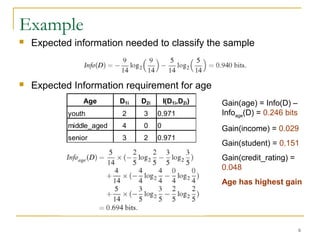
 Expected information needed to classify the sample
 Expected Information requirement for age
Age D1i D2i I(D1i,D2i)
youth 2 3 0.971
middle_aged 4 0 0
senior 3 2 0.971
Gain(age) = Info(D) –
Infoage(D) = 0.246 bits
Gain(income) = 0.029
Gain(student) = 0.151
Gain(credit_rating) =
0.048
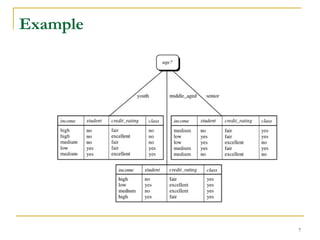
Age has highest gain
7
Example
8
Information-Gain for Continuous-Value Attributes
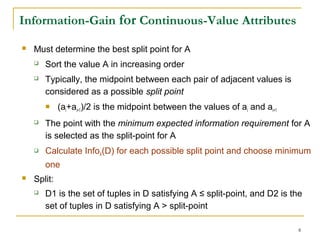
 Must determine the best split point for A
 Sort the value A in increasing order
 Typically, the midpoint between each pair of adjacent values is
considered as a possible split point
 (ai+ai+1)/2 is the midpoint between the values of ai and ai+1
 The point with the minimum expected information requirement for A
is selected as the split-point for A
 Calculate InfoA(D) for each possible split point and choose minimum
one
 Split:
 D1 is the set of tuples in D satisfying A ≤ split-point, and D2 is the
set of tuples in D satisfying A > split-point
9
Gain Ratio for Attribute Selection
 Information gain measure is biased towards attributes with a large
number of values
 Results in more number of partitions - pure
 C4.5 (a successor of ID3) uses gain ratio to overcome the problem
(normalization to information gain)
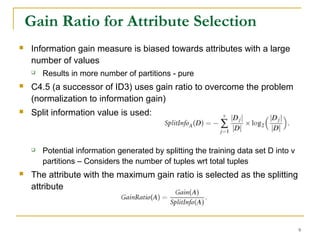
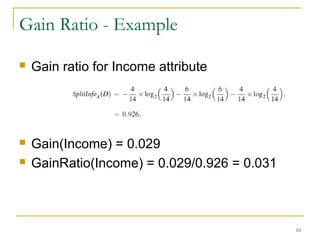
 Split information value is used:
 Potential information generated by splitting the training data set D into v
partitions – Considers the number of tuples wrt total tuples
 The attribute with the maximum gain ratio is selected as the splitting
attribute
10
Gain Ratio - Example
 Gain ratio for Income attribute
 Gain(Income) = 0.029
 GainRatio(Income) = 0.029/0.926 = 0.031
11
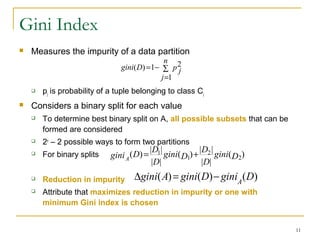
Gini Index
 Measures the impurity of a data partition
 pj is probability of a tuple belonging to class Cj
 Considers a binary split for each value
 To determine best binary split on A, all possible subsets that can be
formed are considered
 2v
– 2 possible ways to form two partitions
 For binary splits
 Reduction in impurity
 Attribute that maximizes reduction in impurity or one with
minimum Gini index is chosen
∑
=
−=
n
j
p jDgini
1
21)(
)(
||
||
)(
||
||
)( 2
2
1
1
Dgini
D
D
Dgini
D
D
DginiA
+=
)()()( DginiDginiAgini A
−=∆
12
Gini index
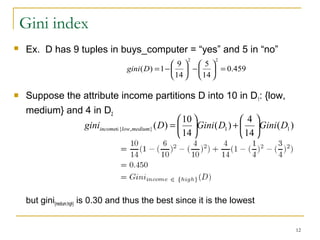
 Ex. D has 9 tuples in buys_computer = “yes” and 5 in “no”
 Suppose the attribute income partitions D into 10 in D1: {low,
medium} and 4 in D2
but gini{medium,high} is 0.30 and thus the best since it is the lowest
459.0
14
5
14
9
1)(
22
=





−





−=Dgini
)(
14
4
)(
14
10
)( 11},{ DGiniDGiniDgini mediumlowincome 





+





=∈
13
Attribute Selection Measures
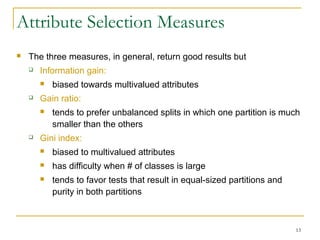
 The three measures, in general, return good results but
 Information gain:
 biased towards multivalued attributes
 Gain ratio:
 tends to prefer unbalanced splits in which one partition is much
smaller than the others
 Gini index:
 biased to multivalued attributes
 has difficulty when # of classes is large
 tends to favor tests that result in equal-sized partitions and
purity in both partitions
14
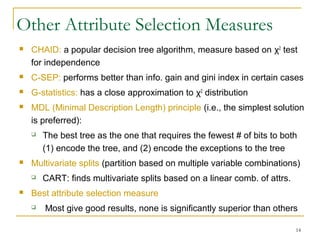
Other Attribute Selection Measures
 CHAID: a popular decision tree algorithm, measure based on χ2
test
for independence
 C-SEP: performs better than info. gain and gini index in certain cases
 G-statistics: has a close approximation to χ2
distribution
 MDL (Minimal Description Length) principle (i.e., the simplest solution
is preferred):
 The best tree as the one that requires the fewest # of bits to both
(1) encode the tree, and (2) encode the exceptions to the tree
 Multivariate splits (partition based on multiple variable combinations)
 CART: finds multivariate splits based on a linear comb. of attrs.
 Best attribute selection measure
 Most give good results, none is significantly superior than others
15
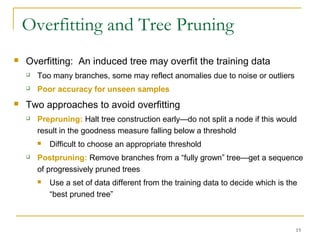
Overfitting and Tree Pruning
 Overfitting: An induced tree may overfit the training data
 Too many branches, some may reflect anomalies due to noise or outliers
 Poor accuracy for unseen samples
 Two approaches to avoid overfitting
 Prepruning: Halt tree construction early—do not split a node if this would
result in the goodness measure falling below a threshold
 Difficult to choose an appropriate threshold
 Postpruning: Remove branches from a “fully grown” tree—get a sequence
of progressively pruned trees
 Use a set of data different from the training data to decide which is the
“best pruned tree”
16
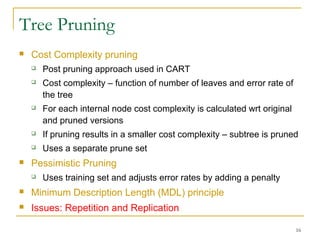
Tree Pruning
 Cost Complexity pruning
 Post pruning approach used in CART
 Cost complexity – function of number of leaves and error rate of
the tree
 For each internal node cost complexity is calculated wrt original
and pruned versions
 If pruning results in a smaller cost complexity – subtree is pruned
 Uses a separate prune set
 Pessimistic Pruning
 Uses training set and adjusts error rates by adding a penalty
 Minimum Description Length (MDL) principle
 Issues: Repetition and Replication
17
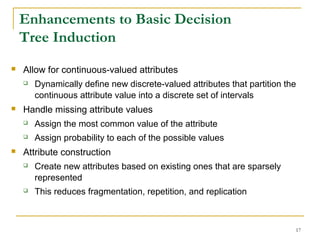
Enhancements to Basic Decision
Tree Induction
 Allow for continuous-valued attributes
 Dynamically define new discrete-valued attributes that partition the
continuous attribute value into a discrete set of intervals
 Handle missing attribute values
 Assign the most common value of the attribute
 Assign probability to each of the possible values
 Attribute construction
 Create new attributes based on existing ones that are sparsely
represented
 This reduces fragmentation, repetition, and replication
18
Scalability and Decision Tree Induction
 Scalability: Classifying data sets with millions of examples and
hundreds of attributes with reasonable speed
 Large scale databases – do not fit into memory
 Repeated Swapping of data – Inefficient
 Scalable Variants
 SLIQ, SPRINT
19
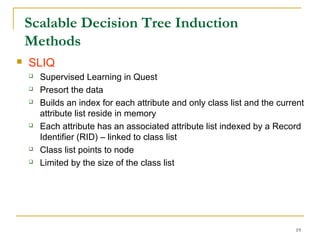
Scalable Decision Tree Induction
Methods
 SLIQ
 Supervised Learning in Quest
 Presort the data
 Builds an index for each attribute and only class list and the current
attribute list reside in memory
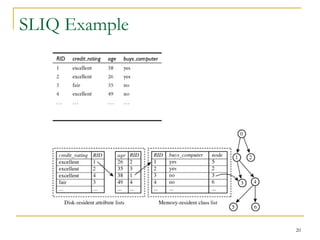
 Each attribute has an associated attribute list indexed by a Record
Identifier (RID) – linked to class list
 Class list points to node
 Limited by the size of the class list
20
SLIQ Example
21
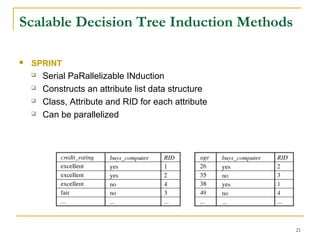
Scalable Decision Tree Induction Methods
 SPRINT
 Serial PaRallelizable INduction
 Constructs an attribute list data structure
 Class, Attribute and RID for each attribute
 Can be parallelized
22
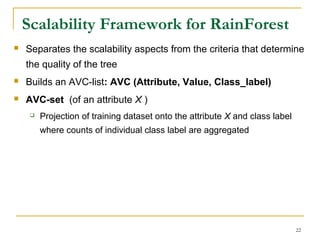
Scalability Framework for RainForest
 Separates the scalability aspects from the criteria that determine
the quality of the tree
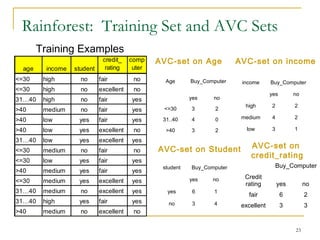
 Builds an AVC-list: AVC (Attribute, Value, Class_label)
 AVC-set (of an attribute X )
 Projection of training dataset onto the attribute X and class label
where counts of individual class label are aggregated
23
Rainforest: Training Set and AVC Sets
student Buy_Computer
yes no
yes 6 1
no 3 4
Age Buy_Computer
yes no
<=30 3 2
31..40 4 0
>40 3 2
Credit
rating
Buy_Computer
yes no
fair 6 2
excellent 3 3
age income student
credit_
rating
buys_
comp
uter
<=30 high no fair no
<=30 high no excellent no
31…40 high no fair yes
>40 medium no fair yes
>40 low yes fair yes
>40 low yes excellent no
31…40 low yes excellent yes
<=30 medium no fair no
<=30 low yes fair yes
>40 medium yes fair yes
<=30 medium yes excellent yes
31…40 medium no excellent yes
31…40 high yes fair yes
>40 medium no excellent no
AVC-set on incomeAVC-set on Age
AVC-set on Student
Training Examples
income Buy_Computer
yes no
high 2 2
medium 4 2
low 3 1
AVC-set on
credit_rating
24
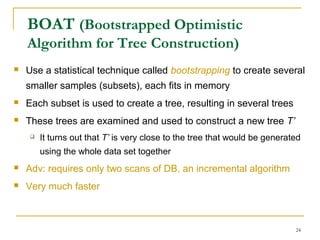
BOAT (Bootstrapped Optimistic
Algorithm for Tree Construction)
 Use a statistical technique called bootstrapping to create several
smaller samples (subsets), each fits in memory
 Each subset is used to create a tree, resulting in several trees
 These trees are examined and used to construct a new tree T’
 It turns out that T’ is very close to the tree that would be generated
using the whole data set together
 Adv: requires only two scans of DB, an incremental algorithm
 Very much faster

2.2 decision tree

  • 1.
  • 2.
    2 Attribute Selection Measures Heuristic for selecting splitting criterion  Also termed as Splitting rules  Ranks the attributes  If selected attribute is continuous valued or discrete with binary split, then split point or split subset must also be chosen  Common measures – Information Gain, Gain ration, Gini Index  Notations  D – Data Partition  Class label attribute has m distinct values – Ci 1=1..m  Ci,D – Set of tuples of class i in D
  • 3.
    3 Attribute Selection Measure: InformationGain  Proposed by Claude Shannon  Select the attribute with the highest information gain  Minimizes the information needed to classify tuples in the resulting partition  Minimizes the expected number of tests needed to classify a tuple  Expected information needed to classify a tuple in D Info(D) = - ∑i=1 m pi log2(pi) where pi = |Ci,D|/|D| which is the probability that an arbitrary sample belongs to class Ci  Info(D) - Average information required to classify a tuple in D  Info(D) is also known as entropy of D
  • 4.
    4 Information Gain  AttributeA with v distinct values {a1, a2, …av}  If A is discrete valued partition D into v subsets {D1,D2,…DV}  Each partition is expected to be pure  Additional information required to classify the samples is: InfoA(D) = ∑j=1 v |Dj| / |D| x Info(Dj)  |Dj| / |D| - Weight of partition  InfoA(D) – Expected information required to classify a tuple from D based on partitioning by A  Smaller the expected information greater the purity of partitions  The Information Gain is given by: Gain(A) = Info(D) – InfoA(D)  Expected reduction in Information requirement by choosing A
  • 5.
    5 Example Age income studentcredit_rating buys_computer youth high no fair no youth high no excellent no middle-aged high no fair yes senior medium no fair yes senior low yes fair yes senior low yes excellent no middle-aged low yes excellent yes youth medium no fair no youth low yes fair yes senior medium yes fair yes youth medium yes excellent yes middle-aged medium no excellent yes middle-aged high yes fair yes senior medium no excellent no Based on the attribute ‘buys_computer’ the number of classes m = 2 C1 – ‘Yes’ C2 – ‘No’
  • 6.
    6 Example  Expected informationneeded to classify the sample  Expected Information requirement for age Age D1i D2i I(D1i,D2i) youth 2 3 0.971 middle_aged 4 0 0 senior 3 2 0.971 Gain(age) = Info(D) – Infoage(D) = 0.246 bits Gain(income) = 0.029 Gain(student) = 0.151 Gain(credit_rating) = 0.048 Age has highest gain
  • 7.
  • 8.
    8 Information-Gain for Continuous-ValueAttributes  Must determine the best split point for A  Sort the value A in increasing order  Typically, the midpoint between each pair of adjacent values is considered as a possible split point  (ai+ai+1)/2 is the midpoint between the values of ai and ai+1  The point with the minimum expected information requirement for A is selected as the split-point for A  Calculate InfoA(D) for each possible split point and choose minimum one  Split:  D1 is the set of tuples in D satisfying A ≤ split-point, and D2 is the set of tuples in D satisfying A > split-point
  • 9.
    9 Gain Ratio forAttribute Selection  Information gain measure is biased towards attributes with a large number of values  Results in more number of partitions - pure  C4.5 (a successor of ID3) uses gain ratio to overcome the problem (normalization to information gain)  Split information value is used:  Potential information generated by splitting the training data set D into v partitions – Considers the number of tuples wrt total tuples  The attribute with the maximum gain ratio is selected as the splitting attribute
  • 10.
    10 Gain Ratio -Example  Gain ratio for Income attribute  Gain(Income) = 0.029  GainRatio(Income) = 0.029/0.926 = 0.031
  • 11.
    11 Gini Index  Measuresthe impurity of a data partition  pj is probability of a tuple belonging to class Cj  Considers a binary split for each value  To determine best binary split on A, all possible subsets that can be formed are considered  2v – 2 possible ways to form two partitions  For binary splits  Reduction in impurity  Attribute that maximizes reduction in impurity or one with minimum Gini index is chosen ∑ = −= n j p jDgini 1 21)( )( || || )( || || )( 2 2 1 1 Dgini D D Dgini D D DginiA += )()()( DginiDginiAgini A −=∆
  • 12.
    12 Gini index  Ex.D has 9 tuples in buys_computer = “yes” and 5 in “no”  Suppose the attribute income partitions D into 10 in D1: {low, medium} and 4 in D2 but gini{medium,high} is 0.30 and thus the best since it is the lowest 459.0 14 5 14 9 1)( 22 =      −      −=Dgini )( 14 4 )( 14 10 )( 11},{ DGiniDGiniDgini mediumlowincome       +      =∈
  • 13.
    13 Attribute Selection Measures The three measures, in general, return good results but  Information gain:  biased towards multivalued attributes  Gain ratio:  tends to prefer unbalanced splits in which one partition is much smaller than the others  Gini index:  biased to multivalued attributes  has difficulty when # of classes is large  tends to favor tests that result in equal-sized partitions and purity in both partitions
  • 14.
    14 Other Attribute SelectionMeasures  CHAID: a popular decision tree algorithm, measure based on χ2 test for independence  C-SEP: performs better than info. gain and gini index in certain cases  G-statistics: has a close approximation to χ2 distribution  MDL (Minimal Description Length) principle (i.e., the simplest solution is preferred):  The best tree as the one that requires the fewest # of bits to both (1) encode the tree, and (2) encode the exceptions to the tree  Multivariate splits (partition based on multiple variable combinations)  CART: finds multivariate splits based on a linear comb. of attrs.  Best attribute selection measure  Most give good results, none is significantly superior than others
  • 15.
    15 Overfitting and TreePruning  Overfitting: An induced tree may overfit the training data  Too many branches, some may reflect anomalies due to noise or outliers  Poor accuracy for unseen samples  Two approaches to avoid overfitting  Prepruning: Halt tree construction early—do not split a node if this would result in the goodness measure falling below a threshold  Difficult to choose an appropriate threshold  Postpruning: Remove branches from a “fully grown” tree—get a sequence of progressively pruned trees  Use a set of data different from the training data to decide which is the “best pruned tree”
  • 16.
    16 Tree Pruning  CostComplexity pruning  Post pruning approach used in CART  Cost complexity – function of number of leaves and error rate of the tree  For each internal node cost complexity is calculated wrt original and pruned versions  If pruning results in a smaller cost complexity – subtree is pruned  Uses a separate prune set  Pessimistic Pruning  Uses training set and adjusts error rates by adding a penalty  Minimum Description Length (MDL) principle  Issues: Repetition and Replication
  • 17.
    17 Enhancements to BasicDecision Tree Induction  Allow for continuous-valued attributes  Dynamically define new discrete-valued attributes that partition the continuous attribute value into a discrete set of intervals  Handle missing attribute values  Assign the most common value of the attribute  Assign probability to each of the possible values  Attribute construction  Create new attributes based on existing ones that are sparsely represented  This reduces fragmentation, repetition, and replication
  • 18.
    18 Scalability and DecisionTree Induction  Scalability: Classifying data sets with millions of examples and hundreds of attributes with reasonable speed  Large scale databases – do not fit into memory  Repeated Swapping of data – Inefficient  Scalable Variants  SLIQ, SPRINT
  • 19.
    19 Scalable Decision TreeInduction Methods  SLIQ  Supervised Learning in Quest  Presort the data  Builds an index for each attribute and only class list and the current attribute list reside in memory  Each attribute has an associated attribute list indexed by a Record Identifier (RID) – linked to class list  Class list points to node  Limited by the size of the class list
  • 20.
  • 21.
    21 Scalable Decision TreeInduction Methods  SPRINT  Serial PaRallelizable INduction  Constructs an attribute list data structure  Class, Attribute and RID for each attribute  Can be parallelized
  • 22.
    22 Scalability Framework forRainForest  Separates the scalability aspects from the criteria that determine the quality of the tree  Builds an AVC-list: AVC (Attribute, Value, Class_label)  AVC-set (of an attribute X )  Projection of training dataset onto the attribute X and class label where counts of individual class label are aggregated
  • 23.
    23 Rainforest: Training Setand AVC Sets student Buy_Computer yes no yes 6 1 no 3 4 Age Buy_Computer yes no <=30 3 2 31..40 4 0 >40 3 2 Credit rating Buy_Computer yes no fair 6 2 excellent 3 3 age income student credit_ rating buys_ comp uter <=30 high no fair no <=30 high no excellent no 31…40 high no fair yes >40 medium no fair yes >40 low yes fair yes >40 low yes excellent no 31…40 low yes excellent yes <=30 medium no fair no <=30 low yes fair yes >40 medium yes fair yes <=30 medium yes excellent yes 31…40 medium no excellent yes 31…40 high yes fair yes >40 medium no excellent no AVC-set on incomeAVC-set on Age AVC-set on Student Training Examples income Buy_Computer yes no high 2 2 medium 4 2 low 3 1 AVC-set on credit_rating
  • 24.
    24 BOAT (Bootstrapped Optimistic Algorithmfor Tree Construction)  Use a statistical technique called bootstrapping to create several smaller samples (subsets), each fits in memory  Each subset is used to create a tree, resulting in several trees  These trees are examined and used to construct a new tree T’  It turns out that T’ is very close to the tree that would be generated using the whole data set together  Adv: requires only two scans of DB, an incremental algorithm  Very much faster

Editor's Notes

  • #4 I : the expected information needed to classify a given sample E (entropy) : expected information based on the partitioning into subsets by A