SEG4630 2009-2010
Tutorial 2 – Frequent Pattern
Mining
2
Frequent Patterns
 Frequent pattern: a pattern (a set of items,
subsequences, substructures, etc.) that occurs
frequently in a data set
 itemset: A set of one or more items
 k-itemset: X = {x1, …, xk}
 Mining algorithms
 Apriori
 FP-growth
Tid Items bought
10 Beer, Nuts, Diaper
20 Beer, Coffee, Diaper
30 Beer, Diaper, Eggs
40 Nuts, Eggs, Milk
50 Nuts, Coffee, Diaper, Eggs, Beer
3
Support & Confidence
 Support
 (absolute) support, or, support count of X: Frequency or
occurrence of an itemset X
 (relative) support, s, is the fraction of transactions that
contains X (i.e., the probability that a transaction contains X)
 An itemset X is frequent if X’s support is no less than a minsup
threshold
 Confidence (association rule: XY )
 sup(XY)/sup(x) (conditional prob.: Pr(Y|X) = Pr(X^Y)/Pr(X) )
 confidence, c, conditional probability that a transaction
having X also contains Y
 Find all the rules XY with minimum support and confidence
 sup(XY) ≥ minsup
 sup(XY)/sup(X) ≥ minconf
4
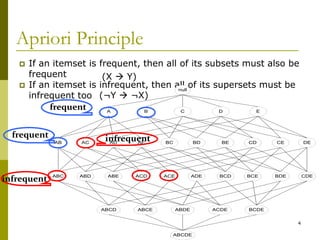
Apriori Principle
 If an itemset is frequent, then all of its subsets must also be
frequent
 If an itemset is infrequent, then all of its supersets must be
infrequent too
null
AB AC AD AE BC BD BE CD CE DE
A B C D E
ABC ABD ABE ACD ACE ADE BCD BCE BDE CDE
ABCD ABCE ABDE ACDE BCDE
ABCDE
frequent
frequent infrequent
infrequent
(X  Y)
(¬Y  ¬X)
5
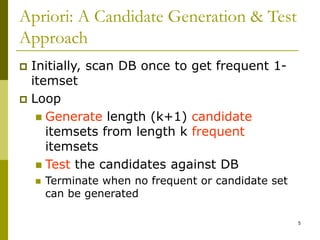
Apriori: A Candidate Generation & Test
Approach
 Initially, scan DB once to get frequent 1-
itemset
 Loop
 Generate length (k+1) candidate
itemsets from length k frequent
itemsets
 Test the candidates against DB
 Terminate when no frequent or candidate set
can be generated
6
Generate candidate itemsets
Example
Frequent 3-itemsets:
{1, 2, 3}, {1, 2, 4}, {1, 2, 5}, {1, 3, 4},
{1, 3, 5}, {2, 3, 4}, {2, 3, 5} and {3, 4, 5}
 Candidate 4-itemset:
{1, 2, 3, 4}, {1, 2, 3, 5}, {1, 2, 4, 5}, {1, 3,
4, 5}, {2, 3, 4, 5}
 Which need not to be counted?
{1, 2, 4, 5} & {1, 3, 4, 5} & {2, 3, 4, 5}
7
Maximal vs Closed Frequent Itemsets
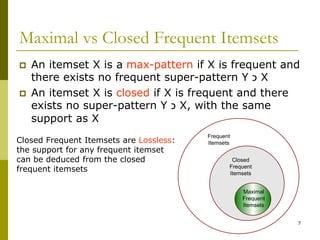
 An itemset X is a max-pattern if X is frequent and
there exists no frequent super-pattern Y ‫כ‬ X
 An itemset X is closed if X is frequent and there
exists no super-pattern Y ‫כ‬ X, with the same
support as X
Frequent
Itemsets
Closed
Frequent
Itemsets
Maximal
Frequent
Itemsets
Closed Frequent Itemsets are Lossless:
the support for any frequent itemset
can be deduced from the closed
frequent itemsets
8
Maximal vs Closed Frequent Itemsets
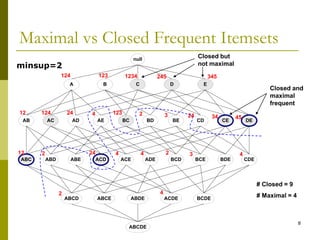
# Closed = 9
# Maximal = 4
null
AB AC AD AE BC BD BE CD CE DE
A B C D E
ABC ABD ABE ACD ACE ADE BCD BCE BDE CDE
ABCD ABCE ABDE ACDE BCDE
ABCDE
124 123 1234 245 345
12 124 24 4 123 2 3 24 34 45
12 2 24 4 4 2 3 4
2 4
Closed and
maximal
frequent
Closed but
not maximal
minsup=2
9
Algorithms to find frequent pattern
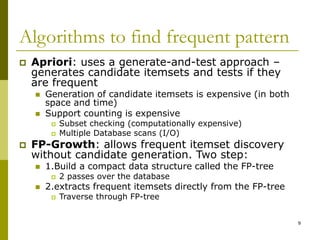
 Apriori: uses a generate-and-test approach –
generates candidate itemsets and tests if they
are frequent
 Generation of candidate itemsets is expensive (in both
space and time)
 Support counting is expensive
 Subset checking (computationally expensive)
 Multiple Database scans (I/O)
 FP-Growth: allows frequent itemset discovery
without candidate generation. Two step:
 1.Build a compact data structure called the FP-tree
 2 passes over the database
 2.extracts frequent itemsets directly from the FP-tree
 Traverse through FP-tree
10
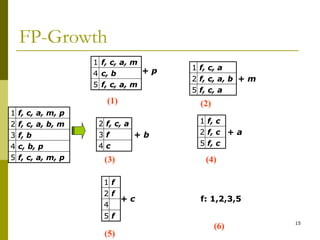
Pattern-Growth Approach: Mining Frequent
Patterns Without Candidate Generation
 The FP-Growth Approach
 Depth-first search (Apriori: Breadth-first search)
 Avoid explicit candidate generation
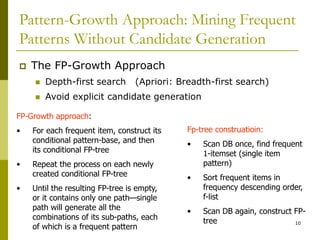
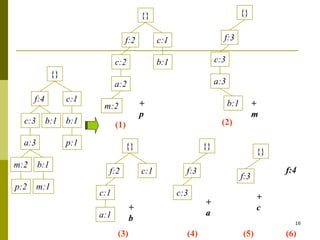
Fp-tree construatioin:
• Scan DB once, find frequent
1-itemset (single item
pattern)
• Sort frequent items in
frequency descending order,
f-list
• Scan DB again, construct FP-
tree
FP-Growth approach:
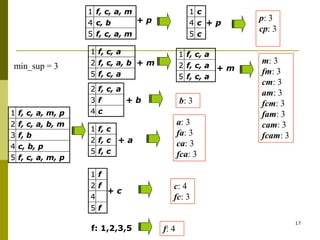
• For each frequent item, construct its
conditional pattern-base, and then
its conditional FP-tree
• Repeat the process on each newly
created conditional FP-tree
• Until the resulting FP-tree is empty,
or it contains only one path—single
path will generate all the
combinations of its sub-paths, each
of which is a frequent pattern
11
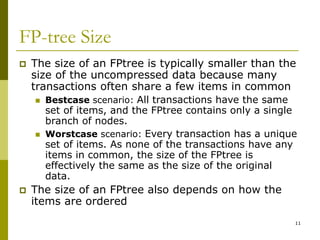
FP-tree Size
 The size of an FPtree is typically smaller than the
size of the uncompressed data because many
transactions often share a few items in common
 Bestcase scenario: All transactions have the same
set of items, and the FPtree contains only a single
branch of nodes.
 Worstcase scenario: Every transaction has a unique
set of items. As none of the transactions have any
items in common, the size of the FPtree is
effectively the same as the size of the original
data.
 The size of an FPtree also depends on how the
items are ordered
12
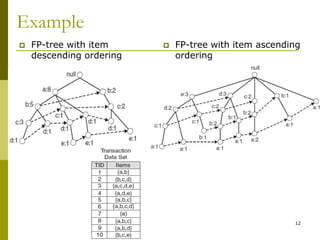
Example
 FP-tree with item
descending ordering
 FP-tree with item ascending
ordering
13
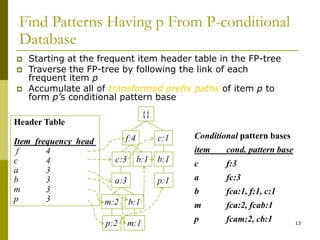
Find Patterns Having p From P-conditional
Database
 Starting at the frequent item header table in the FP-tree
 Traverse the FP-tree by following the link of each
frequent item p
 Accumulate all of transformed prefix paths of item p to
form p’s conditional pattern base
Conditional pattern bases
item cond. pattern base
c f:3
a fc:3
b fca:1, f:1, c:1
m fca:2, fcab:1
p fcam:2, cb:1
{}
f:4 c:1
b:1
p:1
b:1
c:3
a:3
b:1
m:2
p:2 m:1
Header Table
Item frequency head
f 4
c 4
a 3
b 3
m 3
p 3
14
f, c, a, m, p
5
c, b, p
4
f, b
3
f, c, a, b, m
2
f, c, a, m, p
1
f, c, a, m, p
5
c, b, p
4
f, b
3
f, c, a, b, m
2
f, c, a, m, p
1
f, c, a
5
c, b
4
f, b
3
f, c, a, b
2
f, c, a
1
f, c, a
5
c, b
4
f, b
3
f, c, a, b
2
f, c, a
1
f, c, a, m
5
c, b
4
f, c, a, m
1
f, c, a, m
5
c, b
4
f, c, a, m
1
f, c, a
5
f, c, a, b
2
f, c, a
1
f, c, a
5
f, c, a, b
2
f, c, a
1
f, c, a, m
5
c, b
4
f, b
3
f, c, a, b, m
2
f, c, a, m
1
f, c, a, m
5
c, b
4
f, b
3
f, c, a, b, m
2
f, c, a, m
1
c
4
f
3
f, c, a
2
c
4
f
3
f, c, a
2
f, c, a
5
c
4
f
3
f, c, a
2
f, c, a
1
f, c, a
5
c
4
f
3
f, c, a
2
f, c, a
1 f, c
5
f, c
2
f, c
1
f, c
5
f, c
2
f, c
1
f, c
5
c
4
f
3
f, c
2
f, c
1
f, c
5
c
4
f
3
f, c
2
f, c
1
+ p
+ m
+ b
+ a
FP-Growth
15
f, c, a, m, p
5
c, b, p
4
f, b
3
f, c, a, b, m
2
f, c, a, m, p
1
f, c, a, m, p
5
c, b, p
4
f, b
3
f, c, a, b, m
2
f, c, a, m, p
1
f, c, a, m
5
c, b
4
f, c, a, m
1
f, c, a, m
5
c, b
4
f, c, a, m
1
+ p
f, c, a
5
f, c, a, b
2
f, c, a
1
f, c, a
5
f, c, a, b
2
f, c, a
1
+ m
c
4
f
3
f, c, a
2
c
4
f
3
f, c, a
2
+ b
f, c
5
f, c
2
f, c
1
f, c
5
f, c
2
f, c
1
+ a
f: 1,2,3,5
(1) (2)
(3) (4)
(5)
(6)
+ c
f
5
4
f
2
f
1
f
5
4
f
2
f
1
FP-Growth
16
{}
f:4 c:1
b:1
p:1
b:1
c:3
a:3
b:1
m:2
p:2 m:1
{}
f:2 c:1
b:1
p:1
c:2
a:2
m:2
{}
f:3
c:3
a:3
b:1
{}
f:2 c:1
c:1
a:1
{}
f:3
c:3
{}
f:3
+
p
+
m
+
b
+
a
+
c
f:4
(1) (2)
(3) (4) (5) (6)
17
f, c, a, m, p
5
c, b, p
4
f, b
3
f, c, a, b, m
2
f, c, a, m, p
1
f, c, a, m, p
5
c, b, p
4
f, b
3
f, c, a, b, m
2
f, c, a, m, p
1
f, c, a, m
5
c, b
4
f, c, a, m
1
f, c, a, m
5
c, b
4
f, c, a, m
1
+ p
f, c, a
5
f, c, a, b
2
f, c, a
1
f, c, a
5
f, c, a, b
2
f, c, a
1
+ m
c
4
f
3
f, c, a
2
c
4
f
3
f, c, a
2
+ b
f, c
5
f, c
2
f, c
1
f, c
5
f, c
2
f, c
1
+ a
f: 1,2,3,5
+ p
c
5
c
4
c
1
c
5
c
4
c
1
p: 3
cp: 3
f, c, a
5
f, c, a
2
f, c, a
1
f, c, a
5
f, c, a
2
f, c, a
1
+ m
m: 3
fm: 3
cm: 3
am: 3
fcm: 3
fam: 3
cam: 3
fcam: 3
b: 3
f: 4
a: 3
fa: 3
ca: 3
fca: 3
c: 4
fc: 3
+ c
f
5
4
f
2
f
1
f
5
4
f
2
f
1
min_sup = 3

FP growth algorithm, data mining, data analystics

  • 1.
    SEG4630 2009-2010 Tutorial 2– Frequent Pattern Mining
  • 2.
    2 Frequent Patterns  Frequentpattern: a pattern (a set of items, subsequences, substructures, etc.) that occurs frequently in a data set  itemset: A set of one or more items  k-itemset: X = {x1, …, xk}  Mining algorithms  Apriori  FP-growth Tid Items bought 10 Beer, Nuts, Diaper 20 Beer, Coffee, Diaper 30 Beer, Diaper, Eggs 40 Nuts, Eggs, Milk 50 Nuts, Coffee, Diaper, Eggs, Beer
  • 3.
    3 Support & Confidence Support  (absolute) support, or, support count of X: Frequency or occurrence of an itemset X  (relative) support, s, is the fraction of transactions that contains X (i.e., the probability that a transaction contains X)  An itemset X is frequent if X’s support is no less than a minsup threshold  Confidence (association rule: XY )  sup(XY)/sup(x) (conditional prob.: Pr(Y|X) = Pr(X^Y)/Pr(X) )  confidence, c, conditional probability that a transaction having X also contains Y  Find all the rules XY with minimum support and confidence  sup(XY) ≥ minsup  sup(XY)/sup(X) ≥ minconf
  • 4.
    4 Apriori Principle  Ifan itemset is frequent, then all of its subsets must also be frequent  If an itemset is infrequent, then all of its supersets must be infrequent too null AB AC AD AE BC BD BE CD CE DE A B C D E ABC ABD ABE ACD ACE ADE BCD BCE BDE CDE ABCD ABCE ABDE ACDE BCDE ABCDE frequent frequent infrequent infrequent (X  Y) (¬Y  ¬X)
  • 5.
    5 Apriori: A CandidateGeneration & Test Approach  Initially, scan DB once to get frequent 1- itemset  Loop  Generate length (k+1) candidate itemsets from length k frequent itemsets  Test the candidates against DB  Terminate when no frequent or candidate set can be generated
  • 6.
    6 Generate candidate itemsets Example Frequent3-itemsets: {1, 2, 3}, {1, 2, 4}, {1, 2, 5}, {1, 3, 4}, {1, 3, 5}, {2, 3, 4}, {2, 3, 5} and {3, 4, 5}  Candidate 4-itemset: {1, 2, 3, 4}, {1, 2, 3, 5}, {1, 2, 4, 5}, {1, 3, 4, 5}, {2, 3, 4, 5}  Which need not to be counted? {1, 2, 4, 5} & {1, 3, 4, 5} & {2, 3, 4, 5}
  • 7.
    7 Maximal vs ClosedFrequent Itemsets  An itemset X is a max-pattern if X is frequent and there exists no frequent super-pattern Y ‫כ‬ X  An itemset X is closed if X is frequent and there exists no super-pattern Y ‫כ‬ X, with the same support as X Frequent Itemsets Closed Frequent Itemsets Maximal Frequent Itemsets Closed Frequent Itemsets are Lossless: the support for any frequent itemset can be deduced from the closed frequent itemsets
  • 8.
    8 Maximal vs ClosedFrequent Itemsets # Closed = 9 # Maximal = 4 null AB AC AD AE BC BD BE CD CE DE A B C D E ABC ABD ABE ACD ACE ADE BCD BCE BDE CDE ABCD ABCE ABDE ACDE BCDE ABCDE 124 123 1234 245 345 12 124 24 4 123 2 3 24 34 45 12 2 24 4 4 2 3 4 2 4 Closed and maximal frequent Closed but not maximal minsup=2
  • 9.
    9 Algorithms to findfrequent pattern  Apriori: uses a generate-and-test approach – generates candidate itemsets and tests if they are frequent  Generation of candidate itemsets is expensive (in both space and time)  Support counting is expensive  Subset checking (computationally expensive)  Multiple Database scans (I/O)  FP-Growth: allows frequent itemset discovery without candidate generation. Two step:  1.Build a compact data structure called the FP-tree  2 passes over the database  2.extracts frequent itemsets directly from the FP-tree  Traverse through FP-tree
  • 10.
    10 Pattern-Growth Approach: MiningFrequent Patterns Without Candidate Generation  The FP-Growth Approach  Depth-first search (Apriori: Breadth-first search)  Avoid explicit candidate generation Fp-tree construatioin: • Scan DB once, find frequent 1-itemset (single item pattern) • Sort frequent items in frequency descending order, f-list • Scan DB again, construct FP- tree FP-Growth approach: • For each frequent item, construct its conditional pattern-base, and then its conditional FP-tree • Repeat the process on each newly created conditional FP-tree • Until the resulting FP-tree is empty, or it contains only one path—single path will generate all the combinations of its sub-paths, each of which is a frequent pattern
  • 11.
    11 FP-tree Size  Thesize of an FPtree is typically smaller than the size of the uncompressed data because many transactions often share a few items in common  Bestcase scenario: All transactions have the same set of items, and the FPtree contains only a single branch of nodes.  Worstcase scenario: Every transaction has a unique set of items. As none of the transactions have any items in common, the size of the FPtree is effectively the same as the size of the original data.  The size of an FPtree also depends on how the items are ordered
  • 12.
    12 Example  FP-tree withitem descending ordering  FP-tree with item ascending ordering
  • 13.
    13 Find Patterns Havingp From P-conditional Database  Starting at the frequent item header table in the FP-tree  Traverse the FP-tree by following the link of each frequent item p  Accumulate all of transformed prefix paths of item p to form p’s conditional pattern base Conditional pattern bases item cond. pattern base c f:3 a fc:3 b fca:1, f:1, c:1 m fca:2, fcab:1 p fcam:2, cb:1 {} f:4 c:1 b:1 p:1 b:1 c:3 a:3 b:1 m:2 p:2 m:1 Header Table Item frequency head f 4 c 4 a 3 b 3 m 3 p 3
  • 14.
    14 f, c, a,m, p 5 c, b, p 4 f, b 3 f, c, a, b, m 2 f, c, a, m, p 1 f, c, a, m, p 5 c, b, p 4 f, b 3 f, c, a, b, m 2 f, c, a, m, p 1 f, c, a 5 c, b 4 f, b 3 f, c, a, b 2 f, c, a 1 f, c, a 5 c, b 4 f, b 3 f, c, a, b 2 f, c, a 1 f, c, a, m 5 c, b 4 f, c, a, m 1 f, c, a, m 5 c, b 4 f, c, a, m 1 f, c, a 5 f, c, a, b 2 f, c, a 1 f, c, a 5 f, c, a, b 2 f, c, a 1 f, c, a, m 5 c, b 4 f, b 3 f, c, a, b, m 2 f, c, a, m 1 f, c, a, m 5 c, b 4 f, b 3 f, c, a, b, m 2 f, c, a, m 1 c 4 f 3 f, c, a 2 c 4 f 3 f, c, a 2 f, c, a 5 c 4 f 3 f, c, a 2 f, c, a 1 f, c, a 5 c 4 f 3 f, c, a 2 f, c, a 1 f, c 5 f, c 2 f, c 1 f, c 5 f, c 2 f, c 1 f, c 5 c 4 f 3 f, c 2 f, c 1 f, c 5 c 4 f 3 f, c 2 f, c 1 + p + m + b + a FP-Growth
  • 15.
    15 f, c, a,m, p 5 c, b, p 4 f, b 3 f, c, a, b, m 2 f, c, a, m, p 1 f, c, a, m, p 5 c, b, p 4 f, b 3 f, c, a, b, m 2 f, c, a, m, p 1 f, c, a, m 5 c, b 4 f, c, a, m 1 f, c, a, m 5 c, b 4 f, c, a, m 1 + p f, c, a 5 f, c, a, b 2 f, c, a 1 f, c, a 5 f, c, a, b 2 f, c, a 1 + m c 4 f 3 f, c, a 2 c 4 f 3 f, c, a 2 + b f, c 5 f, c 2 f, c 1 f, c 5 f, c 2 f, c 1 + a f: 1,2,3,5 (1) (2) (3) (4) (5) (6) + c f 5 4 f 2 f 1 f 5 4 f 2 f 1 FP-Growth
  • 16.
    16 {} f:4 c:1 b:1 p:1 b:1 c:3 a:3 b:1 m:2 p:2 m:1 {} f:2c:1 b:1 p:1 c:2 a:2 m:2 {} f:3 c:3 a:3 b:1 {} f:2 c:1 c:1 a:1 {} f:3 c:3 {} f:3 + p + m + b + a + c f:4 (1) (2) (3) (4) (5) (6)
  • 17.
    17 f, c, a,m, p 5 c, b, p 4 f, b 3 f, c, a, b, m 2 f, c, a, m, p 1 f, c, a, m, p 5 c, b, p 4 f, b 3 f, c, a, b, m 2 f, c, a, m, p 1 f, c, a, m 5 c, b 4 f, c, a, m 1 f, c, a, m 5 c, b 4 f, c, a, m 1 + p f, c, a 5 f, c, a, b 2 f, c, a 1 f, c, a 5 f, c, a, b 2 f, c, a 1 + m c 4 f 3 f, c, a 2 c 4 f 3 f, c, a 2 + b f, c 5 f, c 2 f, c 1 f, c 5 f, c 2 f, c 1 + a f: 1,2,3,5 + p c 5 c 4 c 1 c 5 c 4 c 1 p: 3 cp: 3 f, c, a 5 f, c, a 2 f, c, a 1 f, c, a 5 f, c, a 2 f, c, a 1 + m m: 3 fm: 3 cm: 3 am: 3 fcm: 3 fam: 3 cam: 3 fcam: 3 b: 3 f: 4 a: 3 fa: 3 ca: 3 fca: 3 c: 4 fc: 3 + c f 5 4 f 2 f 1 f 5 4 f 2 f 1 min_sup = 3