prepared By:
13cse035:Hemanshi maheta
13cse038:Satya parsana
13cse047:Jignesh rathod
 Depth First Search (DFS)
 Breadth First Search (BFS)
Topics
DEPTH-FIRST SEARCH: UNDIRECTED GRAPHS
 Let G = (N , A) be an undirected graph all of whose nodes we wish
to visit.
 Suppose it is somehow possible to mark a node to show it has
already been visited.
 To carry out a depth-first traversal of the graph, choose any node v ϵ
N as the starting point.
 Mark this node to show it has been visited. Next, if there is a
node adjacent to v that has not yet been visited, choose this
node as a new starting point and call the depth-first search
procedure recursively.
 On return from the recursive call, if there is another node
adjacent to v that has not been visited, choose this node as
the next starting point, call the procedure recursively once
again, and so on.
 When all the nodes adjacent to v are marked, the search
starting at v is finished.
 If there remain any nodes of G that have not been
visited,choose any one of them as a new starting point, and
call the procedure yet again.
 Continue thus until all the nodes of G are marked. Here is the
recursive algorithm
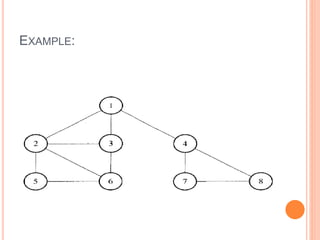
EXAMPLE:
DEPTH-FIRST SEARCH: DIRECTED GRAPHS
 The algorithm is essentially the same as for undirected
graphs, the difference residing in the interpretation of the
word "adjacent".
 In a directed graph, node w is adjacent to node v if the
directed edge (v, w) exists.
 If (v, w) exists but (w, v) does not, then w is adjacent to v
but v is not adjacent to w.
 With this change of interpretation the procedures dfs and
search apply equally well in the case of a directed graph.
Data Structure and Algorithm
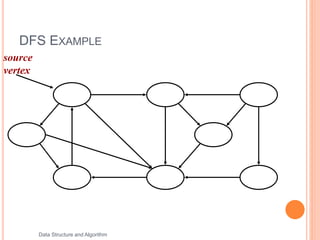
DFS EXAMPLE
source
vertex
Data Structure and Algorithm
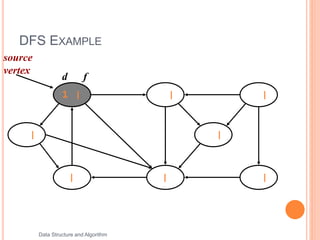
DFS EXAMPLE
1 | | |
|||
| |
source
vertex
d f
Data Structure and Algorithm
DFS EXAMPLE
1 | | |
|||
2 | |
source
vertex
d f
Data Structure and Algorithm
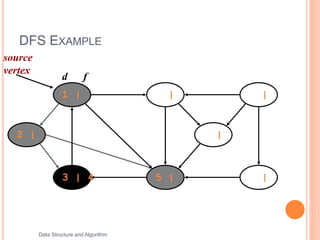
DFS EXAMPLE
1 | | |
||3 |
2 | |
source
vertex
d f
Data Structure and Algorithm
DFS EXAMPLE
1 | | |
||3 | 4
2 | |
source
vertex
d f
Data Structure and Algorithm
DFS EXAMPLE
1 | | |
|5 |3 | 4
2 | |
source
vertex
d f
Data Structure and Algorithm
DFS EXAMPLE
1 | | |
|5 | 63 | 4
2 | |
source
vertex
d f
Data Structure and Algorithm
DFS EXAMPLE
1 | | |
|5 | 63 | 4
2 | 7 |
source
vertex
d f
Data Structure and Algorithm
DFS EXAMPLE
1 | 8 | |
|5 | 63 | 4
2 | 7 |
source
vertex
d f
Data Structure and Algorithm
DFS EXAMPLE
1 | 8 | |
|5 | 63 | 4
2 | 7 9 |
source
vertex
d f
Data Structure and Algorithm
DFS EXAMPLE
1 | 8 | |
|5 | 63 | 4
2 | 7 9 |10
source
vertex
d f
Data Structure and Algorithm
DFS EXAMPLE
1 | 8 |11 |
|5 | 63 | 4
2 | 7 9 |10
source
vertex
d f
Data Structure and Algorithm
DFS EXAMPLE
1 |12 8 |11 |
|5 | 63 | 4
2 | 7 9 |10
source
vertex
d f
Data Structure and Algorithm
DFS EXAMPLE
1 |12 8 |11 13|
|5 | 63 | 4
2 | 7 9 |10
source
vertex
d f
Data Structure and Algorithm
DFS EXAMPLE
1 |12 8 |11 13|
14|5 | 63 | 4
2 | 7 9 |10
source
vertex
d f
Data Structure and Algorithm
DFS EXAMPLE
1 |12 8 |11 13|
14|155 | 63 | 4
2 | 7 9 |10
source
vertex
d f
Data Structure and Algorithm
DFS EXAMPLE
1 |12 8 |11 13|16
14|155 | 63 | 4
2 | 7 9 |10
source
vertex
d f
Data Structure and Algorithm
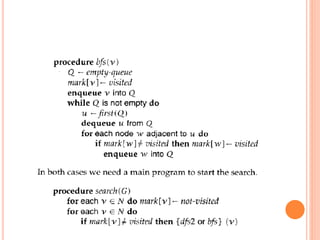
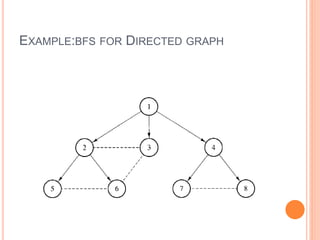
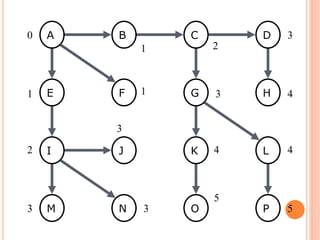
BREADTH-FIRST SEARCH (BFS)
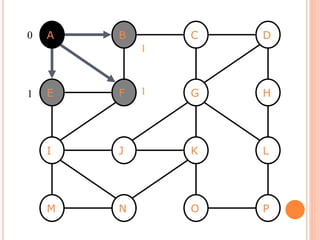
 Search for all vertices that are directly reachable from the root
(called level 1 vertices)
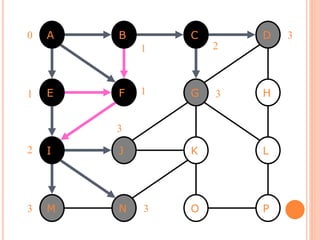
 After mark all these vertices, visit all vertices that are directly
reachable from any level 1 vertices (called level 2 vertices), and so
on.
 In general, level k vertices are directly reachable from a level k – 1
vertices
EXAMPLE:BFS FOR DIRECTED GRAPH
A
ONM
LKJ
E F G H
DCB
I
P
An Example:BFS for undirected graph
A
ONM
LKJ
E F G H
DCB
I
P
0
A
ONM
LKJ
E F G H
DCB
I
P
0
1 1
1
A
ONM
LKJ
E F G H
DCB
I
P
0
1 1
1
2
2
A
ONM
LKJ
E F G H
DCB
I
P
0
1 1
1
2
2
3 3
3
3
3
A
ONM
LKJ
E F G H
DCB
I
P
0
1 1
1
2
2
3 3
3
3
3
4 4
4
A
ONM
LKJ
E F G H
DCB
I
P
0
1 1
1
2
2
3 3
3
3
3
4 4
4
5
5
A
ONM
LKJ
E F G H
DCB
I
P
0
1 1
1
2
2
3 3
3
3
3
4 4
4
5
5
A
ONM
LKJ
E F G H
DCB
I
P
0
1 1
1
2
2
3 3
3
3
3
4 4
4
5
5
Thnk u…very much..

DFS and BFS

  • 1.
  • 2.
     Depth FirstSearch (DFS)  Breadth First Search (BFS) Topics
  • 3.
    DEPTH-FIRST SEARCH: UNDIRECTEDGRAPHS  Let G = (N , A) be an undirected graph all of whose nodes we wish to visit.  Suppose it is somehow possible to mark a node to show it has already been visited.  To carry out a depth-first traversal of the graph, choose any node v ϵ N as the starting point.  Mark this node to show it has been visited. Next, if there is a node adjacent to v that has not yet been visited, choose this node as a new starting point and call the depth-first search procedure recursively.
  • 4.
     On returnfrom the recursive call, if there is another node adjacent to v that has not been visited, choose this node as the next starting point, call the procedure recursively once again, and so on.  When all the nodes adjacent to v are marked, the search starting at v is finished.  If there remain any nodes of G that have not been visited,choose any one of them as a new starting point, and call the procedure yet again.  Continue thus until all the nodes of G are marked. Here is the recursive algorithm
  • 5.
  • 8.
    DEPTH-FIRST SEARCH: DIRECTEDGRAPHS  The algorithm is essentially the same as for undirected graphs, the difference residing in the interpretation of the word "adjacent".  In a directed graph, node w is adjacent to node v if the directed edge (v, w) exists.  If (v, w) exists but (w, v) does not, then w is adjacent to v but v is not adjacent to w.  With this change of interpretation the procedures dfs and search apply equally well in the case of a directed graph.
  • 9.
    Data Structure andAlgorithm DFS EXAMPLE source vertex
  • 10.
    Data Structure andAlgorithm DFS EXAMPLE 1 | | | ||| | | source vertex d f
  • 11.
    Data Structure andAlgorithm DFS EXAMPLE 1 | | | ||| 2 | | source vertex d f
  • 12.
    Data Structure andAlgorithm DFS EXAMPLE 1 | | | ||3 | 2 | | source vertex d f
  • 13.
    Data Structure andAlgorithm DFS EXAMPLE 1 | | | ||3 | 4 2 | | source vertex d f
  • 14.
    Data Structure andAlgorithm DFS EXAMPLE 1 | | | |5 |3 | 4 2 | | source vertex d f
  • 15.
    Data Structure andAlgorithm DFS EXAMPLE 1 | | | |5 | 63 | 4 2 | | source vertex d f
  • 16.
    Data Structure andAlgorithm DFS EXAMPLE 1 | | | |5 | 63 | 4 2 | 7 | source vertex d f
  • 17.
    Data Structure andAlgorithm DFS EXAMPLE 1 | 8 | | |5 | 63 | 4 2 | 7 | source vertex d f
  • 18.
    Data Structure andAlgorithm DFS EXAMPLE 1 | 8 | | |5 | 63 | 4 2 | 7 9 | source vertex d f
  • 19.
    Data Structure andAlgorithm DFS EXAMPLE 1 | 8 | | |5 | 63 | 4 2 | 7 9 |10 source vertex d f
  • 20.
    Data Structure andAlgorithm DFS EXAMPLE 1 | 8 |11 | |5 | 63 | 4 2 | 7 9 |10 source vertex d f
  • 21.
    Data Structure andAlgorithm DFS EXAMPLE 1 |12 8 |11 | |5 | 63 | 4 2 | 7 9 |10 source vertex d f
  • 22.
    Data Structure andAlgorithm DFS EXAMPLE 1 |12 8 |11 13| |5 | 63 | 4 2 | 7 9 |10 source vertex d f
  • 23.
    Data Structure andAlgorithm DFS EXAMPLE 1 |12 8 |11 13| 14|5 | 63 | 4 2 | 7 9 |10 source vertex d f
  • 24.
    Data Structure andAlgorithm DFS EXAMPLE 1 |12 8 |11 13| 14|155 | 63 | 4 2 | 7 9 |10 source vertex d f
  • 25.
    Data Structure andAlgorithm DFS EXAMPLE 1 |12 8 |11 13|16 14|155 | 63 | 4 2 | 7 9 |10 source vertex d f
  • 26.
    Data Structure andAlgorithm BREADTH-FIRST SEARCH (BFS)  Search for all vertices that are directly reachable from the root (called level 1 vertices)  After mark all these vertices, visit all vertices that are directly reachable from any level 1 vertices (called level 2 vertices), and so on.  In general, level k vertices are directly reachable from a level k – 1 vertices
  • 28.
  • 30.
    A ONM LKJ E F GH DCB I P An Example:BFS for undirected graph
  • 31.
    A ONM LKJ E F GH DCB I P 0
  • 32.
    A ONM LKJ E F GH DCB I P 0 1 1 1
  • 33.
    A ONM LKJ E F GH DCB I P 0 1 1 1 2 2
  • 34.
    A ONM LKJ E F GH DCB I P 0 1 1 1 2 2 3 3 3 3 3
  • 35.
    A ONM LKJ E F GH DCB I P 0 1 1 1 2 2 3 3 3 3 3 4 4 4
  • 36.
    A ONM LKJ E F GH DCB I P 0 1 1 1 2 2 3 3 3 3 3 4 4 4 5 5
  • 37.
    A ONM LKJ E F GH DCB I P 0 1 1 1 2 2 3 3 3 3 3 4 4 4 5 5
  • 38.
    A ONM LKJ E F GH DCB I P 0 1 1 1 2 2 3 3 3 3 3 4 4 4 5 5
  • 39.