FP-Growth Algorithm
➢FP-Growth: allows frequent itemset discovery without candidate itemset
generation. Two step approach:
▫ Step 1: Build a compact data structure called the FP-tree
Built using 2 passes over the data-set.
▫ Step 2: Extracts frequent itemsets directly from the FP-tree
FP-Growth Algorithm (contd.)
Step 1: FP-Tree Construction
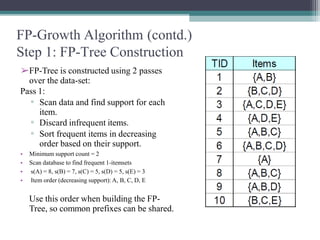
➢FP-Tree is constructed using 2 passes
over the data-set:
Pass 1:
▫ Scan data and find support for each
item.
▫ Discard infrequent items.
▫ Sort frequent items in decreasing
order based on their support.
• Minimum support count = 2
• Scan database to find frequent 1-itemsets
• s(A) = 8, s(B) = 7, s(C) = 5, s(D) = 5, s(E) = 3
• Item order (decreasing support): A, B, C, D, E
Use this order when building the FP-
Tree, so common prefixes can be shared.
FP-Growth Algorithm (contd.)
Step 1: FP-Tree Construction
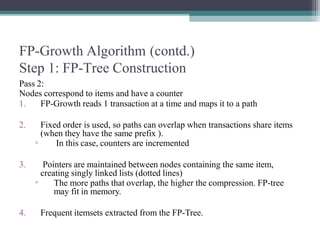
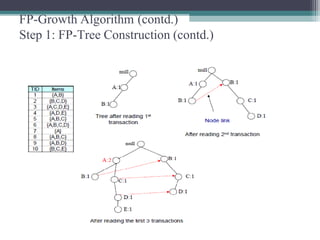
Pass 2:
Nodes correspond to items and have a counter
1. FP-Growth reads 1 transaction at a time and maps it to a path
▫
2. Fixed order is used, so paths can overlap when transactions share items
(when they have the same prefix ).
In this case, counters are incremented
▫
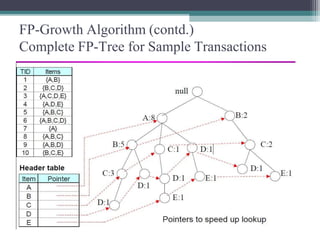
3. Pointers are maintained between nodes containing the same item,
creating singly linked lists (dotted lines)
The more paths that overlap, the higher the compression. FP-tree
may fit in memory.
4. Frequent itemsets extracted from the FP-Tree.
FP-Growth Algorithm (contd.)
Step 1: FP-Tree Construction (contd.)
FP-Growth Algorithm (contd.)
Complete FP-Tree for Sample Transactions
FP-Growth Algorithm (contd.)
Step 2: Frequent Itemset Generation
➢FP-Growth extracts frequent itemsets from the FP-tree.
➢Bottom-up algorithm - from the leaves towards the root
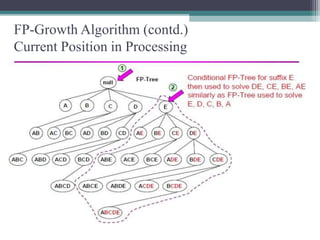
➢Divide and conquer: first look for frequent itemsets ending in e, then de,
etc. . . then d, then cd, etc. . .
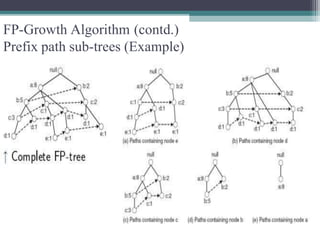
➢First, extract prefix path sub-trees ending in an item(set). (using the linked
lists)
FP-Growth Algorithm (contd.)
Prefix path sub-trees (Example)
FP-Growth Algorithm (contd.)
Example
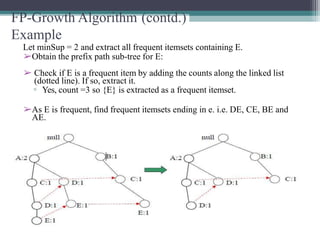
Let minSup = 2 and extract all frequent itemsets containing E.
➢Obtain the prefix path sub-tree for E:
➢ Check if E is a frequent item by adding the counts along the linked list
(dotted line). If so, extract it.
▫ Yes, count =3 so {E} is extracted as a frequent itemset.
➢As E is frequent, find frequent itemsets ending in e. i.e. DE, CE, BE and
AE.
➢E nodes can now be removed
FP-Growth Algorithm (contd.)
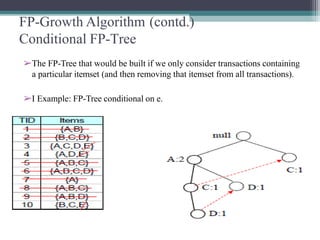
Conditional FP-Tree
➢The FP-Tree that would be built if we only consider transactions containing
a particular itemset (and then removing that itemset from all transactions).
➢I Example: FP-Tree conditional on e.
FP-Growth Algorithm (contd.)
Current Position in Processing
FP-Growth Algorithm (contd.)
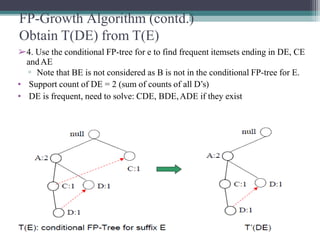
Obtain T(DE) from T(E)
➢4. Use the conditional FP-tree for e to find frequent itemsets ending in DE, CE
andAE
▫ Note that BE is not considered as B is not in the conditional FP-tree for E.
•
•
Support count of DE = 2 (sum of counts of all D’s)
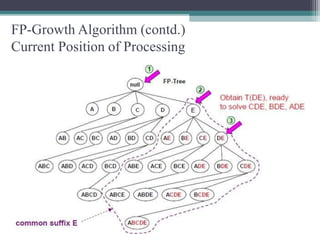
DE is frequent, need to solve: CDE, BDE,ADE if they exist
FP-Growth Algorithm (contd.)
Current Position of Processing
FP-Growth Algorithm (contd.)
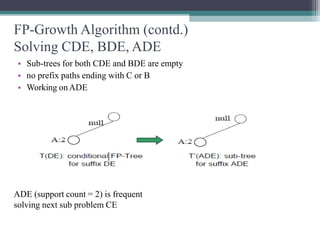
Solving CDE, BDE, ADE
• Sub-trees for both CDE and BDE are empty
• no prefix paths ending with C or B
• Working onADE
ADE (support count = 2) is frequent
solving next sub problem CE
FP-Growth Algorithm (contd.)
Current Position in Processing
FP-Growth Algorithm (contd.)
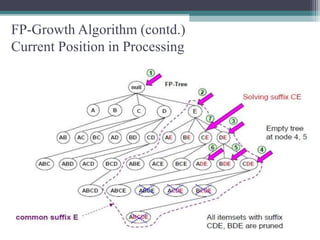
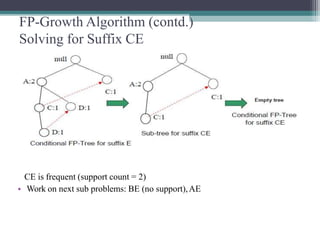
Solving for Suffix CE
CE is frequent (support count = 2)
• Work on next sub problems: BE (no support),AE
FP-Growth Algorithm (contd.)
Current Position in Processing
FP-Growth Algorithm (contd.)
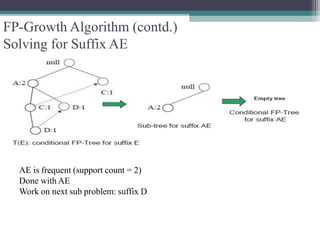
Solving for Suffix AE
AE is frequent (support count = 2)
Done with AE
Work on next sub problem: suffix D
FP-Growth Algorithm (contd.)
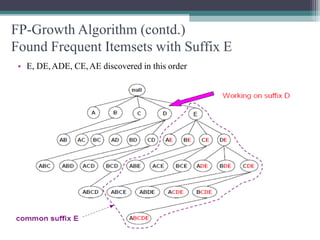
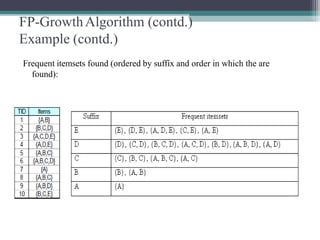
Found Frequent Itemsets with Suffix E
• E, DE,ADE, CE,AE discovered in this order
FP-GrowthAlgorithm (contd.)
Example (contd.)
Frequent itemsets found (ordered by suffix and order in which the are
found):
Comparative Result
Conclusion
It is found that:
• FP-tree: a novel data structure storing compressed, crucial information
about frequent patterns, compact yet complete for frequent pattern mining.
• FP-growth: an efficient mining method of frequent patterns in large
Database: using a highly compact FP-tree, divide-and-conquer method in
nature.
• Both Apriori and FP-Growth are aiming to find out complete set of patterns
but, FP-Growth is more efficient thanApriori in respect to long patterns.
References
1. Liwu, ZOU, Guangwei, REN, “The data mining algorithm analysis for
personalized service,” Fourth International Conference on Multimedia
Information Networking and Security, 2012.
2. Jun TAN,Yingyong BU and Bo YANG, “An Efficient Frequent Pattern
Mining Algorithm”, Sixth International Conference on Fuzzy Systems and
Knowledge Discovery, 2009.
3. Wei Zhang, Hongzhi Liao, Na Zhao, “Research on the FP Growth Algorithm
about Association Rule Mining”, International Seminar on Business and
Information Management, 2008.
4. S.P Latha, DR. N.Ramaraj. “Algorithm for Efficient Data Mining”. In Proc.
Int’Conf. on IEEE International Computational Intelligence and Multimedia
Applications, 2007.
References (contd.)
5. Dongme Sun, Shaohua Teng, Wei Zhang, Haibin Zhu. “An Algorithm to
Improve the Effectiveness of Apriori”. In Proc. Int’l Conf. on 6th IEEE
International Conf. on Cognitive Informatics (ICCI'07), 2007.
6. Daniel Hunyadi, “Performance comparison of Apriori and FP-Growth
algorithms in generating association rules”, Proceedings of the European
Computing Conference, 2006.
7. By Jiawei Han, Micheline Kamber, “Data mining Concepts and
Techniques” Morgan Kaufmann Publishers, 2006.
8. Tan P.-N., Steinbach M., and Kumar V.“Introduction to data mining”
Addison Wesley Publishers, 2006.
References (contd.)
9. Han.J, Pei.J, and Yin. Y.“Mining frequent patterns without candidate
generation”. In Proc. ACM-SIGMOD International Conf. Management
of Data (SIGMOD), 2000.
10. R. Agrawal, Imielinski.t, Swami.A. “Mining Association Rules between
Sets of Items in Large Databases”. In Proc. International Conf. of the
ACM SIGMOD Conference Washington DC, USA, 1993.

FP-growth.pptx

  • 1.
    FP-Growth Algorithm ➢FP-Growth: allowsfrequent itemset discovery without candidate itemset generation. Two step approach: ▫ Step 1: Build a compact data structure called the FP-tree Built using 2 passes over the data-set. ▫ Step 2: Extracts frequent itemsets directly from the FP-tree
  • 2.
    FP-Growth Algorithm (contd.) Step1: FP-Tree Construction ➢FP-Tree is constructed using 2 passes over the data-set: Pass 1: ▫ Scan data and find support for each item. ▫ Discard infrequent items. ▫ Sort frequent items in decreasing order based on their support. • Minimum support count = 2 • Scan database to find frequent 1-itemsets • s(A) = 8, s(B) = 7, s(C) = 5, s(D) = 5, s(E) = 3 • Item order (decreasing support): A, B, C, D, E Use this order when building the FP- Tree, so common prefixes can be shared.
  • 3.
    FP-Growth Algorithm (contd.) Step1: FP-Tree Construction Pass 2: Nodes correspond to items and have a counter 1. FP-Growth reads 1 transaction at a time and maps it to a path ▫ 2. Fixed order is used, so paths can overlap when transactions share items (when they have the same prefix ). In this case, counters are incremented ▫ 3. Pointers are maintained between nodes containing the same item, creating singly linked lists (dotted lines) The more paths that overlap, the higher the compression. FP-tree may fit in memory. 4. Frequent itemsets extracted from the FP-Tree.
  • 4.
    FP-Growth Algorithm (contd.) Step1: FP-Tree Construction (contd.)
  • 5.
    FP-Growth Algorithm (contd.) CompleteFP-Tree for Sample Transactions
  • 6.
    FP-Growth Algorithm (contd.) Step2: Frequent Itemset Generation ➢FP-Growth extracts frequent itemsets from the FP-tree. ➢Bottom-up algorithm - from the leaves towards the root ➢Divide and conquer: first look for frequent itemsets ending in e, then de, etc. . . then d, then cd, etc. . . ➢First, extract prefix path sub-trees ending in an item(set). (using the linked lists)
  • 7.
    FP-Growth Algorithm (contd.) Prefixpath sub-trees (Example)
  • 8.
    FP-Growth Algorithm (contd.) Example LetminSup = 2 and extract all frequent itemsets containing E. ➢Obtain the prefix path sub-tree for E: ➢ Check if E is a frequent item by adding the counts along the linked list (dotted line). If so, extract it. ▫ Yes, count =3 so {E} is extracted as a frequent itemset. ➢As E is frequent, find frequent itemsets ending in e. i.e. DE, CE, BE and AE. ➢E nodes can now be removed
  • 9.
    FP-Growth Algorithm (contd.) ConditionalFP-Tree ➢The FP-Tree that would be built if we only consider transactions containing a particular itemset (and then removing that itemset from all transactions). ➢I Example: FP-Tree conditional on e.
  • 10.
  • 11.
    FP-Growth Algorithm (contd.) ObtainT(DE) from T(E) ➢4. Use the conditional FP-tree for e to find frequent itemsets ending in DE, CE andAE ▫ Note that BE is not considered as B is not in the conditional FP-tree for E. • • Support count of DE = 2 (sum of counts of all D’s) DE is frequent, need to solve: CDE, BDE,ADE if they exist
  • 12.
  • 13.
    FP-Growth Algorithm (contd.) SolvingCDE, BDE, ADE • Sub-trees for both CDE and BDE are empty • no prefix paths ending with C or B • Working onADE ADE (support count = 2) is frequent solving next sub problem CE
  • 14.
  • 15.
    FP-Growth Algorithm (contd.) Solvingfor Suffix CE CE is frequent (support count = 2) • Work on next sub problems: BE (no support),AE
  • 16.
  • 17.
    FP-Growth Algorithm (contd.) Solvingfor Suffix AE AE is frequent (support count = 2) Done with AE Work on next sub problem: suffix D
  • 18.
    FP-Growth Algorithm (contd.) FoundFrequent Itemsets with Suffix E • E, DE,ADE, CE,AE discovered in this order
  • 19.
    FP-GrowthAlgorithm (contd.) Example (contd.) Frequentitemsets found (ordered by suffix and order in which the are found):
  • 20.
  • 21.
    Conclusion It is foundthat: • FP-tree: a novel data structure storing compressed, crucial information about frequent patterns, compact yet complete for frequent pattern mining. • FP-growth: an efficient mining method of frequent patterns in large Database: using a highly compact FP-tree, divide-and-conquer method in nature. • Both Apriori and FP-Growth are aiming to find out complete set of patterns but, FP-Growth is more efficient thanApriori in respect to long patterns.
  • 22.
    References 1. Liwu, ZOU,Guangwei, REN, “The data mining algorithm analysis for personalized service,” Fourth International Conference on Multimedia Information Networking and Security, 2012. 2. Jun TAN,Yingyong BU and Bo YANG, “An Efficient Frequent Pattern Mining Algorithm”, Sixth International Conference on Fuzzy Systems and Knowledge Discovery, 2009. 3. Wei Zhang, Hongzhi Liao, Na Zhao, “Research on the FP Growth Algorithm about Association Rule Mining”, International Seminar on Business and Information Management, 2008. 4. S.P Latha, DR. N.Ramaraj. “Algorithm for Efficient Data Mining”. In Proc. Int’Conf. on IEEE International Computational Intelligence and Multimedia Applications, 2007.
  • 23.
    References (contd.) 5. DongmeSun, Shaohua Teng, Wei Zhang, Haibin Zhu. “An Algorithm to Improve the Effectiveness of Apriori”. In Proc. Int’l Conf. on 6th IEEE International Conf. on Cognitive Informatics (ICCI'07), 2007. 6. Daniel Hunyadi, “Performance comparison of Apriori and FP-Growth algorithms in generating association rules”, Proceedings of the European Computing Conference, 2006. 7. By Jiawei Han, Micheline Kamber, “Data mining Concepts and Techniques” Morgan Kaufmann Publishers, 2006. 8. Tan P.-N., Steinbach M., and Kumar V.“Introduction to data mining” Addison Wesley Publishers, 2006.
  • 24.
    References (contd.) 9. Han.J,Pei.J, and Yin. Y.“Mining frequent patterns without candidate generation”. In Proc. ACM-SIGMOD International Conf. Management of Data (SIGMOD), 2000. 10. R. Agrawal, Imielinski.t, Swami.A. “Mining Association Rules between Sets of Items in Large Databases”. In Proc. International Conf. of the ACM SIGMOD Conference Washington DC, USA, 1993.