FP Growth ALGORITHM
Prof. Navya Francis
Asst. Professor
Kristu Jayanti College
FP Growth Algorithm
• The FP-Growth Algorithm is an alternative way to find frequent item sets without using candidate
generations, thus improving performance.
• It uses a divide-and-conquer strategy.
• The core of this method is the usage of a special data structure named frequent-pattern tree
(FP-tree), which retains the item set association information.
FP Growth Algorithm working steps
• First, it compresses the input database creating an FP-tree instance to represent
frequent items.
• After this first step, it divides the compressed database into a set of conditional
databases, each associated with one frequent pattern.
• Finally, each such database is mined separately.
FPtree example
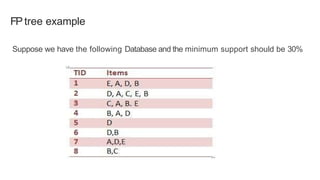
Suppose we have the following Database and the minimum support should be 30%
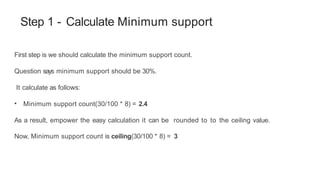
Step 1 - Calculate Minimum support
First step is we should calculate the minimum support count.
Question says minimum support should be 30%.
It calculate as follows:
• Minimum support count(30/100 * 8) = 2.4
As a result, empower the easy calculation it can be rounded to to the ceiling value.
Now, Minimum support count is ceiling(30/100 * 8) = 3
Step 2 - Find frequency of occurrence
Table 1 - Snapshot of the Database
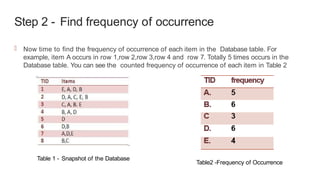
 Now time to find the frequency of occurrence of each item in the Database table. For
example, item A occurs in row 1,row 2,row 3,row 4 and row 7. Totally 5 times occurs in the
Database table. You can see the counted frequency of occurrence of each item in Table 2
Table2 -Frequency of Occurrence
Step 3 - Prioritize the items
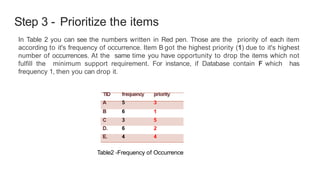
In Table 2 you can see the numbers written in Red pen. Those are the priority of each item
according to it's frequency of occurrence. Item B got the highest priority (1) due to it's highest
number of occurrences. At the same time you have opportunity to drop the items which not
fulfill the minimum support requirement. For instance, if Database contain F which has
frequency 1, then you can drop it.
Table2 -Frequency of Occurrence
Step 4 -Order the items according to priority
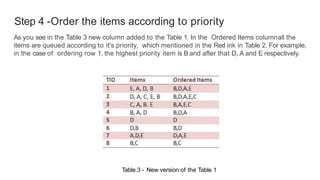
As you see in the Table 3 new column added to the Table 1. In the Ordered Items columnall the
items are queued according to it's priority, which mentioned in the Red ink in Table 2. For example,
in the case of ordering row 1, the highest priority item is B and after that D, A and E respectively.
Table 3 - New version of the Table 1
Step 5 -Order the items according to priority
As a result of previous steps we got a ordered items table (Table 3).
Now it's time to draw the FP tree. We will mention it row by row
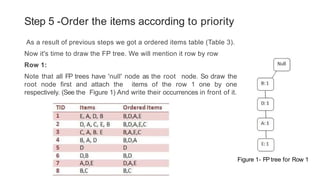
Row 1:
Note that all FP trees have 'null' node as the root node. So draw the
root node first and attach the items of the row 1 one by one
respectively. (See the Figure 1) And write their occurrences in front of it.
Figure 1- FP tree for Row 1
Row 2:
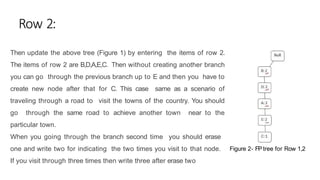
Then update the above tree (Figure 1) by entering the items of row 2.
The items of row 2 are B,D,A,E,C. Then without creating another branch
you can go through the previous branch up to E and then you have to
create new node after that for C. This case same as a scenario of
traveling through a road to visit the towns of the country. You should
go through the same road to achieve another town near to the
particular town.
When you going through the branch second time you should erase
one and write two for indicating the two times you visit to that node.
If you visit through three times then write three after erase two
Figure 2- FPtree for Row 1,2
Row 3:
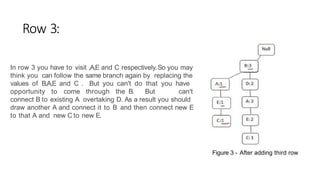
In row 3 you have to visit ,A,E and C respectively.So you may
think you can follow the same branch again by replacing the
values of B,A,E and C . But you can't do that you have
opportunity to come through the B. But can't
connect B to existing A overtaking D. As a result you should
draw another A and connect it to B and then connect new E
to that A and new C to new E.
Figure 3 - After adding third row
Row 4:
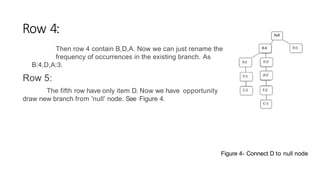
Then row 4 contain B,D,A. Now we can just rename the
frequency of occurrences in the existing branch. As
B:4,D,A:3.
Row 5:
The fifth row have only item D. Now we have opportunity
draw new branch from 'null' node. See Figure 4.
Figure 4- Connect D to null node
 Row 6:
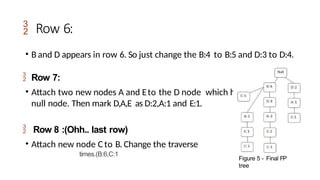
• B and D appears in row 6. So just change the B:4 to B:5 and D:3 to D:4.
 Row 7:
• Attach two new nodes A and Eto the D node which hanging on the
null node. Then mark D,A,E as D:2,A:1 and E:1.
 Row 8 :(Ohh.. last row)
• Attach new node C to B. Change the traverse
times.(B:6,C:1
Figure 5 - Final FP
tree
Step 6 - Validation
• After the five steps the final FP tree as follows: Figure 5.
• How we know is this correct?
• Now count the frequency of occurrence of each item of the FPtree and compare it with
Table 2.
• If both counts equal, then it is positive point to indicate your tree is correct.
Benefits of the FP-tree Structure
 Completeness
 Preserve complete information for frequent pattern mining
 Never break a long pattern of any transaction
 Compactness
 Reduce irrelevant info—infrequent items are gone
 I
o
t
c
e
c
m
u
s
r
r
i
i
n
g
f
r
,
e
t
q
h
u
e
e
m
n
c
o
y
r
e
d
l
e
i
k
s
e
c
e
l
y
n
t
d
o
i
n
b
g
e
o
s
r
h
d
a
e
r
r
e
:
d
t
h
e
more frequently
 N
a
n
e
d
v
e
t
r
h
e
b
e
c
o
l
a
u
r
n
g
t
e
f
r
i
e
t
h
l
d
a
)
nthe original database (not count
node-links
 T h e
r e e
x i
s t s e x a m p
l
e
sof databases, where compression
FP-Growth Complexity
 Therefore, each path in the tree will be at least partially
traversed the number of items existing in that tree path
(the depth of the tree path) * the number of items in the
header.
 Complexity of se
2
arching through all paths is then bounded by
O(header_count * depth of tree)
Thank You

Data Warehosuing & Data Mining: FP Growth

  • 1.
    FP Growth ALGORITHM Prof.Navya Francis Asst. Professor Kristu Jayanti College
  • 2.
    FP Growth Algorithm •The FP-Growth Algorithm is an alternative way to find frequent item sets without using candidate generations, thus improving performance. • It uses a divide-and-conquer strategy. • The core of this method is the usage of a special data structure named frequent-pattern tree (FP-tree), which retains the item set association information.
  • 3.
    FP Growth Algorithmworking steps • First, it compresses the input database creating an FP-tree instance to represent frequent items. • After this first step, it divides the compressed database into a set of conditional databases, each associated with one frequent pattern. • Finally, each such database is mined separately.
  • 4.
    FPtree example Suppose wehave the following Database and the minimum support should be 30%
  • 5.
    Step 1 -Calculate Minimum support First step is we should calculate the minimum support count. Question says minimum support should be 30%. It calculate as follows: • Minimum support count(30/100 * 8) = 2.4 As a result, empower the easy calculation it can be rounded to to the ceiling value. Now, Minimum support count is ceiling(30/100 * 8) = 3
  • 6.
    Step 2 -Find frequency of occurrence Table 1 - Snapshot of the Database  Now time to find the frequency of occurrence of each item in the Database table. For example, item A occurs in row 1,row 2,row 3,row 4 and row 7. Totally 5 times occurs in the Database table. You can see the counted frequency of occurrence of each item in Table 2 Table2 -Frequency of Occurrence
  • 7.
    Step 3 -Prioritize the items In Table 2 you can see the numbers written in Red pen. Those are the priority of each item according to it's frequency of occurrence. Item B got the highest priority (1) due to it's highest number of occurrences. At the same time you have opportunity to drop the items which not fulfill the minimum support requirement. For instance, if Database contain F which has frequency 1, then you can drop it. Table2 -Frequency of Occurrence
  • 8.
    Step 4 -Orderthe items according to priority As you see in the Table 3 new column added to the Table 1. In the Ordered Items columnall the items are queued according to it's priority, which mentioned in the Red ink in Table 2. For example, in the case of ordering row 1, the highest priority item is B and after that D, A and E respectively. Table 3 - New version of the Table 1
  • 9.
    Step 5 -Orderthe items according to priority As a result of previous steps we got a ordered items table (Table 3). Now it's time to draw the FP tree. We will mention it row by row Row 1: Note that all FP trees have 'null' node as the root node. So draw the root node first and attach the items of the row 1 one by one respectively. (See the Figure 1) And write their occurrences in front of it. Figure 1- FP tree for Row 1
  • 10.
    Row 2: Then updatethe above tree (Figure 1) by entering the items of row 2. The items of row 2 are B,D,A,E,C. Then without creating another branch you can go through the previous branch up to E and then you have to create new node after that for C. This case same as a scenario of traveling through a road to visit the towns of the country. You should go through the same road to achieve another town near to the particular town. When you going through the branch second time you should erase one and write two for indicating the two times you visit to that node. If you visit through three times then write three after erase two Figure 2- FPtree for Row 1,2
  • 11.
    Row 3: In row3 you have to visit ,A,E and C respectively.So you may think you can follow the same branch again by replacing the values of B,A,E and C . But you can't do that you have opportunity to come through the B. But can't connect B to existing A overtaking D. As a result you should draw another A and connect it to B and then connect new E to that A and new C to new E. Figure 3 - After adding third row
  • 12.
    Row 4: Then row4 contain B,D,A. Now we can just rename the frequency of occurrences in the existing branch. As B:4,D,A:3. Row 5: The fifth row have only item D. Now we have opportunity draw new branch from 'null' node. See Figure 4. Figure 4- Connect D to null node
  • 13.
     Row 6: •B and D appears in row 6. So just change the B:4 to B:5 and D:3 to D:4.  Row 7: • Attach two new nodes A and Eto the D node which hanging on the null node. Then mark D,A,E as D:2,A:1 and E:1.  Row 8 :(Ohh.. last row) • Attach new node C to B. Change the traverse times.(B:6,C:1 Figure 5 - Final FP tree
  • 14.
    Step 6 -Validation • After the five steps the final FP tree as follows: Figure 5. • How we know is this correct? • Now count the frequency of occurrence of each item of the FPtree and compare it with Table 2. • If both counts equal, then it is positive point to indicate your tree is correct.
  • 15.
    Benefits of theFP-tree Structure  Completeness  Preserve complete information for frequent pattern mining  Never break a long pattern of any transaction  Compactness  Reduce irrelevant info—infrequent items are gone  I o t c e c m u s r r i i n g f r , e t q h u e e m n c o y r e d l e i k s e c e l y n t d o i n b g e o s r h d a e r r e : d t h e more frequently  N a n e d v e t r h e b e c o l a u r n g t e f r i e t h l d a ) nthe original database (not count node-links  T h e r e e x i s t s e x a m p l e sof databases, where compression
  • 16.
    FP-Growth Complexity  Therefore,each path in the tree will be at least partially traversed the number of items existing in that tree path (the depth of the tree path) * the number of items in the header.  Complexity of se 2 arching through all paths is then bounded by O(header_count * depth of tree)
  • 17.