1
Mining Frequent Patterns
without Candidate Generation
Jiawei Han, Jian Pei and Yiwen Yin
SIGMOD 2000’ Conference
Presented By:
Xun Luo and Shun Liang
04/07/2005
2
Outline
•Introduction
•Constructing FP-Tree
• Example 1
•Mining Frequent Patterns using FP-Tree
• Example 2
•Performance Evaluation
•Discussions
3
Introduction
• Terminology
• Apriori-like Algorithms
• Generate-and-Test
• Cost Bottleneck
• FP-Tree and FP-Growth Algorithm
• FP-Tree: Frequent Pattern Tree
• FP-Growth: Mining frequent patterns with FP-Tree
4
Apriori-like Algorithms
• Algorithm
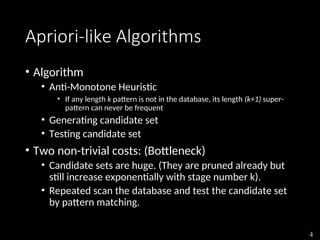
• Anti-Monotone Heuristic
• If any length k pattern is not in the database, its length (k+1) super-
pattern can never be frequent
• Generating candidate set
• Testing candidate set
• Two non-trivial costs: (Bottleneck)
• Candidate sets are huge. (They are pruned already but
still increase exponentially with stage number k).
• Repeated scan the database and test the candidate set
by pattern matching.
5
FP-Tree and FP-Growth Algorithm
• FP-Tree: Frequent Pattern Tree
• Compact presentation of the DB without information loss.
• Easy to traverse, can quickly find out patterns associated with
a certain item.
• Well-ordered by item frequency.
• FP-Growth Algorithm
• Start mining from length-1 patterns
• Recursively do the following
• Constructs its conditional FP-tree
• Concatenate patterns from conditional FP-tree with suffix
• Divide-and-Conquer mining technique
6
Outline
•Introduction
•Constructing FP-Tree
• Example 1
•Mining Frequent Patterns using FP-Tree
• Example 2
•Performance Evaluation
•Discussions
7
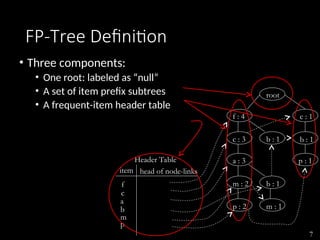
FP-Tree Definition
• Three components:
• One root: labeled as “null”
• A set of item prefix subtrees
• A frequent-item header table
Header Table
item head of node-links
f
c
a
b
m
p
root
p : 1
c : 1
b : 1
b : 1
b : 1
m : 1
f : 4
a : 3
m : 2
p : 2
c : 3
8
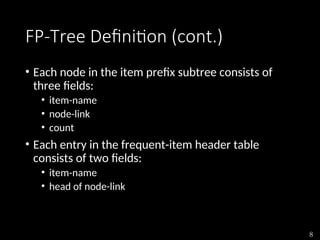
FP-Tree Definition (cont.)
• Each node in the item prefix subtree consists of
three fields:
• item-name
• node-link
• count
• Each entry in the frequent-item header table
consists of two fields:
• item-name
• head of node-link
9
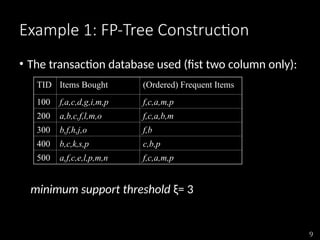
Example 1: FP-Tree Construction
• The transaction database used (fist two column only):
minimum support threshold ξ= 3
TID
TID Items Bought
Items Bought (Ordered) Frequent Items
(Ordered) Frequent Items
100
100 f,a,c,d,g,i,m,p
f,a,c,d,g,i,m,p f,c,a,m,p
f,c,a,m,p
200
200 a,b,c,f,l,m,o
a,b,c,f,l,m,o f,c,a,b,m
f,c,a,b,m
300
300 b,f,h,j,o
b,f,h,j,o f,b
f,b
400
400 b,c,k,s,p
b,c,k,s,p c,b,p
c,b,p
500
500 a,f,c,e,l,p,m,n
a,f,c,e,l,p,m,n f,c,a,m,p
f,c,a,m,p
10
Example 1 (cont.)
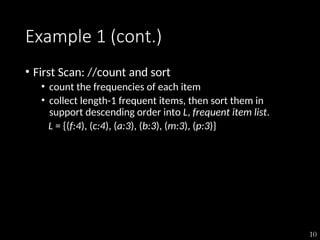
• First Scan: //count and sort
• count the frequencies of each item
• collect length-1 frequent items, then sort them in
support descending order into L, frequent item list.
L = {(f:4), (c:4), (a:3), (b:3), (m:3), (p:3)}
11
Example 1 (cont.)
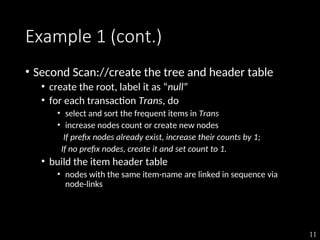
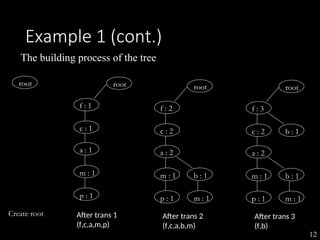
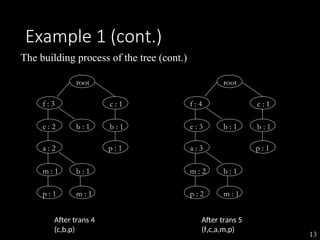
• Second Scan://create the tree and header table
• create the root, label it as “null”
• for each transaction Trans, do
• select and sort the frequent items in Trans
• increase nodes count or create new nodes
If prefix nodes already exist, increase their counts by 1;
If no prefix nodes, create it and set count to 1.
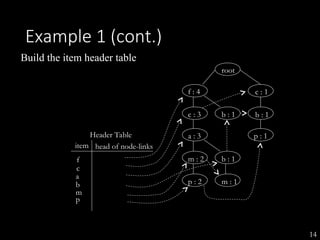
• build the item header table
• nodes with the same item-name are linked in sequence via
node-links
12
Example 1 (cont.)
root
Create root
root
f : 1
a : 1
m : 1
p : 1
c : 1
After trans 1
(f,c,a,m,p)
(f,c,a,m,p)
The building process of the tree
root
b : 1
m : 1
f : 2
a : 2
m : 1
p : 1
c : 2
After trans 2
(f,c,a,b,m)
(f,c,a,b,m)
root
b : 1
b : 1
m : 1
f : 3
a : 2
m : 1
p : 1
c : 2
After trans 3
(f,b)
(f,b)
13
Example 1 (cont.)
The building process of the tree (cont.)
root
p : 1
c : 1
b : 1
b : 1
b : 1
m : 1
f : 3
a : 2
m : 1
p : 1
c : 2
After trans 4
(c,b,p
c,b,p)
root
p : 1
c : 1
b : 1
b : 1
b : 1
m : 1
f : 4
a : 3
m : 2
p : 2
c : 3
After trans 5
(f,c,a,m,p)
f,c,a,m,p)
14
Example 1 (cont.)
Build the item header table
Header Table
item head of node-links
f
c
a
b
m
p
root
p : 1
c : 1
b : 1
b : 1
b : 1
m : 1
f : 4
a : 3
m : 2
p : 2
c : 3
15
FP-Tree Properties
• Completeness
• Each transaction that contains frequent pattern is
mapped to a path.
• Prefix sharing does not cause path ambiguity, as only
path starts from root represents a transaction.
• Compactness
• Number of nodes bounded by overall occurrence of
frequent items.
• Height of tree bounded by maximal number of frequent
items in any transaction.
16
FP-Tree Properties (cont.)
• Traversal Friendly (for mining task)
• For any frequent item ai, all the possible frequent
patterns that contain ai can be obtained by following ai’s
node-links.

• This property is important for divide-and-conquer. It
assures the soundness and completeness of problem
reduction.
17
Outline
•Introduction
•Constructing FP-Tree
• Example 1
•Mining Frequent Patterns using FP-Tree
• Example 2
•Performance Evaluation
•Discussions
18
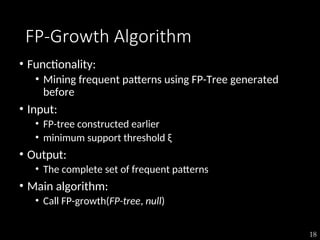
FP-Growth Algorithm
• Functionality:
• Mining frequent patterns using FP-Tree generated
before
• Input:
• FP-tree constructed earlier
• minimum support threshold ξ
• Output:
• The complete set of frequent patterns
• Main algorithm:
• Call FP-growth(FP-tree, null)
19
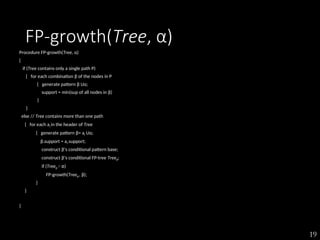
FP-growth(Tree, α)
Procedure FP-growth(Tree, α)
{
if (Tree contains only a single path P)
{ for each combination β of the nodes in P
{ generate pattern β Uα;
support = min(sup of all nodes in β)
}
}
else // Tree contains more than one path
{ for each ai in the header of Tree
{ generate pattern β= ai Uα;
β.support = ai.support;
construct β’s conditional pattern base;
construct β’s conditional FP-tree Treeβ;
if (Treeβ ≠ Φ)
FP-growth(Treeβ , β);
}
}
}
20
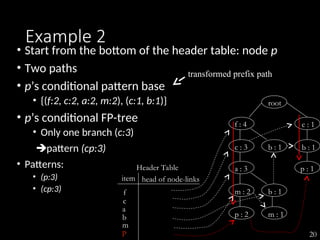
Example 2
• Start from the bottom of the header table: node p
• Two paths
• p’s conditional pattern base
• {(f:2, c:2, a:2, m:2), (c:1, b:1)}
• p’s conditional FP-tree
• Only one branch (c:3)
pattern (cp:3)
• Patterns:
• (p:3)
• (cp:3)
Header Table
item head of node-links
f
c
a
b
m
p
root
p : 1
c : 1
b : 1
b : 1
b : 1
m : 1
f : 4
a : 3
m : 2
p : 2
c : 3
transformed prefix path
21
Example 2 (cont.)
• Continue with node m
• Two paths
• m’s conditional pattern base
• {(f:2, c:2, a:2), (f:1,c:1, a:1, b:1)}
• m’s conditional FP-tree:
• (f:3, c:3, a:3)
• Call mine(<f:3, c:3, a:3>| m)
• Patterns:
• (m:3)
• see next slide
Header Table
item head of node-links
f
c
a
b
m
p
root
p : 1
c : 1
b : 1
b : 1
b : 1
m : 1
f : 4
a : 3
m : 2
p : 2
c : 3
22
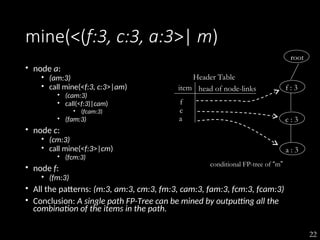
mine(<(f:3, c:3, a:3>| m)
• node a:
• (am:3)
• call mine(<f:3, c:3>|am)
• (cam:3)
• call(<f:3)|cam)
• (fcam:3)
• (fam:3)
• node c:
• (cm:3)
• call mine(<f:3>|cm)
• (fcm:3)
• node f:
• (fm:3)
• All the patterns: (m:3, am:3, cm:3, fm:3, cam:3, fam:3, fcm:3, fcam:3)
• Conclusion: A single path FP-Tree can be mined by outputting all the
combination of the items in the path.
Header Table
item head of node-links
f
c
a
root
f : 3
a : 3
c : 3
conditional FP-tree of “m”
23
Example 2 (cont.)
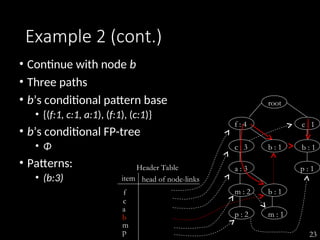
• Continue with node b
• Three paths
• b’s conditional pattern base
• {(f:1, c:1, a:1), (f:1), (c:1)}
• b’s conditional FP-tree
• Φ
• Patterns:
• (b:3)
Header Table
item head of node-links
f
c
a
b
m
p
root
p : 1
c : 1
b : 1
b : 1
b : 1
m : 1
f : 4
a : 3
m : 2
p : 2
c : 3
24
Example 2 (cont.)
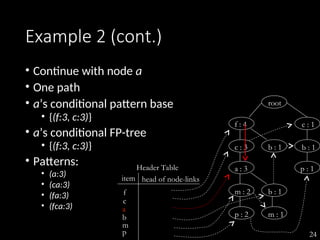
• Continue with node a
• One path
• a’s conditional pattern base
• {(f:3, c:3)}
• a’s conditional FP-tree
• {(f:3, c:3)}
• Patterns:
• (a:3)
• (ca:3)
• (fa:3)
• (fca:3)
Header Table
item head of node-links
f
c
a
b
m
p
root
p : 1
c : 1
b : 1
b : 1
b : 1
m : 1
f : 4
a : 3
m : 2
p : 2
c : 3
25
Example 2 (cont.)
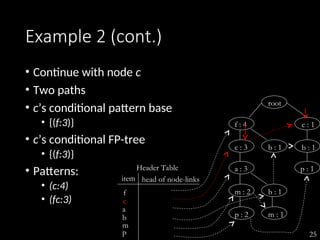
• Continue with node c
• Two paths
• c’s conditional pattern base
• {(f:3)}
• c’s conditional FP-tree
• {(f:3)}
• Patterns:
• (c:4)
• (fc:3)
Header Table
item head of node-links
f
c
a
b
m
p
root
p : 1
c : 1
b : 1
b : 1
b : 1
m : 1
f : 4
a : 3
m : 2
p : 2
c : 3
26
Example 2 (cont.)
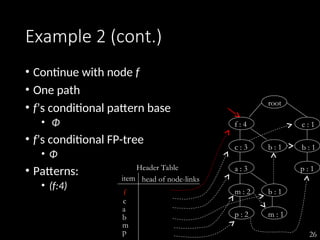
• Continue with node f
• One path
• f’s conditional pattern base
• Φ
• f’s conditional FP-tree
• Φ
• Patterns:
• (f:4)
Header Table
item head of node-links
f
c
a
b
m
p
root
p : 1
c : 1
b : 1
b : 1
b : 1
m : 1
f : 4
a : 3
m : 2
p : 2
c : 3
27
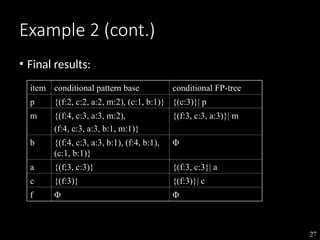
Example 2 (cont.)
• Final results:
item
item conditional pattern base
conditional pattern base conditional FP-tree
conditional FP-tree
p
p {(f:2, c:2, a:2, m:2), (c:1, b:1)}
{(f:2, c:2, a:2, m:2), (c:1, b:1)} {(c:3)}| p
{(c:3)}| p
m
m {(f:4, c:3, a:3, m:2),
{(f:4, c:3, a:3, m:2),
(f:4, c:3, a:3, b:1, m:1)}
{(f:3, c:3, a:3)}| m
b
b {(f:4, c:3, a:3, b:1), (f:4, b:1),
{(f:4, c:3, a:3, b:1), (f:4, b:1),
(c:1, b:1)}
(c:1, b:1)}
Φ
Φ
a
a {(f;3, c:3)}
{(f;3, c:3)} {(f:3, c:3}| a
{(f:3, c:3}| a
c
c {(f:3)}
{(f:3)} {(f:3)}| c
{(f:3)}| c
f
f Φ
Φ Φ
Φ
28
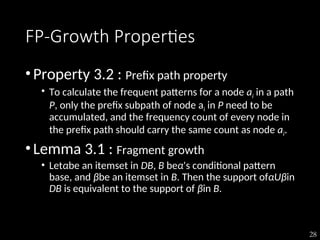
FP-Growth Properties
•Property 3.2 : Prefix path property
• To calculate the frequent patterns for a node ai in a path
P, only the prefix subpath of node ai in P need to be
accumulated, and the frequency count of every node in
the prefix path should carry the same count as node ai.
•Lemma 3.1 : Fragment growth
• Letαbe an itemset in DB, B beα's conditional pattern
base, and βbe an itemset in B. Then the support ofαUβin
DB is equivalent to the support of βin B.
29
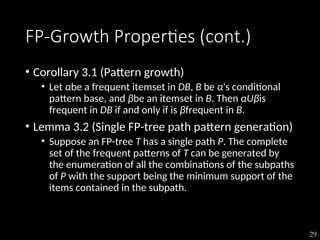
FP-Growth Properties (cont.)
• Corollary 3.1 (Pattern growth)
• Let αbe a frequent itemset in DB, B be α's conditional
pattern base, and βbe an itemset in B. Then αUβis
frequent in DB if and only if is βfrequent in B.
• Lemma 3.2 (Single FP-tree path pattern generation)
• Suppose an FP-tree T has a single path P. The complete
set of the frequent patterns of T can be generated by
the enumeration of all the combinations of the subpaths
of P with the support being the minimum support of the
items contained in the subpath.
30
Outline
•Introduction
•Constructing FP-Tree
• Example 1
•Mining Frequent Patterns using FP-Tree
• Example 2
•Performance Evaluation
•Discussions
31
Performance Evaluation:
FP-Tree vs. Apriori
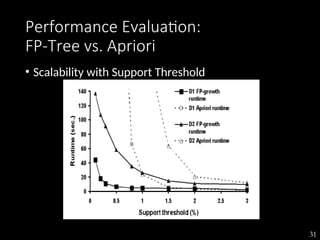
• Scalability with Support Threshold
32
Performance Evaluation:
FP-Tree vs. Apriori (Cont.)
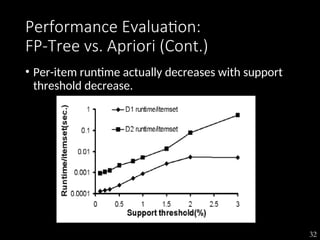
• Per-item runtime actually decreases with support
threshold decrease.
33
Performance Evaluation:
FP-Tree vs. Apriori (Cont.)
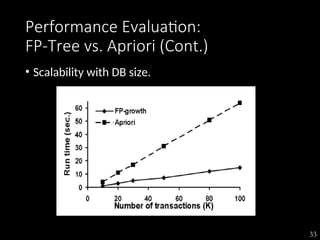
• Scalability with DB size.
34
Outline
•Introduction
•Constructing FP-Tree
• Example 1
•Mining Frequent Patterns using FP-Tree
• Example 2
•Performance Evaluation
•Discussions
35
Discussions
• When database is extremely large.
• Use FP-Tree on projected databases.
• Or, make FP-Tree disk-resident.
• Materialization of an FP-Tree
• Construct it independently of queries, with an
reasonably fit-majority minimum support-threshold.
• Incremental updates of an FP-Tree.
• Record frequency count for every item.
• Control by watermark.
36
Thank you!
• Q & A.

frequent pattern mining without candidate

  • 1.
    1 Mining Frequent Patterns withoutCandidate Generation Jiawei Han, Jian Pei and Yiwen Yin SIGMOD 2000’ Conference Presented By: Xun Luo and Shun Liang 04/07/2005
  • 2.
    2 Outline •Introduction •Constructing FP-Tree • Example1 •Mining Frequent Patterns using FP-Tree • Example 2 •Performance Evaluation •Discussions
  • 3.
    3 Introduction • Terminology • Apriori-likeAlgorithms • Generate-and-Test • Cost Bottleneck • FP-Tree and FP-Growth Algorithm • FP-Tree: Frequent Pattern Tree • FP-Growth: Mining frequent patterns with FP-Tree
  • 4.
    4 Apriori-like Algorithms • Algorithm •Anti-Monotone Heuristic • If any length k pattern is not in the database, its length (k+1) super- pattern can never be frequent • Generating candidate set • Testing candidate set • Two non-trivial costs: (Bottleneck) • Candidate sets are huge. (They are pruned already but still increase exponentially with stage number k). • Repeated scan the database and test the candidate set by pattern matching.
  • 5.
    5 FP-Tree and FP-GrowthAlgorithm • FP-Tree: Frequent Pattern Tree • Compact presentation of the DB without information loss. • Easy to traverse, can quickly find out patterns associated with a certain item. • Well-ordered by item frequency. • FP-Growth Algorithm • Start mining from length-1 patterns • Recursively do the following • Constructs its conditional FP-tree • Concatenate patterns from conditional FP-tree with suffix • Divide-and-Conquer mining technique
  • 6.
    6 Outline •Introduction •Constructing FP-Tree • Example1 •Mining Frequent Patterns using FP-Tree • Example 2 •Performance Evaluation •Discussions
  • 7.
    7 FP-Tree Definition • Threecomponents: • One root: labeled as “null” • A set of item prefix subtrees • A frequent-item header table Header Table item head of node-links f c a b m p root p : 1 c : 1 b : 1 b : 1 b : 1 m : 1 f : 4 a : 3 m : 2 p : 2 c : 3
  • 8.
    8 FP-Tree Definition (cont.) •Each node in the item prefix subtree consists of three fields: • item-name • node-link • count • Each entry in the frequent-item header table consists of two fields: • item-name • head of node-link
  • 9.
    9 Example 1: FP-TreeConstruction • The transaction database used (fist two column only): minimum support threshold ξ= 3 TID TID Items Bought Items Bought (Ordered) Frequent Items (Ordered) Frequent Items 100 100 f,a,c,d,g,i,m,p f,a,c,d,g,i,m,p f,c,a,m,p f,c,a,m,p 200 200 a,b,c,f,l,m,o a,b,c,f,l,m,o f,c,a,b,m f,c,a,b,m 300 300 b,f,h,j,o b,f,h,j,o f,b f,b 400 400 b,c,k,s,p b,c,k,s,p c,b,p c,b,p 500 500 a,f,c,e,l,p,m,n a,f,c,e,l,p,m,n f,c,a,m,p f,c,a,m,p
  • 10.
    10 Example 1 (cont.) •First Scan: //count and sort • count the frequencies of each item • collect length-1 frequent items, then sort them in support descending order into L, frequent item list. L = {(f:4), (c:4), (a:3), (b:3), (m:3), (p:3)}
  • 11.
    11 Example 1 (cont.) •Second Scan://create the tree and header table • create the root, label it as “null” • for each transaction Trans, do • select and sort the frequent items in Trans • increase nodes count or create new nodes If prefix nodes already exist, increase their counts by 1; If no prefix nodes, create it and set count to 1. • build the item header table • nodes with the same item-name are linked in sequence via node-links
  • 12.
    12 Example 1 (cont.) root Createroot root f : 1 a : 1 m : 1 p : 1 c : 1 After trans 1 (f,c,a,m,p) (f,c,a,m,p) The building process of the tree root b : 1 m : 1 f : 2 a : 2 m : 1 p : 1 c : 2 After trans 2 (f,c,a,b,m) (f,c,a,b,m) root b : 1 b : 1 m : 1 f : 3 a : 2 m : 1 p : 1 c : 2 After trans 3 (f,b) (f,b)
  • 13.
    13 Example 1 (cont.) Thebuilding process of the tree (cont.) root p : 1 c : 1 b : 1 b : 1 b : 1 m : 1 f : 3 a : 2 m : 1 p : 1 c : 2 After trans 4 (c,b,p c,b,p) root p : 1 c : 1 b : 1 b : 1 b : 1 m : 1 f : 4 a : 3 m : 2 p : 2 c : 3 After trans 5 (f,c,a,m,p) f,c,a,m,p)
  • 14.
    14 Example 1 (cont.) Buildthe item header table Header Table item head of node-links f c a b m p root p : 1 c : 1 b : 1 b : 1 b : 1 m : 1 f : 4 a : 3 m : 2 p : 2 c : 3
  • 15.
    15 FP-Tree Properties • Completeness •Each transaction that contains frequent pattern is mapped to a path. • Prefix sharing does not cause path ambiguity, as only path starts from root represents a transaction. • Compactness • Number of nodes bounded by overall occurrence of frequent items. • Height of tree bounded by maximal number of frequent items in any transaction.
  • 16.
    16 FP-Tree Properties (cont.) •Traversal Friendly (for mining task) • For any frequent item ai, all the possible frequent patterns that contain ai can be obtained by following ai’s node-links. • This property is important for divide-and-conquer. It assures the soundness and completeness of problem reduction.
  • 17.
    17 Outline •Introduction •Constructing FP-Tree • Example1 •Mining Frequent Patterns using FP-Tree • Example 2 •Performance Evaluation •Discussions
  • 18.
    18 FP-Growth Algorithm • Functionality: •Mining frequent patterns using FP-Tree generated before • Input: • FP-tree constructed earlier • minimum support threshold ξ • Output: • The complete set of frequent patterns • Main algorithm: • Call FP-growth(FP-tree, null)
  • 19.
    19 FP-growth(Tree, α) Procedure FP-growth(Tree,α) { if (Tree contains only a single path P) { for each combination β of the nodes in P { generate pattern β Uα; support = min(sup of all nodes in β) } } else // Tree contains more than one path { for each ai in the header of Tree { generate pattern β= ai Uα; β.support = ai.support; construct β’s conditional pattern base; construct β’s conditional FP-tree Treeβ; if (Treeβ ≠ Φ) FP-growth(Treeβ , β); } } }
  • 20.
    20 Example 2 • Startfrom the bottom of the header table: node p • Two paths • p’s conditional pattern base • {(f:2, c:2, a:2, m:2), (c:1, b:1)} • p’s conditional FP-tree • Only one branch (c:3) pattern (cp:3) • Patterns: • (p:3) • (cp:3) Header Table item head of node-links f c a b m p root p : 1 c : 1 b : 1 b : 1 b : 1 m : 1 f : 4 a : 3 m : 2 p : 2 c : 3 transformed prefix path
  • 21.
    21 Example 2 (cont.) •Continue with node m • Two paths • m’s conditional pattern base • {(f:2, c:2, a:2), (f:1,c:1, a:1, b:1)} • m’s conditional FP-tree: • (f:3, c:3, a:3) • Call mine(<f:3, c:3, a:3>| m) • Patterns: • (m:3) • see next slide Header Table item head of node-links f c a b m p root p : 1 c : 1 b : 1 b : 1 b : 1 m : 1 f : 4 a : 3 m : 2 p : 2 c : 3
  • 22.
    22 mine(<(f:3, c:3, a:3>|m) • node a: • (am:3) • call mine(<f:3, c:3>|am) • (cam:3) • call(<f:3)|cam) • (fcam:3) • (fam:3) • node c: • (cm:3) • call mine(<f:3>|cm) • (fcm:3) • node f: • (fm:3) • All the patterns: (m:3, am:3, cm:3, fm:3, cam:3, fam:3, fcm:3, fcam:3) • Conclusion: A single path FP-Tree can be mined by outputting all the combination of the items in the path. Header Table item head of node-links f c a root f : 3 a : 3 c : 3 conditional FP-tree of “m”
  • 23.
    23 Example 2 (cont.) •Continue with node b • Three paths • b’s conditional pattern base • {(f:1, c:1, a:1), (f:1), (c:1)} • b’s conditional FP-tree • Φ • Patterns: • (b:3) Header Table item head of node-links f c a b m p root p : 1 c : 1 b : 1 b : 1 b : 1 m : 1 f : 4 a : 3 m : 2 p : 2 c : 3
  • 24.
    24 Example 2 (cont.) •Continue with node a • One path • a’s conditional pattern base • {(f:3, c:3)} • a’s conditional FP-tree • {(f:3, c:3)} • Patterns: • (a:3) • (ca:3) • (fa:3) • (fca:3) Header Table item head of node-links f c a b m p root p : 1 c : 1 b : 1 b : 1 b : 1 m : 1 f : 4 a : 3 m : 2 p : 2 c : 3
  • 25.
    25 Example 2 (cont.) •Continue with node c • Two paths • c’s conditional pattern base • {(f:3)} • c’s conditional FP-tree • {(f:3)} • Patterns: • (c:4) • (fc:3) Header Table item head of node-links f c a b m p root p : 1 c : 1 b : 1 b : 1 b : 1 m : 1 f : 4 a : 3 m : 2 p : 2 c : 3
  • 26.
    26 Example 2 (cont.) •Continue with node f • One path • f’s conditional pattern base • Φ • f’s conditional FP-tree • Φ • Patterns: • (f:4) Header Table item head of node-links f c a b m p root p : 1 c : 1 b : 1 b : 1 b : 1 m : 1 f : 4 a : 3 m : 2 p : 2 c : 3
  • 27.
    27 Example 2 (cont.) •Final results: item item conditional pattern base conditional pattern base conditional FP-tree conditional FP-tree p p {(f:2, c:2, a:2, m:2), (c:1, b:1)} {(f:2, c:2, a:2, m:2), (c:1, b:1)} {(c:3)}| p {(c:3)}| p m m {(f:4, c:3, a:3, m:2), {(f:4, c:3, a:3, m:2), (f:4, c:3, a:3, b:1, m:1)} (f:4, c:3, a:3, b:1, m:1)} {(f:3, c:3, a:3)}| m {(f:3, c:3, a:3)}| m b b {(f:4, c:3, a:3, b:1), (f:4, b:1), {(f:4, c:3, a:3, b:1), (f:4, b:1), (c:1, b:1)} (c:1, b:1)} Φ Φ a a {(f;3, c:3)} {(f;3, c:3)} {(f:3, c:3}| a {(f:3, c:3}| a c c {(f:3)} {(f:3)} {(f:3)}| c {(f:3)}| c f f Φ Φ Φ Φ
  • 28.
    28 FP-Growth Properties •Property 3.2: Prefix path property • To calculate the frequent patterns for a node ai in a path P, only the prefix subpath of node ai in P need to be accumulated, and the frequency count of every node in the prefix path should carry the same count as node ai. •Lemma 3.1 : Fragment growth • Letαbe an itemset in DB, B beα's conditional pattern base, and βbe an itemset in B. Then the support ofαUβin DB is equivalent to the support of βin B.
  • 29.
    29 FP-Growth Properties (cont.) •Corollary 3.1 (Pattern growth) • Let αbe a frequent itemset in DB, B be α's conditional pattern base, and βbe an itemset in B. Then αUβis frequent in DB if and only if is βfrequent in B. • Lemma 3.2 (Single FP-tree path pattern generation) • Suppose an FP-tree T has a single path P. The complete set of the frequent patterns of T can be generated by the enumeration of all the combinations of the subpaths of P with the support being the minimum support of the items contained in the subpath.
  • 30.
    30 Outline •Introduction •Constructing FP-Tree • Example1 •Mining Frequent Patterns using FP-Tree • Example 2 •Performance Evaluation •Discussions
  • 31.
    31 Performance Evaluation: FP-Tree vs.Apriori • Scalability with Support Threshold
  • 32.
    32 Performance Evaluation: FP-Tree vs.Apriori (Cont.) • Per-item runtime actually decreases with support threshold decrease.
  • 33.
    33 Performance Evaluation: FP-Tree vs.Apriori (Cont.) • Scalability with DB size.
  • 34.
    34 Outline •Introduction •Constructing FP-Tree • Example1 •Mining Frequent Patterns using FP-Tree • Example 2 •Performance Evaluation •Discussions
  • 35.
    35 Discussions • When databaseis extremely large. • Use FP-Tree on projected databases. • Or, make FP-Tree disk-resident. • Materialization of an FP-Tree • Construct it independently of queries, with an reasonably fit-majority minimum support-threshold. • Incremental updates of an FP-Tree. • Record frequency count for every item. • Control by watermark.
  • 36.