Frequent Item-set Mining
Methods
Prepared By- Mr.Nilesh Magar
Data Mining:
Data mining is the efficient discovery of
valuable, non obvious information from a
large collection of data.
Prepared By- Mr.Nilesh Magar
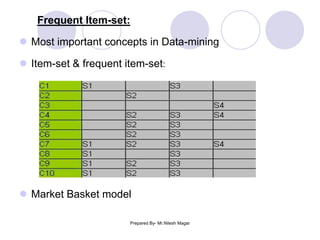
 Most important concepts in Data-mining
 Item-set & frequent item-set:
 Market Basket model
Frequent Item-set:
Prepared By- Mr.Nilesh Magar
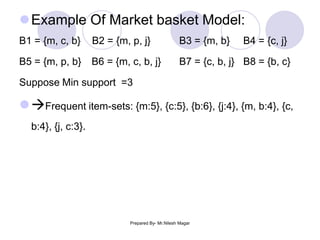
Example Of Market basket Model:
B1 = {m, c, b} B2 = {m, p, j} B3 = {m, b} B4 = {c, j}
B5 = {m, p, b} B6 = {m, c, b, j} B7 = {c, b, j} B8 = {b, c}
Suppose Min support =3
Frequent item-sets: {m:5}, {c:5}, {b:6}, {j:4}, {m, b:4}, {c,
b:4}, {j, c:3}.
Prepared By- Mr.Nilesh Magar
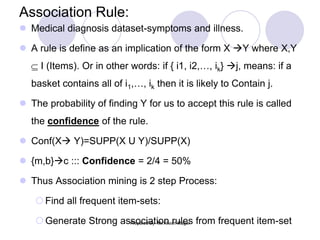
Association Rule:
 Medical diagnosis dataset-symptoms and illness.
 A rule is define as an implication of the form X Y where X,Y
I (Items). Or in other words: if { i1, i2,…, ik} j, means: if a
basket contains all of i1,…, ik then it is likely to Contain j.
 The probability of finding Y for us to accept this rule is called
the confidence of the rule.
 Conf(X Y)=SUPP(X U Y)/SUPP(X)
 {m,b}c ::: Confidence = 2/4 = 50%
 Thus Association mining is 2 step Process:
Find all frequent item-sets:
Generate Strong association rules from frequent item-setPrepared By- Mr.Nilesh Magar
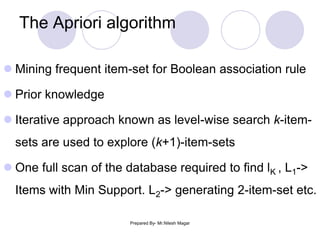
The Apriori algorithm
 Mining frequent item-set for Boolean association rule
 Prior knowledge
 Iterative approach known as level-wise search k-item-
sets are used to explore (k+1)-item-sets
 One full scan of the database required to find lK , L1->
Items with Min Support. L2-> generating 2-item-set etc.
Prepared By- Mr.Nilesh Magar
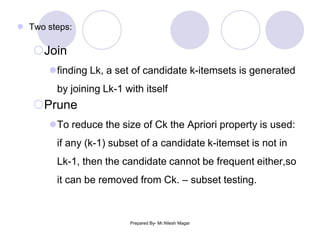
 Two steps:
Join
finding Lk, a set of candidate k-itemsets is generated
by joining Lk-1 with itself
Prune
To reduce the size of Ck the Apriori property is used:
if any (k-1) subset of a candidate k-itemset is not in
Lk-1, then the candidate cannot be frequent either,so
it can be removed from Ck. – subset testing.
Prepared By- Mr.Nilesh Magar
Join & prune
Step
Prepared By- Mr.Nilesh Magar
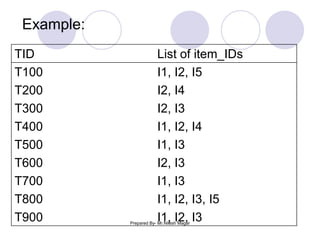
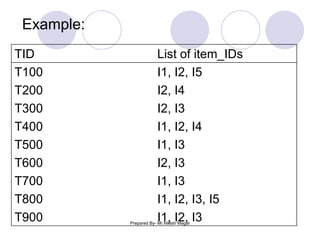
Example:
TID List of item_IDs
T100 I1, I2, I5
T200 I2, I4
T300 I2, I3
T400 I1, I2, I4
T500 I1, I3
T600 I2, I3
T700 I1, I3
T800 I1, I2, I3, I5
T900 I1, I2, I3Prepared By- Mr.Nilesh Magar
Prepared By- Mr.Nilesh Magar
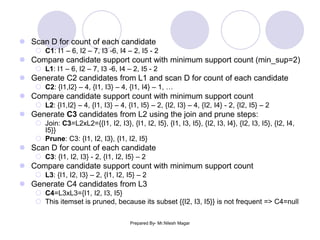
 Scan D for count of each candidate
 C1: I1 – 6, I2 – 7, I3 -6, I4 – 2, I5 - 2
 Compare candidate support count with minimum support count (min_sup=2)
 L1: I1 – 6, I2 – 7, I3 -6, I4 – 2, I5 - 2
 Generate C2 candidates from L1 and scan D for count of each candidate
 C2: {I1,I2} – 4, {I1, I3} – 4, {I1, I4} – 1, …
 Compare candidate support count with minimum support count
 L2: {I1,I2} – 4, {I1, I3} – 4, {I1, I5} – 2, {I2, I3} – 4, {I2, I4} - 2, {I2, I5} – 2
 Generate C3 candidates from L2 using the join and prune steps:
 Join: C3=L2xL2={{I1, I2, I3}, {I1, I2, I5}, {I1, I3, I5}, {I2, I3, I4}, {I2, I3, I5}, {I2, I4,
I5}}
 Prune: C3: {I1, I2, I3}, {I1, I2, I5}
 Scan D for count of each candidate
 C3: {I1, I2, I3} - 2, {I1, I2, I5} – 2
 Compare candidate support count with minimum support count
 L3: {I1, I2, I3} – 2, {I1, I2, I5} – 2
 Generate C4 candidates from L3
 C4=L3xL3={I1, I2, I3, I5}
 This itemset is pruned, because its subset {{I2, I3, I5}} is not frequent => C4=null
Prepared By- Mr.Nilesh Magar
Generating association rules from
frequent item-sets: from Slide 5
Finding the frequent item-sets from
transactions in a database D
Generating strong association rules:
Confidence(A=>B)=P(B|A)=
support_count(AUB)/support_count(A)
support_count(AUB) – number of transactions
containing the itemsets AUB
support_count(A) - number of transactions containing
the itemsets A
Prepared By- Mr.Nilesh Magar
 Example:
 lets have l={I1, I2, I5}
 The nonempty subsets are {I1, I2}, {I1, I5}, {I2, I5}, {I1}, {I2}, {I5}.
 Generating association rules:
I1 and I2=>I5 conf=2/4=50%
I1 and I5=>I2 conf=2/2=100%
I2 and I5=> I1 conf=2/2=100%
I1=>I2 and I5 conf=2/6=33%
I2=>I1 and I5 conf=2/7=29%
I5=>I1 and I2 conf=2/2=100%
If min_conf is 70%, then only the second, third and last rules above
are output.
Prepared By- Mr.Nilesh Magar
Advantages & Disadvantages:
 Adv:
 1) Uses Large item-set
Property
 2) Easily parallelized
 3) Easy to implement
Dis-Adv:
1) Assumes
transaction
database is
memory resident
Requires up to ‘m’
database scan.
Prepared By- Mr.Nilesh Magar
Mining Frequent Itemsets without
candidate generation
The candidate generate and test method
It may need to generate a huge number of
candidate sets
It may need to repeatedly scan the database
and check a large set of candidates by pattern
matching
Frequent-pattern growth method(FP-
growth) – frequent pattern tree(FP-tree)
Prepared By- Mr.Nilesh Magar
Example:
TID List of item_IDs
T100 I1, I2, I5
T200 I2, I4
T300 I2, I3
T400 I1, I2, I4
T500 I1, I3
T600 I2, I3
T700 I1, I3
T800 I1, I2, I3, I5
T900 I1, I2, I3Prepared By- Mr.Nilesh Magar
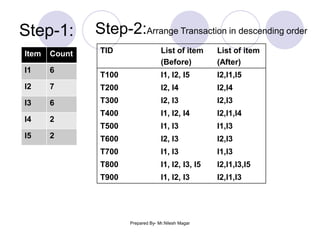
Step-1:
Item Count
I1 6
I2 7
I3 6
I4 2
I5 2
Step-2:Arrange Transaction in descending order
TID List of item
(Before)
List of item
(After)
T100 I1, I2, I5 I2,I1,I5
T200 I2, I4 I2,I4
T300 I2, I3 I2,I3
T400 I1, I2, I4 I2,I1,I4
T500 I1, I3 I1,I3
T600 I2, I3 I2,I3
T700 I1, I3 I1,I3
T800 I1, I2, I3, I5 I2,I1,I3,I5
T900 I1, I2, I3 I2,I1,I3
Prepared By- Mr.Nilesh Magar
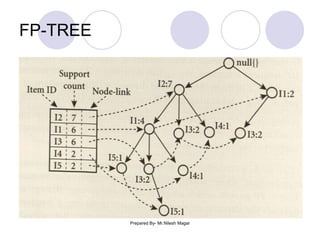
FP-TREE
Prepared By- Mr.Nilesh Magar
Item Conditional
Pattern Base
Conditional
FP-tree
Frequent Pattern
Generated
I5 {{I2, I1:1}, {I2,
I1, I3:1}}
(I2:2, I1:2) {I2, I5:2}, {I1,
I5:2}, {I2, I1, I5:2}
I4 {{I2, I1:2},
{I2:1}}
(I2:2) {I2, I4:2}
I3 {{I2, I1:2},
{I2:2}, {I1:2}}
(I2:4, I1:2),
(I1:2),
{I2, I3:4}, {I1,
I3:4}, {I2, I1, I3:2}
I1 {{I2:4}} (I2:4) {I2, I1:4}
Prepared By- Mr.Nilesh Magar
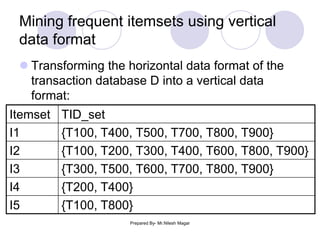
Mining frequent itemsets using vertical
data format
 Transforming the horizontal data format of the
transaction database D into a vertical data
format:
Itemset TID_set
I1 {T100, T400, T500, T700, T800, T900}
I2 {T100, T200, T300, T400, T600, T800, T900}
I3 {T300, T500, T600, T700, T800, T900}
I4 {T200, T400}
I5 {T100, T800}
Prepared By- Mr.Nilesh Magar
Example For Practice
Prepared By- Mr.Nilesh Magar
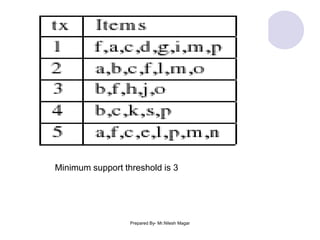
Minimum support threshold is 3
Prepared By- Mr.Nilesh Magar
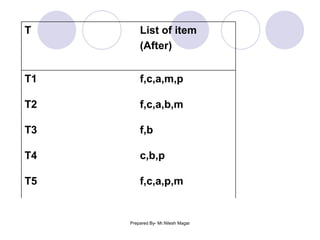
T List of item
(After)
T1 f,c,a,m,p
T2 f,c,a,b,m
T3 f,b
T4 c,b,p
T5 f,c,a,p,m
Prepared By- Mr.Nilesh Magar
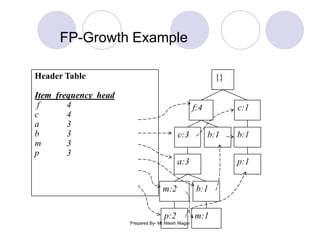
{}
f:4 c:1
b:1
p:1
b:1c:3
a:3
b:1m:2
p:2 m:1
Header Table
Item frequency head
f 4
c 4
a 3
b 3
m 3
p 3
FP-Growth Example
Prepared By- Mr.Nilesh Magar
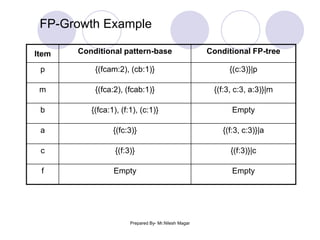
FP-Growth Example
EmptyEmptyf
{(f:3)}|c{(f:3)}c
{(f:3, c:3)}|a{(fc:3)}a
Empty{(fca:1), (f:1), (c:1)}b
{(f:3, c:3, a:3)}|m{(fca:2), (fcab:1)}m
{(c:3)}|p{(fcam:2), (cb:1)}p
Conditional FP-treeConditional pattern-baseItem
Prepared By- Mr.Nilesh Magar
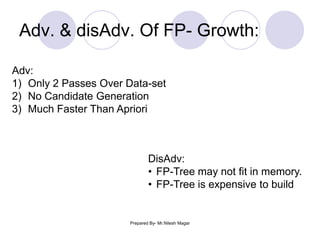
FP-Tree Algorithm:
Input: DB, min_support
Output: FP-Tree
1. Scan DB & count all frequent items.
2. Create null root & set as current node.
3. For each Transaction T
 Sort T’s items.
 For each sorted Item I
 Insert I into tree as a child of current node.
 Connect new tree node to header list.
Prepared By- Mr.Nilesh Magar
FP- Growth Algorithm:
Prepared By- Mr.Nilesh Magar
Adv. & disAdv. Of FP- Growth:
Adv:
1) Only 2 Passes Over Data-set
2) No Candidate Generation
3) Much Faster Than Apriori
DisAdv:
• FP-Tree may not fit in memory.
• FP-Tree is expensive to build
Prepared By- Mr.Nilesh Magar
Subjects
1) U.M.L.
2) P.P.L.
3) D.M.D.W.
4) O.S.
5) Programming Languages
6) RDBMS
Mr. Nilesh Magar
Lecturer at MIT, Kothrud, Pune.
9975155310.
Prepared By - Mr. Nilesh Magar
Thank You
Prepared By - Mr. Nilesh Magar

Frequent itemset mining methods

  • 1.
  • 2.
    Data Mining: Data miningis the efficient discovery of valuable, non obvious information from a large collection of data. Prepared By- Mr.Nilesh Magar
  • 3.
     Most importantconcepts in Data-mining  Item-set & frequent item-set:  Market Basket model Frequent Item-set: Prepared By- Mr.Nilesh Magar
  • 4.
    Example Of Marketbasket Model: B1 = {m, c, b} B2 = {m, p, j} B3 = {m, b} B4 = {c, j} B5 = {m, p, b} B6 = {m, c, b, j} B7 = {c, b, j} B8 = {b, c} Suppose Min support =3 Frequent item-sets: {m:5}, {c:5}, {b:6}, {j:4}, {m, b:4}, {c, b:4}, {j, c:3}. Prepared By- Mr.Nilesh Magar
  • 5.
    Association Rule:  Medicaldiagnosis dataset-symptoms and illness.  A rule is define as an implication of the form X Y where X,Y I (Items). Or in other words: if { i1, i2,…, ik} j, means: if a basket contains all of i1,…, ik then it is likely to Contain j.  The probability of finding Y for us to accept this rule is called the confidence of the rule.  Conf(X Y)=SUPP(X U Y)/SUPP(X)  {m,b}c ::: Confidence = 2/4 = 50%  Thus Association mining is 2 step Process: Find all frequent item-sets: Generate Strong association rules from frequent item-setPrepared By- Mr.Nilesh Magar
  • 6.
    The Apriori algorithm Mining frequent item-set for Boolean association rule  Prior knowledge  Iterative approach known as level-wise search k-item- sets are used to explore (k+1)-item-sets  One full scan of the database required to find lK , L1-> Items with Min Support. L2-> generating 2-item-set etc. Prepared By- Mr.Nilesh Magar
  • 7.
     Two steps: Join findingLk, a set of candidate k-itemsets is generated by joining Lk-1 with itself Prune To reduce the size of Ck the Apriori property is used: if any (k-1) subset of a candidate k-itemset is not in Lk-1, then the candidate cannot be frequent either,so it can be removed from Ck. – subset testing. Prepared By- Mr.Nilesh Magar
  • 8.
    Join & prune Step PreparedBy- Mr.Nilesh Magar
  • 9.
    Example: TID List ofitem_IDs T100 I1, I2, I5 T200 I2, I4 T300 I2, I3 T400 I1, I2, I4 T500 I1, I3 T600 I2, I3 T700 I1, I3 T800 I1, I2, I3, I5 T900 I1, I2, I3Prepared By- Mr.Nilesh Magar
  • 10.
  • 11.
     Scan Dfor count of each candidate  C1: I1 – 6, I2 – 7, I3 -6, I4 – 2, I5 - 2  Compare candidate support count with minimum support count (min_sup=2)  L1: I1 – 6, I2 – 7, I3 -6, I4 – 2, I5 - 2  Generate C2 candidates from L1 and scan D for count of each candidate  C2: {I1,I2} – 4, {I1, I3} – 4, {I1, I4} – 1, …  Compare candidate support count with minimum support count  L2: {I1,I2} – 4, {I1, I3} – 4, {I1, I5} – 2, {I2, I3} – 4, {I2, I4} - 2, {I2, I5} – 2  Generate C3 candidates from L2 using the join and prune steps:  Join: C3=L2xL2={{I1, I2, I3}, {I1, I2, I5}, {I1, I3, I5}, {I2, I3, I4}, {I2, I3, I5}, {I2, I4, I5}}  Prune: C3: {I1, I2, I3}, {I1, I2, I5}  Scan D for count of each candidate  C3: {I1, I2, I3} - 2, {I1, I2, I5} – 2  Compare candidate support count with minimum support count  L3: {I1, I2, I3} – 2, {I1, I2, I5} – 2  Generate C4 candidates from L3  C4=L3xL3={I1, I2, I3, I5}  This itemset is pruned, because its subset {{I2, I3, I5}} is not frequent => C4=null Prepared By- Mr.Nilesh Magar
  • 12.
    Generating association rulesfrom frequent item-sets: from Slide 5 Finding the frequent item-sets from transactions in a database D Generating strong association rules: Confidence(A=>B)=P(B|A)= support_count(AUB)/support_count(A) support_count(AUB) – number of transactions containing the itemsets AUB support_count(A) - number of transactions containing the itemsets A Prepared By- Mr.Nilesh Magar
  • 13.
     Example:  letshave l={I1, I2, I5}  The nonempty subsets are {I1, I2}, {I1, I5}, {I2, I5}, {I1}, {I2}, {I5}.  Generating association rules: I1 and I2=>I5 conf=2/4=50% I1 and I5=>I2 conf=2/2=100% I2 and I5=> I1 conf=2/2=100% I1=>I2 and I5 conf=2/6=33% I2=>I1 and I5 conf=2/7=29% I5=>I1 and I2 conf=2/2=100% If min_conf is 70%, then only the second, third and last rules above are output. Prepared By- Mr.Nilesh Magar
  • 14.
    Advantages & Disadvantages: Adv:  1) Uses Large item-set Property  2) Easily parallelized  3) Easy to implement Dis-Adv: 1) Assumes transaction database is memory resident Requires up to ‘m’ database scan. Prepared By- Mr.Nilesh Magar
  • 15.
    Mining Frequent Itemsetswithout candidate generation The candidate generate and test method It may need to generate a huge number of candidate sets It may need to repeatedly scan the database and check a large set of candidates by pattern matching Frequent-pattern growth method(FP- growth) – frequent pattern tree(FP-tree) Prepared By- Mr.Nilesh Magar
  • 16.
    Example: TID List ofitem_IDs T100 I1, I2, I5 T200 I2, I4 T300 I2, I3 T400 I1, I2, I4 T500 I1, I3 T600 I2, I3 T700 I1, I3 T800 I1, I2, I3, I5 T900 I1, I2, I3Prepared By- Mr.Nilesh Magar
  • 17.
    Step-1: Item Count I1 6 I27 I3 6 I4 2 I5 2 Step-2:Arrange Transaction in descending order TID List of item (Before) List of item (After) T100 I1, I2, I5 I2,I1,I5 T200 I2, I4 I2,I4 T300 I2, I3 I2,I3 T400 I1, I2, I4 I2,I1,I4 T500 I1, I3 I1,I3 T600 I2, I3 I2,I3 T700 I1, I3 I1,I3 T800 I1, I2, I3, I5 I2,I1,I3,I5 T900 I1, I2, I3 I2,I1,I3 Prepared By- Mr.Nilesh Magar
  • 18.
  • 19.
    Item Conditional Pattern Base Conditional FP-tree FrequentPattern Generated I5 {{I2, I1:1}, {I2, I1, I3:1}} (I2:2, I1:2) {I2, I5:2}, {I1, I5:2}, {I2, I1, I5:2} I4 {{I2, I1:2}, {I2:1}} (I2:2) {I2, I4:2} I3 {{I2, I1:2}, {I2:2}, {I1:2}} (I2:4, I1:2), (I1:2), {I2, I3:4}, {I1, I3:4}, {I2, I1, I3:2} I1 {{I2:4}} (I2:4) {I2, I1:4} Prepared By- Mr.Nilesh Magar
  • 20.
    Mining frequent itemsetsusing vertical data format  Transforming the horizontal data format of the transaction database D into a vertical data format: Itemset TID_set I1 {T100, T400, T500, T700, T800, T900} I2 {T100, T200, T300, T400, T600, T800, T900} I3 {T300, T500, T600, T700, T800, T900} I4 {T200, T400} I5 {T100, T800} Prepared By- Mr.Nilesh Magar
  • 21.
    Example For Practice PreparedBy- Mr.Nilesh Magar
  • 22.
    Minimum support thresholdis 3 Prepared By- Mr.Nilesh Magar
  • 23.
  • 24.
    T List ofitem (After) T1 f,c,a,m,p T2 f,c,a,b,m T3 f,b T4 c,b,p T5 f,c,a,p,m Prepared By- Mr.Nilesh Magar
  • 25.
    {} f:4 c:1 b:1 p:1 b:1c:3 a:3 b:1m:2 p:2 m:1 HeaderTable Item frequency head f 4 c 4 a 3 b 3 m 3 p 3 FP-Growth Example Prepared By- Mr.Nilesh Magar
  • 26.
    FP-Growth Example EmptyEmptyf {(f:3)}|c{(f:3)}c {(f:3, c:3)}|a{(fc:3)}a Empty{(fca:1),(f:1), (c:1)}b {(f:3, c:3, a:3)}|m{(fca:2), (fcab:1)}m {(c:3)}|p{(fcam:2), (cb:1)}p Conditional FP-treeConditional pattern-baseItem Prepared By- Mr.Nilesh Magar
  • 27.
    FP-Tree Algorithm: Input: DB,min_support Output: FP-Tree 1. Scan DB & count all frequent items. 2. Create null root & set as current node. 3. For each Transaction T  Sort T’s items.  For each sorted Item I  Insert I into tree as a child of current node.  Connect new tree node to header list. Prepared By- Mr.Nilesh Magar
  • 28.
    FP- Growth Algorithm: PreparedBy- Mr.Nilesh Magar
  • 29.
    Adv. & disAdv.Of FP- Growth: Adv: 1) Only 2 Passes Over Data-set 2) No Candidate Generation 3) Much Faster Than Apriori DisAdv: • FP-Tree may not fit in memory. • FP-Tree is expensive to build Prepared By- Mr.Nilesh Magar
  • 30.
    Subjects 1) U.M.L. 2) P.P.L. 3)D.M.D.W. 4) O.S. 5) Programming Languages 6) RDBMS Mr. Nilesh Magar Lecturer at MIT, Kothrud, Pune. 9975155310. Prepared By - Mr. Nilesh Magar
  • 31.
    Thank You Prepared By- Mr. Nilesh Magar