DRYSDALE CSI
Hair.
Ian Anderson
Saint Ignatius College Geelong
 All mammals have hair.
 Its main purpose is to regulate body temperature.
 Not as important in humans.
 Humans are born with ~5 million hair follicles.
 Of which only 2% are on your head.
 From birth onwards this number decreases!!!
WHY HAVE HAIR?
THE STRUCTURE OF HAIR.
Hair consists of two parts:
1. A follicle.
 A club-shaped structure in the
skin, which has a network of
blood vessels at its base to
provide nutrients for growing
new hair.
 The sebaceous gland
secretes oil to help condition
the hair.
 Nerves wind around the
follicle and stimulate the
erector muscles (which
makes your hair stand on
end).
Source: Bertino & Bertino, 2012
Bertino & Bertino, 2012
THE STRUCTURE OF HAIR.
Hair consists of two parts:
2. A shaft.
 Composed of the keratin (a
protein).
 Made up of three layers.
 An outer cuticle.
 A cortex.
 An inner medulla.
Source: http://www2.dupont.com/
THE STRUCTURE OF HAIR.
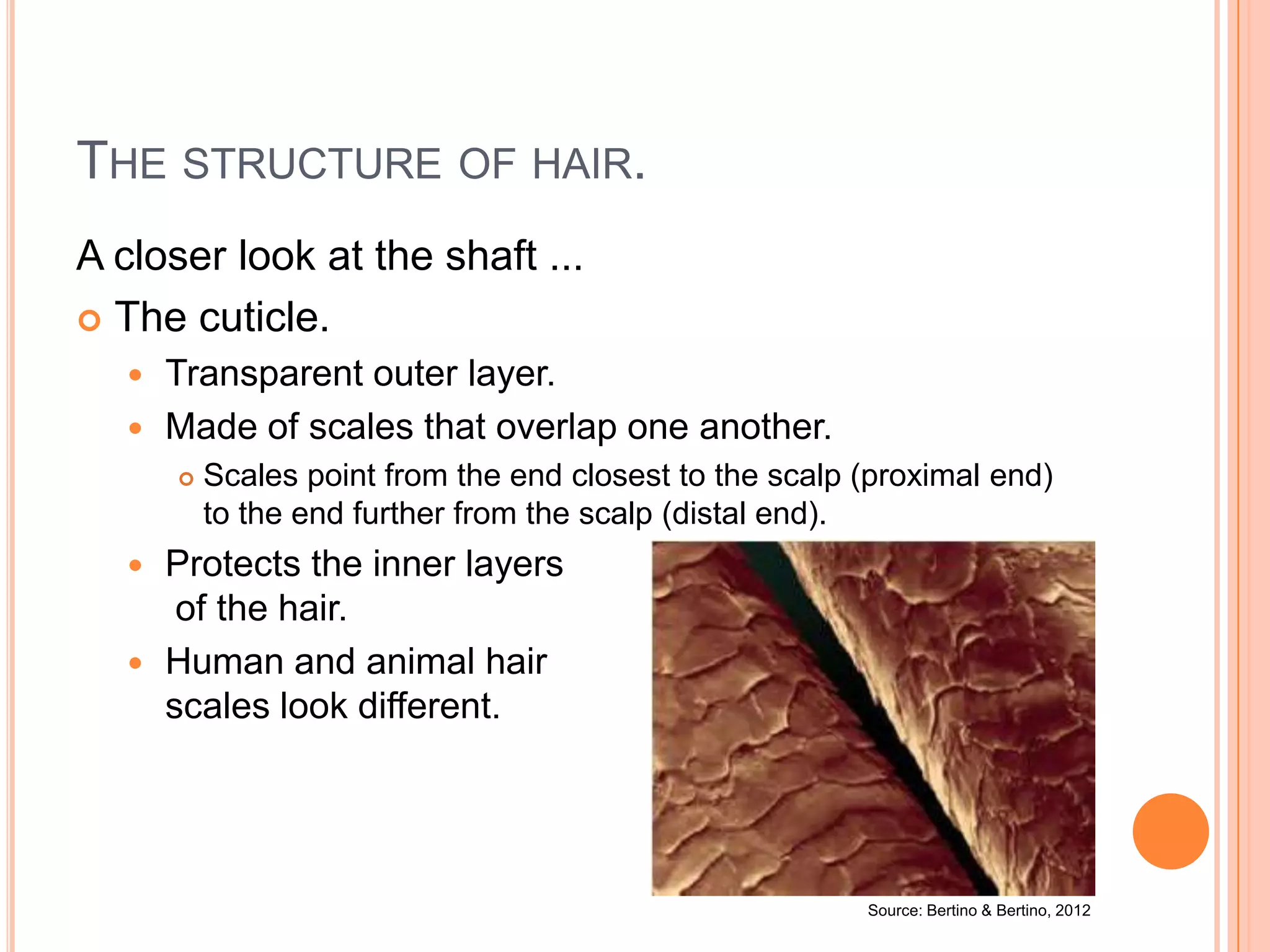
A closer look at the shaft ...
 The cuticle.
 Transparent outer layer.
 Made of scales that overlap one another.
 Scales point from the end closest to the scalp (proximal end)
to the end further from the scalp (distal end).
 Protects the inner layers
of the hair.
 Human and animal hair
scales look different.
Source: Bertino & Bertino, 2012
THE STRUCTURE OF HAIR.
A closer look at the shaft ...
 The cortex.
 The largest part of the hair shaft in humans.
 Gives hair its colour.
 Contains pigment granules called melanin.
 Different amount/type of melanin determines hair colour.
 The medulla.
 The centre of the hair.
 Can be a hollow tube or filled with cells. May be absent,
fragmented, segmented, continuous or even doubled.
 Can contain melanin or be unpigmented.
Source: Bertino & Bertino, 2012
THE STRUCTURE OF HAIR.
A closer look at the shaft …
 5 different groups.
Source: Bertino & Bertino, 2012
TYPES OF HAIR.
In humans, hair varies from one person to another.
 Hair can vary in shape, length, diameter, texture
and colour.
 A cross section may be circular, triangular, irregular
or flattened.
 The texture of the hair can be coarse or fine.
TYPES OF HAIR.
Not only does hair vary
from one person to another.
 Different hairs from one
location on a person can
also vary!
 e.g. Some grey hairs
mixed in amongst brown
ones on a person’s head.
 When collecting hair as
evidence ~50 hairs are
collected from a suspect’s
head (& 25 from the pubic
region!).
TYPES OF HAIR.
Forensic scientists distinguish 6 types of hair on the
human body.
1. Head hair
2. Eyebrow and eyelashes
3. Beard and moustache hair
4. Underarm hair
5. Body hair
6. Pubic hair.
 Each type of hair has its own shape and
characteristics.
HUMAN HAIR V ANIMAL HAIR.
Human hair is different to animal hair, including,
 Pattern of pigmentation.
 Denser towards the cuticle in humans, and usually one
colour along the length
 Varies widely in different animals, but usually denser
towards the medulla, and found in solid masses
(allowing changes in colour along one hair strand).
 The medullary index.
 Ratio of the diameter of the medulla to the diameter of
the entire hair.
 0.5 or more = animal hair; 0.33 or less = human hair.
 Cuticle type.
 Different shaped scales in humans compared to other
mammals.
USING HAIR IN A CRIMINAL INVESTIGATION.
 Remember Locard’s exchange principle?
 Hair is one of the major examples of trace evidence.
 Hair can be collected by plucking, shaking &
scraping surfaces. By place sticky tape of the
surface so that it adheres to it. If a large area, the
surface may be vacuumed.
 If a large number of hairs are collected from a
victim or crime scene, an investigator will compare
them with hair taken from the 6 major body regions
of the victim or suspect/s.
USING HAIR IN A CRIMINAL INVESTIGATION.
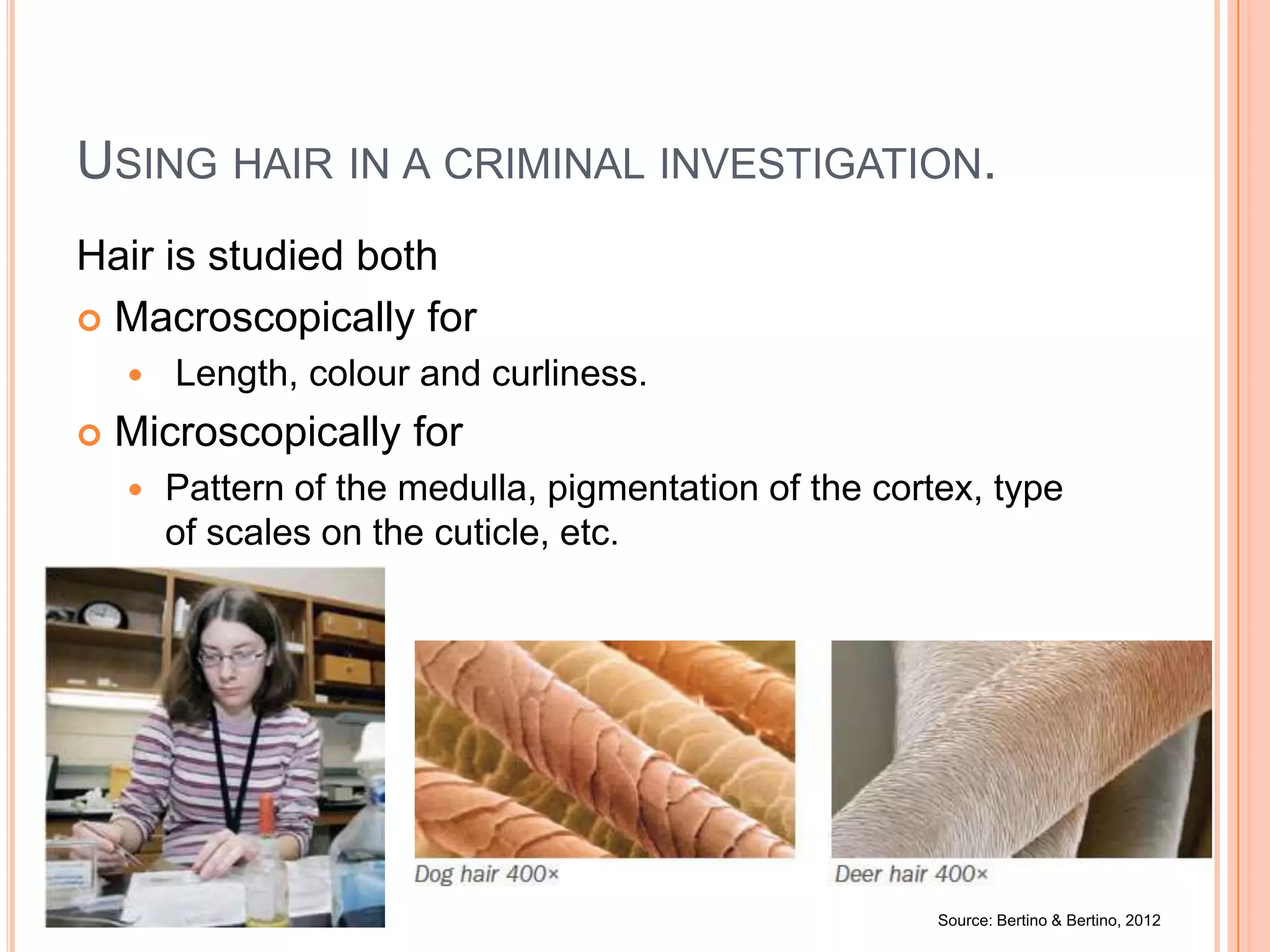
Hair is studied both
 Macroscopically for
 Length, colour and curliness.
 Microscopically for
 Pattern of the medulla, pigmentation of the cortex, type
of scales on the cuticle, etc.
Source: Bertino & Bertino, 2012
USING HAIR IN A CRIMINAL INVESTIGATION.
Testing for substances in the hair shaft.
 Because hair grows out of skin, chemicals that the
skin absorbs are also found in the hair.
 Hair will often return many substances longer than the
skin.
 Also hair takes much longer to decompose than the
body!
 These chemical substances can be detected by
chemical analysis and used to determine a timeline
of exposure to the chemical.
USING HAIR IN A CRIMINAL INVESTIGATION.
Testing the hair follicle.
 If hair is forcibly removed from a victim, the entire
hair follicle may be present.
 Blood and tissue will be attached to the hair follicle
and these can be analysed.
 Blood type.
 DNA analysis.
 Analysis of hair shaft  class evidence only.
 DNA analysis  identification with a high degree of
confidence.
DID YOU KNOW?
Napoleon’s hair.
Napoleon Bonaparte
proclaimed himself emperor of
France in 1804, after which he
invaded much of continental
Europe. Following his defeat at
Waterloo by the British, he was
exiled on the island of St.
Helena in the Atlantic Ocean,
where he eventually died of
stomach cancer.
Source: Bertino & Bertino, 2012
DID YOU KNOW?
Napoleon’s hair …
In 2001, a Canadian Napoleon enthusiast, Ben Weider,
challenged the cause of death. He had five strands of
Napoleon’s hair collected in 1805, 1814, and 1821 tested. The
results of the analysis showed that Napoleon’s hair contained
between 7 and 38 times more arsenic than normal, a fatal dose!
In 2002, further analysis of Napoleon’s hair showed extremely
elevated levels of arsenic, leading researchers to
joke that Napoleon should have died twice before his actual
death, and suggesting that the hair must have been
contaminated during storage.
Eventually another sample of Napoleon’s hair was again tested
and these results contradicted the previous reports, with the
levels of arsenic that had been incorporated into Napoleon’s hair
were much too low to have killed him.
The story continues to cause controversy however, with many
people still believing that the emperor’s death is surrounded by
too many questions to disregard the possibility of murder.
HOW NOT TO GET CAUGHT!
http://sick9CSI.wikispaces.com

Forensic Science - 04 Hair

  • 1.
    DRYSDALE CSI Hair. Ian Anderson SaintIgnatius College Geelong
  • 2.
     All mammalshave hair.  Its main purpose is to regulate body temperature.  Not as important in humans.  Humans are born with ~5 million hair follicles.  Of which only 2% are on your head.  From birth onwards this number decreases!!! WHY HAVE HAIR?
  • 3.
    THE STRUCTURE OFHAIR. Hair consists of two parts: 1. A follicle.  A club-shaped structure in the skin, which has a network of blood vessels at its base to provide nutrients for growing new hair.  The sebaceous gland secretes oil to help condition the hair.  Nerves wind around the follicle and stimulate the erector muscles (which makes your hair stand on end). Source: Bertino & Bertino, 2012
  • 4.
    Bertino & Bertino,2012 THE STRUCTURE OF HAIR. Hair consists of two parts: 2. A shaft.  Composed of the keratin (a protein).  Made up of three layers.  An outer cuticle.  A cortex.  An inner medulla. Source: http://www2.dupont.com/
  • 5.
    THE STRUCTURE OFHAIR. A closer look at the shaft ...  The cuticle.  Transparent outer layer.  Made of scales that overlap one another.  Scales point from the end closest to the scalp (proximal end) to the end further from the scalp (distal end).  Protects the inner layers of the hair.  Human and animal hair scales look different. Source: Bertino & Bertino, 2012
  • 6.
    THE STRUCTURE OFHAIR. A closer look at the shaft ...  The cortex.  The largest part of the hair shaft in humans.  Gives hair its colour.  Contains pigment granules called melanin.  Different amount/type of melanin determines hair colour.  The medulla.  The centre of the hair.  Can be a hollow tube or filled with cells. May be absent, fragmented, segmented, continuous or even doubled.  Can contain melanin or be unpigmented. Source: Bertino & Bertino, 2012
  • 7.
    THE STRUCTURE OFHAIR. A closer look at the shaft …  5 different groups. Source: Bertino & Bertino, 2012
  • 8.
    TYPES OF HAIR. Inhumans, hair varies from one person to another.  Hair can vary in shape, length, diameter, texture and colour.  A cross section may be circular, triangular, irregular or flattened.  The texture of the hair can be coarse or fine.
  • 9.
    TYPES OF HAIR. Notonly does hair vary from one person to another.  Different hairs from one location on a person can also vary!  e.g. Some grey hairs mixed in amongst brown ones on a person’s head.  When collecting hair as evidence ~50 hairs are collected from a suspect’s head (& 25 from the pubic region!).
  • 10.
    TYPES OF HAIR. Forensicscientists distinguish 6 types of hair on the human body. 1. Head hair 2. Eyebrow and eyelashes 3. Beard and moustache hair 4. Underarm hair 5. Body hair 6. Pubic hair.  Each type of hair has its own shape and characteristics.
  • 11.
    HUMAN HAIR VANIMAL HAIR. Human hair is different to animal hair, including,  Pattern of pigmentation.  Denser towards the cuticle in humans, and usually one colour along the length  Varies widely in different animals, but usually denser towards the medulla, and found in solid masses (allowing changes in colour along one hair strand).  The medullary index.  Ratio of the diameter of the medulla to the diameter of the entire hair.  0.5 or more = animal hair; 0.33 or less = human hair.  Cuticle type.  Different shaped scales in humans compared to other mammals.
  • 12.
    USING HAIR INA CRIMINAL INVESTIGATION.  Remember Locard’s exchange principle?  Hair is one of the major examples of trace evidence.  Hair can be collected by plucking, shaking & scraping surfaces. By place sticky tape of the surface so that it adheres to it. If a large area, the surface may be vacuumed.  If a large number of hairs are collected from a victim or crime scene, an investigator will compare them with hair taken from the 6 major body regions of the victim or suspect/s.
  • 13.
    USING HAIR INA CRIMINAL INVESTIGATION. Hair is studied both  Macroscopically for  Length, colour and curliness.  Microscopically for  Pattern of the medulla, pigmentation of the cortex, type of scales on the cuticle, etc. Source: Bertino & Bertino, 2012
  • 14.
    USING HAIR INA CRIMINAL INVESTIGATION. Testing for substances in the hair shaft.  Because hair grows out of skin, chemicals that the skin absorbs are also found in the hair.  Hair will often return many substances longer than the skin.  Also hair takes much longer to decompose than the body!  These chemical substances can be detected by chemical analysis and used to determine a timeline of exposure to the chemical.
  • 15.
    USING HAIR INA CRIMINAL INVESTIGATION. Testing the hair follicle.  If hair is forcibly removed from a victim, the entire hair follicle may be present.  Blood and tissue will be attached to the hair follicle and these can be analysed.  Blood type.  DNA analysis.  Analysis of hair shaft  class evidence only.  DNA analysis  identification with a high degree of confidence.
  • 16.
    DID YOU KNOW? Napoleon’shair. Napoleon Bonaparte proclaimed himself emperor of France in 1804, after which he invaded much of continental Europe. Following his defeat at Waterloo by the British, he was exiled on the island of St. Helena in the Atlantic Ocean, where he eventually died of stomach cancer. Source: Bertino & Bertino, 2012
  • 17.
    DID YOU KNOW? Napoleon’shair … In 2001, a Canadian Napoleon enthusiast, Ben Weider, challenged the cause of death. He had five strands of Napoleon’s hair collected in 1805, 1814, and 1821 tested. The results of the analysis showed that Napoleon’s hair contained between 7 and 38 times more arsenic than normal, a fatal dose! In 2002, further analysis of Napoleon’s hair showed extremely elevated levels of arsenic, leading researchers to joke that Napoleon should have died twice before his actual death, and suggesting that the hair must have been contaminated during storage. Eventually another sample of Napoleon’s hair was again tested and these results contradicted the previous reports, with the levels of arsenic that had been incorporated into Napoleon’s hair were much too low to have killed him. The story continues to cause controversy however, with many people still believing that the emperor’s death is surrounded by too many questions to disregard the possibility of murder.
  • 18.
    HOW NOT TOGET CAUGHT!
  • 19.

Editor's Notes

  • #11 One of the ways in which hairs from the different parts of the body are distinguished is their cross-sectional shape. Head hair is generally circular or elliptical in cross section. Eyebrows and eyelashes are also circular but often have tapering ends. Beard hairs tend to be thick and triangular. Body hair can be oval or triangular, depending on whether the body region has beenregularly shaved. Pubic hair tends to be oval or triangular.Hairs from different parts of the body have other characteristic physical features. Hair from the arms and legs usually has a blunt tip, but may be frayed at the ends from abrasion. Beard hair is usually coarse and may have a double medulla. The diameter of pubic hair may vary greatly, and buckling may be present.
  • #15 Human hair grows at the rate of about 1.3 cm per month (approximately 0.44 mm per day).