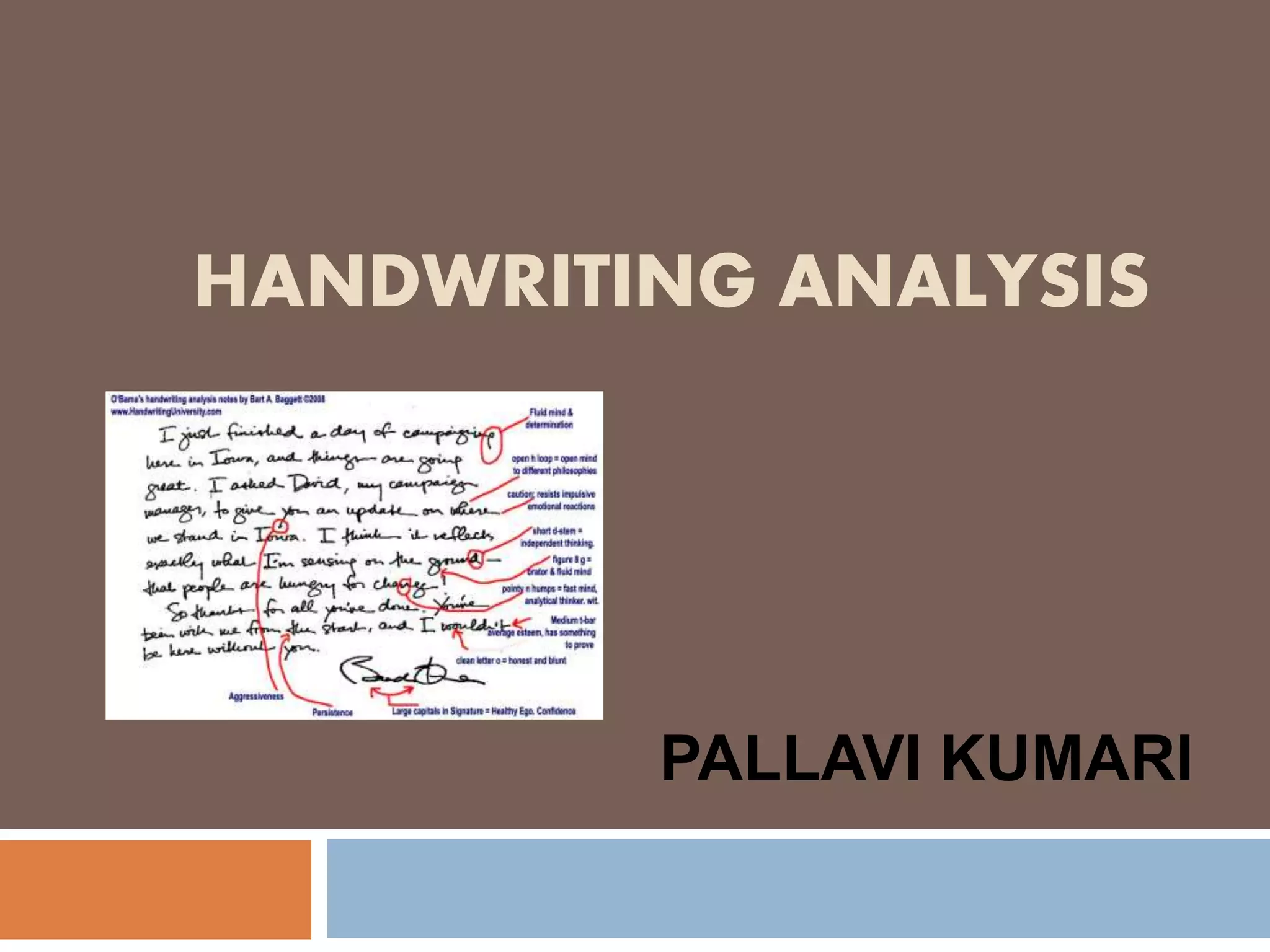
HANDWRITING ANALYSIS
PALLAVI KUMARI
Principles of Handwriting
 Handwriting comes from brain.
 No two persons can write exactly
alike.
 No two samples made by one person
be exactly same.
 Every person has a range of natural
variation to his or her writing;
 No writer can exceed his or her skill
level.
Class Characteristics
•Similarities between individuals or groups of individuals
taught the same or similar writing systems are known as
Class Characteristics.
• These may be quite different from other groups of
individuals but consistent within that specific group.
Individual Characteristics
 Individual characteristics are as unique to a
specific writer.
 It requires a combination of individual
characteristics and frequency of
occurrence to make an individual’s
handwriting unique to him.
 In forensic handwriting analysis, there are
twelve characteristics to be considered
when determining whether or not a
Fundamental Divergences
 They exist in the handwriting two different
persons.
 They are used during comparison of
handwriting samples whether the questioned
handwriting is written by same person or not?
 They are used to approve or disapprove the
writer of questioned handwriting sample.
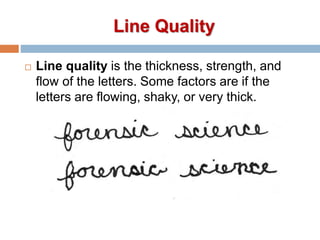
Line Quality
 Line quality is the thickness, strength, and
flow of the letters. Some factors are if the
letters are flowing, shaky, or very thick.
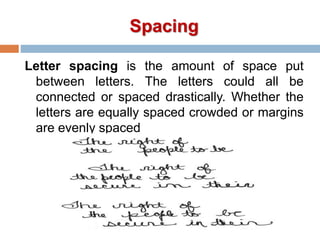
Spacing
Letter spacing is the amount of space put
between letters. The letters could all be
connected or spaced drastically. Whether the
letters are equally spaced crowded or margins
are evenly spaced
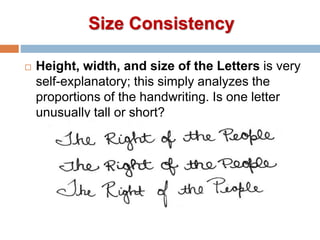
Size Consistency
 Height, width, and size of the Letters is very
self-explanatory; this simply analyzes the
proportions of the handwriting. Is one letter
unusually tall or short?
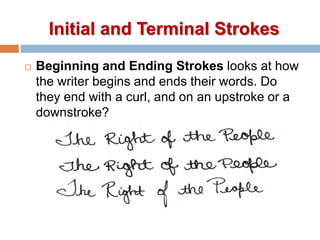
Initial and Terminal Strokes
 Beginning and Ending Strokes looks at how
the writer begins and ends their words. Do
they end with a curl, and on an upstroke or a
downstroke?
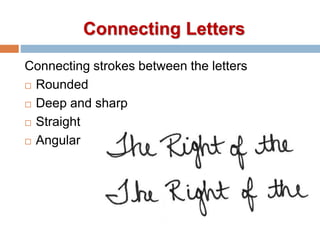
Connecting Letters
Connecting strokes between the letters
 Rounded
 Deep and sharp
 Straight
 Angular
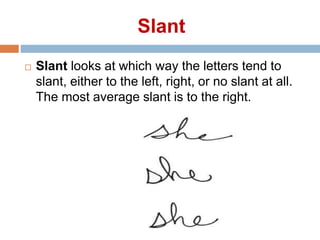
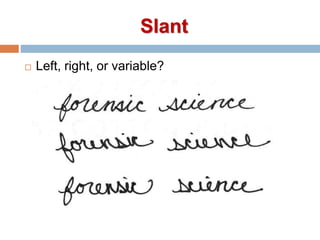
Slant
 Slant looks at which way the letters tend to
slant, either to the left, right, or no slant at all.
The most average slant is to the right.
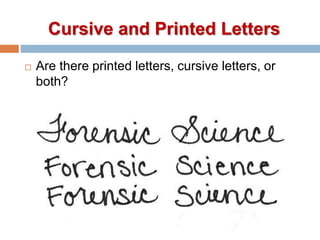
Cursive and Printed Letters
 Are there printed letters, cursive letters, or
both?
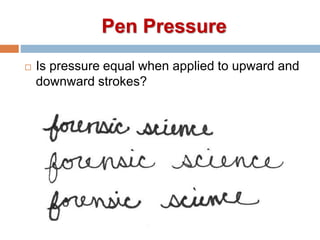
Pen Pressure
 Is pressure equal when applied to upward and
downward strokes?
Slant
 Left, right, or variable?
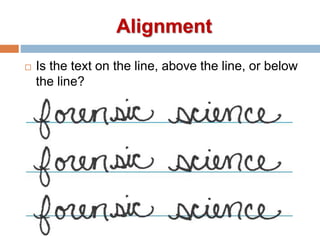
Alignment
 Is the text on the line, above the line, or below
the line?
Fancy Curls or Loops
 Are there fancy loops?
 Any other distinguishing features?
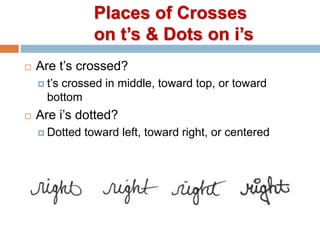
Places of Crosses
on t’s & Dots on i’s
 Are t’s crossed?
 t’s crossed in middle, toward top, or toward
bottom
 Are i’s dotted?
 Dotted toward left, toward right, or centered
Standards for handwriting
comparison
 A set of handwritten or hand printed standards.
 Standards must be adequate for comparison
purposes.
 They must contain a sufficient quantity of
properly prepared material so as to indicate
not only the individual writing habits of the
author but also the range of variation from
specimen to specimen in these habits.
Collected/Admitted standards
Collected standards: They consists of writing
or printing executed from day to day in the
course of business, social, or personal affairs.
Such standards may be referred to as
collected standards.
Request or dictated
standards
 They consists of specimens of the person's
writing or printing executed upon request of
the investigating officers for the sole purpose of
comparison with the questioned documents. An
examiner may dictate to a potential suspect,
slowly then faster so that they have less chance
of disguising the handwriting.
 Use same ink and paper (as said before) pencil,
Requirements of standards
 The amount of standard writing available
 The similarity of type of writing
 The relative date of execution of disputed and
standard writing
 The conditions under which both questioned
and known writing were executed
 The type of writing instruments and paper
employed.
Amount of standard writing
 No definite rule can be formulated for
determining the minimum number of standard
signatures necessary for a particular
examination.
 In the majority of investigations, between 15
and 20 specimen signatures should prove
adequate, but because of the individual or the
conditions under which the standards were
prepared this may not be a sufficient amount.
Similarity of Subject Matter
 In addition quantity of writing, standard and
questioned writing be of a similar type.
 if a check fraud is being investigated, genuine
cancelled checks should be procured;
 if an account entry is challenged, other entries
should be obtained as standards; or
 if the authorship of an anonymous letter is to
be established, letters or pages of writing
should be gathered for purposes of
comparison. The reasons for such choice will
be considered briefly
The Relative Date of
Execution
 A person's writing undergoes gradual changes
just as does his appearance.
 So, material written two or three years before or
after the disputed writing usually proves to be
satisfactory standards; but as the lapse of years
between the execution of the standard and
questioned material becomes greater, there may
be a tendency for the standards to be less
satisfactory.
 The rate of change differs with each individual
and is dependent upon the amount of writing he
Conditions Under Which
Writing was Executed
 The conditions under which writing is executed
may affect its value as comparison standards.
 Specimens affected by unusual writing
conditions, should never be depended upon
exclusively for comparison with writing executed
under more normal conditions.
 Haste, lack of care, or an unnatural writing
position-such as resting the paper on the knee-
introduces writing variations which may make the
specimens entirely unsuited for comparison with
more carefully written material.
Writing Instruments and
Paper
 The type of writing instrument used in
executing a given specimen may have an
influence upon its subsequent comparison with
other specimens.
 for example, steel to fountain or fine to coarse-
or in the grade of pencil -such as from hard to
soft-may also introduce writing variations.
 The composition, size, shape, and ruling of
paper may influence the writing specimens to
some extent.
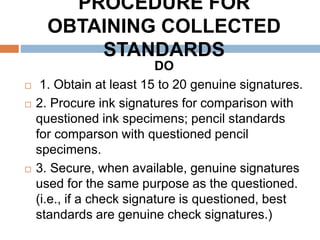
PROCEDURE FOR
OBTAINING COLLECTED
STANDARDS
DO
 1. Obtain at least 15 to 20 genuine signatures.
 2. Procure ink signatures for comparison with
questioned ink specimens; pencil standards
for comparson with questioned pencil
specimens.
 3. Secure, when available, genuine signatures
used for the same purpose as the questioned.
(i.e., if a check signature is questioned, best
standards are genuine check signatures.)
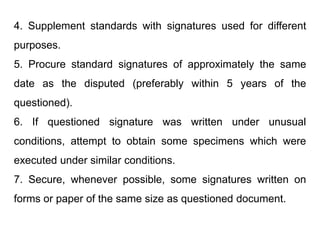
4. Supplement standards with signatures used for different
purposes.
5. Procure standard signatures of approximately the same
date as the disputed (preferably within 5 years of the
questioned).
6. If questioned signature was written under unusual
conditions, attempt to obtain some specimens which were
executed under similar conditions.
7. Secure, whenever possible, some signatures written on
forms or paper of the same size as questioned document.
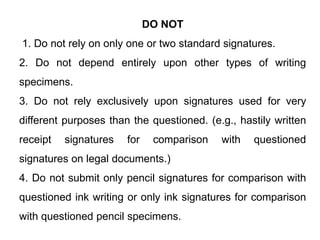
DO NOT
1. Do not rely on only one or two standard signatures.
2. Do not depend entirely upon other types of writing
specimens.
3. Do not rely exclusively upon signatures used for very
different purposes than the questioned. (e.g., hastily written
receipt signatures for comparison with questioned
signatures on legal documents.)
4. Do not submit only pencil signatures for comparison with
questioned ink writing or only ink signatures for comparison
with questioned pencil specimens.
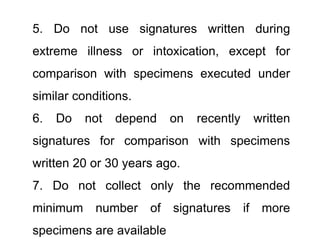
5. Do not use signatures written during
extreme illness or intoxication, except for
comparison with specimens executed under
similar conditions.
6. Do not depend on recently written
signatures for comparison with specimens
written 20 or 30 years ago.
7. Do not collect only the recommended
minimum number of signatures if more
specimens are available
Dictation of Material
 Dictate text to the writer without suggestions
pertaining to the arrangement of material, spelling,
punctuation, capitalization, or other points which
might cause a writer to disguise or modify his
natural writing habits.
 Faster and continuous dictation may prevent a
suspect from furnishing only his best or neatest
writing and avoids writer to frequent stops and
Selection of Text
The texts for request standards may consist of
three types of subject matter:
 the contents of the questioned document;
 some similar material which contains many of
the
same words, phrases, and letter
combinations; or
 dictation of a set or standardized form which
includes all the letters of the alphabet and a
number of the more commonly used words.
FAQ
 What is line quality
 What is emellishments in writing
 What is rhythm in making of writing
References
 O. Hilton, Scientific Examination of Questioned
Documents, CRC Press, Boca Raton (1982).
 R.N. Morris, Forensic Handwriting
Identification: Fundamental Concepts and
Principles, Academic Press, London (2000).
 E. David, The Scientific Examination of
Documents – Methods and Techniques, 2nd
Edition, Taylor & Francis, Hants (1997).
 www.google.com/images/handwritingcharacter
istics
Handwriting_analysis.ppt

Handwriting_analysis.ppt

  • 1.
  • 2.
    Principles of Handwriting Handwriting comes from brain.  No two persons can write exactly alike.  No two samples made by one person be exactly same.  Every person has a range of natural variation to his or her writing;  No writer can exceed his or her skill level.
  • 3.
    Class Characteristics •Similarities betweenindividuals or groups of individuals taught the same or similar writing systems are known as Class Characteristics. • These may be quite different from other groups of individuals but consistent within that specific group.
  • 4.
    Individual Characteristics  Individualcharacteristics are as unique to a specific writer.  It requires a combination of individual characteristics and frequency of occurrence to make an individual’s handwriting unique to him.  In forensic handwriting analysis, there are twelve characteristics to be considered when determining whether or not a
  • 5.
    Fundamental Divergences  Theyexist in the handwriting two different persons.  They are used during comparison of handwriting samples whether the questioned handwriting is written by same person or not?  They are used to approve or disapprove the writer of questioned handwriting sample.
  • 6.
    Line Quality  Linequality is the thickness, strength, and flow of the letters. Some factors are if the letters are flowing, shaky, or very thick.
  • 7.
    Spacing Letter spacing isthe amount of space put between letters. The letters could all be connected or spaced drastically. Whether the letters are equally spaced crowded or margins are evenly spaced
  • 8.
    Size Consistency  Height,width, and size of the Letters is very self-explanatory; this simply analyzes the proportions of the handwriting. Is one letter unusually tall or short?
  • 9.
    Initial and TerminalStrokes  Beginning and Ending Strokes looks at how the writer begins and ends their words. Do they end with a curl, and on an upstroke or a downstroke?
  • 10.
    Connecting Letters Connecting strokesbetween the letters  Rounded  Deep and sharp  Straight  Angular
  • 11.
    Slant  Slant looksat which way the letters tend to slant, either to the left, right, or no slant at all. The most average slant is to the right.
  • 12.
    Cursive and PrintedLetters  Are there printed letters, cursive letters, or both?
  • 13.
    Pen Pressure  Ispressure equal when applied to upward and downward strokes?
  • 14.
  • 15.
    Alignment  Is thetext on the line, above the line, or below the line?
  • 16.
    Fancy Curls orLoops  Are there fancy loops?  Any other distinguishing features?
  • 17.
    Places of Crosses ont’s & Dots on i’s  Are t’s crossed?  t’s crossed in middle, toward top, or toward bottom  Are i’s dotted?  Dotted toward left, toward right, or centered
  • 18.
    Standards for handwriting comparison A set of handwritten or hand printed standards.  Standards must be adequate for comparison purposes.  They must contain a sufficient quantity of properly prepared material so as to indicate not only the individual writing habits of the author but also the range of variation from specimen to specimen in these habits.
  • 19.
    Collected/Admitted standards Collected standards:They consists of writing or printing executed from day to day in the course of business, social, or personal affairs. Such standards may be referred to as collected standards.
  • 20.
    Request or dictated standards They consists of specimens of the person's writing or printing executed upon request of the investigating officers for the sole purpose of comparison with the questioned documents. An examiner may dictate to a potential suspect, slowly then faster so that they have less chance of disguising the handwriting.  Use same ink and paper (as said before) pencil,
  • 21.
    Requirements of standards The amount of standard writing available  The similarity of type of writing  The relative date of execution of disputed and standard writing  The conditions under which both questioned and known writing were executed  The type of writing instruments and paper employed.
  • 22.
    Amount of standardwriting  No definite rule can be formulated for determining the minimum number of standard signatures necessary for a particular examination.  In the majority of investigations, between 15 and 20 specimen signatures should prove adequate, but because of the individual or the conditions under which the standards were prepared this may not be a sufficient amount.
  • 23.
    Similarity of SubjectMatter  In addition quantity of writing, standard and questioned writing be of a similar type.  if a check fraud is being investigated, genuine cancelled checks should be procured;  if an account entry is challenged, other entries should be obtained as standards; or  if the authorship of an anonymous letter is to be established, letters or pages of writing should be gathered for purposes of comparison. The reasons for such choice will be considered briefly
  • 24.
    The Relative Dateof Execution  A person's writing undergoes gradual changes just as does his appearance.  So, material written two or three years before or after the disputed writing usually proves to be satisfactory standards; but as the lapse of years between the execution of the standard and questioned material becomes greater, there may be a tendency for the standards to be less satisfactory.  The rate of change differs with each individual and is dependent upon the amount of writing he
  • 25.
    Conditions Under Which Writingwas Executed  The conditions under which writing is executed may affect its value as comparison standards.  Specimens affected by unusual writing conditions, should never be depended upon exclusively for comparison with writing executed under more normal conditions.  Haste, lack of care, or an unnatural writing position-such as resting the paper on the knee- introduces writing variations which may make the specimens entirely unsuited for comparison with more carefully written material.
  • 26.
    Writing Instruments and Paper The type of writing instrument used in executing a given specimen may have an influence upon its subsequent comparison with other specimens.  for example, steel to fountain or fine to coarse- or in the grade of pencil -such as from hard to soft-may also introduce writing variations.  The composition, size, shape, and ruling of paper may influence the writing specimens to some extent.
  • 27.
    PROCEDURE FOR OBTAINING COLLECTED STANDARDS DO 1. Obtain at least 15 to 20 genuine signatures.  2. Procure ink signatures for comparison with questioned ink specimens; pencil standards for comparson with questioned pencil specimens.  3. Secure, when available, genuine signatures used for the same purpose as the questioned. (i.e., if a check signature is questioned, best standards are genuine check signatures.)
  • 28.
    4. Supplement standardswith signatures used for different purposes. 5. Procure standard signatures of approximately the same date as the disputed (preferably within 5 years of the questioned). 6. If questioned signature was written under unusual conditions, attempt to obtain some specimens which were executed under similar conditions. 7. Secure, whenever possible, some signatures written on forms or paper of the same size as questioned document.
  • 29.
    DO NOT 1. Donot rely on only one or two standard signatures. 2. Do not depend entirely upon other types of writing specimens. 3. Do not rely exclusively upon signatures used for very different purposes than the questioned. (e.g., hastily written receipt signatures for comparison with questioned signatures on legal documents.) 4. Do not submit only pencil signatures for comparison with questioned ink writing or only ink signatures for comparison with questioned pencil specimens.
  • 30.
    5. Do notuse signatures written during extreme illness or intoxication, except for comparison with specimens executed under similar conditions. 6. Do not depend on recently written signatures for comparison with specimens written 20 or 30 years ago. 7. Do not collect only the recommended minimum number of signatures if more specimens are available
  • 31.
    Dictation of Material Dictate text to the writer without suggestions pertaining to the arrangement of material, spelling, punctuation, capitalization, or other points which might cause a writer to disguise or modify his natural writing habits.  Faster and continuous dictation may prevent a suspect from furnishing only his best or neatest writing and avoids writer to frequent stops and
  • 32.
    Selection of Text Thetexts for request standards may consist of three types of subject matter:  the contents of the questioned document;  some similar material which contains many of the same words, phrases, and letter combinations; or  dictation of a set or standardized form which includes all the letters of the alphabet and a number of the more commonly used words.
  • 33.
    FAQ  What isline quality  What is emellishments in writing  What is rhythm in making of writing
  • 34.
    References  O. Hilton,Scientific Examination of Questioned Documents, CRC Press, Boca Raton (1982).  R.N. Morris, Forensic Handwriting Identification: Fundamental Concepts and Principles, Academic Press, London (2000).  E. David, The Scientific Examination of Documents – Methods and Techniques, 2nd Edition, Taylor & Francis, Hants (1997).  www.google.com/images/handwritingcharacter istics