02. Basic chemistry.


Ian Anderson (2013)
Saint Ignatius College Geelong
Knowledge and skills.
 Distinguish between an atom, an element, a molecule,
    an ion and a compound.
   List the important elements found in living organisms.
   Describe the difference between covalent and ionic
    bonding.
   Explain what polar molecules are.
   Describe how hydrogen bonds may form within or
    between molecules with polar covalent bonds.
Atoms.
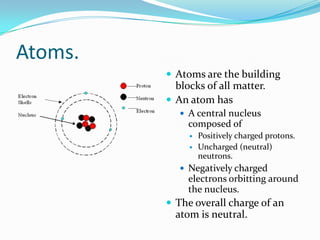
          Atoms are the building
           blocks of all matter.
          An atom has
             A central nucleus
              composed of
                 Positively charged protons.
                 Uncharged (neutral)
                  neutrons.
             Negatively charged
              electrons orbitting around
              the nucleus.
          The overall charge of an
           atom is neutral.
Ions.
                        If an atom gains or loses an
                         electron it becomes a charged
                         ion.
                          Loses one or more electrons
                            positive ion (cation).
                          Gains one or more electron
  Na  Na+ + e-             negative ion (anion).
  H  H + + e-          The charge of an ion means
                         that it will be attracted to or
  O+   2e-      O2-
                         will repel other ions
                         (important in ionic bonding).
Elements.
                               Substances that consist of only
                                one type of atom.
                               Of the 92 naturally occurring
                                elements
                                  Only 11 are found in organisms
                                   in more than trace amounts.
                                  Four of these 11, Carbon (C),
                                   hydrogen (H), oxygen (O) and
                                   nitrogen (N) make up 99% of
   Carbon         Oxygen           organisms by weight.
•6 protons     •8 protons      What makes one element
•6 neutrons    •8 neutrons      different to another is the
•6 electrons   •8 electrons     number of protons its atoms
                                has.
Molecules and compounds.
               Molecules = Two or more atoms
                held together by chemical
                bonds.
                 e.g. H2, O2, CO2, CH4

        O=O
               Compound = a molecule
         O2
                containing two or more
                different types of atoms.
                 e.g. CO2, CH4, H2O


              Note: All compounds are
               molecules. Not all molecules are
               compounds!
Chemical bonding.
 The atoms that make up a molecule are held together
 by either
   Covalent bonds
   Ionic bonds, or
   Metallic bonding (not relevant here).
 Atoms combine with other atoms in order to become
 more stable.
   Atoms are most stable when they have a full outer shell
    [like the noble gases in Gp18].
Covalent bonding.
                     Only occurs between two
                     non-metals.
                       e.g. O2, CO2, H2O, C6H12O6
                     Involves the sharing of
                      electrons.
    Methane (CH4)    Covalent bonds are stronger
                      than ionic bonds (generally).
Ionic bonding.
                       Only occurs between a metal
                        and a non-metal.
                          e.g. NaCl, CaCl2
                       Involves one atom donating an
                        electron (or electrons) to the
                        other. The two (now) ions are
                        held together by the
    Sodium chloride     electrostatic forces of attraction
        (NaCl)
                        (one ion has a +ve charge and
                        the other has a –ve charge).
                       Ionic bonds are easier to break
                        than covalent bonds (generally),
                        but are still strong.
Polar molecules.
               Sometimes in a covalent bond one
Water (H2O)
                atom attracts the shared electron
                more strongly than the other atom
                resulting in unequal sharing of
                electrons.
               Even though the overall charge of
                the molecule is still neutral, there
                is a slightly positive region and a
                slightly negative region.
               The polarity of molecules is an
                important property.
                  e.g. Polarity governs the way that
                   many molecules cross cell
                   membranes.
               e.g. H2O, sugars and amino acids.
Hydrogen bonding.
                                        Resulting from the attraction of
Water (H2O)        δ-
                                         the slightly positive hydrogen
                                         atom on one polar molecule and
                                         the slightly negative atom
                                  δ-     (usually oxygen or nitrogen) in
              δ+        δ+
                                         another polar molecule.
                                        Only occurs between polar
                             δ+   δ+
                                         molecules.
                                        Much weaker than both
                                         covalent and ionic bonds.
                                        Play an important role wrt the
                                         properties of water and the
                                         structures of both DNA and
                                         proteins.
Basic chemistry

Basic chemistry

  • 1.
    02. Basic chemistry. IanAnderson (2013) Saint Ignatius College Geelong
  • 2.
    Knowledge and skills. Distinguish between an atom, an element, a molecule, an ion and a compound.  List the important elements found in living organisms.  Describe the difference between covalent and ionic bonding.  Explain what polar molecules are.  Describe how hydrogen bonds may form within or between molecules with polar covalent bonds.
  • 3.
    Atoms.  Atoms are the building blocks of all matter.  An atom has  A central nucleus composed of  Positively charged protons.  Uncharged (neutral) neutrons.  Negatively charged electrons orbitting around the nucleus.  The overall charge of an atom is neutral.
  • 4.
    Ions.  If an atom gains or loses an electron it becomes a charged ion.  Loses one or more electrons  positive ion (cation).  Gains one or more electron Na  Na+ + e-  negative ion (anion). H  H + + e-  The charge of an ion means that it will be attracted to or O+ 2e-  O2- will repel other ions (important in ionic bonding).
  • 5.
    Elements.  Substances that consist of only one type of atom.  Of the 92 naturally occurring elements  Only 11 are found in organisms in more than trace amounts.  Four of these 11, Carbon (C), hydrogen (H), oxygen (O) and nitrogen (N) make up 99% of Carbon Oxygen organisms by weight. •6 protons •8 protons  What makes one element •6 neutrons •8 neutrons different to another is the •6 electrons •8 electrons number of protons its atoms has.
  • 6.
    Molecules and compounds.  Molecules = Two or more atoms held together by chemical bonds.  e.g. H2, O2, CO2, CH4 O=O  Compound = a molecule O2 containing two or more different types of atoms.  e.g. CO2, CH4, H2O Note: All compounds are molecules. Not all molecules are compounds!
  • 7.
    Chemical bonding.  Theatoms that make up a molecule are held together by either  Covalent bonds  Ionic bonds, or  Metallic bonding (not relevant here).  Atoms combine with other atoms in order to become more stable.  Atoms are most stable when they have a full outer shell [like the noble gases in Gp18].
  • 8.
    Covalent bonding.  Only occurs between two non-metals.  e.g. O2, CO2, H2O, C6H12O6  Involves the sharing of electrons. Methane (CH4)  Covalent bonds are stronger than ionic bonds (generally).
  • 9.
    Ionic bonding.  Only occurs between a metal and a non-metal.  e.g. NaCl, CaCl2  Involves one atom donating an electron (or electrons) to the other. The two (now) ions are held together by the Sodium chloride electrostatic forces of attraction (NaCl) (one ion has a +ve charge and the other has a –ve charge).  Ionic bonds are easier to break than covalent bonds (generally), but are still strong.
  • 10.
    Polar molecules.  Sometimes in a covalent bond one Water (H2O) atom attracts the shared electron more strongly than the other atom resulting in unequal sharing of electrons.  Even though the overall charge of the molecule is still neutral, there is a slightly positive region and a slightly negative region.  The polarity of molecules is an important property.  e.g. Polarity governs the way that many molecules cross cell membranes.  e.g. H2O, sugars and amino acids.
  • 11.
    Hydrogen bonding.  Resulting from the attraction of Water (H2O) δ- the slightly positive hydrogen atom on one polar molecule and the slightly negative atom δ- (usually oxygen or nitrogen) in δ+ δ+ another polar molecule.  Only occurs between polar δ+ δ+ molecules.  Much weaker than both covalent and ionic bonds.  Play an important role wrt the properties of water and the structures of both DNA and proteins.