FUNCTIONING ORGANISMS.
06. Reproduction.
Ian Anderson
Saint Ignatius College Geelong
WHAT IS REPRODUCTION?
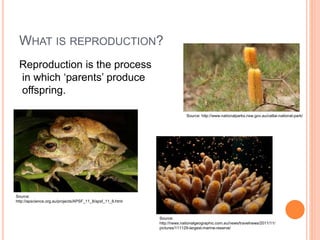
Reproduction is the process
in which ‘parents’ produce
offspring.
Source:
http://news.nationalgeographic.com.au/news/travelnews/2011/11/
pictures/111129-largest-marine-reserve/
Source: http://www.nationalparks.nsw.gov.au/cattai-national-park/
Source:
http://apscience.org.au/projects/APSF_11_8/apsf_11_8.html
WHY DO ORGANISMS REPRODUCE?
 The ability to reproduce is one
of the fundamental
characteristics of all life.
An organism cannot live for ever.
Therefore for a species to
survive, the organisms that make
up that species must reproduce.
If there are insufficient numbers
of individuals reproducing the
species will eventually become
extinct!
Source: http://fineartamerica.com/featured/eastern-grey-
kangaroo-and-joey-cyril-ruoso.html
TYPES OF REPRODUCTION.
Two types of reproduction:
Asexual reproduction.
Sexual reproduction.
Source:
http://www.independent.com/news/2012/jul/30/asexua
l-flora/
Source:
http://vcebiology.edublogs.org/2010/05/16/asexual-
reproduction/
Source: http://www.darwinwasright.org/recombination.html
ASEXUAL REPRODUCTION.
 The production of offspring
from a single parent
organism without the fusion
of gametes.
Requires only one parent.
Does not involve the fusion
of gametes (sex cells).
All offspring are genetically
identical to the parent.
Most commonly occurs in
single-celled organisms,
and can also occur in plants
and animals.
Source:
http://www.independent.com/news/2012/jul/30/asexua
l-flora/
Source:
http://vcebiology.edublogs.org/2010/05/16/asexual-
reproduction/
TYPES OF ASEXUAL REPRODUCTION.
 Binary fission.
Involves the parent cell splitting in two.
Occurs in prokaryotes (bacteria) and many single-celled
organisms including amoeba, paramecium, etc.
Source: http://www.gettyimages.com.au/Source: http://kids.britannica.com/comptons/art-
110462/Two-rodlike-bacteria-of-the-species-Shigella-
have-almost-completed
TYPES OF ASEXUAL REPRODUCTION.
 Budding.
A new organism develops as a bud on the parent.
The offspring may remain attached to the parent to form
a colony or may eventually ‘drop off’.
Occurs in many single-celled organisms including yeast
and in multi-cellular organisms including hydra.
Source:
http://vcebiology.edublogs.org/2010/05/16/asexual-
reproduction/
Source: http://briarscratchbrewing.com/beer/
TYPES OF ASEXUAL REPRODUCTION.
 Sporulation (formation of spores).
Parent produces spores and releases them into the
surrounding environment.
 Spores have a tough protective coat that protects it from
extreme conditions (e.g. drought, extreme heat or cold).
 When conditions become more favourable each spore can
germinate into a new organism.
Can occur in fungi (e.g. mushrooms), mould and ferns.
Source: http://commons.wikimedia.org/ Source: http://myblog123412341234.blogspot.com.au/
TYPES OF ASEXUAL REPRODUCTION.
 Fragmentation.
A new organism grows from a fragment of the parent.
Can occur in fungi, plants, annelid worms and sea stars.
Source: http://biologypop.com/regeneration-peter-reddien-mithhmi/
TYPES OF ASEXUAL REPRODUCTION.
 Vegetative propagation.
A part of a plant (e.g. root, stem or a leaf) grows into a
new plant.
Common in many plants, and seen as tubers, runners,
rhizomes and bulbs.
Source:
http://www.mrothery.co.uk/cellcycleandrepro/cellcyclea
ndrepronotes.htm
Source:
http://www.dkimages.com/discover/Home/Plants/Anato
my-and-Reproduction/
TYPES OF ASEXUAL REPRODUCTION.
 Parthenogenesis (‘virgin birth’).
An unfertilized egg develops into a new organism.
Occurs in many plants and invertebrates, including
water fleas, aphids, and in some amphibians and
reptiles.
Source: http://www.mrcroce.com/parthenogenesis.html
SEXUAL REPRODUCTION.
 Involves the union of
gametes (sex cells) from a
male and a female parent.
Requires two parents.
Involve the fusion of
gametes (sex cells).
Offspring are not all
genetically identical to the
parents.
Most commonly occurs in
multicellular organisms.
Source:
http://www.independent.com/news/2012/jul/30/asexua
l-flora/
Source:
http://adnanslimani.blogspot.com.au/2012/05/egg-
and-sperm.html
SEXUAL REPRODUCTION IN PLANTS.
 Bryophytes (mosses & liverworts).
Life cycle of bryophytes is complex and involves alternation of
generations from a haploid stage to a diploid stage.
 Each stage looks very different from each other.
Parent plant (called a gametophyte) is haploid (contains only
one set of chromosomes) and is either a male or female, and
when mature produces either eggs or sperm.
The sperm when released swims to the egg and fertilizes it,
resulting in the diploid sporophyte.
 The sporophyte remains attached to the gametophyte, relying on it
for water and nutrients.
The sporophyte matures to eventually release haploid spores,
which germinate to develop into the next generation of
gametophytes.
SEXUAL REPRODUCTION IN PLANTS.
Source: Enger et al. (2012)
 Bryophytes (mosses & liverworts).
SEXUAL REPRODUCTION IN PLANTS.
 Ferns.
Life cycle of ferns also involves alternation of
generations from a haploid stage to a diploid stage.
Parent plant (what we recognise as being the fern) is
diploid (contains two sets of chromosomes) and called
the sporophyte. It produces spores, which are released
into the wind.
The spores are haploid, and will germinate into a
gametophyte (which is very small compared to the
parent fern).
The gametophytes then mature and produce sperm or
eggs. The sperm swim to the egg and fertilize it to
produce a new parent plant.
SEXUAL REPRODUCTION IN PLANTS.
 Ferns.
Source: Enger et al. (2012)
SEXUAL REPRODUCTION IN PLANTS.
 Gymnosperms (conifers).
Life cycle of gymnosperms also involves alternation of
generations, although the sporophyte generation (the pine
tree) now dominates, with the gametophyte generation now
much reduced.
The parent plant produces two types of cones which produce
either male or female haploid gametophytes.
 The familiar large cones are female, with the male cones much
smaller.
 The male cones produce pollen, which are released into the air
and fall into the open female cones, where pollination and then
fertilization of the gametes occurs.
The fertilized egg develops into an embryo within a seed.
The seed is eventually released from the cone, falling to the
ground and then able to germinate into a new plant.
SEXUAL REPRODUCTION IN PLANTS.
 Gymnosperms (conifers).
Source: Enger et al. (2012)
SEXUAL REPRODUCTION IN PLANTS.
 Angiosperms (flowering plants).
Life cycle of angiosperms also involves alternation of
generations, although the sporophyte generation (plant)
dominates, with the gametophyte generation (the pollen
and ovum in the flower) now much reduced.
The flower is where sexual reproduction occurs in
flowering plants.
 There is a large variety of variety in the shapes and structures
of flowers.
 Some flowers are male, others are female, and others have
both male and female parts.
 Flowers also differ in the way that they are pollinated.
 Some flowers are self pollinators, while others cross
pollinate and require the wind or animals to assist in
pollination.
SEXUAL REPRODUCTION IN PLANTS.
 Angiosperms (flowering plants).
The female organs are the stigma,
style and ovary, which together are
called the carpel.
 The stigma receives pollen grains.
 The style hold the stigma above the
flower, and is a ‘tube’ leading to the
ovary.
 The ovary produces the female
gamete (called an ovum).
Source: Walpole et al. (2011)
SEXUAL REPRODUCTION IN PLANTS.
 Angiosperms (flowering plants).
Pollen contains the male gametes,
and is produced in the anthers.
The filament holds the anthers up,
allowing pollinators to rub against
the anthers and be dusted by
pollen.
 Anthers and filament are together
called the stamen. Source: Walpole et al. (2011)
SEXUAL REPRODUCTION IN PLANTS.
 Angiosperms (flowering plants).
Pollination occurs when pollen is
transferred from the anther to the
stigma.
Once pollen is attached to the anther it
grows a pollen tube down the style to
the ovary, allowing the transfer of
pollen nucleus.
Fertilisation involves the fusion of the
male and female gametes in the ovary.
The fertilised ovum then develops into
a seed which protects the embryo
inside. The seed are held within the
ovary which develops into a fruit.
Source: Walpole et al. (2011)
SEXUAL REPRODUCTION IN ANIMALS.
 Most animals are able to reproduce sexually.
 Most animals are also sexually dimorphic.
i.e. the males look physically different to the females.
 Fertilisation of the gametes can occur via:
Internal fertilisation.
 Fertilisation of the gametes takes place inside the female.
 Occurs in most mammals, most reptiles, some birds and some
fish.
External fertilisation.
 Fertilisation of the gametes takes place in the external
environment (e.g. water).
 Occurs in most fish and amphibians.
HUMAN REPRODUCTIVE SYSTEM.
 Males.
Testes.
 Held outside the body in the scrotum.
 Produce both sperm and testosterone.
 Sperm are carried from the testes in the sperm ducts, which
transport them past the seminal vesicles and prostrate
glands (which produce the seminal fluid in which the sperm
travel).
 Sperm production commences at puberty and continues
throughout a man’s life.
 Testosterone has an important role in sexual development
(puberty) & reproductive behavior.
 Development of male secondary sexual characteristics.
 Stimulates continual production of sperm & sex drive.
HUMAN REPRODUCTIVE SYSTEM.
 Males.
Source: Walpole et al. (2011)
HUMAN REPRODUCTIVE SYSTEM.
 Females.
Ovaries – produce the female gametes.
Oviducts – where fertilisation takes place.
Uterus – where the baby grows & develops.
Vagina – passageway for sperm to enter the body & the
way out for the baby.
HUMAN REPRODUCTIVE SYSTEM.
 Females.
Source: Walpole et al. (2011)
BIBLIOGRAPHY.
Cash, S., Quinton, G., Tilley, C., & Craven, E. (2013).
Oxford Big Ideas. Science 8: Australian
Curriculum. Melbourne: Oxford University Press.
Enger, E.D., Ross, F.C. & Bailey, D.B. (2012).
Concepts in Biology. Melbourne: McGraw-Hill.
Walpole, B., Merson-Davies, A. & Dann, L. (2011).
Biology for the IB Diploma. Melbourne: Cambridge
University Press.
http://sickscience8.wikispaces.com/

Functioning organisms - 06 Reproduction

  • 1.
    FUNCTIONING ORGANISMS. 06. Reproduction. IanAnderson Saint Ignatius College Geelong
  • 2.
    WHAT IS REPRODUCTION? Reproductionis the process in which ‘parents’ produce offspring. Source: http://news.nationalgeographic.com.au/news/travelnews/2011/11/ pictures/111129-largest-marine-reserve/ Source: http://www.nationalparks.nsw.gov.au/cattai-national-park/ Source: http://apscience.org.au/projects/APSF_11_8/apsf_11_8.html
  • 3.
    WHY DO ORGANISMSREPRODUCE?  The ability to reproduce is one of the fundamental characteristics of all life. An organism cannot live for ever. Therefore for a species to survive, the organisms that make up that species must reproduce. If there are insufficient numbers of individuals reproducing the species will eventually become extinct! Source: http://fineartamerica.com/featured/eastern-grey- kangaroo-and-joey-cyril-ruoso.html
  • 4.
    TYPES OF REPRODUCTION. Twotypes of reproduction: Asexual reproduction. Sexual reproduction. Source: http://www.independent.com/news/2012/jul/30/asexua l-flora/ Source: http://vcebiology.edublogs.org/2010/05/16/asexual- reproduction/ Source: http://www.darwinwasright.org/recombination.html
  • 5.
    ASEXUAL REPRODUCTION.  Theproduction of offspring from a single parent organism without the fusion of gametes. Requires only one parent. Does not involve the fusion of gametes (sex cells). All offspring are genetically identical to the parent. Most commonly occurs in single-celled organisms, and can also occur in plants and animals. Source: http://www.independent.com/news/2012/jul/30/asexua l-flora/ Source: http://vcebiology.edublogs.org/2010/05/16/asexual- reproduction/
  • 6.
    TYPES OF ASEXUALREPRODUCTION.  Binary fission. Involves the parent cell splitting in two. Occurs in prokaryotes (bacteria) and many single-celled organisms including amoeba, paramecium, etc. Source: http://www.gettyimages.com.au/Source: http://kids.britannica.com/comptons/art- 110462/Two-rodlike-bacteria-of-the-species-Shigella- have-almost-completed
  • 7.
    TYPES OF ASEXUALREPRODUCTION.  Budding. A new organism develops as a bud on the parent. The offspring may remain attached to the parent to form a colony or may eventually ‘drop off’. Occurs in many single-celled organisms including yeast and in multi-cellular organisms including hydra. Source: http://vcebiology.edublogs.org/2010/05/16/asexual- reproduction/ Source: http://briarscratchbrewing.com/beer/
  • 8.
    TYPES OF ASEXUALREPRODUCTION.  Sporulation (formation of spores). Parent produces spores and releases them into the surrounding environment.  Spores have a tough protective coat that protects it from extreme conditions (e.g. drought, extreme heat or cold).  When conditions become more favourable each spore can germinate into a new organism. Can occur in fungi (e.g. mushrooms), mould and ferns. Source: http://commons.wikimedia.org/ Source: http://myblog123412341234.blogspot.com.au/
  • 9.
    TYPES OF ASEXUALREPRODUCTION.  Fragmentation. A new organism grows from a fragment of the parent. Can occur in fungi, plants, annelid worms and sea stars. Source: http://biologypop.com/regeneration-peter-reddien-mithhmi/
  • 10.
    TYPES OF ASEXUALREPRODUCTION.  Vegetative propagation. A part of a plant (e.g. root, stem or a leaf) grows into a new plant. Common in many plants, and seen as tubers, runners, rhizomes and bulbs. Source: http://www.mrothery.co.uk/cellcycleandrepro/cellcyclea ndrepronotes.htm Source: http://www.dkimages.com/discover/Home/Plants/Anato my-and-Reproduction/
  • 11.
    TYPES OF ASEXUALREPRODUCTION.  Parthenogenesis (‘virgin birth’). An unfertilized egg develops into a new organism. Occurs in many plants and invertebrates, including water fleas, aphids, and in some amphibians and reptiles. Source: http://www.mrcroce.com/parthenogenesis.html
  • 12.
    SEXUAL REPRODUCTION.  Involvesthe union of gametes (sex cells) from a male and a female parent. Requires two parents. Involve the fusion of gametes (sex cells). Offspring are not all genetically identical to the parents. Most commonly occurs in multicellular organisms. Source: http://www.independent.com/news/2012/jul/30/asexua l-flora/ Source: http://adnanslimani.blogspot.com.au/2012/05/egg- and-sperm.html
  • 13.
    SEXUAL REPRODUCTION INPLANTS.  Bryophytes (mosses & liverworts). Life cycle of bryophytes is complex and involves alternation of generations from a haploid stage to a diploid stage.  Each stage looks very different from each other. Parent plant (called a gametophyte) is haploid (contains only one set of chromosomes) and is either a male or female, and when mature produces either eggs or sperm. The sperm when released swims to the egg and fertilizes it, resulting in the diploid sporophyte.  The sporophyte remains attached to the gametophyte, relying on it for water and nutrients. The sporophyte matures to eventually release haploid spores, which germinate to develop into the next generation of gametophytes.
  • 14.
    SEXUAL REPRODUCTION INPLANTS. Source: Enger et al. (2012)  Bryophytes (mosses & liverworts).
  • 15.
    SEXUAL REPRODUCTION INPLANTS.  Ferns. Life cycle of ferns also involves alternation of generations from a haploid stage to a diploid stage. Parent plant (what we recognise as being the fern) is diploid (contains two sets of chromosomes) and called the sporophyte. It produces spores, which are released into the wind. The spores are haploid, and will germinate into a gametophyte (which is very small compared to the parent fern). The gametophytes then mature and produce sperm or eggs. The sperm swim to the egg and fertilize it to produce a new parent plant.
  • 16.
    SEXUAL REPRODUCTION INPLANTS.  Ferns. Source: Enger et al. (2012)
  • 17.
    SEXUAL REPRODUCTION INPLANTS.  Gymnosperms (conifers). Life cycle of gymnosperms also involves alternation of generations, although the sporophyte generation (the pine tree) now dominates, with the gametophyte generation now much reduced. The parent plant produces two types of cones which produce either male or female haploid gametophytes.  The familiar large cones are female, with the male cones much smaller.  The male cones produce pollen, which are released into the air and fall into the open female cones, where pollination and then fertilization of the gametes occurs. The fertilized egg develops into an embryo within a seed. The seed is eventually released from the cone, falling to the ground and then able to germinate into a new plant.
  • 18.
    SEXUAL REPRODUCTION INPLANTS.  Gymnosperms (conifers). Source: Enger et al. (2012)
  • 19.
    SEXUAL REPRODUCTION INPLANTS.  Angiosperms (flowering plants). Life cycle of angiosperms also involves alternation of generations, although the sporophyte generation (plant) dominates, with the gametophyte generation (the pollen and ovum in the flower) now much reduced. The flower is where sexual reproduction occurs in flowering plants.  There is a large variety of variety in the shapes and structures of flowers.  Some flowers are male, others are female, and others have both male and female parts.  Flowers also differ in the way that they are pollinated.  Some flowers are self pollinators, while others cross pollinate and require the wind or animals to assist in pollination.
  • 20.
    SEXUAL REPRODUCTION INPLANTS.  Angiosperms (flowering plants). The female organs are the stigma, style and ovary, which together are called the carpel.  The stigma receives pollen grains.  The style hold the stigma above the flower, and is a ‘tube’ leading to the ovary.  The ovary produces the female gamete (called an ovum). Source: Walpole et al. (2011)
  • 21.
    SEXUAL REPRODUCTION INPLANTS.  Angiosperms (flowering plants). Pollen contains the male gametes, and is produced in the anthers. The filament holds the anthers up, allowing pollinators to rub against the anthers and be dusted by pollen.  Anthers and filament are together called the stamen. Source: Walpole et al. (2011)
  • 22.
    SEXUAL REPRODUCTION INPLANTS.  Angiosperms (flowering plants). Pollination occurs when pollen is transferred from the anther to the stigma. Once pollen is attached to the anther it grows a pollen tube down the style to the ovary, allowing the transfer of pollen nucleus. Fertilisation involves the fusion of the male and female gametes in the ovary. The fertilised ovum then develops into a seed which protects the embryo inside. The seed are held within the ovary which develops into a fruit. Source: Walpole et al. (2011)
  • 23.
    SEXUAL REPRODUCTION INANIMALS.  Most animals are able to reproduce sexually.  Most animals are also sexually dimorphic. i.e. the males look physically different to the females.  Fertilisation of the gametes can occur via: Internal fertilisation.  Fertilisation of the gametes takes place inside the female.  Occurs in most mammals, most reptiles, some birds and some fish. External fertilisation.  Fertilisation of the gametes takes place in the external environment (e.g. water).  Occurs in most fish and amphibians.
  • 24.
    HUMAN REPRODUCTIVE SYSTEM. Males. Testes.  Held outside the body in the scrotum.  Produce both sperm and testosterone.  Sperm are carried from the testes in the sperm ducts, which transport them past the seminal vesicles and prostrate glands (which produce the seminal fluid in which the sperm travel).  Sperm production commences at puberty and continues throughout a man’s life.  Testosterone has an important role in sexual development (puberty) & reproductive behavior.  Development of male secondary sexual characteristics.  Stimulates continual production of sperm & sex drive.
  • 25.
    HUMAN REPRODUCTIVE SYSTEM. Males. Source: Walpole et al. (2011)
  • 26.
    HUMAN REPRODUCTIVE SYSTEM. Females. Ovaries – produce the female gametes. Oviducts – where fertilisation takes place. Uterus – where the baby grows & develops. Vagina – passageway for sperm to enter the body & the way out for the baby.
  • 27.
    HUMAN REPRODUCTIVE SYSTEM. Females. Source: Walpole et al. (2011)
  • 28.
    BIBLIOGRAPHY. Cash, S., Quinton,G., Tilley, C., & Craven, E. (2013). Oxford Big Ideas. Science 8: Australian Curriculum. Melbourne: Oxford University Press. Enger, E.D., Ross, F.C. & Bailey, D.B. (2012). Concepts in Biology. Melbourne: McGraw-Hill. Walpole, B., Merson-Davies, A. & Dann, L. (2011). Biology for the IB Diploma. Melbourne: Cambridge University Press.
  • 29.