


By :
TEJASVI
BHATIA
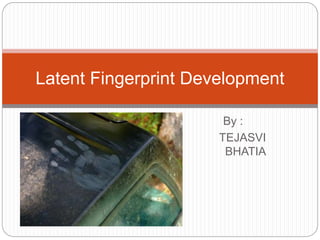
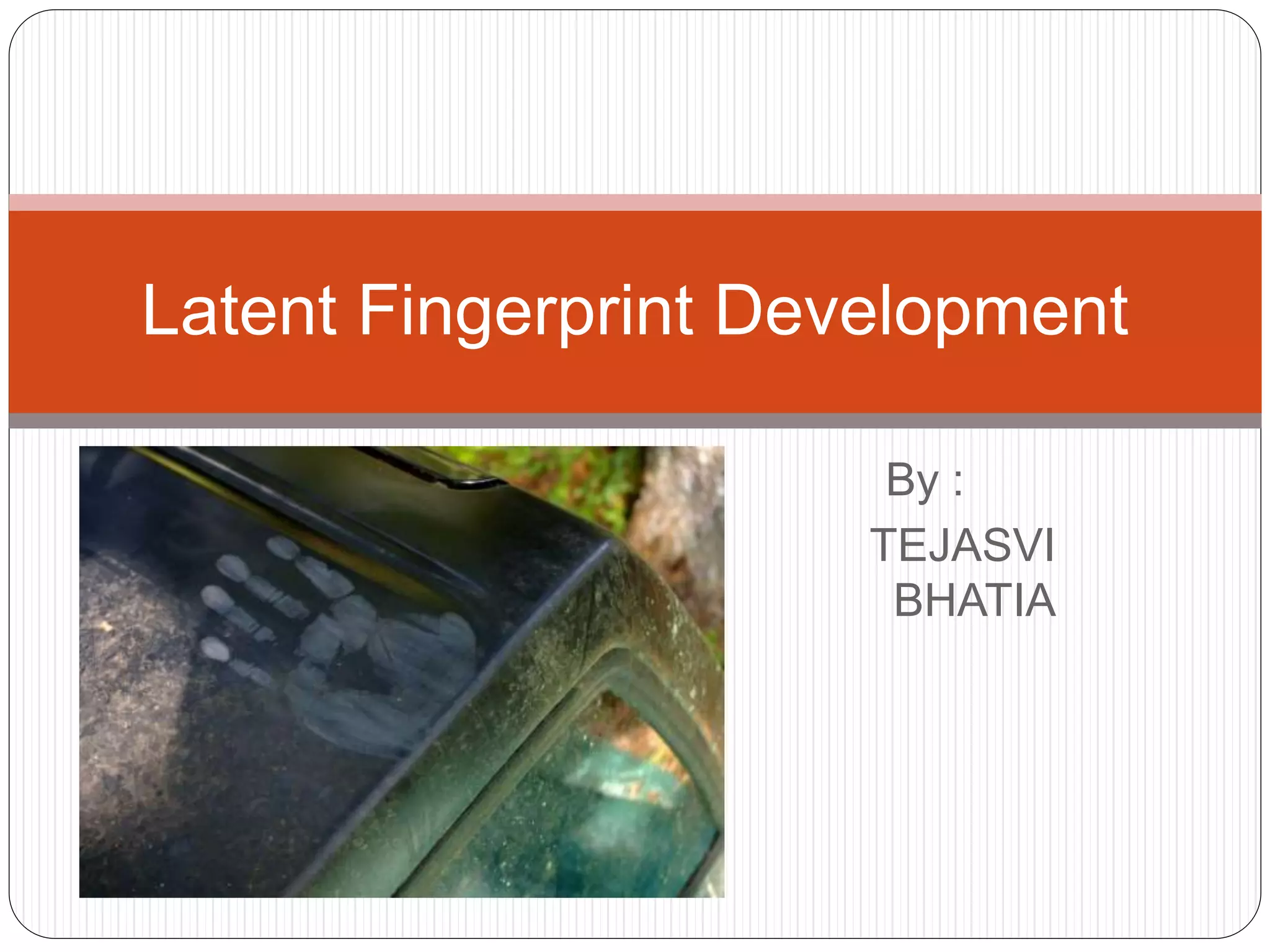
Latent Fingerprint Development
CONTENTS
 Definitions
 Latent print residue
 Why are fingerprints important in Criminal
Investigation?
 Where are latent fingerprints found?
 Items to be included in a fingerprint field kit
 Methods of development
I. Physical methods
II. Chemical methods
 Conclusion
 References
DEFINITIONS
 Fingerprints are the distinctive ridge outlines
which appear on the bulb on the inside of the end
joints of the fingers and thumbs.
 Latent fingerprints have been defined as the
markings of oily matter or perspiration from the
skin glands, left upon any surface which the
hands and fingers may have touched. These are
invisible , and require developing or “disclosing”
treatment to make them visible.
LATENT PRINT RESIDUE
 Latent fingerprints are composed of several
chemicals exuded through the pores in the
fingertips and left on virtually every object
touched.
 The primary component of latent fingerprints is
sweat. Sweat is 99% water, and will dry after a
fairly short period of time.
 The other components of latent fingerprints are
primarily solid and can remain on a surface for a
much longer period of time. They include amino
acids, glucose, lactic acid, peptides, riboflavin,
proteins, lipids, potassium, sodium, calcium, and
numerous others.
WHY ARE FINGERPRINTS
IMPORTANT IN CRIMINAL
INVESTIGATION?
 The potential aids offered to law enforcement by
fingerprints are numerous as:-
I. Fingerprints are unique. No two individuals
have identical fingerprints.
II. Fingerprints do not change throughout the life
span of an individual.
 The finger markings on some lethal weapon
often determine whether the act was that of
suicide or murder.
 Latent fingerprints are found on various objects
that come in contact with a suspects hands at a
crime scene. As these are unique ,a suspect
can be identified as the perpetrator of a crime.
WHERE ARE LATENT
FINGERPRINTS FOUND?
I. Smooth, Non-Porous surfaces
II. Rough, Non-Porous surfaces
III. Paper and Cardboard
IV. Plastic Packaging Material
V. Soft Vinyl (PVC), Rubber, and Leather
VI. Metal (Untreated)
VII. Unfinished Wood
VIII. Wax and Waxed Surfaces
IX. Adhesive-Coated Surfaces
FINGERPRINT FIELD KIT
 Fingerprint powders
 2 brushes for dark and light powders
 2 feather dusters for light and dark powders
 Latent print lifting material
 Mounting material
 Fingerprint record cards
 Supply of cards for mounting latents(black and
white)
 Fingerprint ink
 Glass plate for inking
 Complete post mortem outfit for printing corpses:-
I. Pair of scissors
II. Pair of rubber gloves
 Notebook
 Flashlight
 Atomizer for applying powder
 Atomizer for applying chemicals
METHODS OF DEVELOPMENT
These include:-
 Physical methods
 Chemical methods
PHYSICAL METHODS
POWDERING METHODS
 This method of developing latent fingerprints is
based on the simple physical phenomenon of
adhering. The powder substances when applied
to the latent fingerprints in a proper and
systematic manner ,adhere to the secretions left
on the object bearing latent fingerprints.
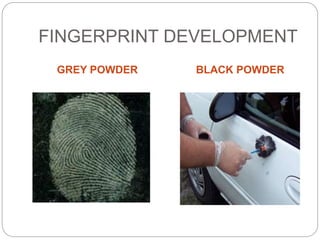
 The most commonly used powders are black and
grey powders.
 Black powders are used for developing prints on
white or light colored surfaces and grey powders
are used on dark colored surfaces to give
maximum contrast.
FINGERPRINT DEVELOPMENT
GREY POWDER BLACK POWDER
FLUORESCENT POWDERS
 When the latent impressions are to be developed
on a multicolored surface, the use of powder of
one color does not prove useful because of lack
of contrast of the developed print against
multicolored background. Such type of
impressions are developed with fluorescent
powders which can be applied like other powders.
 The prints developed with fluorescent powders
glow under ultraviolet light and they can be
photographed on an ordinary film.
 These powders are available in a variety of colors
like green, red and yellow.
FINGERPRINT DEVELOPMENT
•Background surfaces containing
multiple colours are often
processed with fluorescent
powder, as the brilliance of the
powder will contrast with the
background allowing for detailed
photography. Orange Fluorescent
Powder fluoresces with a forensic
light source under Ultraviolet or
blue wavelengths. Powder should
be applied with an Orange Feather
Brush.
XEROX TONERS
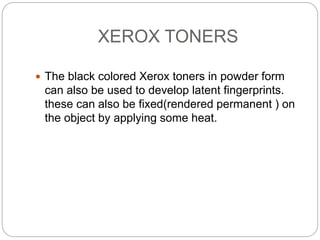
 The black colored Xerox toners in powder form
can also be used to develop latent fingerprints.
these can also be fixed(rendered permanent ) on
the object by applying some heat.
METHOD OF DEVELOPMENT
 The selected powder is lightly applied to the
suspected surface with a fine fingerprint brush.
The brush is applied firstly in one direction and
then in the other direction and when the ridges
start appearing the brushing is done in a way that
its motion follows the flow of ridges. When
sufficient powder adheres to the impression ,the
excess powder is carefully brushed away with a
light soft touch.
 When the object is small and movable ,it can be
tilted to remove the sprinkled fingerprint powder.
The excess powder on the print is removed
carefully by soft and light touches of the brush.
LIFTING POWDERED PRINTS
 When the developed fingerprints cannot be
readily photographed due to physical location of
such prints, they have to be lifted from that
surface for comparison purposes and permanent
recording.
 The fingerprint lifters include photographic paper,
transparent tapes and opaque lifters.
 The sticky surface of the fingerprint lifter is
pressed against the developed print in a careful
manner. When the surface of the lifter has been
uniformly pressed over the developed print, it is
carefully drawn off from the object and mounted
on a suitable card.
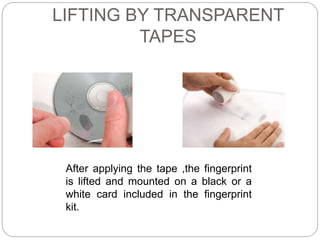
LIFTING BY TRANSPARENT
TAPES
After applying the tape ,the fingerprint
is lifted and mounted on a black or a
white card included in the fingerprint
kit.
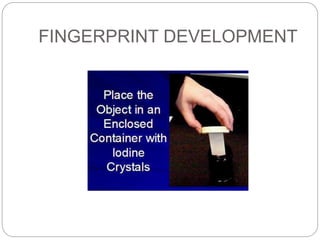
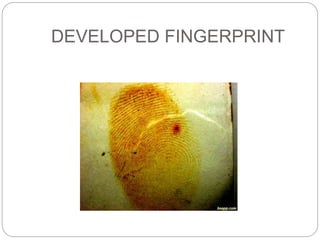
IODINE FUMING METHOD
 This method depends on the principle that when
the oily and fatty deposits of the latent
impressions come in contact with the iodine
fumes produced by subjecting iodine crystals to
slight heat, they become visible in yellowish
brown color. These prints are however not
permanent, and should be photographed before
they begin to fade and are at their full intensity.
 Iodine fuming can be carried out in a closed
chamber or with the help of an iodine fuming
pipe.
FINGERPRINT DEVELOPMENT
DEVELOPED FINGERPRINT
CHEMICAL METHODS
 These methods include:-
I. Silver nitrate method
II. Ninhydrin method
III. Osmic acid method
SILVER NITRATE METHOD
 This method is based on the fact that the sodium
chloride of the deposited perspiration in the latent
impression reacts with silver nitrate solution to
form silver chloride which is light sensitive.
 When exposed to light, it breaks into its
component silver and chloride. The developed
prints are reddish brown in color.
 A 5% silver nitrate solution is generally used for
this purpose.
NINHYDRIN METHOD
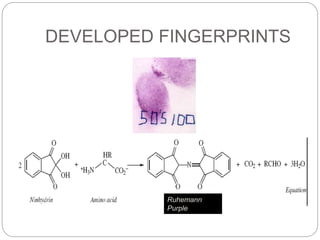
 The development of latent prints with ninhydrin is
based on the chemical reaction of ninhydrin with
amino acids which are present in perspiration
causing the formation of purple reddish stains
that render latent impressions visible.
 Normally 1.5% solution of ninhydrin is used.
DEVELOPED FINGERPRINTS
Ruhemann
Purple
OSMIC ACID METHOD
 This method is based on the reaction of osmic
acid vapors with oily matter of the latent
impressions. When osmic acid vapors come in
contact with sebaceous matter, it is reduced to
metallic osmium which is blue colored.
 The solution is prepared by dissolving 3 grams of
osmic acid in 100cc of carbon tetrachloride, ether
or ethyl alcohol.
CONCLUSION
 It has been aptly said that the criminal’s own hand
is his greatest enemy. As the most important aid
to the sense of touch, the hand and fingers meet
frequently with the surrounding objects and
surfaces, thus producing evidential markings that
may serve either to condemn or to vindicate the
accused.
REFERENCES
 Lee, Henry & R.E. Gaensslen. Advances in
Fingerprint Technology, 2nd Ed. CRC Press.
Boca Raton, Florida.
 Bridges , B.C. practical fingerprinting . Funk
and Wagnallas company, New York,1942
 http://www.onin.com/fp
THANK YOU

Latent fingerprint development

  • 1.
  • 2.
    CONTENTS  Definitions  Latentprint residue  Why are fingerprints important in Criminal Investigation?  Where are latent fingerprints found?  Items to be included in a fingerprint field kit  Methods of development I. Physical methods II. Chemical methods  Conclusion  References
  • 3.
    DEFINITIONS  Fingerprints arethe distinctive ridge outlines which appear on the bulb on the inside of the end joints of the fingers and thumbs.  Latent fingerprints have been defined as the markings of oily matter or perspiration from the skin glands, left upon any surface which the hands and fingers may have touched. These are invisible , and require developing or “disclosing” treatment to make them visible.
  • 4.
    LATENT PRINT RESIDUE Latent fingerprints are composed of several chemicals exuded through the pores in the fingertips and left on virtually every object touched.  The primary component of latent fingerprints is sweat. Sweat is 99% water, and will dry after a fairly short period of time.  The other components of latent fingerprints are primarily solid and can remain on a surface for a much longer period of time. They include amino acids, glucose, lactic acid, peptides, riboflavin, proteins, lipids, potassium, sodium, calcium, and numerous others.
  • 5.
    WHY ARE FINGERPRINTS IMPORTANTIN CRIMINAL INVESTIGATION?  The potential aids offered to law enforcement by fingerprints are numerous as:- I. Fingerprints are unique. No two individuals have identical fingerprints. II. Fingerprints do not change throughout the life span of an individual.  The finger markings on some lethal weapon often determine whether the act was that of suicide or murder.  Latent fingerprints are found on various objects that come in contact with a suspects hands at a crime scene. As these are unique ,a suspect can be identified as the perpetrator of a crime.
  • 6.
    WHERE ARE LATENT FINGERPRINTSFOUND? I. Smooth, Non-Porous surfaces II. Rough, Non-Porous surfaces III. Paper and Cardboard IV. Plastic Packaging Material V. Soft Vinyl (PVC), Rubber, and Leather VI. Metal (Untreated) VII. Unfinished Wood VIII. Wax and Waxed Surfaces IX. Adhesive-Coated Surfaces
  • 7.
    FINGERPRINT FIELD KIT Fingerprint powders  2 brushes for dark and light powders  2 feather dusters for light and dark powders  Latent print lifting material  Mounting material  Fingerprint record cards  Supply of cards for mounting latents(black and white)  Fingerprint ink  Glass plate for inking
  • 8.
     Complete postmortem outfit for printing corpses:- I. Pair of scissors II. Pair of rubber gloves  Notebook  Flashlight  Atomizer for applying powder  Atomizer for applying chemicals
  • 9.
    METHODS OF DEVELOPMENT Theseinclude:-  Physical methods  Chemical methods
  • 10.
    PHYSICAL METHODS POWDERING METHODS This method of developing latent fingerprints is based on the simple physical phenomenon of adhering. The powder substances when applied to the latent fingerprints in a proper and systematic manner ,adhere to the secretions left on the object bearing latent fingerprints.  The most commonly used powders are black and grey powders.  Black powders are used for developing prints on white or light colored surfaces and grey powders are used on dark colored surfaces to give maximum contrast.
  • 11.
  • 12.
    FLUORESCENT POWDERS  Whenthe latent impressions are to be developed on a multicolored surface, the use of powder of one color does not prove useful because of lack of contrast of the developed print against multicolored background. Such type of impressions are developed with fluorescent powders which can be applied like other powders.  The prints developed with fluorescent powders glow under ultraviolet light and they can be photographed on an ordinary film.  These powders are available in a variety of colors like green, red and yellow.
  • 13.
    FINGERPRINT DEVELOPMENT •Background surfacescontaining multiple colours are often processed with fluorescent powder, as the brilliance of the powder will contrast with the background allowing for detailed photography. Orange Fluorescent Powder fluoresces with a forensic light source under Ultraviolet or blue wavelengths. Powder should be applied with an Orange Feather Brush.
  • 14.
    XEROX TONERS  Theblack colored Xerox toners in powder form can also be used to develop latent fingerprints. these can also be fixed(rendered permanent ) on the object by applying some heat.
  • 15.
    METHOD OF DEVELOPMENT The selected powder is lightly applied to the suspected surface with a fine fingerprint brush. The brush is applied firstly in one direction and then in the other direction and when the ridges start appearing the brushing is done in a way that its motion follows the flow of ridges. When sufficient powder adheres to the impression ,the excess powder is carefully brushed away with a light soft touch.  When the object is small and movable ,it can be tilted to remove the sprinkled fingerprint powder. The excess powder on the print is removed carefully by soft and light touches of the brush.
  • 16.
    LIFTING POWDERED PRINTS When the developed fingerprints cannot be readily photographed due to physical location of such prints, they have to be lifted from that surface for comparison purposes and permanent recording.  The fingerprint lifters include photographic paper, transparent tapes and opaque lifters.  The sticky surface of the fingerprint lifter is pressed against the developed print in a careful manner. When the surface of the lifter has been uniformly pressed over the developed print, it is carefully drawn off from the object and mounted on a suitable card.
  • 17.
    LIFTING BY TRANSPARENT TAPES Afterapplying the tape ,the fingerprint is lifted and mounted on a black or a white card included in the fingerprint kit.
  • 18.
    IODINE FUMING METHOD This method depends on the principle that when the oily and fatty deposits of the latent impressions come in contact with the iodine fumes produced by subjecting iodine crystals to slight heat, they become visible in yellowish brown color. These prints are however not permanent, and should be photographed before they begin to fade and are at their full intensity.  Iodine fuming can be carried out in a closed chamber or with the help of an iodine fuming pipe.
  • 19.
  • 20.
  • 21.
    CHEMICAL METHODS  Thesemethods include:- I. Silver nitrate method II. Ninhydrin method III. Osmic acid method
  • 22.
    SILVER NITRATE METHOD This method is based on the fact that the sodium chloride of the deposited perspiration in the latent impression reacts with silver nitrate solution to form silver chloride which is light sensitive.  When exposed to light, it breaks into its component silver and chloride. The developed prints are reddish brown in color.  A 5% silver nitrate solution is generally used for this purpose.
  • 23.
    NINHYDRIN METHOD  Thedevelopment of latent prints with ninhydrin is based on the chemical reaction of ninhydrin with amino acids which are present in perspiration causing the formation of purple reddish stains that render latent impressions visible.  Normally 1.5% solution of ninhydrin is used.
  • 24.
  • 25.
    OSMIC ACID METHOD This method is based on the reaction of osmic acid vapors with oily matter of the latent impressions. When osmic acid vapors come in contact with sebaceous matter, it is reduced to metallic osmium which is blue colored.  The solution is prepared by dissolving 3 grams of osmic acid in 100cc of carbon tetrachloride, ether or ethyl alcohol.
  • 26.
    CONCLUSION  It hasbeen aptly said that the criminal’s own hand is his greatest enemy. As the most important aid to the sense of touch, the hand and fingers meet frequently with the surrounding objects and surfaces, thus producing evidential markings that may serve either to condemn or to vindicate the accused.
  • 27.
    REFERENCES  Lee, Henry& R.E. Gaensslen. Advances in Fingerprint Technology, 2nd Ed. CRC Press. Boca Raton, Florida.  Bridges , B.C. practical fingerprinting . Funk and Wagnallas company, New York,1942  http://www.onin.com/fp
  • 28.