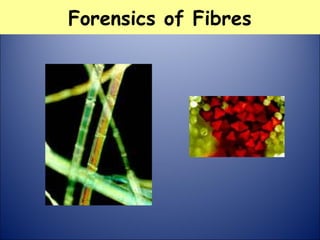
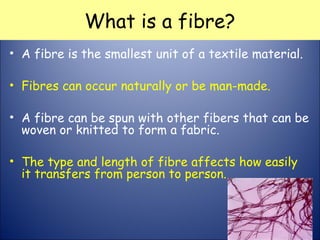
Forensics of Fibres
What is a fibre?
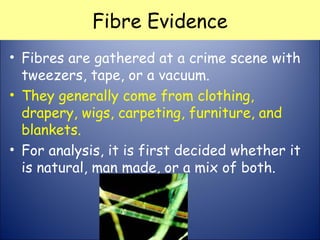
• A fibre is the smallest unit of a textile material.
• Fibres can occur naturally or be man-made.
• A fibre can be spun with other fibers that can be
woven or knitted to form a fabric.
• The type and length of fibre affects how easily
it transfers from person to person.
Fibre Evidence
• Fibres are gathered at a crime scene with
tweezers, tape, or a vacuum. 
• They generally come from clothing,
drapery, wigs, carpeting, furniture, and
blankets. 
• For analysis, it is first decided whether it
is natural, man made, or a mix of both.
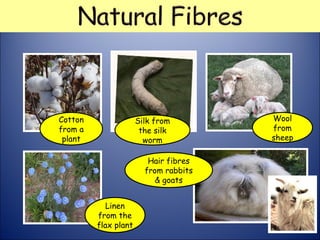
Cotton
from a
plant
Silk from
the silk
worm
Wool
from
sheep
Linen
from the
flax plant
Hair fibres
from rabbits
& goats
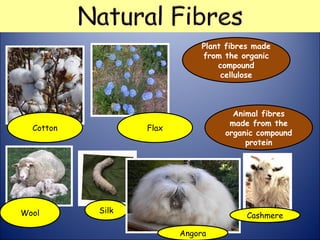
Plant fibres made
from the organic
compound
cellulose
Flax
Wool Silk
Cotton
Cashmere
Animal fibres
made from the
organic compound
protein
Angora
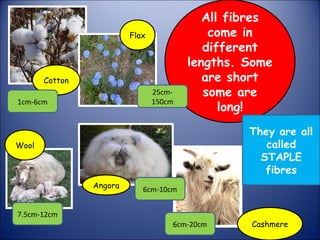
All fibres
come in
different
lengths. Some
are short
some are
long!
Flax
Wool
Cotton
Angora
25cm-
150cm1cm-6cm
7.5cm-12cm
6cm-10cm
6cm-20cm Cashmere
They are all
called
STAPLE
fibres
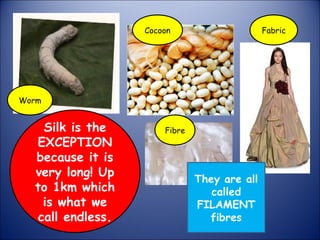
Silk is the
EXCEPTION
because it is
very long! Up
to 1km which
is what we
call endless.
They are all
called
FILAMENT
fibres
Worm
Cocoon
Fibre
Fabric
Natural Fibres
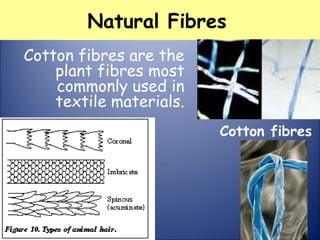
Cotton fibres are the
plant fibres most
commonly used in
textile materials.
Cotton fibres
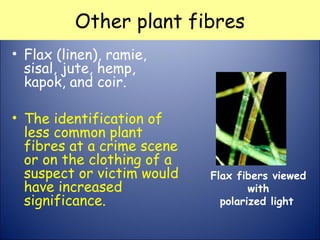
Other plant fibres
• Flax (linen), ramie,
sisal, jute, hemp,
kapok, and coir.
• The identification of
less common plant
fibres at a crime scene
or on the clothing of a
suspect or victim would
have increased
significance.
Flax fibers viewed
with
polarized light
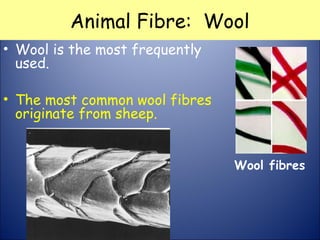
Animal Fibre: Wool
• Wool is the most frequently
used.
• The most common wool fibres
originate from sheep.
Wool fibres
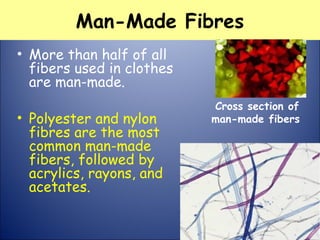
Man-Made Fibres
• More than half of all
fibers used in clothes
are man-made.
• Polyester and nylon
fibres are the most
common man-made
fibers, followed by
acrylics, rayons, and
acetates.
Cross section of
man-made fibers
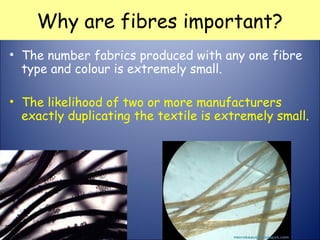
Why are fibres important?
• The number fabrics produced with any one fibre
type and colour is extremely small.
• The likelihood of two or more manufacturers
exactly duplicating the textile is extremely small.
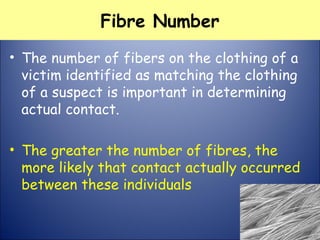
Fibre Number
• The number of fibers on the clothing of a
victim identified as matching the clothing
of a suspect is important in determining
actual contact.
• The greater the number of fibres, the
more likely that contact actually occurred
between these individuals
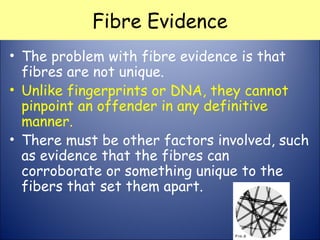
Fibre Evidence
• The problem with fibre evidence is that
fibres are not unique. 
• Unlike fingerprints or DNA, they cannot
pinpoint an offender in any definitive
manner. 
• There must be other factors involved, such
as evidence that the fibres can
corroborate or something unique to the
fibers that set them apart.
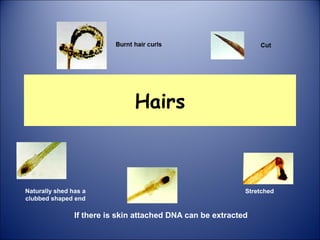
Hairs
Naturally shed has a
clubbed shaped end
Stretched
If there is skin attached DNA can be extracted
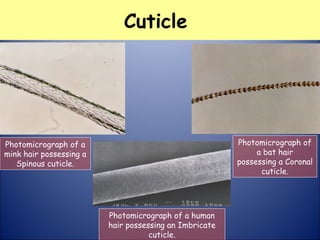
Cuticle
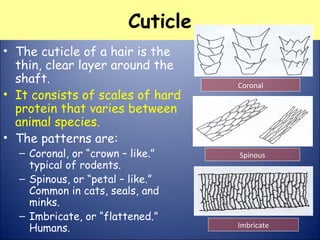
• The cuticle of a hair is the
thin, clear layer around the
shaft.
• It consists of scales of hard
protein that varies between
animal species.
• The patterns are:
– Coronal, or “crown – like.”
typical of rodents.
– Spinous, or “petal – like.”
Common in cats, seals, and
minks.
– Imbricate, or “flattened.”
Humans.
Coronal
Spinous
Imbricate
Cuticle
Photomicrograph of a
mink hair possessing a
Spinous cuticle.
Photomicrograph of
a bat hair
possessing a Coronal
cuticle.
Photomicrograph of a human
hair possessing an Imbricate
cuticle.
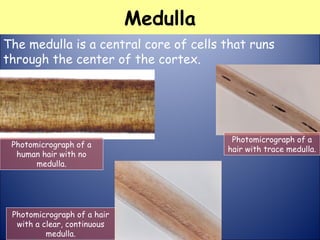
Medulla
Photomicrograph of a
human hair with no
medulla.
Photomicrograph of a
hair with trace medulla.
Photomicrograph of a hair
with a clear, continuous
medulla.
The medulla is a central core of cells that runs
through the center of the cortex.
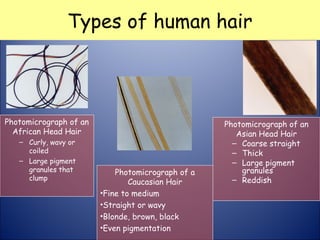
Types of human hair
Photomicrograph of an
African Head Hair
– Curly, wavy or
coiled
– Large pigment
granules that
clump
Photomicrograph of an
Asian Head Hair
– Coarse straight
– Thick
– Large pigment
granules
– Reddish
Photomicrograph of a
Caucasian Hair
•Fine to medium
•Straight or wavy
•Blonde, brown, black
•Even pigmentation
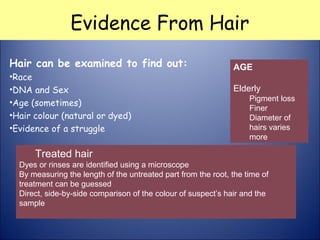
Race and AgeEvidence From Hair
Hair can be examined to find out:
•Race
•DNA and Sex
•Age (sometimes)
•Hair colour (natural or dyed)
•Evidence of a struggle
AGE
Elderly
Pigment loss
Finer
Diameter of
hairs varies
more
Treated hair
Dyes or rinses are identified using a microscope
By measuring the length of the untreated part from the root, the time of
treatment can be guessed
Direct, side-by-side comparison of the colour of suspect’s hair and the
sample
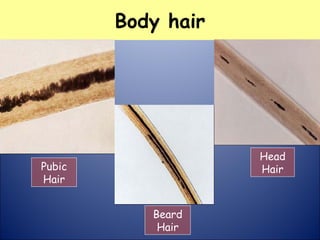
Body hair
Head
Hair
Beard
Hair
Pubic
Hair
Practical
• Part A
• Use the microscopes to look at the samples of fibres and animal hair.
• Draw a labelled diagram of what you see. (Use your notes as a guide)
• Can you identify which are natural or man-made fibres or animal hair?
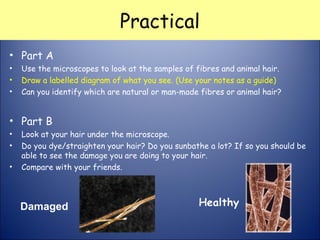
• Part B
• Look at your hair under the microscope.
• Do you dye/straighten your hair? Do you sunbathe a lot? If so you should be
able to see the damage you are doing to your hair.
• Compare with your friends.
Damaged

Fibre and hair analysis

  • 1.
  • 2.
    What is afibre? • A fibre is the smallest unit of a textile material. • Fibres can occur naturally or be man-made. • A fibre can be spun with other fibers that can be woven or knitted to form a fabric. • The type and length of fibre affects how easily it transfers from person to person.
  • 3.
    Fibre Evidence • Fibresare gathered at a crime scene with tweezers, tape, or a vacuum.  • They generally come from clothing, drapery, wigs, carpeting, furniture, and blankets.  • For analysis, it is first decided whether it is natural, man made, or a mix of both.
  • 4.
    Cotton from a plant Silk from thesilk worm Wool from sheep Linen from the flax plant Hair fibres from rabbits & goats
  • 5.
    Plant fibres made fromthe organic compound cellulose Flax Wool Silk Cotton Cashmere Animal fibres made from the organic compound protein Angora
  • 6.
    All fibres come in different lengths.Some are short some are long! Flax Wool Cotton Angora 25cm- 150cm1cm-6cm 7.5cm-12cm 6cm-10cm 6cm-20cm Cashmere They are all called STAPLE fibres
  • 7.
    Silk is the EXCEPTION becauseit is very long! Up to 1km which is what we call endless. They are all called FILAMENT fibres Worm Cocoon Fibre Fabric
  • 8.
    Natural Fibres Cotton fibresare the plant fibres most commonly used in textile materials. Cotton fibres
  • 9.
    Other plant fibres •Flax (linen), ramie, sisal, jute, hemp, kapok, and coir. • The identification of less common plant fibres at a crime scene or on the clothing of a suspect or victim would have increased significance. Flax fibers viewed with polarized light
  • 10.
    Animal Fibre: Wool •Wool is the most frequently used. • The most common wool fibres originate from sheep. Wool fibres
  • 11.
    Man-Made Fibres • Morethan half of all fibers used in clothes are man-made. • Polyester and nylon fibres are the most common man-made fibers, followed by acrylics, rayons, and acetates. Cross section of man-made fibers
  • 12.
    Why are fibresimportant? • The number fabrics produced with any one fibre type and colour is extremely small. • The likelihood of two or more manufacturers exactly duplicating the textile is extremely small.
  • 13.
    Fibre Number • Thenumber of fibers on the clothing of a victim identified as matching the clothing of a suspect is important in determining actual contact. • The greater the number of fibres, the more likely that contact actually occurred between these individuals
  • 14.
    Fibre Evidence • Theproblem with fibre evidence is that fibres are not unique.  • Unlike fingerprints or DNA, they cannot pinpoint an offender in any definitive manner.  • There must be other factors involved, such as evidence that the fibres can corroborate or something unique to the fibers that set them apart.
  • 15.
    Hairs Naturally shed hasa clubbed shaped end Stretched If there is skin attached DNA can be extracted
  • 16.
    Cuticle • The cuticleof a hair is the thin, clear layer around the shaft. • It consists of scales of hard protein that varies between animal species. • The patterns are: – Coronal, or “crown – like.” typical of rodents. – Spinous, or “petal – like.” Common in cats, seals, and minks. – Imbricate, or “flattened.” Humans. Coronal Spinous Imbricate
  • 17.
    Cuticle Photomicrograph of a minkhair possessing a Spinous cuticle. Photomicrograph of a bat hair possessing a Coronal cuticle. Photomicrograph of a human hair possessing an Imbricate cuticle.
  • 18.
    Medulla Photomicrograph of a humanhair with no medulla. Photomicrograph of a hair with trace medulla. Photomicrograph of a hair with a clear, continuous medulla. The medulla is a central core of cells that runs through the center of the cortex.
  • 19.
    Types of humanhair Photomicrograph of an African Head Hair – Curly, wavy or coiled – Large pigment granules that clump Photomicrograph of an Asian Head Hair – Coarse straight – Thick – Large pigment granules – Reddish Photomicrograph of a Caucasian Hair •Fine to medium •Straight or wavy •Blonde, brown, black •Even pigmentation
  • 20.
    Race and AgeEvidenceFrom Hair Hair can be examined to find out: •Race •DNA and Sex •Age (sometimes) •Hair colour (natural or dyed) •Evidence of a struggle AGE Elderly Pigment loss Finer Diameter of hairs varies more Treated hair Dyes or rinses are identified using a microscope By measuring the length of the untreated part from the root, the time of treatment can be guessed Direct, side-by-side comparison of the colour of suspect’s hair and the sample
  • 21.
  • 22.
    Practical • Part A •Use the microscopes to look at the samples of fibres and animal hair. • Draw a labelled diagram of what you see. (Use your notes as a guide) • Can you identify which are natural or man-made fibres or animal hair? • Part B • Look at your hair under the microscope. • Do you dye/straighten your hair? Do you sunbathe a lot? If so you should be able to see the damage you are doing to your hair. • Compare with your friends. Damaged