Fiber and Hair Evidence
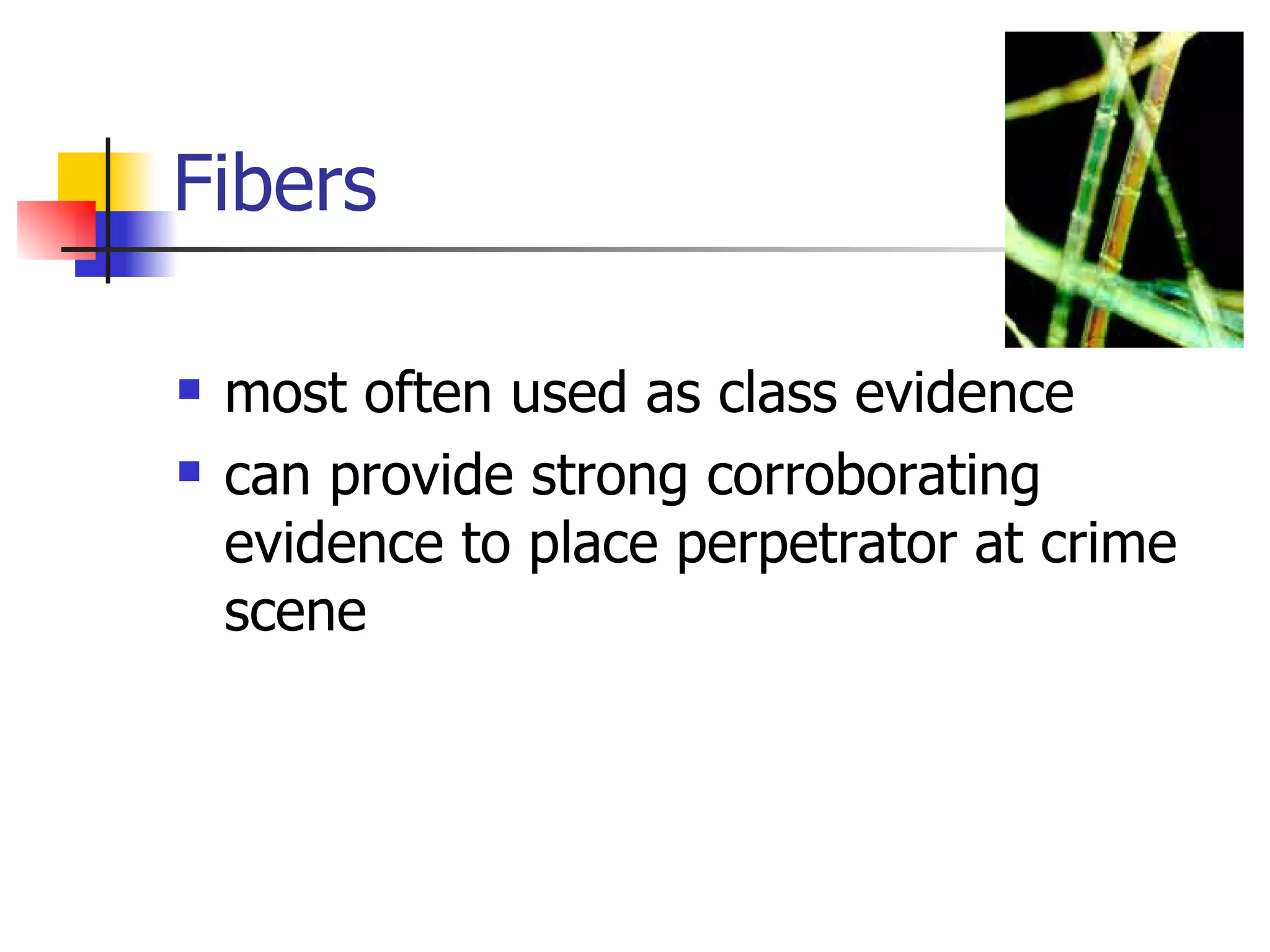
Fibers most often used as class evidence can provide strong corroborating evidence to place perpetrator at crime scene
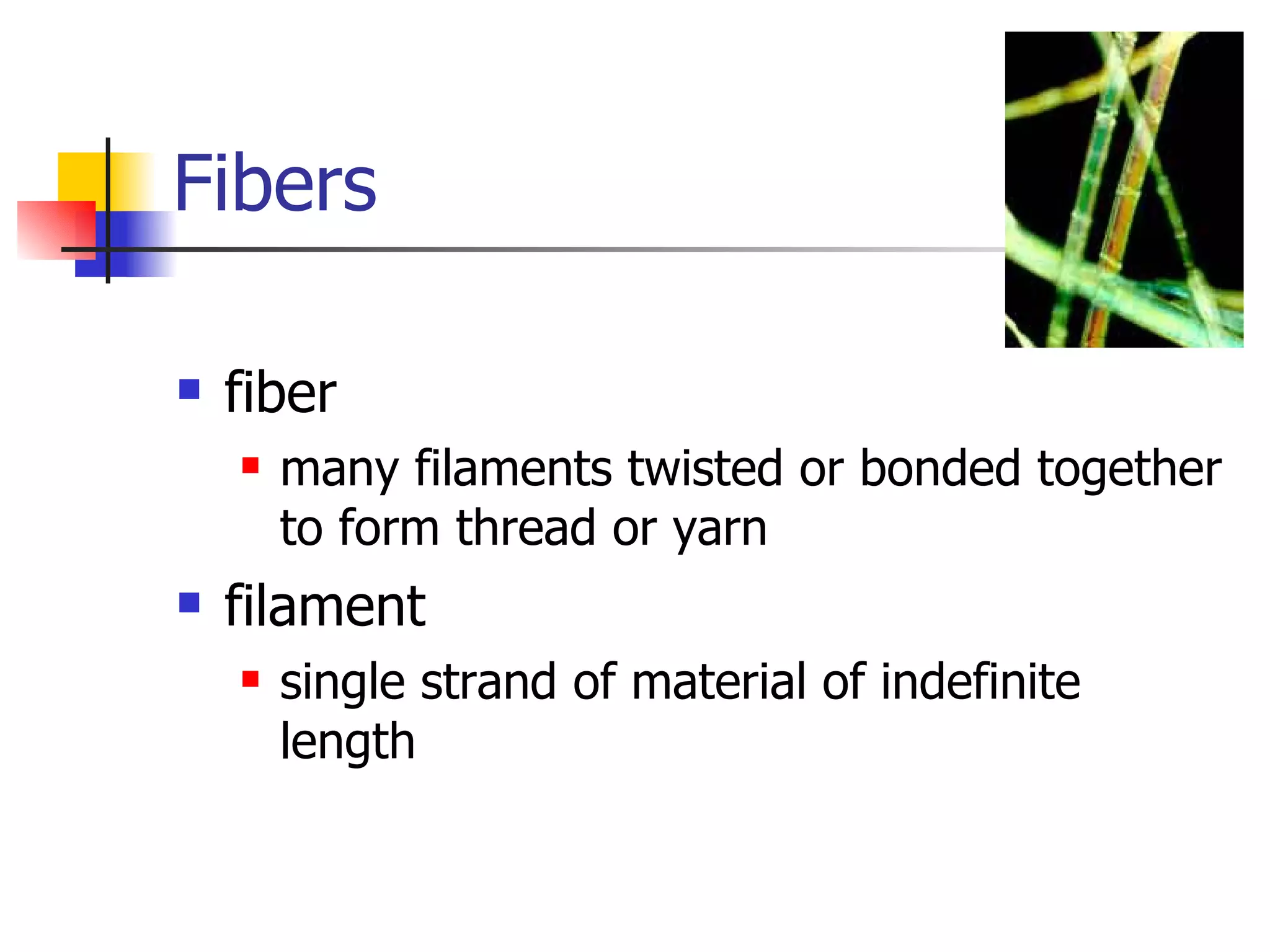
Fibers fiber many filaments twisted or bonded together to form thread or yarn filament  single strand of material of indefinite length
Fibers can be natural silk, wool, mohair, cashmere, angora, cotton, linen, jute, sisal, hemp, ramie, asbestos, fiberglass, rayon can be artificial or synthetic acrylic, aramid, nylon, olefin, spandex, polyester, modacrylic
Fibers physical properties color chromatography of dyes polarization with light blend and /or weave diameter of fibers cross sectional shape
 
Fibers physical properties # of filaments density refractive index refraction is the bending of light waves due to a change in the velocity fluorescence
Fibers chemical properties burning tests (oxidation) analysis ash, behavior in and out of flame, odor thermal decomposition pH, residue and component chemicals chemical decomposition treatment with various strong acids, bases and solvents
Fibers many of these tests would be made between the unknown and  reference samples taken at scene reference samples taken from individuals involved at scene exemplars – scientific standards accepted widely usually found in databases
Fibers many of these tests would be  made between the unknown &  reference samples taken at scene reference samples taken from individuals involved at scene exemplars – scientific standards accepted widely usually found in databases
Hair considered a type of fiber not able to individualize unless DNA is present w/o DNA, it can provide strong corroborative evidence for placing an individual at a crime scene
Hair morphology root in follicle shaft cuticle cortex medulla tip/end
Hair morphology - shaft cuticle scale structure covering the exterior of the hair scales always point to tip of hair scale pattern often used for species identification
Hair morphology - shaft cortex main body of the hair shaft pigment giving hair its color is embedded in the cortex lack of pigment = gray or white number, shape and distribution of pigment granules can be used to narrow down class
Hair morphology - shaft medulla may appear dark or translucent depending on substances inside can be continuous, interrupted or fragmented also used to identify to species medullary index measures diameter of medulla relative to diameter of hair shaft humans usu. less than 1/3, animals usu. more than ½
Hair morphology - root located in hair follicle of skin three stages of growth anagen phase: major growth catagen phase: intermediate telogen phase: mature hair – will “fall” out
Hair morphology - root telogen naturally shed hairs, such as a head hair dislodged through combing, display undamaged, club-shaped roots
Hair morphology - root anagen or catagen a hair forcibly removed from the scalp will exhibit stretching and damage to the root area forcibly removed hairs may have tissue attached may contain DNA
Hair other root is embedded in follicle which is in equalized with the blood supply anything taken into the body is distributed into growing hair (drugs, poisons) esp. metals like Hg, As, Pb time frame can be established as hair grows at a fixed rate

Fiber And Hair Evidence

  • 1.
  • 2.
    Fibers most oftenused as class evidence can provide strong corroborating evidence to place perpetrator at crime scene
  • 3.
    Fibers fiber manyfilaments twisted or bonded together to form thread or yarn filament single strand of material of indefinite length
  • 4.
    Fibers can benatural silk, wool, mohair, cashmere, angora, cotton, linen, jute, sisal, hemp, ramie, asbestos, fiberglass, rayon can be artificial or synthetic acrylic, aramid, nylon, olefin, spandex, polyester, modacrylic
  • 5.
    Fibers physical propertiescolor chromatography of dyes polarization with light blend and /or weave diameter of fibers cross sectional shape
  • 6.
  • 7.
    Fibers physical properties# of filaments density refractive index refraction is the bending of light waves due to a change in the velocity fluorescence
  • 8.
    Fibers chemical propertiesburning tests (oxidation) analysis ash, behavior in and out of flame, odor thermal decomposition pH, residue and component chemicals chemical decomposition treatment with various strong acids, bases and solvents
  • 9.
    Fibers many ofthese tests would be made between the unknown and reference samples taken at scene reference samples taken from individuals involved at scene exemplars – scientific standards accepted widely usually found in databases
  • 10.
    Fibers many ofthese tests would be made between the unknown & reference samples taken at scene reference samples taken from individuals involved at scene exemplars – scientific standards accepted widely usually found in databases
  • 11.
    Hair considered atype of fiber not able to individualize unless DNA is present w/o DNA, it can provide strong corroborative evidence for placing an individual at a crime scene
  • 12.
    Hair morphology rootin follicle shaft cuticle cortex medulla tip/end
  • 13.
    Hair morphology rootin follicle shaft cuticle cortex medulla tip/end
  • 14.
    Hair morphology -shaft cuticle scale structure covering the exterior of the hair scales always point to tip of hair scale pattern often used for species identification
  • 15.
    Hair morphology -shaft cortex main body of the hair shaft pigment giving hair its color is embedded in the cortex lack of pigment = gray or white number, shape and distribution of pigment granules can be used to narrow down class
  • 16.
    Hair morphology -shaft medulla may appear dark or translucent depending on substances inside can be continuous, interrupted or fragmented also used to identify to species medullary index measures diameter of medulla relative to diameter of hair shaft humans usu. less than 1/3, animals usu. more than ½
  • 17.
    Hair morphology -root located in hair follicle of skin three stages of growth anagen phase: major growth catagen phase: intermediate telogen phase: mature hair – will “fall” out
  • 18.
    Hair morphology -root telogen naturally shed hairs, such as a head hair dislodged through combing, display undamaged, club-shaped roots
  • 19.
    Hair morphology -root anagen or catagen a hair forcibly removed from the scalp will exhibit stretching and damage to the root area forcibly removed hairs may have tissue attached may contain DNA
  • 20.
    Hair other rootis embedded in follicle which is in equalized with the blood supply anything taken into the body is distributed into growing hair (drugs, poisons) esp. metals like Hg, As, Pb time frame can be established as hair grows at a fixed rate