Department of criminology and forensic science
DR. HARI SINGH GOURVISHWAVIDYALAYA
( Central university )
SAGAR, MP.
RESTORATION OF OBLITERATED
MARKS
Submitted to:
Dr. Navjot Kaur Kanwal
Assistant Professor Submitted by :
Saanvy Lall( Reg no. Y19242524)
Rupam Jaiswal (Reg no. Y19242523)
M. Sc. Forensic Science 1st Sem.
INTRODUCTION
 Manufacture of valuable items, like automobiles , bicycles,
firearms, watches etc., often register a serial numbers on their
product as a mean if identification or to establish ownership.
 When criminals steal such property they may attempt to alter
or erase the identification marks by either filing the surface
bearing marks with file or by using sand paper or grinding
wheel.
 It is almost impossible to alter such marks without leaving obvious evidence of
an attempted erasure
 Forensic laboratory is increasingly called upon to restore such marks to enable
the police to identify the stolen property with the owner
 Restoration of obliterated marks is often possible in the laboratory, partly or
wholly
TYPE OF MARKS
 1. CAST MARKS - These type of marks are raised above the surface of
metal, but sometime cast marks may sink into the metal surface. Cast marked
numbers or names do not generally identify the main product. It may identify
the components of the product. If the cast marks are erased ,it is impossible to
restore them.
 2. ENGRAVED MARKS- Two types of engraved marks are common, marks
engraved by using chisel, and those made with an electric engraver. If marks
made by chisel or engravers are obliterated, it can be restored provided the
erasure is not too deep .
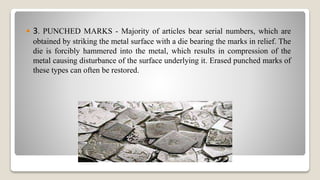
 3. PUNCHED MARKS - Majority of articles bear serial numbers, which are
obtained by striking the metal surface with a die bearing the marks in relief. The
die is forcibly hammered into the metal, which results in compression of the
metal causing disturbance of the surface underlying it. Erased punched marks of
these types can often be restored.
PRINCIPLE OF RESTORATION :-
 Serial numbers are usually stamped on a metal body or frame or on
a plate, with hard steel dies
 This results in the crystalline microstructure of the metal to get
compressed & strained
 When a suitable chemical reagent is applied, the strained &
unstrained areas will dissolve the metal at different rate
 The unequal rate of dissolution, of strained & unstrained metal,
permits bringing out the original numbers
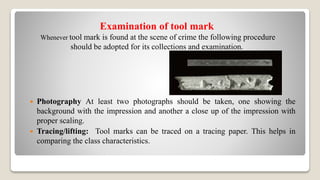
Examination of tool mark
Whenever tool mark is found at the scene of crime the following procedure
should be adopted for its collections and examination.
 Photography At least two photographs should be taken, one showing the
background with the impression and another a close up of the impression with
proper scaling.
 Tracing/lifting: Tool marks can be traced on a tracing paper. This helps in
comparing the class characteristics.
 Plaster of Paris: Plaster of Paris is partly hydrated calcium sulphate
(CaSO4)2 1/2 H2O. This material is used when the impression is of large size.
 Dental casting material: This also gives fine details of tool marks.
 Examination of Tool : The suspected tool is examined for presence of all
traces of metal or wood and foreign particles sticking to the tool/blade using the
stereo microscope.
 Taking test impression - The material on which the test impression is to be made
must be chosen carefully. It must be soft enough so that the tool edge will not be
altered. When the original mark is in wood, paint or soft metal, the standard should
be made with a similar material. Several test impressions should be made at various
angles with the tool.
 COMPARISON OF TOOL MARKS - The tool mark is negative replica of the tool
and mould is negative replica of the tool mark. The comparison is best done by using
comparison microscope and with oblique illumination. Magnification of test and
crime sample should be identical.
TECHNIQUE OF RESTORATION
 The technique of applying the reagent is the same for almost all metals , but
chemical formulae differ from metal to metal.
 Before treatment with chemical reagent, the obliterated surface must be
thoroughly cleaned of dirt and greasy matter or paint with suitable solvent &
photographed.
 The reagent is then applied to this surface with a cotton ball, attached to a stick
or glass rod.
Contd..
 The number is read under suitably adjusted illumination.
 As soon as number appears a photograph need to be taken because it may
disappear after subsequent application of the reagent.
 Best photograph may be obtained after application of transparent oil to the metal
surface.
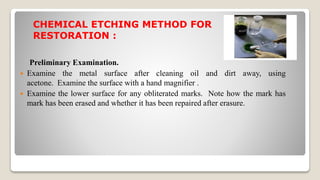
CHEMICAL ETCHING METHOD FOR
RESTORATION :
Preliminary Examination.
 Examine the metal surface after cleaning oil and dirt away, using
acetone. Examine the surface with a hand magnifier .
 Examine the lower surface for any obliterated marks. Note how the mark has
mark has been erased and whether it has been repaired after erasure.
 Identify the type of metal from which the object is made. This is necessary to
choose the appropriate chemical etchant.
Preparation of surface
 Clean the surface using preferably benzene or acetone to free it from grease or
paint. Solvents such as gasoline, commercial paint remover or 50/50 mixture of
acetone and chloroform may also be used.
 Hand polish the area to a smooth, mirror like finish or a reasonably smooth
surface with emery cloth, or other fine abrasive.
 Heating- Treat the area with a blow lamp or Bunsen burner. Care should be
taken not to over heat.
ETCHING PROCEDURES ON DIFFERENT
SURFACES
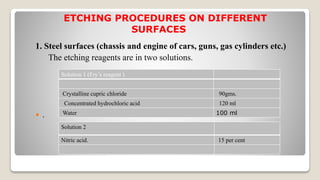
1. Steel surfaces (chassis and engine of cars, guns, gas cylinders etc.)
The etching reagents are in two solutions.
 .
Solution 2
Nitric acid. 15 per cent
Solution 1 (Fry’s reagent )
Crystalline cupric chloride 90gms.
Concentrated hydrochloric acid 120 ml
Water 100 ml
•Apply the Solution 1 by swabbing the surface for approximately 2-3 minutes with
cotton wool dipped in the reagent. Look for any digits revealed and record
these. Clean the surface with acetone (not water). Examine again.
Apply the Solution 2 by swabbing the surface for approximately 1 minute with cotton
wool dipped in this solution. Look for any digits revealed and record these
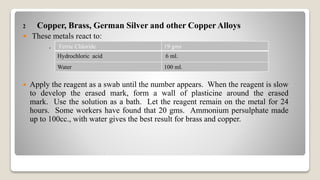
2 Copper, Brass, German Silver and other Copper Alloys
 These metals react to:
.
 Apply the reagent as a swab until the number appears. When the reagent is slow
to develop the erased mark, form a wall of plasticine around the erased
mark. Use the solution as a bath. Let the reagent remain on the metal for 24
hours. Some workers have found that 20 gms. Ammonium persulphate made
up to 100cc., with water gives the best result for brass and copper.
Ferric Chloride 19 gms
Hydrochloric acid 6 ml.
Water 100 ml.
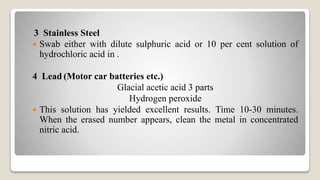
3 Stainless Steel
 Swab either with dilute sulphuric acid or 10 per cent solution of
hydrochloric acid in .
4 Lead (Motor car batteries etc.)
Glacial acetic acid 3 parts
Hydrogen peroxide
 This solution has yielded excellent results. Time 10-30 minutes.
When the erased number appears, clean the metal in concentrated
nitric acid.
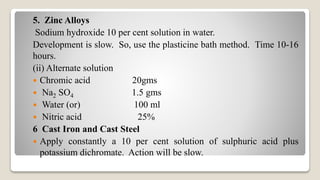
5. Zinc Alloys
Sodium hydroxide 10 per cent solution in water.
Development is slow. So, use the plasticine bath method. Time 10-16
hours.
(ii) Alternate solution
 Chromic acid 20gms
 Na2 SO4 1.5 gms
 Water (or) 100 ml
 Nitric acid 25%
6 Cast Iron and Cast Steel
 Apply constantly a 10 per cent solution of sulphuric acid plus
potassium dichromate. Action will be slow.
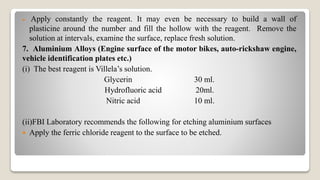
 Apply constantly the reagent. It may even be necessary to build a wall of
plasticine around the number and fill the hollow with the reagent. Remove the
solution at intervals, examine the surface, replace fresh solution.
7. Aluminium Alloys (Engine surface of the motor bikes, auto-rickshaw engine,
vehicle identification plates etc.)
(i) The best reagent is Villela’s solution.
Glycerin 30 ml.
Hydrofluoric acid 20ml.
Nitric acid 10 ml.
(ii)FBI Laboratory recommends the following for etching aluminium surfaces
 Apply the ferric chloride reagent to the surface to be etched.
8. Tin surface.
Hydrochloric acid 10 per cent solution.
 Alternate swabbing and washing. Time 10-20 minutes.
(i) German Silver
Ferric chloride 25%
Hydrochloric acid(conc.) 25%
Water 50%
 Swab the area. Time 10-20 minutes.
(ii) Silver
Concentrated nitric acid.
 Immerse the specimen for few seconds. After each dipping wash with running water.
9. Gold and Platinum
Nitric acid 1pt.
Hydrochloric acid 5pts.
Distilled water 6 pts.
 Carry out etching at 15oC. Time 1 hour or longer.
10. Wood (punched marks)
 Play a jet of steam onto the erased surface. The steam softens the wood and causes
the fibres which were bent during punching the number to spring back and the
broken fibres to swell. Where the mark has been, the wood now projects above the
surface and the mark can be deciphered.
11. Leather
(i) Clean the surface with cotton-wool swab soaked in chloroform, and examine
under ultraviolet light.
(ii) Swab the surface with cotton wool soaked in 2N caustic soda solutions.
12. Rubber
 Some rubber articles are stamped, and when stamping is erased the suspect area
can be treated by lightly swabbing with petrol or even on occasions carbon-
disulphide . This latter solution acts upon rubber very rapidly and should be
used with caution.
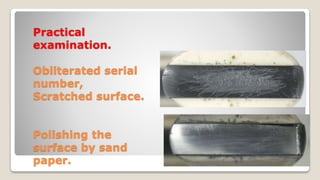
Practical
examination.
Obliterated serial
number,
Scratched surface.
Polishing the
surface by sand
paper.
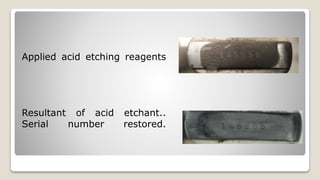
Applied acid etching reagents
Resultant of acid etchant..
Serial number restored.
Preventions
Before applying etching reagent…
 The chemical etching method is the simplest and most effective
method for restoring obliterated numbers.
 The techniques involved require considerable skill and great patience.
The materials used are potentially dangerous and should be used with
full awareness of health and safety requirements.
 Rubber gloves will protect the hands from corrosive acid and when
using volatile liquids work in the open air away from any seat of
naked flame, if laboratory conditions are not available.
 In case of motor vehicles remove the engine from the vehicle if
necessary for ease of access to the engine number surface.
After applying etching reagent… .
 If a mark is successfully restored, it is important that the number is recorded
and, as far as possible, preserved. In an attempt to preserve the mark, the area
should be washed with dilute ammonia solution to neutralize the acid (if the
surface is acid-etched), cleaned thoroughly with acetone and dried. Clear
lacquer should then be thickly sprayed over the mark.
 It is also important to clean up around the mark. Etching reagents are often
splashed or dropped over surrounding parts of the article being examined, and if
not cleaned off, corrosion can result.
 Remember that different parts of marks will appear and disappear as restoration
proceeds. A series of records may be required.
Reference :
• RAUT, Santosh 2008 Toolmark (Forensic physics)
• Sharma, B. R. , 1999. Forensic Science in Criminal
Investigation and Trials, Universal Law Publishing Co.Pvt. Ltd.
• Heard, B.J., 2008,Handbook of Firearm and Ballistic, John
Wiley and Sons Ltd.

restoration of toolmarks

  • 1.
    Department of criminologyand forensic science DR. HARI SINGH GOURVISHWAVIDYALAYA ( Central university ) SAGAR, MP. RESTORATION OF OBLITERATED MARKS Submitted to: Dr. Navjot Kaur Kanwal Assistant Professor Submitted by : Saanvy Lall( Reg no. Y19242524) Rupam Jaiswal (Reg no. Y19242523) M. Sc. Forensic Science 1st Sem.
  • 2.
    INTRODUCTION  Manufacture ofvaluable items, like automobiles , bicycles, firearms, watches etc., often register a serial numbers on their product as a mean if identification or to establish ownership.  When criminals steal such property they may attempt to alter or erase the identification marks by either filing the surface bearing marks with file or by using sand paper or grinding wheel.
  • 3.
     It isalmost impossible to alter such marks without leaving obvious evidence of an attempted erasure  Forensic laboratory is increasingly called upon to restore such marks to enable the police to identify the stolen property with the owner  Restoration of obliterated marks is often possible in the laboratory, partly or wholly
  • 4.
    TYPE OF MARKS 1. CAST MARKS - These type of marks are raised above the surface of metal, but sometime cast marks may sink into the metal surface. Cast marked numbers or names do not generally identify the main product. It may identify the components of the product. If the cast marks are erased ,it is impossible to restore them.  2. ENGRAVED MARKS- Two types of engraved marks are common, marks engraved by using chisel, and those made with an electric engraver. If marks made by chisel or engravers are obliterated, it can be restored provided the erasure is not too deep .
  • 5.
     3. PUNCHEDMARKS - Majority of articles bear serial numbers, which are obtained by striking the metal surface with a die bearing the marks in relief. The die is forcibly hammered into the metal, which results in compression of the metal causing disturbance of the surface underlying it. Erased punched marks of these types can often be restored.
  • 6.
    PRINCIPLE OF RESTORATION:-  Serial numbers are usually stamped on a metal body or frame or on a plate, with hard steel dies  This results in the crystalline microstructure of the metal to get compressed & strained  When a suitable chemical reagent is applied, the strained & unstrained areas will dissolve the metal at different rate  The unequal rate of dissolution, of strained & unstrained metal, permits bringing out the original numbers
  • 7.
    Examination of toolmark Whenever tool mark is found at the scene of crime the following procedure should be adopted for its collections and examination.  Photography At least two photographs should be taken, one showing the background with the impression and another a close up of the impression with proper scaling.  Tracing/lifting: Tool marks can be traced on a tracing paper. This helps in comparing the class characteristics.
  • 8.
     Plaster ofParis: Plaster of Paris is partly hydrated calcium sulphate (CaSO4)2 1/2 H2O. This material is used when the impression is of large size.  Dental casting material: This also gives fine details of tool marks.  Examination of Tool : The suspected tool is examined for presence of all traces of metal or wood and foreign particles sticking to the tool/blade using the stereo microscope.
  • 9.
     Taking testimpression - The material on which the test impression is to be made must be chosen carefully. It must be soft enough so that the tool edge will not be altered. When the original mark is in wood, paint or soft metal, the standard should be made with a similar material. Several test impressions should be made at various angles with the tool.  COMPARISON OF TOOL MARKS - The tool mark is negative replica of the tool and mould is negative replica of the tool mark. The comparison is best done by using comparison microscope and with oblique illumination. Magnification of test and crime sample should be identical.
  • 10.
    TECHNIQUE OF RESTORATION The technique of applying the reagent is the same for almost all metals , but chemical formulae differ from metal to metal.  Before treatment with chemical reagent, the obliterated surface must be thoroughly cleaned of dirt and greasy matter or paint with suitable solvent & photographed.  The reagent is then applied to this surface with a cotton ball, attached to a stick or glass rod.
  • 11.
    Contd..  The numberis read under suitably adjusted illumination.  As soon as number appears a photograph need to be taken because it may disappear after subsequent application of the reagent.  Best photograph may be obtained after application of transparent oil to the metal surface.
  • 12.
    CHEMICAL ETCHING METHODFOR RESTORATION : Preliminary Examination.  Examine the metal surface after cleaning oil and dirt away, using acetone. Examine the surface with a hand magnifier .  Examine the lower surface for any obliterated marks. Note how the mark has mark has been erased and whether it has been repaired after erasure.
  • 13.
     Identify thetype of metal from which the object is made. This is necessary to choose the appropriate chemical etchant. Preparation of surface  Clean the surface using preferably benzene or acetone to free it from grease or paint. Solvents such as gasoline, commercial paint remover or 50/50 mixture of acetone and chloroform may also be used.  Hand polish the area to a smooth, mirror like finish or a reasonably smooth surface with emery cloth, or other fine abrasive.  Heating- Treat the area with a blow lamp or Bunsen burner. Care should be taken not to over heat.
  • 14.
    ETCHING PROCEDURES ONDIFFERENT SURFACES 1. Steel surfaces (chassis and engine of cars, guns, gas cylinders etc.) The etching reagents are in two solutions.  . Solution 2 Nitric acid. 15 per cent Solution 1 (Fry’s reagent ) Crystalline cupric chloride 90gms. Concentrated hydrochloric acid 120 ml Water 100 ml
  • 15.
    •Apply the Solution1 by swabbing the surface for approximately 2-3 minutes with cotton wool dipped in the reagent. Look for any digits revealed and record these. Clean the surface with acetone (not water). Examine again. Apply the Solution 2 by swabbing the surface for approximately 1 minute with cotton wool dipped in this solution. Look for any digits revealed and record these
  • 16.
    2 Copper, Brass,German Silver and other Copper Alloys  These metals react to: .  Apply the reagent as a swab until the number appears. When the reagent is slow to develop the erased mark, form a wall of plasticine around the erased mark. Use the solution as a bath. Let the reagent remain on the metal for 24 hours. Some workers have found that 20 gms. Ammonium persulphate made up to 100cc., with water gives the best result for brass and copper. Ferric Chloride 19 gms Hydrochloric acid 6 ml. Water 100 ml.
  • 17.
    3 Stainless Steel Swab either with dilute sulphuric acid or 10 per cent solution of hydrochloric acid in . 4 Lead (Motor car batteries etc.) Glacial acetic acid 3 parts Hydrogen peroxide  This solution has yielded excellent results. Time 10-30 minutes. When the erased number appears, clean the metal in concentrated nitric acid.
  • 18.
    5. Zinc Alloys Sodiumhydroxide 10 per cent solution in water. Development is slow. So, use the plasticine bath method. Time 10-16 hours. (ii) Alternate solution  Chromic acid 20gms  Na2 SO4 1.5 gms  Water (or) 100 ml  Nitric acid 25% 6 Cast Iron and Cast Steel  Apply constantly a 10 per cent solution of sulphuric acid plus potassium dichromate. Action will be slow.
  • 19.
     Apply constantlythe reagent. It may even be necessary to build a wall of plasticine around the number and fill the hollow with the reagent. Remove the solution at intervals, examine the surface, replace fresh solution. 7. Aluminium Alloys (Engine surface of the motor bikes, auto-rickshaw engine, vehicle identification plates etc.) (i) The best reagent is Villela’s solution. Glycerin 30 ml. Hydrofluoric acid 20ml. Nitric acid 10 ml. (ii)FBI Laboratory recommends the following for etching aluminium surfaces  Apply the ferric chloride reagent to the surface to be etched.
  • 20.
    8. Tin surface. Hydrochloricacid 10 per cent solution.  Alternate swabbing and washing. Time 10-20 minutes. (i) German Silver Ferric chloride 25% Hydrochloric acid(conc.) 25% Water 50%  Swab the area. Time 10-20 minutes. (ii) Silver Concentrated nitric acid.  Immerse the specimen for few seconds. After each dipping wash with running water.
  • 21.
    9. Gold andPlatinum Nitric acid 1pt. Hydrochloric acid 5pts. Distilled water 6 pts.  Carry out etching at 15oC. Time 1 hour or longer. 10. Wood (punched marks)  Play a jet of steam onto the erased surface. The steam softens the wood and causes the fibres which were bent during punching the number to spring back and the broken fibres to swell. Where the mark has been, the wood now projects above the surface and the mark can be deciphered.
  • 22.
    11. Leather (i) Cleanthe surface with cotton-wool swab soaked in chloroform, and examine under ultraviolet light. (ii) Swab the surface with cotton wool soaked in 2N caustic soda solutions. 12. Rubber  Some rubber articles are stamped, and when stamping is erased the suspect area can be treated by lightly swabbing with petrol or even on occasions carbon- disulphide . This latter solution acts upon rubber very rapidly and should be used with caution.
  • 23.
  • 24.
    Applied acid etchingreagents Resultant of acid etchant.. Serial number restored.
  • 25.
    Preventions Before applying etchingreagent…  The chemical etching method is the simplest and most effective method for restoring obliterated numbers.  The techniques involved require considerable skill and great patience. The materials used are potentially dangerous and should be used with full awareness of health and safety requirements.  Rubber gloves will protect the hands from corrosive acid and when using volatile liquids work in the open air away from any seat of naked flame, if laboratory conditions are not available.  In case of motor vehicles remove the engine from the vehicle if necessary for ease of access to the engine number surface.
  • 26.
    After applying etchingreagent… .  If a mark is successfully restored, it is important that the number is recorded and, as far as possible, preserved. In an attempt to preserve the mark, the area should be washed with dilute ammonia solution to neutralize the acid (if the surface is acid-etched), cleaned thoroughly with acetone and dried. Clear lacquer should then be thickly sprayed over the mark.  It is also important to clean up around the mark. Etching reagents are often splashed or dropped over surrounding parts of the article being examined, and if not cleaned off, corrosion can result.  Remember that different parts of marks will appear and disappear as restoration proceeds. A series of records may be required.
  • 28.
    Reference : • RAUT,Santosh 2008 Toolmark (Forensic physics) • Sharma, B. R. , 1999. Forensic Science in Criminal Investigation and Trials, Universal Law Publishing Co.Pvt. Ltd. • Heard, B.J., 2008,Handbook of Firearm and Ballistic, John Wiley and Sons Ltd.