Dr.Nafeeya
1st yr pg
Forensic Medicine &Toxicology
overview
 Layers of hair
 3 phases of hair growth
 Functions of hair
 Hair disorders
 Medicolegal importance
 Medicolegal application
Introduction
 Accessory structure of the skin
 Trichology- study of hair
 Important clues for crime investigators
 Apart from burning ,hair is virtually indestructible
 Identifiable even on bodies with advanced stage of decomposition
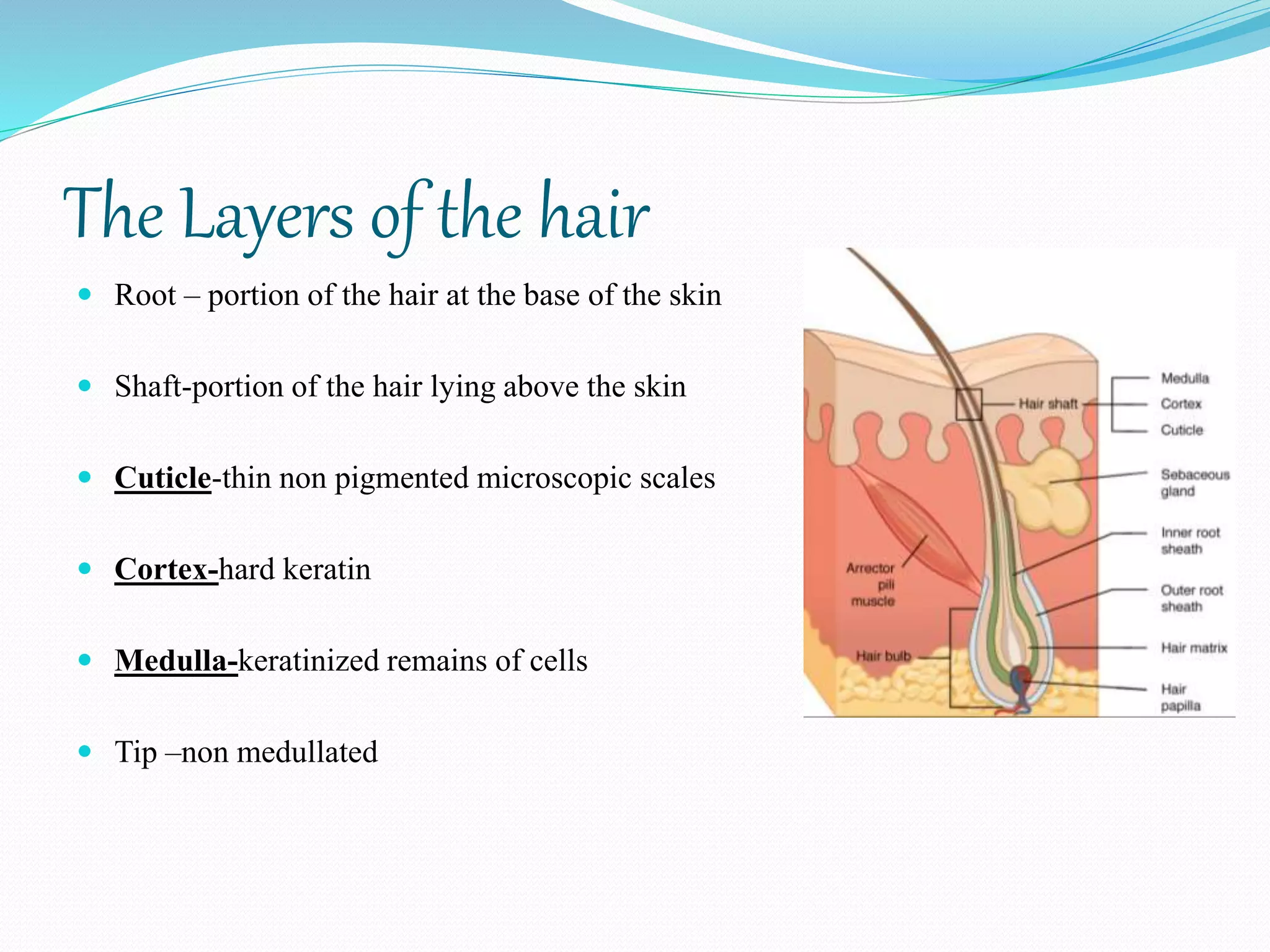
The Layers of the hair
 Root – portion of the hair at the base of the skin
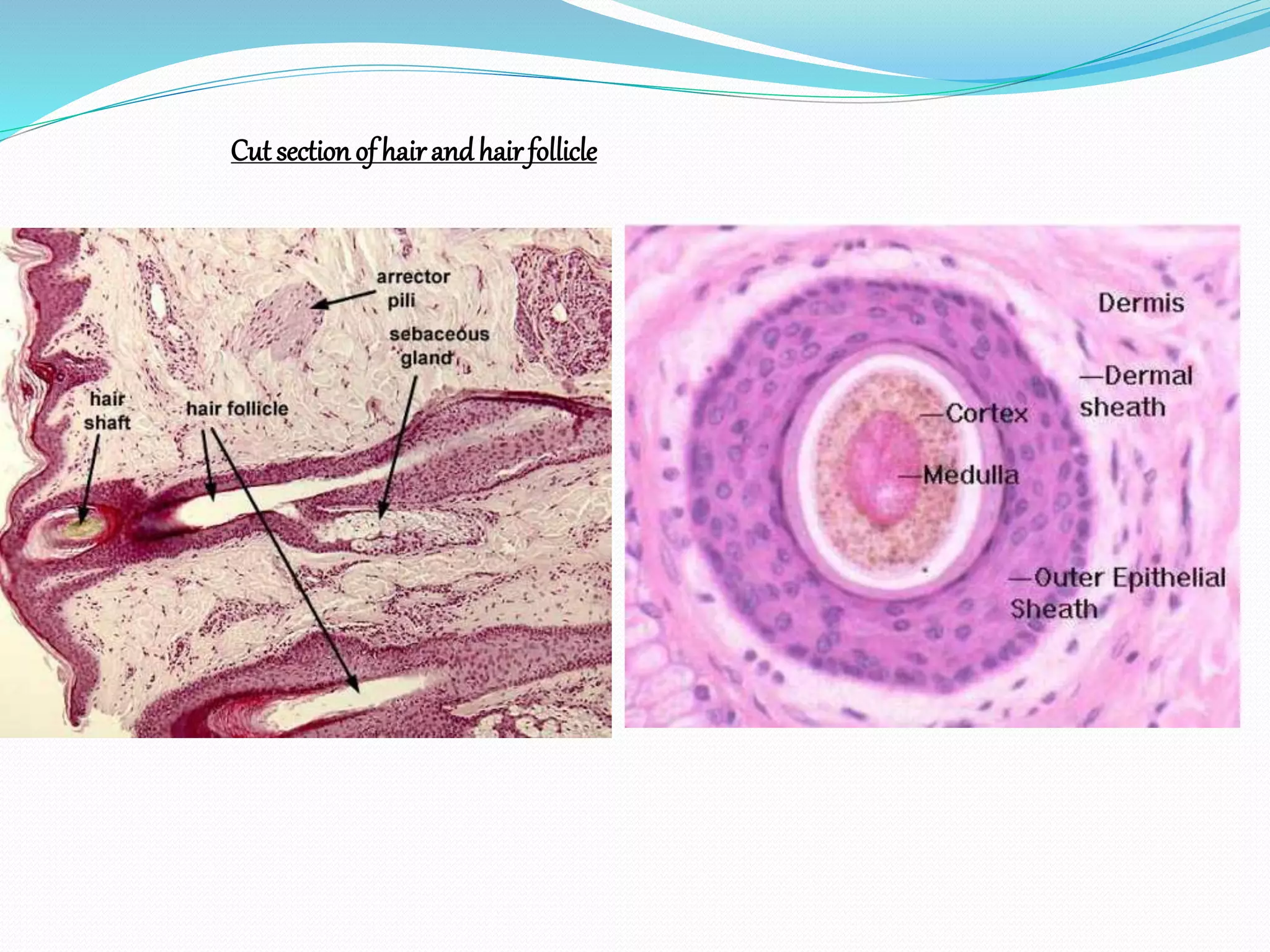
 Shaft-portion of the hair lying above the skin
 Cuticle-thin non pigmented microscopic scales
 Cortex-hard keratin
 Medulla-keratinized remains of cells
 Tip –non medullated
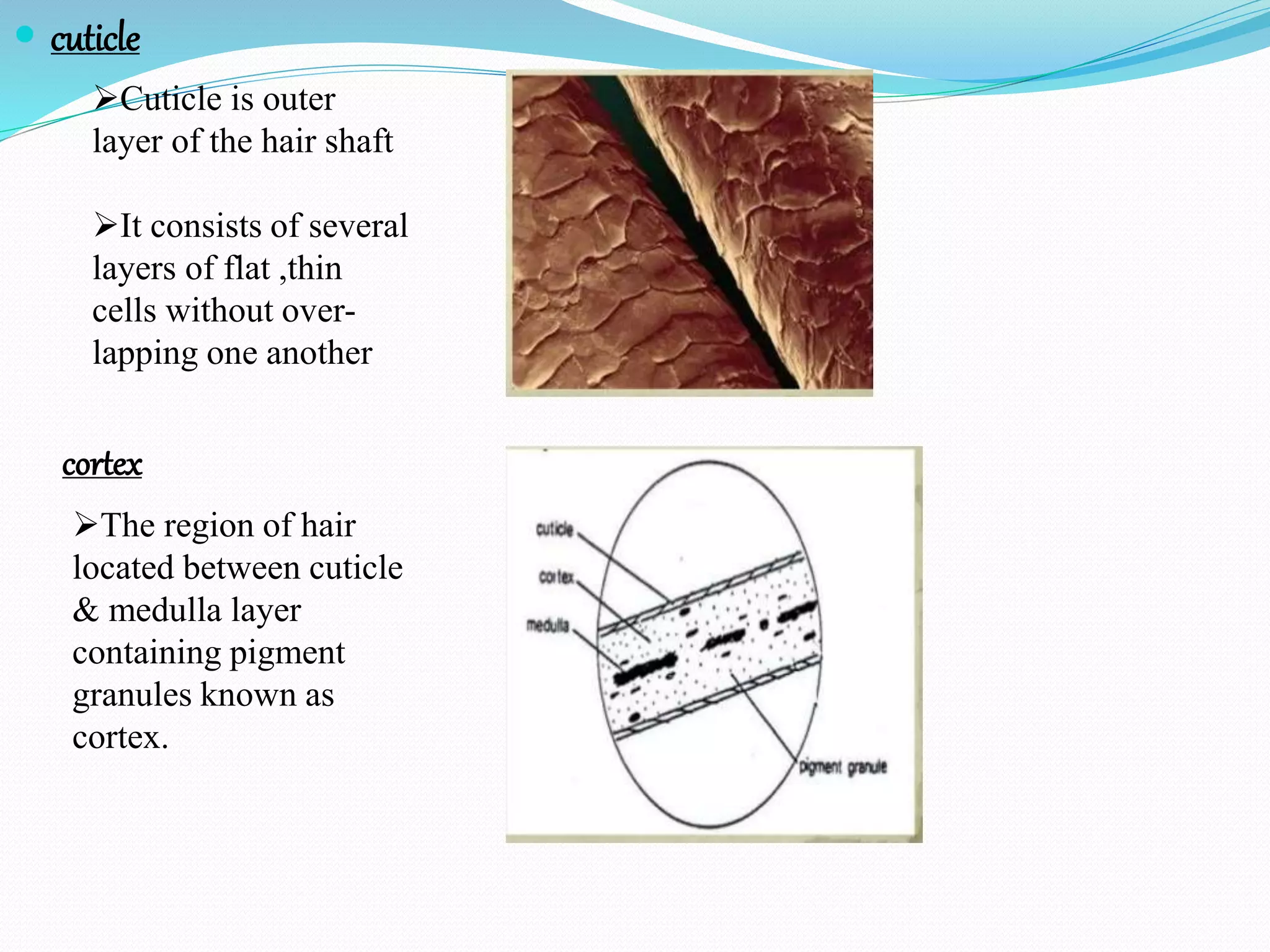
 cuticle
Cuticle is outer
layer of the hair shaft
It consists of several
layers of flat ,thin
cells without over-
lapping one another
cortex
The region of hair
located between cuticle
& medulla layer
containing pigment
granules known as
cortex.
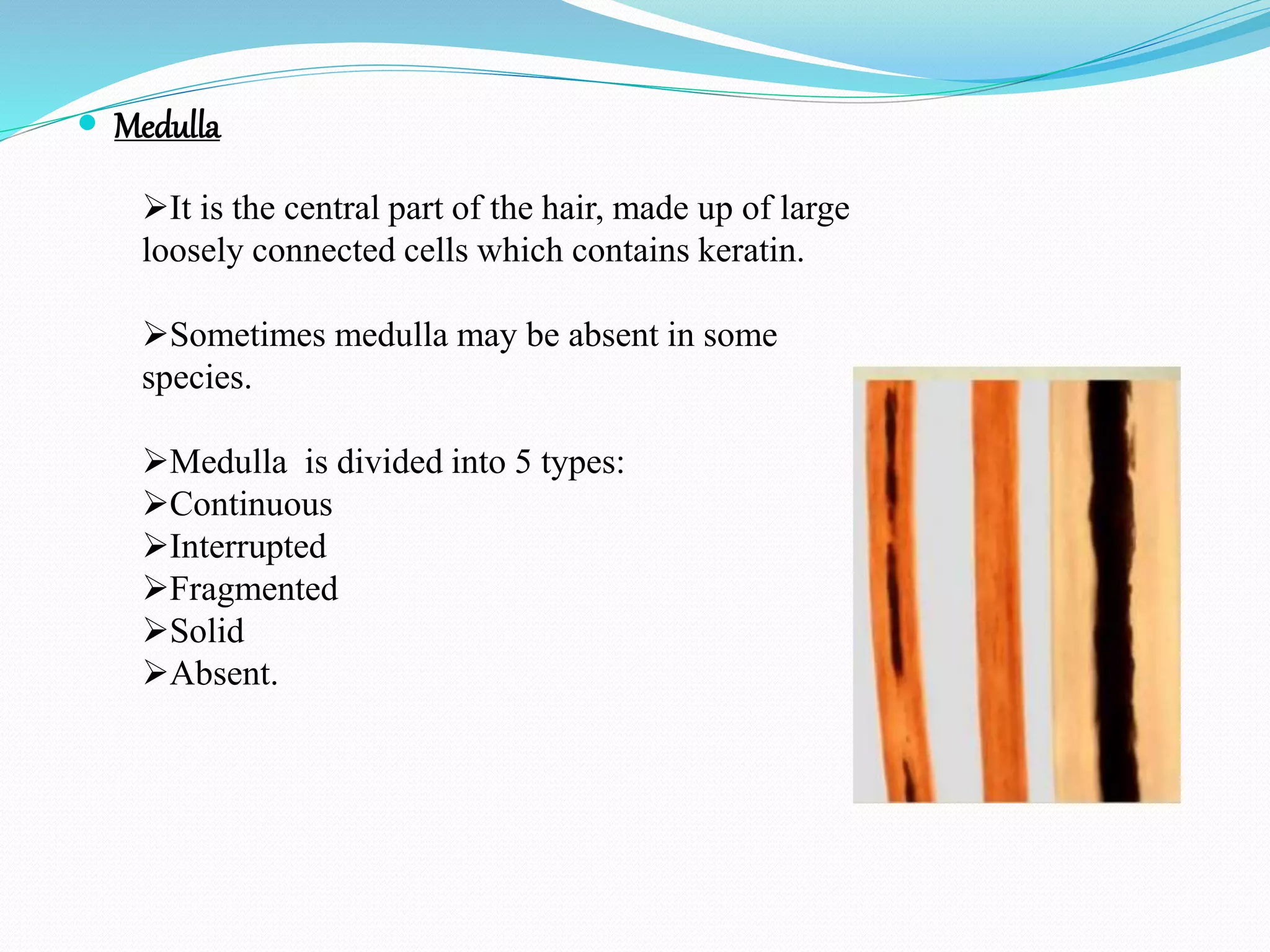
 Medulla
It is the central part of the hair, made up of large
loosely connected cells which contains keratin.
Sometimes medulla may be absent in some
species.
Medulla is divided into 5 types:
Continuous
Interrupted
Fragmented
Solid
Absent.
Cut sectionof hairandhairfollicle
Medullary index of hair
 Ratio of diameter of medulla and diameter of the whole hair shaft
 In humans it is less than 0.3 and in animals more than 0.5
 The value varies in the hair of different parts of the body
 It is also helpful to know the parts of the body from which it is derived.
 MI=DIAMETER OF MEDULLA /DIAMETER OF CORTEX
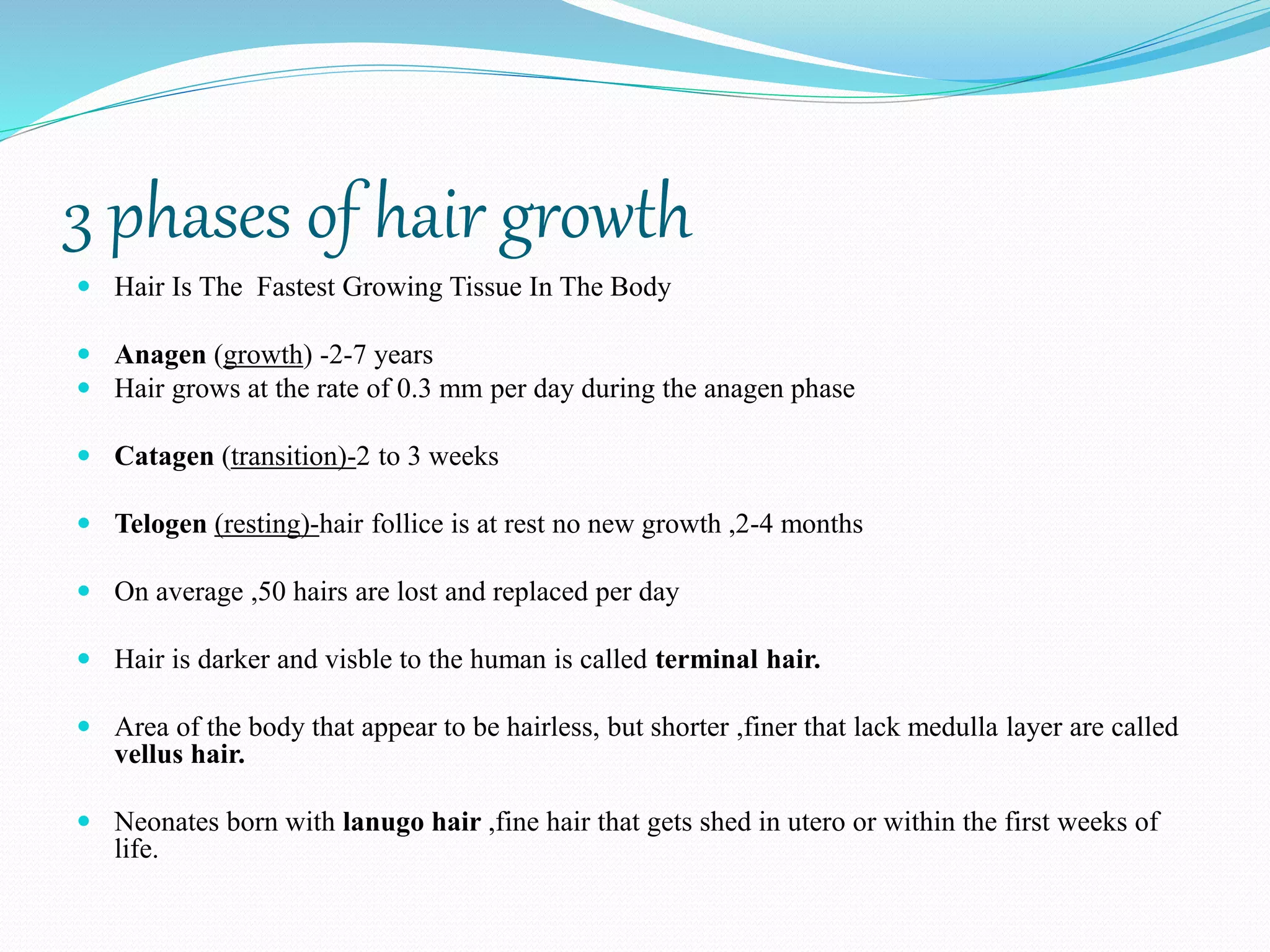
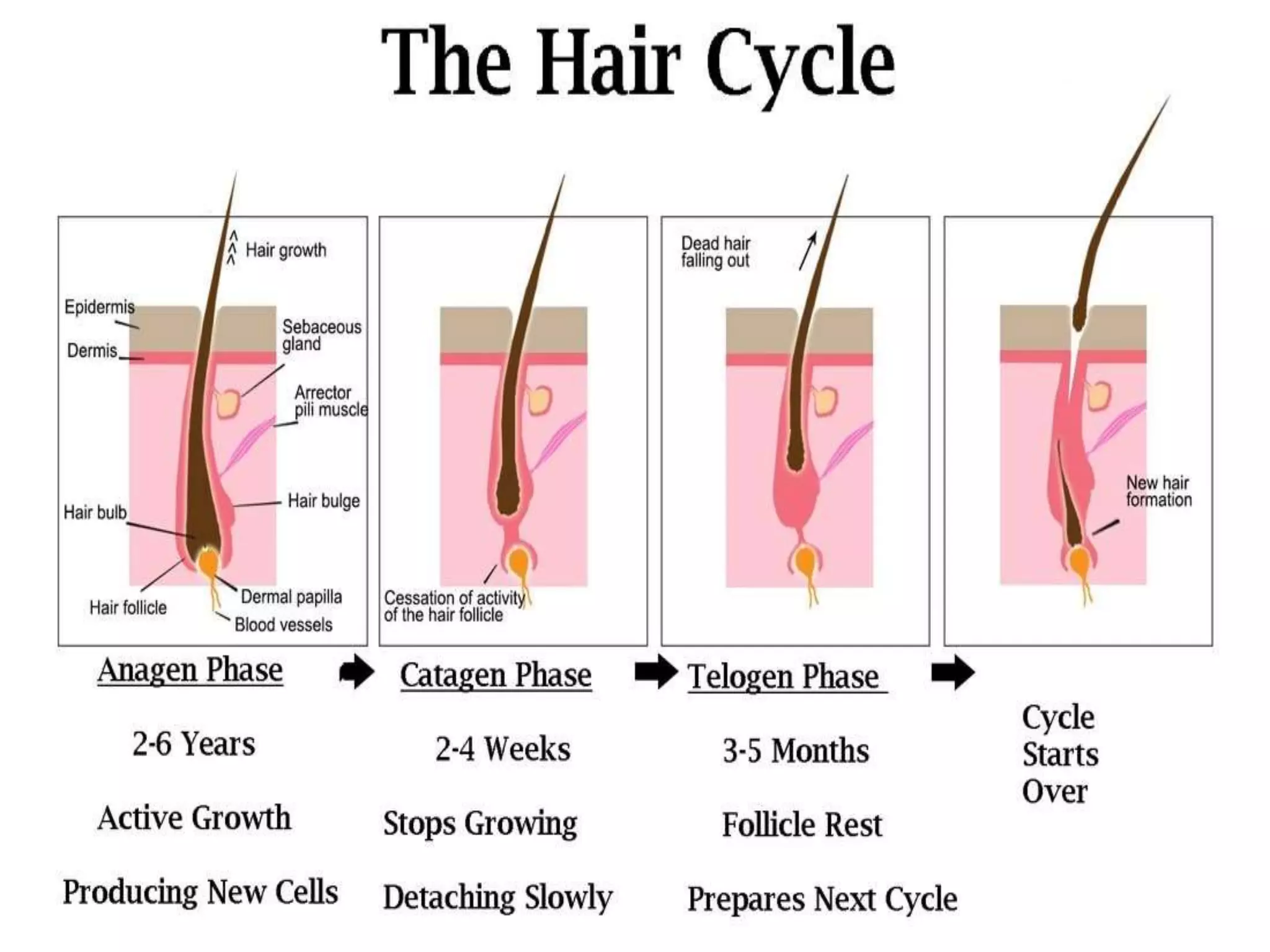
3 phases of hair growth
 Hair Is The Fastest Growing Tissue In The Body
 Anagen (growth) -2-7 years
 Hair grows at the rate of 0.3 mm per day during the anagen phase
 Catagen (transition)-2 to 3 weeks
 Telogen (resting)-hair follice is at rest no new growth ,2-4 months
 On average ,50 hairs are lost and replaced per day
 Hair is darker and visble to the human is called terminal hair.
 Area of the body that appear to be hairless, but shorter ,finer that lack medulla layer are called
vellus hair.
 Neonates born with lanugo hair ,fine hair that gets shed in utero or within the first weeks of
life.
Functions of hair
 Hair is a protein ( alpha –keratin) filament that grows from hair follicles originate in the
dermis and extend through out epidermis to the surface.
 Protection
 Filter
 Regulation of body temperature
 Act as a sense organ
 Facial expression
 Visual identification
 Attraction
Hair disorders
Alopecia areata
Trichotillomania
Werewolf gene/
hypertrichosis
Hair syndromes
Uncombable
hair
syndrome
Loose anagen syndrome
Rapunzel
syndrome
Examination of hair
Temporary
Mount
Permanent
Mount
Scale
casting
Cross
sectioning
Micrometry
Cellulose
acetate
method
Polaroid
coater
method
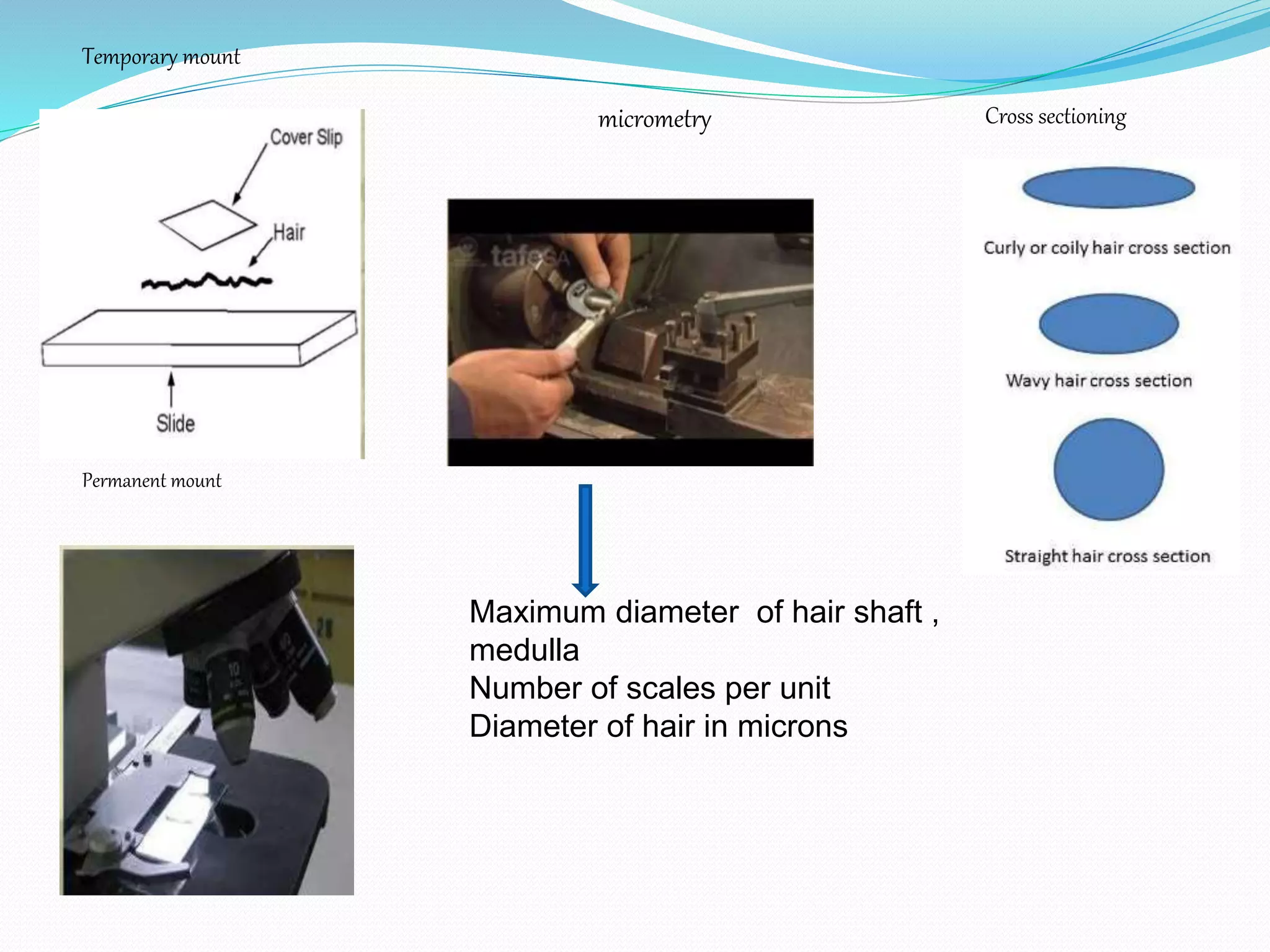
Temporary mount
Permanent mount
Maximum diameter of hair shaft ,
medulla
Number of scales per unit
Diameter of hair in microns
micrometry Cross sectioning
Scale casting method
Cellulose acetatemethod:
 Clean microscope slide-
place thin layer of cellulose
acetate paste
With fine forceps –place
hair on it
Allow to dry for 5 minutes
Observes scales of hair
under microscope
Polaroidcoatermethod:
Place hair on clean microscope
slide
Using polaroid film coater,make
2 or 3 passes along the length of
the hair
Allow to dry -23 hours
With sharp scalpel ,slice
excess coating
Observe the scale impression
microscopically.
MEDICOLEGAL IMPORTANCE
 identification:
 Age of the person-infant ,adult ,elder
 Sex (male or female)
 Racial profile of the person
 Is the material in the crime scene is hair or fibre
 Is it human hair or animal hair
1. Part of the body the hair has orginated
 Has the hair being altered by dyeing,bleaching,
or diseased
 Hair- is it of the victim or the suspect-ABO,DNA Profiling.
 Hair fall naturally or was it forcibly removed
 Cause of injury
Tunnneling -fungus
1.Uncut hair –tip pointed
and non medullated
2.Sharp weapon –clean
uniform cut wound
3.Blunt force-flattening
and splitting of hair shaft
4.Burns-swollen
,fragile,curled,twisted
and peculiar odour
Cause of injury Postmortemrootbanding
1. Decomposed
body
2. An opaque
band of about
0.5mm above
root bulb is
present
3. Seen only by
light
microscope
Medicolegal application
 For identification-Assailant identification
 Nature of weapon
 Nature of assault
Types of
stains
Cases
Seminal Sexual Offence
Blood Injury
Salivary Asphyxial Death
Mud Struggle /RTA
Carbon
Particle
Burns/Firearm Injury
Dyes Concealment Of Natural
Colour
Stains attached
on the hair
 Establish relationship between offence ,offender and the victim
important clue
1. Rape and sodomy cases- pubic hair of the accused may be detected on the
victim or vice versa
2. Bestiality-animal hair may be found around genitalia
3. Road traffic accidents-hair of the victim may be found adherent to the
offending car.
 Helps in differentiating burns from scalds
1. Burns-brittle ,charred with large round vacuoles at the point of burning
2. Scalds-absent.
 Hairalcoholtesting
1. Person consumed alcohol or not
2. The concentration of ethyl glucuronide and fatty acid ethyl esters
found in a hair sample
3. It does not determined the number of times or amount consumed
 Timesincedeath
1. Estimated from growth of scalp hair or beard
2. Growth rate :2.5mm/week or 0.4 mm/day
3. If the date of last shaved is known ,it is possible to calculate for what
period the deceased survived after his last shave.
 Causeof death
1.Poisons such as arsenic ,thallium ,or lead can be determined from
hair.
2.Sometimes accidental poisoning may occur with compunds like
aniline derivatives includes para-phenylene diamine (PPD) and
rescorcinol found in hair dye.
Thank you
REFERRENCE
Narayan reddy 34th edition .
Anil aggrawal
Gawtham biswas
Article of south america –sampling procedure of hair
https://www.slideshare.net/bhaskar29/forensic-examination-of-hairs
https://www.ncbi.nlm.nih.gov/pmc/articles/PMC6088218/

anatomy of hair and its medicolegal importance

  • 1.
    Dr.Nafeeya 1st yr pg ForensicMedicine &Toxicology
  • 2.
    overview  Layers ofhair  3 phases of hair growth  Functions of hair  Hair disorders  Medicolegal importance  Medicolegal application
  • 3.
    Introduction  Accessory structureof the skin  Trichology- study of hair  Important clues for crime investigators  Apart from burning ,hair is virtually indestructible  Identifiable even on bodies with advanced stage of decomposition
  • 4.
    The Layers ofthe hair  Root – portion of the hair at the base of the skin  Shaft-portion of the hair lying above the skin  Cuticle-thin non pigmented microscopic scales  Cortex-hard keratin  Medulla-keratinized remains of cells  Tip –non medullated
  • 5.
     cuticle Cuticle isouter layer of the hair shaft It consists of several layers of flat ,thin cells without over- lapping one another cortex The region of hair located between cuticle & medulla layer containing pigment granules known as cortex.
  • 6.
     Medulla It isthe central part of the hair, made up of large loosely connected cells which contains keratin. Sometimes medulla may be absent in some species. Medulla is divided into 5 types: Continuous Interrupted Fragmented Solid Absent.
  • 7.
  • 8.
    Medullary index ofhair  Ratio of diameter of medulla and diameter of the whole hair shaft  In humans it is less than 0.3 and in animals more than 0.5  The value varies in the hair of different parts of the body  It is also helpful to know the parts of the body from which it is derived.  MI=DIAMETER OF MEDULLA /DIAMETER OF CORTEX
  • 9.
    3 phases ofhair growth  Hair Is The Fastest Growing Tissue In The Body  Anagen (growth) -2-7 years  Hair grows at the rate of 0.3 mm per day during the anagen phase  Catagen (transition)-2 to 3 weeks  Telogen (resting)-hair follice is at rest no new growth ,2-4 months  On average ,50 hairs are lost and replaced per day  Hair is darker and visble to the human is called terminal hair.  Area of the body that appear to be hairless, but shorter ,finer that lack medulla layer are called vellus hair.  Neonates born with lanugo hair ,fine hair that gets shed in utero or within the first weeks of life.
  • 11.
    Functions of hair Hair is a protein ( alpha –keratin) filament that grows from hair follicles originate in the dermis and extend through out epidermis to the surface.  Protection  Filter  Regulation of body temperature  Act as a sense organ  Facial expression  Visual identification  Attraction
  • 12.
  • 13.
  • 14.
  • 15.
    Temporary mount Permanent mount Maximumdiameter of hair shaft , medulla Number of scales per unit Diameter of hair in microns micrometry Cross sectioning
  • 16.
    Scale casting method Celluloseacetatemethod:  Clean microscope slide- place thin layer of cellulose acetate paste With fine forceps –place hair on it Allow to dry for 5 minutes Observes scales of hair under microscope Polaroidcoatermethod: Place hair on clean microscope slide Using polaroid film coater,make 2 or 3 passes along the length of the hair Allow to dry -23 hours With sharp scalpel ,slice excess coating Observe the scale impression microscopically.
  • 17.
  • 18.
     identification:  Ageof the person-infant ,adult ,elder  Sex (male or female)  Racial profile of the person
  • 19.
     Is thematerial in the crime scene is hair or fibre  Is it human hair or animal hair 1. Part of the body the hair has orginated
  • 20.
     Has thehair being altered by dyeing,bleaching, or diseased  Hair- is it of the victim or the suspect-ABO,DNA Profiling.  Hair fall naturally or was it forcibly removed  Cause of injury Tunnneling -fungus
  • 21.
    1.Uncut hair –tippointed and non medullated 2.Sharp weapon –clean uniform cut wound 3.Blunt force-flattening and splitting of hair shaft 4.Burns-swollen ,fragile,curled,twisted and peculiar odour Cause of injury Postmortemrootbanding 1. Decomposed body 2. An opaque band of about 0.5mm above root bulb is present 3. Seen only by light microscope
  • 22.
  • 23.
     For identification-Assailantidentification  Nature of weapon  Nature of assault Types of stains Cases Seminal Sexual Offence Blood Injury Salivary Asphyxial Death Mud Struggle /RTA Carbon Particle Burns/Firearm Injury Dyes Concealment Of Natural Colour Stains attached on the hair
  • 24.
     Establish relationshipbetween offence ,offender and the victim important clue 1. Rape and sodomy cases- pubic hair of the accused may be detected on the victim or vice versa 2. Bestiality-animal hair may be found around genitalia 3. Road traffic accidents-hair of the victim may be found adherent to the offending car.  Helps in differentiating burns from scalds 1. Burns-brittle ,charred with large round vacuoles at the point of burning 2. Scalds-absent.
  • 25.
     Hairalcoholtesting 1. Personconsumed alcohol or not 2. The concentration of ethyl glucuronide and fatty acid ethyl esters found in a hair sample 3. It does not determined the number of times or amount consumed  Timesincedeath 1. Estimated from growth of scalp hair or beard 2. Growth rate :2.5mm/week or 0.4 mm/day 3. If the date of last shaved is known ,it is possible to calculate for what period the deceased survived after his last shave.
  • 26.
     Causeof death 1.Poisonssuch as arsenic ,thallium ,or lead can be determined from hair. 2.Sometimes accidental poisoning may occur with compunds like aniline derivatives includes para-phenylene diamine (PPD) and rescorcinol found in hair dye. Thank you
  • 27.
    REFERRENCE Narayan reddy 34thedition . Anil aggrawal Gawtham biswas Article of south america –sampling procedure of hair https://www.slideshare.net/bhaskar29/forensic-examination-of-hairs https://www.ncbi.nlm.nih.gov/pmc/articles/PMC6088218/