EXAMMINATION OF HAIR
By
Dr. Kaleem khan
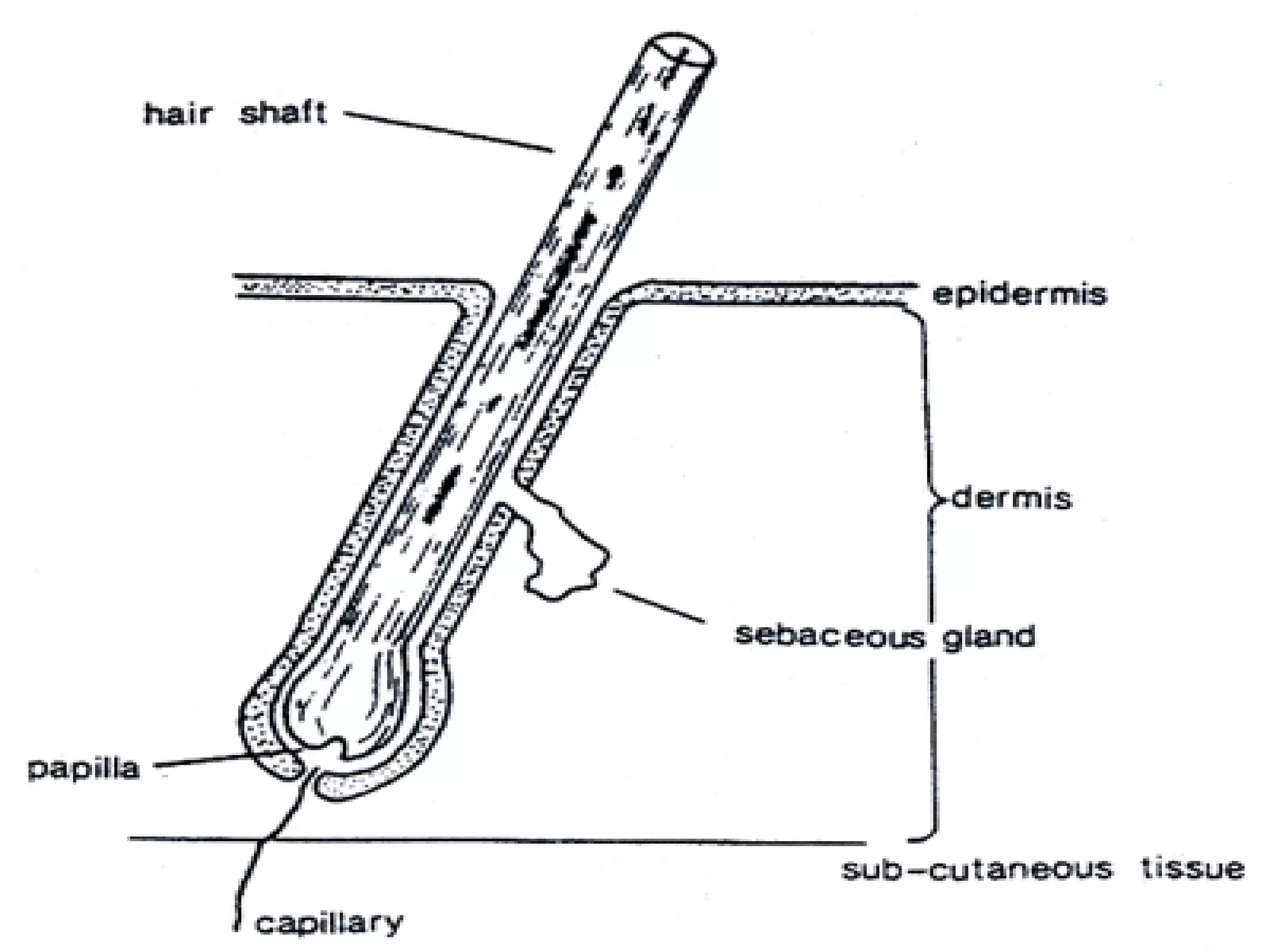
 Hair is a filamentous biomaterial, that grows from
follicles found in the dermis.
 Hair often refers to two distinct structures:
The hair follicle
The shaft
 Hair grows from the papilla
 Point of generation is made up of dead, cornified
cells
 It consists of
◦ Shaft that projects above the skin
◦ Root that is imbedded in the skin
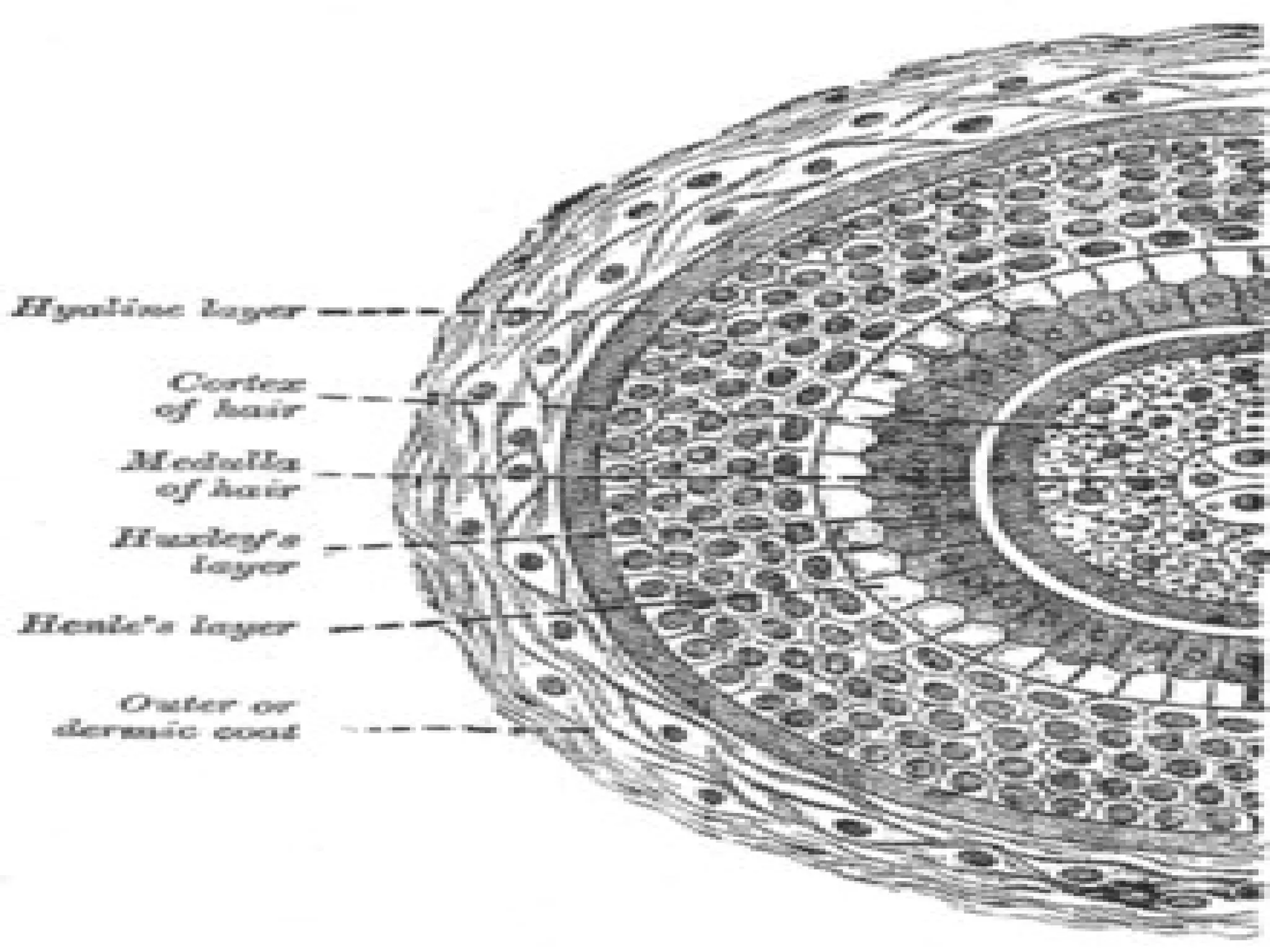
 A cross section of the hair shaft may be divided
roughly into three zones.
 The cuticle
◦ (several layers of flat, thin cells laid out overlapping one another
as roof shingles, )
 The cortex
◦ (keratin bundles in cell structures that remain roughly rod-like)
 The medulla,
◦ (area at the fiber's center.)
 Hair is composed keratin, rope-like intermediate filaments.
 Hair growth begins inside the hair follicle.
 The hair that is visible is the hair shaft is considered "dead".
 Other structures of the hair follicle include the
 Oil producing sebaceous gland.
 The erector pili muscles,
 All natural hair colors are the result of two types of hair
pigment.
◦ Eumelanin -dark-blond, brown, and black hair
◦ pheomelanin - red hair.
 Blond hair is the result of having little pigmentation in the
hair strand.
 Gray hair occurs when melanin decreases or
disappears.
 In humans, hair undergoes cyclical phases
 Growth (anagen),
 Transition (catagen),
 Resting (telogen),
 Anagen phase lasts about 1,000 days.
 Telogen phase, follicle are dormant and hairs fall out- 100 days.
 10 and 18% of all the hairs are in the telogen phase;
 2% are in the catagen phase.
 80 and 90% are actively growing.
 There is no pattern to determine which hairs on the head are in
any phase at a given time

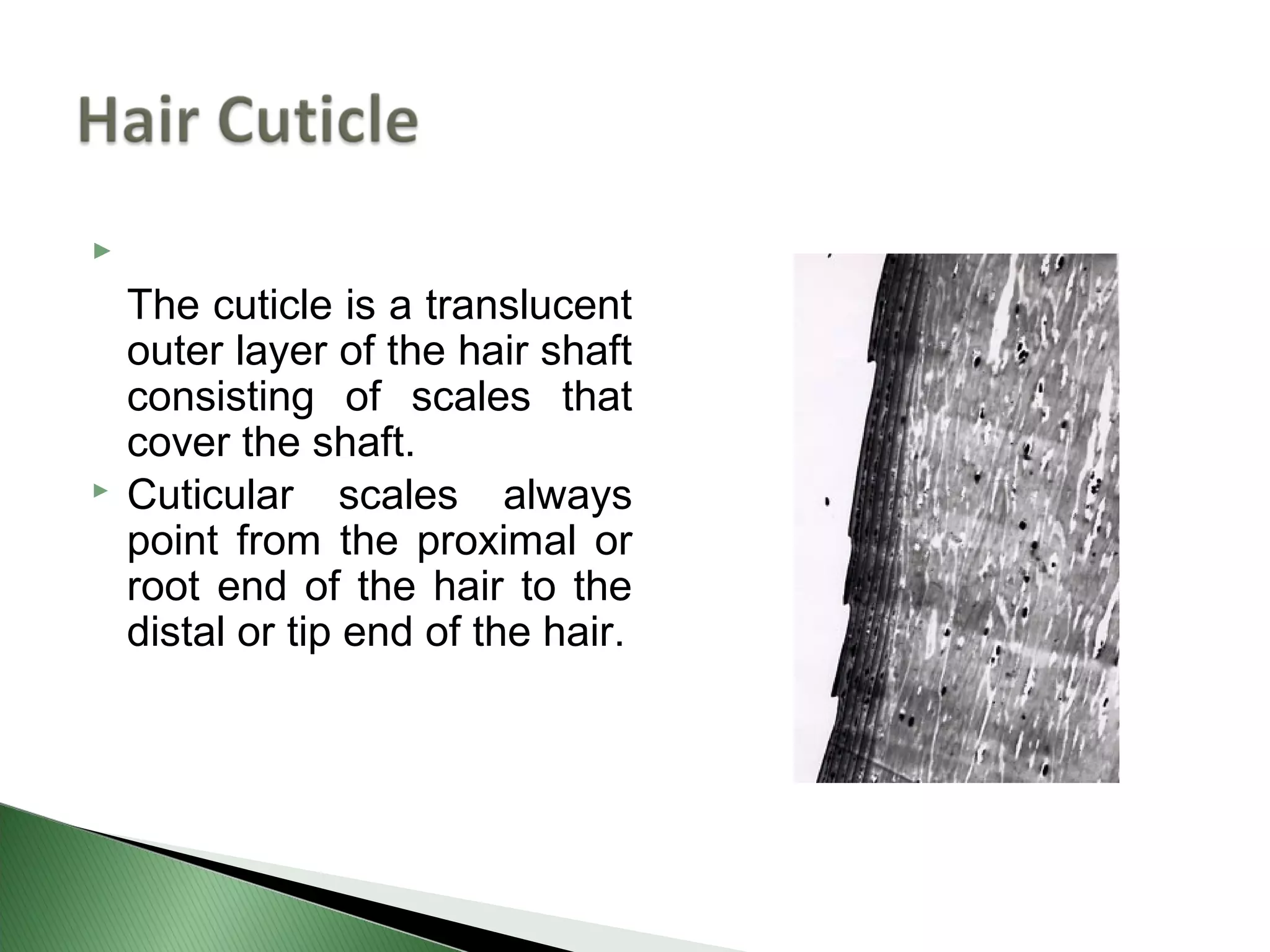
The cuticle is a translucent
outer layer of the hair shaft
consisting of scales that
cover the shaft.
 Cuticular scales always
point from the proximal or
root end of the hair to the
distal or tip end of the hair.
 There are three basic
scale structures that
make up the cuticle—
◦ Coronal (crown-like),
◦ Spinous (petal-like),
◦ Imbricate (flattened).
 Combinations and
variations of these
types are possible.
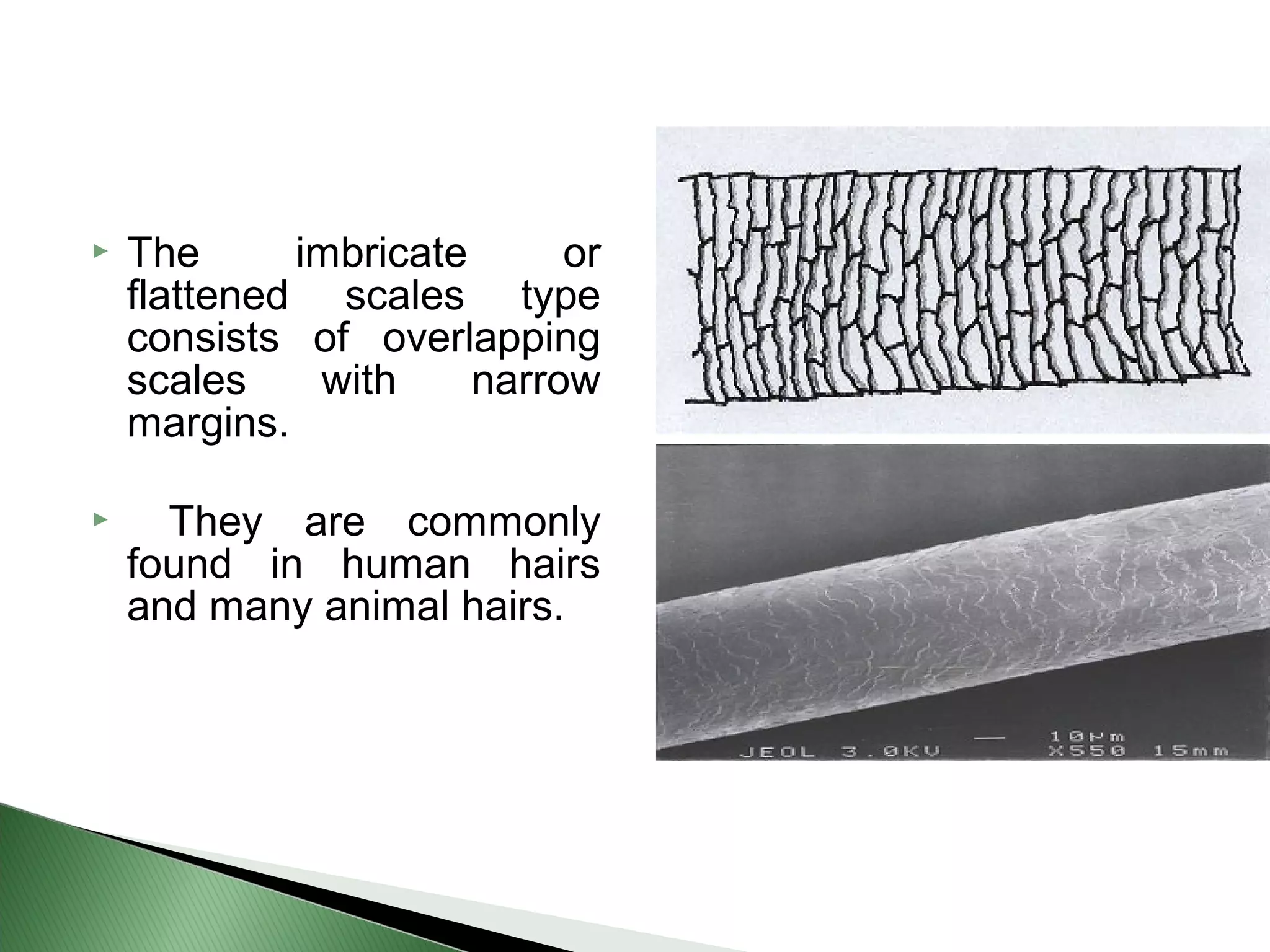
 The imbricate or
flattened scales type
consists of overlapping
scales with narrow
margins.
 They are commonly
found in human hairs
and many animal hairs.
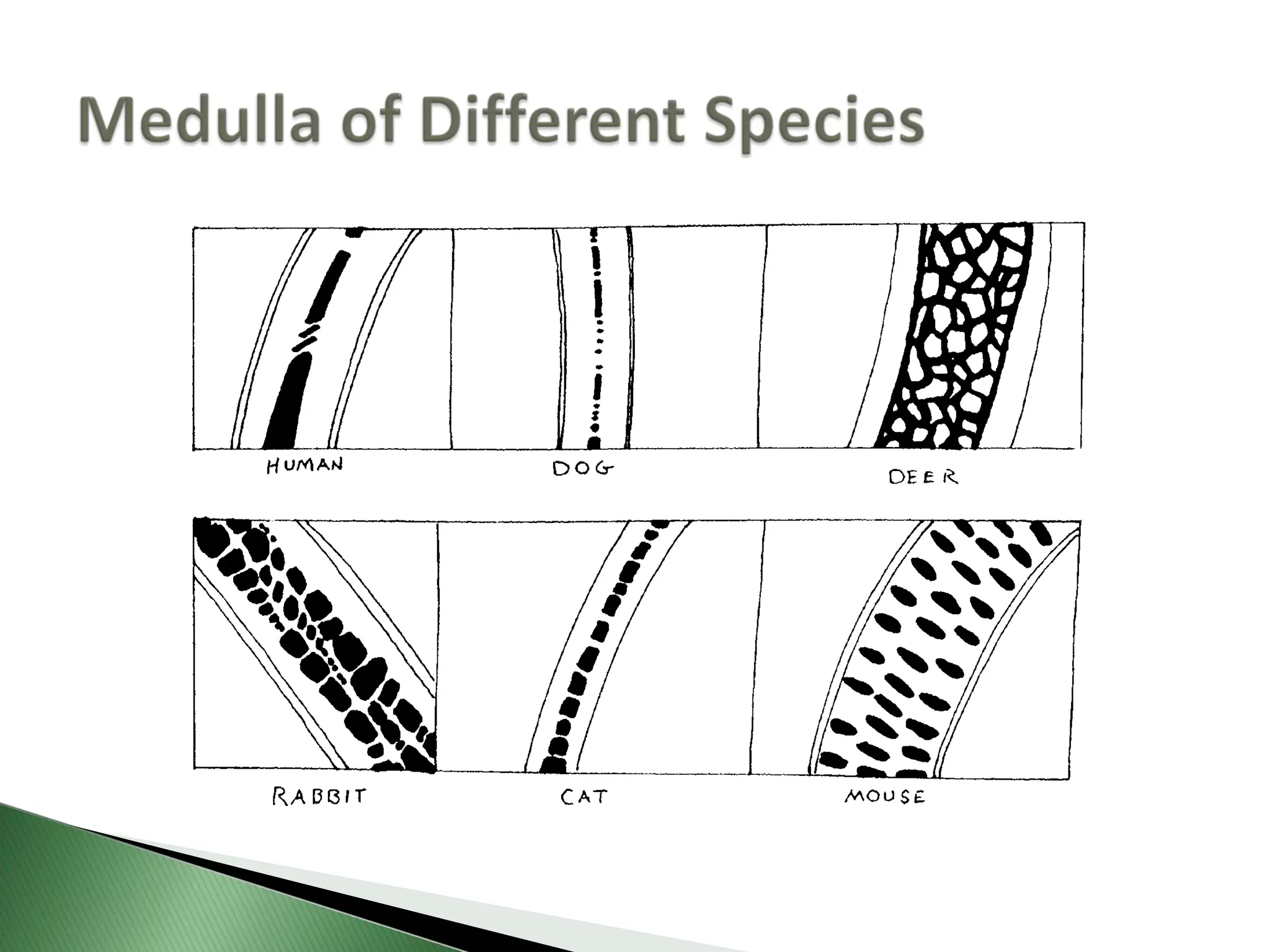
 The medulla is a
central core of cells
that may be present
in the hair.
Human
Animal
Deer
 The medulla, in human hairs, less than one-third the
overall diameter of the hair shaft.
 The medulla in animal hairs is normally
 Continuous and structured and
 Greater than one-third the overall diameter
 Measure of the diameter of the medulla relative to
the diameter of the hair shaft
 Usually expressed as a fraction
◦ Humans: medullary index < 1/3
◦ Animals: medullary index > 1/2
Color
◦ Human consistent in color and pigmentation throughout the
length of the hair shaft, whereas
◦ animal hairs may exhibit radical color changes in a short distance,
called banding.
Pigmentation
◦ human hairs is evenly distributed, or slightly more dense toward
the cuticle,
◦ animal hairs is more centrally distributed, although more dense
toward the medulla.
 Hairs found on a knife or club may support a murder and/or assault
weapon claim.
 Human hairs can be classified by racial origin such as
◦ Caucasian (European origin),
◦ African-American (African origin), and Mongoloid(Asian origin).
◦ The region of the body where a hair originated
◦ The length and color can be determined.
 It can also be determined whether the hair was
◦ Forcibly removed,
◦ Damaged by burning or crushing,
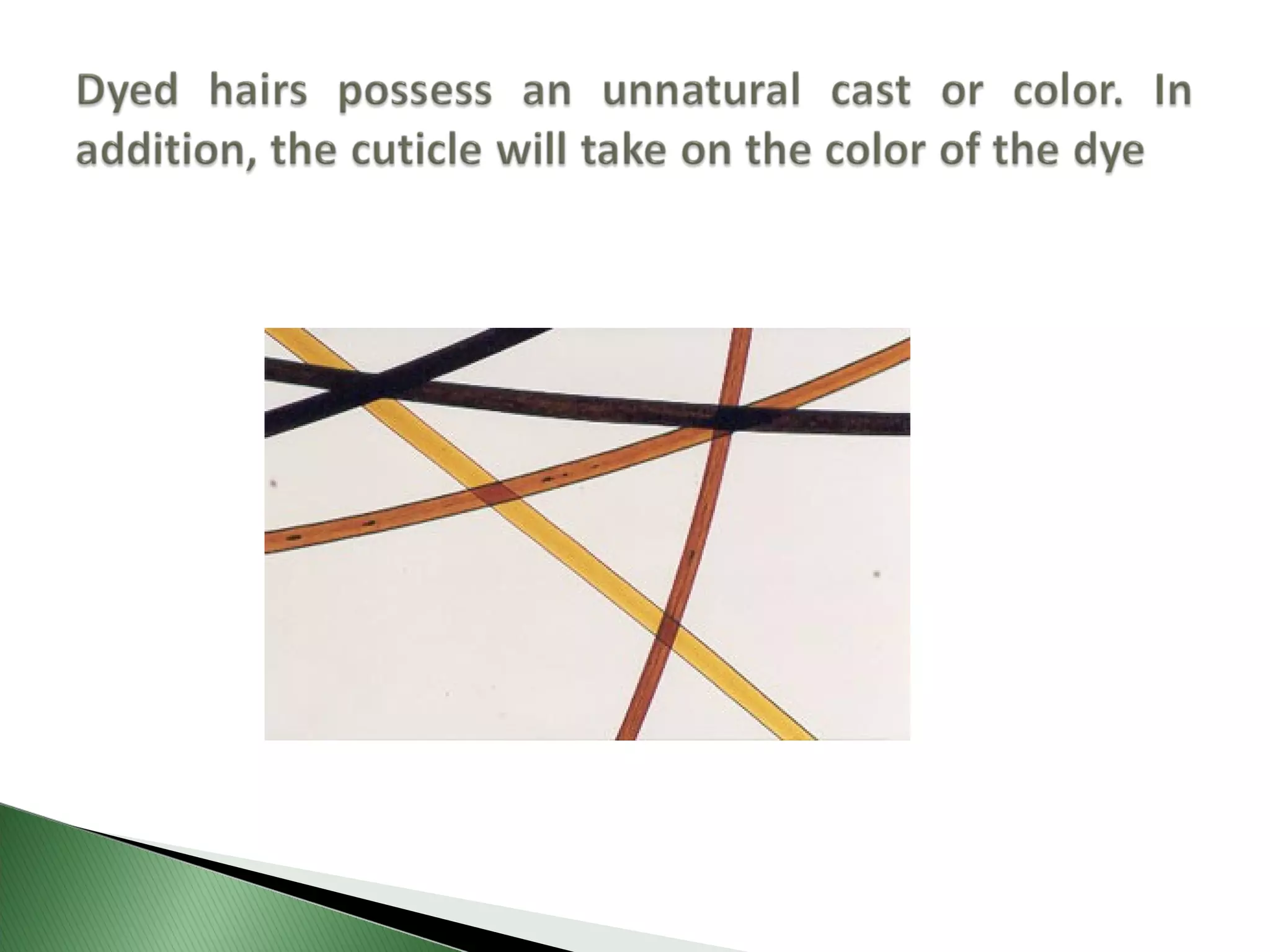
◦ Artificially treated by dyeing or bleaching.
 Some of the methods used to collect hairs from clothing
and bedding items are
◦ scraping,
◦ shaking,
◦ taping, and
◦ picking.
 If the specific location of a hair on a clothing item is important,
 Head hairs and pubic hairs exhibit a greater range
of microscopic characteristics than other human
hairs; therefore, head and pubic hairs are routinely
forensically compared.
 Twenty-five randomly selected head hairs
 same number of hairs be collected from the pubic
Caucasian
 African-
American
 Mongoloid
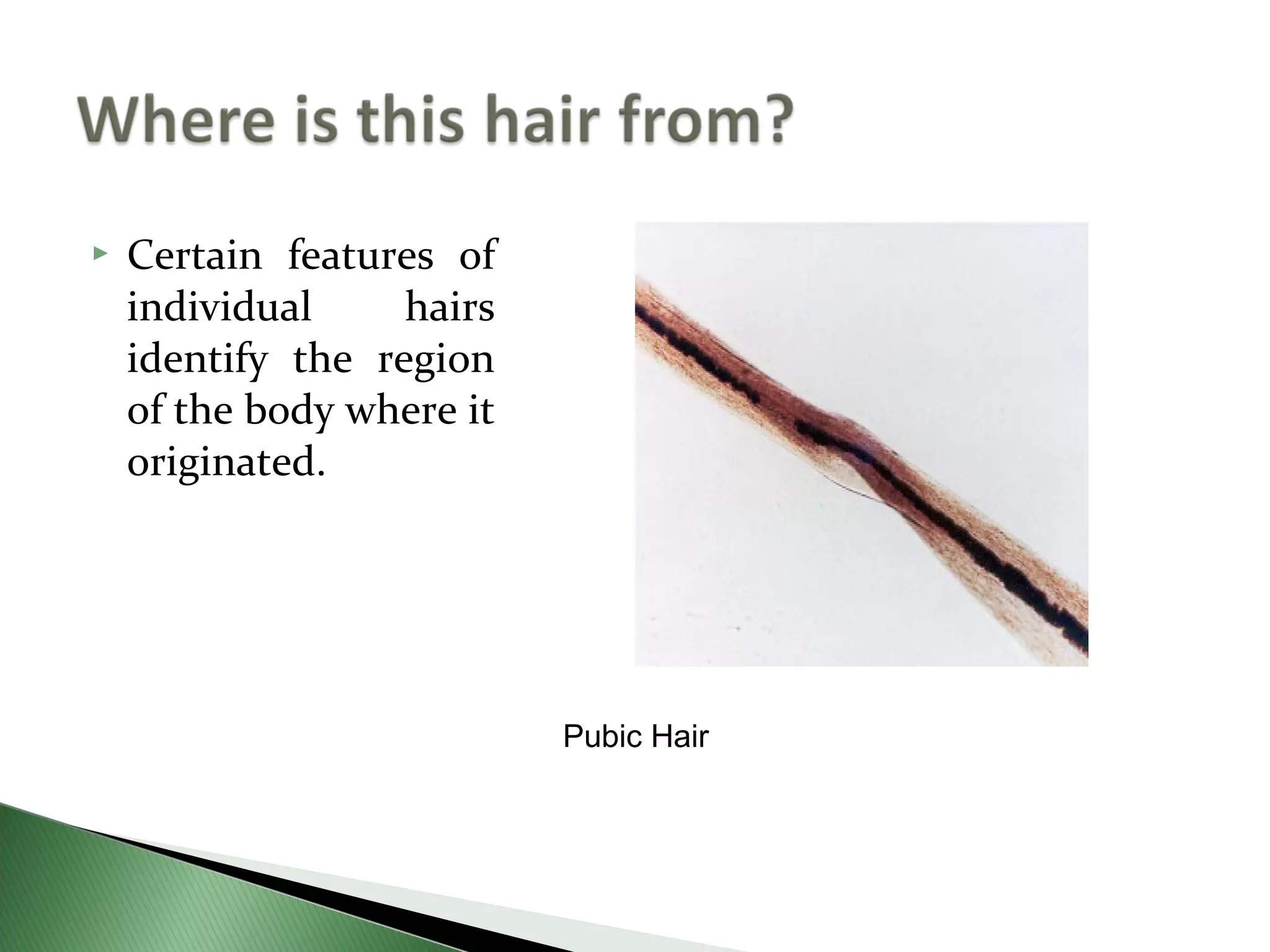
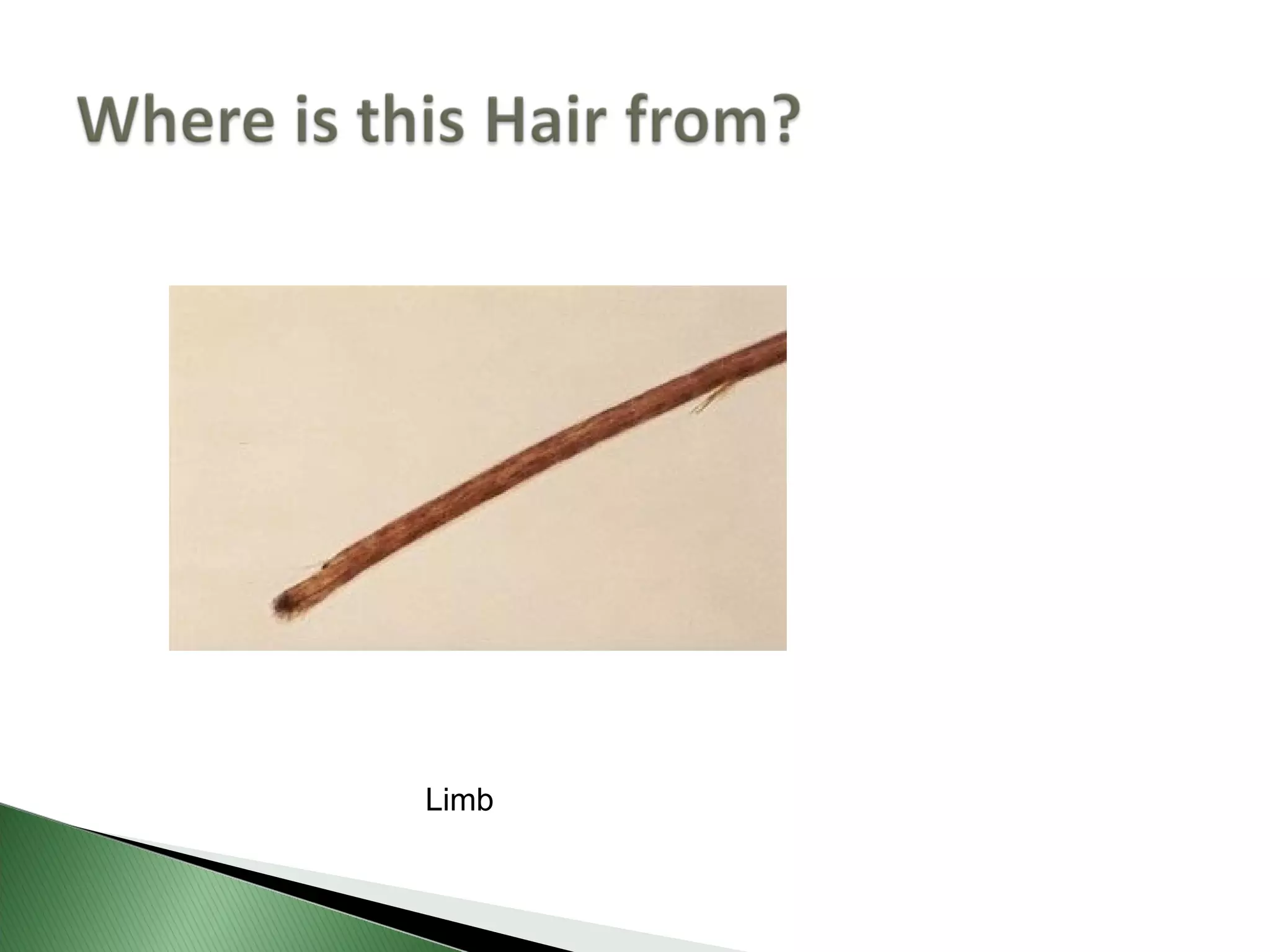
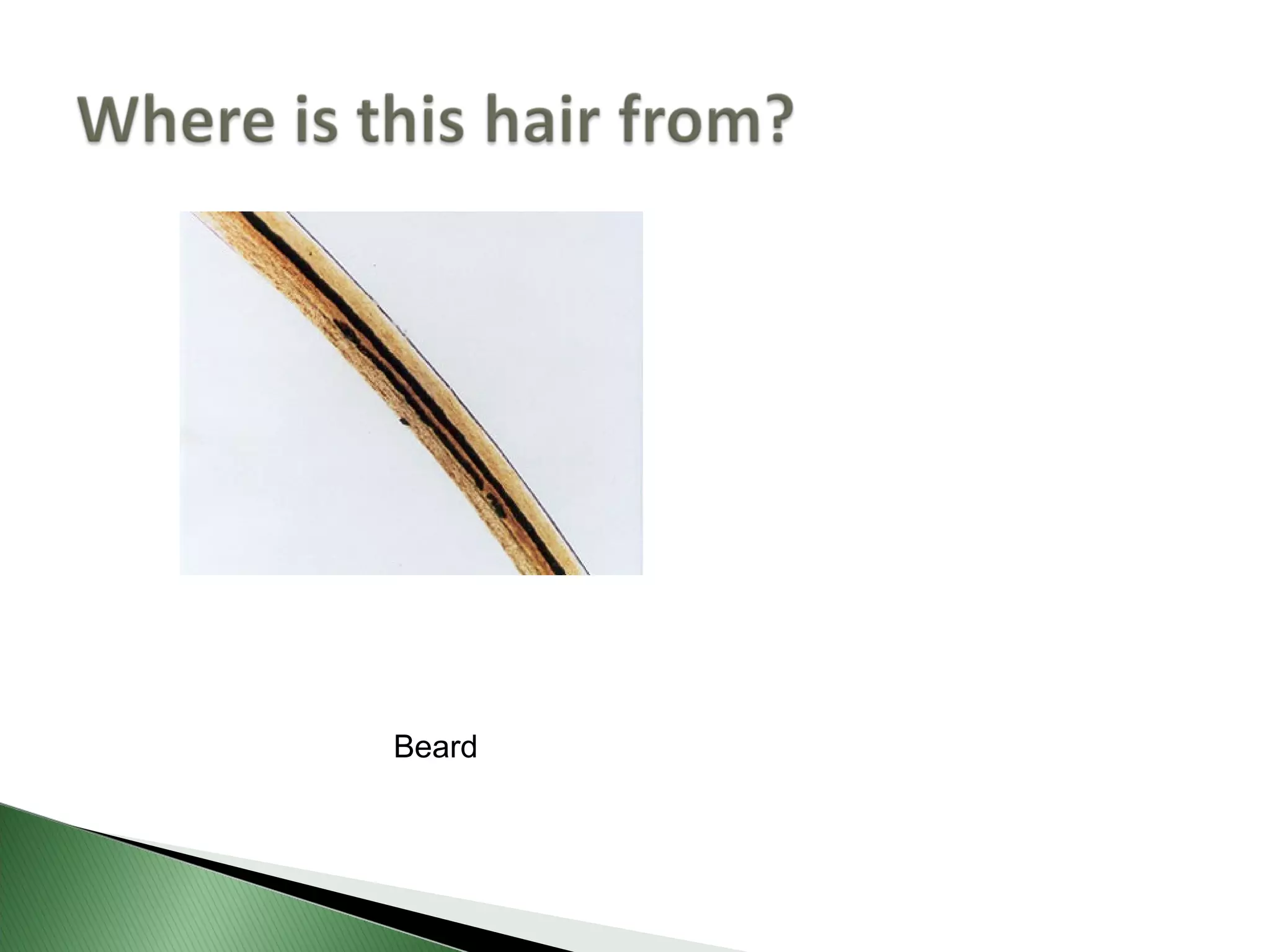
 Certain features of
individual hairs
identify the region
of the body where it
originated.
Pubic Hair
Limb
Beard
 Underarm hair
 Chest hair
 Eyebrow
 General body hair
◦ Hair spray
◦ Hair gel
◦ Permanents
◦ Hair cosmetics
 Environmental/chemical damage
 Mechanical damage
 Crushed
 Burned
 Glass cut
 Broken
 Frayed
 Twisted
 Tangled
 Glass-Cut or
Broken Hair Tip
 Cut Hair Tip
 Worn Razor-Cut
Tip
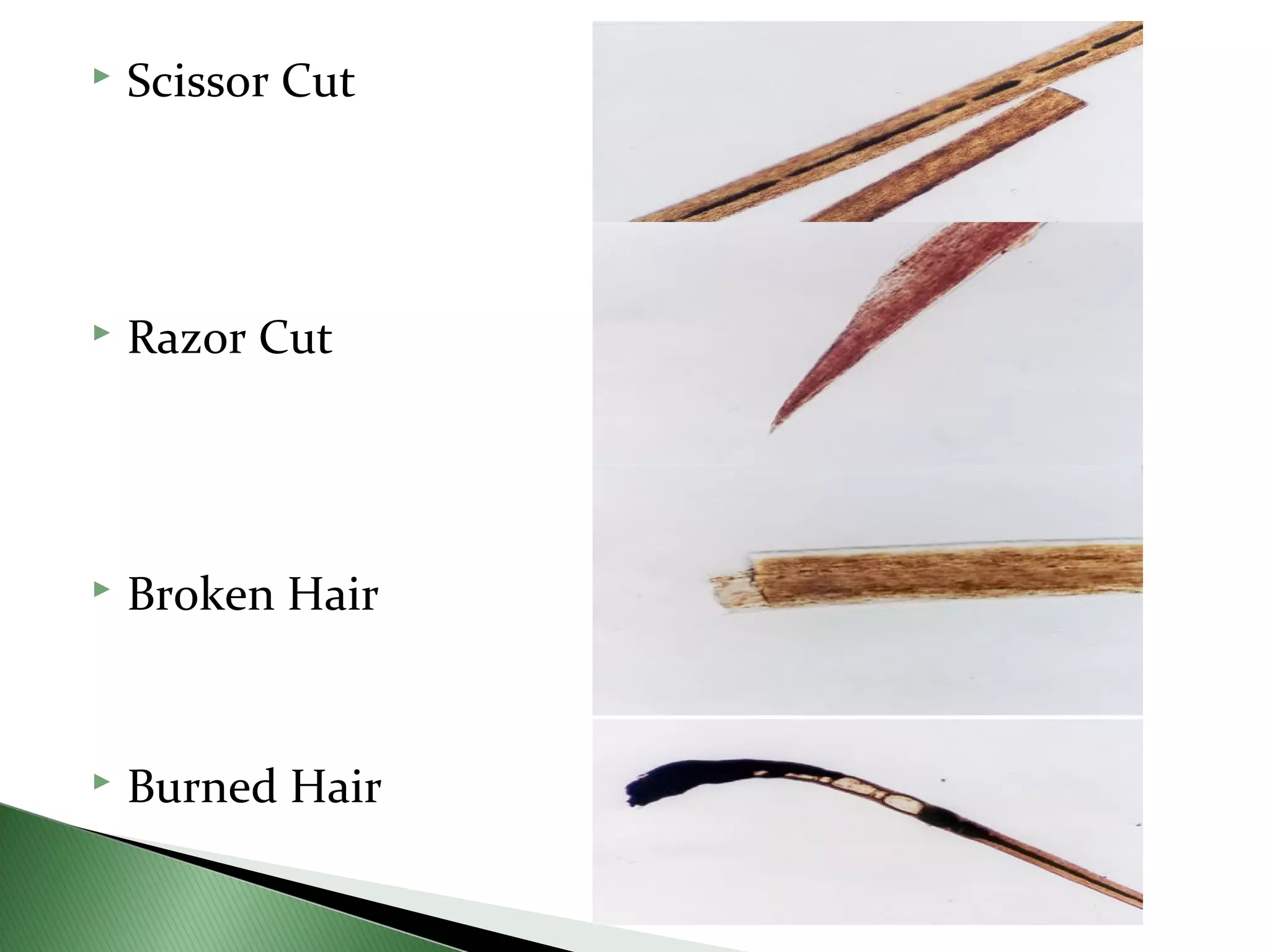
 Scissor Cut
 Razor Cut
 Broken Hair
 Burned Hair
LICE
 Often it is not possible to extract DNA fully, or there is
not enough tissue present to conduct an examination.
 Hairs with large roots and tissue are promising sources of
nuclear DNA.

 However, DNA examinations destroy hairs, eliminating
the possibility of further microscopic examination.
 DNA from cells associated with the root can be extracted
and used for DNA analysis.
 Analysis of the DNA in the nucleus of the cell can be
used for determining identity and DNA from the y-
chromosome focuses on questions of paternity.
 Mitochondrial DNA is useful for establishing maternity.
 Roots of hair in the anogen (growth) phase contain more
DNA than hairs from the telogen (resting) phase.

 contamination issues are important as dead skin cells,
which are also shed passively, contain DNA and may be
collected from surfaces along with hair.
 If a hair from the telogen phase is collected, it may not
contain enough nuclear DNA for analysis, but it might
contain mitochondrial DNA.
 If the hair has been forcibly removed, then pieces of
tissue may be attached and DNA analyses can usually be
run easily on these tissue cells.
 DNA analyses are destructive techniques and consume
portions of the hair.
 A full and detailed microscopical comparison with
possible known sources of hair should be done prior to
DNA analysis because it cannot always be done
afterwards.
THANKS

Forensics of hair analysis

  • 1.
  • 2.
     Hair isa filamentous biomaterial, that grows from follicles found in the dermis.  Hair often refers to two distinct structures: The hair follicle The shaft
  • 4.
     Hair growsfrom the papilla  Point of generation is made up of dead, cornified cells  It consists of ◦ Shaft that projects above the skin ◦ Root that is imbedded in the skin
  • 5.
     A crosssection of the hair shaft may be divided roughly into three zones.  The cuticle ◦ (several layers of flat, thin cells laid out overlapping one another as roof shingles, )  The cortex ◦ (keratin bundles in cell structures that remain roughly rod-like)  The medulla, ◦ (area at the fiber's center.)
  • 8.
     Hair iscomposed keratin, rope-like intermediate filaments.  Hair growth begins inside the hair follicle.  The hair that is visible is the hair shaft is considered "dead".  Other structures of the hair follicle include the  Oil producing sebaceous gland.  The erector pili muscles,
  • 9.
     All naturalhair colors are the result of two types of hair pigment. ◦ Eumelanin -dark-blond, brown, and black hair ◦ pheomelanin - red hair.  Blond hair is the result of having little pigmentation in the hair strand.  Gray hair occurs when melanin decreases or disappears.
  • 10.
     In humans,hair undergoes cyclical phases  Growth (anagen),  Transition (catagen),  Resting (telogen),  Anagen phase lasts about 1,000 days.  Telogen phase, follicle are dormant and hairs fall out- 100 days.  10 and 18% of all the hairs are in the telogen phase;  2% are in the catagen phase.  80 and 90% are actively growing.  There is no pattern to determine which hairs on the head are in any phase at a given time
  • 11.
     The cuticle isa translucent outer layer of the hair shaft consisting of scales that cover the shaft.  Cuticular scales always point from the proximal or root end of the hair to the distal or tip end of the hair.
  • 12.
     There arethree basic scale structures that make up the cuticle— ◦ Coronal (crown-like), ◦ Spinous (petal-like), ◦ Imbricate (flattened).  Combinations and variations of these types are possible.
  • 13.
     The imbricateor flattened scales type consists of overlapping scales with narrow margins.  They are commonly found in human hairs and many animal hairs.
  • 14.
     The medullais a central core of cells that may be present in the hair. Human Animal Deer
  • 15.
     The medulla,in human hairs, less than one-third the overall diameter of the hair shaft.  The medulla in animal hairs is normally  Continuous and structured and  Greater than one-third the overall diameter
  • 16.
     Measure ofthe diameter of the medulla relative to the diameter of the hair shaft  Usually expressed as a fraction ◦ Humans: medullary index < 1/3 ◦ Animals: medullary index > 1/2
  • 18.
    Color ◦ Human consistentin color and pigmentation throughout the length of the hair shaft, whereas ◦ animal hairs may exhibit radical color changes in a short distance, called banding. Pigmentation ◦ human hairs is evenly distributed, or slightly more dense toward the cuticle, ◦ animal hairs is more centrally distributed, although more dense toward the medulla.
  • 19.
     Hairs foundon a knife or club may support a murder and/or assault weapon claim.  Human hairs can be classified by racial origin such as ◦ Caucasian (European origin), ◦ African-American (African origin), and Mongoloid(Asian origin). ◦ The region of the body where a hair originated ◦ The length and color can be determined.  It can also be determined whether the hair was ◦ Forcibly removed, ◦ Damaged by burning or crushing, ◦ Artificially treated by dyeing or bleaching.
  • 20.
     Some ofthe methods used to collect hairs from clothing and bedding items are ◦ scraping, ◦ shaking, ◦ taping, and ◦ picking.  If the specific location of a hair on a clothing item is important,
  • 21.
     Head hairsand pubic hairs exhibit a greater range of microscopic characteristics than other human hairs; therefore, head and pubic hairs are routinely forensically compared.  Twenty-five randomly selected head hairs  same number of hairs be collected from the pubic
  • 22.
  • 23.
     Certain featuresof individual hairs identify the region of the body where it originated. Pubic Hair
  • 24.
  • 25.
  • 26.
     Underarm hair Chest hair  Eyebrow  General body hair
  • 27.
    ◦ Hair spray ◦Hair gel ◦ Permanents ◦ Hair cosmetics
  • 28.
     Environmental/chemical damage Mechanical damage  Crushed  Burned  Glass cut  Broken  Frayed  Twisted  Tangled
  • 29.
     Glass-Cut or BrokenHair Tip  Cut Hair Tip  Worn Razor-Cut Tip
  • 31.
     Scissor Cut Razor Cut  Broken Hair  Burned Hair
  • 32.
  • 33.
     Often itis not possible to extract DNA fully, or there is not enough tissue present to conduct an examination.  Hairs with large roots and tissue are promising sources of nuclear DNA.   However, DNA examinations destroy hairs, eliminating the possibility of further microscopic examination.
  • 34.
     DNA fromcells associated with the root can be extracted and used for DNA analysis.  Analysis of the DNA in the nucleus of the cell can be used for determining identity and DNA from the y- chromosome focuses on questions of paternity.  Mitochondrial DNA is useful for establishing maternity.  Roots of hair in the anogen (growth) phase contain more DNA than hairs from the telogen (resting) phase. 
  • 35.
     contamination issuesare important as dead skin cells, which are also shed passively, contain DNA and may be collected from surfaces along with hair.  If a hair from the telogen phase is collected, it may not contain enough nuclear DNA for analysis, but it might contain mitochondrial DNA.  If the hair has been forcibly removed, then pieces of tissue may be attached and DNA analyses can usually be run easily on these tissue cells.
  • 36.
     DNA analysesare destructive techniques and consume portions of the hair.  A full and detailed microscopical comparison with possible known sources of hair should be done prior to DNA analysis because it cannot always be done afterwards.
  • 37.