Fingerprints
What are Fingerprints?
• Fingerprints are patterns of friction ridge skin.
• Fingers and palms of hands, soles of feet and are
characterized by ridges (hills) and valleys (furrows).
• Patterns form on skin surfaces early in embryonic
development and are carried through life.
Development of Fingerprints
• Fingerprint ridges are formed during the third to
fourth month of fetal development and their
formation completed by the sixth months.
• The ridges, thus, formed during the fetal period do
not change their course or alignment throughout the
life of an individual, until destroyed by
decomposition of skin, after death.
Principles of Fingerprints
Fingerprints follow three basic biological principles:
PATTERN TYPE: All fingerprints can be classified into
pattern types.
UNIQUENESS: Each fingerprint is unique, no two people
have the same fingerprints. Each person's
fingerprints differ from finger to finger. For
example your right thumb will have a different
characteristic orientation, position and
relationship to the right forefinger.
PERMANENCE: Fingerprints are unchanging from 3
months fetal life until decomposition. Scars are
the only exception to this rule, these then
become permanent themselves.
Fingerprint Patterns
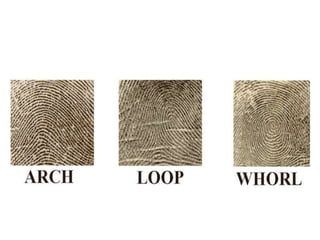
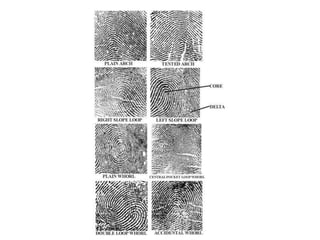
• There are three basic patterns of fingerprints:
 Arches – can be plain or tented.
 Loops – radial or ulnar, depending on whether
direction of slope of pattern is towards inner arm
bone (radius) or outer arm bone (ulna).
 Whorls - most complex, and contain central pocket,
double loop, and accidental.
Collection Methods of Fingerprints
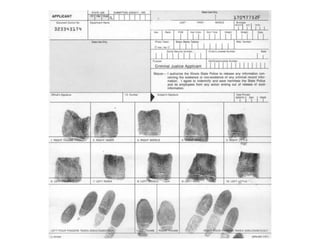
• Roll Prints
• Plain Prints
Henry System of Classification
• Parts of the Henry System are:
–Key
– Major
– Primary
– Secondary
– Sub Secondary
– Second Sub Secondary
– Final
AFIS
• Automated Fingerprint Identification Systems (AFIS)
are used by law enforcement.
• This system searches databases for 10 point set of
prints and searching large files for single prints
retrieved from a crime scene.
Law Enforcement Information
Systems
• FBI recently made its criminal database of
known fingerprint cards (IAFIS) available.
• Latent print examiners can search unknown
latent impressions to assist in identification of
suspects or victims.
Types of Fingerprints
• Three types of fingerprints encountered at
crime scenes or on evidence:
• Patent – clearly recognizable fingerprint that needs no
processing – could be in grease, blood, dirt, or oil.
• Plastic print – also called an impression or
indentation print- could be in tar, butter, silly putty.
Cont…
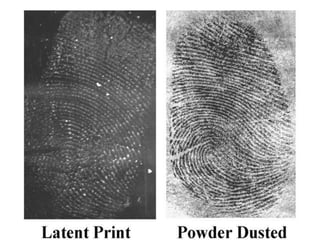
• Latent print – requires additional processing to be
rendered suitable for comparison – processing is
called development or enhancement
Development of Latent Prints
• Fingerprint residue, which is composed of inorganic
and organic residues, comes from eccrine glands and
from touching areas where apocrine glands in body
are before touching item
• Fingerprints can also come from touching external
sources- oils, tars, etc. and then touching surface of
object
Physical Methods
• Latent fingerprint powder dusting is primary method
of visualizing fingerprints.
• Black fingerprint powders generally have best results.
• Magnetic powders and brushes are now available.
• Small particle reagent (SPR) is sprayed on print and
adheres to lipids from prints.
Chemical Methods
• Chemical methods of techniques for visualizing
fingerprints are:
– Silver nitrate – rarely used anymore.
– Iodine fuming – very common –dirty brown
colored print and needs to photographed quickly as
it fades.
Cont…
– Ninhydrin – used since 1910 and is slow to react
unless heat and humidity are present – develops
bluish-purple prints.
– Cyanoacrylate (superglue) is used to fume and
yields an off white colored print – use of heat and
humidity accelerates process.
Cont…
• Physical Developer (PD) photographic type process
based on deposition of silver onto latent fingerprint
residue.
• US Secret Service modified procedure and uses
colloidal gold to enhance prints.
• Normally used after Ninhydrin.
Combination and Special Lighting
• Various types of lights are used to illuminate
fingerprints.
• Bright white light (525 nanometers), lasers, and black
lights with the use of fluorescent powders are
commonly used.
Bloody Fingerprints and Other
Special Situations
• Bloody fingerprints normally are not latent –
primarily composed of blood.
• Most processes for latent print chemical enhancement
do not interfere with blood collection for DNA
profiling by PCR for CODIS.
• Many bloody fingerprints are enhanced by
peroxidase- reaction chemicals
Cont…
• Fingerprints that are on tape, especially the sticky
side, were developed by crystal violet.
• Most common method today is sticky side powder,
which is composed of lycopodium (plant pollen) that
is mixed with detergent and water.
Recognition, Collection and
Preservation of Fingerprint
Evidence
• Fingerprints are among best evidence.
• Objects at a crime scene which are believed to
contain prints should be collected.
• If collection is impossible, latent development
techniques should be used.
• Photographing of developed prints is advisable.
Fingerprint Identification
• David Ashbaugh (1999) noted fingerprint
individuality:
– Friction ridges develop in fetuses.
– Friction ridges remain unchanged except for scars.
– Friction ridge patterns and details are unique.
– Ridge patterns vary within certain boundaries that
allow patterns to be classified.
Cont…
• Overall process of fingerprint examiner according to
Ashbaugh, A.C.E.V. :
– Analysis
– Comparison
– Evaluation
– Verification

Fingerprints

  • 1.
  • 2.
    What are Fingerprints? •Fingerprints are patterns of friction ridge skin. • Fingers and palms of hands, soles of feet and are characterized by ridges (hills) and valleys (furrows). • Patterns form on skin surfaces early in embryonic development and are carried through life.
  • 3.
    Development of Fingerprints •Fingerprint ridges are formed during the third to fourth month of fetal development and their formation completed by the sixth months. • The ridges, thus, formed during the fetal period do not change their course or alignment throughout the life of an individual, until destroyed by decomposition of skin, after death.
  • 4.
    Principles of Fingerprints Fingerprintsfollow three basic biological principles: PATTERN TYPE: All fingerprints can be classified into pattern types. UNIQUENESS: Each fingerprint is unique, no two people have the same fingerprints. Each person's fingerprints differ from finger to finger. For example your right thumb will have a different characteristic orientation, position and relationship to the right forefinger. PERMANENCE: Fingerprints are unchanging from 3 months fetal life until decomposition. Scars are the only exception to this rule, these then become permanent themselves.
  • 5.
    Fingerprint Patterns • Thereare three basic patterns of fingerprints:  Arches – can be plain or tented.  Loops – radial or ulnar, depending on whether direction of slope of pattern is towards inner arm bone (radius) or outer arm bone (ulna).  Whorls - most complex, and contain central pocket, double loop, and accidental.
  • 9.
    Collection Methods ofFingerprints • Roll Prints • Plain Prints
  • 11.
    Henry System ofClassification • Parts of the Henry System are: –Key – Major – Primary – Secondary – Sub Secondary – Second Sub Secondary – Final
  • 13.
    AFIS • Automated FingerprintIdentification Systems (AFIS) are used by law enforcement. • This system searches databases for 10 point set of prints and searching large files for single prints retrieved from a crime scene.
  • 14.
    Law Enforcement Information Systems •FBI recently made its criminal database of known fingerprint cards (IAFIS) available. • Latent print examiners can search unknown latent impressions to assist in identification of suspects or victims.
  • 15.
    Types of Fingerprints •Three types of fingerprints encountered at crime scenes or on evidence: • Patent – clearly recognizable fingerprint that needs no processing – could be in grease, blood, dirt, or oil. • Plastic print – also called an impression or indentation print- could be in tar, butter, silly putty.
  • 16.
    Cont… • Latent print– requires additional processing to be rendered suitable for comparison – processing is called development or enhancement
  • 17.
    Development of LatentPrints • Fingerprint residue, which is composed of inorganic and organic residues, comes from eccrine glands and from touching areas where apocrine glands in body are before touching item • Fingerprints can also come from touching external sources- oils, tars, etc. and then touching surface of object
  • 18.
    Physical Methods • Latentfingerprint powder dusting is primary method of visualizing fingerprints. • Black fingerprint powders generally have best results. • Magnetic powders and brushes are now available. • Small particle reagent (SPR) is sprayed on print and adheres to lipids from prints.
  • 20.
    Chemical Methods • Chemicalmethods of techniques for visualizing fingerprints are: – Silver nitrate – rarely used anymore. – Iodine fuming – very common –dirty brown colored print and needs to photographed quickly as it fades.
  • 21.
    Cont… – Ninhydrin –used since 1910 and is slow to react unless heat and humidity are present – develops bluish-purple prints. – Cyanoacrylate (superglue) is used to fume and yields an off white colored print – use of heat and humidity accelerates process.
  • 22.
    Cont… • Physical Developer(PD) photographic type process based on deposition of silver onto latent fingerprint residue. • US Secret Service modified procedure and uses colloidal gold to enhance prints. • Normally used after Ninhydrin.
  • 23.
    Combination and SpecialLighting • Various types of lights are used to illuminate fingerprints. • Bright white light (525 nanometers), lasers, and black lights with the use of fluorescent powders are commonly used.
  • 24.
    Bloody Fingerprints andOther Special Situations • Bloody fingerprints normally are not latent – primarily composed of blood. • Most processes for latent print chemical enhancement do not interfere with blood collection for DNA profiling by PCR for CODIS. • Many bloody fingerprints are enhanced by peroxidase- reaction chemicals
  • 25.
    Cont… • Fingerprints thatare on tape, especially the sticky side, were developed by crystal violet. • Most common method today is sticky side powder, which is composed of lycopodium (plant pollen) that is mixed with detergent and water.
  • 26.
    Recognition, Collection and Preservationof Fingerprint Evidence • Fingerprints are among best evidence. • Objects at a crime scene which are believed to contain prints should be collected. • If collection is impossible, latent development techniques should be used. • Photographing of developed prints is advisable.
  • 27.
    Fingerprint Identification • DavidAshbaugh (1999) noted fingerprint individuality: – Friction ridges develop in fetuses. – Friction ridges remain unchanged except for scars. – Friction ridge patterns and details are unique. – Ridge patterns vary within certain boundaries that allow patterns to be classified.
  • 28.
    Cont… • Overall processof fingerprint examiner according to Ashbaugh, A.C.E.V. : – Analysis – Comparison – Evaluation – Verification