


FUNCTIONING ORGANISMS.
01. Body systems.
Ian Anderson
Saint Ignatius College Geelong
MULTICELLULAR ORGANISMS.
Why do complex multicellular organisms like humans
need organ systems?
Source: http://www.bodymotsystems.com/
SINGLE-CELLED ORGANISMS.
 Single-celled organisms
can carry out all their life
processes within the one
cell.
 Organisms are able to
exchange substances
directly with their external
environment.
 Nutrients & oxygen can
be collected from the
surrounding water.
 Wastes can be got rid of
directly into the water.
Source: http://www.microscopy-uk.org.uk/mag/art97b/prointro.html
MULTICELLULAR ORGANISMS.
 The cells of multicellular
organisms are not all in
direct contact with their
external environment.
 Not all body cells are
able to exchange
substances with the
external environment.
 They are therefore unable
to obtain their own
nutrients, oxygen & other
substances needed for life
processes, nor get rid of
wastes.
Source: http://www.wrecksite.eu/marine-
species.aspx
MULTICELLULAR ORGANISMS.
 In order to obtain
nutrients, oxygen & other
substances and be able
to get rid of wastes the
cells of multicellular
organisms need a
helping hand.
 They need organ
systems which together
work to provide nutrients,
oxygen, get rid of waste
and lots more.
Source: http://cartoons-
picture.blogspot.com.au/2012/12/cartoon-coyote-pictures.html
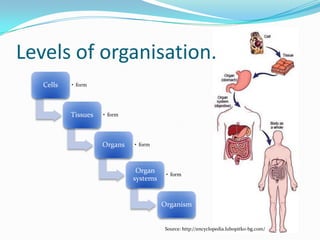
LEVELS OF ORGANISATION.
Cells • form
Tissues • form
Organs • form
Organ
systems
• form
Organism
Source: http://encyclopedia.lubopitko-bg.com/
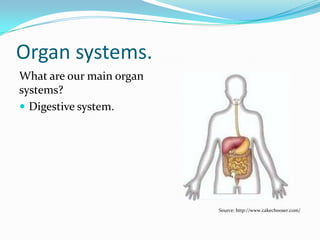
ORGAN SYSTEMS.
What are our main organ
systems?
 Digestive system.
Source: http://www.cakechooser.com/
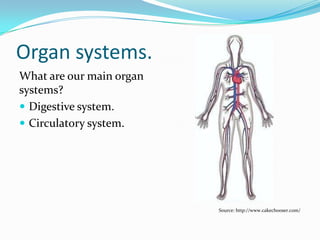
ORGAN SYSTEMS.
What are our main organ
systems?
 Digestive system.
 Circulatory system.
Source: http://www.cakechooser.com/
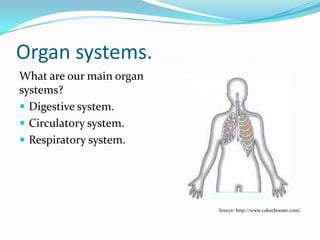
ORGAN SYSTEMS.
What are our main organ
systems?
 Digestive system.
 Circulatory system.
 Respiratory system.
Source: http://www.cakechooser.com/
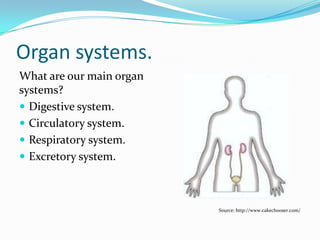
ORGAN SYSTEMS.
What are our main organ
systems?
 Digestive system.
 Circulatory system.
 Respiratory system.
 Excretory system.
Source: http://www.cakechooser.com/
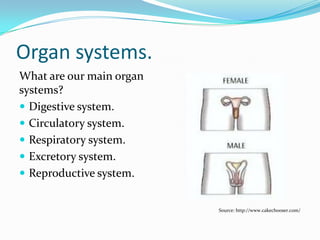
ORGAN SYSTEMS.
What are our main organ
systems?
 Digestive system.
 Circulatory system.
 Respiratory system.
 Excretory system.
 Reproductive system.
Source: http://www.cakechooser.com/
ORGAN SYSTEMS.
What are our main organ
systems?
 Digestive system.
 Circulatory system.
 Respiratory system.
 Excretory system.
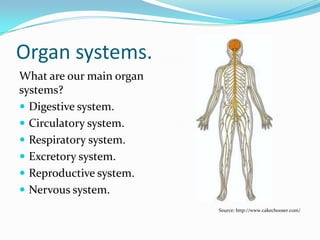
 Reproductive system.
 Nervous system.
Source: http://www.cakechooser.com/
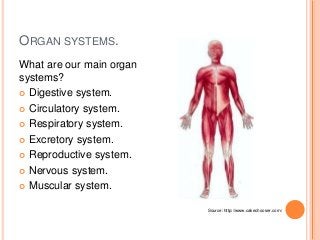
ORGAN SYSTEMS.
What are our main organ
systems?
 Digestive system.
 Circulatory system.
 Respiratory system.
 Excretory system.
 Reproductive system.
 Nervous system.
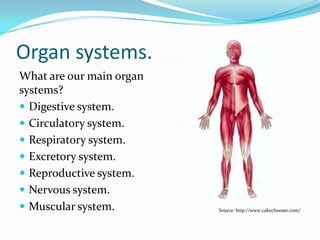
 Muscular system.
Source: http://www.cakechooser.com/
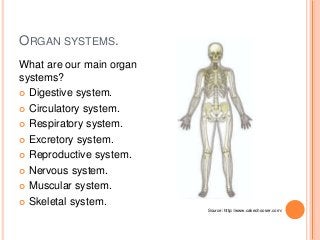
ORGAN SYSTEMS.
What are our main organ
systems?
 Digestive system.
 Circulatory system.
 Respiratory system.
 Excretory system.
 Reproductive system.
 Nervous system.
 Muscular system.
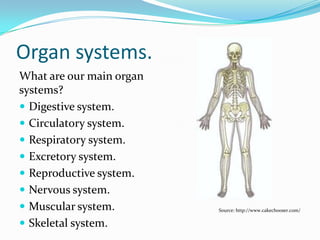
 Skeletal system.
Source: http://www.cakechooser.com/
BIBLIOGRAPHY.
Cash, S., Quinton, G., Tilley, C., & Craven, E. (2013).
Oxford Big Ideas. Science 8: Australian
Curriculum. Melbourne: Oxford University Press.
http://sickscience8.wikispaces.com/

Functioning organisms - 01 Introduction to the organ systems of the human body.

  • 1.
    FUNCTIONING ORGANISMS. 01. Bodysystems. Ian Anderson Saint Ignatius College Geelong
  • 2.
    MULTICELLULAR ORGANISMS. Why docomplex multicellular organisms like humans need organ systems? Source: http://www.bodymotsystems.com/
  • 3.
    SINGLE-CELLED ORGANISMS.  Single-celledorganisms can carry out all their life processes within the one cell.  Organisms are able to exchange substances directly with their external environment.  Nutrients & oxygen can be collected from the surrounding water.  Wastes can be got rid of directly into the water. Source: http://www.microscopy-uk.org.uk/mag/art97b/prointro.html
  • 4.
    MULTICELLULAR ORGANISMS.  Thecells of multicellular organisms are not all in direct contact with their external environment.  Not all body cells are able to exchange substances with the external environment.  They are therefore unable to obtain their own nutrients, oxygen & other substances needed for life processes, nor get rid of wastes. Source: http://www.wrecksite.eu/marine- species.aspx
  • 5.
    MULTICELLULAR ORGANISMS.  Inorder to obtain nutrients, oxygen & other substances and be able to get rid of wastes the cells of multicellular organisms need a helping hand.  They need organ systems which together work to provide nutrients, oxygen, get rid of waste and lots more. Source: http://cartoons- picture.blogspot.com.au/2012/12/cartoon-coyote-pictures.html
  • 6.
    LEVELS OF ORGANISATION. Cells• form Tissues • form Organs • form Organ systems • form Organism Source: http://encyclopedia.lubopitko-bg.com/
  • 7.
    ORGAN SYSTEMS. What areour main organ systems?  Digestive system. Source: http://www.cakechooser.com/
  • 8.
    ORGAN SYSTEMS. What areour main organ systems?  Digestive system.  Circulatory system. Source: http://www.cakechooser.com/
  • 9.
    ORGAN SYSTEMS. What areour main organ systems?  Digestive system.  Circulatory system.  Respiratory system. Source: http://www.cakechooser.com/
  • 10.
    ORGAN SYSTEMS. What areour main organ systems?  Digestive system.  Circulatory system.  Respiratory system.  Excretory system. Source: http://www.cakechooser.com/
  • 11.
    ORGAN SYSTEMS. What areour main organ systems?  Digestive system.  Circulatory system.  Respiratory system.  Excretory system.  Reproductive system. Source: http://www.cakechooser.com/
  • 12.
    ORGAN SYSTEMS. What areour main organ systems?  Digestive system.  Circulatory system.  Respiratory system.  Excretory system.  Reproductive system.  Nervous system. Source: http://www.cakechooser.com/
  • 13.
    ORGAN SYSTEMS. What areour main organ systems?  Digestive system.  Circulatory system.  Respiratory system.  Excretory system.  Reproductive system.  Nervous system.  Muscular system. Source: http://www.cakechooser.com/
  • 14.
    ORGAN SYSTEMS. What areour main organ systems?  Digestive system.  Circulatory system.  Respiratory system.  Excretory system.  Reproductive system.  Nervous system.  Muscular system.  Skeletal system. Source: http://www.cakechooser.com/
  • 15.
    BIBLIOGRAPHY. Cash, S., Quinton,G., Tilley, C., & Craven, E. (2013). Oxford Big Ideas. Science 8: Australian Curriculum. Melbourne: Oxford University Press.
  • 16.