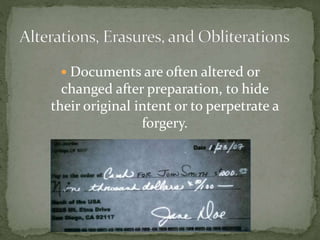
 Documents are often altered or
changed after preparation, to hide
their original intent or to perpetrate a
forgery.
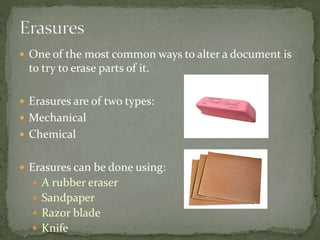
 One of the most common ways to alter a document is
to try to erase parts of it.
 Erasures are of two types:
 Mechanical
 Chemical
 Erasures can be done using:
 A rubber eraser
 Sandpaper
 Razor blade
 Knife
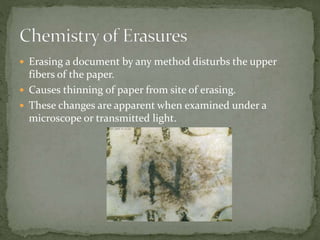
 Erasing a document by any method disturbs the upper
fibers of the paper.
 Causes thinning of paper from site of erasing.
 These changes are apparent when examined under a
microscope or transmitted light.
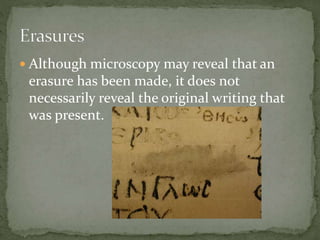
 Although microscopy may reveal that an
erasure has been made, it does not
necessarily reveal the original writing that
was present.
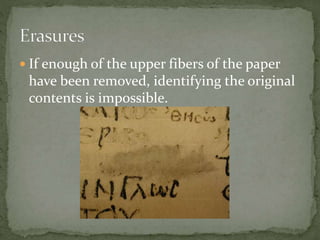
 If enough of the upper fibers of the paper
have been removed, identifying the original
contents is impossible.
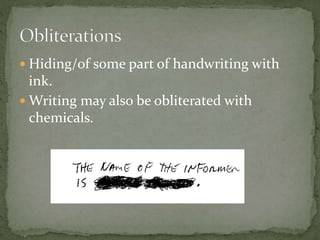
 Hiding/of some part of handwriting with
ink.
 Writing may also be obliterated with
chemicals.
 Strong oxidizing agents can be placed over
ink, creating a colorless product.
 Causes disturbance in paper fibres.
 Chemical obliteration is not visible to the
naked eye.
 Examination under the microscope may
reveal discoloration on the treated area of
the paper.
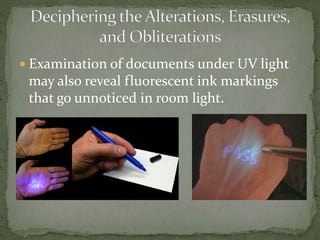
 Examination of documents under UV light
may also reveal fluorescent ink markings
that go unnoticed in room light.
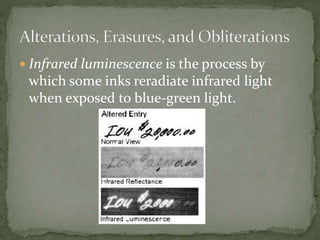
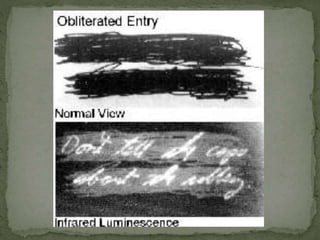
 Infrared luminescence is the process by
which some inks reradiate infrared light
when exposed to blue-green light.
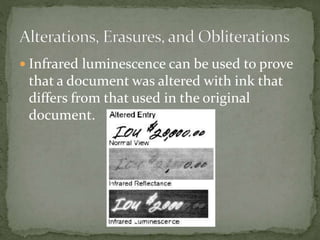
 Infrared luminescence can be used to prove
that a document was altered with ink that
differs from that used in the original
document.
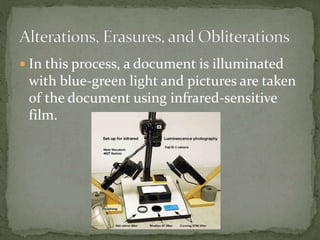
 In this process, a document is illuminated
with blue-green light and pictures are taken
of the document using infrared-sensitive
film.
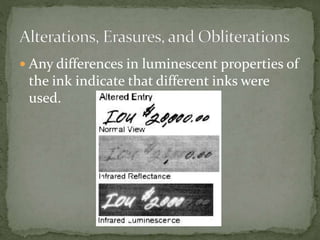
 Any differences in luminescent properties of
the ink indicate that different inks were
used.
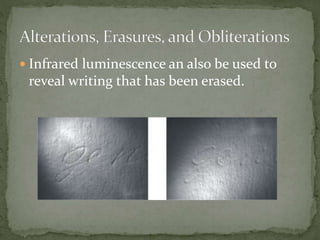
 Infrared luminescence an also be used to
reveal writing that has been erased.
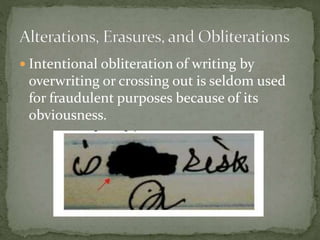
 Intentional obliteration of writing by
overwriting or crossing out is seldom used
for fraudulent purposes because of its
obviousness.
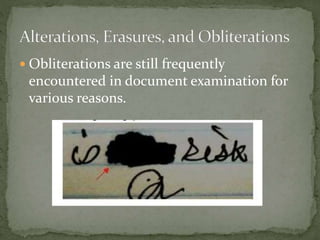
 Obliterations are still frequently
encountered in document examination for
various reasons.
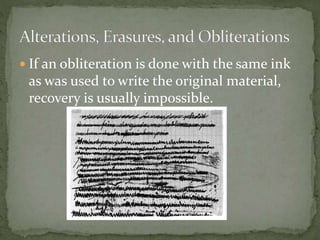
 If an obliteration is done with the same ink
as was used to write the original material,
recovery is usually impossible.
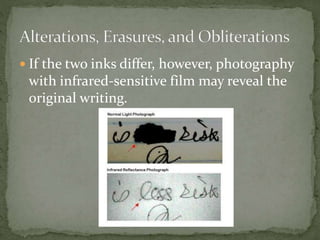
 If the two inks differ, however, photography
with infrared-sensitive film may reveal the
original writing.
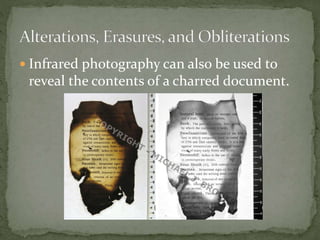
 Infrared photography can also be used to
reveal the contents of a charred document.
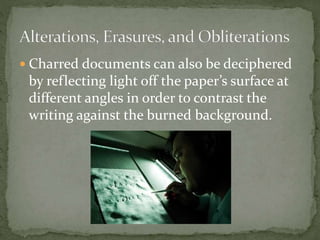
 Charred documents can also be deciphered
by reflecting light off the paper’s surface at
different angles in order to contrast the
writing against the burned background.
 Digital image processing can also be used to
improve or enhance the visual quality of a
document.
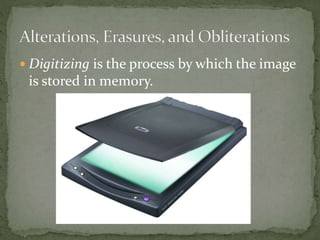
 Digitizing is the process by which the image
is stored in memory.
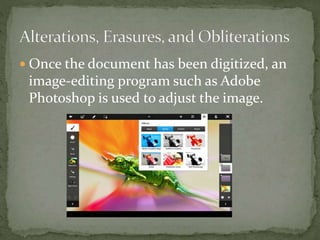
 Once the document has been digitized, an
image-editing program such as Adobe
Photoshop is used to adjust the image.
 A document may be enhanced through:
 Lightening
 Darkening
 Color adjustment
 Contrast adjustment
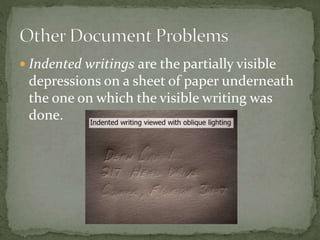
 Indented writings are the partially visible
depressions on a sheet of paper underneath
the one on which the visible writing was
done.
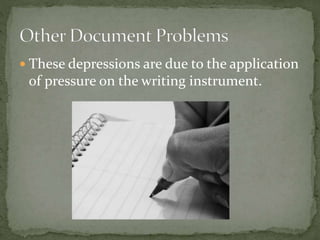
 These depressions are due to the application
of pressure on the writing instrument.
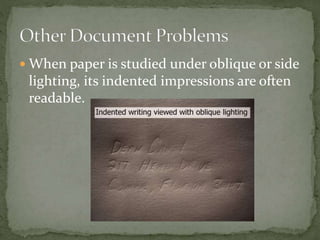
 When paper is studied under oblique or side
lighting, its indented impressions are often
readable.
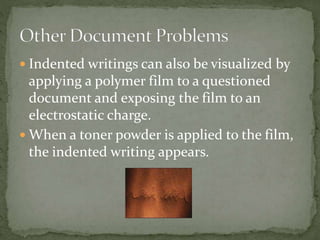
 Indented writings can also be visualized by
applying a polymer film to a questioned
document and exposing the film to an
electrostatic charge.
 When a toner powder is applied to the film,
the indented writing appears.
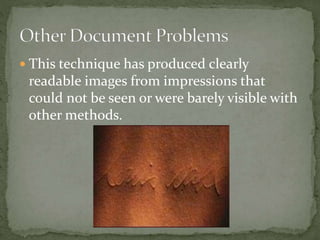
 This technique has produced clearly
readable images from impressions that
could not be seen or were barely visible with
other methods.
 A study of the chemical composition of
writing ink present on documents may
verify whether known and questioned
documents were prepared by the same pen.
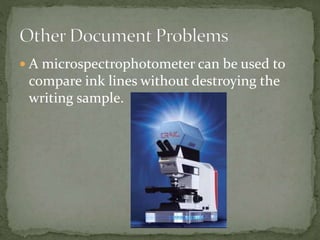
 A microspectrophotometer can be used to
compare ink lines without destroying the
writing sample.
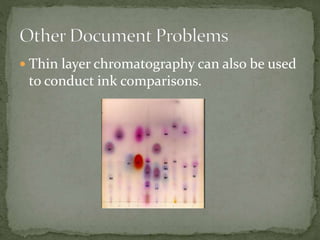
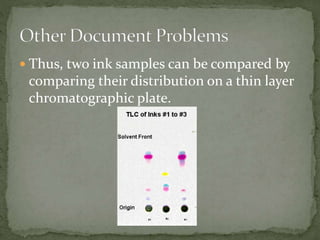
 Thin layer chromatography can also be used
to conduct ink comparisons.
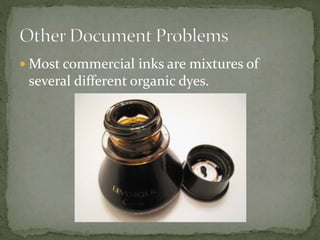
 Most commercial inks are mixtures of
several different organic dyes.
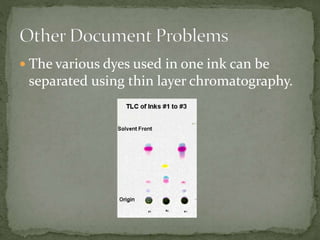
 The various dyes used in one ink can be
separated using thin layer chromatography.
 Thus, two ink samples can be compared by
comparing their distribution on a thin layer
chromatographic plate.
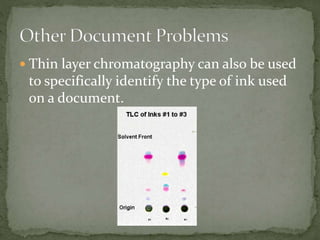
 Thin layer chromatography can also be used
to specifically identify the type of ink used
on a document.
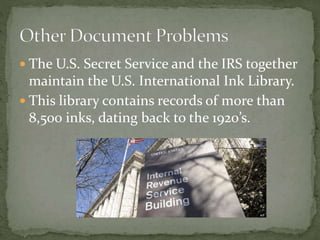
 The U.S. Secret Service and the IRS together
maintain the U.S. International Ink Library.
 This library contains records of more than
8,500 inks, dating back to the 1920’s.
 Each year, new pen and ink formulations are
added to this reference collection.
 This library has been used to prove that
many documents have been fraudulently
backdated.
 For example, one document dated 1958
was proved to have been written with ink
that was not produced until 1959.
 Document examiners will also examine the
composition of the paper on which a
document is written.
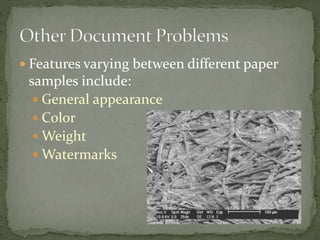
 Features varying between different paper
samples include:
 General appearance
 Color
 Weight
 Watermarks

alterations_oblitearations.pptx

  • 2.
     Documents areoften altered or changed after preparation, to hide their original intent or to perpetrate a forgery.
  • 3.
     One ofthe most common ways to alter a document is to try to erase parts of it.  Erasures are of two types:  Mechanical  Chemical  Erasures can be done using:  A rubber eraser  Sandpaper  Razor blade  Knife
  • 4.
     Erasing adocument by any method disturbs the upper fibers of the paper.  Causes thinning of paper from site of erasing.  These changes are apparent when examined under a microscope or transmitted light.
  • 5.
     Although microscopymay reveal that an erasure has been made, it does not necessarily reveal the original writing that was present.
  • 6.
     If enoughof the upper fibers of the paper have been removed, identifying the original contents is impossible.
  • 7.
     Hiding/of somepart of handwriting with ink.  Writing may also be obliterated with chemicals.
  • 8.
     Strong oxidizingagents can be placed over ink, creating a colorless product.
  • 9.
     Causes disturbancein paper fibres.  Chemical obliteration is not visible to the naked eye.  Examination under the microscope may reveal discoloration on the treated area of the paper.
  • 10.
     Examination ofdocuments under UV light may also reveal fluorescent ink markings that go unnoticed in room light.
  • 11.
     Infrared luminescenceis the process by which some inks reradiate infrared light when exposed to blue-green light.
  • 12.
     Infrared luminescencecan be used to prove that a document was altered with ink that differs from that used in the original document.
  • 13.
     In thisprocess, a document is illuminated with blue-green light and pictures are taken of the document using infrared-sensitive film.
  • 14.
     Any differencesin luminescent properties of the ink indicate that different inks were used.
  • 15.
     Infrared luminescencean also be used to reveal writing that has been erased.
  • 16.
     Intentional obliterationof writing by overwriting or crossing out is seldom used for fraudulent purposes because of its obviousness.
  • 17.
     Obliterations arestill frequently encountered in document examination for various reasons.
  • 18.
     If anobliteration is done with the same ink as was used to write the original material, recovery is usually impossible.
  • 19.
     If thetwo inks differ, however, photography with infrared-sensitive film may reveal the original writing.
  • 21.
     Infrared photographycan also be used to reveal the contents of a charred document.
  • 22.
     Charred documentscan also be deciphered by reflecting light off the paper’s surface at different angles in order to contrast the writing against the burned background.
  • 23.
     Digital imageprocessing can also be used to improve or enhance the visual quality of a document.
  • 24.
     Digitizing isthe process by which the image is stored in memory.
  • 25.
     Once thedocument has been digitized, an image-editing program such as Adobe Photoshop is used to adjust the image.
  • 26.
     A documentmay be enhanced through:  Lightening  Darkening  Color adjustment  Contrast adjustment
  • 27.
     Indented writingsare the partially visible depressions on a sheet of paper underneath the one on which the visible writing was done.
  • 28.
     These depressionsare due to the application of pressure on the writing instrument.
  • 29.
     When paperis studied under oblique or side lighting, its indented impressions are often readable.
  • 30.
     Indented writingscan also be visualized by applying a polymer film to a questioned document and exposing the film to an electrostatic charge.  When a toner powder is applied to the film, the indented writing appears.
  • 31.
     This techniquehas produced clearly readable images from impressions that could not be seen or were barely visible with other methods.
  • 32.
     A studyof the chemical composition of writing ink present on documents may verify whether known and questioned documents were prepared by the same pen.
  • 33.
     A microspectrophotometercan be used to compare ink lines without destroying the writing sample.
  • 34.
     Thin layerchromatography can also be used to conduct ink comparisons.
  • 35.
     Most commercialinks are mixtures of several different organic dyes.
  • 36.
     The variousdyes used in one ink can be separated using thin layer chromatography.
  • 37.
     Thus, twoink samples can be compared by comparing their distribution on a thin layer chromatographic plate.
  • 38.
     Thin layerchromatography can also be used to specifically identify the type of ink used on a document.
  • 39.
     The U.S.Secret Service and the IRS together maintain the U.S. International Ink Library.  This library contains records of more than 8,500 inks, dating back to the 1920’s.
  • 40.
     Each year,new pen and ink formulations are added to this reference collection.
  • 41.
     This libraryhas been used to prove that many documents have been fraudulently backdated.  For example, one document dated 1958 was proved to have been written with ink that was not produced until 1959.
  • 42.
     Document examinerswill also examine the composition of the paper on which a document is written.
  • 43.
     Features varyingbetween different paper samples include:  General appearance  Color  Weight  Watermarks