He’s In Love!
1
Long Hair
4.2 meters
has kept her hair
uncut for 26 years
2
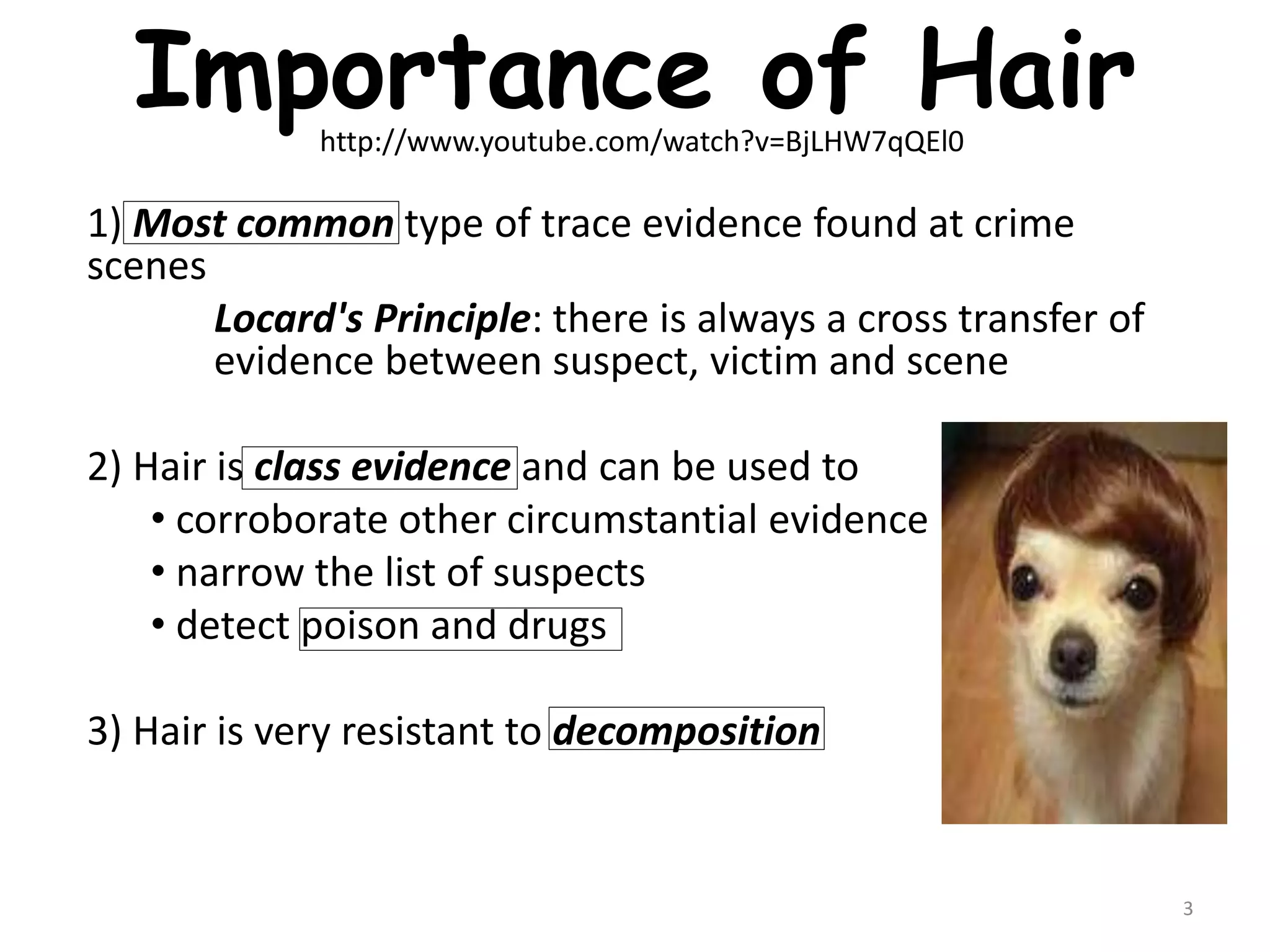
Importance of Hair
1) Most common type of trace evidence found at crime
scenes
Locard's Principle: there is always a cross transfer of
evidence between suspect, victim and scene
2) Hair is class evidence and can be used to
• corroborate other circumstantial evidence
• narrow the list of suspects
• detect poison and drugs
3) Hair is very resistant to decomposition
http://www.youtube.com/watch?v=BjLHW7qQEl0
3
Hair Basics
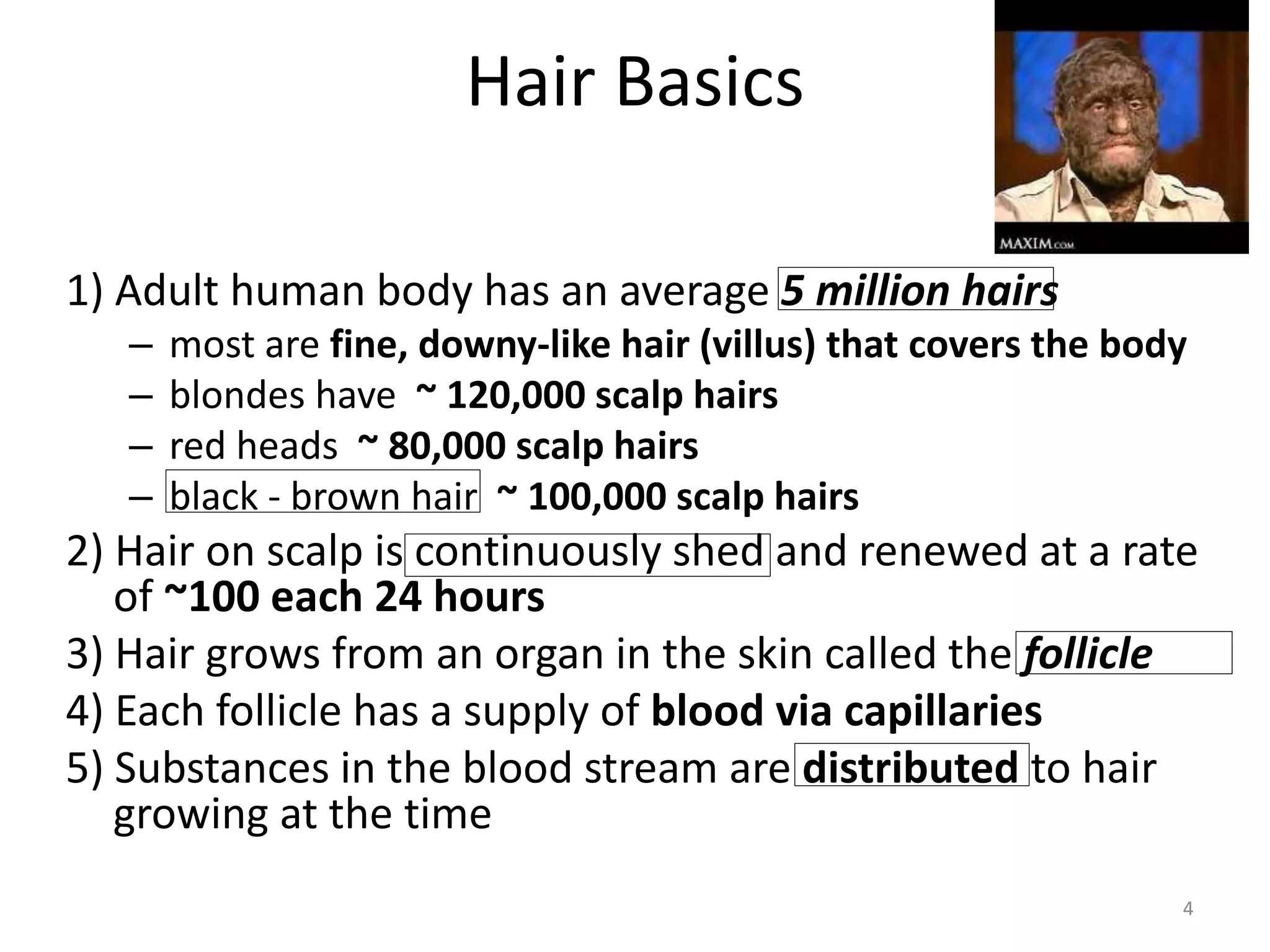
1) Adult human body has an average 5 million hairs
– most are fine, downy-like hair (villus) that covers the body
– blondes have ~ 120,000 scalp hairs
– red heads ~ 80,000 scalp hairs
– black - brown hair ~ 100,000 scalp hairs
2) Hair on scalp is continuously shed and renewed at a rate
of ~100 each 24 hours
3) Hair grows from an organ in the skin called the follicle
4) Each follicle has a supply of blood via capillaries
5) Substances in the blood stream are distributed to hair
growing at the time
4
Diagram of Hair in Follicle
5
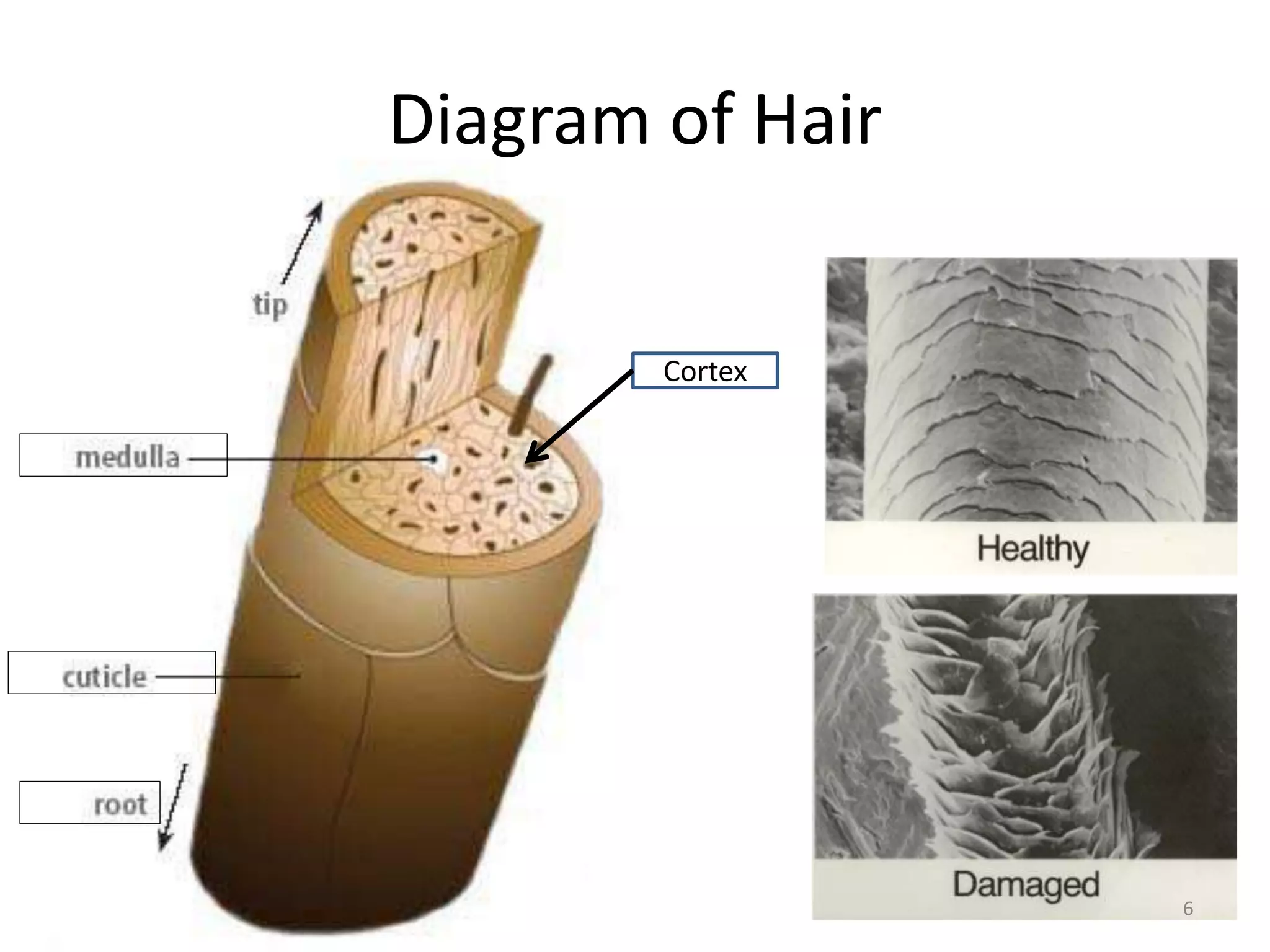
Diagram of Hair
6
Cortex
Hair Composition
Hair is composed of a tough protein called Keratin
– made of amino acids
– primarily the amino acid cystine, which contains
sulfur
– Chemical bonds between cystine molecules
strengthen the protein
7
Parts of Hair
1) Root or bulb: proximal end of hair that is
embedded in the follicle
2) Shaft: part of hair extending above the skin
3) Tip: distal end of hair
Tip
8
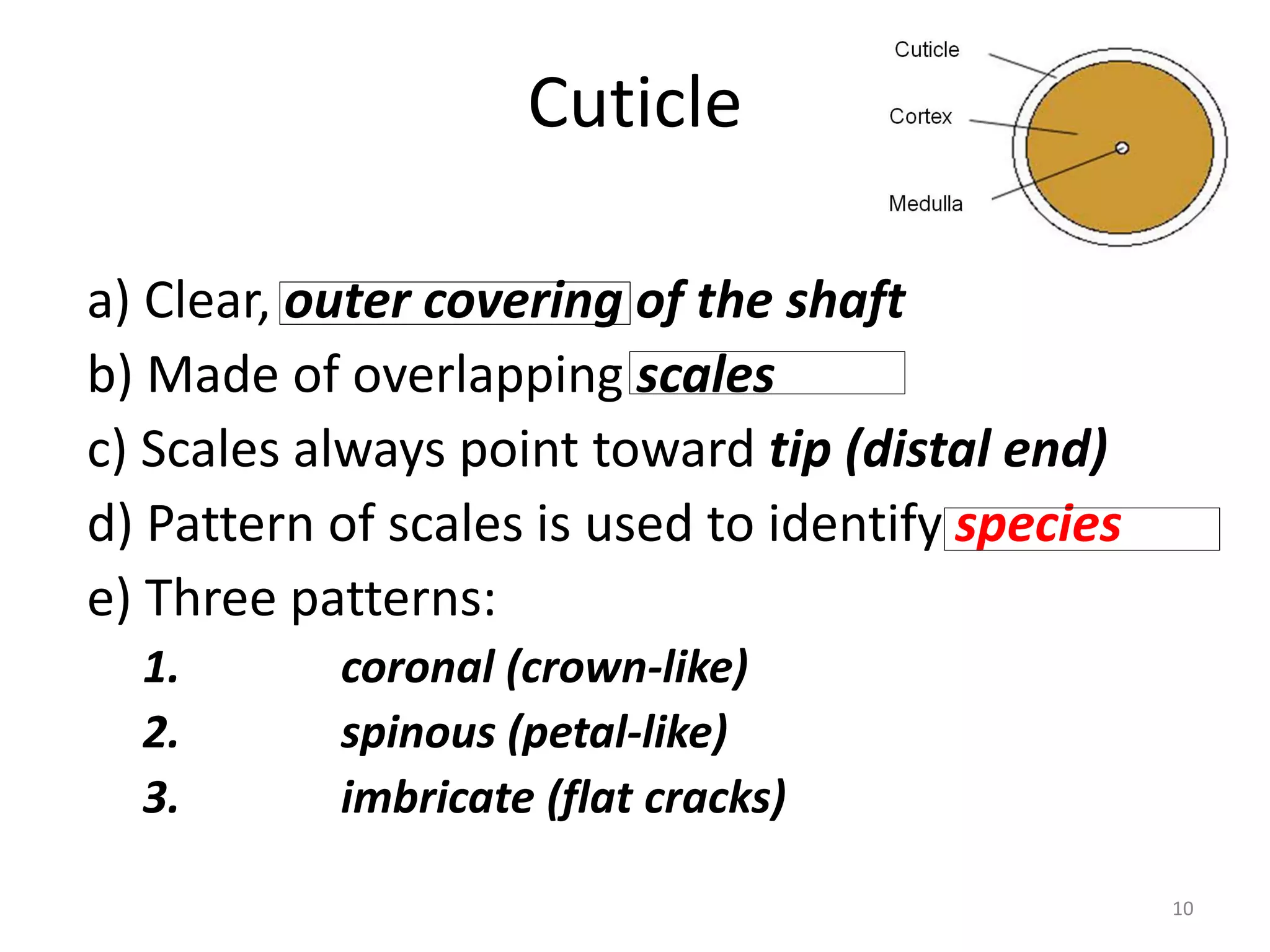
Cross Section of Hair
9
Cuticle
a) Clear, outer covering of the shaft
b) Made of overlapping scales
c) Scales always point toward tip (distal end)
d) Pattern of scales is used to identify species
e) Three patterns:
1. coronal (crown-like)
2. spinous (petal-like)
3. imbricate (flat cracks)
10
Types of Cuticles
1) Coronal Cuticle
– crown-like scales, resembling stacks of cup
– found in hairs of very fine diameter
– commonly found: rodent and bat hair
– rarely found: human hair
2) Spinous Cuticle
– petal-like scales
– triangular in shape
– Found: mink, seals, cats
– never found on humans
3) Imbricate Cuticle
– flattened scales
– overlapping scales with irregular margins
– commonly found: human and other animals
– Eg. Dogs, deer
11
Cortex
a) largest portion of the shaft
b) made of keratin protein molecules aligned
parallel to length of shaft
c) contains pigment called melanin
d) melanin varies in color, shape and distribution
e) absence of pigments = gray or white color hair
f) Ovoid bodies are clumps of pigment in cortex
g) size and shape of Ovoid bodies provide class
characteristics
12
Medulla
a) row of cells, like a canal in the center of cortex
b) may be dark or translucent, depending on
whether there is air, liquid or pigments
c) medulla patterns
1) Continuous: no breaks, common in
Native Americans and Asians
2) Interrupted: even breaks
3) Fragmented: uneven breaks
4) Absent: most common pattern in humans
Continuous
Interrupted
Fragmented
13
Longitudinal Section of Hair
14
Racial Determination
Negroid
Mongoloid
Caucasoid
Usually kinky,
containing dense,
unevenly distributed
pigments.
Cross section is flat
to oval in shape.
Usually straight or wavy
with very fine to coarse
pigments that are more
evenly distributed .
Cross section are oval to
round in shape.
Usually coarse
containing
pigment
granules larger
in size than
Caucasians.
Cross sections
are round in
shape.
15
General Rules
a) Asians & Native Americans have round shape,
no twisting
b) Africans have flat to crescent shape with
undulating or twisting; densely clumped
pigmentation
c) Americans, Europeans, Mexicans, Middle
Easterners have an oval shape, rarely twisting
or undulating; evenly distributed fine
pigmentation
16
Hair Growth
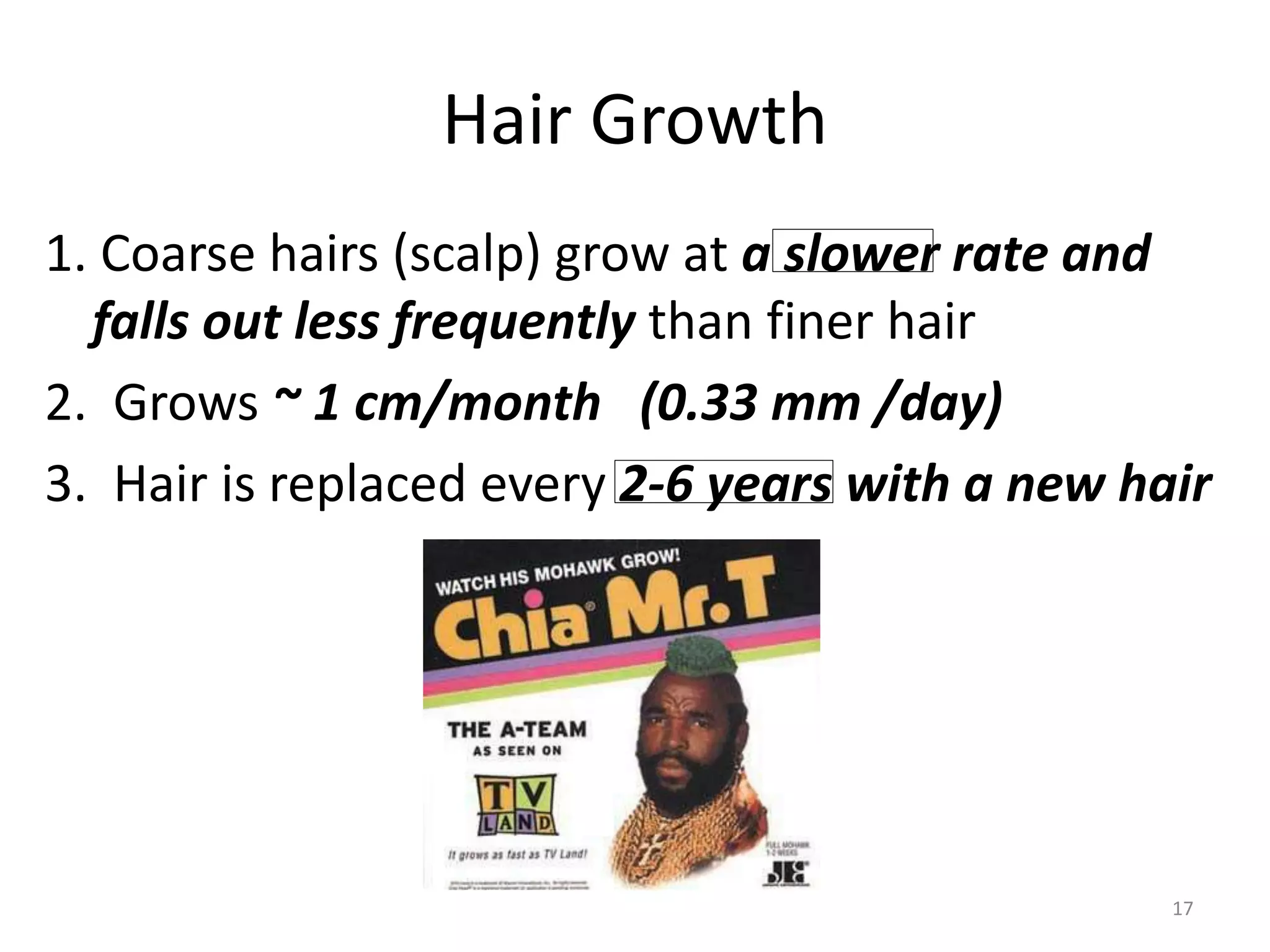
1. Coarse hairs (scalp) grow at a slower rate and
falls out less frequently than finer hair
2. Grows ~ 1 cm/month (0.33 mm /day)
3. Hair is replaced every 2-6 years with a new hair
17
Hair Growth
18
Anagen Phase (growth phase)
• lasts up to 6 years (genetically determined)
• 80-90% of hair is in this phase
• around the dermal papilla is the hair matrix, a
collection of rapidly dividing epithelial cells that
produce the hair shaft
• root of hair has a flame shape appearance and is
attached to follicle
• hair pulled out during this phase will have a
sheath of tissue around the root called a
"follicular tag," which contains DNA
19
Catagen Phase (intermediate phase)
• lasts ~ 3 weeks
• end of active hair growth
• hair follicle shrinks to about 1/6 of the normal
length
• the dermal papilla breaks away, the bulb
detaches from the blood supply and the hair
shaft is pushed up as the follicle disintegrates
• root shrinks in diameter and has an
elongated shape
20
Telogen Phase (follicle resting phase)
• lasts 2-6 months
• 8-10% of hair
• hair is not growing, but remains attached to
the follicle while the dermal papilla is in a
resting phase below
• naturally shed hair has a narrow club shape
root
21
Collection of Hair Evidence
A. Visibly observed hairs collected by hand, tweezers are not
recommended in most cases, because they can damage hair
B. Infrared light or lasers may be used to visually identify non-
visible hairs
C. Clear tape can be used in either roller form or sheet to lift
both visible and non-visible hair
D. Vacuuming method of collection is used for large crime
scenes where the most likely points of transfer are unknown
E. Garments may be brushed, scraped or shook over white
paper or cloth
F. Garment may be placed in a bag and shook, so that hair can
be collected from the bottom of the bag
22
Collection of Exemplars
Exemplar: A biological sample (such as blood or saliva) collected from a
known individual to be used for comparison results from evidence samples
A. Anyone who may have left hair at the crime scene
should be sampled for comparison purposes.
B. Approximately 100 scalp hairs from various areas of the
head should be pulled (anagen) and combed (telogen).
C. For body hair, 30- 50 hairs should be collected and
labeled as to their origin.
D. As a matter of routine, hair samples are collected from
the victim of suspicious death during an autopsy.
23
Great Hair of the Past
24

1st hair notes teacher

  • 1.
  • 2.
    Long Hair 4.2 meters haskept her hair uncut for 26 years 2
  • 3.
    Importance of Hair 1)Most common type of trace evidence found at crime scenes Locard's Principle: there is always a cross transfer of evidence between suspect, victim and scene 2) Hair is class evidence and can be used to • corroborate other circumstantial evidence • narrow the list of suspects • detect poison and drugs 3) Hair is very resistant to decomposition http://www.youtube.com/watch?v=BjLHW7qQEl0 3
  • 4.
    Hair Basics 1) Adulthuman body has an average 5 million hairs – most are fine, downy-like hair (villus) that covers the body – blondes have ~ 120,000 scalp hairs – red heads ~ 80,000 scalp hairs – black - brown hair ~ 100,000 scalp hairs 2) Hair on scalp is continuously shed and renewed at a rate of ~100 each 24 hours 3) Hair grows from an organ in the skin called the follicle 4) Each follicle has a supply of blood via capillaries 5) Substances in the blood stream are distributed to hair growing at the time 4
  • 5.
    Diagram of Hairin Follicle 5
  • 6.
  • 7.
    Hair Composition Hair iscomposed of a tough protein called Keratin – made of amino acids – primarily the amino acid cystine, which contains sulfur – Chemical bonds between cystine molecules strengthen the protein 7
  • 8.
    Parts of Hair 1)Root or bulb: proximal end of hair that is embedded in the follicle 2) Shaft: part of hair extending above the skin 3) Tip: distal end of hair Tip 8
  • 9.
  • 10.
    Cuticle a) Clear, outercovering of the shaft b) Made of overlapping scales c) Scales always point toward tip (distal end) d) Pattern of scales is used to identify species e) Three patterns: 1. coronal (crown-like) 2. spinous (petal-like) 3. imbricate (flat cracks) 10
  • 11.
    Types of Cuticles 1)Coronal Cuticle – crown-like scales, resembling stacks of cup – found in hairs of very fine diameter – commonly found: rodent and bat hair – rarely found: human hair 2) Spinous Cuticle – petal-like scales – triangular in shape – Found: mink, seals, cats – never found on humans 3) Imbricate Cuticle – flattened scales – overlapping scales with irregular margins – commonly found: human and other animals – Eg. Dogs, deer 11
  • 12.
    Cortex a) largest portionof the shaft b) made of keratin protein molecules aligned parallel to length of shaft c) contains pigment called melanin d) melanin varies in color, shape and distribution e) absence of pigments = gray or white color hair f) Ovoid bodies are clumps of pigment in cortex g) size and shape of Ovoid bodies provide class characteristics 12
  • 13.
    Medulla a) row ofcells, like a canal in the center of cortex b) may be dark or translucent, depending on whether there is air, liquid or pigments c) medulla patterns 1) Continuous: no breaks, common in Native Americans and Asians 2) Interrupted: even breaks 3) Fragmented: uneven breaks 4) Absent: most common pattern in humans Continuous Interrupted Fragmented 13
  • 14.
  • 15.
    Racial Determination Negroid Mongoloid Caucasoid Usually kinky, containingdense, unevenly distributed pigments. Cross section is flat to oval in shape. Usually straight or wavy with very fine to coarse pigments that are more evenly distributed . Cross section are oval to round in shape. Usually coarse containing pigment granules larger in size than Caucasians. Cross sections are round in shape. 15
  • 16.
    General Rules a) Asians& Native Americans have round shape, no twisting b) Africans have flat to crescent shape with undulating or twisting; densely clumped pigmentation c) Americans, Europeans, Mexicans, Middle Easterners have an oval shape, rarely twisting or undulating; evenly distributed fine pigmentation 16
  • 17.
    Hair Growth 1. Coarsehairs (scalp) grow at a slower rate and falls out less frequently than finer hair 2. Grows ~ 1 cm/month (0.33 mm /day) 3. Hair is replaced every 2-6 years with a new hair 17
  • 18.
  • 19.
    Anagen Phase (growthphase) • lasts up to 6 years (genetically determined) • 80-90% of hair is in this phase • around the dermal papilla is the hair matrix, a collection of rapidly dividing epithelial cells that produce the hair shaft • root of hair has a flame shape appearance and is attached to follicle • hair pulled out during this phase will have a sheath of tissue around the root called a "follicular tag," which contains DNA 19
  • 20.
    Catagen Phase (intermediatephase) • lasts ~ 3 weeks • end of active hair growth • hair follicle shrinks to about 1/6 of the normal length • the dermal papilla breaks away, the bulb detaches from the blood supply and the hair shaft is pushed up as the follicle disintegrates • root shrinks in diameter and has an elongated shape 20
  • 21.
    Telogen Phase (follicleresting phase) • lasts 2-6 months • 8-10% of hair • hair is not growing, but remains attached to the follicle while the dermal papilla is in a resting phase below • naturally shed hair has a narrow club shape root 21
  • 22.
    Collection of HairEvidence A. Visibly observed hairs collected by hand, tweezers are not recommended in most cases, because they can damage hair B. Infrared light or lasers may be used to visually identify non- visible hairs C. Clear tape can be used in either roller form or sheet to lift both visible and non-visible hair D. Vacuuming method of collection is used for large crime scenes where the most likely points of transfer are unknown E. Garments may be brushed, scraped or shook over white paper or cloth F. Garment may be placed in a bag and shook, so that hair can be collected from the bottom of the bag 22
  • 23.
    Collection of Exemplars Exemplar:A biological sample (such as blood or saliva) collected from a known individual to be used for comparison results from evidence samples A. Anyone who may have left hair at the crime scene should be sampled for comparison purposes. B. Approximately 100 scalp hairs from various areas of the head should be pulled (anagen) and combed (telogen). C. For body hair, 30- 50 hairs should be collected and labeled as to their origin. D. As a matter of routine, hair samples are collected from the victim of suspicious death during an autopsy. 23
  • 24.
    Great Hair ofthe Past 24

Editor's Notes

  • #5 Hypertrichosis or Human Werewolf Syndrome